Inst Hyundai Azera 2008 Owner's Guide
[x] Cancel search | Manufacturer: HYUNDAI, Model Year: 2008, Model line: Azera, Model: Hyundai Azera 2008Pages: 345, PDF Size: 14.61 MB
Page 41 of 345

1
FEATURES OF YOUR HYUNDAI
27
SEAT BELTS!
B150A02S-AATSEAT BELT PRECAUTIONS
WARNING:All occupants of the vehicle must wear
their seat belts at all times. Seat belts and
child restraints reduce the risk of serious
or fatal injuries for all occupants in the
event of a collision or sudden stop. With-
out a seat belt, occupants could be shifted
too close to a deploying airbag, strike the
interior structure or be thrown from the
vehicle. Properly worn seat belts greatly
reduce these hazards. Even with ad-
vanced airbags, unbelted occupants can
be severely injured by a deploying airbag.
Always follow the precautions about seat
belts, airbags and occupant safety con-
tained in this manual.B150B04Y-AATInfant or Small ChildAll 50 states have child restraint laws. You
should be aware of the specific require-
ments in your state. Child and/or infant
safety seats must be properly placed and
installed in the rear seat. Information about
the use of these restraints begins on page
1-34.
!
WARNING:
Every person in your vehicle needs to be
properly restrained at all times, includ-
ing infants and children. Never hold a
child in your arms or lap when riding in a
vehicle. The violent forces created dur-
ing a crash will tear the child from your
arms and throw the child against the
interior. Always use a child restraint
appropriate for your child's height and
weight, see page 1-34.NOTE:Small children are best protected from
injury in an accident when properly re-
strained in the rear seat by a child re-
straint system that meets the require-
ments of the Federal Motor Vehicle
Safety Standards. Before buying any
child restraint system, make sure that it
has a label certifying that it meets Fed-
eral Motor Vehicle Safety Standard 213.
The restraint must be appropriate for
your child's height and weight. Check
the label on the child restraint for this
information. See page 1-34.
B150C02A-AATLarger ChildrenChildren who are too large for child re-
straint systems should always occupy the
rear seat and use the available lap/shoul-
der belts. The lap portion should be fas-
tened snug on the hips and as low as
possible. Check belt fit periodically. A
child's squirming could put the belt out of
position. Children are afforded the most
safety in the event of an accident when
they are restrained by a proper restraint
system in the rear seat. If a larger child
(over age 13) must be seated in the front
seat, the child should be securely re-
strained by the available lap/shoulder belt
and the seat should be placed in the
rearmost position. Children under the age
of 13 should be restrained securely in the
rear seat. NEVER place a child under the
age of 13 in the front seat. NEVER place a
rear facing child seat in the front seat of a
vehicle.
Page 42 of 345
1FEATURES OF YOUR HYUNDAI28
!
B160A02A-AATCARE OF SEAT BELTSSeat belt systems should never be disas-
sembled or modified. In addition, care
should be taken to assure that seat belts
and belt hardware are not damaged by
seat hinges, doors or other abuse.
WARNING:
When you return the rear seatback to its
upright position after the rear seatback
was folded down, be careful not to dam-
age the seat belt webbing or buckle. Be
sure that the webbing or buckle does not
get caught or pinched in the rear seat. A
seat belt with damaged webbing or buckle
will not be as strong and could possibly
fail during a collision or sudden stop,
resulting in serious injury.
B150D01A-AATPregnant WomenThe use of a seat belt is recommended for
pregnant women to lessen the chance of
injury in an accident. When a seat belt is
used, the lap belt portion should be placed
as low and snugly as possible on the hips,
not across the abdomen. For specific rec-
ommendations, consult a physician.B150E01A-AATInjured PersonA seat belt should be used when an injured
person is being transported. When this is
necessary, you should consult a physician
for recommendations.B150F01A-AATOne Person Per BeltTwo people (including children) should
never attempt to use a single seat belt. This
could increase the severity of injuries in
case of an accident.
WARNING:
Riding with a reclined seatback increases
your chance of serious or fatal injuries in
the event of a collision or sudden stop.
The protection of your restraint system
(seat belts and airbags) is greatly re-
duced by reclining your seat. Seat belts
must be snug against your hips and chest
to work properly. The more the seatback
is reclined, the greater the chance that an
occupant's hips will slide under the lap
belt causing serious internal injuries or
the occupant's neck could strike the
shoulder belt. Drivers and passengers
should always sit well back in their seats,
properly belted (see page 1-30), and with
the seatbacks upright.
!
B150G02A-AATDo Not Lie DownTo reduce the chance of injuries in the
event of an accident and to achieve maxi-
mum effectiveness of the restraint system,
all passengers should be sitting up and the
front seats should be in an upright position
when the car is moving. A seat belt cannot
provide proper protection if the person is
lying down in the rear seat or if the front seat
is in a reclined position.
Page 44 of 345
1FEATURES OF YOUR HYUNDAI30
This type of seat belt combines the fea-
tures of both an emergency locking retrac-
tor seat belt and an automatic locking
retractor seat belt. To fasten your seat belt,
pull it out of the retractor and insert the
metal tab into the buckle.
There will be an audible "click" when the
tab locks into the buckle. When not secur-
ing a child restraint, the seat belt operates
in the same way as the driver's seat belt
(Emergency Locking Retractor Type). It
automatically adjusts to the proper length
only after the lap belt portion of the seat belt
is adjusted manually so that it fits snugly
around your hips. When the seat belt is
fully extended from the retractor to allow
the installation of a child restraint system,
the seat belt operation changes to allow
the belt to retract, but not to extend (Auto-
matic Locking Retractor Type). See page
1-39.NOTE:o Although the combination retractor
provides the same level of protection
for seated passengers in either emer-
gency or automatic locking modes, it
is recommended that seated passen-
gers use the emergency locking fea-
ture for improved convenience.
B190A02TG-AATSEAT BELTS-Front Passenger and
Rear Seat 3-Point System with Com-
bination Locking RetractorCombination retractor type seat belts are
installed in the rear seat positions to help
accommodate the installation of child re-
straint systems. Although a combination
retractor is also installed in the front passen-
ger seat position, Hyundai strongly recom-
mends that children always be seated in the
rear seat. NEVER place any infant restraint
system in the front seat of the vehicle.
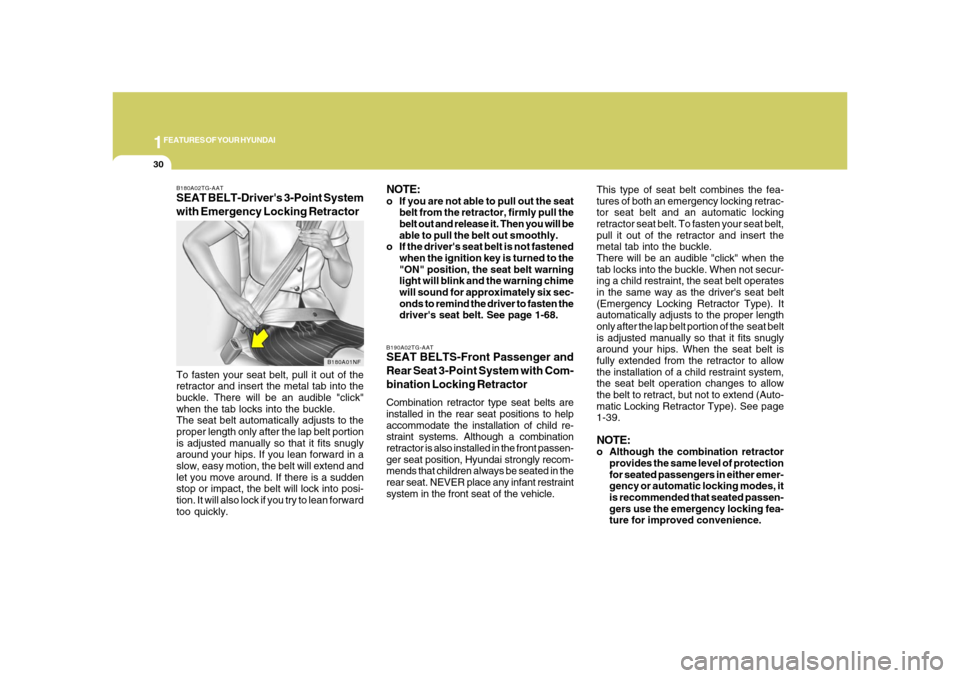
B180A02TG-AATSEAT BELT-Driver's 3-Point System
with Emergency Locking RetractorTo fasten your seat belt, pull it out of the
retractor and insert the metal tab into the
buckle. There will be an audible "click"
when the tab locks into the buckle.
The seat belt automatically adjusts to the
proper length only after the lap belt portion
is adjusted manually so that it fits snugly
around your hips. If you lean forward in a
slow, easy motion, the belt will extend and
let you move around. If there is a sudden
stop or impact, the belt will lock into posi-
tion. It will also lock if you try to lean forward
too quickly.
B180A01NF
NOTE:o If you are not able to pull out the seat
belt from the retractor, firmly pull the
belt out and release it. Then you will be
able to pull the belt out smoothly.
o If the driver's seat belt is not fastened
when the ignition key is turned to the
"ON" position, the seat belt warning
light will blink and the warning chime
will sound for approximately six sec-
onds to remind the driver to fasten the
driver's seat belt. See page 1-68.
Page 46 of 345
1FEATURES OF YOUR HYUNDAI32
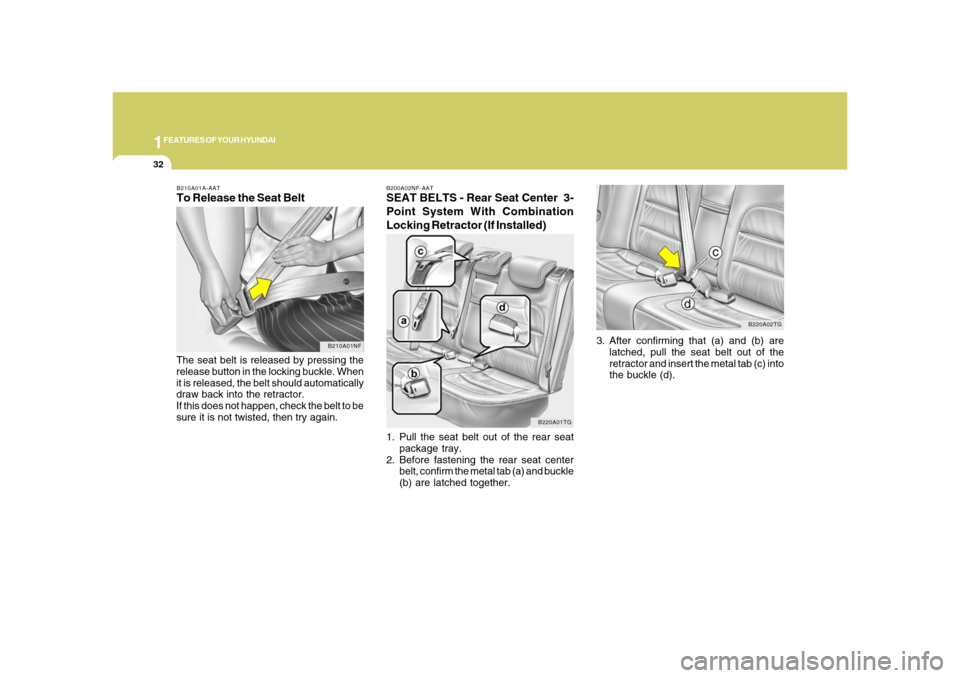
3. After confirming that (a) and (b) are
latched, pull the seat belt out of the
retractor and insert the metal tab (c) into
the buckle (d).
B220A02TG
B200A02NF-AATSEAT BELTS - Rear Seat Center 3-
Point System With Combination
Locking Retractor (If Installed)1. Pull the seat belt out of the rear seat
package tray.
2. Before fastening the rear seat center
belt, confirm the metal tab (a) and buckle
(b) are latched together.
B220A01TG
The seat belt is released by pressing the
release button in the locking buckle. When
it is released, the belt should automatically
draw back into the retractor.
If this does not happen, check the belt to be
sure it is not twisted, then try again.B210A01A-AATTo Release the Seat Belt
B210A01NF
Page 48 of 345
1FEATURES OF YOUR HYUNDAI34
!
WARNING:
o A child restraint system must be
placed in the rear seat. Never install
a child or infant seat on the front
passenger's seat. Should an accident
occur and cause the passenger's
front airbag to deploy, it could se-
verely injure or kill an infant or child
seated in an infant or child seat. Thus
only use a child restraint in the rear
seat of your vehicle.
o A safety belt or child restraint system
can become very hot if it is left in a
closed vehicle on a sunny day, even
if the outside temperature does not
feel hot. Be sure to check the seat
cover and buckles before placing a
child there.
o When the child restraint system is not
in use, store it in the trunk or fasten it
with a safety belt so that it will not be
thrown forward in the case of a sud-
den stop or an accident.
o Children may be seriously injured or
killed by an inflating airbag. All chil-
dren, even those too large for child
restraints, must ride in the rear seat.
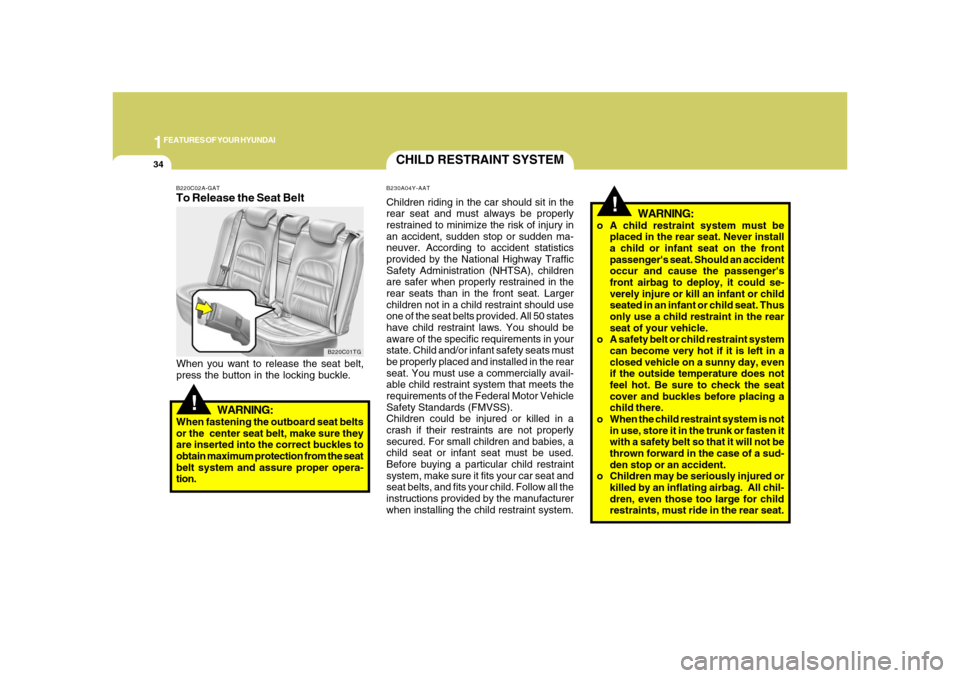
B220C02A-GATTo Release the Seat BeltWhen you want to release the seat belt,
press the button in the locking buckle.
!
WARNING:
When fastening the outboard seat belts
or the center seat belt, make sure they
are inserted into the correct buckles to
obtain maximum protection from the seat
belt system and assure proper opera-
tion.
CHILD RESTRAINT SYSTEMB230A04Y-AATChildren riding in the car should sit in the
rear seat and must always be properly
restrained to minimize the risk of injury in
an accident, sudden stop or sudden ma-
neuver. According to accident statistics
provided by the National Highway Traffic
Safety Administration (NHTSA), children
are safer when properly restrained in the
rear seats than in the front seat. Larger
children not in a child restraint should use
one of the seat belts provided. All 50 states
have child restraint laws. You should be
aware of the specific requirements in your
state. Child and/or infant safety seats must
be properly placed and installed in the rear
seat. You must use a commercially avail-
able child restraint system that meets the
requirements of the Federal Motor Vehicle
Safety Standards (FMVSS).
Children could be injured or killed in a
crash if their restraints are not properly
secured. For small children and babies, a
child seat or infant seat must be used.
Before buying a particular child restraint
system, make sure it fits your car seat and
seat belts, and fits your child. Follow all the
instructions provided by the manufacturer
when installing the child restraint system.
B220C01TG
Page 49 of 345
1
FEATURES OF YOUR HYUNDAI
35
!
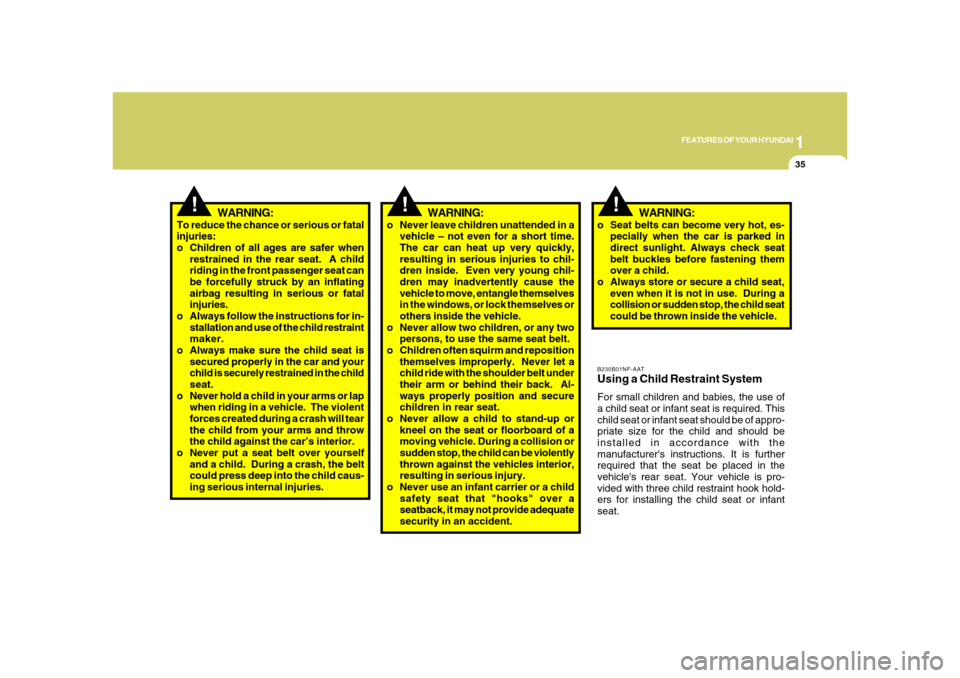
To reduce the chance or serious or fatal
injuries:
o Children of all ages are safer when
restrained in the rear seat. A child
riding in the front passenger seat can
be forcefully struck by an inflating
airbag resulting in serious or fatal
injuries.
o Always follow the instructions for in-
stallation and use of the child restraint
maker.
o Always make sure the child seat is
secured properly in the car and your
child is securely restrained in the child
seat.
o Never hold a child in your arms or lap
when riding in a vehicle. The violent
forces created during a crash will tear
the child from your arms and throw
the child against the car’s interior.
o Never put a seat belt over yourself
and a child. During a crash, the belt
could press deep into the child caus-
ing serious internal injuries.o Never leave children unattended in a
vehicle – not even for a short time.
The car can heat up very quickly,
resulting in serious injuries to chil-
dren inside. Even very young chil-
dren may inadvertently cause the
vehicle to move, entangle themselves
in the windows, or lock themselves or
others inside the vehicle.
o Never allow two children, or any two
persons, to use the same seat belt.
o Children often squirm and reposition
themselves improperly. Never let a
child ride with the shoulder belt under
their arm or behind their back. Al-
ways properly position and secure
children in rear seat.
o Never allow a child to stand-up or
kneel on the seat or floorboard of a
moving vehicle. During a collision or
sudden stop, the child can be violently
thrown against the vehicles interior,
resulting in serious injury.
o Never use an infant carrier or a child
safety seat that "hooks" over a
seatback, it may not provide adequate
security in an accident.
!
WARNING: WARNING:
!
WARNING:
B230B01NF-AATUsing a Child Restraint SystemFor small children and babies, the use of
a child seat or infant seat is required. This
child seat or infant seat should be of appro-
priate size for the child and should be
installed in accordance with the
manufacturer's instructions. It is further
required that the seat be placed in the
vehicle's rear seat. Your vehicle is pro-
vided with three child restraint hook hold-
ers for installing the child seat or infant
seat. o Seat belts can become very hot, es-
pecially when the car is parked in
direct sunlight. Always check seat
belt buckles before fastening them
over a child.
o Always store or secure a child seat,
even when it is not in use. During a
collision or sudden stop, the child seat
could be thrown inside the vehicle.
Page 50 of 345
1FEATURES OF YOUR HYUNDAI36
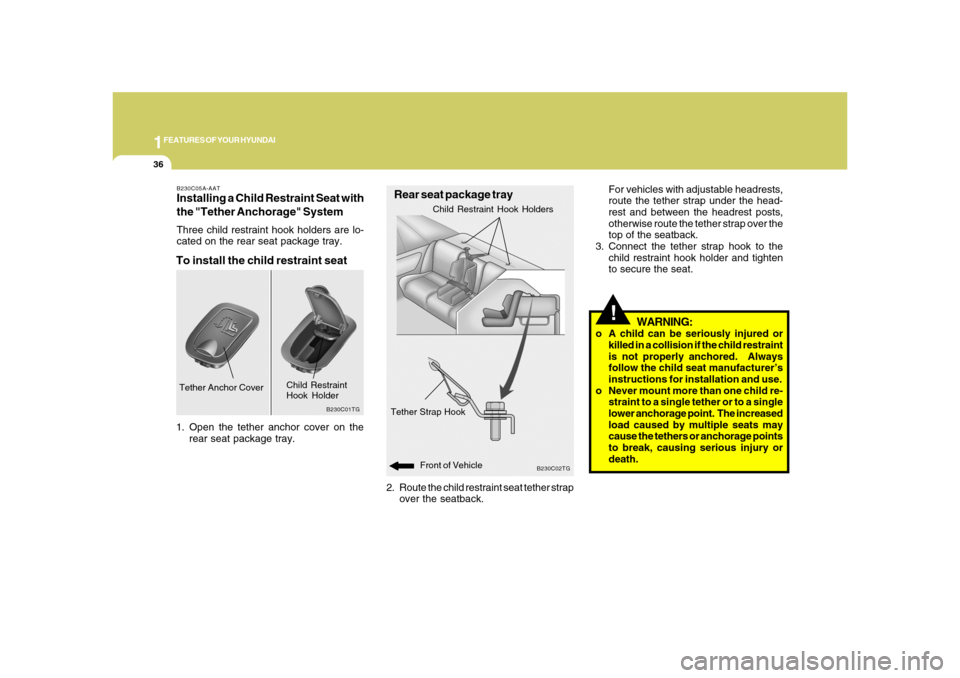
!For vehicles with adjustable headrests,
route the tether strap under the head-
rest and between the headrest posts,
otherwise route the tether strap over the
top of the seatback.
3. Connect the tether strap hook to the
child restraint hook holder and tighten
to secure the seat.
WARNING:
o A child can be seriously injured or
killed in a collision if the child restraint
is not properly anchored. Always
follow the child seat manufacturer’s
instructions for installation and use.
o Never mount more than one child re-
straint to a single tether or to a single
lower anchorage point. The increased
load caused by multiple seats may
cause the tethers or anchorage points
to break, causing serious injury or
death.
2. Route the child restraint seat tether strap
over the seatback.
B230C02TG
Rear seat package trayTether Strap Hook
Child Restraint Hook Holders
B230C05A-AATInstalling a Child Restraint Seat with
the "Tether Anchorage" SystemThree child restraint hook holders are lo-
cated on the rear seat package tray.To install the child restraint seat1. Open the tether anchor cover on the
rear seat package tray.
B230C01TG
Tether Anchor Cover
Child Restraint
Hook Holder
Front of Vehicle
Page 51 of 345
1
FEATURES OF YOUR HYUNDAI
37
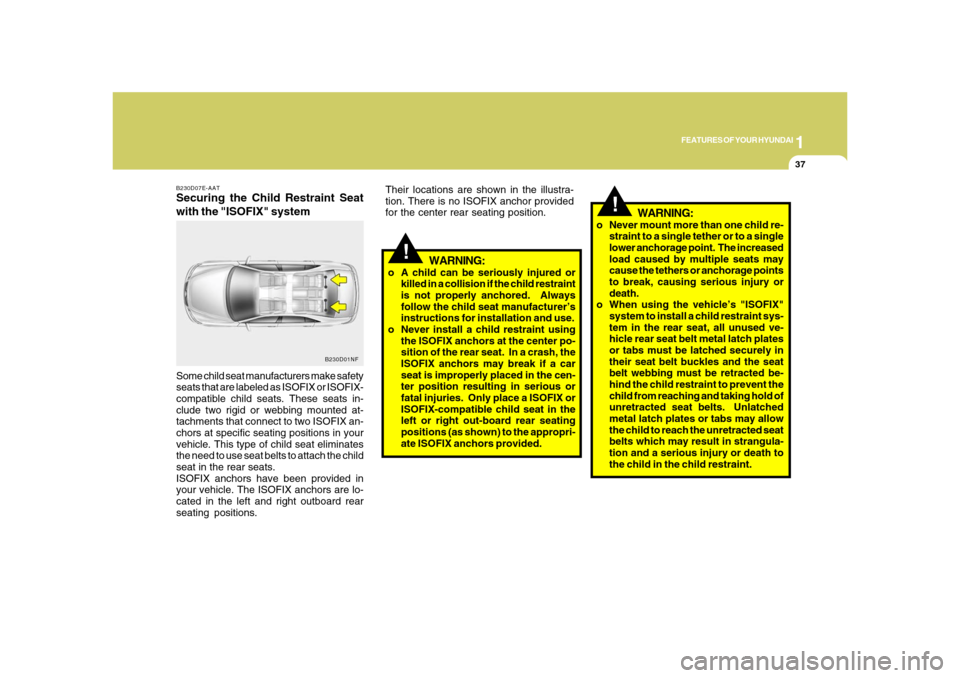
B230D07E-AATSecuring the Child Restraint Seat
with the "ISOFIX" systemSome child seat manufacturers make safety
seats that are labeled as ISOFIX or ISOFIX-
compatible child seats. These seats in-
clude two rigid or webbing mounted at-
tachments that connect to two ISOFIX an-
chors at specific seating positions in your
vehicle. This type of child seat eliminates
the need to use seat belts to attach the child
seat in the rear seats.
ISOFIX anchors have been provided in
your vehicle. The ISOFIX anchors are lo-
cated in the left and right outboard rear
seating positions.
B230D01NF
!
WARNING:
o A child can be seriously injured or
killed in a collision if the child restraint
is not properly anchored. Always
follow the child seat manufacturer’s
instructions for installation and use.
o Never install a child restraint using
the ISOFIX anchors at the center po-
sition of the rear seat. In a crash, the
ISOFIX anchors may break if a car
seat is improperly placed in the cen-
ter position resulting in serious or
fatal injuries. Only place a ISOFIX or
ISOFIX-compatible child seat in the
left or right out-board rear seating
positions (as shown) to the appropri-
ate ISOFIX anchors provided. Their locations are shown in the illustra-
tion. There is no ISOFIX anchor provided
for the center rear seating position.
!
o Never mount more than one child re-
straint to a single tether or to a single
lower anchorage point. The increased
load caused by multiple seats may
cause the tethers or anchorage points
to break, causing serious injury or
death.
o When using the vehicle’s "ISOFIX"
system to install a child restraint sys-
tem in the rear seat, all unused ve-
hicle rear seat belt metal latch plates
or tabs must be latched securely in
their seat belt buckles and the seat
belt webbing must be retracted be-
hind the child restraint to prevent the
child from reaching and taking hold of
unretracted seat belts. Unlatched
metal latch plates or tabs may allow
the child to reach the unretracted seat
belts which may result in strangula-
tion and a serious injury or death to
the child in the child restraint.
WARNING:
Page 52 of 345
1FEATURES OF YOUR HYUNDAI38
!
WARNING:
A child can be seriously injured or killed
in a collision if the child restraint is not
properly anchored to the car and the
child is not properly restrained in the
child restraint. Always follow the child
seat manufacturer’s instructions for in-
stallation and use.
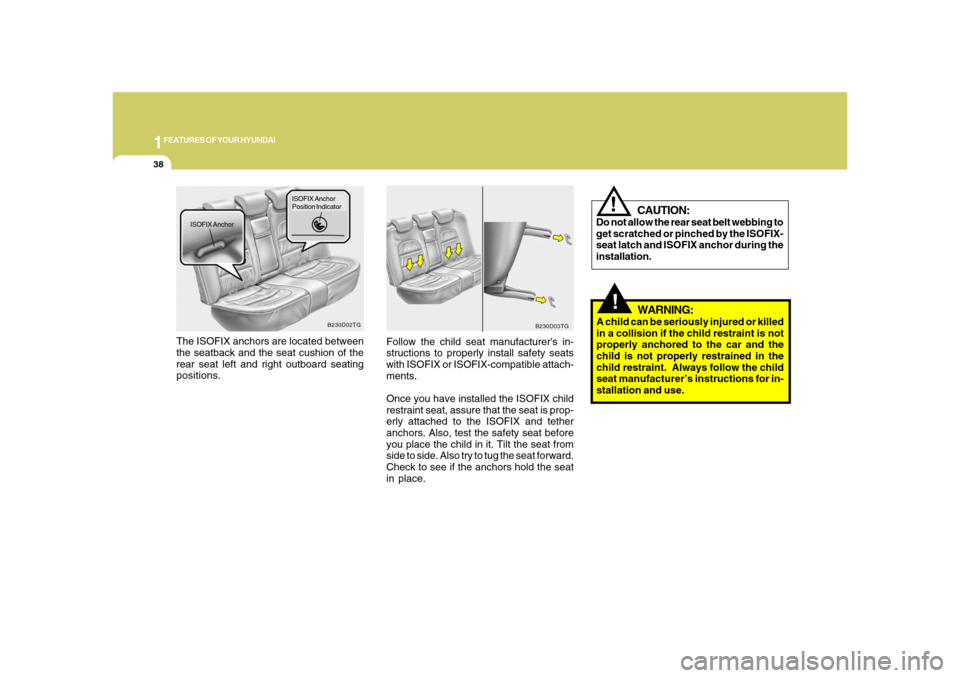
The ISOFIX anchors are located between
the seatback and the seat cushion of the
rear seat left and right outboard seating
positions.
B230D02TG
ISOFIX AnchorISOFIX Anchor
Position Indicator
B230D03TG
Follow the child seat manufacturer's in-
structions to properly install safety seats
with ISOFIX or ISOFIX-compatible attach-
ments.
Once you have installed the ISOFIX child
restraint seat, assure that the seat is prop-
erly attached to the ISOFIX and tether
anchors. Also, test the safety seat before
you place the child in it. Tilt the seat from
side to side. Also try to tug the seat forward.
Check to see if the anchors hold the seat
in place.
!
CAUTION:
Do not allow the rear seat belt webbing to
get scratched or pinched by the ISOFIX-
seat latch and ISOFIX anchor during the
installation.
Page 53 of 345
1
FEATURES OF YOUR HYUNDAI
39
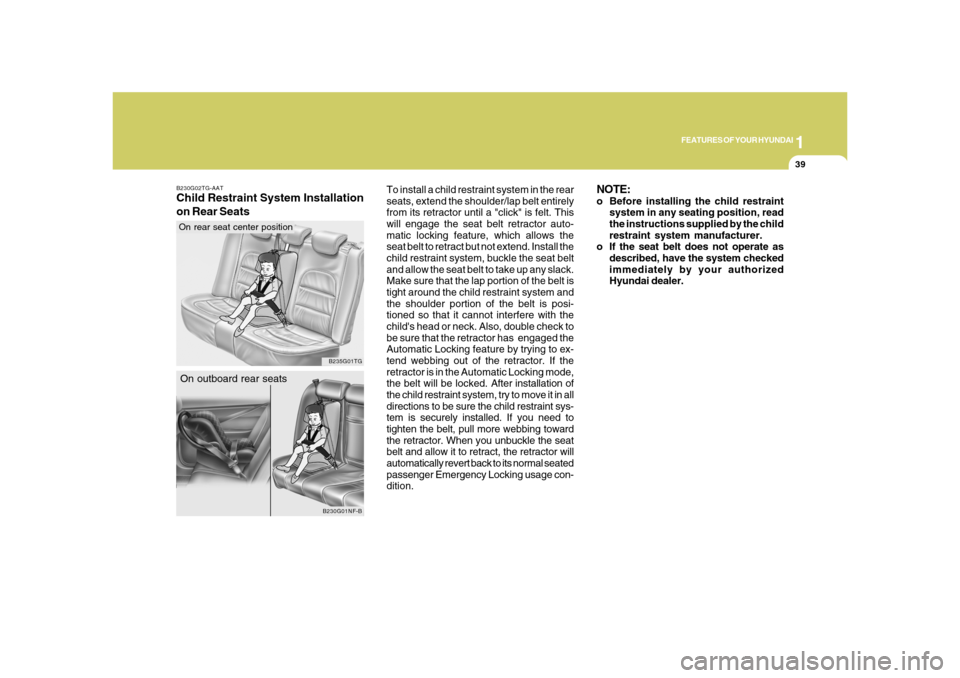
To install a child restraint system in the rear
seats, extend the shoulder/lap belt entirely
from its retractor until a "click" is felt. This
will engage the seat belt retractor auto-
matic locking feature, which allows the
seat belt to retract but not extend. Install the
child restraint system, buckle the seat belt
and allow the seat belt to take up any slack.
Make sure that the lap portion of the belt is
tight around the child restraint system and
the shoulder portion of the belt is posi-
tioned so that it cannot interfere with the
child's head or neck. Also, double check to
be sure that the retractor has engaged the
Automatic Locking feature by trying to ex-
tend webbing out of the retractor. If the
retractor is in the Automatic Locking mode,
the belt will be locked. After installation of
the child restraint system, try to move it in all
directions to be sure the child restraint sys-
tem is securely installed. If you need to
tighten the belt, pull more webbing toward
the retractor. When you unbuckle the seat
belt and allow it to retract, the retractor will
automatically revert back to its normal seated
passenger Emergency Locking usage con-
dition.
B230G02TG-AATChild Restraint System Installation
on Rear Seats
B230G01NF-B
On outboard rear seats
B235G01TG
On rear seat center position
NOTE:o Before installing the child restraint
system in any seating position, read
the instructions supplied by the child
restraint system manufacturer.
o If the seat belt does not operate as
described, have the system checked
immediately by your authorized
Hyundai dealer.