service Hyundai Azera 2008 Owner's Guide
[x] Cancel search | Manufacturer: HYUNDAI, Model Year: 2008, Model line: Azera, Model: Hyundai Azera 2008Pages: 345, PDF Size: 14.61 MB
Page 280 of 345
6
DO-IT-YOURSELF MAINTENANCE
4
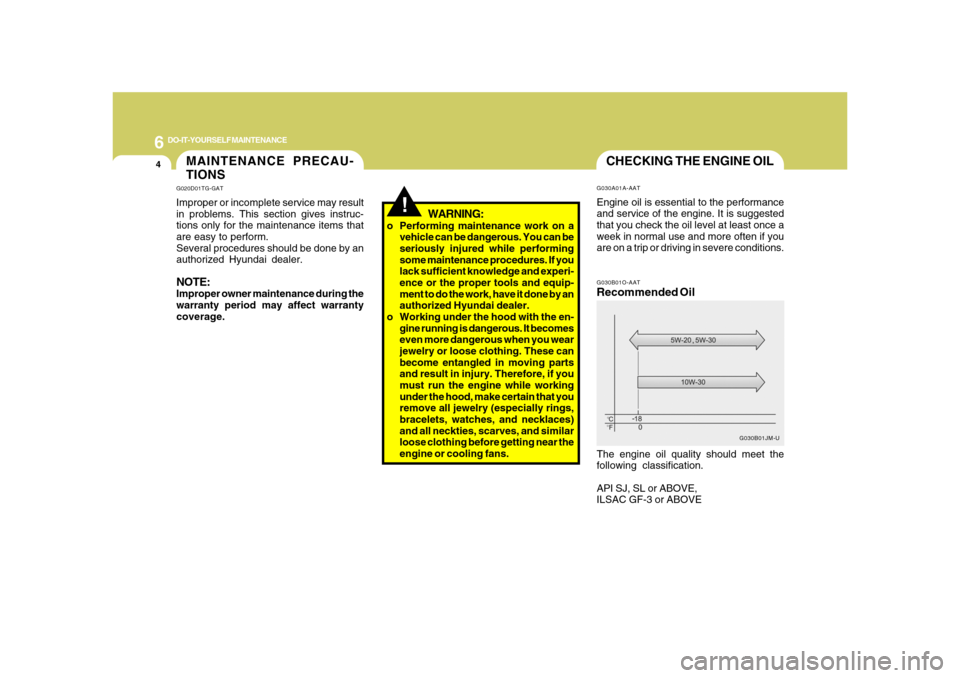
CHECKING THE ENGINE OILG030B01O-AATRecommended OilThe engine oil quality should meet the
following classification.
API SJ, SL or ABOVE,
ILSAC GF-3 or ABOVE
G030B01JM-U G030A01A-AAT
Engine oil is essential to the performance
and service of the engine. It is suggested
that you check the oil level at least once a
week in normal use and more often if you
are on a trip or driving in severe conditions.
MAINTENANCE PRECAU-
TIONS
!
G020D01TG-GATImproper or incomplete service may result
in problems. This section gives instruc-
tions only for the maintenance items that
are easy to perform.
Several procedures should be done by an
authorized Hyundai dealer.NOTE:Improper owner maintenance during the
warranty period may affect warranty
coverage.
WARNING:
o Performing maintenance work on a
vehicle can be dangerous. You can be
seriously injured while performing
some maintenance procedures. If you
lack sufficient knowledge and experi-
ence or the proper tools and equip-
ment to do the work, have it done by an
authorized Hyundai dealer.
o Working under the hood with the en-
gine running is dangerous. It becomes
even more dangerous when you wear
jewelry or loose clothing. These can
become entangled in moving parts
and result in injury. Therefore, if you
must run the engine while working
under the hood, make certain that you
remove all jewelry (especially rings,
bracelets, watches, and necklaces)
and all neckties, scarves, and similar
loose clothing before getting near the
engine or cooling fans.
Page 282 of 345
6
DO-IT-YOURSELF MAINTENANCE
6
CHECKING AND CHANGING
THE ENGINE COOLANT!
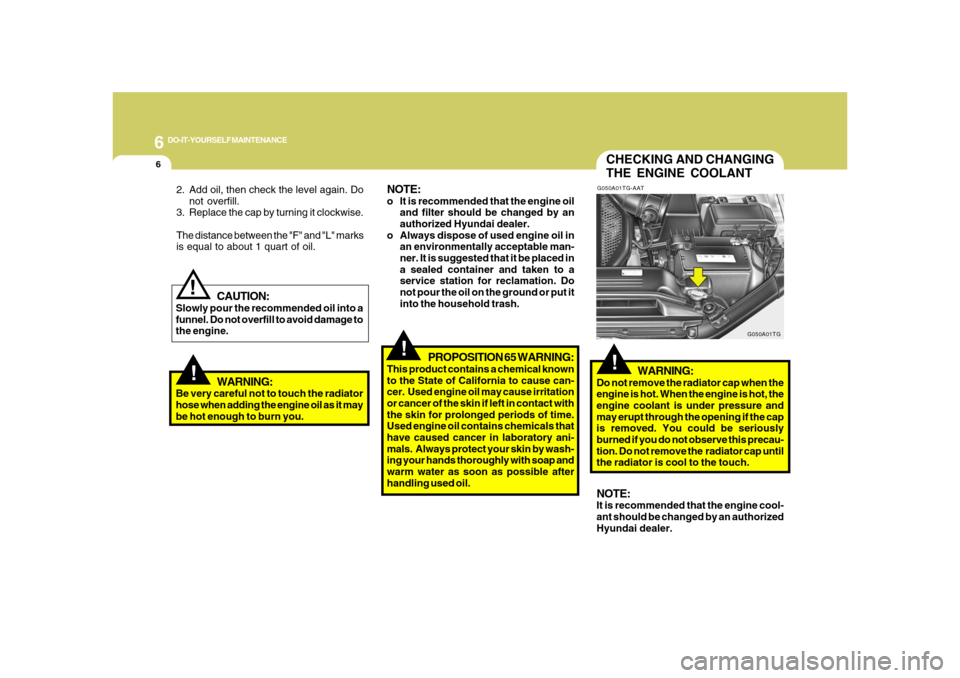
G050A01TG-AAT
WARNING:
Do not remove the radiator cap when the
engine is hot. When the engine is hot, the
engine coolant is under pressure and
may erupt through the opening if the cap
is removed. You could be seriously
burned if you do not observe this precau-
tion. Do not remove the radiator cap until
the radiator is cool to the touch.
!
NOTE:o It is recommended that the engine oil
and filter should be changed by an
authorized Hyundai dealer.
o Always dispose of used engine oil in
an environmentally acceptable man-
ner. It is suggested that it be placed in
a sealed container and taken to a
service station for reclamation. Do
not pour the oil on the ground or put it
into the household trash.
PROPOSITION 65 WARNING:
This product contains a chemical known
to the State of California to cause can-
cer. Used engine oil may cause irritation
or cancer of the skin if left in contact with
the skin for prolonged periods of time.
Used engine oil contains chemicals that
have caused cancer in laboratory ani-
mals. Always protect your skin by wash-
ing your hands thoroughly with soap and
warm water as soon as possible after
handling used oil.
!!
CAUTION:
Slowly pour the recommended oil into a
funnel. Do not overfill to avoid damage to
the engine.
WARNING:
Be very careful not to touch the radiator
hose when adding the engine oil as it may
be hot enough to burn you.
NOTE:It is recommended that the engine cool-
ant should be changed by an authorized
Hyundai dealer. 2. Add oil, then check the level again. Do
not overfill.
3. Replace the cap by turning it clockwise.
The distance between the "F" and "L" marks
is equal to about 1 quart of oil.
G050A01TG
Page 289 of 345
6
DO-IT-YOURSELF MAINTENANCE
13
!
CAUTION:
Use of aftermarket ATF additives may
cause damage to the automatic
transaxle.
Only use HYUNDAI GENUINE ATF SP III,
DIAMOND ATF SP III, SK ATF SP III or
other brands meeting the SP III specifi-
cation approved by Hyundai Motor Co..
If you are having your vehicle serviced
at a facility other than a Hyundai dealer,
verify that the correct ATF is used for
your vehicle.
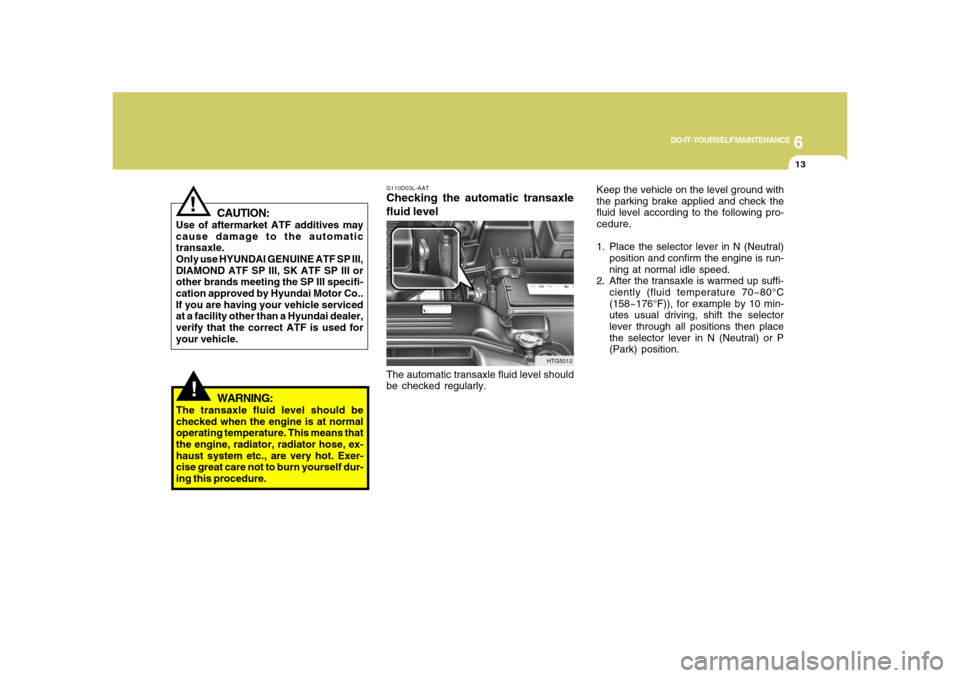
G110D03L-AATChecking the automatic transaxle
fluid levelThe automatic transaxle fluid level should
be checked regularly.
!
WARNING:
The transaxle fluid level should be
checked when the engine is at normal
operating temperature. This means that
the engine, radiator, radiator hose, ex-
haust system etc., are very hot. Exer-
cise great care not to burn yourself dur-
ing this procedure.
HTG5012
Keep the vehicle on the level ground with
the parking brake applied and check the
fluid level according to the following pro-
cedure.
1. Place the selector lever in N (Neutral)
position and confirm the engine is run-
ning at normal idle speed.
2. After the transaxle is warmed up suffi-
ciently (fluid temperature 70~80°C
(158~176°F)), for example by 10 min-
utes usual driving, shift the selector
lever through all positions then place
the selector lever in N (Neutral) or P
(Park) position.
Page 304 of 345
6
DO-IT-YOURSELF MAINTENANCE
28
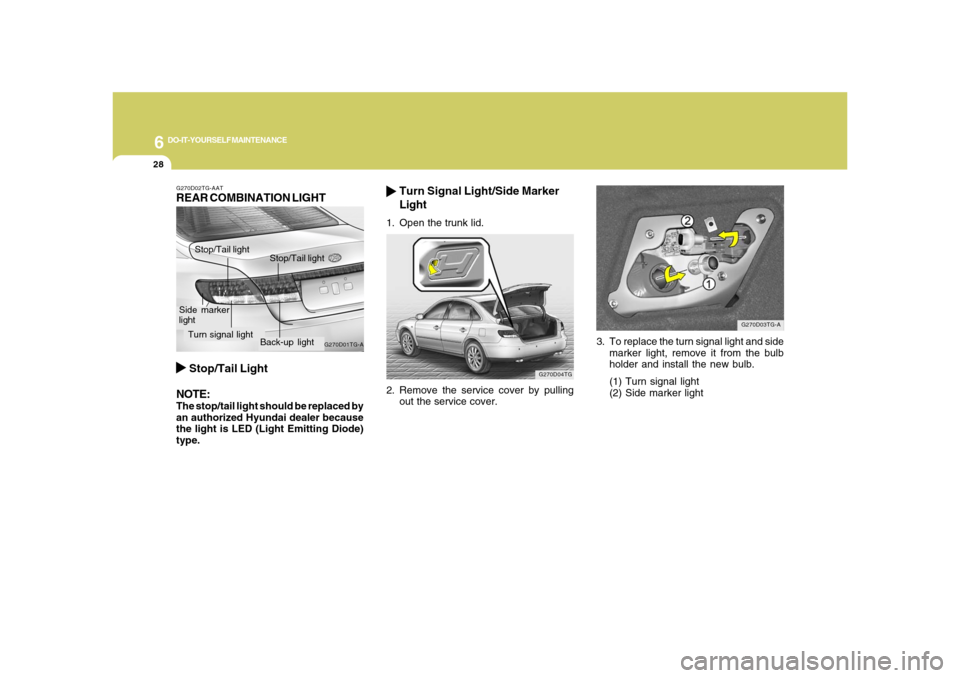
3. To replace the turn signal light and side
marker light, remove it from the bulb
holder and install the new bulb.
(1) Turn signal light
(2) Side marker light
G270D03TG-A
Turn Signal Light/Side Marker
Light
1. Open the trunk lid.2. Remove the service cover by pulling
out the service cover.
G270D04TG
G270D02TG-AATREAR COMBINATION LIGHT
Stop/Tail Light
NOTE:The stop/tail light should be replaced by
an authorized Hyundai dealer because
the light is LED (Light Emitting Diode)
type.
Turn signal lightSide marker
light
G270D01TG-A
Stop/Tail light
Stop/Tail light
Back-up light
Page 328 of 345
8
CONSUMER INFORMATION, REPORTING SAFETY DEFECTS & BINDING ARBITRATION OF WARRANTY CLAIMS
12
!
I090B02JM-AATTIRE MAINTENANCE
In addition to proper inflation, correct
wheel alignment helps to decrease tire
wear. If you find a tire is worn unevenly,
have your dealer check the wheel align-
ment.
When you have new tires installed,
make sure they are balanced. This will
increase vehicle ride comfort and tire
life. Additionally, a tire shoud always be
rebalanced if it is removed from the
wheel.
!
WARNING:
To reduce the chance or serious or
fatal injuries from an accident caused
by tire failure or loss of vehicle control:
o Replace tires that are worn, show
uneven wear, or are damaged.
Worn tires can cause loss of brak-
ing effectiveness, steering con-
trol, and traction.
o Do not drive your vehicle with too
little or too much pressure in your
tires. This can lead to uneven
wear and tire failure.
o When replacing tires, never mix
radial and bias-ply tires on the
same car. You must replace all
tires (including the spare) if mov-
ing from radial to bias-ply tires.
o Using tires and wheel other than
the recommended sizes could
cause unusual handling charac-
teristics and poor vehicle control,
resulting in a serious accident.o Wheels that do not meet Hyundai's
specifications may fit poorly and
result in damage to the vehicle or
unusual handling and poor ve-
hicle control.
o Tires degrade over time, even when
they are not being used. Regard-
less of the remaining tread, it is
recommended that tires tread, It is
recommended that tires generally
be replaced after 6 years of normal
service. Heat caused by not cli-
mates or frequent high loading
Conditions can accelerate the ag-
ing process. Failure to follow this
Warning can result in sudden tire
failure, which could lead to a loss
of control and an accident involv-
ing serious injury or death.WARNING:
Page 330 of 345
8
CONSUMER INFORMATION, REPORTING SAFETY DEFECTS & BINDING ARBITRATION OF WARRANTY CLAIMS
14
Traction AA, A, B, C - The traction
grades, from highest to lowest, are AA,
A, B, and C. Those grades represent
the tire's ability to stop on wet pave-
ment as measured under controlled
conditions on specified government test
surfaces of asphalt and concrete. A tire
marked C may have poor traction per-
formance.
!
WARNING:
The traction grade assigned to this
tire is based on straight-ahead brak-
ing traction tests, and does not in-
clude acceleration, cornering, hy-
droplaning, or peak traction charac-
teristics.
I130B04A-AATTire Quality Grading
Department of Transportation quality
grades - All passenger vehicle tires
must conform to Federal Safety Stan-
dards in addition to these grades. These
quality grades are molded on the
sidewall.
Treadwear - The treadwear grade is a
comparative rating based on the wear
rate of the tire when tested under con-
trolled conditions on a specified gov-
ernment test course. For example, a
tire graded 150 would wear one and a
half (1 - 1/2) times as well on the
government course as a tire graded
100. The relative performance of tires
depends upon the actual conditions of
their use, however, and may depart
significantly from the norm due to varia-
tions in driving habits, service prac-
tices and differences in road character-
istics and climate.
CONSUMER INFORMATIONI130A01A-AATThis consumer information has been pre-
pared in accordance with regulations is-
sued by the National Highway Traffic Safety
Administration of the U.S. Department of
Transportation. It provides the purchasers
and/or prospective purchasers of Hyundai
automobiles with information on uniform
tire quality grading. Your Hyundai dealer
will help answer any questions you may
have as you read this information.
Page 342 of 345

10
INDEX
5
Scheduled maintenance .................................................. 5-4
Service requirements ........................................................ 5-2
Maintenance Precautions.................................................... 6-4
Mirrors
Homelink mirror ............................................................1-102
Outside rearview .............................................................1-99
Outside rearview mirror folding switch ........................1-101
Outside rearview mirror heater ....................................1-100
O
Odometer............................................................................1-75
Outside Rearview Mirror ....................................................1-99
P
Parking Brake ...................................................................1-108
Checking parking brake pedal .......................................6-18
Power Adjustable Pedals ..................................................2-10
Power Outlets .....................................................................1-89
Power Steering Fluid Level ...............................................6-23
R
Rear Seat ...........................................................................1-25
Armrest ..........................................................................1-117
Folding rear seatbacks ...................................................1-25
Rear seatback safety lock ..............................................1-26
Warning...........................................................................1-26Rear Window Curtain ......................................................1-118
Rear Window Defroster Switch .........................................1-87
Reporting Safety Defects ...................................................8-16
S
Seat.....................................................................................1-18
Front ................................................................................1-19
Rear.................................................................................1-25
Seat Belts ...........................................................................1-27
3-Point system ................................................................1-30
Adjusting your seat belt ..................................................1-31
Care of seat belts ...........................................................1-28
Pre-tensioner seat belt ...................................................1-40
Precautions.....................................................................1-27
Seatback Pocket ................................................................1-91
Speedometer......................................................................1-75
Starting Procedure ............................................................... 2-5
Steering Wheel Tilt & Telescopic ....................................1-118
Stereo Sound System ......................................................1-135
Sun Visor ..........................................................................1-115
Sunglass Holder ................................................................1-97
Sunroof...............................................................................1-91
T
Tachometer.........................................................................1-74
Theft-Alarm System ............................................................1-11
Page 345 of 345

Seoul KoreaPrinting: DEC. 12, 2007
Publication No.: A3LO-EU7DO
Printed in KoreaSERVICE STATION INFORMATION
FUEL:UNLEADED gasoline only
Pump Octane Rating of 87 (Research Octane Number 91) or higher.FUEL TANK CAPACITYUS.gal (Imp.gal., liter) 19.8 (16.4, 75)TIRE PRESSURE:See the label on the driver's side of the center pillar outer panel.OTHER TIRE INFORMATION:See pages 8-2 through 8-13.HOOD RELEASE:Pull handle under left side of dash.ENGINE OIL:API grade SJ, SL or ABOVE / ILSAC grade GF-3 or ABOVE and fuel efficient
oil. Use SAE 5W-20, 5W-30 or 10W-30 if normal temperatures are above
0°F (-18°C). See page 6-4 or 9-4.
AUTOMATIC TRANSAXLE:Apply the parking brake, with the engine running, shift the selector lever
through all ranges and return to "N" (Neutral) position. Then check the level
of fluid on the dipstick. Use only HYUNDAI GENUINE ATF SP III,
DIAMOND ATF SP III, SK ATF SP III or other brands meeting the SP III
specification approved by Hyundai Motor Co..QUICK INDEXo Car will not start ....................................................................... 3-2
o Flat tire ...................................................................................... 3-6
o Warning light/chime comes on...................................... 1-66 ~ 1-73
o Engine overheats....................................................................... 3-4
o Towing of your vehicle ........................................................... 3-12
o Starting the engine ..................................................................... 2-4
o Driving tips for first 1,200 miles (2,000 km) ............................ 1-3
o Scheduled maintenance.............................................................. 5-4
o Reporting safety defects ......................................................... 8-16