belt Hyundai Azera 2008 Owner's Manual
[x] Cancel search | Manufacturer: HYUNDAI, Model Year: 2008, Model line: Azera, Model: Hyundai Azera 2008Pages: 345, PDF Size: 14.61 MB
Page 6 of 345
F4
A110A01A-AAT
VEHICLE DATA COLLECTION AND EVENT DATA RECORDERS
Your Hyundai vehicle is equipped with many high technology, electronically controlled systems
that help to ensure your vehicle operates properly and provides the performance that you
expect. These systems utilize computers to monitor the operation of various systems and
components and help to control their operation. These computerized system operations are
wide-ranging and involve components to reduce emissions, to continuously evaluate the
readiness of the airbag and seat belt pretensioner systems, to determine when the airbag and
seat belt pre-tensioner systems should be deployed and then to activate the deployment, and
if equipped, to operate anti-lock braking, traction control and electrical stability control to assist
the driver to control the vehicle in difficult driving situations. These systems electronically store
information that is useful to service technicians when they need to diagnose and repair these
systems. Additional information is stored only when a crash occurs that results in the
deployment of the airbags or seat belt pre-tensioners. This type of data storage is done by
devices called event data recorders(EDR).
After a crash event, the airbag and seat belt pre-tensioner computer system, known as the
Supplemental Restraint System Control Module (SRSCM) or Airbag Control Unit (ACU), may
record some information about the condition of the vehicle and how it was being operated. This
information consists of data related to seat belt usage and if there was diagnostic information
in the airbag or seat belt systems at the time that a crash occurred, and if the ACU sensed that
a crash of sufficient severity occurred to require seat belt pre-tensioner or airbag deployment.
To retrieve this information, special equipment is needed and access to the vehicle or the device
that stores the data is required. Hyundai will not access information about a crash event or share
it with others except:
o in response to an official request of police or similar government office, or
o with the consent of the vehicle owner or, if the vehicle is leased, with the consent of the lessee,
or
o as part of Hyundai’s defense of litigation, or
o as required by law.
Page 11 of 345
F9
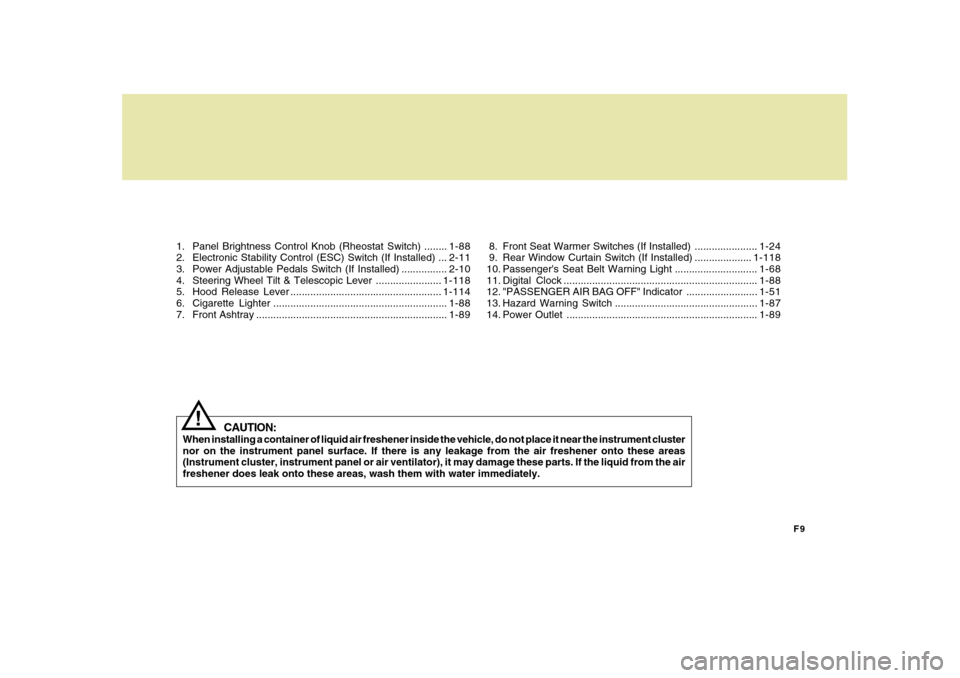
1. Panel Brightness Control Knob (Rheostat Switch) ........1-88
2. Electronic Stability Control (ESC) Switch (If Installed) ...2-11
3. Power Adjustable Pedals Switch (If Installed) ................2-10
4. Steering Wheel Tilt & Telescopic Lever .......................1-118
5. Hood Release Lever .....................................................1-114
6. Cigarette Lighter .............................................................1-88
7. Front Ashtray ...................................................................1-89
CAUTION:
When installing a container of liquid air freshener inside the vehicle, do not place it near the instrument cluster
nor on the instrument panel surface. If there is any leakage from the air freshener onto these areas
(Instrument cluster, instrument panel or air ventilator), it may damage these parts. If the liquid from the air
freshener does leak onto these areas, wash them with water immediately.
!
8. Front Seat Warmer Switches (If Installed) ......................1-24
9. Rear Window Curtain Switch (If Installed) ....................1-118
10. Passenger's Seat Belt Warning Light .............................1-68
11. Digital Clock ....................................................................1-88
12. "PASSENGER AIR BAG OFF" Indicator .........................1-51
13. Hazard Warning Switch ..................................................1-87
14. Power Outlet ...................................................................1-89
Page 14 of 345
YOUR VEHICLE AT A GLANCE
F12
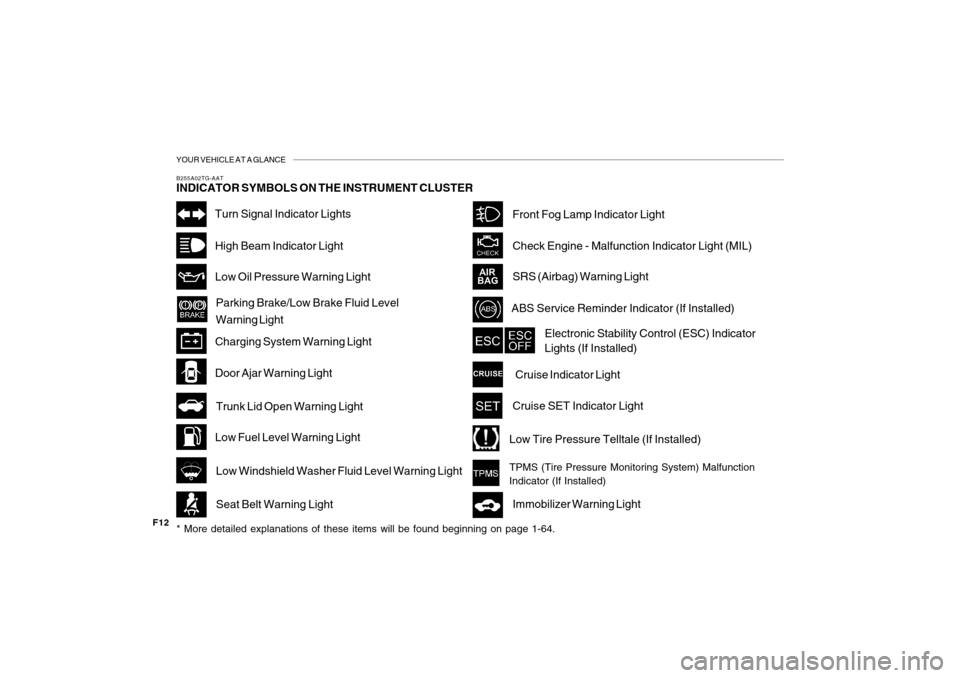
B255A02TG-AATINDICATOR SYMBOLS ON THE INSTRUMENT CLUSTER* More detailed explanations of these items will be found beginning on page 1-64.
Turn Signal Indicator LightsHigh Beam Indicator LightLow Oil Pressure Warning LightParking Brake/Low Brake Fluid Level
Warning Light
Charging System Warning LightDoor Ajar Warning LightTrunk Lid Open Warning LightLow Fuel Level Warning Light
Low Windshield Washer Fluid Level Warning LightSeat Belt Warning Light
Front Fog Lamp Indicator LightCheck Engine - Malfunction Indicator Light (MIL)SRS (Airbag) Warning LightABS Service Reminder Indicator (If Installed)
Electronic Stability Control (ESC) Indicator
Lights (If Installed)Cruise Indicator LightCruise SET Indicator LightLow Tire Pressure Telltale (If Installed)TPMS (Tire Pressure Monitoring System) Malfunction
Indicator (If Installed)Immobilizer Warning Light
Page 15 of 345
1
Fuel Recommendations.................................................... 1-2
Breaking in Your New Hyundai......................................... 1-3
Immobilizer System........................................................... 1-3
Door Locks ........................................................................ 1-7
Theft-Alarm System ........................................................1-11
Windows..........................................................................1-14
Seats................................................................................1-18
I.M.S (Integrated Memory System) ................................1-22
Seat Belts ........................................................................1-27
Child Restraint System ....................................................1-34
Advanced Supplemental Restraint (AIRBAG)
System (SRS) ................................................................1-43
Instrument Cluster and Indicator Lights .........................1-60
Warning and Indicator Lights..........................................1-64
Trip Computer .................................................................1-75
Multi-Function Light Switch .............................................1-80
Windshield Wiper and Washer Switch ............................1-83
Sunroof............................................................................1-91
Mirror...............................................................................1-99
Homelink Mirror ............................................................1-102
Hood Release ...............................................................1-114
Cruise Control...............................................................1-119
Heating and Cooling Control ........................................1-123
Stereo Sound System ..................................................1-135
Audio System................................................................1-137
Antenna ........................................................................1-198
FEATURES OF YOUR HYUNDAI
1
Page 21 of 345
1
FEATURES OF YOUR HYUNDAI
7
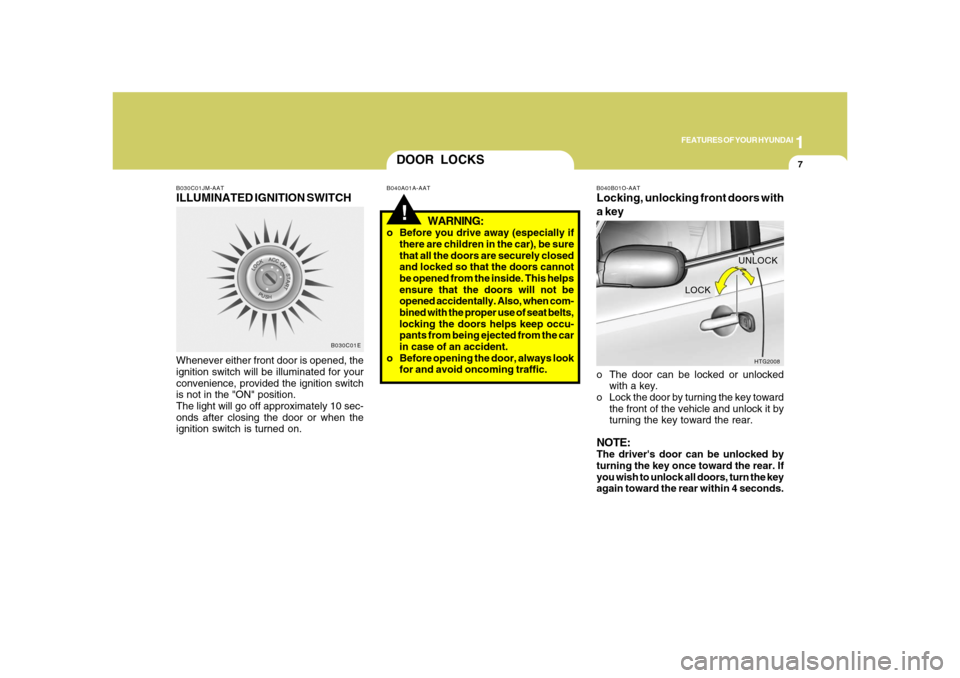
B030C01JM-AATILLUMINATED IGNITION SWITCHWhenever either front door is opened, the
ignition switch will be illuminated for your
convenience, provided the ignition switch
is not in the "ON" position.
The light will go off approximately 10 sec-
onds after closing the door or when the
ignition switch is turned on.
B030C01E
DOOR LOCKS!
B040A01A-AAT
WARNING:
o Before you drive away (especially if
there are children in the car), be sure
that all the doors are securely closed
and locked so that the doors cannot
be opened from the inside. This helps
ensure that the doors will not be
opened accidentally. Also, when com-
bined with the proper use of seat belts,
locking the doors helps keep occu-
pants from being ejected from the car
in case of an accident.
o Before opening the door, always look
for and avoid oncoming traffic.
B040B01O-AATLocking, unlocking front doors with
a keyo The door can be locked or unlocked
with a key.
o Lock the door by turning the key toward
the front of the vehicle and unlock it by
turning the key toward the rear.NOTE:The driver's door can be unlocked by
turning the key once toward the rear. If
you wish to unlock all doors, turn the key
again toward the rear within 4 seconds.
HTG2008
LOCKUNLOCK
Page 34 of 345
1FEATURES OF YOUR HYUNDAI20
!
WARNING:
Riding with a reclined seatback in-
creases your chance of serious or fatal
injuries in the event of a collision or
sudden stop. The protection of your
restraint system (seat belts and airbags)
is greatly reduced by reclining your seat.
Seat belts must be snug against your
hips and chest to work properly. The
more the seatback is reclined, the greater
the chance that an occupant's hips will
slide under the lap belt or the occupant's
neck will strike the shoulder belt. Driv-
ers and passengers should always sit
well back in their seats, properly belted,
and with the seatbacks upright.
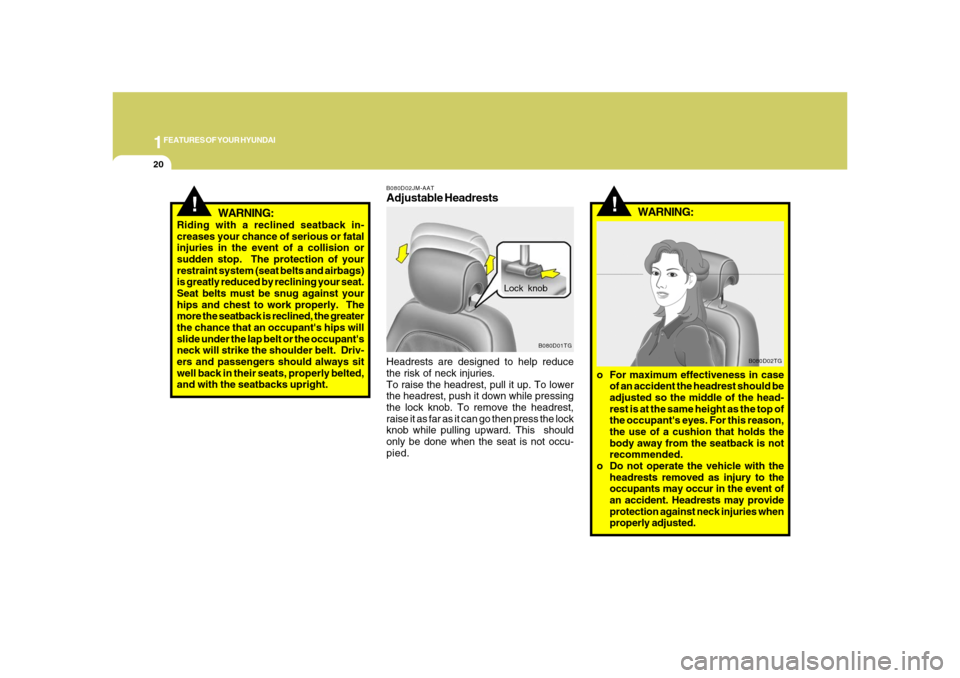
B080D02JM-AATAdjustable HeadrestsHeadrests are designed to help reduce
the risk of neck injuries.
To raise the headrest, pull it up. To lower
the headrest, push it down while pressing
the lock knob. To remove the headrest,
raise it as far as it can go then press the lock
knob while pulling upward. This should
only be done when the seat is not occu-
pied.
B080D01TG
Lock knob
!
WARNING:
o For maximum effectiveness in case
of an accident the headrest should be
adjusted so the middle of the head-
rest is at the same height as the top of
the occupant's eyes. For this reason,
the use of a cushion that holds the
body away from the seatback is not
recommended.
o Do not operate the vehicle with the
headrests removed as injury to the
occupants may occur in the event of
an accident. Headrests may provide
protection against neck injuries when
properly adjusted.
B080D02TG
Page 39 of 345
1
FEATURES OF YOUR HYUNDAI
25
B110A01NF-GATREAR SEAT
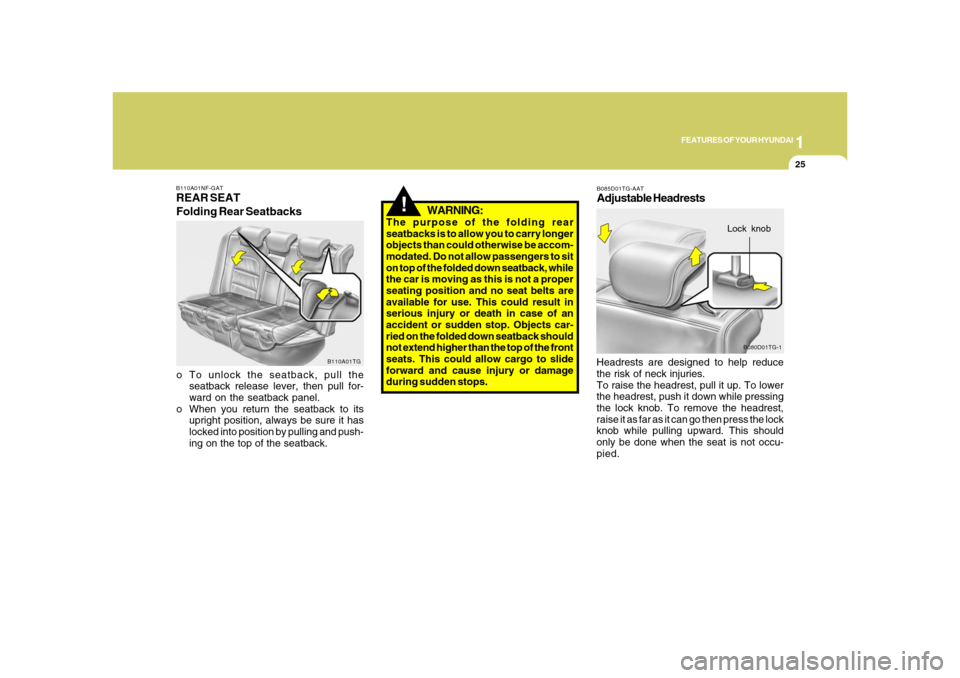
Folding Rear Seatbackso To unlock the seatback, pull the
seatback release lever, then pull for-
ward on the seatback panel.
o When you return the seatback to its
upright position, always be sure it has
locked into position by pulling and push-
ing on the top of the seatback.
B110A01TG
!
WARNING:
The purpose of the folding rear
seatbacks is to allow you to carry longer
objects than could otherwise be accom-
modated. Do not allow passengers to sit
on top of the folded down seatback, while
the car is moving as this is not a proper
seating position and no seat belts are
available for use. This could result in
serious injury or death in case of an
accident or sudden stop. Objects car-
ried on the folded down seatback should
not extend higher than the top of the front
seats. This could allow cargo to slide
forward and cause injury or damage
during sudden stops.
B085D01TG-AATAdjustable HeadrestsHeadrests are designed to help reduce
the risk of neck injuries.
To raise the headrest, pull it up. To lower
the headrest, push it down while pressing
the lock knob. To remove the headrest,
raise it as far as it can go then press the lock
knob while pulling upward. This should
only be done when the seat is not occu-
pied.
B080D01TG-1
Lock knob
Page 41 of 345

1
FEATURES OF YOUR HYUNDAI
27
SEAT BELTS!
B150A02S-AATSEAT BELT PRECAUTIONS
WARNING:All occupants of the vehicle must wear
their seat belts at all times. Seat belts and
child restraints reduce the risk of serious
or fatal injuries for all occupants in the
event of a collision or sudden stop. With-
out a seat belt, occupants could be shifted
too close to a deploying airbag, strike the
interior structure or be thrown from the
vehicle. Properly worn seat belts greatly
reduce these hazards. Even with ad-
vanced airbags, unbelted occupants can
be severely injured by a deploying airbag.
Always follow the precautions about seat
belts, airbags and occupant safety con-
tained in this manual.B150B04Y-AATInfant or Small ChildAll 50 states have child restraint laws. You
should be aware of the specific require-
ments in your state. Child and/or infant
safety seats must be properly placed and
installed in the rear seat. Information about
the use of these restraints begins on page
1-34.
!
WARNING:
Every person in your vehicle needs to be
properly restrained at all times, includ-
ing infants and children. Never hold a
child in your arms or lap when riding in a
vehicle. The violent forces created dur-
ing a crash will tear the child from your
arms and throw the child against the
interior. Always use a child restraint
appropriate for your child's height and
weight, see page 1-34.NOTE:Small children are best protected from
injury in an accident when properly re-
strained in the rear seat by a child re-
straint system that meets the require-
ments of the Federal Motor Vehicle
Safety Standards. Before buying any
child restraint system, make sure that it
has a label certifying that it meets Fed-
eral Motor Vehicle Safety Standard 213.
The restraint must be appropriate for
your child's height and weight. Check
the label on the child restraint for this
information. See page 1-34.
B150C02A-AATLarger ChildrenChildren who are too large for child re-
straint systems should always occupy the
rear seat and use the available lap/shoul-
der belts. The lap portion should be fas-
tened snug on the hips and as low as
possible. Check belt fit periodically. A
child's squirming could put the belt out of
position. Children are afforded the most
safety in the event of an accident when
they are restrained by a proper restraint
system in the rear seat. If a larger child
(over age 13) must be seated in the front
seat, the child should be securely re-
strained by the available lap/shoulder belt
and the seat should be placed in the
rearmost position. Children under the age
of 13 should be restrained securely in the
rear seat. NEVER place a child under the
age of 13 in the front seat. NEVER place a
rear facing child seat in the front seat of a
vehicle.
Page 42 of 345
1FEATURES OF YOUR HYUNDAI28
!
B160A02A-AATCARE OF SEAT BELTSSeat belt systems should never be disas-
sembled or modified. In addition, care
should be taken to assure that seat belts
and belt hardware are not damaged by
seat hinges, doors or other abuse.
WARNING:
When you return the rear seatback to its
upright position after the rear seatback
was folded down, be careful not to dam-
age the seat belt webbing or buckle. Be
sure that the webbing or buckle does not
get caught or pinched in the rear seat. A
seat belt with damaged webbing or buckle
will not be as strong and could possibly
fail during a collision or sudden stop,
resulting in serious injury.
B150D01A-AATPregnant WomenThe use of a seat belt is recommended for
pregnant women to lessen the chance of
injury in an accident. When a seat belt is
used, the lap belt portion should be placed
as low and snugly as possible on the hips,
not across the abdomen. For specific rec-
ommendations, consult a physician.B150E01A-AATInjured PersonA seat belt should be used when an injured
person is being transported. When this is
necessary, you should consult a physician
for recommendations.B150F01A-AATOne Person Per BeltTwo people (including children) should
never attempt to use a single seat belt. This
could increase the severity of injuries in
case of an accident.
WARNING:
Riding with a reclined seatback increases
your chance of serious or fatal injuries in
the event of a collision or sudden stop.
The protection of your restraint system
(seat belts and airbags) is greatly re-
duced by reclining your seat. Seat belts
must be snug against your hips and chest
to work properly. The more the seatback
is reclined, the greater the chance that an
occupant's hips will slide under the lap
belt causing serious internal injuries or
the occupant's neck could strike the
shoulder belt. Drivers and passengers
should always sit well back in their seats,
properly belted (see page 1-30), and with
the seatbacks upright.
!
B150G02A-AATDo Not Lie DownTo reduce the chance of injuries in the
event of an accident and to achieve maxi-
mum effectiveness of the restraint system,
all passengers should be sitting up and the
front seats should be in an upright position
when the car is moving. A seat belt cannot
provide proper protection if the person is
lying down in the rear seat or if the front seat
is in a reclined position.
Page 43 of 345
1
FEATURES OF YOUR HYUNDAI
29
B160C01A-AATKeep Belts Clean and DrySeat belts should be kept clean and dry. If
belts become dirty, they can be cleaned by
using a mild soap solution and warm wa-
ter. Bleach, dye, strong detergents or abra-
sives should not be used because they
may damage and weaken the fabric.B160D01A-AATWhen to Replace Seat BeltsEntire in-use seat belt assembly or assem-
blies should be replaced if the vehicle has
been involved in an accident. This should
be done even if no damage is visible.
Additional questions concerning seat belt
operation should be directed to your
Hyundai Dealer.
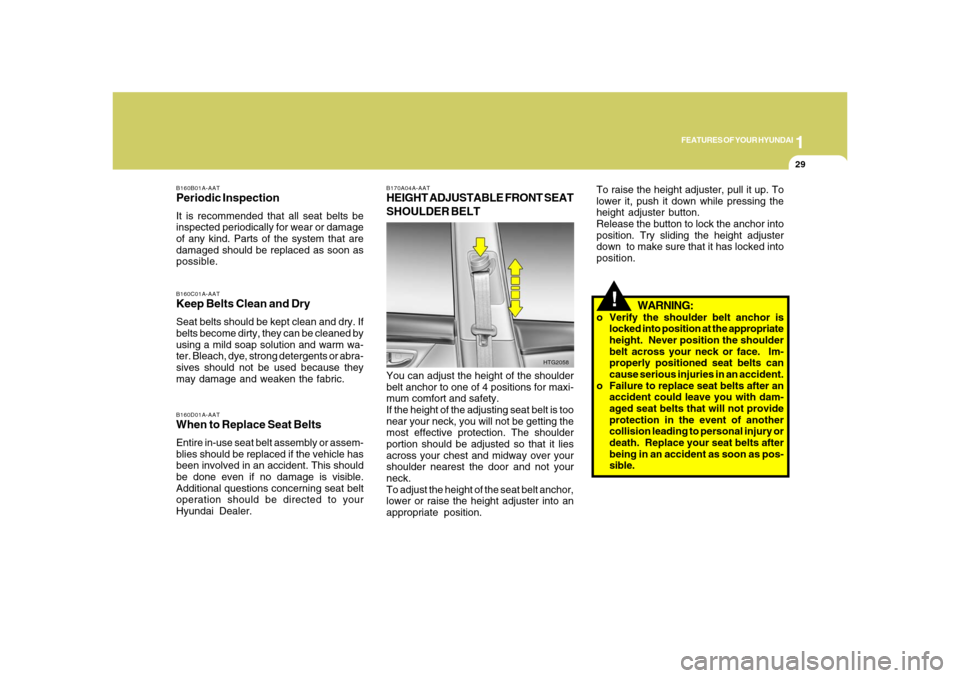
B170A04A-AATHEIGHT ADJUSTABLE FRONT SEAT
SHOULDER BELTYou can adjust the height of the shoulder
belt anchor to one of 4 positions for maxi-
mum comfort and safety.
If the height of the adjusting seat belt is too
near your neck, you will not be getting the
most effective protection. The shoulder
portion should be adjusted so that it lies
across your chest and midway over your
shoulder nearest the door and not your
neck.
To adjust the height of the seat belt anchor,
lower or raise the height adjuster into an
appropriate position.
HTG2058 B160B01A-AAT
Periodic InspectionIt is recommended that all seat belts be
inspected periodically for wear or damage
of any kind. Parts of the system that are
damaged should be replaced as soon as
possible.
!
To raise the height adjuster, pull it up. To
lower it, push it down while pressing the
height adjuster button.
Release the button to lock the anchor into
position. Try sliding the height adjuster
down to make sure that it has locked into
position.
WARNING:
o Verify the shoulder belt anchor is
locked into position at the appropriate
height. Never position the shoulder
belt across your neck or face. Im-
properly positioned seat belts can
cause serious injuries in an accident.
o Failure to replace seat belts after an
accident could leave you with dam-
aged seat belts that will not provide
protection in the event of another
collision leading to personal injury or
death. Replace your seat belts after
being in an accident as soon as pos-
sible.