wheel Hyundai Azera 2017 Repair Manual
[x] Cancel search | Manufacturer: HYUNDAI, Model Year: 2017, Model line: Azera, Model: Hyundai Azera 2017Pages: 520, PDF Size: 16.33 MB
Page 403 of 520
611
What to do in an emergency
The TPMS malfunction indicatormay blink for approximately 1
minute and then remain continu-
ously illuminated if the vehicle is
moving around electric power sup-
ply cables or radios transmitter
such as at police stations, govern-
ment and public offices, broadcast-
ing stations, military installations,
airports, or transmitting towers,
etc. This can interfere with normal
operation of the Tire Pressure
Monitoring System (TPMS).
The TPMS malfunction indicator may blink for approximately 1
minute and then remain continu-
ously illuminated if snow chains are
used or some separate electronic
devices such as notebook comput-
er, mobile charger, remote starter
or navigation etc., are used in the
vehicle. This can interfere with nor-
mal operation of the Tire Pressure
Monitoring System (TPMS).Changing a tire with TPMS
If you have a flat tire, the low Tire
Pressure and Position telltales will
come on. Have the flat tire repaired
by an authorized HYUNDAI dealer
as soon as possible or replace the
flat tire with the spare tire. Each wheel is equipped with a tire
pressure sensor mounted inside the
tire behind the valve stem. You must
use TPMS specific wheels. It is rec-
ommended that you always have your
tires serviced by an authorized
HYUNDAI dealer as soon as possible.
After you replace the low pressure
tire with the spare tire, the TPMS
malfunction indicator may blink for
approximately 1 minute and then
remain continuously illuminated
because the TPMS sensor is not
mounted on the spare wheel.
Once the low pressure tire is reinflat-
ed to the recommended pressure
and installed on the vehicle is initiat-
ed by an authorized HYUNDAI deal-
er, the TPMS malfunction indicator
and the low tire pressure and posi-
tion telltales will turn off within a few
minutes of driving.
If the indicators do not go off after a
few minutes of driving, please visit
an authorized HYUNDAI dealer.
CAUTION
Never use a puncture-repairing
agent not approved by HYUNDAIto repair and/or inflate a lowpressure tire. The tire sealantnot approved by HYUNDAI maydamage the tire pressure sen-sor. The sealant on the tire pres-sure sensor and wheel shall beeliminated when you replace thetire with a new one.
Page 405 of 520
613
What to do in an emergency
IF YOU HAVE A FLAT TIRE
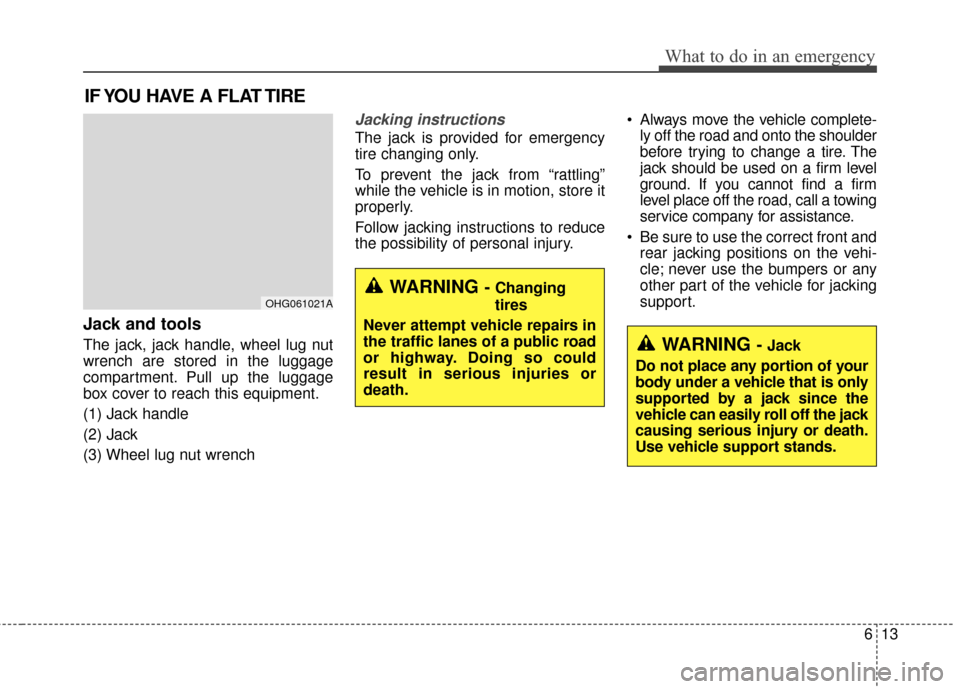
Jack and tools
The jack, jack handle, wheel lug nut
wrench are stored in the luggage
compartment. Pull up the luggage
box cover to reach this equipment.
(1) Jack handle
(2) Jack
(3) Wheel lug nut wrench
Jacking instructions
The jack is provided for emergency
tire changing only.
To prevent the jack from “rattling”
while the vehicle is in motion, store it
properly.
Follow jacking instructions to reduce
the possibility of personal injury. Always move the vehicle complete-
ly off the road and onto the shoulder
before trying to change a tire. The
jack should be used on a firm level
ground. If you cannot find a firm
level place off the road, call a towing
service company for assistance.
Be sure to use the correct front and rear jacking positions on the vehi-
cle; never use the bumpers or any
other part of the vehicle for jacking
support.
WARNING - Changing
tires
Never attempt vehicle repairs in
the traffic lanes of a public road
or highway. Doing so could
result in serious injuries or
death.OHG061021A
WARNING - Jack
Do not place any portion of your
body under a vehicle that is only
supported by a jack since the
vehicle can easily roll off the jack
causing serious injury or death.
Use vehicle support stands.
Page 407 of 520
615
What to do in an emergency
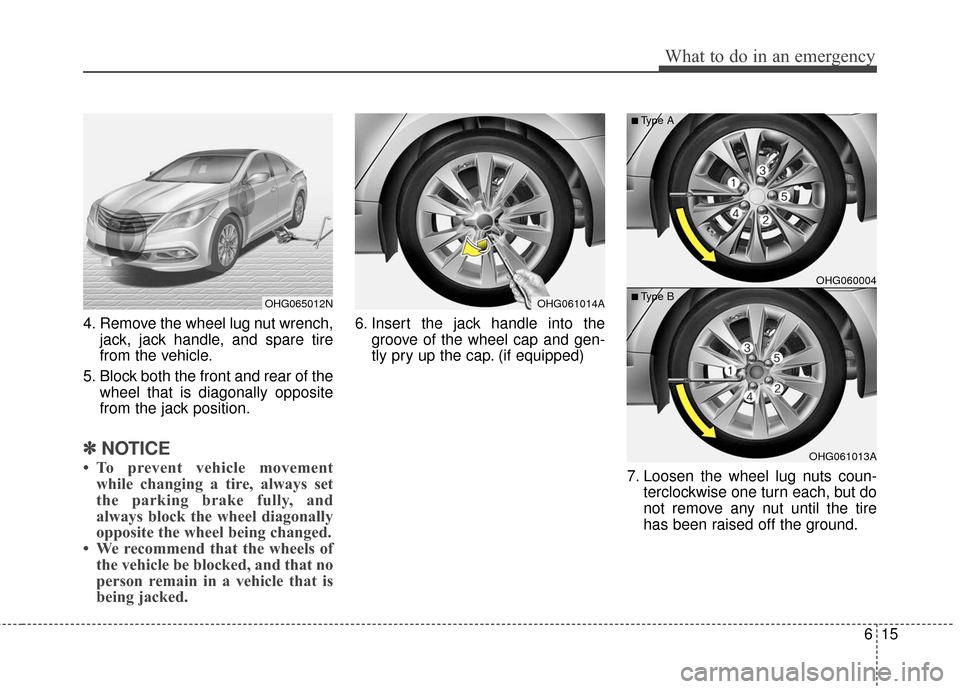
4. Remove the wheel lug nut wrench,jack, jack handle, and spare tire
from the vehicle.
5. Block both the front and rear of the wheel that is diagonally opposite
from the jack position.
✽ ✽NOTICE
• To prevent vehicle movement
while changing a tire, always set
the parking brake fully, and
always block the wheel diagonally
opposite the wheel being changed.
• We recommend that the wheels of the vehicle be blocked, and that no
person remain in a vehicle that is
being jacked.
6. Insert the jack handle into the
groove of the wheel cap and gen-
tly pry up the cap. (if equipped)
7. Loosen the wheel lug nuts coun-terclockwise one turn each, but do
not remove any nut until the tire
has been raised off the ground.
OHG065012NOHG061014A
OHG060004
OHG061013A
■Type A
■ Type B
Page 408 of 520
What to do in an emergency
16
6
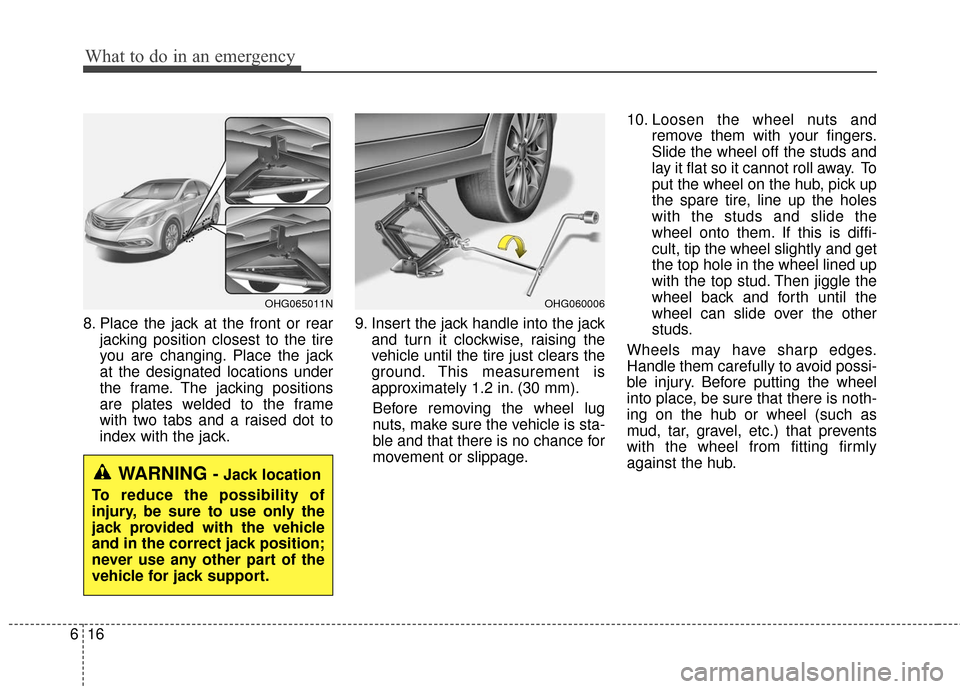
8. Place the jack at the front or rear
jacking position closest to the tire
you are changing. Place the jack
at the designated locations under
the frame. The jacking positions
are plates welded to the frame
with two tabs and a raised dot to
index with the jack. 9. Insert the jack handle into the jack
and turn it clockwise, raising the
vehicle until the tire just clears the
ground. This measurement is
approximately 1.2 in. (30 mm).
Before removing the wheel lug
nuts, make sure the vehicle is sta-
ble and that there is no chance for
movement or slippage. 10. Loosen the wheel nuts and
remove them with your fingers.
Slide the wheel off the studs and
lay it flat so it cannot roll away. To
put the wheel on the hub, pick up
the spare tire, line up the holes
with the studs and slide the
wheel onto them. If this is diffi-
cult, tip the wheel slightly and get
the top hole in the wheel lined up
with the top stud. Then jiggle the
wheel back and forth until the
wheel can slide over the other
studs.
Wheels may have sharp edges.
Handle them carefully to avoid possi-
ble injury. Before putting the wheel
into place, be sure that there is noth-
ing on the hub or wheel (such as
mud, tar, gravel, etc.) that prevents
with the wheel from fitting firmly
against the hub.
OHG060006OHG065011N
WARNING - Jack location
To reduce the possibility of
injury, be sure to use only the
jack provided with the vehicle
and in the correct jack position;
never use any other part of the
vehicle for jack support.
Page 409 of 520
617
What to do in an emergency
11. To install the wheel, hold it on thestuds, put the wheel nuts on the
studs and tighten them finger
tight. The nuts should be installed
with their tappered small diame-
ter ends directed inward. Jiggle
the tire to be sure it is completely
seated, then tighten the nuts as
much as possible with your fin-
gers again.
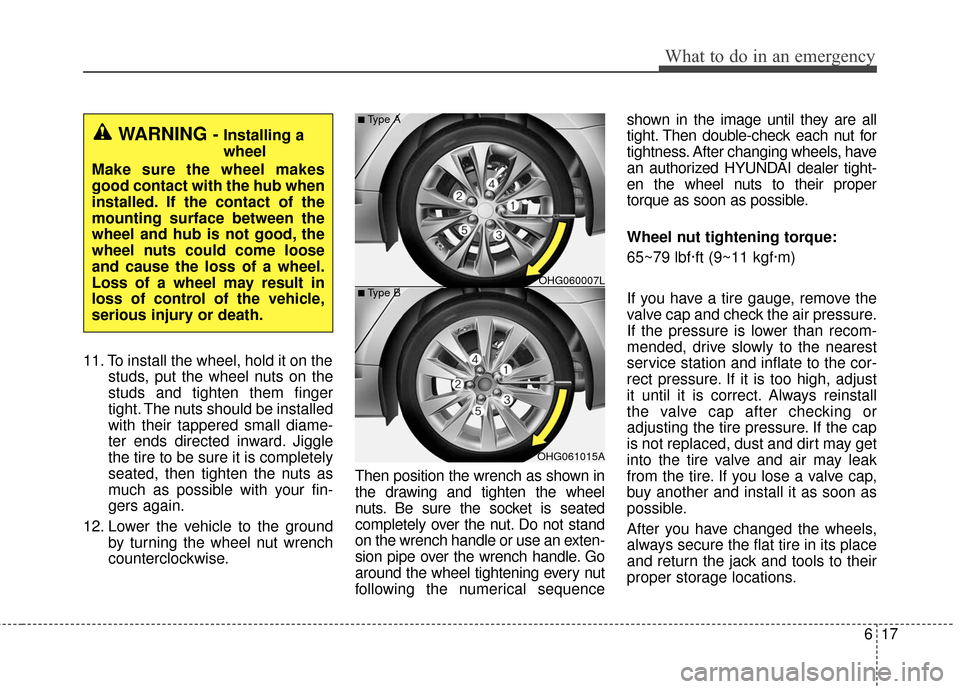
12. Lower the vehicle to the ground by turning the wheel nut wrench
counterclockwise. Then position the wrench as shown in
the drawing and tighten the wheel
nuts. Be sure the socket is seated
completely over the nut. Do not stand
on the wrench handle or use an exten-
sion pipe over the wrench handle. Go
around the wheel tightening every nut
following the numerical sequence shown in the image until they are all
tight. Then double-check each nut for
tightness. After changing wheels, have
an authorized HYUNDAI dealer tight-
en the wheel nuts to their proper
torque as soon as possible.
Wheel nut tightening torque:
65~79 lbf·ft (9~11 kgf·m)
If you have a tire gauge, remove the
valve cap and check the air pressure.
If the pressure is lower than recom-
mended, drive slowly to the nearest
service station and inflate to the cor-
rect pressure. If it is too high, adjust
it until it is correct. Always reinstall
the valve cap after checking or
adjusting the tire pressure. If the cap
is not replaced, dust and dirt may get
into the tire valve and air may leak
from the tire. If you lose a valve cap,
buy another and install it as soon as
possible.
After you have changed the wheels,
always secure the flat tire in its place
and return the jack and tools to their
proper storage locations.
WARNING - Installing a
wheel
Make sure the wheel makes
good contact with the hub when
installed. If the contact of the
mounting surface between the
wheel and hub is not good, the
wheel nuts could come loose
and cause the loss of a wheel.
Loss of a wheel may result in
loss of control of the vehicle,
serious injury or death.
OHG060007L■Type B
■Type A
OHG061015A
Page 410 of 520
What to do in an emergency
18
6
Note that most lug nuts do not have
metric threads. Be sure to use
extreme care in checking for thread
style before installing aftermarket lug
nuts or wheels. If in doubt, consult an
authorized HYUNDAI dealer. To prevent the jack, jack handle,
wheel lug nut wrench and spare tire
from rattling while the vehicle is in
motion, store them properly.
Check the inflation pressures as
soon as possible after installing the
spare tire. Adjust it to the specified
pressure, if necessary. Refer to
“Tires and wheels” in section 8.
Important - use of compact spare
tire
Your vehicle is equipped with a com-
pact spare tire. This compact spare
tire takes up less space than a regu-
lar-size tire. This tire is smaller than a
conventional tire and is designed for
temporary use only.
You should drive carefully when the compact spare is in use. The
compact spare should be replaced
by the proper conventional tire and
rim at the first opportunity.
The operation of this vehicle is not recommended with more than one
compact spare tire in use at the
same time.
CAUTION - Replacing lug
nuts
Make certain during wheelremoval that the same nuts thatwere removed are reinstalled - or,if replaced, that nuts with metricthreads and the same chamferconfiguration are used. Yourvehicle has metric threads on thewheel studs and nuts. Installationof a non-metric thread nut on ametric stud will not secure thewheel to the hub properly andwill damage the stud so that itmust be replaced.
WARNING - Wheel studs
Do not drive your vehicle with
damaged wheel studs. If the
studs are damaged, they may
lose their ability to retain the
wheel. This could lead to the
loss of the wheel and a collision
resulting in serious injuries.
Page 411 of 520
619
What to do in an emergency
The compact spare should be inflat-
ed to 60 psi (420 kPa).
✽ ✽NOTICE
Check the inflation pressure after
installing the spare tire. Adjust it to
the specified pressure, as necessary.
When using a compact spare tire,
observe the following precautions:
Under no circumstances should you
exceed 50 mph; a higher speed
could damage the tire.
Ensure that you drive slowly enough for the road conditions to avoid all
hazards. Any road hazard, such as a
pothole or debris, could seriously
damage the compact spare.
Any continuous road use of this tire could result in tire failure, loss of
vehicle control, and possible per-
sonal injury.
Do not exceed the vehicle’s maxi- mum load rating or the load-carry-
ing capacity shown on the sidewall
of the compact spare tire.
Avoid driving over obstacles. The compact spare tire diameter is
smaller than the diameter of a con-
ventional tire and reduces the
ground clearance approximately 1
inch, which could result in damage
to the vehicle.
Do not take this vehicle through an automatic car wash while the com-
pact spare tire is installed. Do not use tire chains on the com-
pact spare tire. Because of the small-
er size, a tire chain will not fit proper-
ly. This could damage the vehicle
and result in loss of the chain.
Do not use the compact spare tire on any other vehicle because this
tire has been designed especially
for your vehicle.
The compact spare tire’s tread life is shorter than a regular tire. Inspect
your compact spare tire regularly
and replace worn compact spare
tires with the same size and design,
mounted on the same wheel.
The compact spare tire should not be used on any other wheels, nor
should standard tires, snow tires,
wheel covers or trim rings be used
with the compact spare wheel. If
such use is attempted, damage to
these items or other vehicle com-
ponents may occur.
Do not use more than one compact spare tire at a time.
Do not tow a trailer while the com- pact spare tire is installed.WARNING - Spare tire
Do not operate your vehicle on
this compact spare at speeds
over 50 mph. The compact
spare tire is for emergency use
only. The original tire should be
repaired or replaced as soon as
possible to avoid failure of the
spare, possibly leading to per-
sonal injury or death.
Page 413 of 520
621
What to do in an emergency
TOWING
Towing service
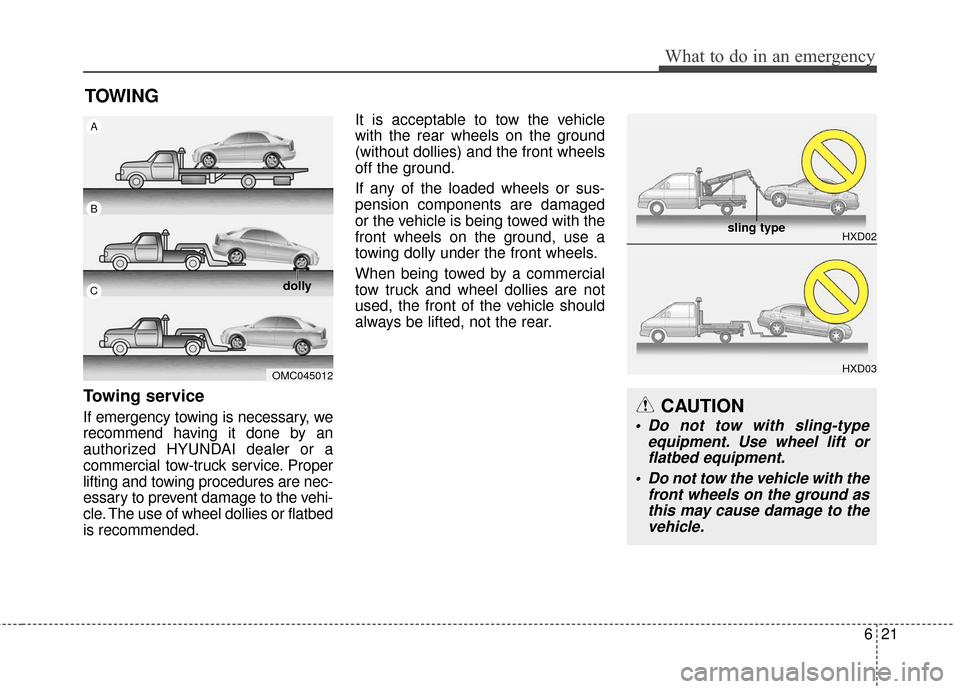
If emergency towing is necessary, we
recommend having it done by an
authorized HYUNDAI dealer or a
commercial tow-truck service. Proper
lifting and towing procedures are nec-
essary to prevent damage to the vehi-
cle. The use of wheel dollies or flatbed
is recommended.It is acceptable to tow the vehicle
with the rear wheels on the ground
(without dollies) and the front wheels
off the ground.
If any of the loaded wheels or sus-
pension components are damaged
or the vehicle is being towed with the
front wheels on the ground, use a
towing dolly under the front wheels.
When being towed by a commercial
tow truck and wheel dollies are not
used, the front of the vehicle should
always be lifted, not the rear.
HXD02
HXD03
CAUTION
• Do not tow with sling-type
equipment. Use wheel lift orflatbed equipment.
Do not tow the vehicle with the front wheels on the ground asthis may cause damage to thevehicle.
OMC045012
A
B
Cdolly sling type
Page 414 of 520
What to do in an emergency
22
6
When towing your vehicle in an
emergency without wheel dollies :
1. Set the ignition switch in the ACC
position.
2. Place the shift lever in N (Neutral).
3. Release the parking brake.
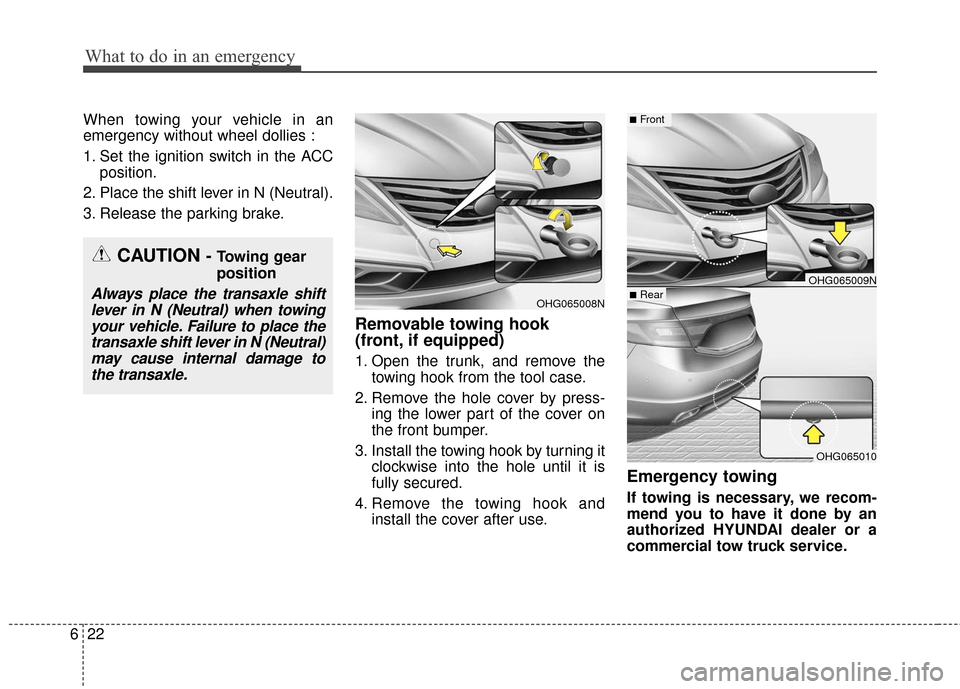
Removable towing hook
(front, if equipped)
1. Open the trunk, and remove the towing hook from the tool case.
2. Remove the hole cover by press- ing the lower part of the cover on
the front bumper.
3. Install the towing hook by turning it clockwise into the hole until it is
fully secured.
4. Remove the towing hook and install the cover after use.
Emergency towing
If towing is necessary, we recom-
mend you to have it done by an
authorized HYUNDAI dealer or a
commercial tow truck service.
OHG065008N
OHG065009N■Rear
■Front
OHG065010
CAUTION - Towing gear
position
Always place the transaxle shiftlever in N (Neutral) when towingyour vehicle. Failure to place thetransaxle shift lever in N (Neutral)may cause internal damage tothe transaxle.
Page 415 of 520
623
What to do in an emergency
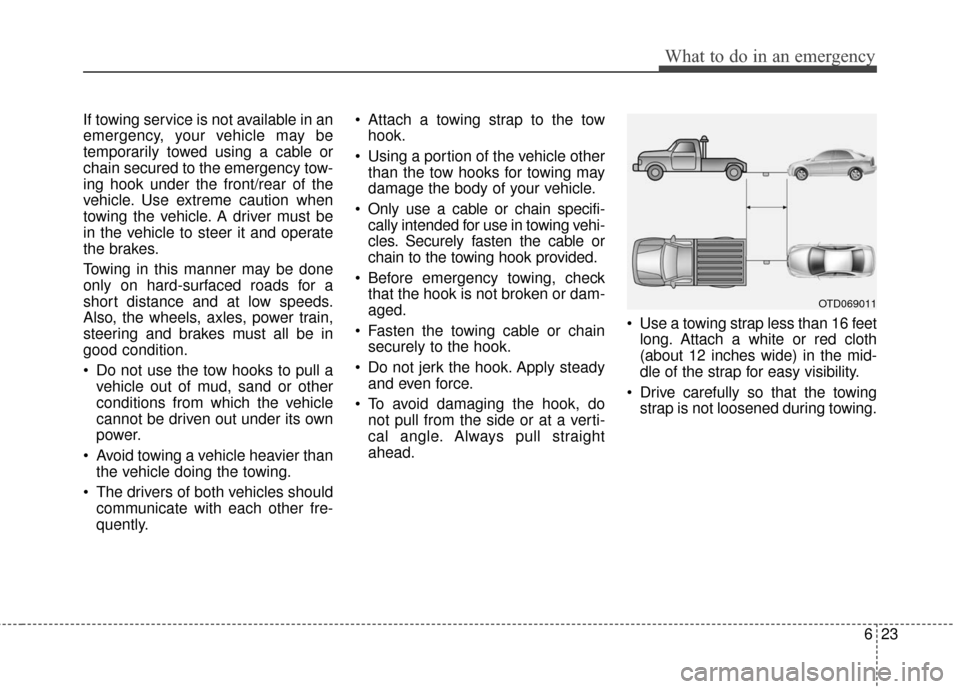
If towing service is not available in an
emergency, your vehicle may be
temporarily towed using a cable or
chain secured to the emergency tow-
ing hook under the front/rear of the
vehicle. Use extreme caution when
towing the vehicle. A driver must be
in the vehicle to steer it and operate
the brakes.
Towing in this manner may be done
only on hard-surfaced roads for a
short distance and at low speeds.
Also, the wheels, axles, power train,
steering and brakes must all be in
good condition.
Do not use the tow hooks to pull avehicle out of mud, sand or other
conditions from which the vehicle
cannot be driven out under its own
power.
Avoid towing a vehicle heavier than the vehicle doing the towing.
The drivers of both vehicles should communicate with each other fre-
quently. Attach a towing strap to the tow
hook.
Using a portion of the vehicle other than the tow hooks for towing may
damage the body of your vehicle.
Only use a cable or chain specifi- cally intended for use in towing vehi-
cles. Securely fasten the cable or
chain to the towing hook provided.
Before emergency towing, check that the hook is not broken or dam-
aged.
Fasten the towing cable or chain securely to the hook.
Do not jerk the hook. Apply steady and even force.
To avoid damaging the hook, do not pull from the side or at a verti-
cal angle. Always pull straight
ahead. Use a towing strap less than 16 feet
long. Attach a white or red cloth
(about 12 inches wide) in the mid-
dle of the strap for easy visibility.
Drive carefully so that the towing strap is not loosened during towing.
OTD069011