cooling Hyundai Coupe 2002 User Guide
[x] Cancel search | Manufacturer: HYUNDAI, Model Year: 2002, Model line: Coupe, Model: Hyundai Coupe 2002Pages: 140, PDF Size: 1.45 MB
Page 86 of 140
DRIVING YOUR HYUNDAI
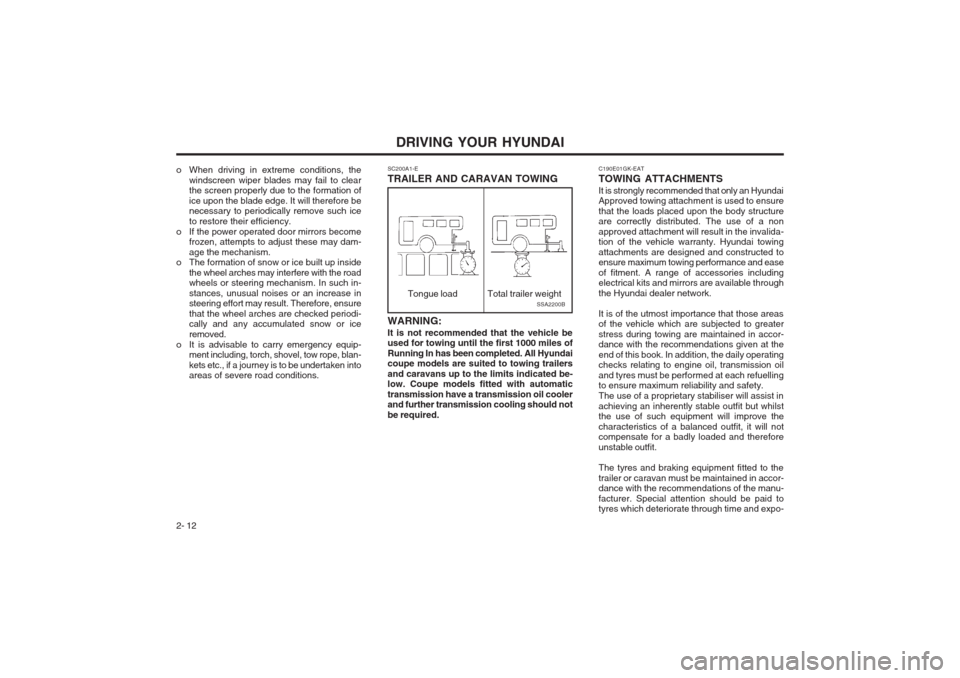
2- 12 WARNING: It is not recommended that the vehicle be used for towing until the first 1000 miles of Running In has been completed. All Hyundai coupe models are suited to towing trailers and caravans up to the limits indicated be- low. Coupe models fitted with automatic transmission have a transmission oil cooler and further transmission cooling should not be required.
SC200A1-E TRAILER AND CARAVAN TOWING
Tongue loadSSA2200B
Total trailer weight
C190E01GK-EAT TOWING ATTACHMENTSIt is strongly recommended that only an Hyundai Approved towing attachment is used to ensure that the loads placed upon the body structure are correctly distributed. The use of a non approved attachment will result in the invalida- tion of the vehicle warranty. Hyundai towing attachments are designed and constructed to ensure maximum towing performance and ease of fitment. A range of accessories including electrical kits and mirrors are available through the Hyundai dealer network. It is of the utmost importance that those areas of the vehicle which are subjected to greater stress during towing are maintained in accor- dance with the recommendations given at the end of this book. In addition, the daily operating checks relating to engine oil, transmission oil and tyres must be performed at each refuelling to ensure maximum reliability and safety. The use of a proprietary stabiliser will assist inachieving an inherently stable outfit but whilst the use of such equipment will improve the characteristics of a balanced outfit, it will not compensate for a badly loaded and therefore unstable outfit. The tyres and braking equipment fitted to the trailer or caravan must be maintained in accor- dance with the recommendations of the manu- facturer. Special attention should be paid to tyres which deteriorate through time and expo-
o When driving in extreme conditions, the
windscreen wiper blades may fail to clearthe screen properly due to the formation of ice upon the blade edge. It will therefore be necessary to periodically remove such ice to restore their efficiency.
o If the power operated door mirrors become frozen, attempts to adjust these may dam-age the mechanism.
o The formation of snow or ice built up inside
the wheel arches may interfere with the road wheels or steering mechanism. In such in- stances, unusual noises or an increase in steering effort may result. Therefore, ensure that the wheel arches are checked periodi- cally and any accumulated snow or ice removed.
o It is advisable to carry emergency equip- ment including, torch, shovel, tow rope, blan-kets etc., if a journey is to be undertaken into areas of severe road conditions.
Page 90 of 140
IN CASE OF EMERGENCY
3-2 4. Check to see if the water pump drive belt is
missing. If it is not missing, check to see that it is tight. If the drive belt seems to be satisfac- tory, check for coolant leaking from the radia- tor, hoses or under the car. (If the air condi- tioning had been in use, it is normal for cold water to be draining from it).
WARNING: Whilst the engine is running, keep hands and clothing away from moving parts such as the fan and drive belts to prevent injury.
5. If the water pump drive belt is broken or coolant is leaking out, stop the engine imme- diately and call the nearest Hyundai dealer for assistance.
WARNING:Do not remove the radiator cap when the engine is hot since steam and boiling water may be ejected from the radiator resulting in burns or scalding.
6. If the cause of the overheating cannot be found, wait until the engine temperature has returned to normal. Then, if coolant has been lost, carefully remove the radiator cap and add water to bring the fluid level in the reser- voir up to the base of the radiator fill opening. Fill the coolant expansion tank to the halfway mark.
WARNING: Motor vehicle batteries contain sulphuric acid and emit hydrogen gas. Protective clothing should be worn and care exercised to prevent the acid from coming into contact with skin or clothing and the vehicle. Naked lights should not be permitted in the vicinity of the battery. Care should be exercised to prevent sparks occurring during connection. If acid acciden- tally comes into contact with skin or eyes, the affected area should immediately be flushed with copious amounts of water and medical assistance sought.
1. Ensure that the booster battery is 12 volt type.
If the booster battery is installed in another vehicle, ensure that the two vehicles are not touching.
2. Turn off all unnecessary electrical equipment in both vehicles.
3. Ensure that the engine of the vehicle provid- ing the jump start is running prior to connec- tion of the jump cables.
4. Connect the red jump cable to the positive (+)
terminal of the booster battery and the other end to the positive (+) terminal of the dis- charged battery.
5. Attach the black jump cable to the negative
(-) terminal of the booster battery, and the other end to a ground point within the engine compartment of the vehicle with the flat bat- tery. Do not connect to the negative battery terminal of the flat battery since sparks may be generated with the subsequent risk of explosion. 6. Raise the booster vehicle engine speed to
2,000 r.p.m. and start the engine of the vehi- cle with the flat battery.
7. Remove jump cables in the reverse order of installation (black cable first).
CAUTION: If the jump cable is incorrectly installed, dam- age to the vehicle electrical system may oc- cur, in particular the electronic components such as the Fuel Injection system computer and the Automatic Transmission computer. The battery must never be disconnected whilst the engine is running. SD040A1-E IF THE ENGINE OVERHEATSIf the temperature gauge indicates overheating:
1. Pull off the road and stop as soon as it is safe to do so.
2. Place the gear selector lever in "P" (auto- matic), or neutral (manual transaxle) and set the parking brake. If the air conditioning is on, turn it off.
3. If coolant is running out under the car or steam is coming out from under the bonnet stop the engine. Do not open the bonnet until the cool-ant has stopped running or the steam- ing has stopped. If there is no visible loss of coolant and no steam, leave the engine run- ning and check to be sure the engine cooling fan is operating. If the fan is not running, turn the engine off.
Page 91 of 140
3-3
IN CASE OF EMERGENCY
SD060A1-E IN THE EVENT OF A PUNCTURE If a puncture occurs whilst driving the vehicle:
1. Bring the car to rest as soon as it is safe to do so and with the minimum amount ofbraking required which will assist in main- taining the maximum amount of control. The vehicle should be parked wherever possible upon firm level ground to facilitate wheel changing.
2. If the vehicle is creating a hazard and the road conditions do not permit the wheel to bechanged safely, assistance should be sought.
3. Passengers must not be allowed to remain inside the vehicle during wheel changing. Ifa puncture occurs whilst the vehicle is on a SD070A1-E CHANGING A FLAT TYRE
7. Proceed with caution until it is established
that the engine is operating normally. If the engine overheats repeatedly, the advice of a Hyundai dealer should be sought.
CAUTION: Serious loss of coolant indicates there is a leak in the cooling system and this should be checked as soon as possible by a Hyundai dealer.
It is of the utmost importance that care is exer- cised when changing road wheels. Ensure that the parking brake is set and that the gear shift lever is in reverse (P, if the vehicle has automatic transmission).
D040A01GK-EAT TEMPORARY SPARE TYREThe following instructions for the temporary spare tyre should be observed:
1. Check inflation pressure as soon as practical
after installing the spare tyre, and adjust to the specified pressure. The tyre pressure should be periodically checked and maintained at the specified pressure while the tyre is stored.
2. The spare tyre should only be used temporari-
ly and should be returned to the luggagecompartment as soon as the original tyre can be repaired or replaced.
3. Continuous use at speeds of over 50 mph (80 km/h) is not recommended. 4. As the temporary spare tyre is specifically
designed for your car, it should not be used onany other vehicle.
5. The temporary spare tyre should not be used on any other wheels, nor should standard tyre, snow tyre, wheel covers or trim rings be used with the temporary spare wheel. If such use is attempted, damage to these items or other car components may occur.
6. The temporary spare tyre pressure should be checked once a month while the tyre is stored.
CAUTION:
o Do not use snow chains with your tempo- rary spare tyre.
o Do not use more than one temporary spare
tyre at a time.
Spare Tyre Pressure
Type Size Inflation Pressure T125/70 R16420 kPa (60 psi)
motorway, the passengers should take ref- uge on the motorway embankment to avoid the possibility of injury occurring should the vehicle be struck by other motorway traffic.
4. Wheel changing should be performed ac- cording to the following instructions.
D060A01GK
Page 101 of 140
VEHICLE MAINTENANCE REQUIREMENTS 5-3
I I I I II I I I I
R III I II I I
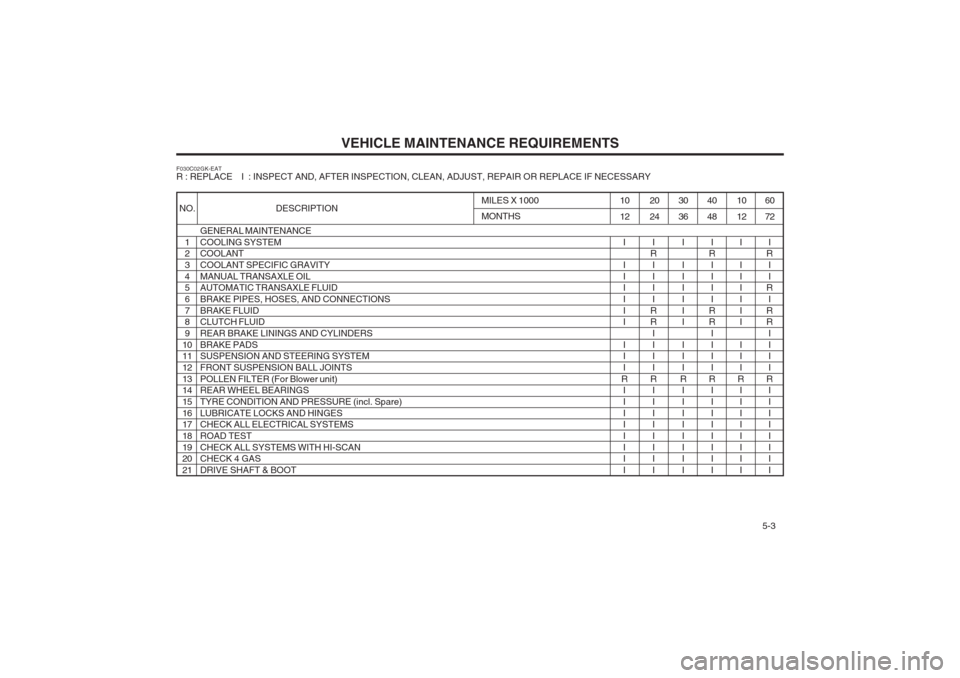
F030C02GK-EAT R : REPLACE I : INSPECT AND, AFTER INSPECTION, CLEAN, ADJUST, REPAIR OR REPLACE IF NECESSARY
GENERAL MAINTENANCE COOLING SYSTEM COOLANT COOLANT SPECIFIC GRAVITYMANUAL TRANSAXLE OIL AUTOMATIC TRANSAXLE FLUID BRAKE PIPES, HOSES, AND CONNECTIONSBRAKE FLUID CLUTCH FLUID REAR BRAKE LININGS AND CYLINDERSBRAKE PADS SUSPENSION AND STEERING SYSTEM FRONT SUSPENSION BALL JOINTSPOLLEN FILTER (For Blower unit) REAR WHEEL BEARINGS TYRE CONDITION AND PRESSURE (incl. Spare)LUBRICATE LOCKS AND HINGES CHECK ALL ELECTRICAL SYSTEMS ROAD TESTCHECK ALL SYSTEMS WITH HI-SCAN CHECK 4 GAS DRIVE SHAFT & BOOT
MILES X 1000 MONTHS
NO. DESCRIPTION
1 2 34 5 67 8 9
10 11 1213 14 1516 17 1819 20 21I I I I II I I I I
R III I II I I
10 12 202430364048 10126072
I
R
I I I I
R R I I I I
R III I II I II
R
I I I I
R R I I I I
R III I II I I I I I I II I I I I
R III I II I I I
R
II
R
I
R R I I I I
R III I II I I
Page 104 of 140
VEHICLE MAINTENANCE REQUIREMENTS
5- 6
6ZF070D1-A
o Manual transaxle oil Inspect the manual transaxle oil according to the maintenance schedule. NOTE: If the oil level is low, check for possible leaks before adding oil. Do not overfill.
6ZF070H1-A
o Rear brake drums and linings/
parking brake
Check the rear brake drums and linings for scoring, burning, leaking fluid, broken parts, and excessive wear. Inspect the parking brake sys- tem including the parking brake lever and cables. For detailed service procedures, refer to the Shop Manual. 6ZF070J1-A
o Brake pads, calipers and rotorsCheck the pads for excessive wear, discs for run out and wear, and calipers for fluid leakage. 6ZF070K1-A
o Exhaust pipe and muffler Visually inspect the exhaust pipes, muffler and hangers for cracks, deterioration, or damage. Start the engine and listen carefully for any exhaust gas leakage. Tighten connections or replace parts as necessary. 6ZF070L1-A
o Suspension mounting bolts Check the suspension connections for loose- ness or damage. Retighten to the specified torque.
F070E03A-AAT
o Automatic transaxle fluid The fluid level should be in the "HOT" range of the dipstick, after engine and transaxle are at normal operating temperature. Check the Automatic Transaxle Fluid level with the engine running and the transaxle in neutral, with the parking brake properly applied. Use DIAMOND ATF SP- III,
SK ATF SP- III when adding or changing fluid. 6ZF070M1-A
o Steering gear box, linkage & boots/
lower arm ball joint
With the vehicle stopped and engine off, check for excessive freeplay in the steering wheel. Check the linkage for bends or damage. Check the dust boots and ball joints for deterioration, cracks, or damage. Replace any damaged parts. 6ZF070N1-A
o Power steering pump, belt and hos-
es
Check the power steering pump and hoses for leakage and damage. Replace any damaged or leaking parts immediately. Inspect the power steering belt for evidence of cuts, cracks, exces- sive wear, oiliness and proper tension. Replace or adjust it if necessary.
6ZF070F1-A o Brake hoses and lines Visually check for proper installation, chafing, cracks, deterioration and any leakage. Replace any deteriorated or damaged parts immediately. 6ZF070G2-A
o Brake fluidCheck brake fluid level in the brake fluid reser- voir. The level should be between "MIN" and "MAX" marks on the side of the reservoir. Use only hydraulic brake fluid conforming to DOT 3 or DOT 4.
6ZF070B1-A
o Cooling system Check the cooling system part, such as radiator, coolant reservoir, hoses and connections for leakage and damage. Replace any damaged parts. 6ZF070C1-A
o CoolantThe coolant should be changed at the intervals specified in the maintenance schedule.
Page 111 of 140
OWNER MAINTENANCE
6-6 CAUTION: The oil being drained from the engine will be hot. Care should be exercised to prevent scalding.
4. When the oil has drained from the sump,
replace the drain plug using a new washer ensuring that the plug is not over tightened.
Tightening torque :
4.5 ~ 4.0 kgf.m (1.6/2.0L)4.5 ~ 3.5 kgf.m (2.7L)
5. Remove the oil filter by rotating counterclock- wise, using a proprietary oil filter removal toolif necessary. Note that the oil filter will contain approximately 0.5 litres of oil and this should be collected in a suitable receptacle.
6. Install a new oil filter having smeared the
sealing ring with clean oil and rotating clock- wise until the filter contacts the mounting and then a further one half turn. Do not over- tighten. Tightening torque: 1.2 ~ 1.6 kgf.m.
7. Pour the specified quantity of the recom- mended oil into the engine and replace the filler cap. Start the engine and ensure that no oil leaks exist. Turn off the engine and after a couple minutes, recheck the oil level.
WARNING: Prolonged and repeated contact with used engine oils may result in serious skin disor- ders including dermatitis and cancer. Avoid contact with skin as far as possible and al-
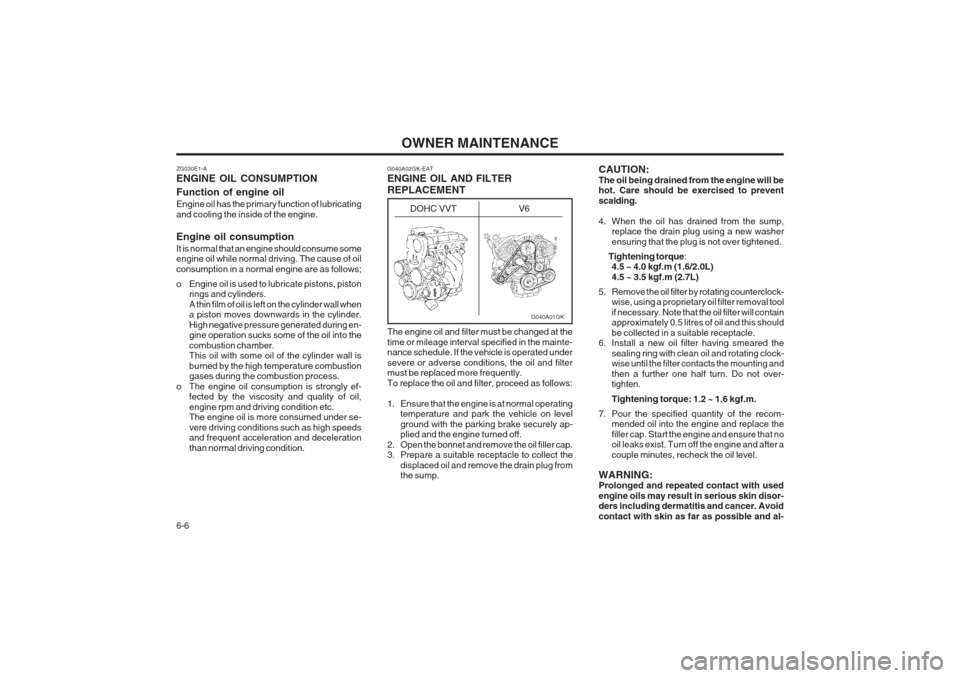
G040A02GK-EAT ENGINE OIL AND FILTER REPLACEMENT The engine oil and filter must be changed at the time or mileage interval specified in the mainte- nance schedule. If the vehicle is operated under severe or adverse conditions, the oil and filter must be replaced more frequently. To replace the oil and filter, proceed as follows:
1. Ensure that the engine is at normal operating
temperature and park the vehicle on level ground with the parking brake securely ap- plied and the engine turned off.
2. Open the bonnet and remove the oil filler cap.
3. Prepare a suitable receptacle to collect the displaced oil and remove the drain plug fromthe sump.
ZG030E1-A ENGINE OIL CONSUMPTION Function of engine oil Engine oil has the primary function of lubricating and cooling the inside of the engine. Engine oil consumption It is normal that an engine should consume some engine oil while normal driving. The cause of oil consumption in a normal engine are as follows;
o Engine oil is used to lubricate pistons, piston
rings and cylinders. A thin film of oil is left on the cylinder wall when a piston moves downwards in the cylinder. High negative pressure generated during en- gine operation sucks some of the oil into the combustion chamber. This oil with some oil of the cylinder wall is burned by the high temperature combustion gases during the combustion process.
o The engine oil consumption is strongly ef- fected by the viscosity and quality of oil, engine rpm and driving condition etc. The engine oil is more consumed under se- vere driving conditions such as high speeds and frequent acceleration and deceleration than normal driving condition.
G040A01GK
DOHC VVT V6
Page 112 of 140
OWNER MAINTENANCE 6-7
ways wash thoroughly after any contact. Keep used oils out of reach of children. It is illegal to pollute drains, water courses and soil. Use only authorized waste collection facilities including civic amenity sites and garages for the disposal of used oil and oil filters. If in doubt, contact the local authority for dis- posal instructions. SG050A1-E ENGINE COOLANT CHECKING AND REPLACING WARNING: Do not remove the radiator cap when the engine is hot, since the system is pressurized and coolant may be ejected from the radiator resulting in scalding. SG050B1-E Coolant recommendations
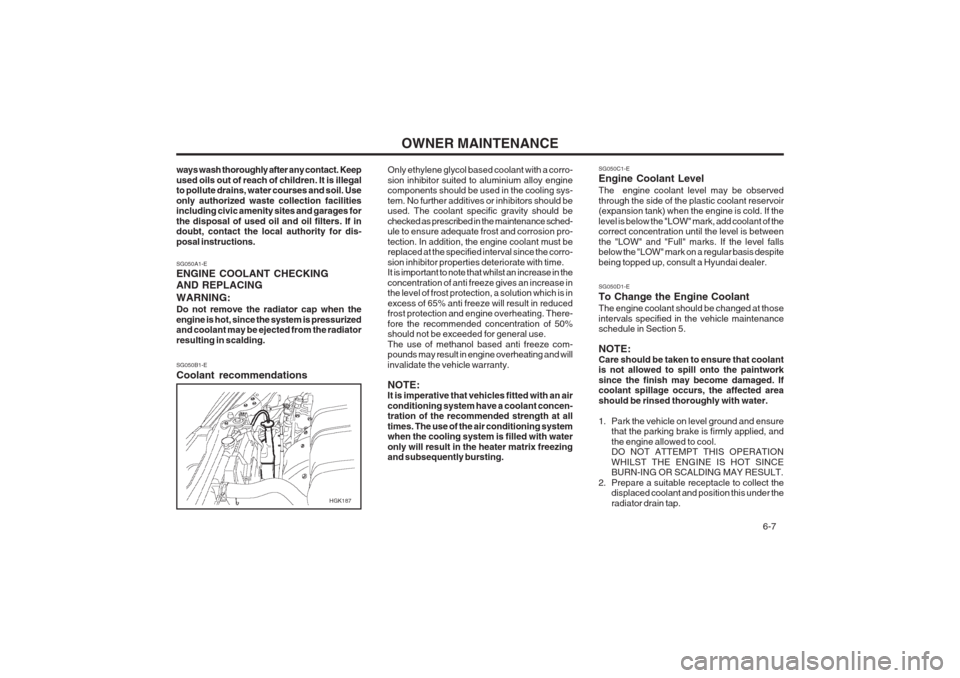
Only ethylene glycol based coolant with a corro- sion inhibitor suited to aluminium alloy engine components should be used in the cooling sys- tem. No further additives or inhibitors should be used. The coolant specific gravity should be checked as prescribed in the maintenance sched- ule to ensure adequate frost and corrosion pro- tection. In addition, the engine coolant must be replaced at the specified interval since the corro- sion inhibitor properties deteriorate with time. It is important to note that whilst an increase in the concentration of anti freeze gives an increase in the level of frost protection, a solution which is in excess of 65% anti freeze will result in reduced frost protection and engine overheating. There- fore the recommended concentration of 50% should not be exceeded for general use. The use of methanol based anti freeze com- pounds may result in engine overheating and will invalidate the vehicle warranty. NOTE: It is imperative that vehicles fitted with an air conditioning system have a coolant concen- tration of the recommended strength at all times. The use of the air conditioning system when the cooling system is filled with water only will result in the heater matrix freezing and subsequently bursting.SG050C1-E Engine Coolant Level The engine coolant level may be observed through the side of the plastic coolant reservoir (expansion tank) when the engine is cold. If the level is below the "LOW" mark, add coolant of the correct concentration until the level is between the "LOW" and "Full" marks. If the level falls below the "LOW" mark on a regular basis despite being topped up, consult a Hyundai dealer. SG050D1-E To Change the Engine Coolant The engine coolant should be changed at those intervals specified in the vehicle maintenance schedule in Section 5. NOTE: Care should be taken to ensure that coolant is not allowed to spill onto the paintwork since the finish may become damaged. If coolant spillage occurs, the affected area should be rinsed thoroughly with water.
1. Park the vehicle on level ground and ensure
that the parking brake is firmly applied, and the engine allowed to cool. DO NOT ATTEMPT THIS OPERATION WHILST THE ENGINE IS HOT SINCE BURN-ING OR SCALDING MAY RESULT.
2. Prepare a suitable receptacle to collect the displaced coolant and position this under the radiator drain tap.
HGK187
Page 113 of 140
OWNER MAINTENANCE
6-8 CAUTION: Sparking plugs must only be cleaned using purpose designed equipment. Wire brushing may damage the centre electrodeinsulator causing mis-firing to occur. Only the correct grade of sparking plug should be used. Use of an incorrect grade may result in serious engine damage.
3. With the heater temperature control set to the
"HOT" position, remove the radiator cap and open the radiator drain tap.
4. When the engine coolant has drained com- pletely, close the drain tap ensuring that this is not over tightened.
5. Prepare a suitable quantity of new engine
coolant (refer to section 9) and pour this into the radiator.
6. Start the engine with the radiator cap still removed and continue to add coolant as the level decreases as air is expelled from the system. When the level remains constant, replace the radiator cap and replenish the coolant reservoir.
7. When the engine is hot, check to ensure that no coolant leaks are present.
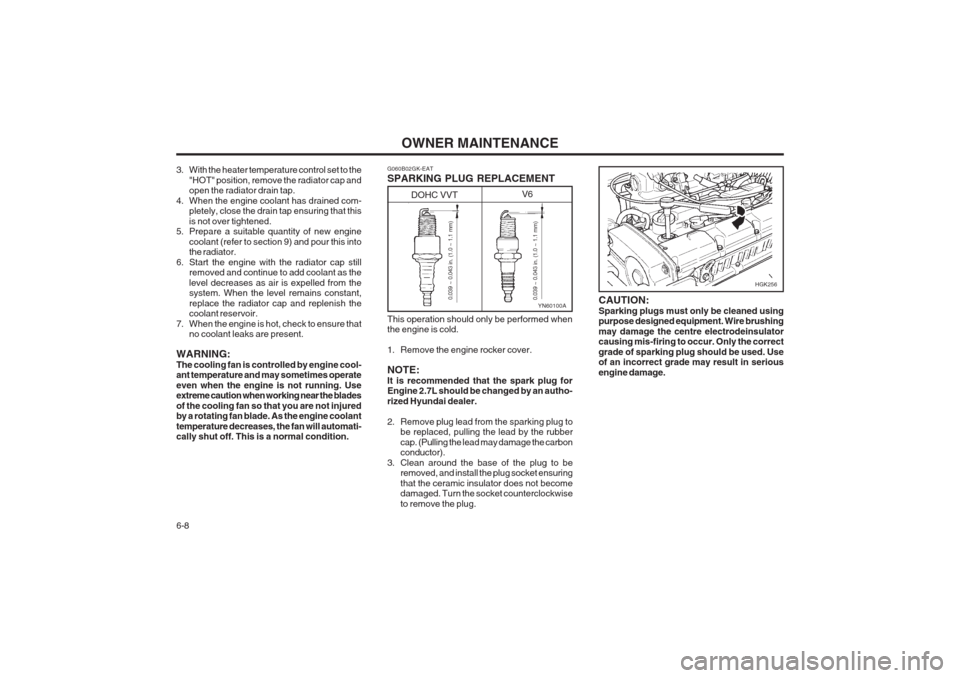
WARNING: The cooling fan is controlled by engine cool- ant temperature and may sometimes operate even when the engine is not running. Use extreme caution when working near the blades of the cooling fan so that you are not injured by a rotating fan blade. As the engine coolant temperature decreases, the fan will automati- cally shut off. This is a normal condition. G060B02GK-EAT SPARKING PLUG REPLACEMENT This operation should only be performed when the engine is cold.
1. Remove the engine rocker cover.NOTE: It is recommended that the spark plug for Engine 2.7L should be changed by an autho- rized Hyundai dealer.
2. Remove plug lead from the sparking plug to
be replaced, pulling the lead by the rubber cap. (Pulling the lead may damage the carbon conductor).
3. Clean around the base of the plug to be removed, and install the plug socket ensuring that the ceramic insulator does not become damaged. Turn the socket counterclockwise to remove the plug.
YN60100A0.039 ~ 0.043 in. (1.0 ~ 1.1 mm)
0.039 ~ 0.043 in. (1.0 ~ 1.1 mm)
DOHC VVT V6
HGK256
Page 117 of 140
OWNER MAINTENANCE
6-12 SG120A1-E BRAKE SYSTEM CHECKING CAUTION: Correct operation of the braking system is essential to the safe operation of the vehicle and therefore, any maintenance operations other than those listed below should be en- trusted to a Hyundai dealer. SG120C2-E Brake Fluid Recommendations Only brake fluid conforming to DOT 3 or DOT 4 specifications or higher may be used in the braking system. Care should be taken to ob- serve the instructions and precautions printed upon the container. SG120D1-E Brake Fluid LevelThe fluid level in the brake fluid reservoir should be checked periodically. The level should be between the "MIN" and "MAX" marks on the side of the reservoir. If the level is at or below the "MIN" mark, fluid should be added having care- fully cleaned the area surrounding the reservoir cap to ensure that dirt is not allowed to enter the system. It should be borne in mind that the brake fluid level will decrease slightly as the friction linings of the pads and shoes become worn and that this is a normal condition.
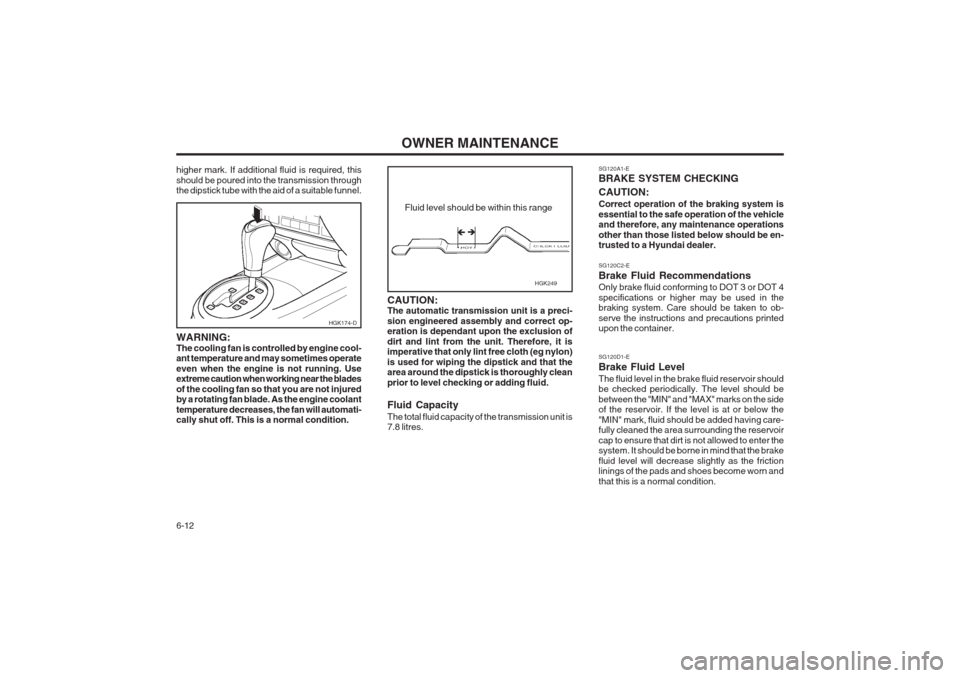
higher mark. If additional fluid is required, thisshould be poured into the transmission through the dipstick tube with the aid of a suitable funnel. WARNING: The cooling fan is controlled by engine cool- ant temperature and may sometimes operate even when the engine is not running. Use extreme caution when working near the blades of the cooling fan so that you are not injured by a rotating fan blade. As the engine coolant temperature decreases, the fan will automati- cally shut off. This is a normal condition.
CAUTION:The automatic transmission unit is a preci- sion engineered assembly and correct op- eration is dependant upon the exclusion of dirt and lint from the unit. Therefore, it is imperative that only lint free cloth (eg nylon) is used for wiping the dipstick and that the area around the dipstick is thoroughly clean prior to level checking or adding fluid. Fluid Capacity The total fluid capacity of the transmission unit is 7.8 litres.
HGK174-D
Fluid level should be within this range
HGK249
ÎÎ
Page 122 of 140
OWNER MAINTENANCE 6-17
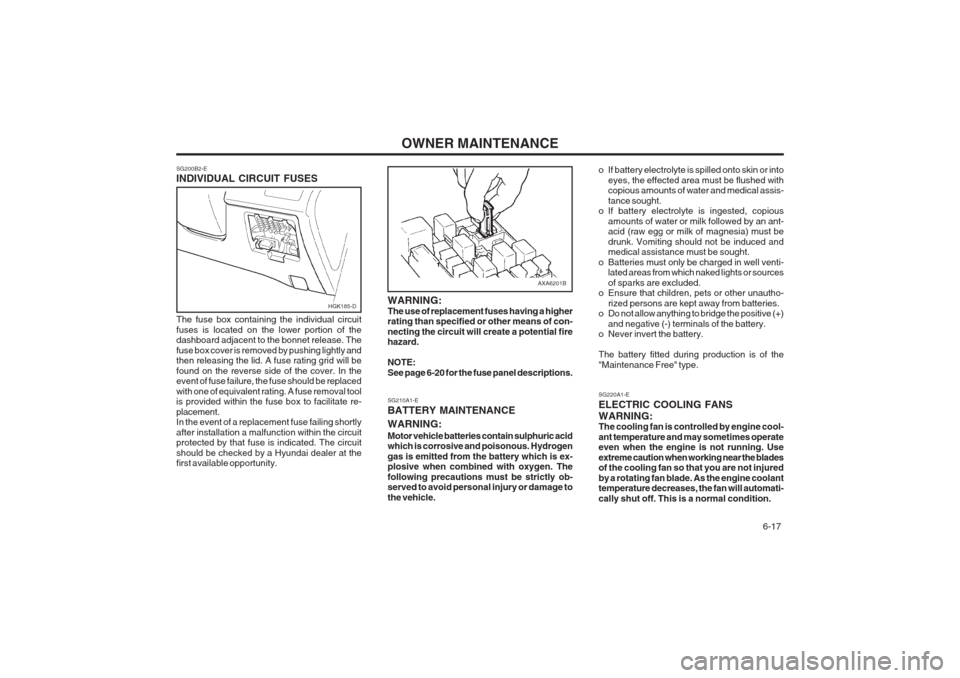
SG200B2-E INDIVIDUAL CIRCUIT FUSES The fuse box containing the individual circuit fuses is located on the lower portion of the dashboard adjacent to the bonnet release. The fuse box cover is removed by pushing lightly and then releasing the lid. A fuse rating grid will be found on the reverse side of the cover. In the event of fuse failure, the fuse should be replaced with one of equivalent rating. A fuse removal tool is provided within the fuse box to facilitate re- placement. In the event of a replacement fuse failing shortly after installation a malfunction within the circuit protected by that fuse is indicated. The circuit should be checked by a Hyundai dealer at the first available opportunity.
AXA6201B
WARNING: The use of replacement fuses having a higher rating than specified or other means of con- necting the circuit will create a potential fire hazard. NOTE: See page 6-20 for the fuse panel descriptions. SG210A1-E BATTERY MAINTENANCE WARNING: Motor vehicle batteries contain sulphuric acid which is corrosive and poisonous. Hydrogen gas is emitted from the battery which is ex- plosive when combined with oxygen. The following precautions must be strictly ob- served to avoid personal injury or damage to the vehicle.
HGK185-D
SG220A1-E ELECTRIC COOLING FANSWARNING: The cooling fan is controlled by engine cool- ant temperature and may sometimes operate even when the engine is not running. Use extreme caution when working near the blades of the cooling fan so that you are not injured by a rotating fan blade. As the engine coolant temperature decreases, the fan will automati- cally shut off. This is a normal condition.
o If battery electrolyte is spilled onto skin or into
eyes, the effected area must be flushed with copious amounts of water and medical assis- tance sought.
o If battery electrolyte is ingested, copious
amounts of water or milk followed by an ant- acid (raw egg or milk of magnesia) must be drunk. Vomiting should not be induced and medical assistance must be sought.
o Batteries must only be charged in well venti- lated areas from which naked lights or sources of sparks are excluded.
o Ensure that children, pets or other unautho-
rized persons are kept away from batteries.
o Do not allow anything to bridge the positive (+)
and negative (-) terminals of the battery.
o Never invert the battery. The battery fitted during production is of the "Maintenance Free" type.