fuel Hyundai Coupe 2002 Owner's Manual
[x] Cancel search | Manufacturer: HYUNDAI, Model Year: 2002, Model line: Coupe, Model: Hyundai Coupe 2002Pages: 140, PDF Size: 1.45 MB
Page 4 of 140

SA030A1-EFOREWORD
Hyundai Motor Company wish to take this opportunity to thank you for purchasing a Hyundai product and to welcome you to the ever increasing number of discriminating motorists who drive Hyundai vehicles. The advanced engineeringand construction methods employed during both design and production of the Hyundai marque are something ofwhich we are proud, and this commitment to providing a high quality product is supported by a comprehensive aftersales and warranty service of which we are equally proud. This owners manual will introduce the operating and maintenance requirements for the vehicle and it is recommended that it is carefully read to ensure that the maximum performance and durability along with safe and satisfactory operationare obtained. The recommended routine maintenance servicing along with any running repairs that may be requiredshould be entrusted to a franchised Hyundai dealer to ensure that only the latest methods and genuine Hyundaireplacement parts are used for the continued reliability, safety and performance of the vehicle. Should any question or query exist regarding any aspect of your Hyundai please contact the nearest Hyundai dealer who will be only too pleased to assist wherever possible. Note: This owners manual should be considered as part of the vehicle and should be kept in the vehicle at all times for
ease of reference.In the event of the vehicle being sold please ensure that this manual is left in the vehicle for the reference of the new owner. CAUTION: Severe engine and transaxle damage may result from the use of poor quality fuels and lubricants that do not meet Hyundai specifications. You must always use high quality fuels and lubricants that meetthe specifications listed on Page 9-3 in the Vehicle Specifications section of the Owner's Manual. Copyright 2002 Hyundai Motor Company. All rights reserved. No part of this publication may be reproduced, stored in any retrieval system or transmitted in any form or by any means without the prior written permission of Hyundai MotorCompany.
Page 5 of 140
SA040A1-ECAUTION: MODIFICATIONS TO ORIGINAL VEHICLE SPECIFICATION
Modification to the original vehicle specification may invalidate the manufactur- ers warranty and may adversely affect the safety and durability of the vehicle.Components which are subject to modification or are added to the originalvehicle specification without the express approval of the manufacturer and resultin consequential loss or damage are not covered by the vehicle manufacturerswarranty.
SA050A1-E TWO WAY RADIO INSTALLATION
This vehicle is fitted with electronically controlled fuel injection or other micro processor controlled equipment. It is possible for incorrectly installed two way radio equipment including mobiletelephones to adversely affect these systems.Before radio equipment of this kind is installed, please contact your Hyundaidealer for recommendation regarding the suitability of the particular radioequipment concerned and the recommended method of installation and equip- ment location. Incorrectly installed or unsuitable equipment which gives rise to incorrect functioning of or damage to electronic vehicle components will not fallwithin the scope of the vehicle manufacturers warranty.
Page 9 of 140
CONTROLS AND EQUIPMENT1- 1
The use of leaded fuel in this vehicle will result in irreversible pollution of the catalyst element. Such pollution will prevent correct operation of the catalyst and give rise to increased operating temperatures leading to the catalyst element melting and restricting the exhaust flow along with an increase in exhaust emission levels. CAUTION: The vehicle warranty will not extend to dam- age arising from the use of incorrect fuels. Overseas Operation: When the vehicle is to be operated overseas, the vehicle operator should establish that a suitable fuel for satisfactory operation of the vehicle is available.
SB020A1-E RUNNING IN The longevity and performance of the vehicle are greatly affected by the care exercised during the first 1000 miles of motoring. Because of modern manufacturing techniques, rigid guidelines re- garding maximum road speeds have become unnecessary. However, certain precautions should be observed in order to obtain the best possible performance and useful life from the vehicle.
1) Do not race the engine without a load (i.e
revving the engine in neutral).
2) During the first 500 miles the maximum en- gine speed should be restricted to 3000 rpmand gradually increased thereafter.
3) Avoid prolonged constant speed operation.
The internal components of the engine will become more quickly run in if the operation speed is varied during the running in period.
4) Never allow the engine to labour. Use the
gearbox freely and avoid large throttle open- ings when the engine speed is below 1500 rpm.
5) Avoid rapid acceleration and maximum
throttle openings.
6) Avoid harsh braking during the first 100
miles of urban motoring or 1000 miles of motorway driving to allow the friction facings of the brake pads and shoes to bed against the discs and drums properly.
7) Avoid trailer towing during the running in period.
1. CONTROLS AND
EQUIPMENT
SB010E1-E PETROLS FOR CLEANER AIR To help contribute to cleaner air, Hyundai recom- mends that you use petrols treated with deter- gent additives, which help to prevent deposit formation in the engine. These petrols will help the engines run cleaner and the Emission Con- trol System performance.
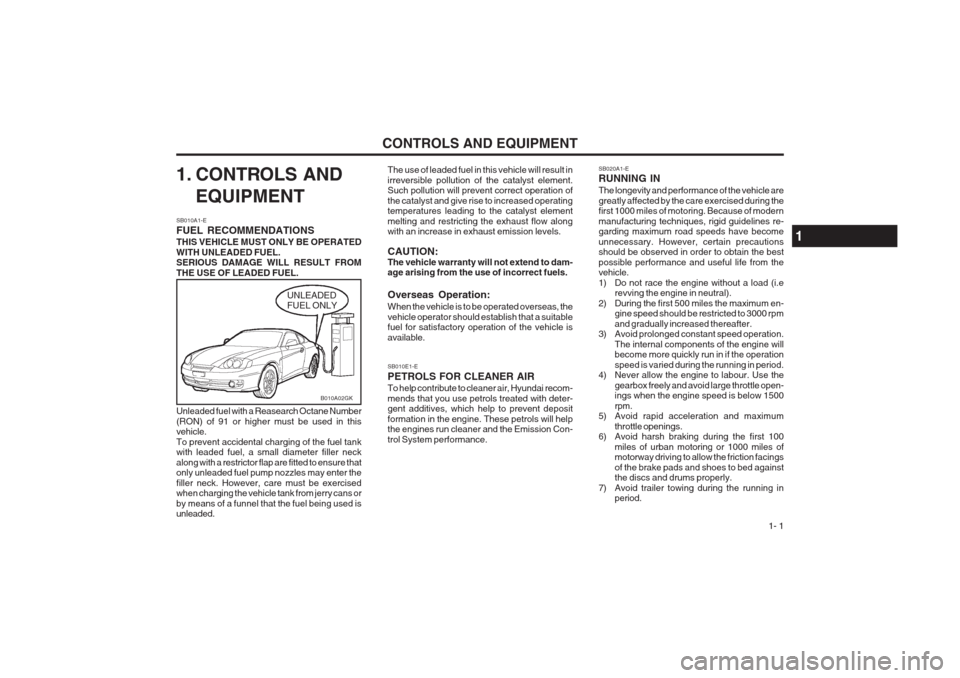
Unleaded fuel with a Reasearch Octane Number(RON) of 91 or higher must be used in this vehicle. To prevent accidental charging of the fuel tank with leaded fuel, a small diameter filler neck along with a restrictor flap are fitted to ensure that only unleaded fuel pump nozzles may enter the filler neck. However, care must be exercised when charging the vehicle tank from jerry cans or by means of a funnel that the fuel being used is unleaded.
SB010A1-E FUEL RECOMMENDATIONS THIS VEHICLE MUST ONLY BE OPERATED WITH UNLEADED FUEL. SERIOUS DAMAGE WILL RESULT FROM THE USE OF LEADED FUEL.
1
B010A02GK
UNLEADED FUEL ONLY
Page 33 of 140
CONTROLS AND EQUIPMENT1- 25
HGK026B
1
234 5 67 8
910 1112 13 14
151617 18 1920 21
2
2223
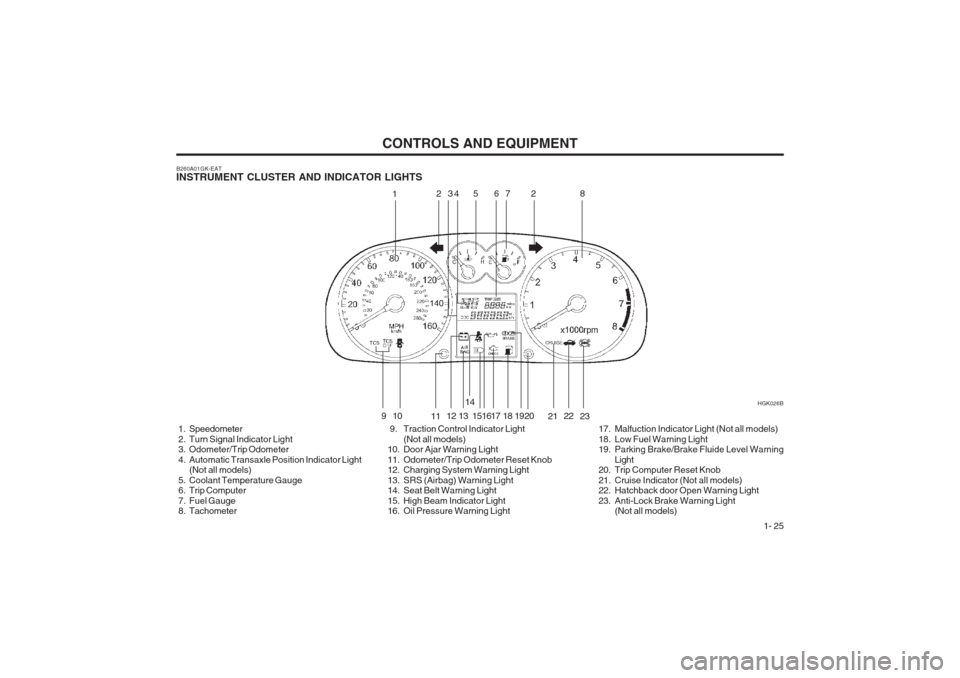
B260A01GK-EAT INSTRUMENT CLUSTER AND INDICATOR LIGHTS
1. Speedometer
2. Turn Signal Indicator Light
3. Odometer/Trip Odometer
4. Automatic Transaxle Position Indicator Light (Not all models)
5. Coolant Temperature Gauge
6. Trip Computer
7. Fuel Gauge
8. Tachometer 9. Traction Control Indicator Light
(Not all models)
10. Door Ajar Warning Light
11. Odometer/Trip Odometer Reset Knob
12. Charging System Warning Light
13. SRS (Airbag) Warning Light
14. Seat Belt Warning Light
15. High Beam Indicator Light
16. Oil Pressure Warning Light 17. Malfuction Indicator Light (Not all models)
18. Low Fuel Warning Light
19. Parking Brake/Brake Fluide Level Warning
Light
20. Trip Computer Reset Knob
21. Cruise Indicator (Not all models)
22. Hatchback door Open Warning Light
23. Anti-Lock Brake Warning Light (Not all models)
Page 35 of 140
CONTROLS AND EQUIPMENT1- 27
SB2100I-E
DOOR AJAR WARNING LAMP
The door ajar warning lamp indicates that a door is not correctly closed. Ensure that the lamp is extinguished prior to driving the vehicle.
SB210P1-E
LOW FUEL LEVEL WARNING LAMP
The low fuel warning lamp serves to warn the driver that the remaining fuel quantity is approxi- mately 9 litres and that the vehicle should be refuelled. If the vehicle is driven for an extended period with the low fuel warning lamp illuminated there exists a possibility that misfiring due to fuel
defective, approximately fifty per cent of thenormal braking performance will be available. If failure of one of the circuits occurs, the required amount of pedal effort, pedal travel and stopping distance will be increased. Use of the gearbox is recommended to assist in bringing the vehicle to rest. The vehicle must not be driven once brake failure has occurred until the system has been repaired and is functioning normally. The braking system employs a vacuum servo in order that the pedal efforts are reduced. Power for the servo is derived from the engine and therefore, in the event of the engine stopping or the vehicle being towed, pedal efforts will be substantially increased.
SB210M1-E CHARGING SYSTEM WARNING LAMP
The charging system warning lamp should illumi- nate when the ignition switch is turned to the "ON" position and should be extinguished when the engine is started. If the lamp fails to illuminate when the ignition is turned "ON" or fails to extin- guish after starting the engine, the nearest Hyundai dealer should be contacted. If the lamp illuminates whilst the vehicle is being driven, stop the vehicle as soon as it is safe to do so and check the condition of the generator drive belt. If the belt is in place and the tension is satisfactory, the advice of a Hyundai dealer should be sought.
B260H01GK-EAT PARKING BRAKE/BRAKE FLUID LEVEL WARNING LAMP
WARNING: In the event of problems being suspected with the braking system, the advice of the nearest Hyundai dealer must be sought be- fore the vehicle is driven. Driving the vehicle with either an electrical or hydraulic braking system defect may be dangerous, resulting in accident or personal injury. Warning lamp operation The parking brake/brake fluid level warning lamp will be illuminated whenever the ignition switch is turned to the "ON" or "START" position when the parking brake is applied and must be extin- guished in a three seconds after the engine starts. If the warning lamp fails to extinguish or illumi- nates at any other time, the vehicle must be brought to rest in a safe location and the level of brake fluid in the reservoir checked. If the fluid level is incorrect, fluid conforming to DOT 3 or DOT 4 specifications should be added. If, after correcting the brake fluid level, the warning lamp continues to be illuminated, the advice of the nearest Hyundai dealer must be sought before the vehicle is driven again. The Hyundai Lantra is equipped with a diagonally split dual braking system which will ensure that in the event of one of the brake circuits becoming SB210N2-E
HATCHBACK DOOR OPEN WARNING LAMP
The hatchback door warning lamp indicates when the hatchback door is open or is not fully closed. Ensure that the lamp has extinguished prior to driving the vehicle.CAUTION: If the drive belt (generator belt) is loosen, broken, or missing while the vehicle is driv- ing, there may be a serious malfunction, en- gine could overheat because this belt also drives the water pump.
Page 36 of 140
CONTROLS AND EQUIPMENT
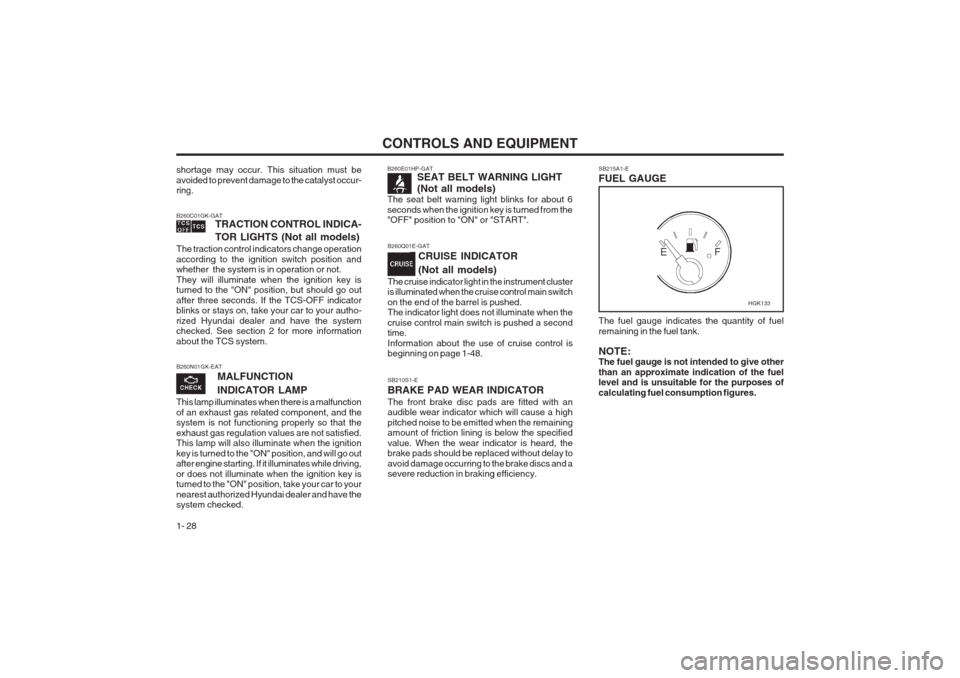
1- 28 SB210S1-E BRAKE PAD WEAR INDICATORThe front brake disc pads are fitted with an audible wear indicator which will cause a high pitched noise to be emitted when the remaining amount of friction lining is below the specified value. When the wear indicator is heard, the brake pads should be replaced without delay to avoid damage occurring to the brake discs and a severe reduction in braking efficiency.SB215A1-E FUEL GAUGE The fuel gauge indicates the quantity of fuel remaining in the fuel tank. NOTE: The fuel gauge is not intended to give other than an approximate indication of the fuel level and is unsuitable for the purposes of calculating fuel consumption figures.
B260N01GK-EAT
MALFUNCTION INDICATOR LAMP
This lamp illuminates when there is a malfunction of an exhaust gas related component, and the system is not functioning properly so that the exhaust gas regulation values are not satisfied. This lamp will also illuminate when the ignition
key is turned to the "ON" position, and will go out after engine starting. If it illuminates while driving, or does not illuminate when the ignition key is turned to the "ON" position, take your car to your nearest authorized Hyundai dealer and have the system checked.
shortage may occur. This situation must be avoided to prevent damage to the catalyst occur- ring. B260C01GK-GAT TRACTION CONTROL INDICA-
TOR LIGHTS (Not all models)
The traction control indicators change operation according to the ignition switch position and whether the system is in operation or not. They will illuminate when the ignition key is turned to the "ON" position, but should go out after three seconds. If the TCS-OFF indicator blinks or stays on, take your car to your autho- rized Hyundai dealer and have the system checked. See section 2 for more information about the TCS system.B260E01HP-GAT SEAT BELT WARNING LIGHT (Not all models)
The seat belt warning light blinks for about 6 seconds when the ignition key is turned from the "OFF" position to "ON" or "START".
B260Q01E-GAT
CRUISE INDICATOR (Not all models)
The cruise indicator light in the instrument cluster is illuminated when the cruise control main switch on the end of the barrel is pushed. The indicator light does not illuminate when the cruise control main switch is pushed a second time. Information about the use of cruise control is beginning on page 1-48.
HGK133
Page 39 of 140
CONTROLS AND EQUIPMENT1- 31
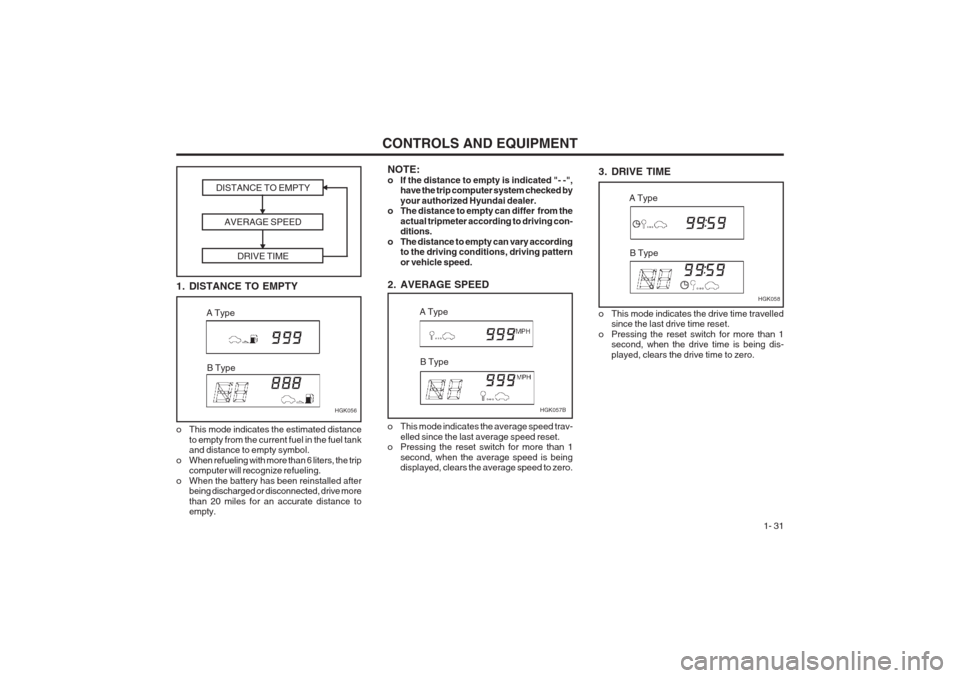
3. DRIVE TIME
HGK058
A Type
B Type
NOTE:
o If the distance to empty is indicated "- -", have the trip computer system checked byyour authorized Hyundai dealer.
o The distance to empty can differ from the
actual tripmeter according to driving con- ditions.
o The distance to empty can vary according to the driving conditions, driving pattern or vehicle speed.
2. AVERAGE SPEED
o This mode indicates the average speed trav- elled since the last average speed reset.
o Pressing the reset switch for more than 1
second, when the average speed is being displayed, clears the average speed to zero. HGK057B
A Type
B Type
1. DISTANCE TO EMPTY DISTANCE TO EMPTY
AVERAGE SPEED DRIVE TIME
o This mode indicates the estimated distanceto empty from the current fuel in the fuel tank and distance to empty symbol.
o When refueling with more than 6 liters, the trip computer will recognize refueling.
o When the battery has been reinstalled after being discharged or disconnected, drive more than 20 miles for an accurate distance to empty. HGK056
A Type
B Type
o This mode indicates the drive time travelled since the last drive time reset.
o Pressing the reset switch for more than 1 second, when the drive time is being dis- played, clears the drive time to zero.
Page 40 of 140
CONTROLS AND EQUIPMENT
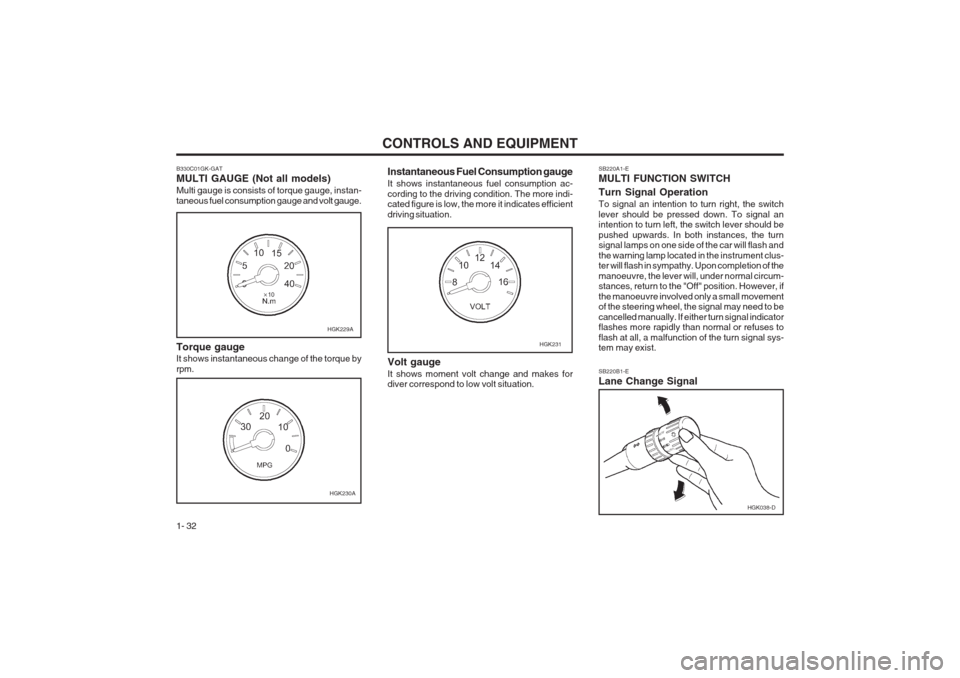
1- 32 Instantaneous Fuel Consumption gauge It shows instantaneous fuel consumption ac- cording to the driving condition. The more indi- cated figure is low, the more it indicates efficient driving situation. Volt gauge It shows moment volt change and makes for diver correspond to low volt situation.
HGK231
B330C01GK-GAT MULTI GAUGE (Not all models) Multi gauge is consists of torque gauge, instan- taneous fuel consumption gauge and volt gauge. Torque gauge It shows instantaneous change of the torque by rpm.
HGK229A
HGK230A
SB220A1-E MULTI FUNCTION SWITCH Turn Signal Operation To signal an intention to turn right, the switch lever should be pressed down. To signal an intention to turn left, the switch lever should be pushed upwards. In both instances, the turn signal lamps on one side of the car will flash and the warning lamp located in the instrument clus- ter will flash in sympathy. Upon completion of the manoeuvre, the lever will, under normal circum- stances, return to the "Off" position. However, if the manoeuvre involved only a small movement of the steering wheel, the signal may need to be cancelled manually. If either turn signal indicator flashes more rapidly than normal or refuses to flash at all, a malfunction of the turn signal sys- tem may exist. SB220B1-E Lane Change Signal
HGK038-D
Page 53 of 140
CONTROLS AND EQUIPMENT1- 45
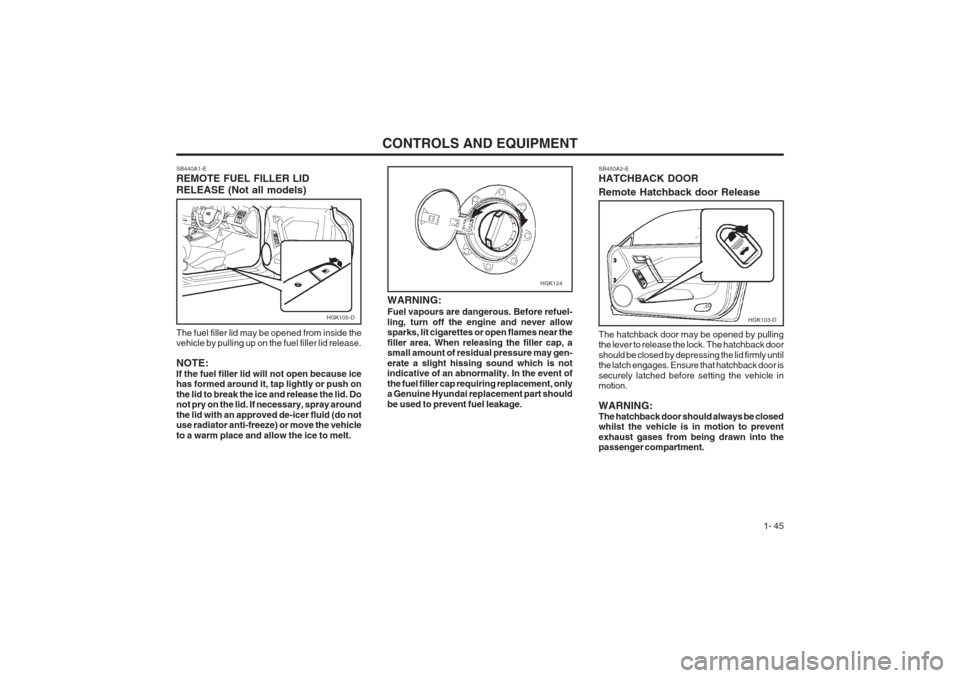
SB450A2-E HATCHBACK DOOR Remote Hatchback door Release The hatchback door may be opened by pulling the lever to release the lock. The hatchback door should be closed by depressing the lid firmly until the latch engages. Ensure that hatchback door is securely latched before setting the vehicle in motion. WARNING: The hatchback door should always be closed whilst the vehicle is in motion to prevent exhaust gases from being drawn into the passenger compartment.
HGK103-D
SB440A1-E REMOTE FUEL FILLER LID RELEASE (Not all models) The fuel filler lid may be opened from inside the vehicle by pulling up on the fuel filler lid release. NOTE: If the fuel filler lid will not open because ice has formed around it, tap lightly or push on the lid to break the ice and release the lid. Do not pry on the lid. If necessary, spray around the lid with an approved de-icer fluid (do not use radiator anti-freeze) or move the vehicle to a warm place and allow the ice to melt.
HGK105-D
HGK124
WARNING: Fuel vapours are dangerous. Before refuel- ling, turn off the engine and never allow sparks, lit cigarettes or open flames near the filler area. When releasing the filler cap, a small amount of residual pressure may gen- erate a slight hissing sound which is not indicative of an abnormality. In the event of the fuel filler cap requiring replacement, only a Genuine Hyundai replacement part should be used to prevent fuel leakage.
Page 76 of 140
DRIVING YOUR HYUNDAI
2- 2
SC030A1-E BEFORE STARTING THE ENGINEBefore you start the engine, you should always:
1. Look around the vehicle to be sure there are
no flat tires, puddles of oil or water or otherindications of possible trouble.
2. After entering the car, check to be sure the parking brake is engaged.
3. Check that all windows, and lights are clean.
4. Check that the interior and exterior mirrors are clean and in position.
5. Check your seat, seatback and head re- straint to be sure they are in their proper positions.
6. Lock all the doors.
7. Fasten your seat belt and be sure that all other occupants have fastened theirs.
8. Turn off all lights and accessories that are
not needed.
9. When you turn the ignition switch to "ON' check that all appropriate warning lights areoperating and that you have sufficient fuel.
10.Check the operation of warning lights and all bulbs when key is in the "ON" position. o To start the engine, insert the ignition key
and turn it to the "START" position. Release it as soon as the engine starts. Do not hold the key in the "START" position for more that 15 seconds.
NOTE: For safety, the engine will not start if the shift lever is not in "P" or "N" Position (Auto T/A).
SC040A1-F COMBINATION IGNITION SWITCH AND STEERING LOCK To Start the Engine
o If your Hyundai is equipped with a manual transaxle, place the shift lever in neutral and depress the clutch pedal fully.
o If your Hyundai has an automatic transaxle, place the shift lever in "P" (park). SC050A2-E
KEY POSITIONS WARNING:
The engine must never be turned off and the
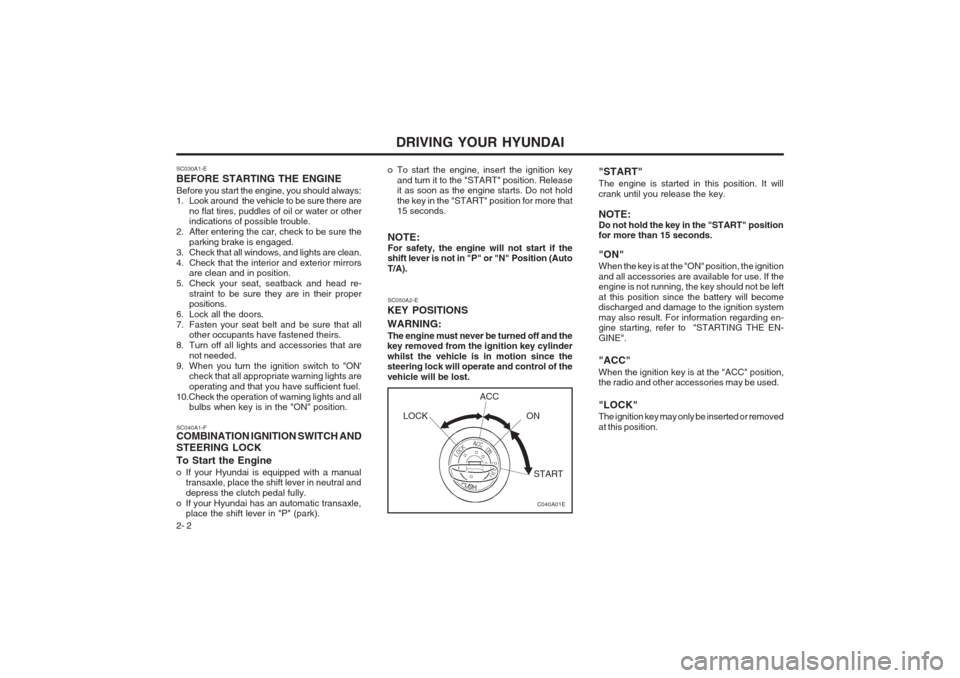
key removed from the ignition key cylinder whilst the vehicle is in motion since the steering lock will operate and control of the vehicle will be lost. "START" The engine is started in this position. It will crank until you release the key. NOTE: Do not hold the key in the "START" position for more than 15 seconds. "ON" When the key is at the "ON" position, the ignition and all accessories are available for use. If the engine is not running, the key should not be left at this position since the battery will become discharged and damage to the ignition system may also result. For information regarding en- gine starting, refer to "STARTING THE EN- GINE". "ACC" When the ignition key is at the "ACC" position, the radio and other accessories may be used. "LOCK" The ignition key may only be inserted or removed at this position.
C040A01E
LOCK
ACC
ON
START