lock Hyundai Coupe 2002 Owner's Guide
[x] Cancel search | Manufacturer: HYUNDAI, Model Year: 2002, Model line: Coupe, Model: Hyundai Coupe 2002Pages: 140, PDF Size: 1.45 MB
Page 48 of 140
CONTROLS AND EQUIPMENT
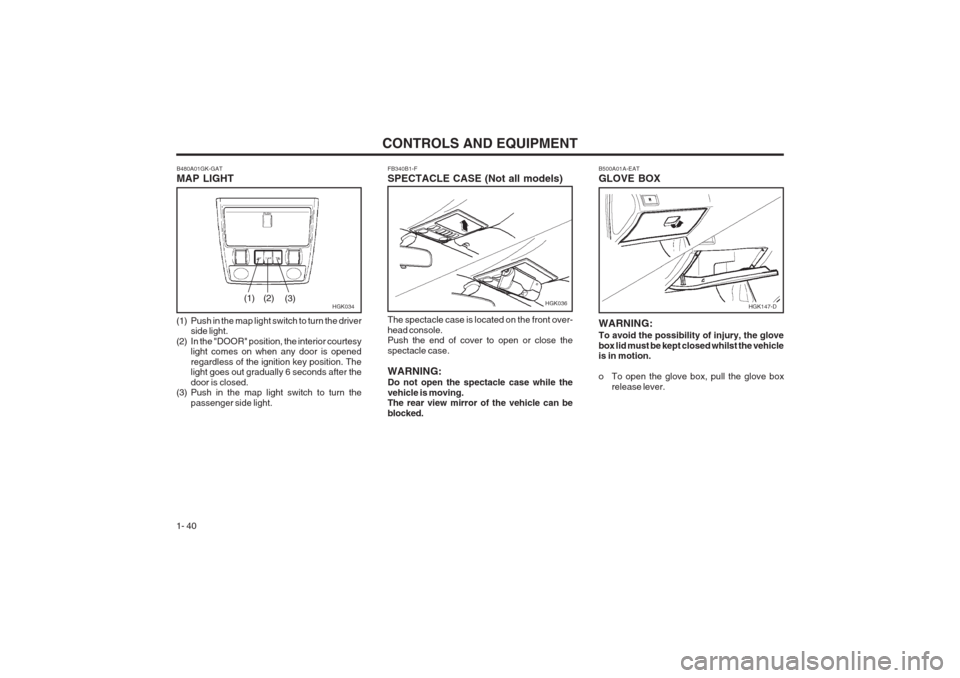
1- 40 FB340B1-F SPECTACLE CASE (Not all models) The spectacle case is located on the front over- head console. Push the end of cover to open or close the spectacle case. WARNING: Do not open the spectacle case while the vehicle is moving. The rear view mirror of the vehicle can be blocked.
B480A01GK-GAT MAP LIGHT
HGK034
(1) Push in the map light switch to turn the driver side light.
(2) In the "DOOR" position, the interior courtesy light comes on when any door is opened regardless of the ignition key position. The light goes out gradually 6 seconds after the door is closed.
(3) Push in the map light switch to turn the
passenger side light.(1) (2) (3)HGK036
B500A01A-EAT GLOVE BOX
WARNING: To avoid the possibility of injury, the glove box lid must be kept closed whilst the vehicle is in motion.
o To open the glove box, pull the glove box
release lever.
HGK147-D
Page 52 of 140
CONTROLS AND EQUIPMENT
1- 44
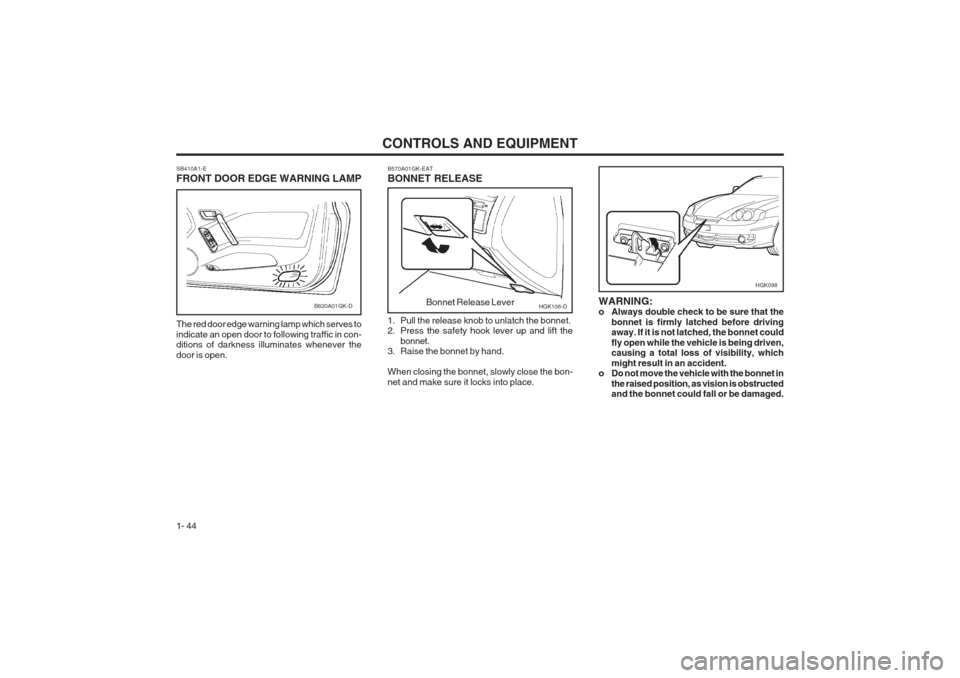
SB410A1-E FRONT DOOR EDGE WARNING LAMP The red door edge warning lamp which serves to indicate an open door to following traffic in con- ditions of darkness illuminates whenever the door is open.
B620A01GK-DWARNING:
o Always double check to be sure that the
bonnet is firmly latched before drivingaway. If it is not latched, the bonnet could fly open while the vehicle is being driven, causing a total loss of visibility, which might result in an accident.
o Do not move the vehicle with the bonnet in
the raised position, as vision is obstructed and the bonnet could fall or be damaged.
B570A01GK-EAT BONNET RELEASE
1. Pull the release knob to unlatch the bonnet.
2. Press the safety hook lever up and lift the
bonnet.
3. Raise the bonnet by hand. When closing the bonnet, slowly close the bon- net and make sure it locks into place.HGK106-DBonnet Release Lever
HGK098
Page 53 of 140
CONTROLS AND EQUIPMENT1- 45
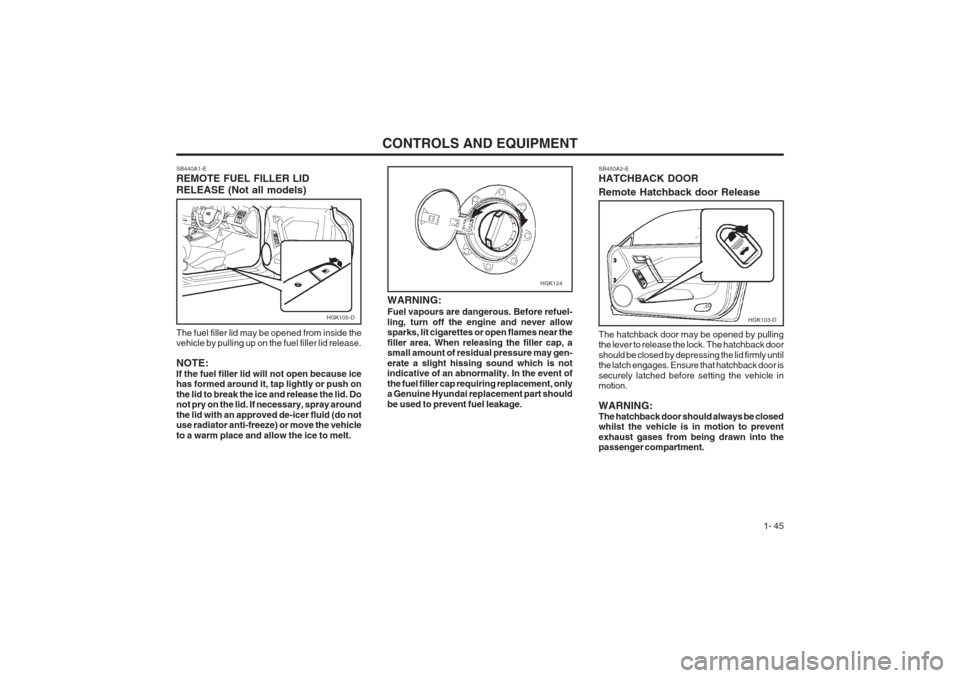
SB450A2-E HATCHBACK DOOR Remote Hatchback door Release The hatchback door may be opened by pulling the lever to release the lock. The hatchback door should be closed by depressing the lid firmly until the latch engages. Ensure that hatchback door is securely latched before setting the vehicle in motion. WARNING: The hatchback door should always be closed whilst the vehicle is in motion to prevent exhaust gases from being drawn into the passenger compartment.
HGK103-D
SB440A1-E REMOTE FUEL FILLER LID RELEASE (Not all models) The fuel filler lid may be opened from inside the vehicle by pulling up on the fuel filler lid release. NOTE: If the fuel filler lid will not open because ice has formed around it, tap lightly or push on the lid to break the ice and release the lid. Do not pry on the lid. If necessary, spray around the lid with an approved de-icer fluid (do not use radiator anti-freeze) or move the vehicle to a warm place and allow the ice to melt.
HGK105-D
HGK124
WARNING: Fuel vapours are dangerous. Before refuel- ling, turn off the engine and never allow sparks, lit cigarettes or open flames near the filler area. When releasing the filler cap, a small amount of residual pressure may gen- erate a slight hissing sound which is not indicative of an abnormality. In the event of the fuel filler cap requiring replacement, only a Genuine Hyundai replacement part should be used to prevent fuel leakage.
Page 54 of 140
CONTROLS AND EQUIPMENT
1- 46
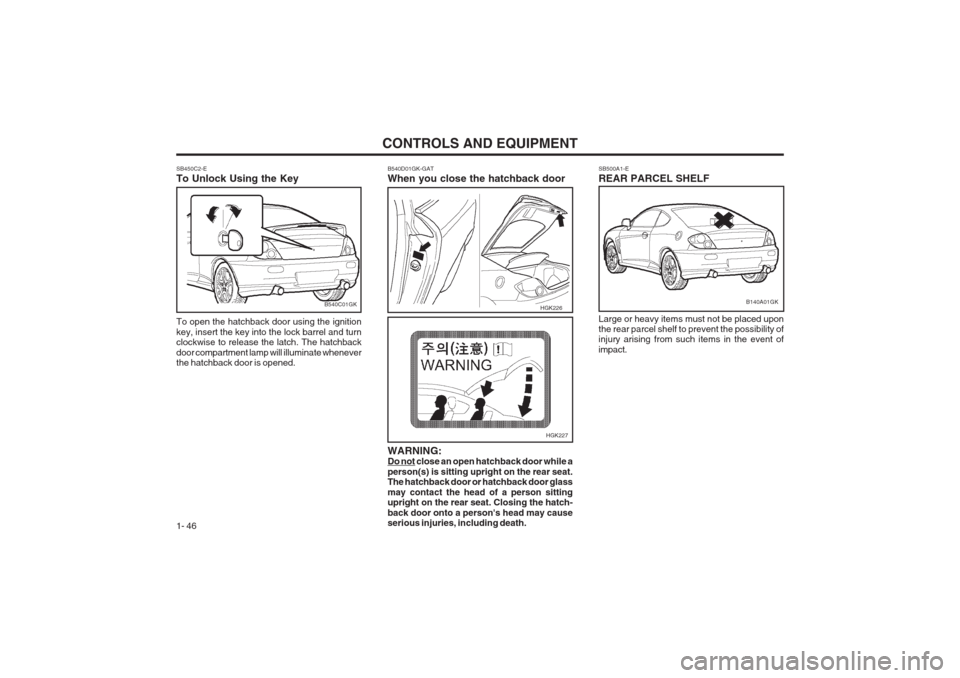
SB450C2-E To Unlock Using the Key To open the hatchback door using the ignition key, insert the key into the lock barrel and turn clockwise to release the latch. The hatchback door compartment lamp will illuminate whenever the hatchback door is opened.
SB500A1-E REAR PARCEL SHELF Large or heavy items must not be placed upon the rear parcel shelf to prevent the possibility ofinjury arising from such items in the event of impact.
B540C01GK
B540D01GK-GAT
When you close the hatchback door
HGK226
HGK227
WARNING:
Do not close an open hatchback door while a person(s) is sitting upright on the rear seat. The hatchback door or hatchback door glass may contact the head of a person sitting upright on the rear seat. Closing the hatch- back door onto a person's head may cause serious injuries, including death.
B140A01GK
Page 55 of 140
CONTROLS AND EQUIPMENT1- 47
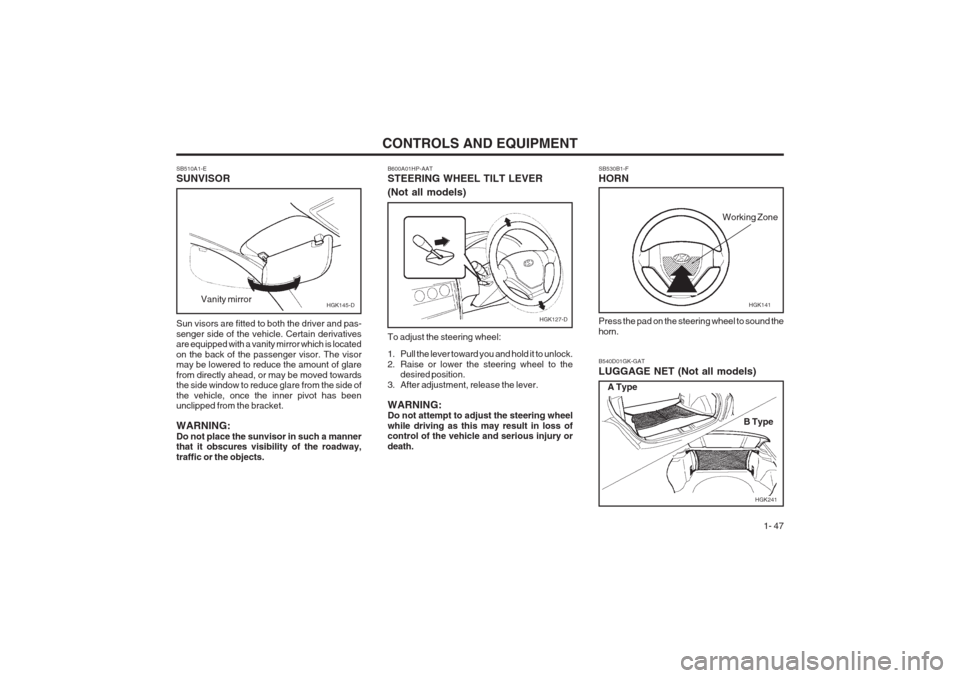
SB530B1-F HORN Press the pad on the steering wheel to sound the horn.
HGK141
Working Zone
B540D01GK-GAT LUGGAGE NET (Not all models)
HGK241
A Type
B Type
SB510A1-E SUNVISOR Sun visors are fitted to both the driver and pas- senger side of the vehicle. Certain derivatives are equipped with a vanity mirror which is located on the back of the passenger visor. The visor may be lowered to reduce the amount of glare from directly ahead, or may be moved towards the side window to reduce glare from the side of the vehicle, once the inner pivot has been unclipped from the bracket. WARNING: Do not place the sunvisor in such a manner that it obscures visibility of the roadway, traffic or the objects.
Vanity mirror
HGK145-D
B600A01HP-AAT STEERING WHEEL TILT LEVER (Not all models) To adjust the steering wheel:
1. Pull the lever toward you and hold it to unlock.
2. Raise or lower the steering wheel to the
desired position.
3. After adjustment, release the lever. WARNING: Do not attempt to adjust the steering wheel while driving as this may result in loss of control of the vehicle and serious injury or death.
HGK127-D
Page 63 of 140
CONTROLS AND EQUIPMENT1- 55
B730A01FC-EAT Operation Tips
o To keep dust or unpleasant fumes from enter-
ing the car through the ventilation system, temporarily set the air intake control at "Recir- culation". Be sure to return the control to "Fresh" when the irritation has passed to keep fresh air in the vehicle. This will helpkeep the driver alert and comfortable.
o Air for the heating/cooling system is drawn in through the grilles just ahead of the wind- screen. Care should be taken that these are not blocked by leaves, snow, ice or other obstructions.
o To prevent interior fog on the windscreen, set
the air intake control to the fresh air ( ) position and fan speed to the desi-red posi- tion.
NOTE:When the A/C is operated continuously on the floor-defrost level (
) or defrost level
(), it may cause fog to form on the exterior
windscreen by the temperature differential. At this time set the air flow control to the face level position (
)and fan speed control to the
low position.
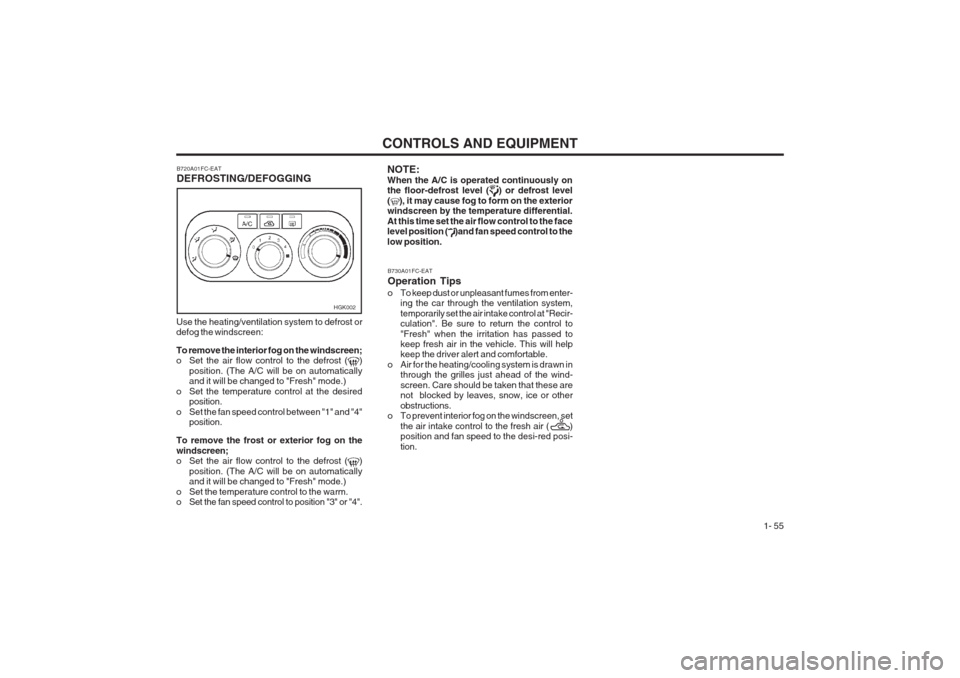
Use the heating/ventilation system to defrost or defog the windscreen: To remove the interior fog on the windscreen;
o Set the air flow control to the defrost (
)
position. (The A/C will be on automatically and it will be changed to "Fresh" mode.)
o Set the temperature control at the desired position.
o Set the fan speed control between "1" and "4" position.
To remove the frost or exterior fog on the windscreen;
o Set the air flow control to the defrost (
)
position. (The A/C will be on automatically and it will be changed to "Fresh" mode.)
o Set the temperature control to the warm.
o Set the fan speed control to position "3" or "4". B720A01FC-EAT DEFROSTING/DEFOGGING
HGK002
Page 71 of 140
CONTROLS AND EQUIPMENT1- 63
SSAR014AB750B02Y-AAT Using a cellular phone or a two-way radio When a cellular phone is used inside the vehicle, noise may be produced from the audio equip- ment. This does not mean that something is wrong with the audio equipment. In such a case, use the cellular phone at a place as far as possible from the audio equipment. CAUTION: When using a communication system such a cellular phone or a radio set inside the vehi- cle, a separate external antenna must be fitted. When a cellular phone or a radio set is used by using an internal antenna alone, it may interfere with the vehicle's electrical sys- tem and adversely affect safe operation of the vehicle. WARNING: Don't use a cellular phone when you are driving, you must stop at a safe place to use a cellular phone.SSAR013A
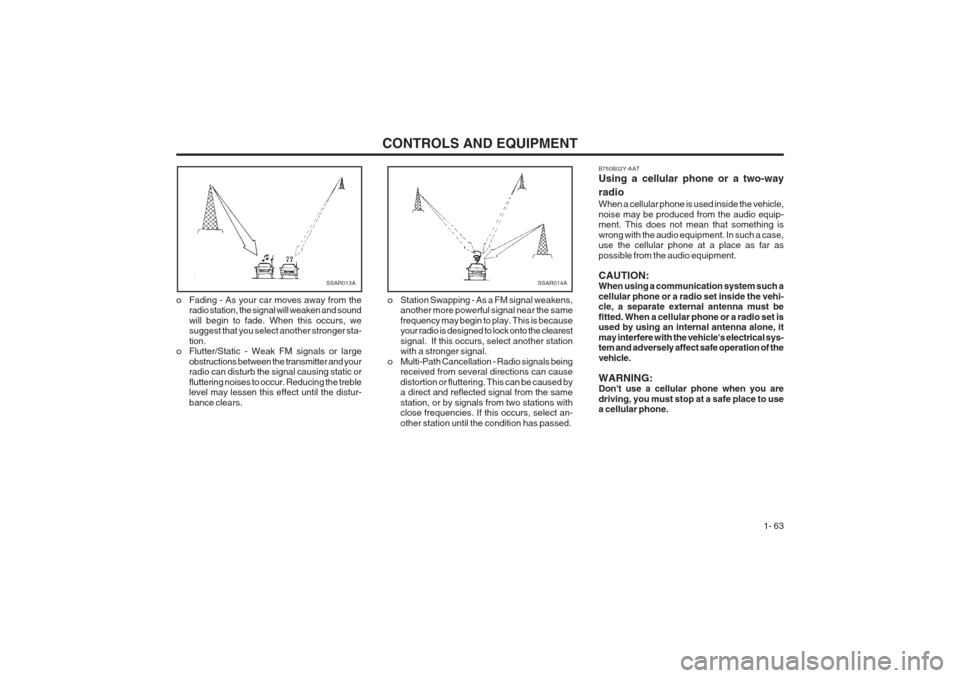
o Station Swapping - As a FM signal weakens,another more powerful signal near the same frequency may begin to play. This is because your radio is designed to lock onto the clearest signal. If this occurs, select another station with a stronger signal.
o Multi-Path Cancellation - Radio signals being received from several directions can cause distortion or fluttering. This can be caused by a direct and reflected signal from the same station, or by signals from two stations with close frequencies. If this occurs, select an- other station until the condition has passed.
o Fading - As your car moves away from the
radio station, the signal will weaken and soundwill begin to fade. When this occurs, we suggest that you select another stronger sta- tion.
o Flutter/Static - Weak FM signals or large
obstructions between the transmitter and your radio can disturb the signal causing static or fluttering noises to occur. Reducing the treble level may lessen this effect until the distur- bance clears.
Page 74 of 140
CONTROLS AND EQUIPMENT
1- 66
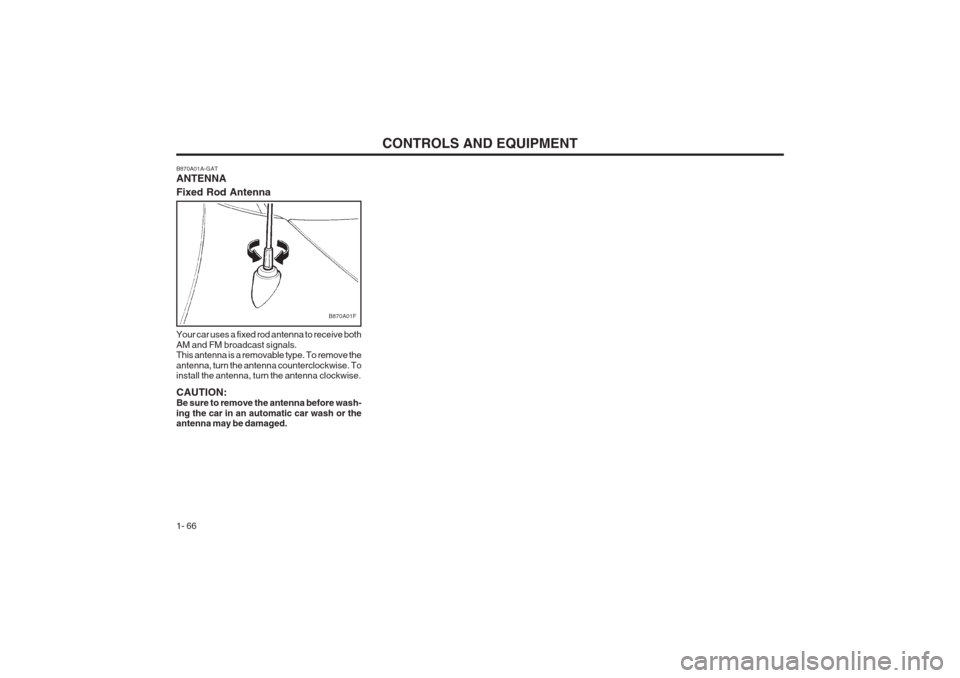
B870A01A-GAT ANTENNA Fixed Rod Antenna Your car uses a fixed rod antenna to receive both AM and FM broadcast signals. This antenna is a removable type. To remove the antenna, turn the antenna counterclockwise. To install the antenna, turn the antenna clockwise. CAUTION: Be sure to remove the antenna before wash- ing the car in an automatic car wash or the antenna may be damaged.
B870A01F
Page 76 of 140
DRIVING YOUR HYUNDAI
2- 2
SC030A1-E BEFORE STARTING THE ENGINEBefore you start the engine, you should always:
1. Look around the vehicle to be sure there are
no flat tires, puddles of oil or water or otherindications of possible trouble.
2. After entering the car, check to be sure the parking brake is engaged.
3. Check that all windows, and lights are clean.
4. Check that the interior and exterior mirrors are clean and in position.
5. Check your seat, seatback and head re- straint to be sure they are in their proper positions.
6. Lock all the doors.
7. Fasten your seat belt and be sure that all other occupants have fastened theirs.
8. Turn off all lights and accessories that are
not needed.
9. When you turn the ignition switch to "ON' check that all appropriate warning lights areoperating and that you have sufficient fuel.
10.Check the operation of warning lights and all bulbs when key is in the "ON" position. o To start the engine, insert the ignition key
and turn it to the "START" position. Release it as soon as the engine starts. Do not hold the key in the "START" position for more that 15 seconds.
NOTE: For safety, the engine will not start if the shift lever is not in "P" or "N" Position (Auto T/A).
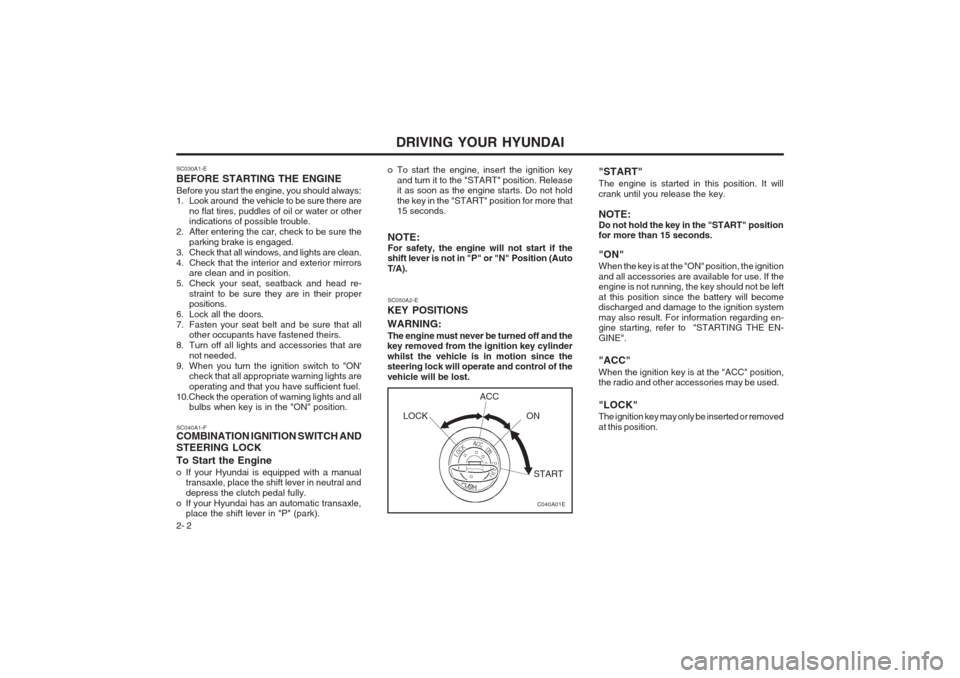
SC040A1-F COMBINATION IGNITION SWITCH AND STEERING LOCK To Start the Engine
o If your Hyundai is equipped with a manual transaxle, place the shift lever in neutral and depress the clutch pedal fully.
o If your Hyundai has an automatic transaxle, place the shift lever in "P" (park). SC050A2-E
KEY POSITIONS WARNING:
The engine must never be turned off and the
key removed from the ignition key cylinder whilst the vehicle is in motion since the steering lock will operate and control of the vehicle will be lost. "START" The engine is started in this position. It will crank until you release the key. NOTE: Do not hold the key in the "START" position for more than 15 seconds. "ON" When the key is at the "ON" position, the ignition and all accessories are available for use. If the engine is not running, the key should not be left at this position since the battery will become discharged and damage to the ignition system may also result. For information regarding en- gine starting, refer to "STARTING THE EN- GINE". "ACC" When the ignition key is at the "ACC" position, the radio and other accessories may be used. "LOCK" The ignition key may only be inserted or removed at this position.
C040A01E
LOCK
ACC
ON
START
Page 77 of 140
DRIVING YOUR HYUNDAI 2- 3
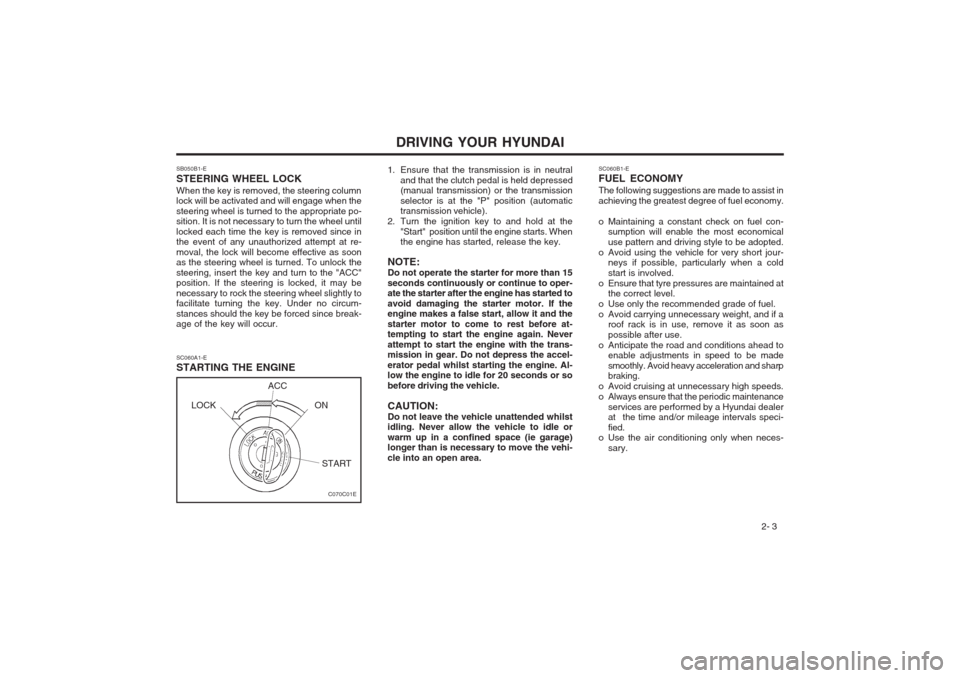
SB050B1-E STEERING WHEEL LOCKWhen the key is removed, the steering column lock will be activated and will engage when the steering wheel is turned to the appropriate po- sition. It is not necessary to turn the wheel until locked each time the key is removed since in the event of any unauthorized attempt at re- moval, the lock will become effective as soon as the steering wheel is turned. To unlock the steering, insert the key and turn to the "ACC" position. If the steering is locked, it may be necessary to rock the steering wheel slightly to facilitate turning the key. Under no circum- stances should the key be forced since break- age of the key will occur.
SC060B1-E FUEL ECONOMY The following suggestions are made to assist in achieving the greatest degree of fuel economy.
o Maintaining a constant check on fuel con-
sumption will enable the most economical use pattern and driving style to be adopted.
o Avoid using the vehicle for very short jour- neys if possible, particularly when a coldstart is involved.
o Ensure that tyre pressures are maintained at the correct level.
o Use only the recommended grade of fuel.
o Avoid carrying unnecessary weight, and if a roof rack is in use, remove it as soon aspossible after use.
o Anticipate the road and conditions ahead to enable adjustments in speed to be madesmoothly. Avoid heavy acceleration and sharp braking.
o Avoid cruising at unnecessary high speeds.
o Always ensure that the periodic maintenance services are performed by a Hyundai dealer
at the time and/or mileage intervals speci- fied.
o Use the air conditioning only when neces-
sary.
SC060A1-E STARTING THE ENGINE 1. Ensure that the transmission is in neutral
and that the clutch pedal is held depressed (manual transmission) or the transmission selector is at the "P" position (automatic transmission vehicle).
2. Turn the ignition key to and hold at the
"Start" position until the engine starts. Whenthe engine has started, release the key.
NOTE: Do not operate the starter for more than 15seconds continuously or continue to oper- ate the starter after the engine has started to avoid damaging the starter motor. If the engine makes a false start, allow it and the starter motor to come to rest before at- tempting to start the engine again. Never attempt to start the engine with the trans- mission in gear. Do not depress the accel- erator pedal whilst starting the engine. Al- low the engine to idle for 20 seconds or so before driving the vehicle. CAUTION: Do not leave the vehicle unattended whilst idling. Never allow the vehicle to idle or warm up in a confined space (ie garage) longer than is necessary to move the vehi- cle into an open area.
C070C01E
LOCK ACC
ON
START