lock Hyundai Coupe 2002 Service Manual
[x] Cancel search | Manufacturer: HYUNDAI, Model Year: 2002, Model line: Coupe, Model: Hyundai Coupe 2002Pages: 140, PDF Size: 1.45 MB
Page 111 of 140
OWNER MAINTENANCE
6-6 CAUTION: The oil being drained from the engine will be hot. Care should be exercised to prevent scalding.
4. When the oil has drained from the sump,
replace the drain plug using a new washer ensuring that the plug is not over tightened.
Tightening torque :
4.5 ~ 4.0 kgf.m (1.6/2.0L)4.5 ~ 3.5 kgf.m (2.7L)
5. Remove the oil filter by rotating counterclock- wise, using a proprietary oil filter removal toolif necessary. Note that the oil filter will contain approximately 0.5 litres of oil and this should be collected in a suitable receptacle.
6. Install a new oil filter having smeared the
sealing ring with clean oil and rotating clock- wise until the filter contacts the mounting and then a further one half turn. Do not over- tighten. Tightening torque: 1.2 ~ 1.6 kgf.m.
7. Pour the specified quantity of the recom- mended oil into the engine and replace the filler cap. Start the engine and ensure that no oil leaks exist. Turn off the engine and after a couple minutes, recheck the oil level.
WARNING: Prolonged and repeated contact with used engine oils may result in serious skin disor- ders including dermatitis and cancer. Avoid contact with skin as far as possible and al-
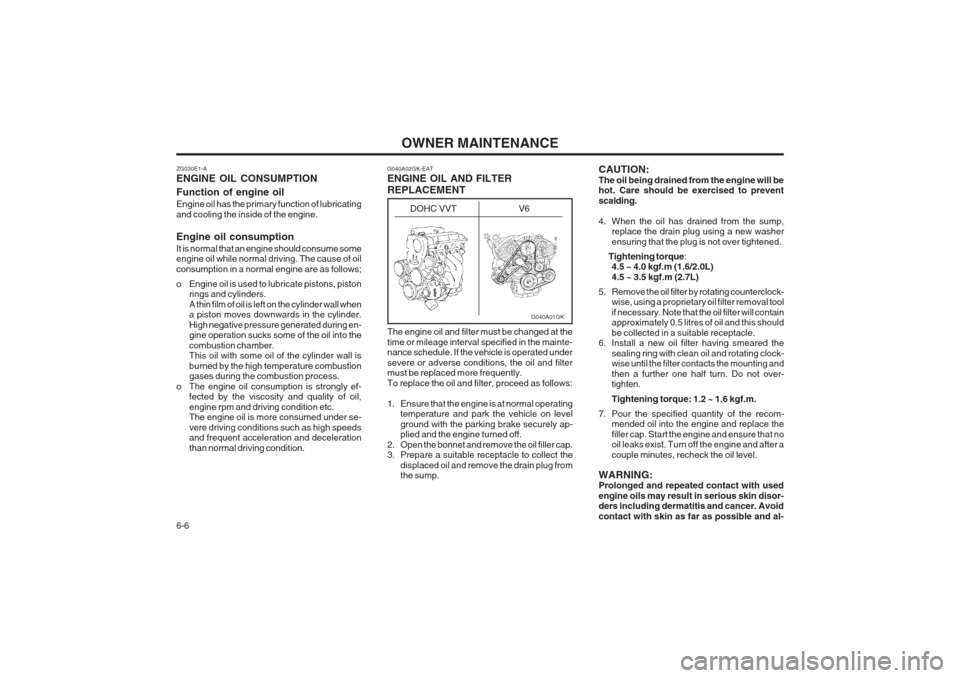
G040A02GK-EAT ENGINE OIL AND FILTER REPLACEMENT The engine oil and filter must be changed at the time or mileage interval specified in the mainte- nance schedule. If the vehicle is operated under severe or adverse conditions, the oil and filter must be replaced more frequently. To replace the oil and filter, proceed as follows:
1. Ensure that the engine is at normal operating
temperature and park the vehicle on level ground with the parking brake securely ap- plied and the engine turned off.
2. Open the bonnet and remove the oil filler cap.
3. Prepare a suitable receptacle to collect the displaced oil and remove the drain plug fromthe sump.
ZG030E1-A ENGINE OIL CONSUMPTION Function of engine oil Engine oil has the primary function of lubricating and cooling the inside of the engine. Engine oil consumption It is normal that an engine should consume some engine oil while normal driving. The cause of oil consumption in a normal engine are as follows;
o Engine oil is used to lubricate pistons, piston
rings and cylinders. A thin film of oil is left on the cylinder wall when a piston moves downwards in the cylinder. High negative pressure generated during en- gine operation sucks some of the oil into the combustion chamber. This oil with some oil of the cylinder wall is burned by the high temperature combustion gases during the combustion process.
o The engine oil consumption is strongly ef- fected by the viscosity and quality of oil, engine rpm and driving condition etc. The engine oil is more consumed under se- vere driving conditions such as high speeds and frequent acceleration and deceleration than normal driving condition.
G040A01GK
DOHC VVT V6
Page 113 of 140
OWNER MAINTENANCE
6-8 CAUTION: Sparking plugs must only be cleaned using purpose designed equipment. Wire brushing may damage the centre electrodeinsulator causing mis-firing to occur. Only the correct grade of sparking plug should be used. Use of an incorrect grade may result in serious engine damage.
3. With the heater temperature control set to the
"HOT" position, remove the radiator cap and open the radiator drain tap.
4. When the engine coolant has drained com- pletely, close the drain tap ensuring that this is not over tightened.
5. Prepare a suitable quantity of new engine
coolant (refer to section 9) and pour this into the radiator.
6. Start the engine with the radiator cap still removed and continue to add coolant as the level decreases as air is expelled from the system. When the level remains constant, replace the radiator cap and replenish the coolant reservoir.
7. When the engine is hot, check to ensure that no coolant leaks are present.
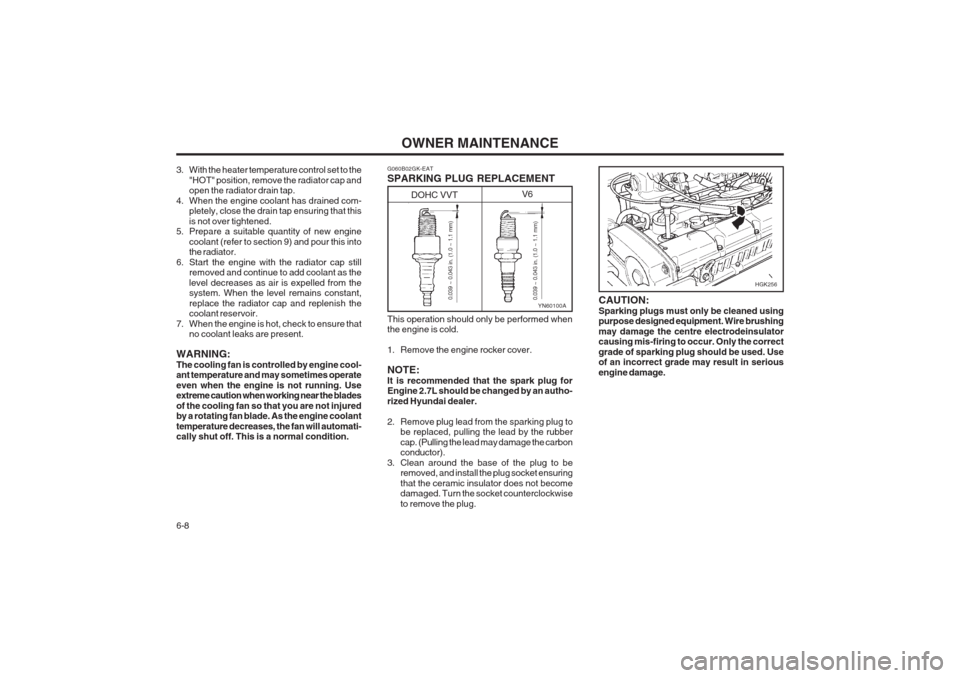
WARNING: The cooling fan is controlled by engine cool- ant temperature and may sometimes operate even when the engine is not running. Use extreme caution when working near the blades of the cooling fan so that you are not injured by a rotating fan blade. As the engine coolant temperature decreases, the fan will automati- cally shut off. This is a normal condition. G060B02GK-EAT SPARKING PLUG REPLACEMENT This operation should only be performed when the engine is cold.
1. Remove the engine rocker cover.NOTE: It is recommended that the spark plug for Engine 2.7L should be changed by an autho- rized Hyundai dealer.
2. Remove plug lead from the sparking plug to
be replaced, pulling the lead by the rubber cap. (Pulling the lead may damage the carbon conductor).
3. Clean around the base of the plug to be removed, and install the plug socket ensuring that the ceramic insulator does not become damaged. Turn the socket counterclockwise to remove the plug.
YN60100A0.039 ~ 0.043 in. (1.0 ~ 1.1 mm)
0.039 ~ 0.043 in. (1.0 ~ 1.1 mm)
DOHC VVT V6
HGK256
Page 118 of 140
OWNER MAINTENANCE 6-13
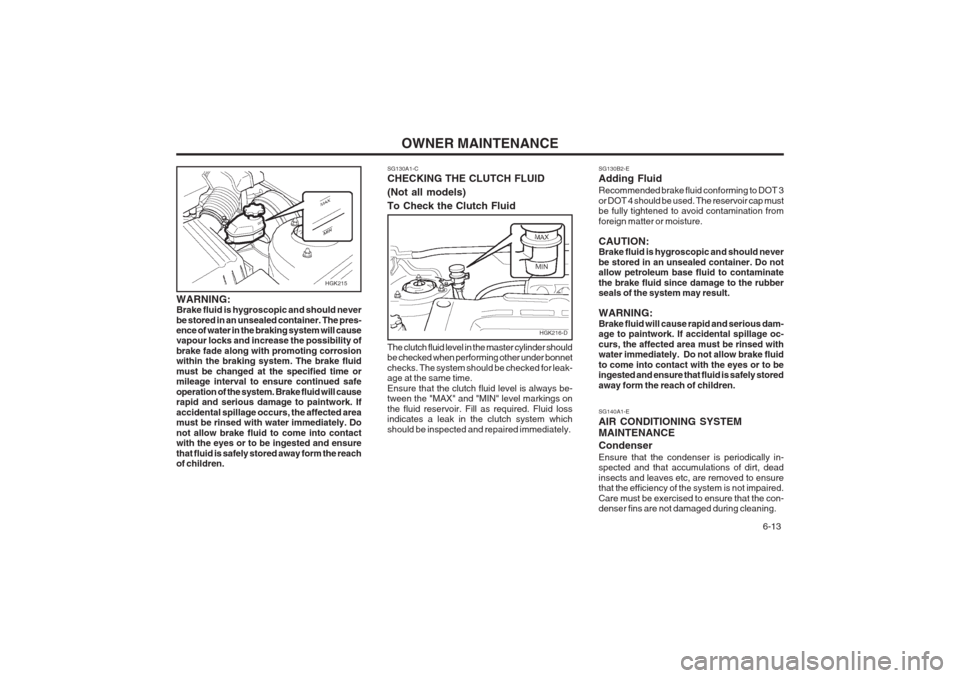
WARNING: Brake fluid is hygroscopic and should never be stored in an unsealed container. The pres- ence of water in the braking system will causevapour locks and increase the possibility of brake fade along with promoting corrosion within the braking system. The brake fluid must be changed at the specified time or mileage interval to ensure continued safe operation of the system. Brake fluid will cause rapid and serious damage to paintwork. If accidental spillage occurs, the affected area must be rinsed with water immediately. Do not allow brake fluid to come into contact with the eyes or to be ingested and ensure that fluid is safely stored away form the reach of children. SG130A1-C CHECKING THE CLUTCH FLUID (Not all models)To Check the Clutch Fluid The clutch fluid level in the master cylinder should be checked when performing other under bonnet checks. The system should be checked for leak- age at the same time. Ensure that the clutch fluid level is always be- tween the "MAX" and "MIN" level markings on the fluid reservoir. Fill as required. Fluid loss indicates a leak in the clutch system which should be inspected and repaired immediately.
SG130B2-E Adding Fluid Recommended brake fluid conforming to DOT 3 or DOT 4 should be used. The reservoir cap must be fully tightened to avoid contamination from foreign matter or moisture. CAUTION: Brake fluid is hygroscopic and should never be stored in an unsealed container. Do not allow petroleum base fluid to contaminate the brake fluid since damage to the rubber seals of the system may result. WARNING: Brake fluid will cause rapid and serious dam- age to paintwork. If accidental spillage oc- curs, the affected area must be rinsed with water immediately. Do not allow brake fluid to come into contact with the eyes or to be ingested and ensure that fluid is safely stored away form the reach of children. SG140A1-E AIR CONDITIONING SYSTEM MAINTENANCE Condenser Ensure that the condenser is periodically in- spected and that accumulations of dirt, dead insects and leaves etc, are removed to ensure that the efficiency of the system is not impaired. Care must be exercised to ensure that the con- denser fins are not damaged during cleaning.
HGK215
HGK216-D
Page 128 of 140
OWNER MAINTENANCE 6-23
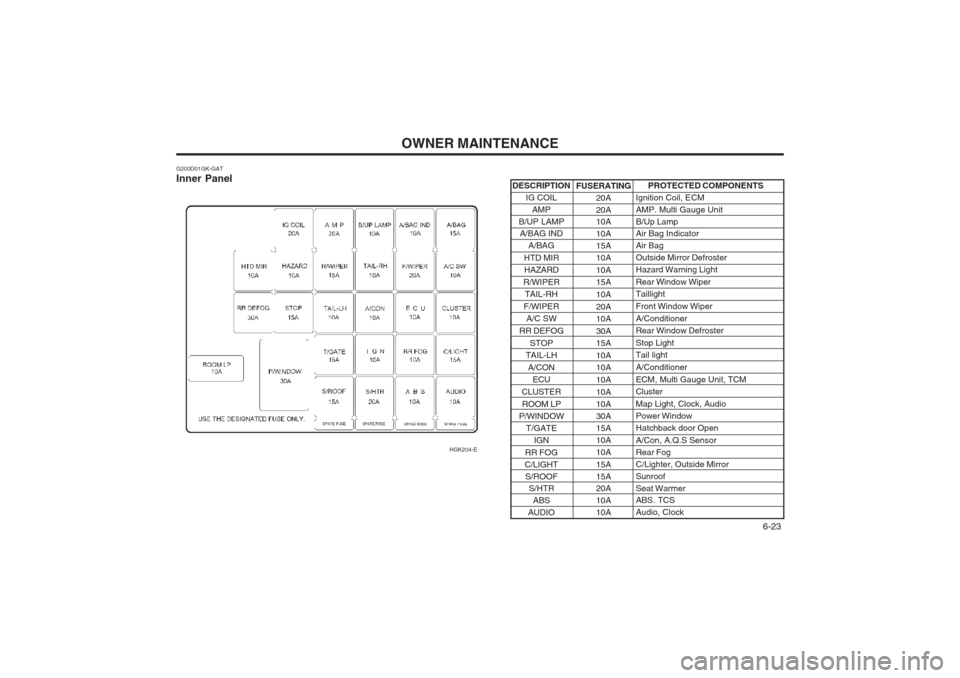
DESCRIPTION
IG COILAMP
B/UP LAMP A/BAG IND
A/BAG
HTD MIR HAZARD
R/WIPER TAIL-RH
F/WIPER A/C SW
RR DEFOG STOP
TAIL-LH
A/CON ECU
CLUSTER ROOM LP
P/WINDOW T/GATE IGN
RR FOG
C/LIGHT S/ROOF S/HTR
ABS
AUDIO
G200D01GK-GAT Inner Panel
HGK204-E
PROTECTED COMPONENTS
Ignition Coil, ECM
AMP. Multi Gauge UnitB/Up Lamp Air Bag Indicator Air BagOutside Mirror DefrosterHazard Warning Light Rear Window Wiper Taillight Front Window WiperA/Conditioner Rear Window Defroster Stop Light Tail light A/Conditioner
ECM, Multi Gauge Unit, TCM Cluster Map Light, Clock, Audio Power WindowHatchback door Open A/Con, A.Q.S Sensor Rear FogC/Lighter, Outside MirrorSunroofSeat Warmer ABS. TCS Audio, Clock
FUSERATING
20A20A 10A 10A15A10A 10A 15A 10A20A 10A 30A 15A 10A 10A 10A10A 10A30A15A10A10A 15A 15A 20A 10A10A
Page 130 of 140
EMISSION CONTROL SYSTEM
7-2
hicle operator in order to prevent operational problems arising from damage to the catalyst. Damage to the catalyst will result if contamina- tion occurs through the use of leaded fuel. Whilst the vehicle is fitted with a reduced diameter filler neck to prevent charging of the fuel tank with a leaded fuel pump nozzle, it is possible that the use of funnels or jerry cans will permit leaded fuel to be introduced into the fuel tank. The catalyst is intolerant of unburnt fuel and therefore if an engine misfire condition exists, damage to the catalyst will occur. It is imperative that if a misfire condition develops, the vehicle is immediately presented to a Hyundai dealer for rectification. Similarly, the practice of certain ignition system diagnosis procedures which in- volve inducing a misfire (cylinder power balance tests for example) may result in catalyst dam- age. For these reasons, it is advisable that the ex- haust gas emission be tested at each routine service with a gas analyzer having a Hydrocar- bon measuring facility to ensure continued reli- ability of the catalyst. Push or tow starting of the vehicle is to be avoided since unburnt fuel may be enter the catalyst and result in damage. (Note, it is impos- sible to push or tow start a Hyundai model equipped with fuel injection since the fuel pump safety interlock will prevent the pump from oper- ating under these conditions). Operation of the catalyst involves extremely high temperatures being attained within the catalytic convertor, and although the convertor is fitted
with heat shields, it is important that the vehicleis not parked over combustible or volatile mate- rial which may result in fire. If the above precautions are not adhered to and the catalyst becomes inoperative, the resultant increase in core temperature will result in a "melt down" where the catalyst core will melt and subsequently may block the exhaust system. Due to the fragile nature of the catalyst element, it is important that damage does not occur when the vehicle is raised by means of a garage jack. Care must also be exercised to avoid driving over road hazards or debris which may cause damage to the catalyst element.
Page 131 of 140
CONSUMER INFORMATION 8-1
SI010B1-E Engine Number
SI010A1-EVEHICLE IDENTIFICATION NUMBER (VIN)
SI000A1-E
8. CONSUMER
INFORMATION
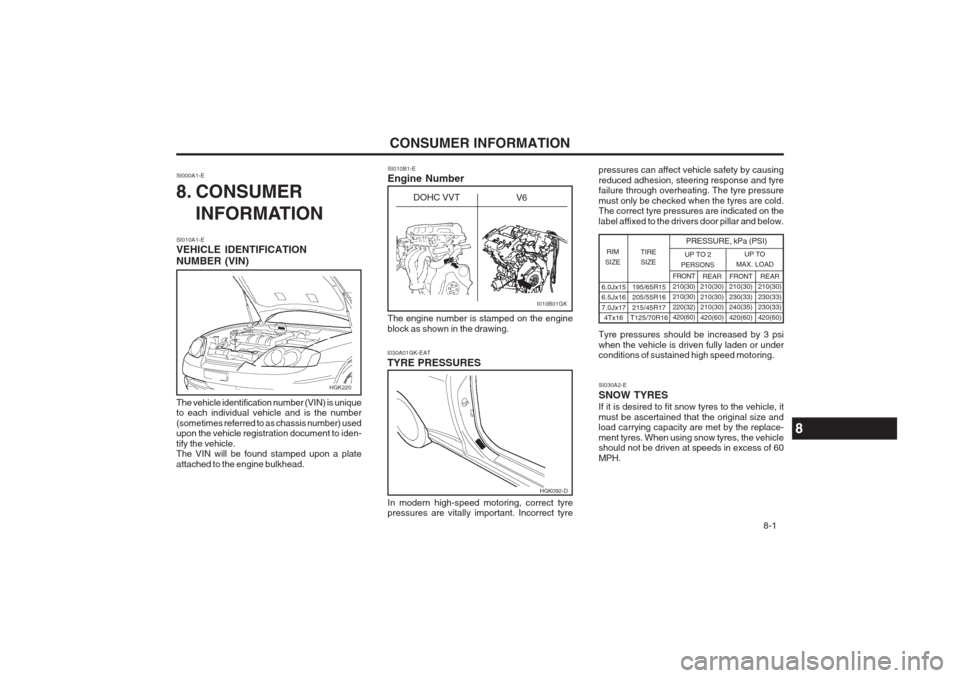
The vehicle identification number (VIN) is unique to each individual vehicle and is the number (sometimes referred to as chassis number) used upon the vehicle registration document to iden- tify the vehicle. The VIN will be found stamped upon a plate attached to the engine bulkhead. The engine number is stamped on the engineblock as shown in the drawing.
I030A01GK-EAT TYRE PRESSURES
In modern high-speed motoring, correct tyre pressures are vitally important. Incorrect tyre pressures can affect vehicle safety by causing reduced adhesion, steering response and tyre failure through overheating. The tyre pressure must only be checked when the tyres are cold. The correct tyre pressures are indicated on the label affixed to the drivers door pillar and below. Tyre pressures should be increased by 3 psi when the vehicle is driven fully laden or under conditions of sustained high speed motoring. SI030A2-E SNOW TYRES If it is desired to fit snow tyres to the vehicle, it must be ascertained that the original size and load carrying capacity are met by the replace- ment tyres. When using snow tyres, the vehicle should not be driven at speeds in excess of 60 MPH.
8
I010B01GK
HGK220
HGK092-D
DOHC VVT
V6
6.0Jx15 6.5Jx16 7.0Jx174Tx16 TIRE SIZE
RIM
SIZE PRESSURE, kPa (PSI)
195/65R15205/55R16 215/45R17
T125/70R16 REAR
210(30)210(30) 210(30) 420(60) FRONT
210(30)230(33) 240(35) 420(60)
UP TO 2
PERSONS UP TO
MAX. LOAD
REAR
210(30)230(33) 230(33) 420(60)
FRONT210(30) 210(30) 220(32) 420(60)
Page 137 of 140
INDEX10-1
C CARE OF CASSETTE
TAPE ........................................................... 1-64
CARE OF DISC ................................................................................ 1-64
CARE OF SEAT BELTS .................................................................. 1-11
CATALYTIC CONVERTOR OPERATING PRECAUTIONS .......7-1~7-2
CENTRAL DOOR LOCK .................................................................... 1-4
CHANGING A FLAT TYPE ................................................................ 3-3
CHECKING THE CLUTCH FLUID ...................................................6-13
CHILD RESTRAINT SYSTEM ......................................................... 1-13
CIGAR LIGHTER .............................................................................. 1-36
CLUTCH PEDAL FREEPLAY .......................................................... 6-15
COMBINATION IGNITION SWITCH AND STEERING LOCK .......... 2-2 CRUISE CONTROL ......................................................................... 1-48
D DAILY OPERATING CHECKS ........................................................... 6-4
DEFROSTING/DEMISTING ............................................................. 1-55
DIGITAL CLOCK .............................................................................. 1-36
DOOR LOCKS .................................................................................... 1-2
DOOR WINDOWS .............................................................................. 1-6
DRINK HOLDER .............................................................................. 1-37
DRIVE BELTS .................................................................................. 6-16
DRIVING FOR ECONOMY .............................................................. 2-10
JK000A2-EAT 10. INDEX A AIR BAG
........................................................................................... 1-18
AIR CONDITIONING SWITCH ......................................................... 1-54
AIR CONDITIONING SYSTEM MAINTENANCE ............................6-13
AIR CLEANER ELEMENT REPLACEMENT ..................................... 6-9
AIR FILTER ...................................................................................... 1-61
ANTENNA ......................................................................................... 1-66
ANTI-LOCK BRAKE SYSTEM ........................................................... 2-8
AUTOMATIC TRANSMISSION FLUID ............................................. 6-11
AUTOMATIC TRANSMISSION .......................................................... 2-5
B BATTERY MAINTENANCE .............................................................. 6-17
BEFORE FOLDING THE REAR SEATS ........................................... 1-9
BEFORE STARTING THE ENGINE .................................................. 2-2
BONNET RELEASE ......................................................................... 1-44
BRAKE PEDAL FREEPLAY ............................................................. 6-16
BRAKE SYSTEM CHECKING ......................................................... 6-12
10