lock Hyundai Coupe 2002 Owner's Guide
[x] Cancel search | Manufacturer: HYUNDAI, Model Year: 2002, Model line: Coupe, Model: Hyundai Coupe 2002Pages: 140, PDF Size: 1.45 MB
Page 78 of 140
DRIVING YOUR HYUNDAI
2- 4 CAUTION:
o Do not attempt to engage reverse gear
when the car is in motion.
o To avoid damaging the selector mecha- nism, do not use the gear shift lever as a hand rest. Release the lever immediately the shift is completed.
o To avoid premature clutch wear, do not use the clutch pedal as a foot rest, and donot hold the vehicle on a gradient using the clutch.
o Ensure that the engine is not over-revved by upshifting before the tachometer needleenters the red zone.
o Do not coast with the shift lever at the neutral position.
o When descending long gradients, make use of the engine braking to assist thefootbrake to avoid brake fade or over- heating.
o When slippery conditions are encountered, increased caution should be exercisedwhen gear changing, braking or ac- celerating. Abrupt changes in speed may cause a loss of traction or control of the vehicle.
o The starter motor will not operate unless the clutch pedal is depressed whilst theengine is being started.
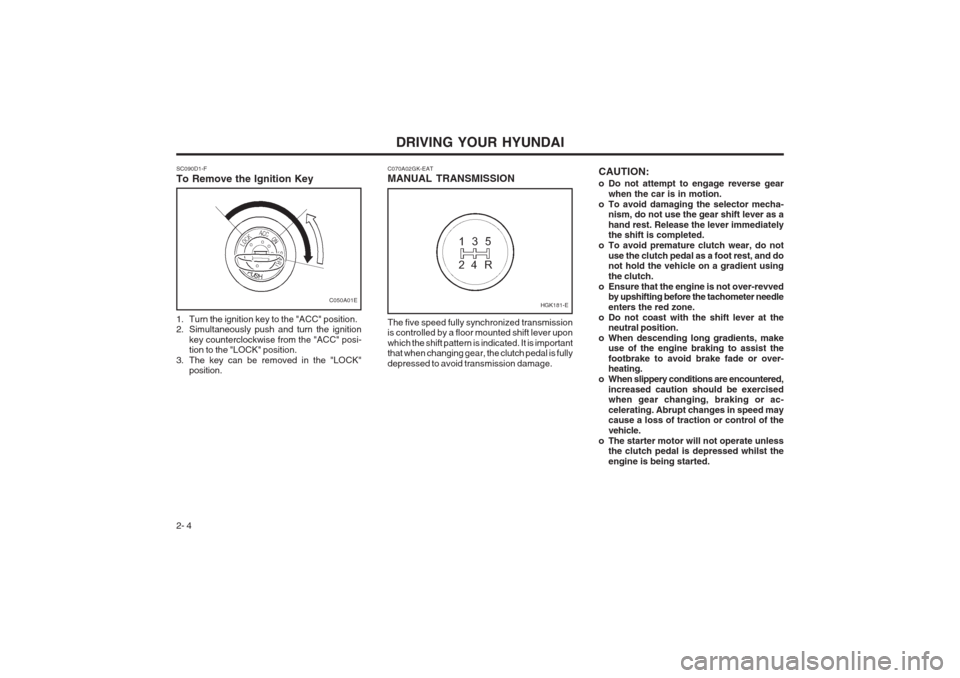
C070A02GK-EAT MANUAL TRANSMISSION The five speed fully synchronized transmission is controlled by a floor mounted shift lever upon which the shift pattern is indicated. It is important that when changing gear, the clutch pedal is fully depressed to avoid transmission damage.
SC090D1-F To Remove the Ignition Key
1. Turn the ignition key to the "ACC" position.
2. Simultaneously push and turn the ignition
key counterclockwise from the "ACC" posi-tion to the "LOCK" position.
3. The key can be removed in the "LOCK" position.
C050A01EHGK181-E
Page 82 of 140
DRIVING YOUR HYUNDAI
2- 8 o Since the power assistance provided by the
brake servo is derived from the engine, coasting with the engine turned off or towing of the vehicle with the engine turned off will result in greatly increased pedal pressures being required to stop the vehicle.
o Do not hold the vehicle on the upgrade with the accelerator pedal. This can cause thetransmission to overheat. Always use the brake pedal or parking brake.
SC140B1-E ANTI-LOCK BRAKE SYSTEM (Not all models) The Anti-Lock Brake System (ABS) is designed to prevent wheel lock-up during sudden braking or on hazardous road surfaces. The ABS con- trol module monitors the wheel speed and con- trols the pressure applied to each brake. Thus, in emergency situations or on slick roads, ABS will increase vehicle control during braking. NOTE: During ABS operation, a slight pulsation may be felt in the brake pedal when the brakes are applied. Also, a noise may be heard in the engine compartment while brak- ing. These conditions are normal and indi- cate that the anti-lock brake system is func- tioning properly.
when you are driving down a long hill, slowdown and shift to a lower gear. When you do this, engine braking will help slow the car.
o Slow down before shifting to a lower gear.
Otherwise, the lower gear may not be en-gaged.
o Always use the parking brake. Do not de- pend on placing the transaxle in "P" to keep the car from moving.
o Exercise extreme caution when driving on a slippery surface. Be especially careful whenbraking, accelerating or shifting gears. On a slippery surface, an abrupt change in vehi- cle speed can cause the drive wheels to lose traction and the vehicle to go out of control.
WARNING:
o Avoid high cornering speeds.
o Do not make quick steering wheel move- ments, such as sharp lane changes orfast, sharp turns.
o Always wear your seat belts.
o The risk of rollover is greatly increased if
you lose control of your vehicle at high- way speeds.
o Loss of control often occurs if two or more wheels drop off the roadway andthe driver oversteers to reenter the road- way.
o In the event your vehicle leaves the road- way, do not steer sharply. Instead, slowdown before pulling back into the travel lanes. o In a collision crash, un unbelted person
is significantly more likely to die than aperson wearing a seatbelt.
SC140A1-E EFFECTIVE BRAKINGBraking system performance and friction mate- rial life are greatly affected by the driving style adopted. The following suggestions are made to assist in achieving the best results from the braking system.
o Anticipate the road and conditions ahead in order that heavy braking may be avoided.
o When descending long gradients, use the engine to assist in retarding the vehicle to minimize the possibility of brake fade occur- ring.
o When trailer towing, ensure that the trailer brakes function correctly and use enginebraking to assist the vehicle braking system.
o Use only genuine Hyundai replacement brake pads and shoes to ensure consistentfriction characteristics and wear rates.
o After driving through deep water (e.g.
fording), the brakes may become wet and performance reduced. Always check brake efficiency after emerging from the water and dry the brakes by lightly depressing the brake pedal several times whilst driving slow- ly.
o Apply the parking brake only when the vehi- cle is at rest.
Page 83 of 140
DRIVING YOUR HYUNDAI 2- 9
WARNING: ABS will not prevent accidents due to im-proper or dangerous driving manoeuvres. Even though vehicle control is improved during emergency braking, always maintain a safe distance between you and objects ahead. Vehicle speeds should always be reduced during extreme road conditions. The braking distance for cars equipped with an anti-lock braking system may be longer than for those without it in the following road conditions.
o Driving on rough, gravel or snow-cov-
ered roads.
o Driving with tire chains installed.
o Driving on roads where the road surface is pitted or has different surface height.
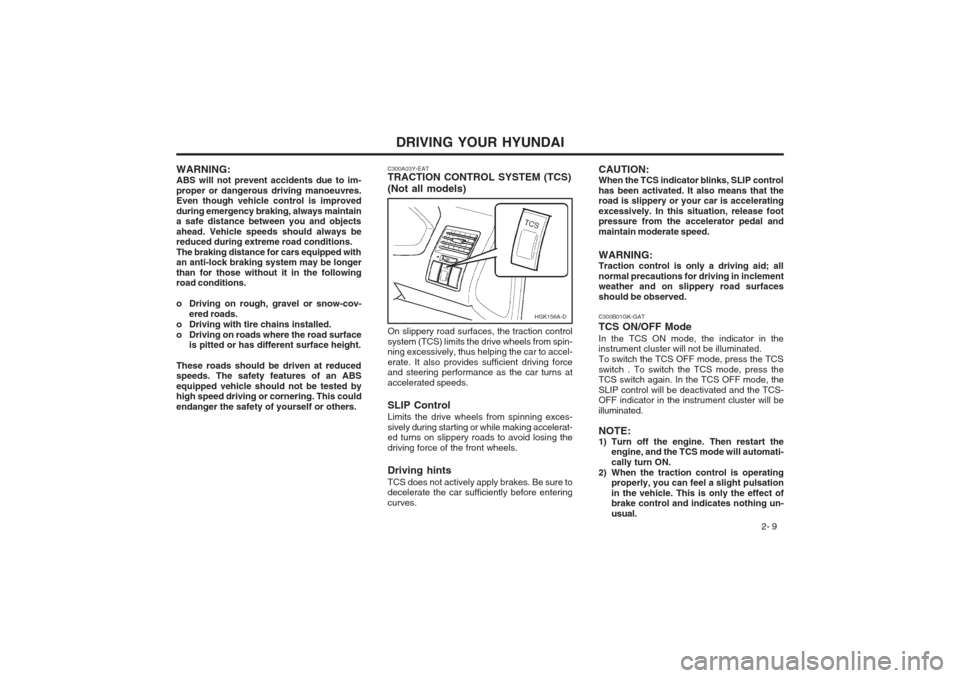
These roads should be driven at reduced speeds. The safety features of an ABS equipped vehicle should not be tested by high speed driving or cornering. This could endanger the safety of yourself or others. C300B01GK-GAT TCS ON/OFF ModeIn the TCS ON mode, the indicator in the instrument cluster will not be illuminated. To switch the TCS OFF mode, press the TCSswitch . To switch the TCS mode, press the TCS switch again. In the TCS OFF mode, the SLIP control will be deactivated and the TCS- OFF indicator in the instrument cluster will be illuminated. NOTE:
1) Turn off the engine. Then restart the
engine, and the TCS mode will automati-cally turn ON.
2) When the traction control is operating properly, you can feel a slight pulsationin the vehicle. This is only the effect of brake control and indicates nothing un- usual.
CAUTION:When the TCS indicator blinks, SLIP controlhas been activated. It also means that the road is slippery or your car is accelerating excessively. In this situation, release foot pressure from the accelerator pedal and maintain moderate speed. WARNING: Traction control is only a driving aid; allnormal precautions for driving in inclement weather and on slippery road surfaces should be observed.
C300A03Y-EAT TRACTION CONTROL SYSTEM (TCS) (Not all models)
HGK156A-D
On slippery road surfaces, the traction control system (TCS) limits the drive wheels from spin- ning excessively, thus helping the car to accel- erate. It also provides sufficient driving force and steering performance as the car turns at accelerated speeds. SLIP Control Limits the drive wheels from spinning exces- sively during starting or while making accelerat- ed turns on slippery roads to avoid losing the driving force of the front wheels. Driving hints TCS does not actively apply brakes. Be sure to decelerate the car sufficiently before entering curves.
Page 85 of 140
DRIVING YOUR HYUNDAI 2- 11
o Remember, your car does not require ex-
tended warm-up. As soon as the engine is running smoothly, you can drive away. In very cold weather, however, give your en- gine a slightly longer warm-up period.
o Don't "lug" or "over-rev" the engine. Lugging
is driving too slowly in too high a gearresulting in the engine bucking. If this hap- pens to you, shift to a lower gear. Over-revving is racing the engine beyond its safe limit. This can be avoided by shifting at the recommended speeds.
o Use your air conditioning sparingly. The air conditioning system is operated by the en-gine power so your fuel economy is reduced when you use it.
SC160A1-F SMOOTH CORNERINGAvoid braking or gear changing in corners, especially when roads are wet. Ideally, corners should always be taken under gentle accelera- tion. If you follow these suggestions, tire wear will be held to a minimum. SC170A1-E WINTER MOTORINGThe onset of winter conditions subject motor vehicles to greater operating demands. There- fore, the following suggestions will assist in maintaining peak performance and reliability during these periods: ZC170B1-E Electrical SystemWinter conditions impose severe demands upon vehicle electrical systems, particularly the charg- ing circuit. The battery condition and perfor- mance along with the alternator performance and drive belt condition should be checked prior to the onset of winter. ZC170C1-E Anti-freeze/Corrosion inhibitorThe cooling system must always contain an Ethylene-Glycol based anti-freeze solution. The system is filled during manufacture with solu- tion of the correct strength which should be checked before the onset of winter and adjust- ed or changed as required. NOTE: The anti-freeze solution contains a corro- sion inhibitor to prevent degradation of the aluminum castings contained within the engine. Therefore, never, drain the system and refill with water only. In addition, anti-freeze solution must ALWAYS be used in vehicles fitted with air conditioning, to prevent the heater matrix from freezing and subsequently bursting with the refrigeration sys- tem in use.
ZC170D1-E Door LocksShould the door lock mechanism become fro- zen, a proprietary lock de-icer should be used. Alternatively, warming the door key may thaw the door lock. However, the key should be handled carefully to avoid burning the fingers. Never attempt to thaw a frozen door lock using hot water, since the water will eventually freeze and compound the problem. NOTE: The proper temperature for using the immo-bilizer key is from -40°F (-40°C) to 176°F (80°C). If you heat the immobilizer key over 176°F (80°C) to open the frozen lock, it may cause damage to the transponder in its head. SC170E1-E Windscreen Washers and WipersThe windscreen washer bottle should be filled with a solution of water and a proprietary winter screen wash additive. The windscreen wipers should not be used if the blades are frozen to the windscreen or if they are covered with snow, before this is removed. NOTE: Never allow undiluted screen washer fluid additive to spill upon the paintwork or use engine coolant anti-freeze since damage to the paintwork may result.
Page 92 of 140
IN CASE OF EMERGENCY
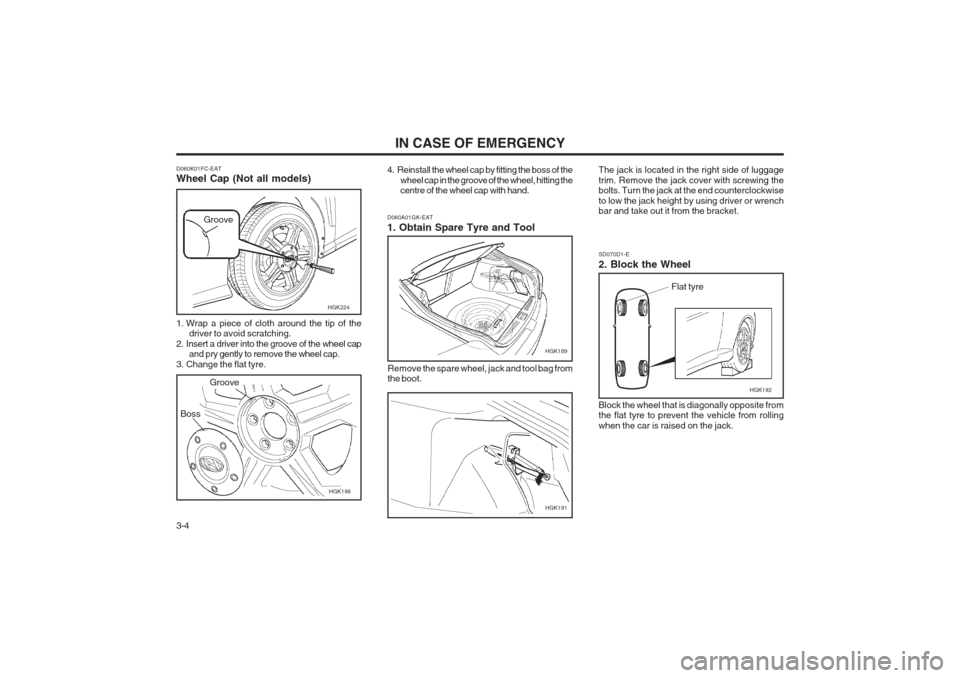
3-4 Remove the spare wheel, jack and tool bag from the boot.
SD070D1-E 2. Block the Wheel Block the wheel that is diagonally opposite from the flat tyre to prevent the vehicle from rolling when the car is raised on the jack.
D060A01GK-EAT 1. Obtain Spare Tyre and Tool
D060K01FC-EAT Wheel Cap (Not all models)
1. Wrap a piece of cloth around the tip of the
driver to avoid scratching.
2. Insert a driver into the groove of the wheel cap and pry gently to remove the wheel cap.
3. Change the flat tyre. 4. Reinstall the wheel cap by fitting the boss of the
wheel cap in the groove of the wheel, hitting the
centre of the wheel cap with hand.
Boss
HGK196
HGK224
Groove
Groove
HGK189
HGK191
The jack is located in the right side of luggage trim. Remove the jack cover with screwing the bolts. Turn the jack at the end counterclockwise to low the jack height by using driver or wrench bar and take out it from the bracket.
Flat tyre
HGK192
Page 93 of 140
3-5
IN CASE OF EMERGENCY
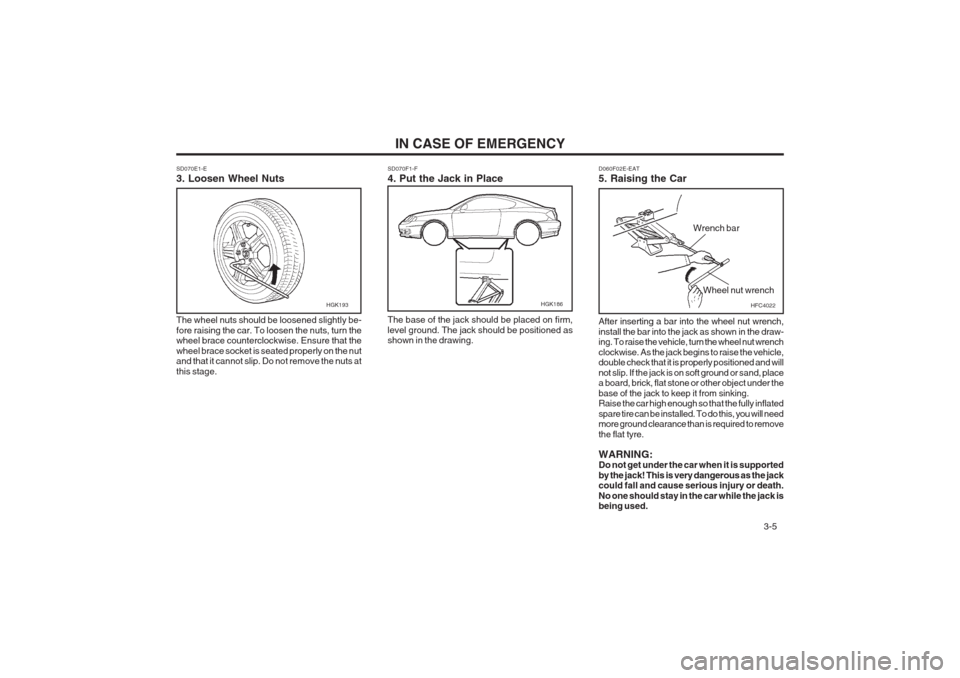
SD070E1-E 3. Loosen Wheel Nuts The wheel nuts should be loosened slightly be- fore raising the car. To loosen the nuts, turn the wheel brace counterclockwise. Ensure that the wheel brace socket is seated properly on the nut and that it cannot slip. Do not remove the nuts at this stage. SD070F1-F 4. Put the Jack in Place The base of the jack should be placed on firm, level ground. The jack should be positioned as shown in the drawing.
HGK193HGK186
D060F02E-EAT 5. Raising the Car After inserting a bar into the wheel nut wrench, install the bar into the jack as shown in the draw- ing. To raise the vehicle, turn the wheel nut wrench clockwise. As the jack begins to raise the vehicle, double check that it is properly positioned and will
not slip. If the jack is on soft ground or
sand, place
a board, brick, flat stone or other object under thebase of the jack to keep it from sinking. Raise the car high enough so that the fully inflated spare tire can be installed. To do this, you will need more ground clearance than is required to remove
the flat tyre. WARNING: Do not get under the car when it is supported by the jack! This is very dangerous as the jack could fall and cause serious injury or death. No one should stay in the car while the jack is being used.
HFC4022
Wrench bar
Wheel nut wrench
Page 95 of 140
3-7
IN CASE OF EMERGENCY
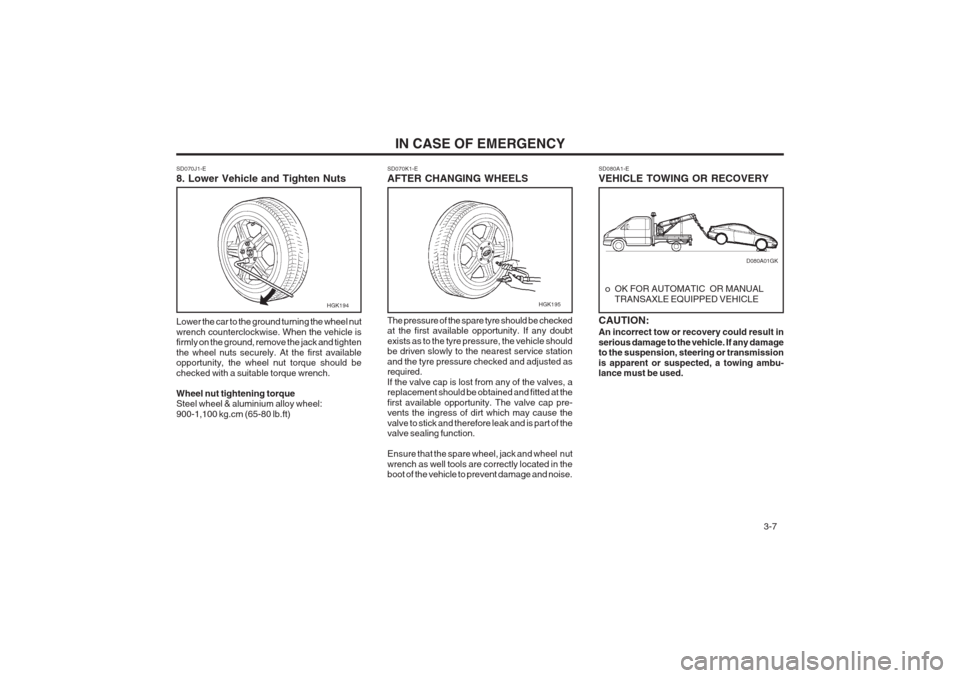
SD080A1-E VEHICLE TOWING OR RECOVERY
o OK FOR AUTOMATIC OR MANUALTRANSAXLE EQUIPPED VEHICLE
CAUTION: An incorrect tow or recovery could result in serious damage to the vehicle. If any damage to the suspension, steering or transmission is apparent or suspected, a towing ambu- lance must be used.
HGK194
SD070J1-E 8. Lower Vehicle and Tighten Nuts Lower the car to the ground turning the wheel nut wrench counterclockwise. When the vehicle is firmly on the ground, remove the jack and tighten the wheel nuts securely. At the first available opportunity, the wheel nut torque should be checked with a suitable torque wrench. Wheel nut tightening torque Steel wheel & aluminium alloy wheel: 900-1,100 kg.cm (65-80 lb.ft) SD070K1-E AFTER CHANGING WHEELS The pressure of the spare tyre should be checked at the first available opportunity. If any doubt exists as to the tyre pressure, the vehicle should be driven slowly to the nearest service station and the tyre pressure checked and adjusted as required. If the valve cap is lost from any of the valves, a replacement should be obtained and fitted at the first available opportunity. The valve cap pre- vents the ingress of dirt which may cause the valve to stick and therefore leak and is part of the valve sealing function. Ensure that the spare wheel, jack and wheel nut wrench as well tools are correctly located in the boot of the vehicle to prevent damage and noise.
D080A01GK
HGK195
Page 96 of 140
IN CASE OF EMERGENCY
3-8 since the steering lock is not designed to withstand the force required to hold the front wheels straight during the tow.
o The vehicle must not be towed with the front wheels on the ground for more than thirty miles.
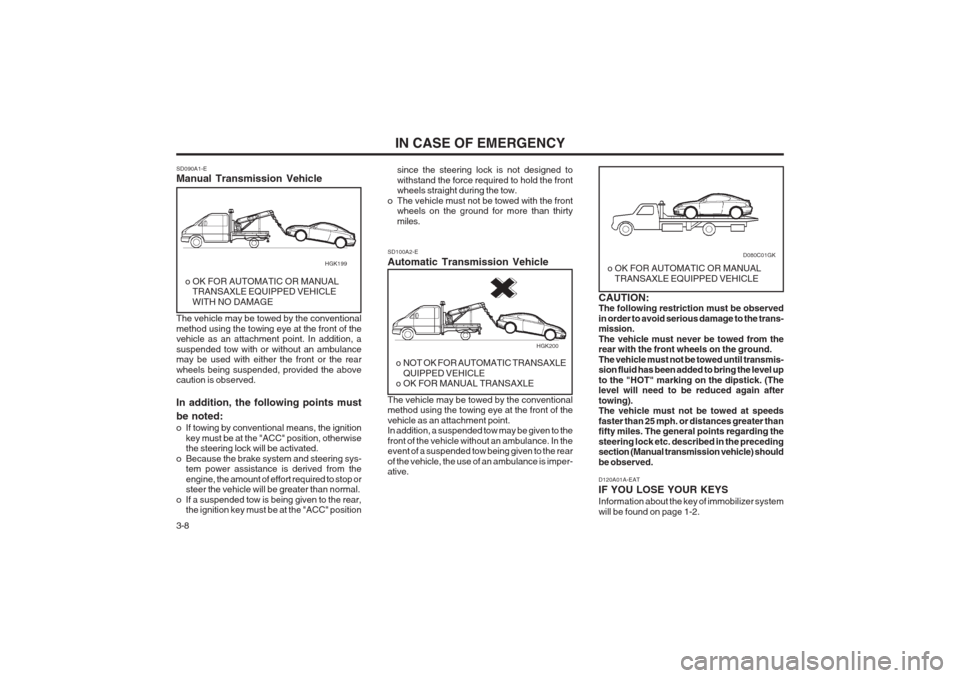
SD100A2-E Automatic Transmission Vehicle
o NOT OK FOR AUTOMATIC TRANSAXLE QUIPPED VEHICLE
o OK FOR MANUAL TRANSAXLE
The vehicle may be towed by the conventional method using the towing eye at the front of the vehicle as an attachment point. In addition, a suspended tow may be given to the front of the vehicle without an ambulance. In the event of a suspended tow being given to the rear of the vehicle, the use of an ambulance is imper- ative.
o OK FOR AUTOMATIC OR MANUAL
TRANSAXLE EQUIPPED VEHICLE
CAUTION: The following restriction must be observed in order to avoid serious damage to the trans- mission. The vehicle must never be towed from the rear with the front wheels on the ground. The vehicle must not be towed until transmis- sion fluid has been added to bring the level up to the "HOT" marking on the dipstick. (The level will need to be reduced again after towing). The vehicle must not be towed at speeds faster than 25 mph. or distances greater than fifty miles. The general points regarding the steering lock etc. described in the preceding section (Manual transmission vehicle) should be observed. D120A01A-EAT IF YOU LOSE YOUR KEYS Information about the key of immobilizer system will be found on page 1-2.
SD090A1-E Manual Transmission Vehicle
o OK FOR AUTOMATIC OR MANUAL
TRANSAXLE EQUIPPED VEHICLE WITH NO DAMAGE
The vehicle may be towed by the conventionalmethod using the towing eye at the front of the vehicle as an attachment point. In addition, a suspended tow with or without an ambulance may be used with either the front or the rear wheels being suspended, provided the above caution is observed. In addition, the following points must be noted:
o If towing by conventional means, the ignition key must be at the "ACC" position, otherwise the steering lock will be activated.
o Because the brake system and steering sys- tem power assistance is derived from the engine, the amount of effort required to stop or steer the vehicle will be greater than normal.
o If a suspended tow is being given to the rear, the ignition key must be at the "ACC" position HGK200
D080C01GK
HGK199
Page 101 of 140

VEHICLE MAINTENANCE REQUIREMENTS 5-3
I I I I II I I I I
R III I II I I
F030C02GK-EAT R : REPLACE I : INSPECT AND, AFTER INSPECTION, CLEAN, ADJUST, REPAIR OR REPLACE IF NECESSARY
GENERAL MAINTENANCE COOLING SYSTEM COOLANT COOLANT SPECIFIC GRAVITYMANUAL TRANSAXLE OIL AUTOMATIC TRANSAXLE FLUID BRAKE PIPES, HOSES, AND CONNECTIONSBRAKE FLUID CLUTCH FLUID REAR BRAKE LININGS AND CYLINDERSBRAKE PADS SUSPENSION AND STEERING SYSTEM FRONT SUSPENSION BALL JOINTSPOLLEN FILTER (For Blower unit) REAR WHEEL BEARINGS TYRE CONDITION AND PRESSURE (incl. Spare)LUBRICATE LOCKS AND HINGES CHECK ALL ELECTRICAL SYSTEMS ROAD TESTCHECK ALL SYSTEMS WITH HI-SCAN CHECK 4 GAS DRIVE SHAFT & BOOT
MILES X 1000 MONTHS
NO. DESCRIPTION
1 2 34 5 67 8 9
10 11 1213 14 1516 17 1819 20 21I I I I II I I I I
R III I II I I
10 12 202430364048 10126072
I
R
I I I I
R R I I I I
R III I II I II
R
I I I I
R R I I I I
R III I II I I I I I I II I I I I
R III I II I I I
R
II
R
I
R R I I I I
R III I II I I
Page 110 of 140
OWNER MAINTENANCE 6-5
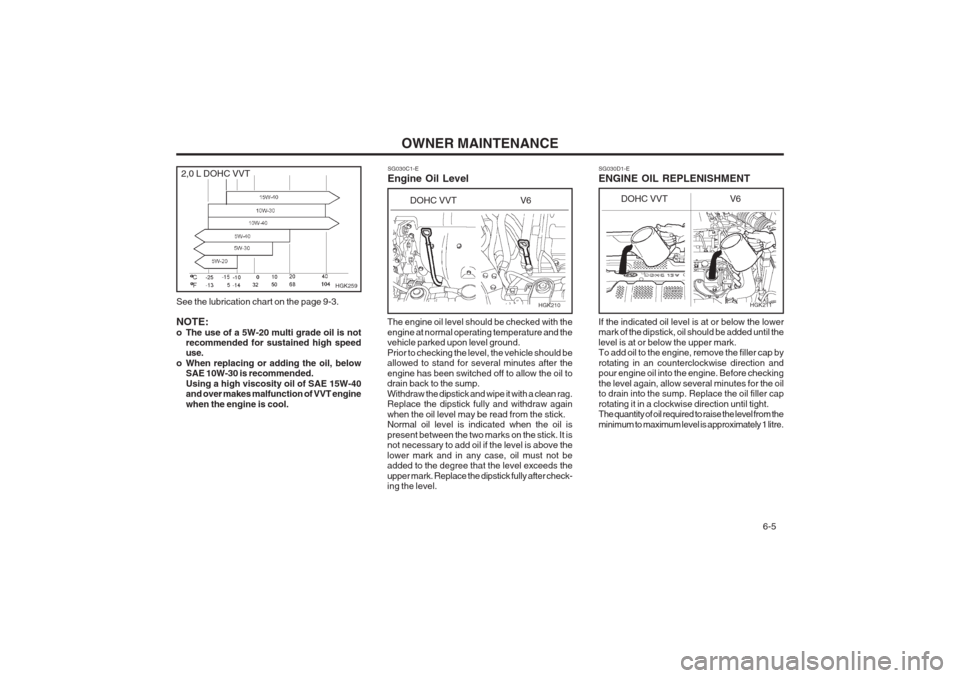
See the lubrication chart on the page 9-3. NOTE:
o The use of a 5W-20 multi grade oil is not
recommended for sustained high speed use.
o When replacing or adding the oil, below SAE 10W-30 is recommended. Using a high viscosity oil of SAE 15W-40 and over makes malfunction of VVT engine when the engine is cool. SG030D1-E ENGINE OIL REPLENISHMENT If the indicated oil level is at or below the lower mark of the dipstick, oil should be added until the level is at or below the upper mark. To add oil to the engine, remove the filler cap by rotating in an counterclockwise direction and pour engine oil into the engine. Before checking the level again, allow several minutes for the oil to drain into the sump. Replace the oil filler cap rotating it in a clockwise direction until tight. The quantity of oil required to raise the level from the minimum to maximum level is approximately 1 litre.
SG030C1-E Engine Oil Level
The engine oil level should be checked with the engine at normal operating temperature and the vehicle parked upon level ground. Prior to checking the level, the vehicle should be allowed to stand for several minutes after the engine has been switched off to allow the oil to drain back to the sump. Withdraw the dipstick and wipe it with a clean rag. Replace the dipstick fully and withdraw again when the oil level may be read from the stick. Normal oil level is indicated when the oil is present between the two marks on the stick. It is not necessary to add oil if the level is above the lower mark and in any case, oil must not be added to the degree that the level exceeds the upper mark. Replace the dipstick fully after check- ing the level.
HGK210HGK211
DOHC VVT V6 DOHC VVT V6
HGK259
2,0 L DOHC VVT