air conditioning Hyundai Coupe 2002 Owner's Manual
[x] Cancel search | Manufacturer: HYUNDAI, Model Year: 2002, Model line: Coupe, Model: Hyundai Coupe 2002Pages: 140, PDF Size: 1.45 MB
Page 59 of 140
CONTROLS AND EQUIPMENT1- 51
HGK002
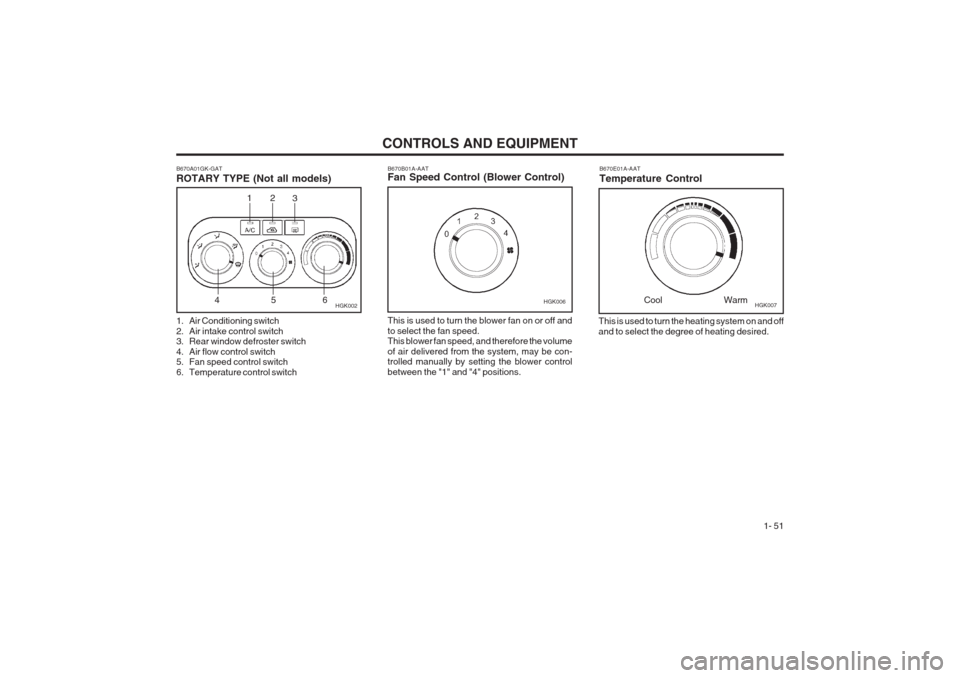
B670A01GK-GAT ROTARY TYPE (Not all models)
This is used to turn the heating system on and off and to select the degree of heating desired.B670E01A-AAT Temperature ControlCool Warm
B670B01A-AAT Fan Speed Control (Blower Control)HGK006
This is used to turn the blower fan on or off and to select the fan speed. This blower fan speed, and therefore the volume of air delivered from the system, may be con- trolled manually by setting the blower control between the "1" and "4" positions.
12 3
456
1. Air Conditioning switch
2. Air intake control switch
3. Rear window defroster switch
4. Air flow control switch
5. Fan speed control switch
6. Temperature control switch HGK007
Page 62 of 140
CONTROLS AND EQUIPMENT
1- 54
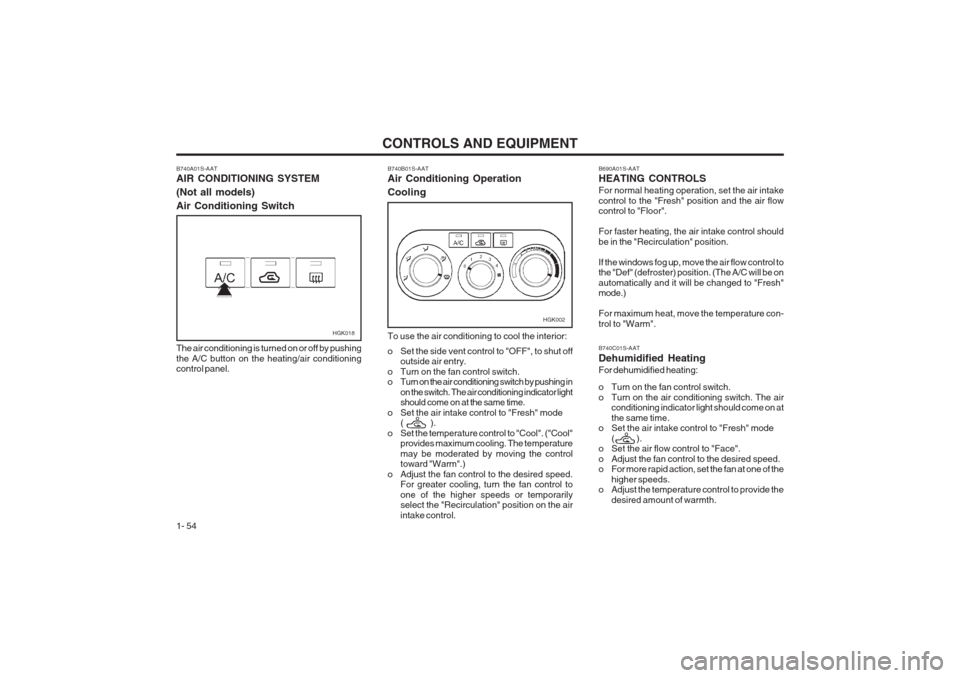
B740A01S-AAT AIR CONDITIONING SYSTEM (Not all models)Air Conditioning Switch
HGK018
The air conditioning is turned on or off by pushing the A/C button on the heating/air conditioning control panel.
HGK002
B740B01S-AAT Air Conditioning Operation Cooling To use the air conditioning to cool the interior:
o Set the side vent control to "OFF", to shut off outside air entry.
o Turn on the fan control switch.
o Turn on the air conditioning switch by pushing in on the switch. The air conditioning indicator lightshould come on at the same time.
o Set the air intake control to "Fresh" mode ( ).
o Set the temperature control to "Cool". ("Cool" provides maximum cooling. The temperature may be moderated by moving the control toward "Warm".)
o Adjust the fan control to the desired speed. For greater cooling, turn the fan control to one of the higher speeds or temporarily select the "Recirculation" position on the air intake control.B690A01S-AAT HEATING CONTROLS For normal heating operation, set the air intake control to the "Fresh" position and the air flow control to "Floor". For faster heating, the air intake control should be in the "Recirculation" position. If the windows fog up, move the air flow control to the "Def" (defroster) position. (The A/C will be on automatically and it will be changed to "Fresh" mode.) For maximum heat, move the temperature con- trol to "Warm". B740C01S-AAT Dehumidified HeatingFor dehumidified heating:
o Turn on the fan control switch.
o Turn on the air conditioning switch. The airconditioning indicator light should come on atthe same time.
o Set the air intake control to "Fresh" mode
( ).
o Set the air flow control to "Face".
o Adjust the fan control to the desired speed.
o For more rapid action, set the fan at one of the
higher speeds.
o Adjust the temperature control to provide the
desired amount of warmth.
Page 64 of 140
CONTROLS AND EQUIPMENT
1- 56
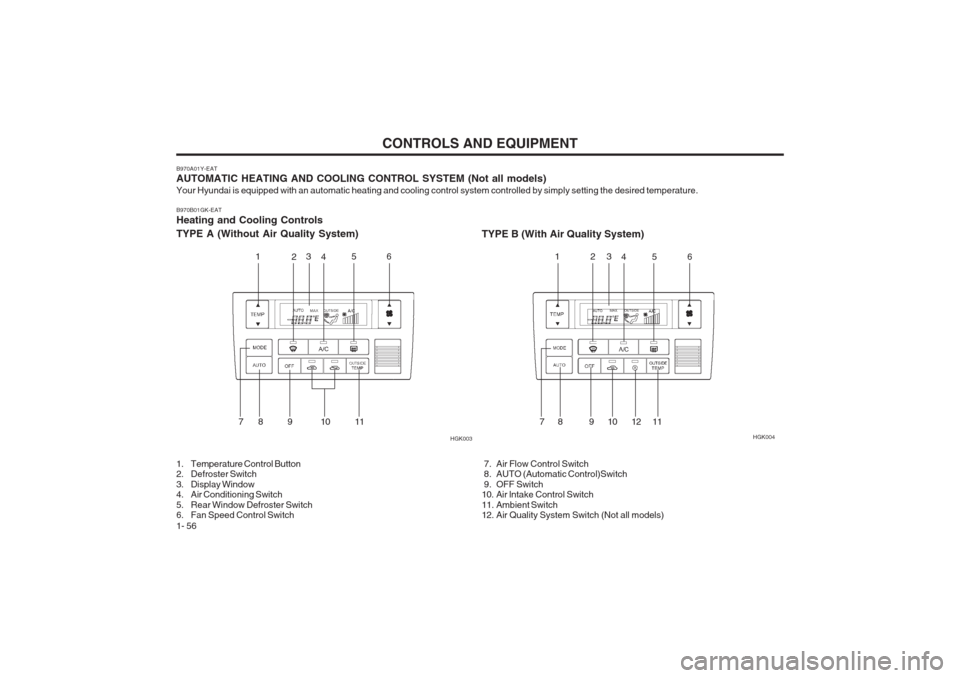
B970A01Y-EAT AUTOMATIC HEATING AND COOLING CONTROL SYSTEM (Not all models) Your Hyundai is equipped with an automatic heating and cooling control system controlled by simply setting the desired temperat
ure.
B970B01GK-EATHeating and Cooling Controls TYPE A (Without Air Quality System) TYPE B (With Air Quality System)
1. Temperature Control Button
2. Defroster Switch
3. Display Window
4. Air Conditioning Switch
5. Rear Window Defroster Switch
6. Fan Speed Control Switch 7. Air Flow Control Switch
8. AUTO (Automatic Control)Switch
9. OFF Switch
10. Air lntake Control Switch
11. Ambient Switch
12. Air Quality System Switch (Not all models)HGK004
HGK003
1 235
4 6
78 9 10 11 12
3
45 6
78 910 1211
Page 67 of 140
CONTROLS AND EQUIPMENT1- 59
With the "Recirculation" mode selected, and air from within the passenger compartment will be drawn through the heating system and heated or cooled according to the function selected. NOTE:
o It should be noted that prolonged opera-tion of the heating system in "recircula-tion" mode will give rise to fogging of the windscreen and side windows and the air within the passenger compartment will become stale. In addition, prolonged use of the air conditioning with the "Recircu- lation" mode selected may result in the air within the passenger compartment be- coming excessively dry.
o When the ignition switch is turned "ON"
the air intake control will change to "
"
mode (regardless of switch position). It is normal operation. The air intake control is operated in "AUTO" mode when turning the ignition to the ON position if the "AUTO" mode was used before shutting off the engine. Exhaust gas cutoff mode :
Air enters the vehicle from the outside. But if exhaust gas enters the vehicle from the outside, the exhaust gas cutoff mode ( ) is automa tically converted to the mode, to
prevent exhaust gas from entering the vehicle. NOTE:
o It should be noted that prolonged opera- tion of the heating system in recirculationmode ( ) will give rise to mis-ting of the windscreen and side windows and the air within the passenger compartment will become stale. In addition, prolonged use of the air conditioning with the recircula- tion mode ( ) selected may result in the air within the passenger compartmentbecoming excessively dry.
o When the ignition switch is turned "ON" the air intake control will change to "Fresh" mode (regardless of switch position). It is normal operation. The air intake control is operated in "AUTO" mode when turning the ignition to the ON position if the "AUTO" mode was used before shutting off the engine.
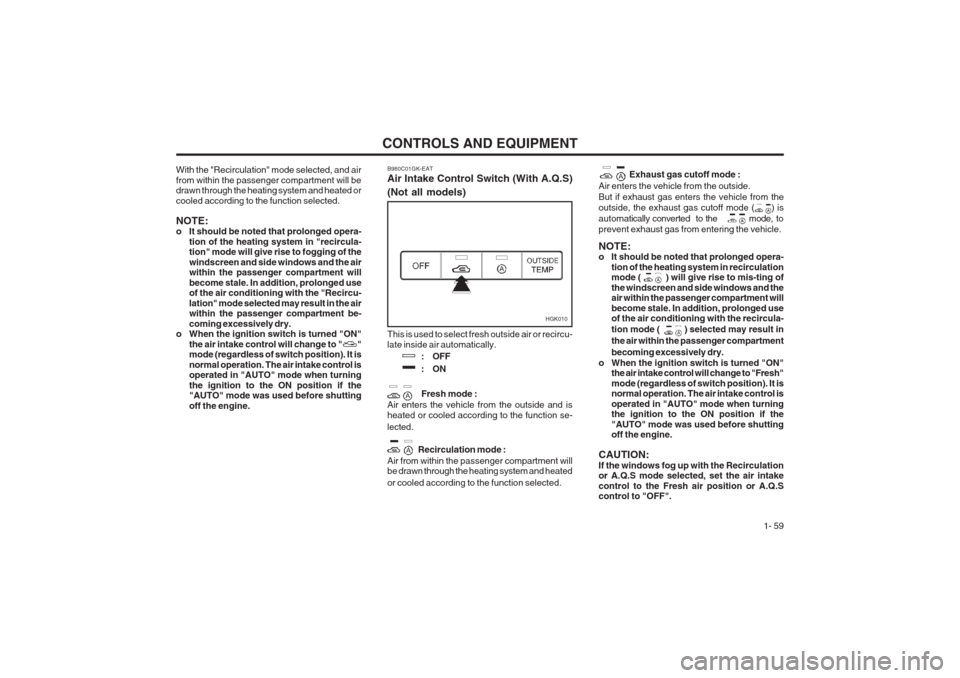
CAUTION: If the windows fog up with the Recirculation or A.Q.S mode selected, set the air intake control to the Fresh air position or A.Q.S control to "OFF".This is used to select fresh outside air or recircu- late inside air automatically. : OFF
:ON Fresh mode :
Air enters the vehicle from the outside and is heated or cooled according to the function se- lected.
Recirculation mode :
Air from within the passenger compartment will be drawn through the heating system and heated or cooled according to the function selected.
B980C01GK-EAT Air Intake Control Switch (With A.Q.S) (Not all models)
HGK010
Page 77 of 140
DRIVING YOUR HYUNDAI 2- 3
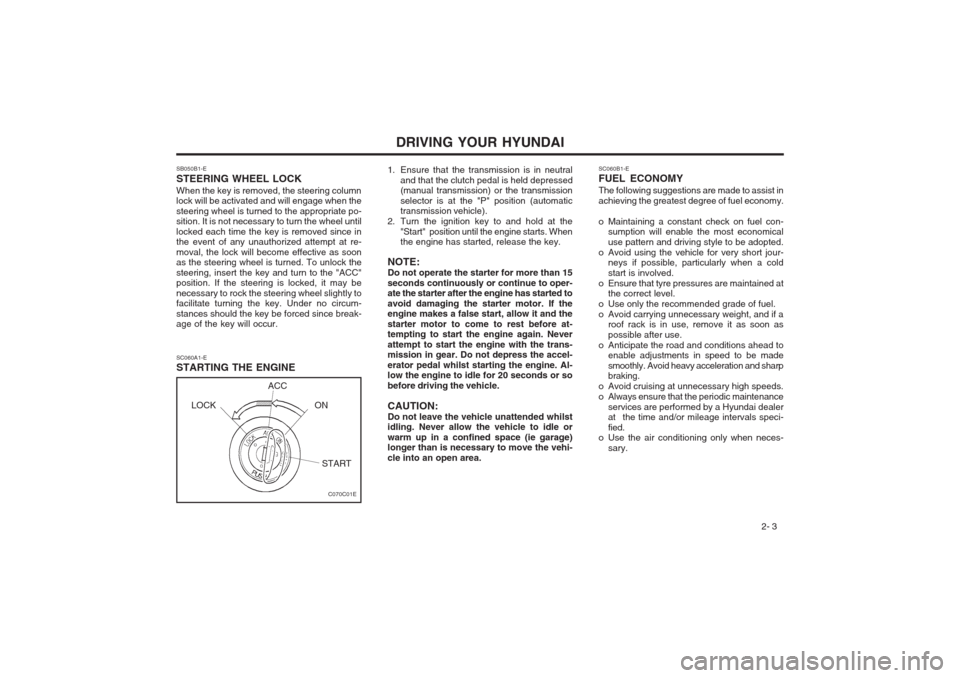
SB050B1-E STEERING WHEEL LOCKWhen the key is removed, the steering column lock will be activated and will engage when the steering wheel is turned to the appropriate po- sition. It is not necessary to turn the wheel until locked each time the key is removed since in the event of any unauthorized attempt at re- moval, the lock will become effective as soon as the steering wheel is turned. To unlock the steering, insert the key and turn to the "ACC" position. If the steering is locked, it may be necessary to rock the steering wheel slightly to facilitate turning the key. Under no circum- stances should the key be forced since break- age of the key will occur.
SC060B1-E FUEL ECONOMY The following suggestions are made to assist in achieving the greatest degree of fuel economy.
o Maintaining a constant check on fuel con-
sumption will enable the most economical use pattern and driving style to be adopted.
o Avoid using the vehicle for very short jour- neys if possible, particularly when a coldstart is involved.
o Ensure that tyre pressures are maintained at the correct level.
o Use only the recommended grade of fuel.
o Avoid carrying unnecessary weight, and if a roof rack is in use, remove it as soon aspossible after use.
o Anticipate the road and conditions ahead to enable adjustments in speed to be madesmoothly. Avoid heavy acceleration and sharp braking.
o Avoid cruising at unnecessary high speeds.
o Always ensure that the periodic maintenance services are performed by a Hyundai dealer
at the time and/or mileage intervals speci- fied.
o Use the air conditioning only when neces-
sary.
SC060A1-E STARTING THE ENGINE 1. Ensure that the transmission is in neutral
and that the clutch pedal is held depressed (manual transmission) or the transmission selector is at the "P" position (automatic transmission vehicle).
2. Turn the ignition key to and hold at the
"Start" position until the engine starts. Whenthe engine has started, release the key.
NOTE: Do not operate the starter for more than 15seconds continuously or continue to oper- ate the starter after the engine has started to avoid damaging the starter motor. If the engine makes a false start, allow it and the starter motor to come to rest before at- tempting to start the engine again. Never attempt to start the engine with the trans- mission in gear. Do not depress the accel- erator pedal whilst starting the engine. Al- low the engine to idle for 20 seconds or so before driving the vehicle. CAUTION: Do not leave the vehicle unattended whilst idling. Never allow the vehicle to idle or warm up in a confined space (ie garage) longer than is necessary to move the vehi- cle into an open area.
C070C01E
LOCK ACC
ON
START
Page 85 of 140
DRIVING YOUR HYUNDAI 2- 11
o Remember, your car does not require ex-
tended warm-up. As soon as the engine is running smoothly, you can drive away. In very cold weather, however, give your en- gine a slightly longer warm-up period.
o Don't "lug" or "over-rev" the engine. Lugging
is driving too slowly in too high a gearresulting in the engine bucking. If this hap- pens to you, shift to a lower gear. Over-revving is racing the engine beyond its safe limit. This can be avoided by shifting at the recommended speeds.
o Use your air conditioning sparingly. The air conditioning system is operated by the en-gine power so your fuel economy is reduced when you use it.
SC160A1-F SMOOTH CORNERINGAvoid braking or gear changing in corners, especially when roads are wet. Ideally, corners should always be taken under gentle accelera- tion. If you follow these suggestions, tire wear will be held to a minimum. SC170A1-E WINTER MOTORINGThe onset of winter conditions subject motor vehicles to greater operating demands. There- fore, the following suggestions will assist in maintaining peak performance and reliability during these periods: ZC170B1-E Electrical SystemWinter conditions impose severe demands upon vehicle electrical systems, particularly the charg- ing circuit. The battery condition and perfor- mance along with the alternator performance and drive belt condition should be checked prior to the onset of winter. ZC170C1-E Anti-freeze/Corrosion inhibitorThe cooling system must always contain an Ethylene-Glycol based anti-freeze solution. The system is filled during manufacture with solu- tion of the correct strength which should be checked before the onset of winter and adjust- ed or changed as required. NOTE: The anti-freeze solution contains a corro- sion inhibitor to prevent degradation of the aluminum castings contained within the engine. Therefore, never, drain the system and refill with water only. In addition, anti-freeze solution must ALWAYS be used in vehicles fitted with air conditioning, to prevent the heater matrix from freezing and subsequently bursting with the refrigeration sys- tem in use.
ZC170D1-E Door LocksShould the door lock mechanism become fro- zen, a proprietary lock de-icer should be used. Alternatively, warming the door key may thaw the door lock. However, the key should be handled carefully to avoid burning the fingers. Never attempt to thaw a frozen door lock using hot water, since the water will eventually freeze and compound the problem. NOTE: The proper temperature for using the immo-bilizer key is from -40°F (-40°C) to 176°F (80°C). If you heat the immobilizer key over 176°F (80°C) to open the frozen lock, it may cause damage to the transponder in its head. SC170E1-E Windscreen Washers and WipersThe windscreen washer bottle should be filled with a solution of water and a proprietary winter screen wash additive. The windscreen wipers should not be used if the blades are frozen to the windscreen or if they are covered with snow, before this is removed. NOTE: Never allow undiluted screen washer fluid additive to spill upon the paintwork or use engine coolant anti-freeze since damage to the paintwork may result.
Page 90 of 140
IN CASE OF EMERGENCY
3-2 4. Check to see if the water pump drive belt is
missing. If it is not missing, check to see that it is tight. If the drive belt seems to be satisfac- tory, check for coolant leaking from the radia- tor, hoses or under the car. (If the air condi- tioning had been in use, it is normal for cold water to be draining from it).
WARNING: Whilst the engine is running, keep hands and clothing away from moving parts such as the fan and drive belts to prevent injury.
5. If the water pump drive belt is broken or coolant is leaking out, stop the engine imme- diately and call the nearest Hyundai dealer for assistance.
WARNING:Do not remove the radiator cap when the engine is hot since steam and boiling water may be ejected from the radiator resulting in burns or scalding.
6. If the cause of the overheating cannot be found, wait until the engine temperature has returned to normal. Then, if coolant has been lost, carefully remove the radiator cap and add water to bring the fluid level in the reser- voir up to the base of the radiator fill opening. Fill the coolant expansion tank to the halfway mark.
WARNING: Motor vehicle batteries contain sulphuric acid and emit hydrogen gas. Protective clothing should be worn and care exercised to prevent the acid from coming into contact with skin or clothing and the vehicle. Naked lights should not be permitted in the vicinity of the battery. Care should be exercised to prevent sparks occurring during connection. If acid acciden- tally comes into contact with skin or eyes, the affected area should immediately be flushed with copious amounts of water and medical assistance sought.
1. Ensure that the booster battery is 12 volt type.
If the booster battery is installed in another vehicle, ensure that the two vehicles are not touching.
2. Turn off all unnecessary electrical equipment in both vehicles.
3. Ensure that the engine of the vehicle provid- ing the jump start is running prior to connec- tion of the jump cables.
4. Connect the red jump cable to the positive (+)
terminal of the booster battery and the other end to the positive (+) terminal of the dis- charged battery.
5. Attach the black jump cable to the negative
(-) terminal of the booster battery, and the other end to a ground point within the engine compartment of the vehicle with the flat bat- tery. Do not connect to the negative battery terminal of the flat battery since sparks may be generated with the subsequent risk of explosion. 6. Raise the booster vehicle engine speed to
2,000 r.p.m. and start the engine of the vehi- cle with the flat battery.
7. Remove jump cables in the reverse order of installation (black cable first).
CAUTION: If the jump cable is incorrectly installed, dam- age to the vehicle electrical system may oc- cur, in particular the electronic components such as the Fuel Injection system computer and the Automatic Transmission computer. The battery must never be disconnected whilst the engine is running. SD040A1-E IF THE ENGINE OVERHEATSIf the temperature gauge indicates overheating:
1. Pull off the road and stop as soon as it is safe to do so.
2. Place the gear selector lever in "P" (auto- matic), or neutral (manual transaxle) and set the parking brake. If the air conditioning is on, turn it off.
3. If coolant is running out under the car or steam is coming out from under the bonnet stop the engine. Do not open the bonnet until the cool-ant has stopped running or the steam- ing has stopped. If there is no visible loss of coolant and no steam, leave the engine run- ning and check to be sure the engine cooling fan is operating. If the fan is not running, turn the engine off.
Page 105 of 140
VEHICLE MAINTENANCE REQUIREMENTS 5-7
6ZF070Q1-A
o Air conditioning refrigerant Check the air conditioning lines and connections for leakage and damage. Check air conditioning performance according to the relevant shop manual if necessary.
6ZF070P1-A
o Driveshafts and boots Check the drive shafts, boots and clamps for cracks, deterioration, or damage. Replace any damaged parts and, if necessary, repack the grease.
Page 112 of 140
OWNER MAINTENANCE 6-7
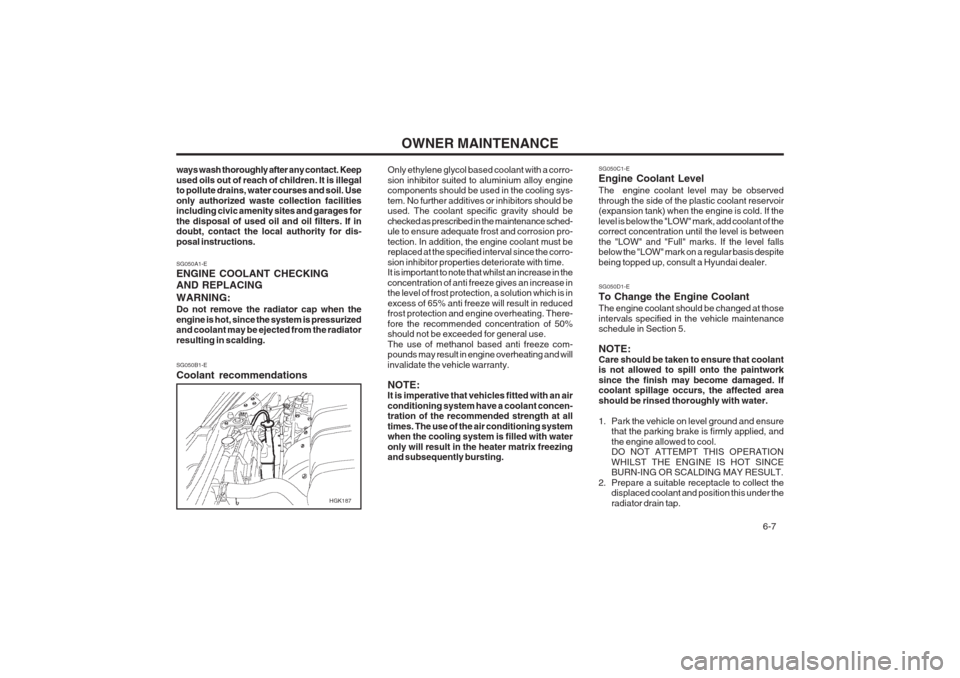
ways wash thoroughly after any contact. Keep used oils out of reach of children. It is illegal to pollute drains, water courses and soil. Use only authorized waste collection facilities including civic amenity sites and garages for the disposal of used oil and oil filters. If in doubt, contact the local authority for dis- posal instructions. SG050A1-E ENGINE COOLANT CHECKING AND REPLACING WARNING: Do not remove the radiator cap when the engine is hot, since the system is pressurized and coolant may be ejected from the radiator resulting in scalding. SG050B1-E Coolant recommendations
Only ethylene glycol based coolant with a corro- sion inhibitor suited to aluminium alloy engine components should be used in the cooling sys- tem. No further additives or inhibitors should be used. The coolant specific gravity should be checked as prescribed in the maintenance sched- ule to ensure adequate frost and corrosion pro- tection. In addition, the engine coolant must be replaced at the specified interval since the corro- sion inhibitor properties deteriorate with time. It is important to note that whilst an increase in the concentration of anti freeze gives an increase in the level of frost protection, a solution which is in excess of 65% anti freeze will result in reduced frost protection and engine overheating. There- fore the recommended concentration of 50% should not be exceeded for general use. The use of methanol based anti freeze com- pounds may result in engine overheating and will invalidate the vehicle warranty. NOTE: It is imperative that vehicles fitted with an air conditioning system have a coolant concen- tration of the recommended strength at all times. The use of the air conditioning system when the cooling system is filled with water only will result in the heater matrix freezing and subsequently bursting.SG050C1-E Engine Coolant Level The engine coolant level may be observed through the side of the plastic coolant reservoir (expansion tank) when the engine is cold. If the level is below the "LOW" mark, add coolant of the correct concentration until the level is between the "LOW" and "Full" marks. If the level falls below the "LOW" mark on a regular basis despite being topped up, consult a Hyundai dealer. SG050D1-E To Change the Engine Coolant The engine coolant should be changed at those intervals specified in the vehicle maintenance schedule in Section 5. NOTE: Care should be taken to ensure that coolant is not allowed to spill onto the paintwork since the finish may become damaged. If coolant spillage occurs, the affected area should be rinsed thoroughly with water.
1. Park the vehicle on level ground and ensure
that the parking brake is firmly applied, and the engine allowed to cool. DO NOT ATTEMPT THIS OPERATION WHILST THE ENGINE IS HOT SINCE BURN-ING OR SCALDING MAY RESULT.
2. Prepare a suitable receptacle to collect the displaced coolant and position this under the radiator drain tap.
HGK187
Page 118 of 140
OWNER MAINTENANCE 6-13
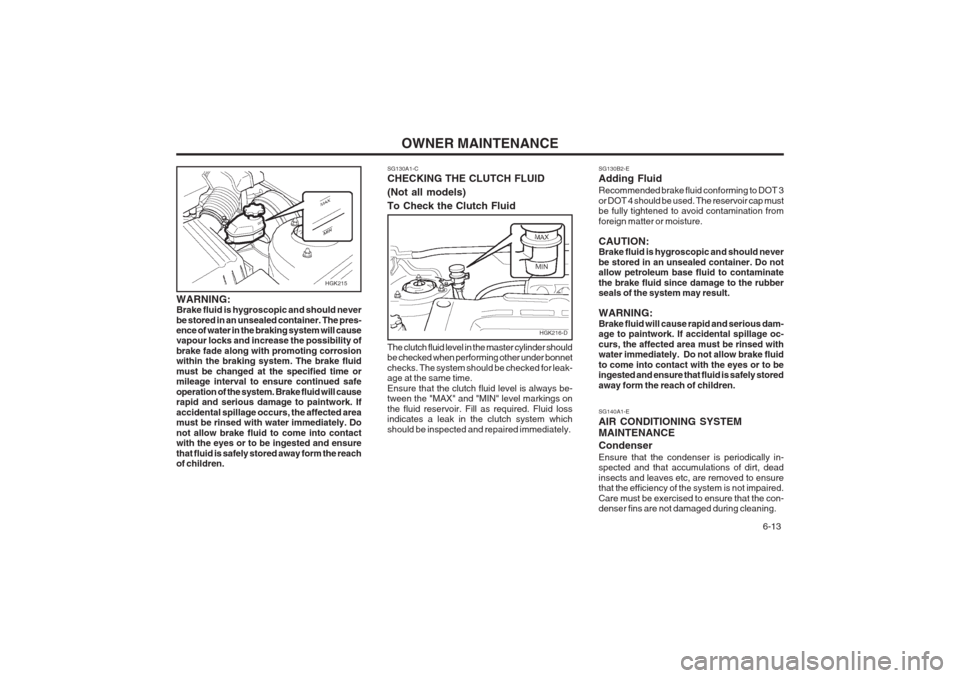
WARNING: Brake fluid is hygroscopic and should never be stored in an unsealed container. The pres- ence of water in the braking system will causevapour locks and increase the possibility of brake fade along with promoting corrosion within the braking system. The brake fluid must be changed at the specified time or mileage interval to ensure continued safe operation of the system. Brake fluid will cause rapid and serious damage to paintwork. If accidental spillage occurs, the affected area must be rinsed with water immediately. Do not allow brake fluid to come into contact with the eyes or to be ingested and ensure that fluid is safely stored away form the reach of children. SG130A1-C CHECKING THE CLUTCH FLUID (Not all models)To Check the Clutch Fluid The clutch fluid level in the master cylinder should be checked when performing other under bonnet checks. The system should be checked for leak- age at the same time. Ensure that the clutch fluid level is always be- tween the "MAX" and "MIN" level markings on the fluid reservoir. Fill as required. Fluid loss indicates a leak in the clutch system which should be inspected and repaired immediately.
SG130B2-E Adding Fluid Recommended brake fluid conforming to DOT 3 or DOT 4 should be used. The reservoir cap must be fully tightened to avoid contamination from foreign matter or moisture. CAUTION: Brake fluid is hygroscopic and should never be stored in an unsealed container. Do not allow petroleum base fluid to contaminate the brake fluid since damage to the rubber seals of the system may result. WARNING: Brake fluid will cause rapid and serious dam- age to paintwork. If accidental spillage oc- curs, the affected area must be rinsed with water immediately. Do not allow brake fluid to come into contact with the eyes or to be ingested and ensure that fluid is safely stored away form the reach of children. SG140A1-E AIR CONDITIONING SYSTEM MAINTENANCE Condenser Ensure that the condenser is periodically in- spected and that accumulations of dirt, dead insects and leaves etc, are removed to ensure that the efficiency of the system is not impaired. Care must be exercised to ensure that the con- denser fins are not damaged during cleaning.
HGK215
HGK216-D