tow Hyundai Coupe 2002 Owner's Manual
[x] Cancel search | Manufacturer: HYUNDAI, Model Year: 2002, Model line: Coupe, Model: Hyundai Coupe 2002Pages: 140, PDF Size: 1.45 MB
Page 1 of 140
SA000A1-E
This Owners Manual should be considered a part of the car and remain with it when it is sold for the use of the next owner.
OWNER I.D.
ORIGINAL: ADDRESS: DATE OF SALE: SUBSEQUENT: ADDRESS: TRANSFER DATE: NAME: STREET:TOWN:COUNTY:P.CODE: NAME: STREET:TOWN:COUNTY:P.CODE:
Page 9 of 140
CONTROLS AND EQUIPMENT1- 1
The use of leaded fuel in this vehicle will result in irreversible pollution of the catalyst element. Such pollution will prevent correct operation of the catalyst and give rise to increased operating temperatures leading to the catalyst element melting and restricting the exhaust flow along with an increase in exhaust emission levels. CAUTION: The vehicle warranty will not extend to dam- age arising from the use of incorrect fuels. Overseas Operation: When the vehicle is to be operated overseas, the vehicle operator should establish that a suitable fuel for satisfactory operation of the vehicle is available.
SB020A1-E RUNNING IN The longevity and performance of the vehicle are greatly affected by the care exercised during the first 1000 miles of motoring. Because of modern manufacturing techniques, rigid guidelines re- garding maximum road speeds have become unnecessary. However, certain precautions should be observed in order to obtain the best possible performance and useful life from the vehicle.
1) Do not race the engine without a load (i.e
revving the engine in neutral).
2) During the first 500 miles the maximum en- gine speed should be restricted to 3000 rpmand gradually increased thereafter.
3) Avoid prolonged constant speed operation.
The internal components of the engine will become more quickly run in if the operation speed is varied during the running in period.
4) Never allow the engine to labour. Use the
gearbox freely and avoid large throttle open- ings when the engine speed is below 1500 rpm.
5) Avoid rapid acceleration and maximum
throttle openings.
6) Avoid harsh braking during the first 100
miles of urban motoring or 1000 miles of motorway driving to allow the friction facings of the brake pads and shoes to bed against the discs and drums properly.
7) Avoid trailer towing during the running in period.
1. CONTROLS AND
EQUIPMENT
SB010E1-E PETROLS FOR CLEANER AIR To help contribute to cleaner air, Hyundai recom- mends that you use petrols treated with deter- gent additives, which help to prevent deposit formation in the engine. These petrols will help the engines run cleaner and the Emission Con- trol System performance.
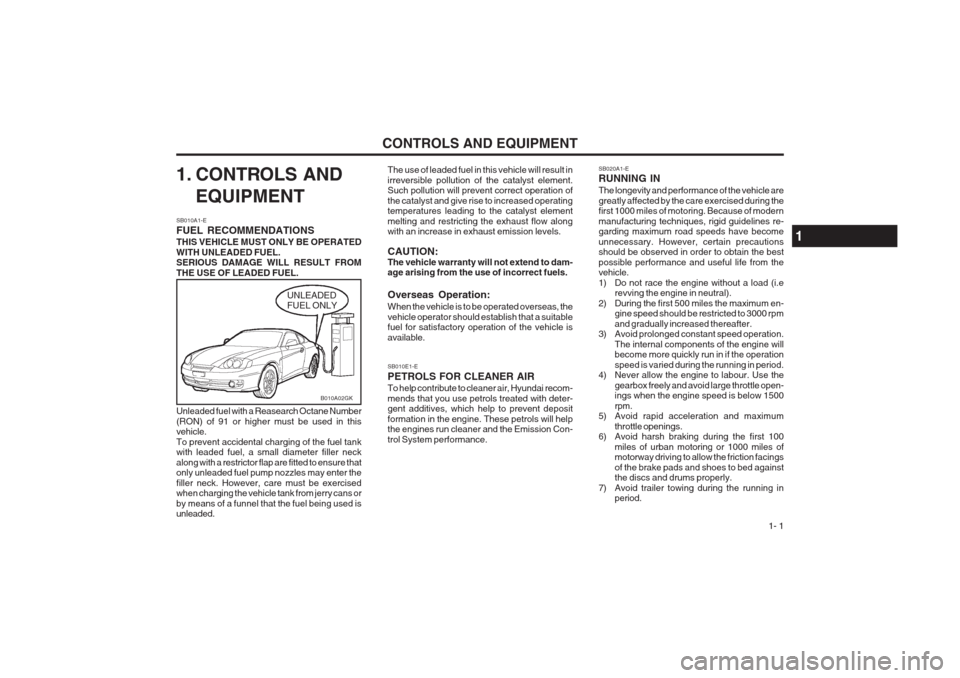
Unleaded fuel with a Reasearch Octane Number(RON) of 91 or higher must be used in this vehicle. To prevent accidental charging of the fuel tank with leaded fuel, a small diameter filler neck along with a restrictor flap are fitted to ensure that only unleaded fuel pump nozzles may enter the filler neck. However, care must be exercised when charging the vehicle tank from jerry cans or by means of a funnel that the fuel being used is unleaded.
SB010A1-E FUEL RECOMMENDATIONS THIS VEHICLE MUST ONLY BE OPERATED WITH UNLEADED FUEL. SERIOUS DAMAGE WILL RESULT FROM THE USE OF LEADED FUEL.
1
B010A02GK
UNLEADED FUEL ONLY
Page 11 of 140

CONTROLS AND EQUIPMENT1- 3
SB040B1-F Locking, unlocking front doors with a key
o The door can be locked or unlocked with a key.
o Lock the door by turning the key toward the
front of the vehicle and unlock it by turning thekey toward the rear.
HGK101-D
UNLOCK
LOCKHGK099-D
B040C01S-AAT Locking From the Outside The doors can be locked without a key. To lock the doors from the outside, first push the inside lock switch to the "LOCK" position, so that the red mark on the switch is not visible, then close the door. NOTE:
o When locking the door this way, be carefulnot to lock the door with the ignition keyleft in the vehicle.
o To protect against theft, always remove the ignition key, close all windows, and lock all doors when leaving your vehicle unattended.
HGK208-D
UNLOCK
LOCK
B040D01S-AAT Locking From the Inside To lock the doors from the inside, simply close the door and push the lock switch to the "LOCK" position. When this is done, neither the outside nor the inside door handle can be used. NOTE: When the door is locked, the red mark on the switch is not visible.
Page 12 of 140
CONTROLS AND EQUIPMENT
1- 4
HGK099-D
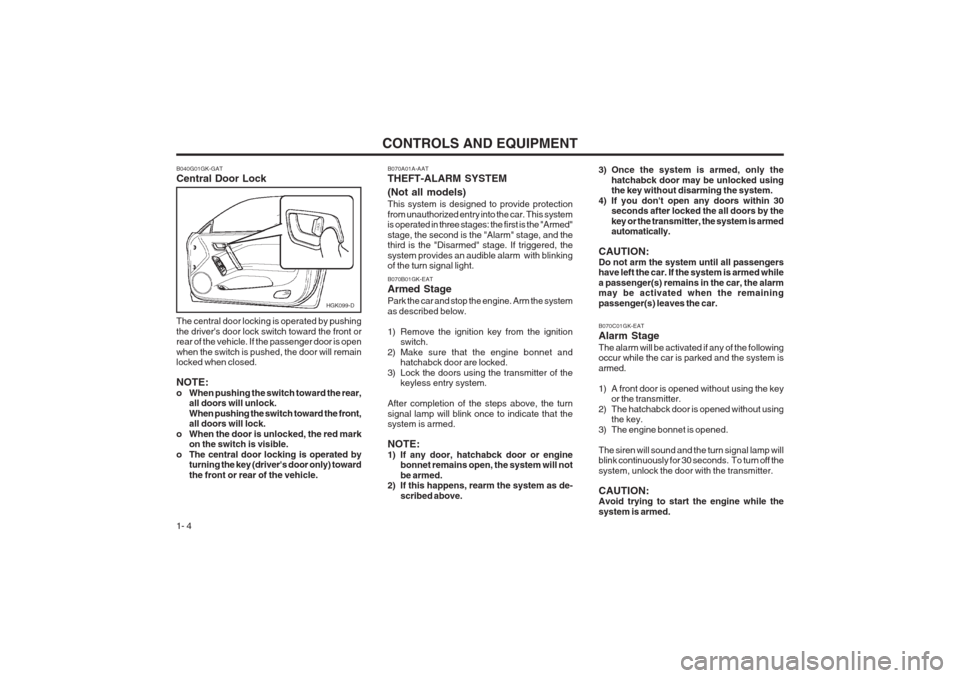
B040G01GK-GAT Central Door Lock The central door locking is operated by pushing the driver's door lock switch toward the front or rear of the vehicle. If the passenger door is open when the switch is pushed, the door will remain locked when closed. NOTE:
o When pushing the switch toward the rear, all doors will unlock.When pushing the switch toward the front, all doors will lock.
o When the door is unlocked, the red mark on the switch is visible.
o The central door locking is operated by turning the key (driver's door only) toward the front or rear of the vehicle. B070A01A-AAT THEFT-ALARM SYSTEM (Not all models) This system is designed to provide protection from unauthorized entry into the car. This system is operated in three stages: the first is the "Armed" stage, the second is the "Alarm" stage, and the third is the "Disarmed" stage. If triggered, the system provides an audible alarm with blinking of the turn signal light.
B070C01GK-EAT Alarm Stage The alarm will be activated if any of the following occur while the car is parked and the system is armed.
1) A front door is opened without using the keyor the transmitter.
2) The hatchabck door is opened without using the key.
3) The engine bonnet is opened.The siren will sound and the turn signal lamp will blink continuously for 30 seconds. To turn off the system, unlock the door with the transmitter. CAUTION: Avoid trying to start the engine while the system is armed.
B070B01GK-EAT Armed Stage Park the car and stop the engine. Arm the system as described below.
1) Remove the ignition key from the ignition
switch.
2) Make sure that the engine bonnet and hatchabck door are locked.
3) Lock the doors using the transmitter of the keyless entry system.
After completion of the steps above, the turn signal lamp will blink once to indicate that the system is armed. NOTE:
1) If any door, hatchabck door or engine bonnet remains open, the system will notbe armed.
2) If this happens, rearm the system as de-
scribed above. 3) Once the system is armed, only the
hatchabck door may be unlocked using the key without disarming the system.
4) If you don't open any doors within 30 seconds after locked the all doors by the key or the transmitter, the system is armed automatically.
CAUTION: Do not arm the system until all passengers have left the car. If the system is armed while a passenger(s) remains in the car, the alarm may be activated when the remaining passenger(s) leaves the car.
Page 20 of 140
CONTROLS AND EQUIPMENT
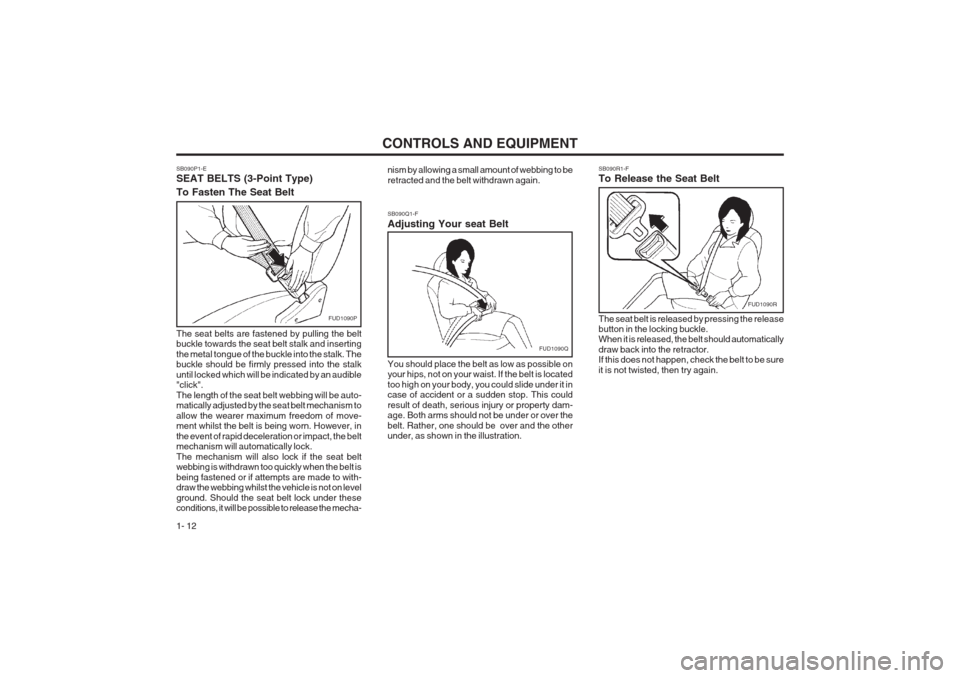
1- 12 SB090R1-F To Release the Seat Belt
FUD1090R
The seat belt is released by pressing the release button in the locking buckle.When it is released, the belt should automatically draw back into the retractor. If this does not happen, check the belt to be sure it is not twisted, then try again.
SB090P1-E SEAT BELTS (3-Point Type) To Fasten The Seat Belt
SB090Q1-F Adjusting Your seat BeltFUD1090P
The seat belts are fastened by pulling the belt buckle towards the seat belt stalk and inserting the metal tongue of the buckle into the stalk. The buckle should be firmly pressed into the stalk until locked which will be indicated by an audible "click". The length of the seat belt webbing will be auto- matically adjusted by the seat belt mechanism to allow the wearer maximum freedom of move- ment whilst the belt is being worn. However, in the event of rapid deceleration or impact, the belt mechanism will automatically lock. The mechanism will also lock if the seat belt webbing is withdrawn too quickly when the belt is being fastened or if attempts are made to with- draw the webbing whilst the vehicle is not on level ground. Should the seat belt lock under these conditions, it will be possible to release the mecha-
FUD1090Q
You should place the belt as low as possible on your hips, not on your waist. If the belt is located too high on your body, you could slide under it in case of accident or a sudden stop. This could result of death, serious injury or property dam- age. Both arms should not be under or over the belt. Rather, one should be over and the other under, as shown in the illustration.
nism by allowing a small amount of webbing to be retracted and the belt withdrawn again.
Page 22 of 140
CONTROLS AND EQUIPMENT
1- 14
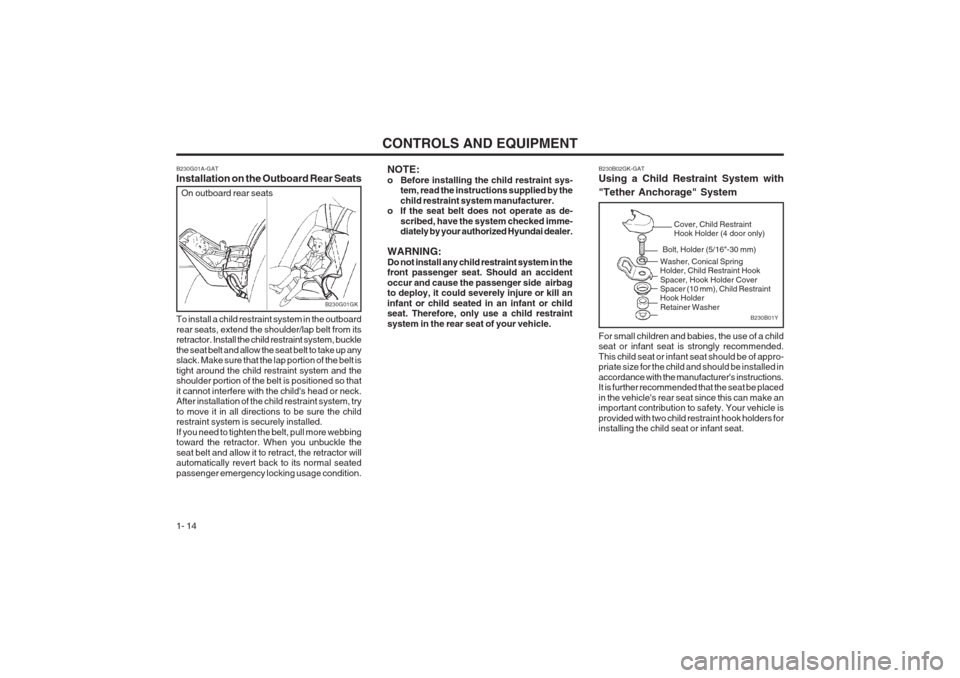
B230G01A-GAT Installation on the Outboard Rear Seats
B230G01GK
On outboard rear seats
To install a child restraint system in the outboard rear seats, extend the shoulder/lap belt from its retractor. Install the child restraint system, buckle the seat belt and allow the seat belt to take up any slack. Make sure that the lap portion of the belt is tight around the child restraint system and the shoulder portion of the belt is positioned so that it cannot interfere with the child's head or neck. After installation of the child restraint system, try to move it in all directions to be sure the child restraint system is securely installed. If you need to tighten the belt, pull more webbing toward the retractor. When you unbuckle the seat belt and allow it to retract, the retractor will automatically revert back to its normal seated passenger emergency locking usage condition. NOTE:
o Before installing the child restraint sys-
tem, read the instructions supplied by thechild restraint system manufacturer.
o If the seat belt does not operate as de-
scribed, have the system checked imme- diately by your authorized Hyundai dealer.
WARNING: Do not install any child restraint system in the front passenger seat. Should an accident occur and cause the passenger side airbag to deploy, it could severely injure or kill an infant or child seated in an infant or child seat. Therefore, only use a child restraint system in the rear seat of your vehicle. B230B02GK-GAT Using a Child Restraint System with "Tether Anchorage" System For small children and babies, the use of a child seat or infant seat is strongly recommended. This child seat or infant seat should be of appro- priate size for the child and should be installed in accordance with the manufacturer's instructions. It is further recommended that the seat be placed in the vehicle's rear seat since this can make an important contribution to safety. Your vehicle is provided with two child restraint hook holders for installing the child seat or infant seat.
B230B01Y
Cover, Child Restraint Hook Holder (4 door only)
Bolt, Holder (5/16"-30 mm)
Washer, Conical SpringHolder, Child Restraint Hook Spacer, Hook Holder Cover Spacer (10 mm), Child RestraintHook Holder Retainer Washer
Page 31 of 140
CONTROLS AND EQUIPMENT1- 23
o If you sell your vehicle, be sure to inform
the new owner of these important points and make certain that this manual is transferred to the new owner together with the vehicle.
o If your car was flooded and has soaked carpeting or water on flooring, you shouldn't try to start engine; have car towed to authorized Hyundai dealer.
Page 35 of 140
CONTROLS AND EQUIPMENT1- 27
SB2100I-E
DOOR AJAR WARNING LAMP
The door ajar warning lamp indicates that a door is not correctly closed. Ensure that the lamp is extinguished prior to driving the vehicle.
SB210P1-E
LOW FUEL LEVEL WARNING LAMP
The low fuel warning lamp serves to warn the driver that the remaining fuel quantity is approxi- mately 9 litres and that the vehicle should be refuelled. If the vehicle is driven for an extended period with the low fuel warning lamp illuminated there exists a possibility that misfiring due to fuel
defective, approximately fifty per cent of thenormal braking performance will be available. If failure of one of the circuits occurs, the required amount of pedal effort, pedal travel and stopping distance will be increased. Use of the gearbox is recommended to assist in bringing the vehicle to rest. The vehicle must not be driven once brake failure has occurred until the system has been repaired and is functioning normally. The braking system employs a vacuum servo in order that the pedal efforts are reduced. Power for the servo is derived from the engine and therefore, in the event of the engine stopping or the vehicle being towed, pedal efforts will be substantially increased.
SB210M1-E CHARGING SYSTEM WARNING LAMP
The charging system warning lamp should illumi- nate when the ignition switch is turned to the "ON" position and should be extinguished when the engine is started. If the lamp fails to illuminate when the ignition is turned "ON" or fails to extin- guish after starting the engine, the nearest Hyundai dealer should be contacted. If the lamp illuminates whilst the vehicle is being driven, stop the vehicle as soon as it is safe to do so and check the condition of the generator drive belt. If the belt is in place and the tension is satisfactory, the advice of a Hyundai dealer should be sought.
B260H01GK-EAT PARKING BRAKE/BRAKE FLUID LEVEL WARNING LAMP
WARNING: In the event of problems being suspected with the braking system, the advice of the nearest Hyundai dealer must be sought be- fore the vehicle is driven. Driving the vehicle with either an electrical or hydraulic braking system defect may be dangerous, resulting in accident or personal injury. Warning lamp operation The parking brake/brake fluid level warning lamp will be illuminated whenever the ignition switch is turned to the "ON" or "START" position when the parking brake is applied and must be extin- guished in a three seconds after the engine starts. If the warning lamp fails to extinguish or illumi- nates at any other time, the vehicle must be brought to rest in a safe location and the level of brake fluid in the reservoir checked. If the fluid level is incorrect, fluid conforming to DOT 3 or DOT 4 specifications should be added. If, after correcting the brake fluid level, the warning lamp continues to be illuminated, the advice of the nearest Hyundai dealer must be sought before the vehicle is driven again. The Hyundai Lantra is equipped with a diagonally split dual braking system which will ensure that in the event of one of the brake circuits becoming SB210N2-E
HATCHBACK DOOR OPEN WARNING LAMP
The hatchback door warning lamp indicates when the hatchback door is open or is not fully closed. Ensure that the lamp has extinguished prior to driving the vehicle.CAUTION: If the drive belt (generator belt) is loosen, broken, or missing while the vehicle is driv- ing, there may be a serious malfunction, en- gine could overheat because this belt also drives the water pump.
Page 41 of 140
CONTROLS AND EQUIPMENT1- 33
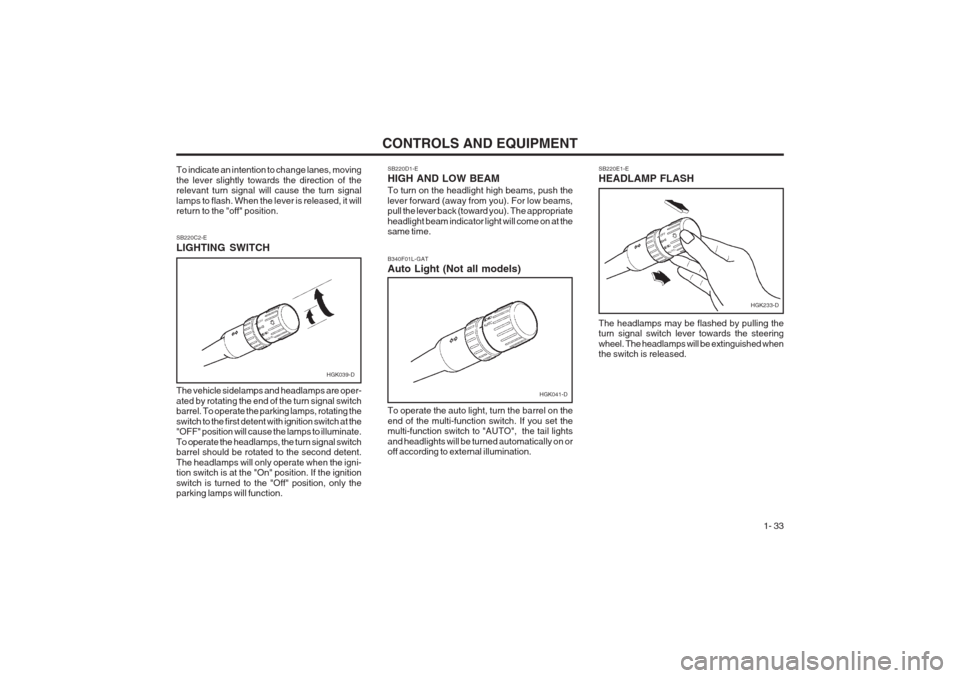
SB220D1-E HIGH AND LOW BEAM To turn on the headlight high beams, push the lever forward (away from you). For low beams, pull the lever back (toward you). The appropriate headlight beam indicator light will come on at the same time.
SB220E1-E HEADLAMP FLASH
SB220C2-E LIGHTING SWITCH The vehicle sidelamps and headlamps are oper- ated by rotating the end of the turn signal switch barrel. To operate the parking lamps, rotating the switch to the first detent with ignition switch at the "OFF" position will cause the lamps to illuminate. To operate the headlamps, the turn signal switch barrel should be rotated to the second detent. The headlamps will only operate when the igni- tion switch is at the "On" position. If the ignition switch is turned to the "Off" position, only the parking lamps will function. The headlamps may be flashed by pulling theturn signal switch lever towards the steering wheel. The headlamps will be extinguished when the switch is released.
To indicate an intention to change lanes, moving the lever slightly towards the direction of the relevant turn signal will cause the turn signal lamps to flash. When the lever is released, it will return to the "off" position.
HGK039-D
To operate the auto light, turn the barrel on the end of the multi-function switch. If you set the multi-function switch to "AUTO", the tail lights and headlights will be turned automatically on or off according to external illumination.
B340F01L-GAT Auto Light (Not all models)
HGK041-D
HGK233-D
Page 42 of 140
CONTROLS AND EQUIPMENT
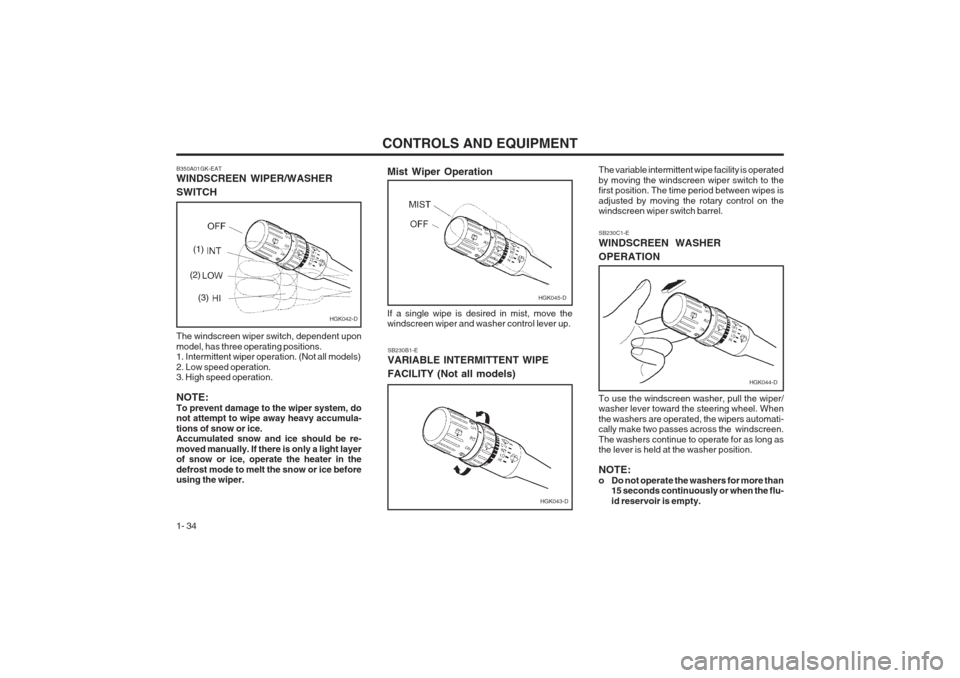
1- 34 SB230B1-E VARIABLE INTERMITTENT WIPE FACILITY (Not all models)
B350A01GK-EAT WINDSCREEN WIPER/WASHER SWITCH The windscreen wiper switch, dependent upon model, has three operating positions. 1. Intermittent wiper operation. (Not all models) 2. Low speed operation. 3. High speed operation. NOTE: To prevent damage to the wiper system, do not attempt to wipe away heavy accumula- tions of snow or ice. Accumulated snow and ice should be re- moved manually. If there is only a light layer of snow or ice, operate the heater in the defrost mode to melt the snow or ice before using the wiper. The variable intermittent wipe facility is operated by moving the windscreen wiper switch to the first position. The time period between wipes is adjusted by moving the rotary control on the windscreen wiper switch barrel. SB230C1-E WINDSCREEN WASHER OPERATION To use the windscreen washer, pull the wiper/ washer lever toward the steering wheel. When the washers are operated, the wipers automati- cally make two passes across the windscreen. The washers continue to operate for as long as the lever is held at the washer position. NOTE:
o Do not operate the washers for more than
15 seconds continuously or when the flu-id reservoir is empty.
HGK042-D
(1)
(2) (3)
HGK043-D
Mist Wiper Operation
HGK045-D
If a single wipe is desired in mist, move the windscreen wiper and washer control lever up.
HGK044-D