radio Hyundai Coupe 2003 User Guide
[x] Cancel search | Manufacturer: HYUNDAI, Model Year: 2003, Model line: Coupe, Model: Hyundai Coupe 2003Pages: 310, PDF Size: 2.87 MB
Page 90 of 310

FEATURES OF YOUR HYUNDAI
1- 82
6.Adjust Treble Press
button and then multifunction button
(2) "-" or "+". TREB and the set value are dis- played. Set the desired treble via both buttons. Center setting: Press both buttons simulta- neously.
7. Adjust Balance Press
button and then multifunction button (3)
" " or " ". BAL and the set value are displayed. Set the desired balance via both buttons. Center setting: Press both buttons simulta- neously.
8. Fader Press
button and then multifunction button (4)
" " or " ". FAD and the set value are displayed. Set the desired fade level via both buttons. Center setting: Press both buttons simulta- neously.
9. Loudness On / Off Press
button and then multifunction button (5)
"LD". LOUD ON or LOUD OFF are displayed. The loudness can be switched on or off alter-nately by pressing the multifunction button.
10.Linear Adjustment It controls the amplification ratio from high to low tone. Activate tone menu. Then again press andhold button
for more than 2 seconds. The
tone values for the set signal source (e.g. radio/ FM) are set to an average value FM LINEAR.Press and hold
button for more than 4 sec-
onds. All tone values for the signal sources radio and tape /CD are set to an average value ALLLINEAR. 11.Adjust Mono /Stereo Three different reception optimization setting can be set in order to suppress reception dependentinterference and reflections.Repeatedly press multifunction button (6) "ST" intone menu until the desired optimization is set. AUTO: Setting for normal operation - i.e., the unit switches from stereo to mono and back depend-ing upon reception location (provides the opti-mum setting for almost all reception areas). STEREO: Setting for unusual reception situa- tions - i.e. the unit is set permanently to stereo(e.g. for private radio stations in city areas) MONO: Setting for reception conditions in which reflections constantly occur - i.e., the unit is setconstantly to mono.The setting is effective immediately after press-ing the multifunction button "ST" and is alsoretained on switching off.
B260D01GK-GAT RADIO OPERATION
1. Select operating Mode Press
Button. The operating mode. Radio,
CD can be selected. The last selected operating mode is selectedafter the button is pressed for the first time. If theother operating modes are to be selected, pressthe
button quickly and repeatedly until the
desired operating mode is selected.
2. Select Waveband Press
button repeatedly until desired
waveband FM 1, FM 2 or AM is selected. When changing the waveband, the last selected stationis selected.
3. Switch on radio menu mode Press
button. The radio menu mode is
switched on and displayed, The unit switches back to the normal display if no buttons arepressed within the next 8 seconds.
4. Radio Operation Setting procedures for station selection. The desired broadcasting station can be se-lected via station search, manual tuning,autostore, direct frequency input and stationbuttons.
Page 91 of 310

FEATURES OF YOUR HYUNDAI 1- 83
5. FM, AM station search Turn the right rotary control to the left/right in desired waveband. The radio searches in de-scending/ascending order.
6. Scan search In the desired waveband (FM or AM) press the right rotary control, SC is displayed. An auto-matic station search is started. The first search isperformed on an insensitive plane, all furthersearches on a sensitive plane. Receivable sta-tions can be heard for 8 seconds. Press the rightrotary control if the received program should beretained.
7. Direct frequency input Select radio menu mode and then, within 8 sec- onds, enter the frequency using the multifunctionbuttons. 8. FM /AM station - retrieve/store Store: 10 frequencies or programs can be stored respectively on each of wavebands FM 1, FM 2and AM.Press multifunction button for 2 - 4 seconds inorder to store the desired station or program. Retrieve: press multifunction button "1-0". The stored station is requested.The frequency is displayed if the station cannotbe identified.
9.AM / FM autostore Select desired wave band. Select radio menu mode by pressing
button. Then Press multi-
function button "AS" repeatedly until AS-SEEK is displayed. The 10 stations with the best recep-tion are stored under the station buttons in orderof quality. The auto store plane is identified on thedisplay by AS. Select radio menu mode in orderto quit the autostore storage plane. Then pressmultifunction button "AS". The radio switchesback to the station button plane. 10.Manual tuning Select radio menu and the turn the right rotary control.Turning steps of 100 kHz (FM) or 9 kHz (AM) areperformer.Pressing the right rotary control switches to finetuning (1 kHz steps) for AM. The function is quitif there is no further actuation within 10 seconds.
B260B04GK
B260E01GK-GAT CD OPERATION 1.CDs - insert / eject Press
button briefly; the display folds down-
wards and the CD slot with the printed side upwards. The unit pulls in the CD automaticallyand begins to play the disc from the first track.Then fold the display up again. After playing thelast track, the unit automatically begins to playthe first track of the CD again. If there is alreadya CD in the CD slot, press
button repeatedly
until CD appears on the display. In order to eject a CD, press
button briefly; the display folds
downward and the CD is ejected. Then remove the CD. Then fold the display up again. NOTE: The CD is not ejected when the unit is switchedoff but remains in the CD slot.
2. Track skip - forwards / reverse Turn right rotary control to right/left. If the track has been playing for longer than 10seconds when the return function is triggered, areturn to the beginning of the track takes place.Through further turning of the right rotary control,several tracks can be skipped over in forward orreverse directions. Skip returns to the first to thelast track.
Page 97 of 310

DRIVING YOUR HYUNDAI
2- 2 C040A01A-AAT KEY POSITIONS WARNING: The engine should not be turned off or thekey removed from the ignition key cylinderwhile the vehicle is in motion. The steeringwheel is locked by removing the key.
C020A01A-AAT BEFORE STARTING THE ENGINEBefore you start the engine, you should always:
1. Look around the vehicle to be sure there are
no flat tires, puddles of oil, water or other indications of possible trouble.
2. After entering the car, check to be sure the parking brake is engaged.
3. Check that all windows, and lights are clean.
4. Check that the interior and exterior mirrors are clean and in position.
5. Check your seat, seatback and headrest to be sure they are in their proper positions.
6. Close all the doors.
7. Fasten your seat belt and be sure that all other occupants have fastened theirs.
8. Turn off all lights and accessories that are not needed.
9. When you turn the ignition switch to "ON", check that all appropriate warning lights areoperating and that you have sufficient fuel.
10. Check the operation of warning lights and all bulbs when key is in the "ON" position. o To start the engine, insert the ignition key and
turn it to the "START" position. Release it assoon as the engine starts. Do not hold the keyin the "START" position for more than 15seconds.
NOTE:For safety, the engine will not start if the shiftlever is not in "P" or "N" Position (AutomaticTransaxle).
C030A01A-GAT COMBINATION IGNITION SWITCH To Start the Engine
o If your Hyundai is equipped with a manual transaxle, place the shift lever in neutral and depress the clutch pedal fully.
o If your Hyundai has an automatic transaxle, place the shift lever in "P" (park). o "START"The engine is started in this position. It will crankuntil you release the key. NOTE: Do not hold the key in the "START" positionfor more than 15 seconds.
o "ON" When the key is in the "ON" position, the ignition is on and all accessories may be turned on. If theengine is not running, the key should not be leftin the "ON" position. This will discharge thebattery and may also damage the ignition sys-tem.
o "ACC" With the key in the "ACC" position, some electri-cal accessories (radio, etc.) may be operated.
o "LOCK" The key can be removed or inserted in thisposition.To protect against theft, the steering wheel locksby removing the key. NOTE: To unlocking the steering wheel, insert thekey, and then turn the steering wheel and keysimultaneously.
C040A01E
LOCK
ACC
ON
START
Page 140 of 310
DO-IT-YOURSELF MAINTENANCE
6-8 5. Replace the radiator and reservoir caps and
check to be sure the drain cocks are fully closed and not leaking.
WARNING: The cooling fan is controlled by engine cool- ant temperature and may sometimes oper-ate even when the engine is not running.Use extreme caution when working near theblades of the coolant fan so that you are notinjured by a rotating fan blade. As the en-gine coolant temperature decreases, the fanwill automatically shut off. This is a normalcondition. G060A02Y-GAT
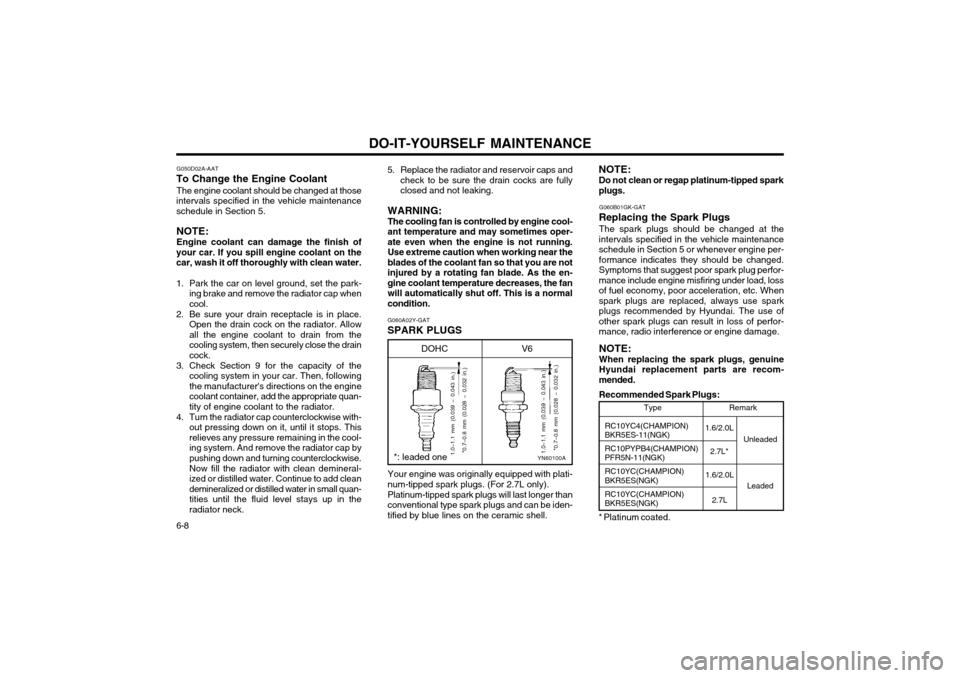
SPARK PLUGS
YN60100A
V6
Your engine was originally equipped with plati- num-tipped spark plugs. (For 2.7L only). Platinum-tipped spark plugs will last longer than conventional type spark plugs and can be iden-tified by blue lines on the ceramic shell. NOTE: Do not clean or regap platinum-tipped spark plugs.
G060B01GK-GAT
Replacing the Spark Plugs The spark plugs should be changed at the
intervals specified in the vehicle maintenanceschedule in Section 5 or whenever engine per-formance indicates they should be changed.Symptoms that suggest poor spark plug perfor-mance include engine misfiring under load, lossof fuel economy, poor acceleration, etc. Whenspark plugs are replaced, always use sparkplugs recommended by Hyundai. The use ofother spark plugs can result in loss of perfor-mance, radio interference or engine damage.
NOTE: When replacing the spark plugs, genuine
Hyundai replacement parts are recom- mended. Recommended Spark Plugs:
Type
RC10YC4(CHAMPION) BKR5ES-11(NGK) RC10PYPB4(CHAMPION) PFR5N-11(NGK) RC10YC(CHAMPION) BKR5ES(NGK) RC10YC(CHAMPION) BKR5ES(NGK) Remark
Unleaded
Leaded
1.6/2.0L 2.7L*
2.7L
1.6/2.0L
1.0~1.1 mm (0.039 ~ 0.043 in.)*0.7~0.8 mm (0.028 ~ 0.032 in.)*: leaded one
G050D02A-AAT
To Change the Engine Coolant
The engine coolant should be changed at those
intervals specified in the vehicle maintenance schedule in Section 5.
NOTE: Engine coolant can damage the finish of
your car. If you spill engine coolant on the car, wash it off thoroughly with clean water.
1. Park the car on level ground, set the park- ing brake and remove the radiator cap when cool.
2. Be sure your drain receptacle is in place. Open the drain cock on the radiator. Allowall the engine coolant to drain from thecooling system, then securely close the draincock.
3. Check Section 9 for the capacity of the cooling system in your car. Then, followingthe manufacturer's directions on the enginecoolant container, add the appropriate quan-tity of engine coolant to the radiator.
4. Turn the radiator cap counterclockwise with- out pressing down on it, until it stops. Thisrelieves any pressure remaining in the cool-ing system. And remove the radiator cap bypushing down and turning counterclockwise. Now fill the radiator with clean demineral- ized or distilled water. Continue to add cleandemineralized or distilled water in small quan-tities until the fluid level stays up in theradiator neck. DOHC1.0~1.1 mm (0.039 ~ 0.043 in.)
*0.7~0.8 mm (0.028 ~ 0.032 in.)
* Platinum coated.
Page 150 of 310

DO-IT-YOURSELF MAINTENANCE
6-18 CAUTION: A burned-out fuse indicates that there is a problem in the electrical circuit. If you re-place a fuse and it blows as soon as theaccessory is turned on, the problem is seri-ous and should be referred to a Hyundaidealer for diagnosis and repair. Never re-place a fuse with anything except a fusewith the same or a lower amperage rating. Ahigher capacity fuse could cause damageand create a fire hazard. NOTE: See page 6-23 for the fuse panel descrip- tions.
Burned out
G200B03YGood G210A01A-AAT CHECKING THE BATTERY WARNING: Batteries can be dangerous! When working with batteries, carefully observe the follow-ing precautions to avoid serious injuries. The fluid in the battery contains a strong solu- tion of sulfuric acid, which is poisonous andhighly corrosive. Be careful not to spill it onyourself or the car. If you do spill battery fluid onyourself, immediately do the following:
o If battery fluid is on your skin, flush the
affected areas with water for at least 15 minutes and then seek medical assistance.
o If battery fluid is in your eyes, rinse out your eyes with water and get medical assistanceas soon as possible. While you are beingdriven to get medical assistance, continueto rinse your eyes by using a sponge or softcloth saturated with water.
o If you swallow battery fluid, drink a large quantity of water or milk followed by milk ofmagnesia, eat a raw egg or drink vegetableoil. Get medical assistance as soon aspossible.
While batteries are being charged (either by abattery charger or by the vehicle's alternator),they produce explosive gases. Always observethese warnings to prevent injuries from occur-ring:
4. Replace the blown fuse by pressing a new
fuse of the same rating into place. The fuseshould be a snug fit. If it is not, have the fuseclip repaired or replaced by a Hyundai dealer.If you do not have a spare fuse, you may beable to borrow a fuse of the same or lowerrating from an accessory you can tempo-rarily get along without (the radio or cigarettelighter, for example). Always remember toreplace the borrowed fuse.
AXA6201B
Page 166 of 310

INDEX
10-2
Driving
Economical driving ....................................................................... 2-11
Smooth cornering ......................................................................... 2-11
Winter driving ................................................................................ 2-11
E Emissions Control Systems ................................................................ 7-1
Engine Before starting the engine .............................................................. 2-2
Changing the oil and filter .............................................................. 6-6
Compartment .................................................................................. 6-1
Coolant ........................................................................................... 6-7
Coolant temperature gauge .......................................................... 1-29
If the engine overheats ................................................................... 3-2
Number ........................................................................................... 8-1
Oil .................................................................................................. 6-4 Oil consumption .............................................................................. 6-6
Starting ........................................................................................... 2-3
Engine Exhaust Can Be Dangerous ................................................... 2-1
FFog Li ght ........................................................................................... 1-43
Front Seats Adjustable front seats ..................................................................... 1-8
Adjustable headrests ...................................................................... 1-8Adjusting seat forward and rearward ............................................. 1-8
Adjusting seatback angle ...................... ......................................... 1-8
Lumbar support control ............... ................................................... 1-9
Seat cushion height adjustment ..................................................... 1-9
Seat warm er ................................................................................... 1-9
Fuel
Capacity .......................................................................................... 9-1
Gauge ........................................................................................... 1-28
Recommendations .......................................................................... 1-1 Fuel Filler Lid
Remote release ............................................................................ 1-45
Fuse Panel Description .......................................................... 6-23 ~ 6-24
Fuses ................................................................................................ 6-17
GGeneral Everyday Checks .................................................................. 6-4
Glove box .......................................................................................... 1-41
HHazard Warn ing System ................................................................... 1-36
Headlight Bulb ................................................................................... 6-20
Headlight Leveling Device System ................................................... 1-38
Heating and Cooling Control Rotary type ........................................................................ 1-51 ~ 1-56
Automatic type ................................................................... 1-57 ~ 1-62
High-mounted rear stoplight .............................................................. 1-44
Hood Release ................................................................................... 1-44
Horn ................................................................................................ 1-47
IIgnition Switch ..................................................................................... 2-2
Immobilizer System ............................................................................. 1-2
Infinity Sound System (B260) ........................................................... 1-80
Anti-Theft Device .......................................................................... 1-81
General operation ......................................................................... 1-81
Radio operation ............................................................................ 1-82
CD operation ................................................................................ 1-83
Instrument Cluster and Indicator ....................................................... 1-26
Instrument Panel Light Control (Rheostat) .......................................1-37
Instruments and Controls .................................................................. 1-25
Intermittent Wiper .............................................................................. 1-35
Page 167 of 310

INDEX10-3
R Rear Seats
Before Folding the Rear Seats ..................................................... 1-10
Fold down ..................................................................................... 1-10
Rear seat entry ............................................................................. 1-10
Rear Seat Pos itions ....................................................................... 1-9
Rear Window Defroster Switch ......................................................... 1-36
Rear Window Wiper and Switch .. ..................................................... 1-35
SSeat Belts 3-Point type .................................................................................. 1-13
Adjustable height .......................................................................... 1-13
Adjusting your seat belt ................................................................ 1-13
Care of seat belts ......................................................................... 1-12
Precautions ................................................................................... 1-11
Pre-tentioner Seat Belt ................................................................. 1-18
Spark Plugs ........................................................................................ 6-8
Spectacle Case ................................................................................. 1-40
Speedometer ..................................................................................... 1-30
Starting Procedures ............................................................................ 2-3Steering Wheel Free play ...................................................................................... 6-15
Tilt lever ........................................................................................ 1-47
Stereo Radio Operation (H250, H260) ....................................1-65, 1-72
Stereo Sound System ............................................................ 1-63 ~ 1-64Sun Visor .......................................................................................... 1-46
Sunroof .............................................................................................. 1-38
TTachometer ....................................................................................... 1-30
Tail Gate ........................................................................................... 1-45
TCS (Traction control system) .......................................................... 2-10
Theft Alarm System ............................................................................ 1-5
JJump Starting
...................................................................................... 3-1
K
Keys .................................................................................................. 1-2 If you lose your keys .................................................................... 3-10
Positions ......................................................................................... 2-2
L
Light Bulb Replacement .................................................................... 6-20
Lubrication Chart ................................................................................. 9-3
Luggage Net ...................................................................................... 1-47
M Maintenance Intervals Explanation of scheduled maintenance items ....................... 5-5 ~ 5-7
Maintenance under severe usage conditions ................................. 5-4
Scheduled maintenance ................................................................. 5-2
Service requirements ...................................................................... 5-1
Map Light .......................................................................................... 1-40
Mirros Day-night inside rearview ............................................................. 1-42
Outside rearview folding ............................................................... 1-42
Outsde rearview heating .............................................................. 1-41
Multi gauge ........................................................................................ 1-32
OOdometer .......................................................................................... 1-30
PParking Brake ................................................................................... 1-43
Power Steering Fluid Level ............................................................... 6-19
Page 172 of 310
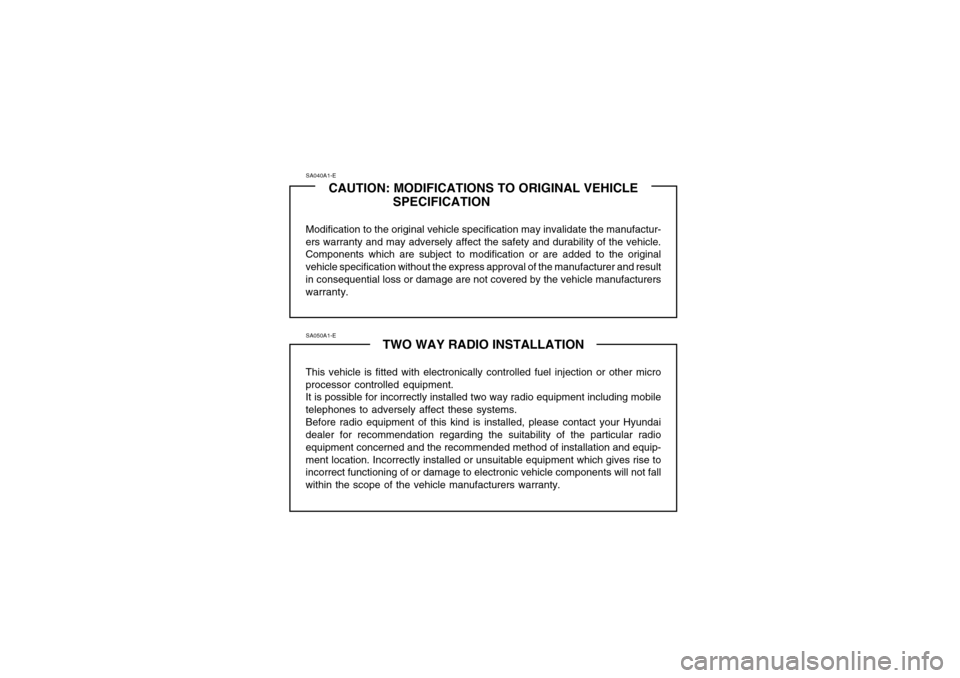
SA040A1-ECAUTION: MODIFICATIONS TO ORIGINAL VEHICLE SPECIFICATION
Modification to the original vehicle specification may invalidate the manufactur- ers warranty and may adversely affect the safety and durability of the vehicle. Components which are subject to modification or are added to the original vehicle specification without the express approval of the manufacturer and resultin consequential loss or damage are not covered by the vehicle manufacturers warranty.
SA050A1-E TWO WAY RADIO INSTALLATION
This vehicle is fitted with electronically controlled fuel injection or other micro processor controlled equipment. It is possible for incorrectly installed two way radio equipment including mobile telephones to adversely affect these systems.Before radio equipment of this kind is installed, please contact your Hyundai dealer for recommendation regarding the suitability of the particular radio equipment concerned and the recommended method of installation and equip-ment location. Incorrectly installed or unsuitable equipment which gives rise to incorrect functioning of or damage to electronic vehicle components will not fall within the scope of the vehicle manufacturers warranty.
Page 239 of 310
CONTROLS AND EQUIPMENT1- 63
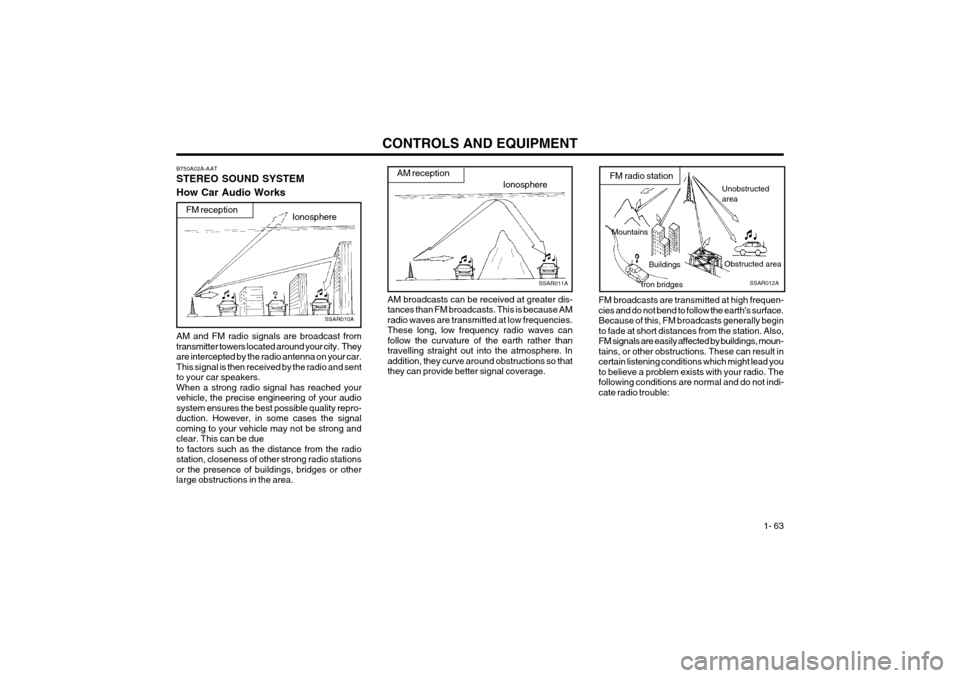
MountainsBuildings Obstructed area
Iron bridges
Unobstructed area
FM radio station
SSAR012A
Ionosphere
SSAR011A
AM receptionB750A02A-AAT STEREO SOUND SYSTEM How Car Audio Works
FM reception
SSAR010A
AM and FM radio signals are broadcast from transmitter towers located around your city. Theyare intercepted by the radio antenna on your car.This signal is then received by the radio and sentto your car speakers.When a strong radio signal has reached yourvehicle, the precise engineering of your audiosystem ensures the best possible quality repro-duction. However, in some cases the signalcoming to your vehicle may not be strong andclear. This can be dueto factors such as the distance from the radiostation, closeness of other strong radio stationsor the presence of buildings, bridges or otherlarge obstructions in the area. AM broadcasts can be received at greater dis-tances than FM broadcasts. This is because AMradio waves are transmitted at low frequencies.These long, low frequency radio waves canfollow the curvature of the earth rather thantravelling straight out into the atmosphere. Inaddition, they curve around obstructions so thatthey can provide better signal coverage.
FM broadcasts are transmitted at high frequen-cies and do not bend to follow the earth's surface.Because of this, FM broadcasts generally beginto fade at short distances from the station. Also,FM signals are easily affected by buildings, moun-tains, or other obstructions. These can result incertain listening conditions which might lead youto believe a problem exists with your radio. Thefollowing conditions are normal and do not indi-cate radio trouble:
Ionosphere
Page 240 of 310

CONTROLS AND EQUIPMENT
1- 64
SSAR014A B750B02Y-AAT Using a cellular phone or a two-way radio When a cellular phone is used inside the vehicle, noise may be produced from the audio equip-ment. This does not mean that something iswrong with the audio equipment. In such a case,use the cellular phone at a place as far aspossible from the audio equipment. CAUTION: When using a communication system such acellular phone or a radio set inside the vehi-cle, a separate external antenna must befitted. When a cellular phone or a radio set isused with an internal antenna alone, it mayinterfere with the vehicle's electrical systemand adversely affect safe operation of thevehicle. WARNING: Don't use a cellular phone when you aredriving. Stop at a safe place to use a cellularphone.SSAR013A
o Station Swapping - As an FM signal weak-ens, another more powerful signal near the same frequency may begin to play. This isbecause your radio is designed to lock ontothe clearest signal. If this occurs, selectanother station with a stronger signal.
o Multi-Path Cancellation - Radio signals being received from several directions can causedistortion or fluttering. This can be caused bya direct and reflected signal from the samestation, or by signals from two stations withclose frequencies. If this occurs, select an-other station until the condition has passed.
o Fading - As your car moves away from the
radio station, the signal will weaken and soundwill begin to fade. When this occurs, wesuggest that you select another stronger sta-tion.
o Flutter/Static - Weak FM signals or large obstructions between the transmitter and yourradio can disturb the signal causing static orfluttering noises to occur. Reducing the treblelevel may lessen this effect until the distur-bance clears.