wheel Hyundai Coupe 2003 Workshop Manual
[x] Cancel search | Manufacturer: HYUNDAI, Model Year: 2003, Model line: Coupe, Model: Hyundai Coupe 2003Pages: 310, PDF Size: 2.87 MB
Page 262 of 310
IN CASE OF EMERGENCY
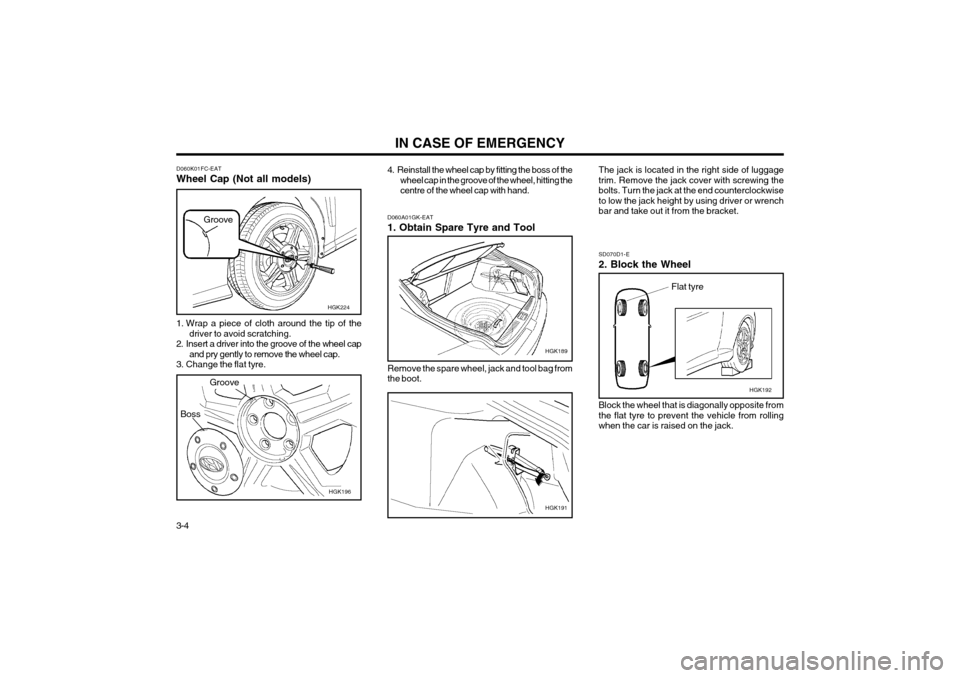
3-4 Remove the spare wheel, jack and tool bag from the boot.
SD070D1-E 2. Block the Wheel Block the wheel that is diagonally opposite from the flat tyre to prevent the vehicle from rollingwhen the car is raised on the jack.
D060A01GK-EAT 1. Obtain Spare Tyre and Tool
D060K01FC-EAT Wheel Cap (Not all models)
1. Wrap a piece of cloth around the tip of the
driver to avoid scratching.
2. Insert a driver into the groove of the wheel cap and pry gently to remove the wheel cap.
3. Change the flat tyre. 4. Reinstall the wheel cap by fitting the boss of the
wheel cap in the groove of the wheel, hitting the
centre of the wheel cap with hand.
Boss
HGK196
HGK224
Groove
Groove
HGK189
HGK191
The jack is located in the right side of luggage trim. Remove the jack cover with screwing thebolts. Turn the jack at the end counterclockwiseto low the jack height by using driver or wrenchbar and take out it from the bracket.
Flat tyre
HGK192
Page 263 of 310

3-5
IN CASE OF EMERGENCY
SD070E1-E 3. Loosen Wheel Nuts The wheel nuts should be loosened slightly be- fore raising the car. To loosen the nuts, turn thewheel brace counterclockwise. Ensure that thewheel brace socket is seated properly on the nutand that it cannot slip. Do not remove the nuts atthis stage. SD070F1-F 4. Put the Jack in Place The base of the jack should be placed on firm, level ground. The jack should be positioned asshown in the drawing.
HGK193HGK186
D060F02E-EAT 5. Raising the Car After inserting a bar into the wheel nut wrench, install the bar into the jack as shown in the draw-ing. To raise the vehicle, turn the wheel nut wrenchclockwise. As the jack begins to raise the vehicle,double check that it is properly positioned and will
not slip. If the jack is on soft ground or sand, placea board, brick, flat stone or other object under thebase of the jack to keep it from sinking.Raise the car high enough so that the fully inflatedspare tire can be installed. To do this, you will needmore ground clearance than is required to removethe flat
tyre.
WARNING:Do not get under the car when it is supportedby the jack! This is very dangerous as the jackcould fall and cause serious injury or death.No one should stay in the car while the jack isbeing used.
HFC4022
Wrench bar
Wheel nut wrench
Page 264 of 310

IN CASE OF EMERGENCY
3-6
HGK232
D060H02Y-EAT 7. Reinstall Wheel Nuts To reinstall the wheel hold it on the studs put the wheel nuts on the studs and tighten them fingertight. The nuts should be installed with their smalldiameter ends directed inward. Jiggle the tyre tobe sure it is completely seated, then tighten thenuts as much as possible with your fingers again.
WARNING:Wheels and wheel cover may have sharpedges. Handle them carefully to avoid pos-sible severe injury. Before putting the wheel into place, be sure that there is nothing on the hub or wheel(such as mud, tar, gravel, etc.) that interfereswith the wheel from fitting solidly against thehub. If there is, remove it. If there is not goodcontact on the mounting surface between thewheel and hub, the wheel nuts could comeloose and cause the loss of a wheel. Loss ofa wheel may result in loss of control of thevehicle. This may cause serious injury ordeath.
STA3071H
D060G02Y-EAT 6. Changing Wheels Loosen the wheel nuts and remove them with your fingers. Slide the wheel off the studs and layit flat so it cannot roll away. To put the wheel onthe hub, pick up the spare tyre, line up the holeswith the studs and slide the wheel onto them. Ifthis is difficult, tip the wheel slightly and get thetop hole in the wheel lined up with the top stud.Then jiggle the wheel back and forth until thewheel can be slid over the other studs.
D060H01GK
Page 265 of 310

3-7
IN CASE OF EMERGENCY
SD080A1-E VEHICLE TOWING OR RECOVERY
o OK FOR AUTOMATIC OR MANUALTRANSAXLE EQUIPPED VEHICLE
CAUTION: An incorrect tow or recovery could result in serious damage to the vehicle. If any damageto the suspension, steering or transaxle isapparent or suspected, a towing dolly mustbe used.
HGK194
SD070J1-E 8. Lower Vehicle and Tighten Nuts Lower the car to the ground turning the wheel nut wrench counterclockwise. When the vehicle isfirmly on the ground, remove the jack and tightenthe wheel nuts securely. At the first availableopportunity, the wheel nut torque should bechecked with a suitable torque wrench. Wheel nut tightening torque Steel wheel & aluminium alloy wheel:90-110 Nm. (65-80 lb.ft) SD070K1-E AFTER CHANGING WHEELS The pressure of the spare tyre should be checked at the first available opportunity. If any doubtexists as to the tyre pressure, the vehicle shouldbe driven slowly to the nearest service stationand the tyre pressure checked and adjusted asrequired.If the valve cap is lost from any of the valves, areplacement should be obtained and fitted at thefirst available opportunity. The valve cap pre-vents the ingress of dirt which may cause thevalve to stick and therefore leak and is part of thevalve sealing function. Ensure that the spare wheel, jack and wheel nut wrench as well tools are correctly located in theboot of the vehicle to prevent damage and noise.
D080A01GK
HGK195
Page 266 of 310

IN CASE OF EMERGENCY
3-8 since the steering lock is not designed to withstand the force required to hold the frontwheels straight during the tow.
o The vehicle must not be towed with the front wheels on the ground for more than thirtymiles.
SD100A2-E Automatic Transaxle Vehicle
o NOT OK FOR AUTOMATIC TRANSAXLE QUIPPED VEHICLE
o OK FOR MANUAL TRANSAXLE
The vehicle may be towed by the conventional method using the towing eye at the front of thevehicle as an attachment point.In addition, a suspended tow may be given to thefront of the vehicle without an towing dolly. In theevent of a suspended tow being given to the rearof the vehicle, the use of an towing dolly isimperative.
o OK FOR AUTOMATIC OR MANUAL TRANSAXLE EQUIPPED VEHICLE
CAUTION: The following restriction must be observedin order to avoid serious damage to thetransaxle.The vehicle must never be towed from therear with the front wheels on the ground.The vehicle must not be towed until transaxlefluid has been added to bring the level up tothe "HOT" marking on the dipstick. (The levelwill need to be reduced again after towing).The vehicle must not be towed at speedsfaster than 25 mph. or distances greater thanfifty miles. The general points regarding thesteering lock etc. described in the precedingsection (Manual transaxle vehicle) should beobserved.
D120A01A-EAT IF YOU LOSE YOUR KEYS Information about the key of immobilizer system will be found on page 1-2.
SD090A1-E Manual Transaxle Vehicle
o OK FOR AUTOMATIC OR MANUAL
TRANSAXLE EQUIPPED VEHICLE WITH NO DAMAGE
The vehicle may be towed by the conventionalmethod using the towing eye at the front of thevehicle as an attachment point. In addition, asuspended tow with or without an towing dollymay be used with either the front or the rearwheels being suspended, provided the abovecaution is observed. In addition, the following points must be noted:
o If towing by conventional means, the ignition key must be at the "ACC" position, otherwise the steering lock will be activated.
o Because the brake system and steering sys- tem power assistance is derived from theengine, the amount of effort required to stop orsteer the vehicle will be greater than normal.
o If a suspended tow is being given to the rear, the ignition key must be at the "ACC" position HGK200
D080C01GK
HGK199
Page 267 of 310

APPEARANCE CARE 4-1
retreatment programme must be observed in accordance with the Terms and Conditionsoutlined in the separate Anti Perforation War-ranty Booklet.
NOTE: The underbody should never be steam
cleaned since the underbody coating may be removed by this process.
During the interim period between power
washing the underbody, the more vulnera-ble areas such as wheel arches should behosed off particularly during the winter sea-son to prevent prolonged contact with roadsalts. Ensure that the various drain points located
at the bottom of the door panels and sillsare kept clear to prevent water from becom-ing trapped within the cavities. Whereverpossible, the parking of the vehicle in aconfined, poorly ventilated location (a ga-rage for example) should be avoided whenthe vehicle is wet or is covered with snow orice. Under these conditions, the internalcavities of the vehicle will remain damp forprolonged periods of time which will en-courage corrosion. Parking the vehicle wheregood ventilation exists (outside for example)is preferable.
SE020A1-E PROTECTING YOUR HYUNDAI FROM CORROSION By using the most advanced design and con- struction practices, every Hyundai is built toretain the original factory finish for many years.However, long term durability is also greatlydependant upon maintaining the various protec-tion systems and coatings used in manufacturesince constant, exposure to the elements willresult in a breakdown and loss of effectiveness.The following suggestions are made to assist inthe maintenance of the vehicle bodywork.
SE030A1-E UNDERBODY COATINGS Every Hyundai passenger car receives a full
underbody and cavity injection treatment during production. In order that this treatment mayretain maximum effectiveness it is recommend-ed that the underbody receives a power washand a thorough inspection after each winterseason. In doing so any accumulations of mud,which act as moisture traps and combine withroad salts to accelerate corrosion will be re-moved. In order to maintain the Anti PerforationWarranty, the requirements regarding the
SE000A1-E
4. APPEARANCE
CARE
E030A01GK-AAT VALETINGRegular cleaning of the exterior paintwork serves two important functions. Firstly, the removal of abrasive dirt and contaminants will maintain thelustre of the paintwork and will preventdiscolouration and dulling due to prolonged con-tact.Secondly, the presence of damage through im-pact or abrasion will be apparent allowing earlyrectification to be made thus preventing corro-sion from becoming established and spreadingbeneath the paint film. To avoid "water spotting"the vehicle should not be washed in direct sun-light particularly in the case of vehicles havingdark body colours. The heat from the sun rays isabsorbed by the paint film increasing the surfacetemperature. This action causes water used forwashing to evaporate quickly leaving behind thedeposits from the water and the shampoo used.Use only a shampoo intended for the purposeand ensure that the body work is thoroughlywetted to soften the dirt film prior to attempting toremove this.After removing the dirt film with a soft sponge, thebody work should be thoroughly rinsed and thendried with a good quality chamois leather toprevent streaking or spotting of the paint work.Household detergents, solvents and abrasivecleaning materials should not be used in order toavoid damaging the paint film.High pressure car washes may cause water toenter your vehicle.Plastic wheel covers should be cleaned using asponge and water. Cast alloy wheels should becleaned using a mild soap or neutral detergent.Abrasive compounds must not be used since inthe event of these damaging the lacquer coating,
4
Page 268 of 310

APPEARANCE CARE
4-2
oxidization of the aluminium wheel will occur, spoiling the appearance.The use of an a toothbrush will facilitate cleaningbetween the wheel "spokes". SE040B1-E STAIN/SPOT REMOVAL Should tree sap, dead insects or tar prove to be difficult to remove from the paint film, turpentineor a proprietary paint cutting compound may beused. Ensure that the area to be cleaned is notrubbed intensively to prevent breaking throughthe colour coat and exposing the under coat. SE040C1-E POLISHING The exterior paint work should be polished with a proprietary wax polish when water no longercollects in bead form on the paint work. Theinstructions of the product manufacturer shouldbe adhered to. SE040E1-E BUMPER MAINTENANCEThe special material from which the bumpers are manufactured warrants special attention to pre-serve the appearance of the bumpers. Avoidcontact with battery electrolyte or brake fluid andensure that accidental spillages are immediatelyflushed with water.Do not use abrasive cleaning materials whichmay damage the bumpers.
SE040F1-E ACCIDENT REPAIRSIn the event of the body work sustaining damage, the following points should be noted prior torepairs being undertaken.If body panels are replaced or repaired, anticorrosion treatment must be applied to the repairarea. The product used must be compatible withthose used in manufacture. It is recommendedthat repairs are entrusted to a Hyundai dealer toensure that replacement parts used are of thesame high quality as those used in manufactureof the vehicle and that the correct repair methodsand materials will ensure adequate levels ofcorrosion protection and the continued validity ofthe Anti Perforation Warranty. SE050A1-E INTERIOR During the winter period, it is possible that the passenger compartment flooring may becomewet from damp footwear or quantities of snowadhering to footwear. The carpet should not beallowed to remain in this condition since thecarpet may begin to create musty smells and willpromote corrosion of the floor pan in addition tothe carpet and under felt beginning to rot. SE050C1-E INTERIOR VALETINGThe soft trim and carpets should be maintained with the regular use of a vacuum cleaner. Heavysoiling should be removed with a dry cleaningagent recommended for this purpose followingthe instructions of the product manufacturer.Paint thinner, solvents or other such cleaningmaterials should not be used since damage tothe upholstery may result.
SE050D1-E SEAT BELTSSeat belts should be cleaned only with a mild soap solution. Strong detergents, solvens orbleaches may damage the belt webbing andtherefore reduce the effectiveness of the belt.Belts which display signs of fraying, wear of cutshould be replaced. SE050E1-E WINDOWSA proprietary glass cleaner should be used to clean the inside of the windows. However, therear heated windscreen must only be cleanedusing a light horizontal cleaning action. Careshould be exercised to avoid the use of abrasivecleaners or contact with items of jewellery whichmay damage the heating elements.
Avoid subjecting the bumpers to high tempera-tures such as may be encountered in high bakepaint ovens.
Page 271 of 310

VEHICLE MAINTENANCE REQUIREMENTS 5-3
I I I I II I I I I
R
III I II I I
F030C02GK-EAT R : REPLACE I : INSPECT AND, AFTER INSPECTION, CLEAN, ADJUST, REPAIR OR REPLACE IF NECESSARY
GENERAL MAINTENANCE COOLING SYSTEM COOLANT COOLANT SPECIFIC GRAVITYMANUAL TRANSAXLE OIL AUTOMATIC TRANSAXLE FLUID BRAKE PIPES, HOSES, AND CONNECTIONSBRAKE FLUID CLUTCH FLUID REAR BRAKE LININGS AND CYLINDERSBRAKE PADS SUSPENSION AND STEERING SYSTEM FRONT SUSPENSION BALL JOINTSPOLLEN FILTER (For Blower unit) REAR WHEEL BEARINGS TYRE CONDITION AND PRESSURE (incl. Spare)LUBRICATE LOCKS AND HINGES CHECK ALL ELECTRICAL SYSTEMS ROAD TESTCHECK ALL SYSTEMS WITH HI-SCAN CHECK 4 GAS DRIVE SHAFT & BOOT
MILES X 1000 MONTHS
NO. DESCRIPTION1 2 34 5 67 8 9
10 11 1213 14 1516 17 1819 20 21I I I I II I I I I
R
III I II I I
10 12 202430364048 50606072
I
R I I I I
R R I I I I
R
III I II I II
R I I I I
R R I I I I
R
III I II I I I I I I II I I I I
R
III I II I I I
R II
R I
R R I I I I
R
III I II I I
Page 274 of 310

VEHICLE MAINTENANCE REQUIREMENTS
5- 6
6ZF070D1-A
o Manual transaxle oil Inspect the manual transaxle oil according to the maintenance schedule. NOTE: If the oil level is low, check for possible leaksbefore adding oil. Do not overfill.
6ZF070H1-A
o Rear brake drums and linings/
parking brake
Check the rear brake drums and linings for scoring, burning, leaking fluid, broken parts, andexcessive wear. Inspect the parking brake sys-tem including the parking brake lever and cables.For detailed service procedures, refer to theShop Manual. 6ZF070J1-A
o Brake pads, calipers and rotorsCheck the pads for excessive wear, discs for run out and wear, and calipers for fluid leakage. 6ZF070K1-A
o Exhaust pipe and mufflerVisually inspect the exhaust pipes, muffler and hangers for cracks, deterioration, or damage.Start the engine and listen carefully for anyexhaust gas leakage. Tighten connections orreplace parts as necessary. 6ZF070L1-A
o Suspension mounting bolts Check the suspension connections for loose- ness or damage. Retighten to the specified torque.
F070E03A-AAT
o Automatic transaxle fluid The fluid level should be in the "HOT" range of the dipstick, after engine and transaxle are at normaloperating temperature. Check the AutomaticTransaxle Fluid level with the engine running andthe transaxle in neutral, with the parking brakeproperly applied. Use DIAMOND ATF SP- III,
SK ATF SP- III when adding or changing fluid. 6ZF070M1-A
o Steering gear box, linkage & boots/
lower arm ball joint
With the vehicle stopped and engine off, check for excessive freeplay in the steering wheel.Check the linkage for bends or damage. Checkthe dust boots and ball joints for deterioration,cracks, or damage. Replace any damaged parts. 6ZF070N1-A
o Power steering pump, belt and hos-
es
Check the power steering pump and hoses for leakage and damage. Replace any damaged orleaking parts immediately. Inspect the powersteering belt for evidence of cuts, cracks, exces-sive wear, oiliness and proper tension. Replaceor adjust it if necessary.
6ZF070F1-A o Brake hoses and linesVisually check for proper installation, chafing, cracks, deterioration and any leakage. Replaceany deteriorated or damaged parts immediately. 6ZF070G2-A
o Brake fluidCheck brake fluid level in the brake fluid reser- voir. The level should be between "MIN" and"MAX" marks on the side of the reservoir. Useonly hydraulic brake fluid conforming to DOT 3 orDOT 4.
6ZF070B1-A
o Cooling systemCheck the cooling system part, such as radiator, coolant reservoir, hoses and connections forleakage and damage. Replace any damagedparts. 6ZF070C1-A
o Coolant The coolant should be changed at the intervals specified in the maintenance schedule.
Page 290 of 310

OWNER MAINTENANCE 6-15
4. Replace the air filter with a new one.
5. Installation is the reverse order of disassem-bly. CAUTION:Be sure to install the air filter in the directionof the arrow sign. Otherwise, it may causenoise or deterioration. SG150A1-E STEERING WHEEL FREEPLAY Steering wheel freeplay should be checked to ensure that the specified value is not exceeded.
HGK218
SG160A1-E CLUTCH PEDAL FREEPLAY
SSA6160A
0.24 ~ 0.51 in. (6 ~ 13 mm)
The clutch pedal freeplay should be checked against the specified value. If the freeplay is notcorrect, the clutch should be adjusted by aHyundai dealer.
1.18in.(30 mm)
3. Remove the filter cover.
HGK253-D
HGK254-D