charging Hyundai Coupe 2003 Owner's Manual
[x] Cancel search | Manufacturer: HYUNDAI, Model Year: 2003, Model line: Coupe, Model: Hyundai Coupe 2003Pages: 310, PDF Size: 2.87 MB
Page 34 of 310

FEATURES OF YOUR HYUNDAI
1- 26
HGK026C
B260A01GK-GAT INSTRUMENT CLUSTER AND INDICATOR LIGHTS
1234 5 6 7 8
9 10 11 12
1314
151617 18 19 20
1. Speedometer
2. Turn Signal Indicator Light
3. Odometer/Trip Odometer
4. Automatic Transaxle Position Indicator Light (If installed)
5. Coolant Temperature Gauge
6. Trip Computer
7. Fuel Gauge 8. Tachometer
9. Traction Control Indicator Light (If installed)
10. Door Ajar Warning Light
11. Odometer/Trip Odometer Reset Knob
12. Charging System Warning Light
13. SRS (Airbag) Warning Light
14. Seat Belt Warning Light
15. High Beam Indicator Light
16. Oil Pressure Warning Light17. Malfunction Indicator Light (If installed)
18. Low Fuel Warning Light
19. Parking Brake/Brake Fluid Level Warning
Light
20. Trip Computer Reset Knob
21. Cruise Indicator (If installed)
22. Tailgate Open Warning Light
23. Anti-Lock Brake Warning Light (If installed)
2
2122
23
Page 36 of 310

FEATURES OF YOUR HYUNDAI
1- 28
B260J01S-GAT Charging System Warning Light
The charging system warning light should come on when the ignition is turned on, then go outwhen the engine is running. If the light stays onwhile the engine is running, there is a malfunctionin the electrical charging system. If the lightcomes on while you are driving, stop, turn off theengine and check under the hood. First, makecertain the generator drive belt is in place. If it is,check the tension of the belt.And then, have the system checked by yourHyundai dealer. CAUTION: If the drive belt (generator belt) is loose,broken, or mission while the vehicle is driv-ing, there may be a serious malfunction, en-gine could overheat because this belt alsodrives the water pump. B260L01A-GAT
Door Ajar Warning Light
The door ajar warning light warns you that a dooris not completely closed.
B260H01GK-AAT Parking Brake/Low Brake Fluid Level Warning Light
CAUTION: If you suspect brake trouble, have your brakeschecked by a Hyundai dealer as soon aspossible. Driving your car with a problem ineither the brake electrical system or brakehydraulic system is dangerous, and couldresult in a serious injury or death. Warning Light Operation The parking brake/brake fluid level warning light should come on when the parking brake is ap-plied and the ignition switch is turned to "ON" or"START". After the engine is started, the lightshould go out in three seconds.If the parking brake is not applied, the warninglight should come on when the ignition switch isturned to "ON" or "START", then go out in threeseconds. If the light comes on at any other time,you should slow the vehicle and bring it to acomplete stop in a safe location off the roadway.The brake fluid level warning light indicates thatthe brake fluid level in the brake master cylinderis low and hydraulic brake fluid conforming toDOT 3 or DOT 4 specifications should be added.After adding fluid, if no other trouble is found, thecar should be immediately and carefully driven toa Hyundai dealer for inspection. If further troubleis experienced, the vehicle should not be drivenat all but taken to a dealer by a professionaltowing service or some other safe method. Your Hyundai is equipped with dual-diagonalbraking systems. This means you still have brak-ing on two wheels even if one of the dual systemsshould fail. With only one of the dual systemsworking, more than normal pedal travel andgreater pedal pressure are required to stop thecar. Also, the car will not stop in as short adistance with only half of the brake system work-ing. If the brakes fail while you are driving, shift toa lower gear for additional engine braking andstop the car as soon as it is safe to do so.
B260M01A-AAT
Low Fuel Level Warning Light
The low fuel level warning light comes on when the fuel tank is approaching empty. When itcomes on, you should add fuel as soon aspossible. Driving with the fuel level warning lighton or with the fuel level below "E" can cause theengine to misfire and damage the catalytic con-verter.
B260K01F-AAT Tail Gate Open Warning Light
This light remains on unless the tail gate is completely closed.
B265C01O-AAT Traction Control Indicator Lights (If installed)
The traction control indicators change operation according to the ignition switch position andwhether the system is in operation or not.They will illuminate when the ignition key isturned to the "ON" position, but should go outafter three seconds. If the TCS or TCS-OFF
Page 110 of 310
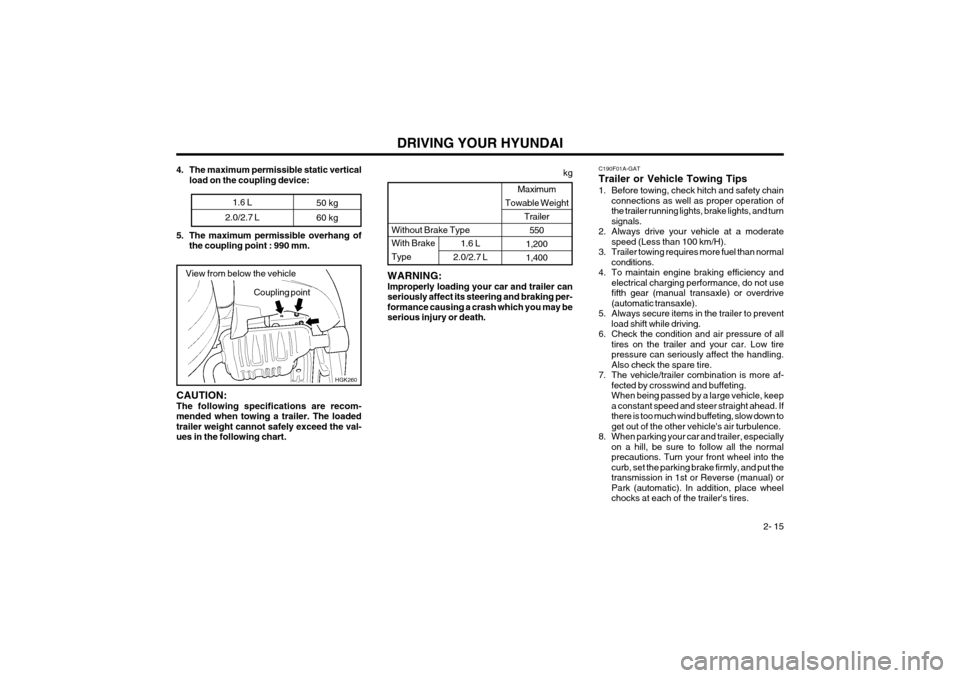
DRIVING YOUR HYUNDAI 2- 15
Maximum
Towable Weight Trailer550
1,200 1,400
CAUTION: The following specifications are recom-
mended when towing a trailer. The loadedtrailer weight cannot safely exceed the val-ues in the following chart.
kg
With Brake Type1.6 L
2.0/2.7 L
4. The maximum permissible static vertical
load on the coupling device:
WARNING: Improperly loading your car and trailer can
seriously affect its steering and braking per-formance causing a crash which you may be
serious injury or death.Without Brake Type
Coupling point
HGK260
1.6 L
2.0/2.7 L 50 kg 60 kg
View from below the vehicle
5. The maximum permissible overhang of
the coupling point : 990 mm.
C190F01A-GAT Trailer or Vehicle Towing Tips
1. Before towing, check hitch and safety chainconnections as well as proper operation of the trailer running lights, brake lights, and turnsignals.
2. Always drive your vehicle at a moderate speed (Less than 100 km/H).
3. Trailer towing requires more fuel than normal conditions.
4. To maintain engine braking efficiency and electrical charging performance, do not usefifth gear (manual transaxle) or overdrive(automatic transaxle).
5. Always secure items in the trailer to prevent load shift while driving.
6. Check the condition and air pressure of all tires on the trailer and your car. Low tirepressure can seriously affect the handling.Also check the spare tire.
7. The vehicle/trailer combination is more af- fected by crosswind and buffeting.When being passed by a large vehicle, keepa constant speed and steer straight ahead. Ifthere is too much wind buffeting, slow down toget out of the other vehicle's air turbulence.
8. When parking your car and trailer, especially on a hill, be sure to follow all the normalprecautions. Turn your front wheel into thecurb, set the parking brake firmly, and put thetransmission in 1st or Reverse (manual) orPark (automatic). In addition, place wheelchocks at each of the trailer's tires.
Page 113 of 310

WHAT TO DO IN AN EMERGENCY
3-2
tance. Automobile batteries contain sulfuric acid. This is poisonous and highly corrosive.When jump starting, wear protective glassesand be careful not to get acid on yourself,your clothing or on the car.
o If you should accidentally get acid on your
skin or in your eyes, immediately remove any contaminated clothing and flush the area withclear water for at least 15 minutes. Thenpromptly obtain medical attention. If you mustbe transported to an emergency facility, con-tinue to apply water to the affected area witha sponge or cloth.
o The gas produced by the battery during the jump-start operation is highly explosive. Donot smoke or allow a spark or open flame inthe vicinity.
o The battery being used to provide the jump start must be 12-volt. If you cannot determinethat it is a 12-volt battery, do not attempt touse it for the jump start.
o To jump start a car with a discharged battery, follow this procedure exactly:
1. If the booster battery is installed in another vehicle, be sure the two vehicles are nottouching.
2. Turn off all unnecessary lights and acces- sories in both vehicles. 3. Attach the clamps of the jumper cable in the
exact location shown on the previous page.First, attach one clamp of the jumper cable tothe positive (+) post or cable of the dis-charged battery. Then attach the other end ofthe same cable to the positive (+) post orcable of the booster battery. Next, using theother cable, attach one clamp to the negative(-) post or cable of the booster battery. Thenattach the other end of that cable to a solidmetal part of the engine away from thebattery. Do not connect the cable to anymoving part.
4. Start the engine in the car with the booster battery and let it run for a few minutes. Thiswill help to assure that the booster battery isfully charged. During the jumping operation,run the engine in this vehicle at about 2000rpm.
5. Start the engine in the car with the discharged battery using the normal starting procedure.After the engine starts, leave the jumpercables connected and let the engine run atfast idle or about 2000 rpm for several min-utes.
6. Carefully remove the jumper cables in the reverse order of attachment.
If you do not know why your battery becamedischarged (because the lights were left on,etc.), have the charging system checked by yourHyundai dealer. D030A02A-AAT IF THE ENGINE OVERHEATSIf your temperature gauge indicates overheating, you experience a loss of power, or hear loudpinging or knocking, the engine is probably toohot. If this happens to you, you should:
1. Pull off the road and stop as soon as it is safe
to do so.
2. Place the gear selector lever in "P" (auto- matic), or neutral (manual transaxle) and set the parking brake. If the air conditioning is on,turn it off.
3. If engine coolant is running out under the car or steam is coming out from the hood, stopthe engine. Do not open the hood until theengine coolant has stopped running or thesteaming has stopped. If there is no visibleloss of engine coolant and no steam, leavethe engine running and check to be sure theengine cooling fan is operating. If the fan isnot running, turn the engine off.
4. Check to see if the water pump drive belt is missing. If it is not missing, check to see thatit is tight. If the drive belt seems to be satis-factory, check for engine coolant leaking fromthe radiator, hoses or under the car. (If the airconditioning had been in use, it is normal forcold water to be draining from it when youstop).
WARNING:While the engine is running, keep hair, hands,and clothing away from moving parts such asthe fan and drive belts to prevent injury.
Page 177 of 310

CONTROLS AND EQUIPMENT1- 1
The use of leaded fuel in this vehicle will result in irreversible pollution of the catalyst element.Such pollution will prevent correct operation ofthe catalyst and give rise to increased operatingtemperatures leading to the catalyst elementmelting and restricting the exhaust flow alongwith an increase in exhaust emission levels. CAUTION: The vehicle warranty will not extend to dam-age arising from the use of incorrect fuels. Overseas Operation: When the vehicle is to be operated overseas, the vehicle operator should establish that a suitablefuel for satisfactory operation of the vehicle isavailable.
B020A01S-EAT RUNNING INThe longevity and performance of the vehicle are greatly affected by the care exercised during thefirst 1,000 miles of motoring. Because of modernmanufacturing techniques, rigid guidelines re-garding maximum road speeds have becomeunnecessary. However, certain precautionsshould be observed in order to obtain the bestpossible performance and useful life from thevehicle.
1) Do not race the engine without a load (i.e
revving the engine in neutral).
2) During the first 500 miles the maximum en- gine speed should be restricted to 3,000 rpmand gradually increased thereafter.
3) Avoid prolonged constant speed operation. The internal components of the engine willbecome more quickly run in if the operationspeed is varied during the running in period.
4) Never allow the engine to labour. Use the gearbox freely and avoid large throttle open-ings when the engine speed is below 1,500rpm.
5) Avoid rapid acceleration and maximum throttle openings.
6) Avoid harsh braking during the first 100 miles of urban motoring or 1,000 miles ofmotorway driving to allow the friction facingsof the brake pads and shoes to bed againstthe discs and drums properly.
7) No trailer towing should be undertaken dur- ing the running in period.
1. CONTROLS AND
EQUIPMENT
B010E01A-EAT PETROLS FOR CLEANER AIR To help contribute to cleaner air, Hyundai recom- mends that you use petrols treated with deter-gent additives, which help to prevent depositformation in the engine. These petrols will helpthe engines run cleaner and the Emission Con-trol System performance.
Unleaded fuel with a Reasearch Octane Number(RON) of 91 or higher must be used in thisvehicle.To prevent accidental charging of the fuel tankwith leaded fuel, a small diameter filler neckalong with a restrictor flap are fitted to ensure thatonly unleaded fuel pump nozzles may enter thefiller neck. However, care must be exercisedwhen refuelling the vehicle tank from jerry cansor by means of a funnel that the fuel being usedis unleaded.
B010A01A-EAT FUEL RECOMMENDATIONS THIS VEHICLE MUST ONLY BE OPERATED WITH UNLEADED FUEL.SERIOUS DAMAGE WILL RESULT FROMTHE USE OF LEADED FUEL.
1
B010A02GK
UNLEADED FUEL ONLY
Page 202 of 310

CONTROLS AND EQUIPMENT
1- 26 HGK026UK
1
234 5 67 8
910 1112 13 14
151617 18 1920 21
2
2223
B260A01GK-EAT INSTRUMENT CLUSTER AND INDICATOR LIGHTS
1. Speedometer
2. Turn Signal Indicator Light
3. Odometer/Trip Odometer
4. Automatic Transaxle Position Indicator Light (Not all models)
5. Coolant Temperature Gauge
6. Trip Computer
7. Fuel Gauge
8. Tachometer 9. Traction Control Indicator Light
(Not all models)
10. Door Ajar Warning Light
11. Odometer/Trip Odometer Reset Knob
12. Charging System Warning Light
13. SRS (Airbag) Warning Light
14. Seat Belt Warning Light
15. High Beam Indicator Light
16. Oil Pressure Warning Light 17. Malfuction Indicator Light (Not all models)
18. Low Fuel Warning Light
19. Parking Brake/Brake Fluide Level Warning
Light
20. Trip Computer Reset Knob
21. Cruise Indicator (Not all models)
22. Hatchback door Open Warning Light
23. Anti-Lock Brake Warning Light (Not all models)
Page 204 of 310

CONTROLS AND EQUIPMENT
1- 28 SB2100I-E
DOOR AJAR WARNING LAMP
The door ajar warning lamp indicates that a door is not correctly closed. Ensure that the lamp isextinguished prior to driving the vehicle.
SB210P1-E
LOW FUEL LEVEL WARNING LAMP
The low fuel warning lamp serves to warn the driver that the remaining fuel quantity is approxi-mately 9 litres and that the vehicle should berefuelled. If the vehicle is driven for an extendedperiod with the low fuel warning lamp illuminatedthere exists a possibility that misfiring due to fuel
becoming defective, approximately fifty per centof the normal braking performance will be avail-able.If failure of one of the circuits occurs, the requiredamount of pedal effort, pedal travel and stoppingdistance will be increased. Use of the gearbox isrecommended to assist in bringing the vehicle torest. The vehicle must not be driven once brakefailure has occurred until the system has beenrepaired and is functioning normally.The braking system employs a vacuum servo inorder that the pedal efforts are reduced. Powerfor the servo is derived from the engine andtherefore, in the event of the engine stopping orthe vehicle being towed, pedal efforts will besubstantially increased. SB210M1-E
CHARGING SYSTEM WARNING LAMP
The charging system warning lamp should illumi- nate when the ignition switch is turned to the"ON" position and should be extinguished whenthe engine is started. If the lamp fails to illuminatewhen the ignition is turned "ON" or fails to extin-guish after starting the engine, the nearestHyundai dealer should be contacted. If the lampilluminates whilst the vehicle is being driven, stopthe vehicle as soon as it is safe to do so andcheck the condition of the generator drive belt. Ifthe belt is in place and the tension is satisfactory,the advice of a Hyundai dealer should be sought.
B260H01GK-EAT PARKING BRAKE/BRAKE FLUID LEVEL WARNING LAMP
CAUTION: In the event of problems being suspected with the braking system, the advice of thenearest Hyundai dealer must be sought be-fore the vehicle is driven. Driving the vehiclewith either an electrical or hydraulic brakingsystem defect may be dangerous, resultingin accident or personal injury. Warning lamp operation The parking brake/brake fluid level warning lamp will be illuminated whenever the ignition switch isturned to the "ON" or "START" position when theparking brake is applied and must be extin-guished in a three seconds after the enginestarts.If the warning lamp fails to extinguish or illumi-nates at any other time, the vehicle must bebrought to rest in a safe location and the level ofbrake fluid in the reservoir checked. If the fluidlevel is incorrect, fluid conforming to DOT 3 orDOT 4 specifications should be added. If, aftercorrecting the brake fluid level, the warning lampcontinues to be illuminated, the advice of thenearest Hyundai dealer must be sought beforethe vehicle is driven again.The Hyundai Coupe is equipped with a diago-nally split dual braking system which will ensurethat in the event of one of the brake circuits SB210N2-E
HATCHBACK DOOR OPEN WARNING LAMP
The hatchback door warning lamp indicates when the hatchback door is open or is not fully closed.Ensure that the lamp has extinguished prior todriving the vehicle.CAUTION: If the drive belt (generator belt) is loose,broken, or missing while the vehicle is driv-ing, there may be a serious malfunction, en-gine could overheat because this belt alsodrives the water pump.
Page 300 of 310

EMISSION CONTROL SYSTEM
7-2
hicle operator in order to prevent operational problems arising from damage to the catalyst.Damage to the catalyst will result if contamina-tion occurs through the use of leaded fuel. Whilstthe vehicle is fitted with a reduced diameter fillerneck to prevent charging of the fuel tank with aleaded fuel pump nozzle, it is possible that theuse of funnels or jerry cans will permit leaded fuelto be introduced into the fuel tank.The catalyst is intolerant of unburnt fuel andtherefore if an engine misfire condition exists,damage to the catalyst will occur. It is imperativethat if a misfire condition develops, the vehicle isimmediately presented to a Hyundai dealer forrectification. Similarly, the practice of certainignition system diagnosis procedures which in-volve inducing a misfire (cylinder power balancetests for example) may result in catalyst dam-age.For these reasons, it is advisable that the ex-haust gas emission be tested at each routineservice with a gas analyzer having a Hydrocar-bon measuring facility to ensure continued reli-ability of the catalyst.Push or tow starting of the vehicle is to beavoided since unburnt fuel may be enter thecatalyst and result in damage. (Note, it is impos-sible to push or tow start a Hyundai modelequipped with fuel injection since the fuel pumpsafety interlock will prevent the pump from oper-ating under these conditions).Operation of the catalyst involves extremely hightemperatures being attained within the catalyticconvertor, and although the convertor is fitted
with heat shields, it is important that the vehicleis not parked over combustible or volatile mate-rial which may result in fire.If the above precautions are not adhered to andthe catalyst becomes inoperative, the resultantincrease in core temperature will result in a "meltdown" where the catalyst core will melt andsubsequently may block the exhaust system.Due to the fragile nature of the catalyst element,it is important that damage does not occur whenthe vehicle is raised by means of a garage jack.Care must also be exercised to avoid drivingover road hazards or debris which may causedamage to the catalyst element.