brakes Hyundai Coupe 2004 User Guide
[x] Cancel search | Manufacturer: HYUNDAI, Model Year: 2004, Model line: Coupe, Model: Hyundai Coupe 2004Pages: 389, PDF Size: 10.22 MB
Page 111 of 389

DRIVING YOUR HYUNDAI
2- 16
9. If the trailer has electric brakes, start your
vehicle and trailer moving, and then apply the trailer brake controller by hand to be sure thebrakes are working. This lets you check yourelectrical connection at the same time.
10. During your trip, check occasionally to be sure that the load is secure, and that thelights and any trailer brakes are still working.
11. Avoid jerky starts, sudden acceleration or sudden stops.
12. Avoid sharp turns and rapid lane changes.
13. Avoid holding the brake pedal down too long or too frequently. This could cause the brakesto overheat, resulting in reduced braking effi-ciency.
14. When going down a hill, shift into a lower gear and use the engine braking effect.When ascending a long grade, downshift thetransmission to a lower gear and reducespeed to reduce chances of engine overload-ing and/or overheating.
15. If you have to stop while going uphill, do not hold the vehicle in place by pressing on theaccelerator. This can cause the automatictransmission to overheat. Use the parkingbrake or footbrake. NOTE:When towing check transaxle fluid more fre-quently. CAUTION: If overheating should occur when towing,(temperature gauge reads near red zone),taking the following action may reduce oreliminate the problem.
1. Turn off the air conditioner.
2. Reduce highway speed.
3. Select a lower gear when going uphill.
4. While in stop and go traffic, place the gear
selector in park or neutral and idle theengine at a higher speed.
Page 115 of 389
WHAT TO DO IN AN EMERGENCY
3-4
Boss
D060A01A-AAT CHANGING A FLAT TIRE The procedure described on the following pages can be used to rotate tires as well as to changea flat tire. When preparing to change a flat tire,check to be sure the gear selector lever is in "P"(automatic) or reverse gear (manual transaxle)and that the parking brake is set, then:
D060A01GK
D050A01A-AAT IF YOU HAVE A FLAT TIREIf a tire goes flat while you are driving:
1. Take your foot off the accelerator pedal and
let the car slow down while driving straight ahead. Do not apply the brakes immediatelyor attempt to pull off the road as this maycause a loss of control. When the car hasslowed to such a speed that it is safe to do so,brake carefully and pull off the road. Drive offthe road as far as possible and park on firm,level ground. If you are on a divided highway,do not park in the median area between thetwo traffic lanes.
2. When the car is stopped, turn on your emer- gency hazard flashers, set the parking brakeand put the transaxle in "P" (automatic) orreverse (manual transaxle).
3. Have all passengers get out of the car. Be sure they all get out on the side of the car thatis away from traffic.
4. Change the tire following the instructions pro- vided on the following pages.
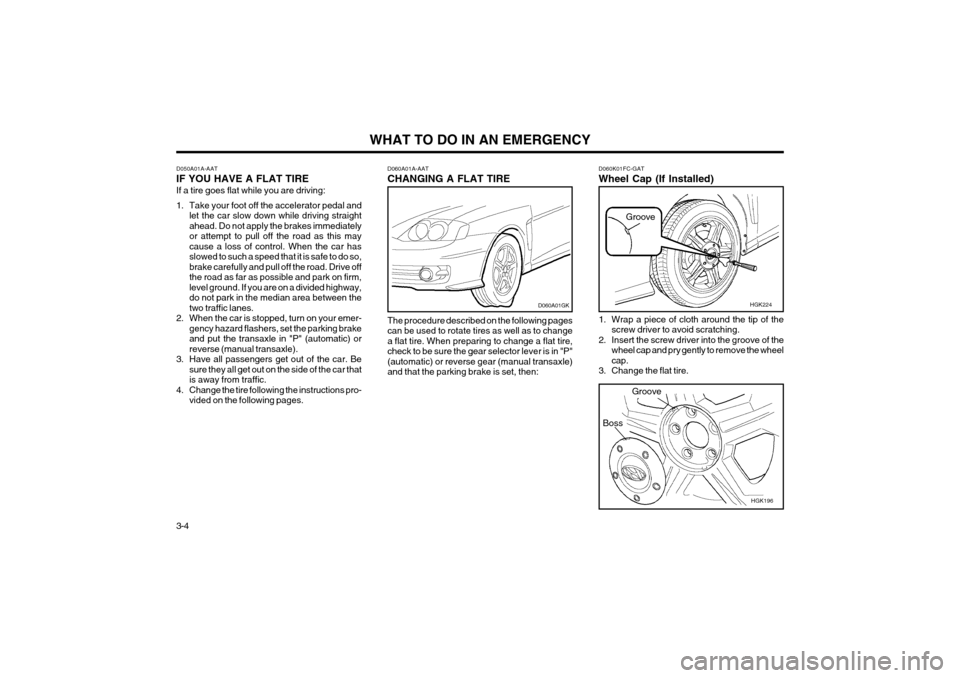
D060K01FC-GAT Wheel Cap (If Installed)
HGK196
1. Wrap a piece of cloth around the tip of the
screw driver to avoid scratching.
2. Insert the screw driver into the groove of the wheel cap and pry gently to remove the wheel cap.
3. Change the flat tire. HGK224
Groove
Groove
Page 120 of 389

WHAT TO DO IN AN EMERGENCY 3-9
D080C02A-GAT Towing a Car With an Automatic Transaxle CAUTION: A car with an automatic transaxle should never be towed from the rear with the frontwheels on the ground. This can cause seri-ous damage to the transaxle. If the car mustbe towed from the rear, a towing dolly mustbe used under the front wheels. If the car is being towed with the rear wheels on the ground, be sure the parking brake is re-leased.
o NOT OK FOR AUTOMATIC TRANSAXLE
EQUIPPED VEHICLE
o OK FOR MANUAL TRANSAXLE
D080D02A-AAT Emergency Towing For emergency towing when no commercial tow vehicle is available, attach a tow cable, chain orstrap to one of the towing hooks under the front/rear of your car. Do not attempt to tow yourvehicle in this manner on any unpaved surface.This could result in serious damage to your car.Nor should towing be attempted if the wheels,drive train, axles, steering or brakes are dam-aged. Before towing, be sure the transaxle is inneutral and the key is in "ACC" (with the engineoff) or in the "ON" position (with the enginerunning). A driver must be in the towed car tosteer it and operate the brakes. CAUTION:
o If the car is being towed with all four
wheels on the ground, it can be towedonly from the front. Be sure that thetransaxle is in neutral. Do not tow at speedsgreater than 50 km/h (30 mph) and formore than 25 km (15 miles).
o Be sure the steering is unlocked by plac- ing the key in the "ACC" position. A drivermust be in the towed vehicle to operatethe steering and brakes
o OK FOR AUTOMATIC OR MANUAL
TRANSAXLE EQUIPPED VEHICLE
HGK200
D080C01GK
HGK188
NOTE: Before towing, check the level of the transaxlefluid. If it is below the "HOT" range on thedipstick, add fluid. If you cannot add fluid, atowing dolly must be used.
Front
Rear
Page 129 of 389

VEHICLE MAINTENANCE REQUIREMENTS
5- 4 European Community Only Except European Community
ENGINE OIL AND FILTER AIR CLEANER FILTER SPARK PLUGSTIMING BELTBRAKE PADS, CALIPERS AND ROTORSREAR BRAKE DRUMS/LININGS/PADS, PARKING BRAKESTEERING GEAR BOX, LINKAGE& BOOTS/LOWER ARM BALL JOINTDRIVESHAFTS AND BOOTSMANUAL TRANSAXLE OILAUTOMATICTRANSAXLE FLUIDAIR CONDITIONER FILTER (FOR BLOWER UNIT)
F040A03GK-GAT
MAINTENANCE UNDER SEVERE USAGE CONDITIONS
The following items must be serviced more frequently on cars normally used under severe driving conditions. Refer to the chart below for the appropriate maintenance intervals. R : Replace I : Inspect and, after inspection, clean, adjust, repair or replace if necessary
DRIVING
CONDITIONMAINTENANCE INTERVALS
R R RR
II II
RRR
MAINTENANCE
OPERATION
MAINTENANCE ITEM
EVERY 7,500 KM OR 6 MONTHS EVERY 5,000 KM OR 6 MONTHSMORE FREQUENTLYMORE FREQUENTLYEVERY 60,000 KM OR 48 MONTHSMORE FREQUENTLYMORE FREQUENTLY MORE FREQUENTLYEVERY 15,000 KM OR 12 MONTHS EVERY 100,000 KMEVERY 45,000 KMEVERY 40,000 KMMORE FREQUENTLYA, B, C, F, H C, E B, HD, E, F, GC, D, G, HC, D, G, H C, D, E, FC, D, E, F, G A, C, D, E, F, G, H, I, J A, C, E, F, G, H, IC, E
SEVERE DRIVING CONDITIONS
A - Repeated short distance driving
B - Extensive idling
C - Driving in dusty, rough roads
D - Driving in areas using salt or other corrosive materials or in very cold weather
E - Driving in sandy areas F - More than 50% driving in heavy city traffic during hot weather
above 32°C (90°F)
G - Driving in mountainous areas
H - Towing a trailer
I - Driving as a patrol car, taxi, other commercial use car or vehicle towing
J - Driving over 170 km/h1.6 DOHC/2.7 V6 2.0 DOHC CVVT
Page 131 of 389

VEHICLE MAINTENANCE REQUIREMENTS
5- 6 F070D01A-AAT
o Manual Transaxle Oil Inspect the manual transaxle oil according to
the maintenance schedule. NOTE: If the oil level is low, check for possible
leaks before adding oil. Do not overfill.
F070E02A-AAT
o Automatic Transaxle Fluid
The fluid level should be in the "HOT" range of
the dipstick, after the engine and transaxle are at normal operating temperature. Check theautomatic transaxle fluid level with the enginerunning and the transaxle in neutral, with theparking brake properly applied. Use DIAMONDATF SP- III or SK ATF SP- III when adding or
changing fluid.
F070F01A-AAT
o Brake Hoses and Lines
Visually check for proper installation, chafing,
cracks, deterioration and any leakage. Replaceany deteriorated or damaged parts immediate-ly. F070G02A-AAT
o Brake Fluid
Check brake fluid level in the brake fluid reser-
voir. The level should be between "MIN" and"MAX" marks on the side of the reservoir. Useonly hydraulic brake fluid conforming to DOT 3or DOT 4.
F070H01A-AAT
o Rear Brake Drums/Linings,
Parking Brake
Check the rear brake drums and linings for
scoring, burning, leaking fluid, broken parts,and excessive wear. Inspect the parking brakesystem including the parking brake lever andcables. For detailed service procedures, refer to the Shop Manual.
F070J01A-AAT
o Brake Pads, Calipers and Rotors Check the pads for excessive wear, discs for run out and wear, and calipers for fluid leakage. F070K01A-AAT
o Exhaust Pipe and Muffler Visually inspect the exhaust pipes, muffler and hangers for cracks, deterioration, or damage.Start the engine and listen carefully for anyexhaust gas leakage. Tighten connections orreplace parts as necessary. F070L01A-AAT o Suspension Mounting Bolts Check the suspension connections for loose- ness or damage. Retighten to the specifiedtorque. F070M01A-AAT
o Steering Gear Box, Linkage & Boots/
Lower arm Ball Joint
With the vehicle stopped and engine off, check for excessive free-play in the steering wheel.Check the linkage for bends or damage. Checkthe dust boots and ball joints for deterioration,cracks, or damage. Replace any damaged parts. F070N01A-AAT
o Power Steering Pump, Belt and
Hoses
Check the power steering pump and hoses for leakage and damage. Replace any damaged orleaking parts immediately. Inspect the powersteering belt for evidence of cuts, cracks, ex-cessive wear, oiliness and proper tension. Re-place or adjust it if necessary. F070P01A-AAT
o Driveshafts and Boots Check the drive shafts, boots and clamps for cracks, deterioration, or damage. Replace anydamaged parts and, if necessary, repack thegrease.
F070C01A-AAT
o Coolant
The coolant should be changed at the
intervals specified in the maintenance sched-ule.
Page 145 of 389

DO-IT-YOURSELF MAINTENANCE 6-13
While the engine is idling, apply the brakes and
move the gear selector lever from "P" to each of its other positions — "R", "N", "D" — andthen return to "N" or "P". With the engine stillidling:
1. Open the hood, being careful to keep hands, long hair and clothing clear of any moving parts.
2. Remove the transaxle dipstick, wipe it clean, reinsert the dipstick as far as it will go, thenremove it again. Now check the fluid level onthe dipstick. It should be in the "HOT" rangeon the dipstick.
3. If the transaxle fluid level is low, use a funnel to add transaxle fluid through the dipsticktube until the level reaches the "HOT" range.Do not overfill. WARNING: The cooling fan is controlled by engine cool-
ant temperature and may sometimes oper- ate even when the engine is not running.Use extreme caution when working near theblades of the cooling fan, so that you are notinjured by a rotating fan blade. As the en-gine coolant temperature decreases, the fanwill automatically shut off. This is a normalcondition. Fluid level should be within this range
HGK249
ÎÎ
DOHC V6
HGK212
G120C02A-AAT
Recommended Brake Fluid
Use only hydraulic brake fluid conforming to
DOT 3 or DOT 4 specifications in your braking system. Follow the instructions printed on thecontainer. G120A01A-AAT
CHECKING THE BRAKES
CAUTION: Because brakes are essential to the safe
operation of the car, it is suggested that they be checked and inspected by yourHyundai dealer. The brakes should bechecked and inspected for wear at thoseintervals specified in the vehicle mainte-nance schedule in Section 5.
G120B01A-AAT
Checking the Brake Fluid Level WARNING: Use caution when handling brake fluid. It
can damage your vision if it gets into your eyes. It will also damage your vehicle's paintif spilled on it and not removed immediately.
Page 166 of 389

INDEX10-1
Catalytic Converter
.................................................................... 7-1 ~ 7-2
CD Auto changer (H250, H260) .............................................. 1-70, 1-77
Child Restraint system ........................................................... 1-14 ~ 1-19
Child Seat Restraint Suitability For Seat Position ............................1-18
Cigarette Lighter ................................................................................ 1-37
Clock ................................................................................................ 1-36
Clutch Checking fluid ............................................................................... 6-13
Pedal free play ............................................................................. 6-16
Combination Light Daytime running lights .................................................................. 1-34
Headlight flasher ........................................................................... 1-34
Headlight switch ........................................................................... 1-33
High-beam switch ......................................................................... 1-34
Lane change signal ...................................................................... 1-33
Turn signal operation .................................................................... 1-33
Compact Disk Player Operation (H260) ........................................... 1-75
Cooling Fans ..................................................................................... 6-19
Corrosion Protection Cleaning the interior ....................................................................... 4-3
Protecting your Hyundai from corrosion ................ ......................... 4-1
Washing and waxing ...................................................................... 4-2
Cruise Control ................................................................................... 1-47
D Defrosting/Defogging ......................................................................... 1-54
Door
Central door lock ............................................................................ 1-5
Door locks ...................................................................................... 1-3 Locking and unlocking front door with a key ................................. 1-4
Drink Holder ...................................................................................... 1-38
Drive Belts ........................................................................................ 6-17
ZK000A1-G 10. INDEX A
Air bag ....................................................................................
1-20 ~ 1-24
Air cleaner filter ................................................................................. 6-10
Air Conditioning Care .............................................................................................. 6-14
Operation ...................................................................................... 6-14
Switch ........................................................................................... 1-55
Air filter .............................................................................................. 1-62
Antenna ............................................................................................. 1-87
Ashtray .............................................................................................. 1-37
Audio Fault Code .............................................................................. 1-79
Automatic Transaxle ........................................................................... 2-6 B Battery ...................................................................................... 2-11, 6-18
Brake Anti-lock system ............................................................................. 2-9
Checking the brakes .................................................................... 6-13
Fluid .............................................................................................. 6-13
Pedal clearance ............................................................................ 6-16
Pedal free play ............................................................................. 6-16
Practices ......................................................................................... 2-8
Breaking-In your new Hyundai ........................................................... 1-1
C Care of Cassette tapes .......................................................... 1-85 ~ 1-86
Care of Disk ...................................................................................... 1-85
Cassette Tape Player Operation (H250) ..........................................1-68
10
Page 244 of 389
1CONTROLS AND EQUIPMENT
64HIGH-MOUNTED REAR STOP LIGHT
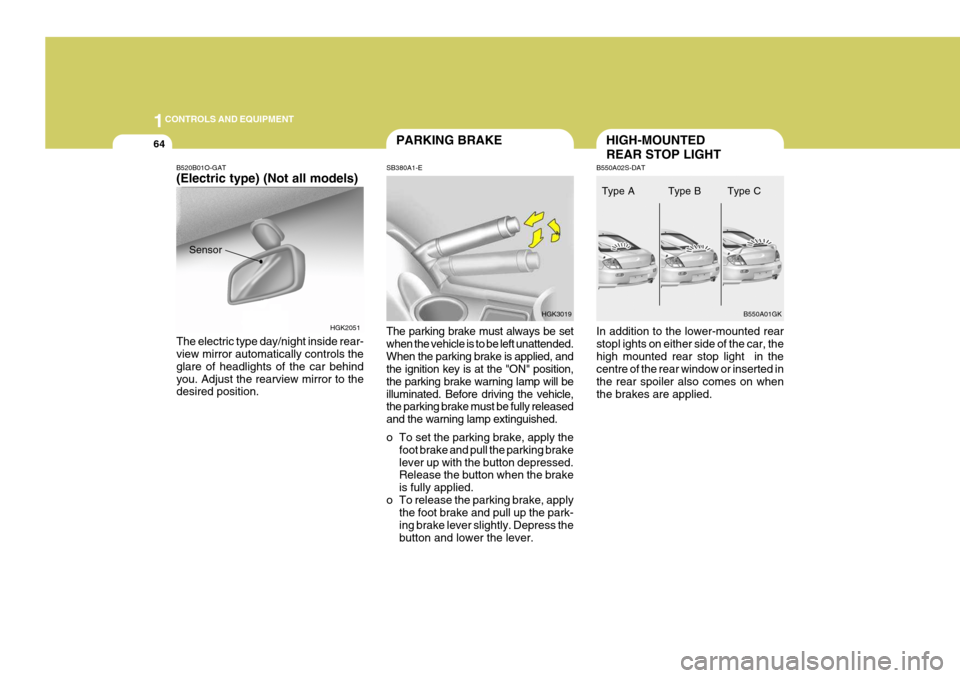
B550A02S-DAT In addition to the lower-mounted rear stopl ights on either side of the car, thehigh mounted rear stop light in the centre of the rear window or inserted in the rear spoiler also comes on whenthe brakes are applied. Type A
B550A01GK
Type B Type C
PARKING BRAKE
SB380A1-E The parking brake must always be set when the vehicle is to be left unattended.When the parking brake is applied, and the ignition key is at the "ON" position, the parking brake warning lamp will beilluminated. Before driving the vehicle, the parking brake must be fully released and the warning lamp extinguished.
o To set the parking brake, apply the foot brake and pull the parking brake lever up with the button depressed. Release the button when the brake is fully applied.
o To release the parking brake, apply the foot brake and pull up the park-ing brake lever slightly. Depress thebutton and lower the lever. HGK3019
B520B01O-GAT (Electric type) (Not all models) The electric type day/night inside rear- view mirror automatically controls the glare of headlights of the car behindyou. Adjust the rearview mirror to the desired position.
Sensor
HGK2051
Page 253 of 389
1
CONTROLS AND EQUIPMENT
73AUDIO REMOTE CONTROL SWITCH
!WARNING:
o Keep the main switch off when not using the cruise control.
o Use the cruise control system only when traveling on open high- ways in good weather.
o Do not use the cruise control when it may not be safe to keepthe car at a constant speed, for instance, driving in heavy or vary-ing traffic, or on slippery (rainy, icy or snow-covered) or winding roads or over 6% up-hill or down-hill roads.
o Pay particular attention to the
driving conditions whenever us-ing the cruise control system.
o During cruise-control driving
with a manual transaxle vehicle,do not shift into neutral without depressing the clutch pedal, or the engine will be overrevved. Ifthis happens, depress the clutch pedal or release the main switch. o With the cruise control engaged,
when the brake pedal is applied, it is normal to hear the cruise control system deactivate. This is an indication of normal systemoperation.
o During normal cruise control
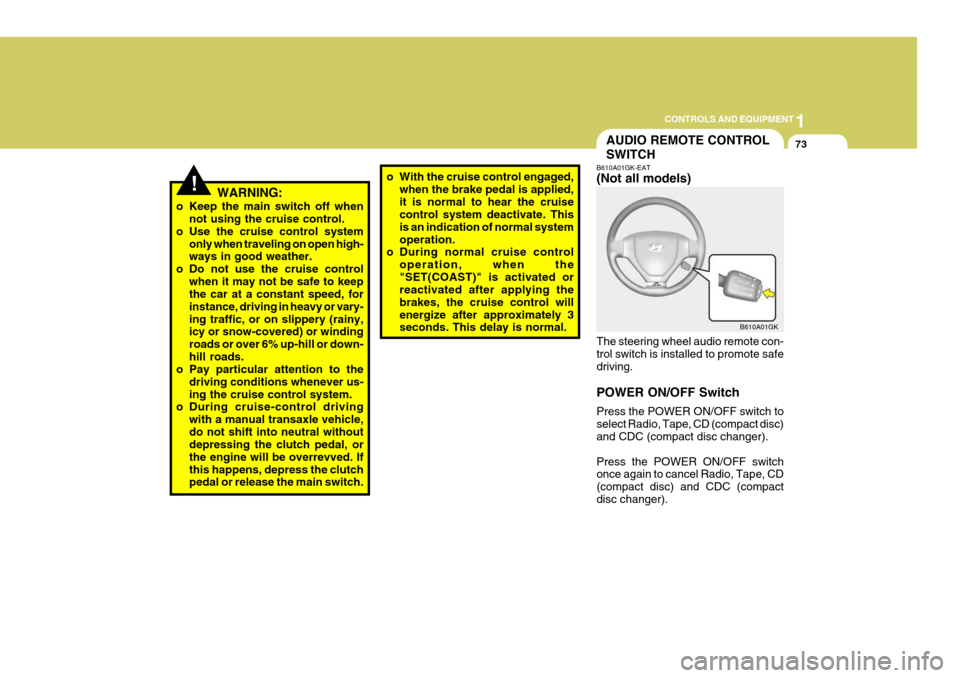
operation, when the"SET(COAST)" is activated or reactivated after applying the brakes, the cruise control willenergize after approximately 3 seconds. This delay is normal. B610A01GK-EAT (Not all models) The steering wheel audio remote con- trol switch is installed to promote safe driving. POWER ON/OFF Switch Press the POWER ON/OFF switch to select Radio, Tape, CD (compact disc) and CDC (compact disc changer). Press the POWER ON/OFF switch once again to cancel Radio, Tape, CD (compact disc) and CDC (compactdisc changer).B610A01GK
Page 287 of 389
2
DRIVING YOUR HYUNDAI
11EFFECTIVE BRAKING
!
C090I01L-GAT
CAUTION:
o Shift into "R" and "P" position only when the vehicle has com- pletely stopped.
o Do not accelerate the engine in reverse or any of the forwardpositions with the brakes applied.
o Always apply the footbrake when shifting from "P" or "N", to "R","D"position.
o Do not use the "P" (Park) posi- tion in place of the parking brake.Always set the parking brake,shift the transaxle into "P" (Park) position and turn off the ignition when you leave the vehicle, evenmomentarily. Never leave the ve- hicle unattended while the en- gine is running.
o Check the automatic transaxle fluid level regularly, and add fluidas necessary. SC140A1-E Braking system performance and fric- tion material life are greatly affected by the driving style adopted. The follow- ing suggestions are made to assist inachieving the best results from the braking system.
o Anticipate the road and conditions
ahead in order that heavy braking may be avoided.
o When descending long gradients, use the engine to assist in retardingthe vehicle to minimize the possibil-ity of brake fade occur-ring.
o When trailer towing, ensure that the
trailer brakes function correctly anduse engine braking to assist the vehicle braking system.
o Use only genuine Hyundai replace- ment brake pads and shoes to en-sure consistent friction characteris- tics and wear rates.
o After driving through deep water (e.g. fording), the brakes may be-come wet and performance reduced.Always check brake efficiency after emerging from the water and dry thebrakes by lightly depressing thebrake pedal several times whilst driving slowly.
o Apply the parking brake only when the vehicle is at rest.
o Since the power assistance pro-
vided by the brake servo is derived from the engine, coasting with the engine turned off or towing of the vehicle with the engine turned offwill result in greatly increased pedal pressures being required to stop the vehicle.
o Do not hold the vehicle on the up- grade with the accelerator pedal.This can cause the transaxle tooverheat. Always use the brake pedal or parking brake.