clock Hyundai Coupe 2004 User Guide
[x] Cancel search | Manufacturer: HYUNDAI, Model Year: 2004, Model line: Coupe, Model: Hyundai Coupe 2004Pages: 389, PDF Size: 10.22 MB
Page 117 of 389

WHAT TO DO IN AN EMERGENCY
3-6
D060E01A-AAT 4. Put the Jack in Place
The base of the jack should be placed on firm, level ground. The jack should be positioned asshown in the drawing.
HGK186D060F02E-AAT 5. Raising the Car After inserting a bar into the wheel nut wrench, install the bar into the jack as shown in thedrawing. To raise the vehicle, turn the jack handleclockwise. As the jack begins to raise the ve-hicle, double check that it is properly positionedand will not slip. If the jack is on soft
ground or
sand, place a board, brick, flat stone or otherobject under the base of the jack to keep it fromsinking.Raise the car high enough so that the fullyinflated spare tire can be installed. To do this, youwill need more ground clearance than is requiredto remove the flat tire. WARNING: Do not get under the car when it is supportedby the jack! This is very dangerous as the jackcould fall and cause serious injury or death.No one should stay in the car while the jack isbeing used.
D060G02Y-AAT 6. Changing Wheels Loosen the wheel nuts and remove them with your fingers. Slide the wheel off the studs and layit flat so it cannot roll away. To put the wheel onthe hub, pick up the spare tire, line up the holeswith the studs and slide the wheel onto them. Ifthis is difficult, tip the wheel slightly and get thetop hole in the wheel lined up with the top stud.Then jiggle the wheel back and forth until thewheel can be slid over the other studs.
HGK232HFC4022
Wrench bar
Wheel nut wrench
Page 118 of 389

WHAT TO DO IN AN EMERGENCY 3-7
D060H02A-AAT 7. Re-install Wheel Nuts To reinstall the wheel, hold it on the studs, put the wheel nuts on the studs and tighten them fingertight. The nuts should be installed with their smalldiameter ends directed inward. Jiggle the tire tobe sure it is completely seated, then tighten thenuts as much as possible with your fingers again.
D060H01GK
WARNING: Wheels and wheel covers may have sharpedges. Handle them carefully to avoid pos-sible severe injury. Before putting the wheelinto place, be sure that there is nothing on thehub or wheel (such as mud, tar, gravel, etc.)that interferes with the wheel from fittingsolidly against the hub. If there is, remove it.If there is not good contact on the mountingsurface between the wheel and hub, the wheelnuts could come loose and cause the loss ofa wheel. Loss of a wheel may result in loss ofcontrol of the vehicle. This may cause seri-ous injury or death.
STA3071H
Lower the car to the ground by turning the wheel nut wrench counterclockwise. Then position thewrench as shown in the drawing and tighten thewheel nuts. Be sure the socket is seated com-pletely over the nut. Do not stand on the wrenchhandle or use an extension pipe over the wrenchhandle.Go around the wheel tightening every other nutuntil they are all tight. Then double-check eachnut for tightness. After changing wheels, have atechnician tighten the wheel nuts to their propertorque as soon as possible. Wheel nut tightening torque: Steel wheel & aluminium alloy wheel:900-1,100 kg.cm,100 kg.cm (65-80 lb.ft)
D060I01E-GAT 8. Lower Vehicle and Tighten Nuts
HGK194
Page 137 of 389

DO-IT-YOURSELF MAINTENANCE 6-5
HGK210
G030C01A-AAT
To Check the Oil Level G030D01A-GAT
Adding Oil
Before checking the oil, warm up the engine to
the normal operating temperature and be sure it is parked on level ground. Turn the engine off.
Wait five minutes, then remove the dipstick,
wipe it off, fully reinsert the dipstick and with-draw it again. Then note the highest level the oilhas reached on the dipstick. It should be be-tween the upper ("FULL") and lower ("LOW")range. If the oil level is close to or below the "L" mark,
add oil until it reaches the "F" mark. To add oil:
1. Remove the oil filler cap by turning it counter- clockwise.
2. Add oil, then check the level again. Do not overfill.
3. Replace the cap by turning it clockwise.
The distance between the "F" and "L" marks is
equal to about 1 liter of oil.HGK211
DOHC V6 DOHC V6
See the lubrication chart on the page 9-3. NOTE:
o The use of a 5W-20 multi grade oil is not recommended for sustained high speed use.
o When replacing or adding the oil, below SAE 10W-30 is recommended. Using a high viscosity oil of SAE 15W-40 and over makes malfunction of CVVTengine when the engine is cool.
HGK259
2.0 L (DOHC CVVT)
Page 138 of 389

DO-IT-YOURSELF MAINTENANCE
6-6 G040A02GK-GAT
CHANGING THE OIL AND FILTER
The engine oil and filter should be changed at those intervals specified in the maintenanceschedule in Section 5. If the car is being drivenin severe conditions, more frequent oil and filterchanges are required. The procedure for changing the oil and filter is as follows:
1. Park the car on level ground and set the parking brake. Start the engine and let itwarm up until the needle on the coolanttemperature gauge moves above the lowestmark. Turn the engine off and place the gearselector lever in "P" (automatic) or reversegear (manual transaxle).
2. Open the hood and remove the engine oil filler cap.
G040A01GK 3. Slide underneath the car and loosen the
drain plug by turning it counterclockwise with a wrench of the proper size. Be surethat a drain pan is in position to catch the oilas it drains out, then remove the drain plug.
WARNING: Be very careful when draining the engine oil as it may be hot enough to burn you!
4. When the oil has stopped draining, replace the drain plug using a new washer and retighten by turning it clockwise. Tightening torque :
4.5 ~ 4.0 kgf.m (1.6/2.0L) 4.5 ~ 3.5 kgf.m (2.7L)
5. Remove the oil filter by turning it counter- clockwise with a oil filter wrench of the proper size. A certain amount of oil willcome out when you remove the filter. So besure to have your drain pan in place under-neath it.
6. Install a new oil filter in accordance with the instructions on the carton or on the filteritself. Do not over-tighten. Tightening torque: 1.2 ~ 1.6 kgf.m.Be sure that the mounting surface on the engine is clean and that the old gasket isremoved completely. Lubricate the new gas-ket on the filter with clean engine oil beforeinstallation.
DOHC
G350A01A-GAT
ENGINE OIL CONSUMPTION Function of Engine Oil
Engine oil has the primary function of lubricat-
ing and cooling the inside of the engine. Engine oil consumption
It is normal that an engine should consume
some engine oil while normal driving. The cause of oil consumption in a normal engine are asfollows;
o Engine oil is used to lubricate pistons, piston rings and cylinders.
o A thin film of oil is left on the cylinder wall when a piston moves downwards in the cylinder. High negative pressure generatedduring engine operation sucks some of theoil into the combustion chamber. This oil with some oil of the cylinder wall is burned by the high temperature combustiongases during the combustion process.
o The engine oil consumption is strongly ef- fected by the viscosity and quality of oil,engine rpm and driving condition etc. Moreengine oil may be consumed under severedriving conditions such as high speeds, fre-quent acceleration and deceleration, com-pared to normal driving condition. V6
Page 140 of 389

DO-IT-YOURSELF MAINTENANCE
6-8 4. Turn the radiator cap counterclockwise with-
out pressing down on it, until it stops. This relieves any pressure remaining in the cool-ing system. And remove the radiator cap bypushing down and turning counterclockwise. Now fill the radiator with clean demineral- ized or distilled water. Continue to add cleandemineralized or distilled water in small quan-tities until the fluid level stays up in theradiator neck.
G050D02A-AAT
To Change the Engine Coolant
The engine coolant should be changed at those
intervals specified in the vehicle maintenanceschedule in Section 5.
NOTE: Engine coolant can damage the finish of
your car. If you spill engine coolant on the car, wash it off thoroughly with clean water.
1. Park the car on level ground, set the park- ing brake and remove the radiator cap when cool.
2. Be sure your drain receptacle is in place. Open the drain cock on the radiator. Allowall the engine coolant to drain from thecooling system, then securely close the draincock.
3. Check Section 9 for the capacity of the cooling system in your car. Then, followingthe manufacturer's directions on the enginecoolant container, add the appropriate quan-tity of engine coolant to the radiator.
G050D01A
5. Start the engine, top off the radiator withwater and then add engine coolant to the reservoir until the level is between "L" and"F".
6. Replace the radiator and reservoir caps and check to be sure the drain cocks are fullyclosed and not leaking.
WARNING: The cooling fan is controlled by engine cool- ant temperature and may sometimes oper-ate even when the engine is not running.Use extreme caution when working near theblades of the coolant fan so that you are notinjured by a rotating fan blade. As the en-gine coolant temperature decreases, the fanwill automatically shut off. This is a normalcondition.
G050D02A
Page 142 of 389

DO-IT-YOURSELF MAINTENANCE
6-10 G070A02GK-AAT
CHANGING THE AIR CLEANER FIL- TER
To change the filter, unsnap the clips around the cover. When this is done, the cover can belifted off, the old filter removed and the new filterput in its place. Genuine Hyundai ReplacementParts are recommended. CAUTION:
o Operating your vehicle without a proper air cleaner filter in place can result in excessive engine wear.
o Be careful that dust or dirt does not enter the air intake, or damage may result.
o When removing the air cleaner filter, be careful that dust or dirt does not enterthe air intake. These may result in dam-age to the air cleaner filter.
HGK213
WARNING: It is recommended that the engine be cool
or cold when changing the spark plugs. If the engine is hot, you could burn yourselfon the insulated connector, the spark plugor the engine itself.
4. When preparing to remove the old spark plug, guide the socket down over the spark plug, being careful not to damage the ce-ramic insulator.
5. To remove the old spark plug, turn the wrench handle in a counterclockwise direc-tion.
6. To install the new spark plug, guide the socket down over the spark plug, beingcareful not to damage the ceramic insulator. NOTE: Spark plugs should be tightened firmly. Over-
tightening can damage the threads in the aluminum cylinder head. Also, leaving them too loose can cause the spark plug to get very hot and possibly result in damage tothe engine.
7. Replace the cable by pushing the insulated connector directly down onto the electrode. Check to be sure it has snapped into placeand can't fall off.
HGK258HGK257
Page 144 of 389

DO-IT-YOURSELF MAINTENANCE
6-12 G110D02Y-AAT
To Check the Transaxle Fluid Level
HGK174
Park the car on level ground with the parking brake engaged. When the transaxle fluid levelis checked, the transaxle fluid should be atnormal operating temperature and the engineidling.
G110C02Y-GAT
Transaxle Fluid Capacity
The fluid capacity of the automatic transaxle is 7.8 liters (8.2 U.S. quarts). WARNING: The transaxle fluid level should be checked when the engine is at normal operating tem-perature. This means that the engine, radia-tor, exhaust system etc., are very hot. Exer-cise great care not to burn yourself duringthis procedure.
G100B02A-AAT
To Check the Manual Transaxle Fluid Level
SSA6100B
Park the car on level ground with the engine off.
1. Using a wrench of the correct size, loosen the oil filler plug by turning it counterclock- wise and remove it with your fingers.
2. Use your finger or suitable tool to feel inside the hole. The oil level should be at its bottomedge. If it is not, check for leaks beforeadding oil. To refill the transaxle or bring theoil level up,add oil slowly until it reaches theproper level. Do not overfill.
3. Replace the plug and washer, screw it in with your fingers and then tighten securelywith the wrench. G110A02A-AAT CHECKING THE TRANSAXLE FLUID (AUTOMATIC) Transaxle fluid in the automatic transaxle should be checked at those intervals specified in thevehicle maintenance schedule in Section 5. NOTE: Basically automatic transaxle fluid is red color. As driving distance increases, thefluid color turns darkish red gradually. It isnormal condition and you should not usefluid color as a criterion for replacing thetransaxle fluid. You must replace the automatic transaxle fluid in accordance with intervals specifiedin the vehicle maintenances schedule insection 5. G110B03A-AAT
Recommended Fluid
Your Hyundai automatic transaxle is specially
designed to operate with DIAMOND ATF SP-III or SK ATF SP-III. Damage caused by anonspecified fluid is not covered by your newvehicle limited warranty.
Page 157 of 389

DO-IT-YOURSELF MAINTENANCE 6-25
DESCRIPTION
IG COIL
AMP
B/UP LAMP
A/BAG IND
A/BAG
HTD MIR HAZARD
R/WIPER TAIL-RH
F/WIPER
A/C SW
RR DEFOG STOP
TAIL-LH
A/CON ECU
CLUSTER
ROOM LP
P/WINDOW T/GATE
IGN
RR FOG C/LIGHT
S/ROOF S/HTR ABS
AUDIO
G200D01GK-GAT
Inner Panel
HGK204-E
PROTECTED COMPONENTS
Ignition Coil, ECM
AMP. Multi Gauge Unit B/Up LampAir Bag Indicator Air Bag Outside Mirror DefrosterHazard Warning Light Rear Window Wiper
Tail LightFront Window Wiper A/Conditioner Rear Window DefrosterStop Light
Tail Light A/Conditioner
ECM, Multi Gauge Unit, TCMCluster Map Light, Clock, Audio Power WindowTail Gate Open A/Con, A.Q.S Sensor Rear FogC/Lighter, Outside Mirror Sunroof Seat WarmerABS. TCS Audio, Clock
FUSERATING
20A20A 10A10A 15A 10A10A 15A 10A20A 10A 30A15A 10A 10A10A 10A 10A30A 15A 10A10A 15A 15A20A 10A 10A
Page 166 of 389

INDEX10-1
Catalytic Converter
.................................................................... 7-1 ~ 7-2
CD Auto changer (H250, H260) .............................................. 1-70, 1-77
Child Restraint system ........................................................... 1-14 ~ 1-19
Child Seat Restraint Suitability For Seat Position ............................1-18
Cigarette Lighter ................................................................................ 1-37
Clock ................................................................................................ 1-36
Clutch Checking fluid ............................................................................... 6-13
Pedal free play ............................................................................. 6-16
Combination Light Daytime running lights .................................................................. 1-34
Headlight flasher ........................................................................... 1-34
Headlight switch ........................................................................... 1-33
High-beam switch ......................................................................... 1-34
Lane change signal ...................................................................... 1-33
Turn signal operation .................................................................... 1-33
Compact Disk Player Operation (H260) ........................................... 1-75
Cooling Fans ..................................................................................... 6-19
Corrosion Protection Cleaning the interior ....................................................................... 4-3
Protecting your Hyundai from corrosion ................ ......................... 4-1
Washing and waxing ...................................................................... 4-2
Cruise Control ................................................................................... 1-47
D Defrosting/Defogging ......................................................................... 1-54
Door
Central door lock ............................................................................ 1-5
Door locks ...................................................................................... 1-3 Locking and unlocking front door with a key ................................. 1-4
Drink Holder ...................................................................................... 1-38
Drive Belts ........................................................................................ 6-17
ZK000A1-G 10. INDEX A
Air bag ....................................................................................
1-20 ~ 1-24
Air cleaner filter ................................................................................. 6-10
Air Conditioning Care .............................................................................................. 6-14
Operation ...................................................................................... 6-14
Switch ........................................................................................... 1-55
Air filter .............................................................................................. 1-62
Antenna ............................................................................................. 1-87
Ashtray .............................................................................................. 1-37
Audio Fault Code .............................................................................. 1-79
Automatic Transaxle ........................................................................... 2-6 B Battery ...................................................................................... 2-11, 6-18
Brake Anti-lock system ............................................................................. 2-9
Checking the brakes .................................................................... 6-13
Fluid .............................................................................................. 6-13
Pedal clearance ............................................................................ 6-16
Pedal free play ............................................................................. 6-16
Practices ......................................................................................... 2-8
Breaking-In your new Hyundai ........................................................... 1-1
C Care of Cassette tapes .......................................................... 1-85 ~ 1-86
Care of Disk ...................................................................................... 1-85
Cassette Tape Player Operation (H250) ..........................................1-68
10
Page 179 of 389
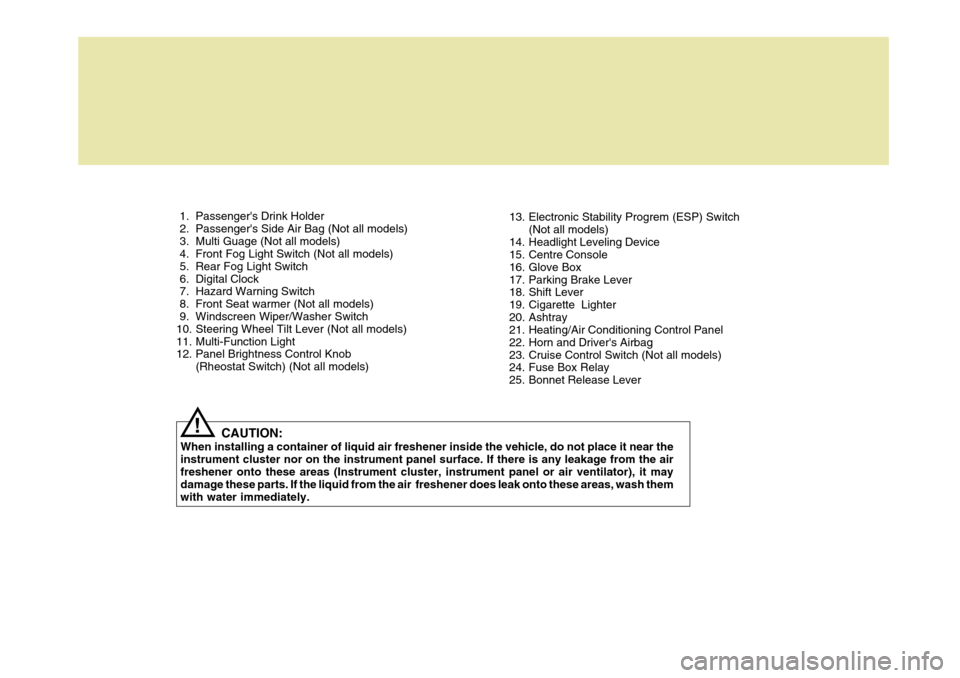
CAUTION:
When installing a container of liquid air freshener inside the vehicle, do not place it near the instrument cluster nor on the instrument panel surface. If there is any leakage from the air freshener onto these areas (Instrument cluster, instrument panel or air ventilator), it may damage these parts. If the liquid from the air freshener does leak onto these areas, wash themwith water immediately.!
1. Passenger's Drink Holder
2. Passenger's Side Air Bag (Not all models)
3. Multi Guage (Not all models)
4. Front Fog Light Switch (Not all models)
5. Rear Fog Light Switch
6. Digital Clock
7. Hazard Warning Switch
8. Front Seat warmer (Not all models)
9. Windscreen Wiper/Washer Switch
10. Steering Wheel Tilt Lever (Not all models)
11. Multi-Function Light
12. Panel Brightness Control Knob
(Rheostat Switch) (Not all models) 13. Electronic Stability Progrem (ESP) Switch
(Not all models)
14. Headlight Leveling Device
15. Centre Console
16. Glove Box
17. Parking Brake Lever
18. Shift Lever
19. Cigarette Lighter
20. Ashtray
21. Heating/Air Conditioning Control Panel
22. Horn and Driver's Airbag
23. Cruise Control Switch (Not all models)
24. Fuse Box Relay
25. Bonnet Release Lever