fuel type Hyundai Coupe 2004 User Guide
[x] Cancel search | Manufacturer: HYUNDAI, Model Year: 2004, Model line: Coupe, Model: Hyundai Coupe 2004Pages: 389, PDF Size: 10.22 MB
Page 227 of 389
1
CONTROLS AND EQUIPMENT
47TRIP COMPUTER
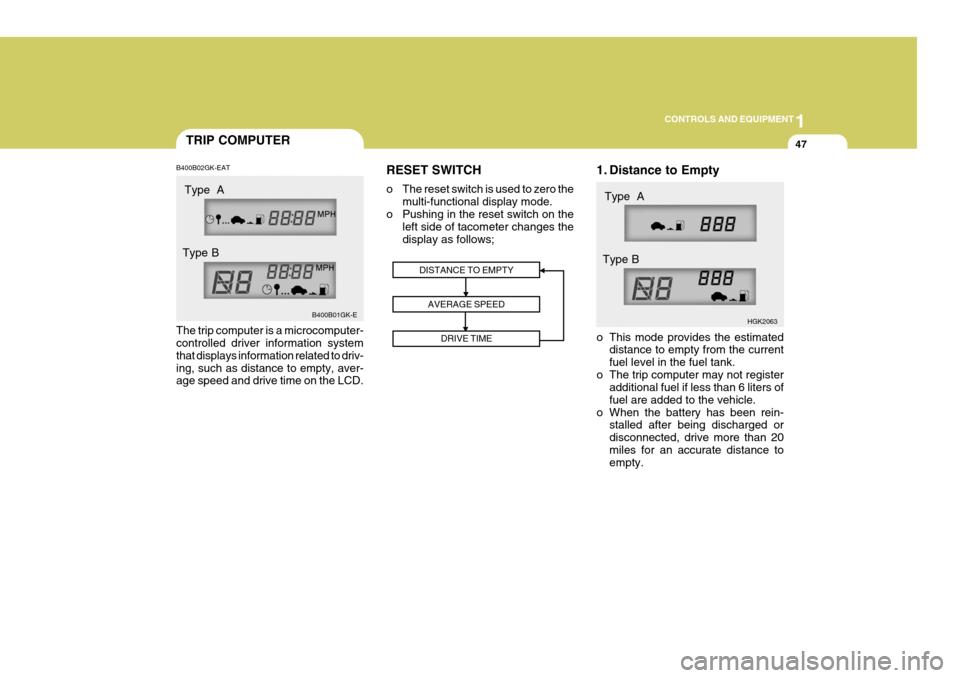
B400B02GK-EAT The trip computer is a microcomputer- controlled driver information system that displays information related to driv-ing, such as distance to empty, aver- age speed and drive time on the LCD. RESET SWITCH
o The reset switch is used to zero the
multi-functional display mode.
o Pushing in the reset switch on the left side of tacometer changes the display as follows; 1. Distance to Empty
o This mode provides the estimated
distance to empty from the current fuel level in the fuel tank.
o The trip computer may not register additional fuel if less than 6 liters offuel are added to the vehicle.
o When the battery has been rein- stalled after being discharged ordisconnected, drive more than 20miles for an accurate distance to empty.
DISTANCE TO EMPTY
AVERAGE SPEED DRIVE TIME
B400B01GK-E HGK2063
Type A
Type B Type A
Type B
Page 228 of 389
1CONTROLS AND EQUIPMENT
48
NOTE:
o When the distance to empty is
less than 50 km, the symbol will always come on and the distanceto empty digits will indicate "--- " with flash until more fuel is added.
o The distance to empty can differ from the actual tripmeter ac-cording to driving conditions.
o The distance to empty can vary according to the driving condi-tions, driving pattern or vehiclespeed. 2. AVERAGE SPEED
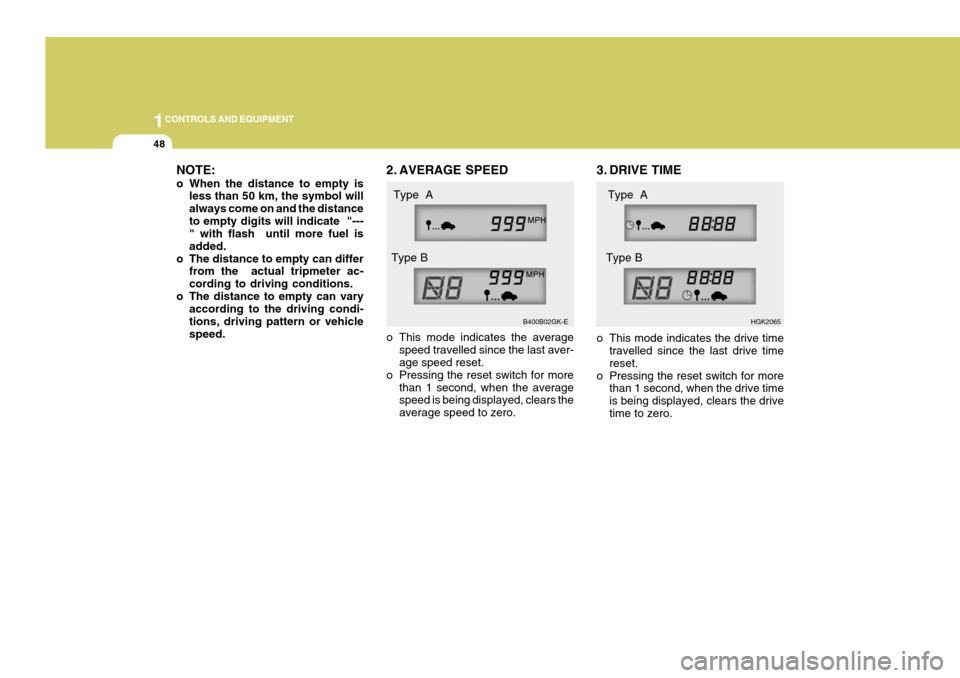
o This mode indicates the average
speed travelled since the last aver- age speed reset.
o Pressing the reset switch for more than 1 second, when the averagespeed is being displayed, clears the average speed to zero. 3. DRIVE TIME
o This mode indicates the drive time
travelled since the last drive time reset.
o Pressing the reset switch for more than 1 second, when the drive timeis being displayed, clears the drivetime to zero.
B400B02GK-E
HGK2065
Type A
Type B Type A
Type B
Page 283 of 389

2
DRIVING YOUR HYUNDAI
7
o When slippery conditions are encountered, increased caution should be exercised when gear changing, braking or ac-celerating. Abrupt changes in speed may cause a loss of trac- tion or control of the vehicle.
o During cold weather, shifting may be difficult until the transaxle lu-bricant has warmed up. This isnormal and not harmful to the transaxle.
o If you've come to a complete stop and it's hard to shift into 1st orR(Reverse), put the shift lever in N(Neutral) position and let up onthe clutch. Press the clutch pedal back down, and then shift into 1st or R(Reverse) gear position.
o Do not use the shift lever as a handrest during driving, as thiscan result in premature wear ofthe transaxle shift forks.
SC090B1-F Using the Clutch The clutch should be pressed all the way to the floor before shifting, thenreleased slowly. Do not rest your foot on the clutch pedal while driving. This can cause unnecessary wear.Do not partially engage the clutch to hold the car on an incline. This causes unnecessary wear.Use the parking brake to hold the car on an incline. Do not operate the clutch pedal rapidly and repeatedly. C070E01GK-AAT RECOMMENDED SHIFT POINTS The shift points as shown below are recommended for optimum fueleconomy and performance. Type A (5 speed)
Shift from-to 1-2 2-33-4 4-5 Recommended
15 mph (20 km/h)25 mph (40 km/h) 35 mph (55 km/h)45 mph (75 km/h)
Type A (6 speed)
Shift from-to 1-2 2-33-4 4-5 5-6 Recommended
10 mph (15 km/h)20 mph (35 km/h)30 mph (50 km/h) 45 mph (70 km/h) 60 mph (95 km/h)
Page 297 of 389
2
DRIVING YOUR HYUNDAI
21
!WARNING:
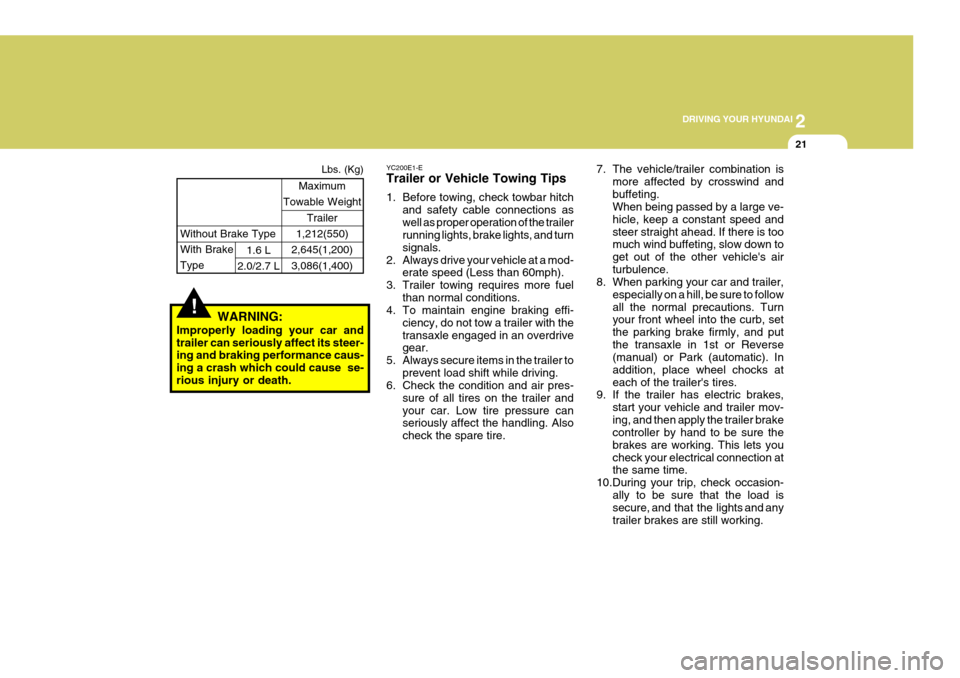
Improperly loading your car and trailer can seriously affect its steer- ing and braking performance caus- ing a crash which could cause se-rious injury or death. Without Brake Type
Maximum
Towable Weight
Trailer
1,212(550)
2,645(1,200) 3,086(1,400)
With Brake Type1.6 L
2.0/2.7 L Lbs. (Kg)
7. The vehicle/trailer combination is
more affected by crosswind and buffeting. When being passed by a large ve- hicle, keep a constant speed andsteer straight ahead. If there is too much wind buffeting, slow down to get out of the other vehicle's airturbulence.
8. When parking your car and trailer,
especially on a hill, be sure to followall the normal precautions. Turn your front wheel into the curb, set the parking brake firmly, and putthe transaxle in 1st or Reverse (manual) or Park (automatic). In addition, place wheel chocks ateach of the trailer's tires.
9. If the trailer has electric brakes,
start your vehicle and trailer mov-ing, and then apply the trailer brake controller by hand to be sure the brakes are working. This lets youcheck your electrical connection at the same time.
10.During your trip, check occasion- ally to be sure that the load issecure, and that the lights and any trailer brakes are still working.
YC200E1-E Trailer or Vehicle Towing Tips
1. Before towing, check towbar hitch
and safety cable connections as well as proper operation of the trailer running lights, brake lights, and turn signals.
2. Always drive your vehicle at a mod- erate speed (Less than 60mph).
3. Trailer towing requires more fuel than normal conditions.
4. To maintain engine braking effi-
ciency, do not tow a trailer with thetransaxle engaged in an overdrive gear.
5. Always secure items in the trailer to prevent load shift while driving.
6. Check the condition and air pres-
sure of all tires on the trailer and your car. Low tire pressure can seriously affect the handling. Also check the spare tire.
Page 302 of 389
3 IN CASE OF EMERGENCY
4
7. Swithc "ON" the main beam
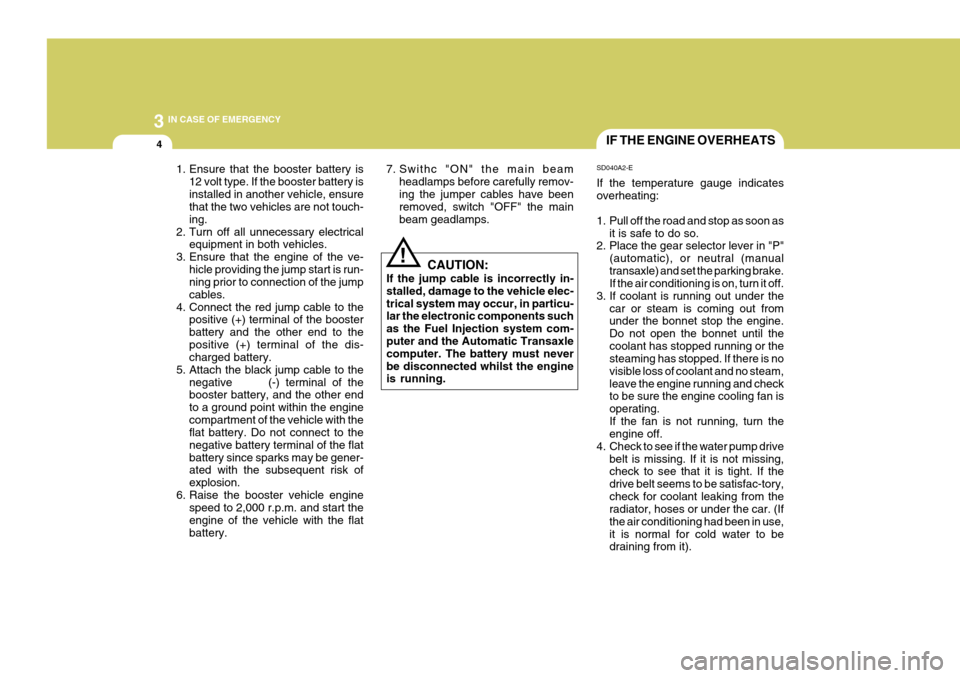
headlamps before carefully remov- ing the jumper cables have been removed, switch "OFF" the main beam geadlamps. SD040A2-E If the temperature gauge indicates overheating:
1. Pull off the road and stop as soon as
it is safe to do so.
2. Place the gear selector lever in "P"
(automatic), or neutral (manual transaxle) and set the parking brake. If the air conditioning is on, turn it off.
3. If coolant is running out under the car or steam is coming out fromunder the bonnet stop the engine. Do not open the bonnet until thecoolant has stopped running or the steaming has stopped. If there is no visible loss of coolant and no steam,leave the engine running and check to be sure the engine cooling fan is operating.If the fan is not running, turn the engine off.
4. Check to see if the water pump drive belt is missing. If it is not missing,check to see that it is tight. If the drive belt seems to be satisfac-tory,check for coolant leaking from the radiator, hoses or under the car. (If the air conditioning had been in use,it is normal for cold water to be draining from it).
IF THE ENGINE OVERHEATS
1. Ensure that the booster battery is 12 volt type. If the booster battery is installed in another vehicle, ensure that the two vehicles are not touch- ing.
2. Turn off all unnecessary electrical equipment in both vehicles.
3. Ensure that the engine of the ve- hicle providing the jump start is run- ning prior to connection of the jump cables.
4. Connect the red jump cable to the positive (+) terminal of the boosterbattery and the other end to thepositive (+) terminal of the dis- charged battery.
5. Attach the black jump cable to the negative (-) terminal of thebooster battery, and the other end to a ground point within the enginecompartment of the vehicle with the flat battery. Do not connect to the negative battery terminal of the flatbattery since sparks may be gener- ated with the subsequent risk of explosion.
6. Raise the booster vehicle engine speed to 2,000 r.p.m. and start theengine of the vehicle with the flatbattery. CAUTION:
If the jump cable is incorrectly in-stalled, damage to the vehicle elec-trical system may occur, in particu- lar the electronic components such as the Fuel Injection system com- puter and the Automatic Transaxle computer. The battery must neverbe disconnected whilst the engine is running.
!
Page 320 of 389
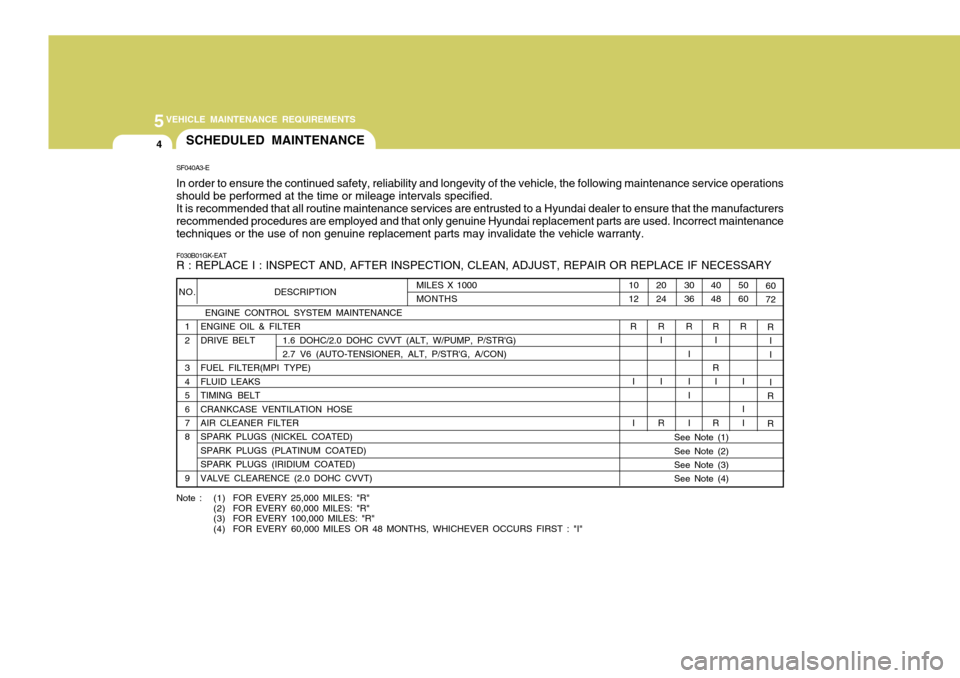
5VEHICLE MAINTENANCE REQUIREMENTS
4
DESCRIPTION ENGINE CONTROL SYSTEM MAINTENANCE ENGINE OIL & FILTER
DRIVE BELT 1.6 DOHC/2.0 DOHC CVVT (ALT, W/PUMP, P/STR'G) 2.7 V6 (AUTO-TENSIONER, ALT, P/STR'G, A/CON)
FUEL FILTER(MPI TYPE)FLUID LEAKSTIMING BELTCRANKCASE VENTILATION HOSEAIR CLEANER FILTER SPARK PLUGS (NICKEL COATED) SPARK PLUGS (PLATINUM COATED)SPARK PLUGS (IRIDIUM COATED)VALVE CLEARENCE (2.0 DOHC CVVT) 30 36
R I I I I
See Note (1) See Note (2) See Note (3) See Note (4)
NO.
1 2 3 4567 8 9
SF040A3-E In order to ensure the continued safety, reliability and longevity of the vehicle, the following maintenance service operations should be performed at the time or mileage intervals specified. It is recommended that all routine maintenance services are entrusted to a Hyundai dealer to ensure that the manufacturers recommended procedures are employed and that only genuine Hyundai replacement parts are used. Incorrect maintenance techniques or the use of non genuine replacement parts may invalidate the vehicle warranty. F030B01GK-EAT R : REPLACE I : INSPECT AND, AFTER INSPECTION, CLEAN, ADJUST, REPAIR OR REPLACE IF NECESSARY50 60
R
I I I 6072
R II I
R R
40 48
R I
R I
R
2024
R I I
R
10 12
R
I I
MILES X 1000 MONTHS
SCHEDULED MAINTENANCE
Note : (1) FOR EVERY 25,000 MILES: "R"
(2) FOR EVERY 60,000 MILES: "R"
(3) FOR EVERY 100,000 MILES: "R"
(4) FOR EVERY 60,000 MILES OR 48 MONTHS, WHICHEVER OCCURS FIRST : "I"
Page 339 of 389
6
OWNER MAINTENANCE
13
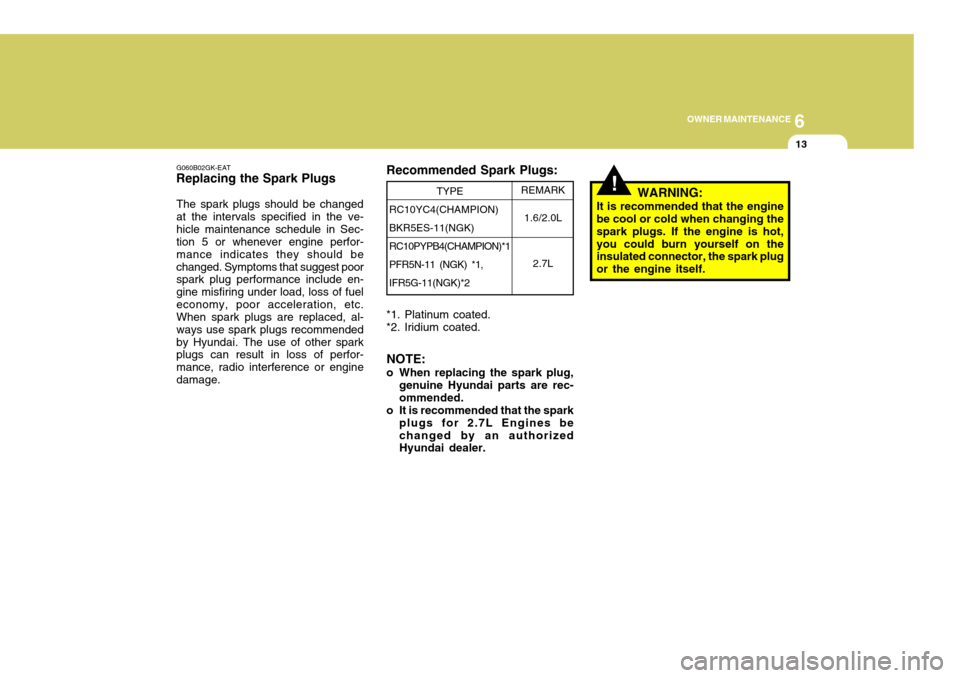
Recommended Spark Plugs:
G060B02GK-EAT
Replacing the Spark Plugs
The spark plugs should be changed at the intervals specified in the ve-hicle maintenance schedule in Sec- tion 5 or whenever engine perfor- mance indicates they should bechanged. Symptoms that suggest poor spark plug performance include en- gine misfiring under load, loss of fueleconomy, poor acceleration, etc. When spark plugs are replaced, al- ways use spark plugs recommendedby Hyundai. The use of other spark plugs can result in loss of perfor- mance, radio interference or enginedamage. TYPE
RC10YC4(CHAMPION) BKR5ES-11(NGK)RC10PYPB4(CHAMPION)*1
PFR5N-11 (NGK) *1,IFR5G-11(NGK)*2
REMARK
1.6/2.0L
2.7L
NOTE:
o When replacing the spark plug, genuine Hyundai parts are rec- ommended.
o It is recommended that the spark plugs for 2.7L Engines bechanged by an authorized Hyundai dealer.
*1. Platinum coated. *2. Iridium coated.
!WARNING:
It is recommended that the engine be cool or cold when changing the spark plugs. If the engine is hot,you could burn yourself on the insulated connector, the spark plug or the engine itself.
Page 382 of 389
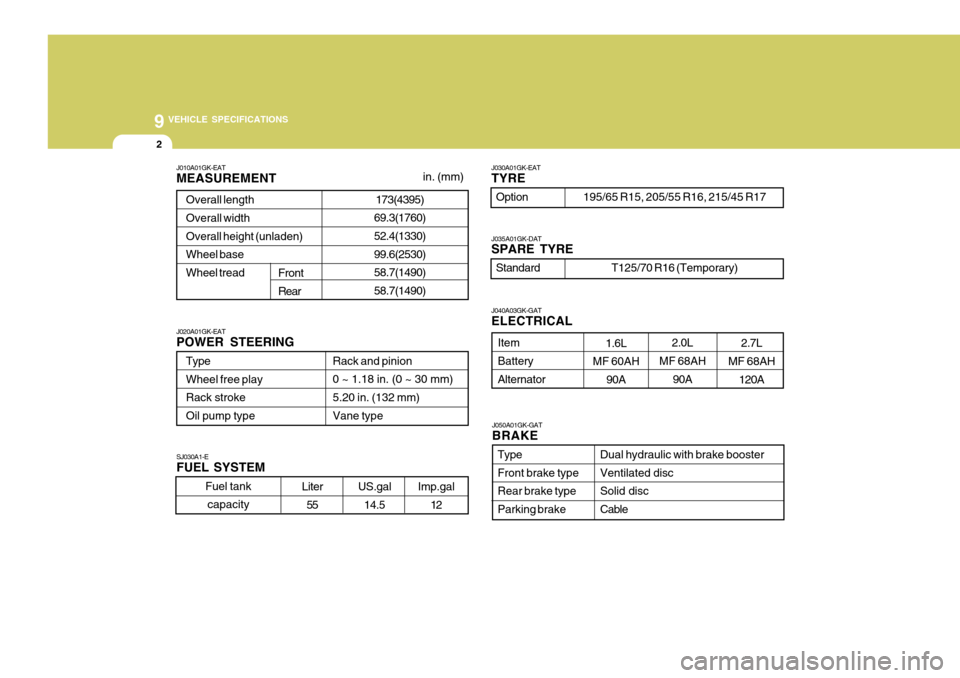
9 VEHICLE SPECIFICATIONS
2
J010A01GK-EAT MEASUREMENT 173(4395)
69.3(1760) 52.4(1330) 99.6(2530)58.7(1490) 58.7(1490)
Overall length Overall width Overall height (unladen)Wheel base Wheel tread FrontRear
Type Wheel free play Rack strokeOil pump type Rack and pinion0 ~ 1.18 in. (0 ~ 30 mm) 5.20 in. (132 mm) Vane type
Option
Item Battery Alternator
in. (mm)
Fuel tank
capacity Imp.gal
12 2.7L
MF 68AH
120A
195/65 R15, 205/55 R16, 215/45 R17
2.0L
MF 68AH 90A
Dual hydraulic with brake booster Ventilated disc Solid discCable
Type Front brake type Rear brake typeParking brake
US.gal
14.5Liter55
Standard T125/70 R16 (Temporary)
1.6L
MF 60AH
90A
SJ030A1-E FUEL SYSTEM
J020A01GK-EATPOWER STEERING J030A01GK-EAT TYRE J040A03GK-GAT ELECTRICAL
J050A01GK-GAT BRAKE
J035A01GK-DATSPARE TYRE
Page 387 of 389

10
INDEX
3
F Folding rear seat ....................................................... 1-17
Front ashtray ............................................................. 1-57
Front door edge warning lamp ................................. 1-65
Front fog light switch ................................................ 1-54
Front seat adjustment ............................................... 1-12
Fuel economy ............................................................. 2-5
Fuel gauge ................................................................ 1-44
Fuel recommendations ................................................ 1-2
Fuse panel description .............................................. 6-41
Fusible links .............................................................. 6-28
GGlove box .................................................................. 1-62
H Hatchback door ......................................................... 1-67
Rear window wiper and washer ............................... 1-53
Hazard warning system ............................................ 1-55
Headlight aiming adjustment..................................... 6-31
Headlight leveling device syst em .............................1-58
Head restraint adjustment .................... ..................... 1-13
Heated rear window.................................................. 1-55
Heating and cooling control ...................................... 1-75
Rotary type ................................................ 1-76 ~ 1-83
Automatic type ........................................... 1-84 ~ 1-91
Height adjustable front seat shoulder belt ................1-20
Horn .......................................................................... 1-69I
If the engine cannot be cranked
................................ 3-2
If the engine overheats ............................................... 3-4
If the engine will not start ........................................... 3-2
If your vehicle must be towed ..................................3-12
Immobilizer system ..................................................... 1-4
Individual circuit fuses ............................................... 6-28
Instrument cluster and indicatorlight......................... 1-38
Instrument panel illumination control ........................1-37
In the event of a puncture .......................................... 3-6 J
Jump starting .............................................................. 3-3
K Key positions ............................................................... 2-3
Keys ............................................................................ 1-4 L Lighting switch .......................................................... 1-50
Luggage net .............................................................. 1-70
Lumbar support adj ustment...................................... 1-14
M Maintenance and servicing requirements ...................5-2
Maintenance under severe usage conditions ............. 5-6
Manual transaxle lubricant .......... .............................. 6-18
Manual transaxle ......................................................... 2-6
Page 388 of 389

10INDEX
4
Map light ................................................................... 1-61
Multi functi on switch................................................. 1-50
Multi gauge ............................................................... 1-49
O Odometer .................................................................. 1-46
Outside rearview mirror heater ................................. 1-63
PParking brake ............................................................ 1-64
Pollen filter ................................................................ 1-91
Power steering fluid level ................... ....................... 6-31
Power steering hoses ............................................... 6-30
Power window ........................................................... 1-11
Pre-tensioner seat belt .............................................. 1-28
Protecting your hyundai from corrosion ...................... 4-2
R Rear fog light switch ................................................. 1-54
Rear parcel shelf ....................................................... 1-18
Rear seat entry ......................................................... 1-16
Rear seat pos itions................................................... 1-16
Recommended shift points ......................................... 2-7
Remote fuel filler lid releas e .....................................1-66
Replacing light bulbs ................................................. 6-33
Running in your nero Hyundai .................................... 1-3SScheduled maintenance
.............................................. 5-4
Seat belt pr ecautions................................................ 1-18
Seat belts (3-point type) .... .......................................1-21
Seat cushion height adjustm ent ...............................1-15
Seat warmer .............................................................. 1-15
Service history ............................................................ 5-1
Smooth cornering ...................................................... 2-16
Snow tyres .................................................................. 8-4
Spare tyre ................................................................... 3-5
Sparking plug replacement .......................................6-13
Spectacle case .......................................................... 1-61
Speedometer ............................................................. 1-45
Starting the engine ...................................................... 2-3
Steering wheel freeplay ............................................ 6-26
Steering wheel tilt lever ............................................ 1-69
Stereo sound system ................................................ 1-92
Sun viso r ................................................................... 1-68
Sunroof ...................................................................... 1-59
Supplemental restraint (airbag) system ....................1-30
T Tachometer ............................................................... 1-45
Theft-alarm system ..................................................... 1-8
Trailer or vehicle towing ............................................ 2-18
Electronic stability program (ESP)............................ 2-13
Trailer or vehicle towing tips..................................... 2-21