tow Hyundai Coupe 2004 Service Manual
[x] Cancel search | Manufacturer: HYUNDAI, Model Year: 2004, Model line: Coupe, Model: Hyundai Coupe 2004Pages: 389, PDF Size: 10.22 MB
Page 262 of 389
1FEATURES OF YOUR HYUNDAI
82AIR CONDITIONING SYSTEM
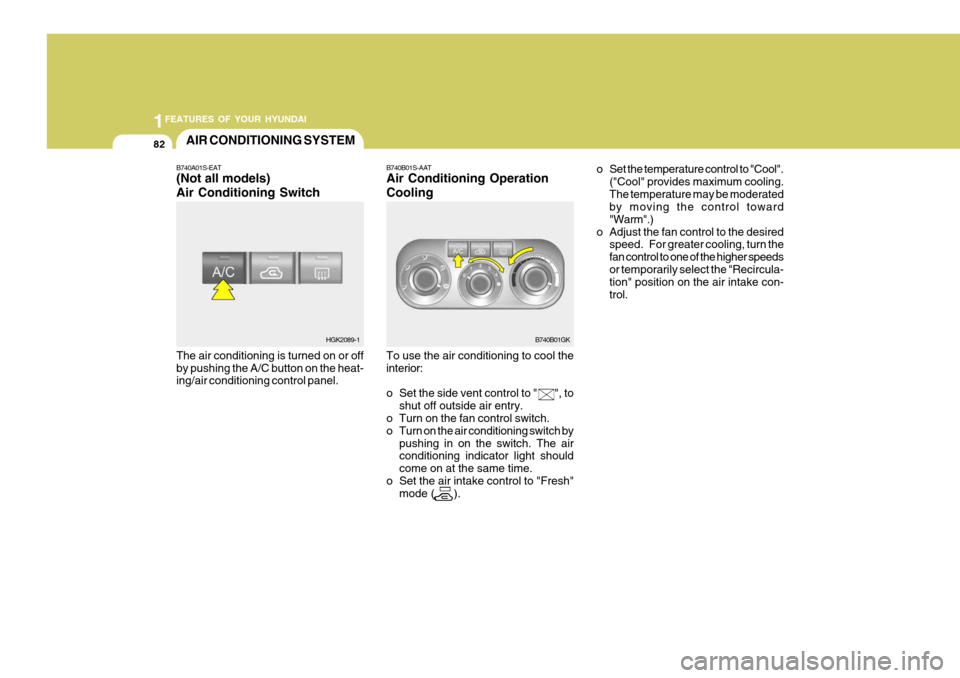
B740A01S-EAT (Not all models) Air Conditioning Switch The air conditioning is turned on or off by pushing the A/C button on the heat- ing/air conditioning control panel. B740B01S-AAT Air Conditioning Operation Cooling To use the air conditioning to cool the interior:
o Set the side vent control to " ", to
shut off outside air entry.
o Turn on the fan control switch.
o Turn on the air conditioning switch by
pushing in on the switch. The air conditioning indicator light should come on at the same time.
o Set the air intake control to "Fresh" mode ( ). o Set the temperature control to "Cool".
("Cool" provides maximum cooling.The temperature may be moderated by moving the control toward "Warm".)
o Adjust the fan control to the desired speed. For greater cooling, turn thefan control to one of the higher speedsor temporarily select the "Recircula- tion" position on the air intake con- trol.
HGK2089-1 B740B01GK
Page 272 of 389
1FEATURES OF YOUR HYUNDAI
92STEREO SOUND SYSTEM
AM reception
Ionosphere
FM reception
B750A01L
B750A02A-AAT How Car Audio Works
Ionosphere
B750A02L Mountains
Buildings Unobstructed
area
FM radio station
B750A03L
Obstructed area Iron bridges
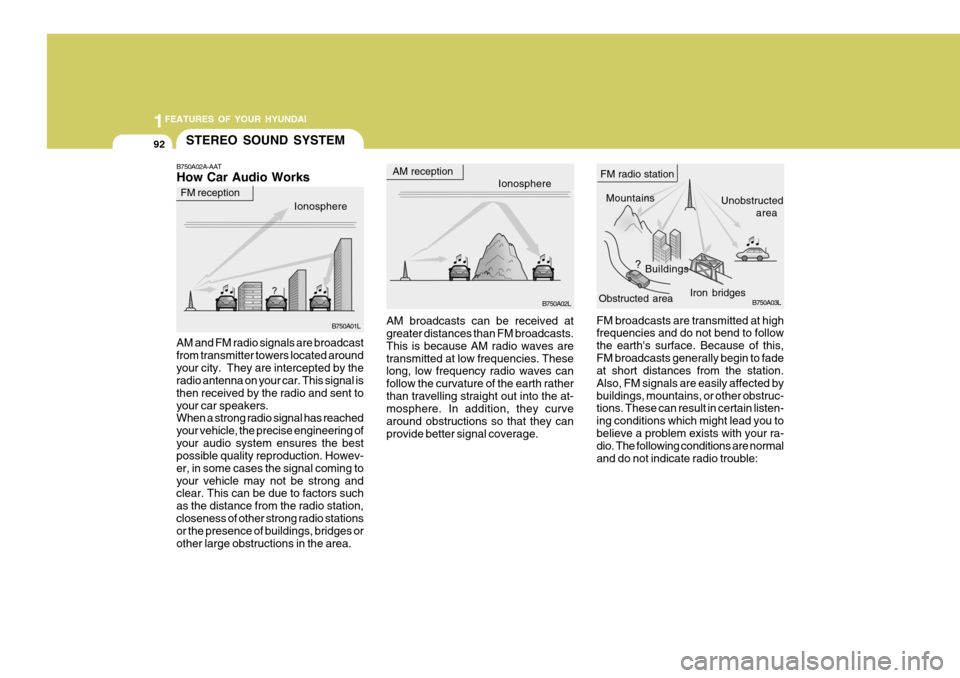
FM broadcasts are transmitted at high frequencies and do not bend to follow the earth's surface. Because of this,FM broadcasts generally begin to fade at short distances from the station. Also, FM signals are easily affected bybuildings, mountains, or other obstruc- tions. These can result in certain listen- ing conditions which might lead you tobelieve a problem exists with your ra- dio. The following conditions are normal and do not indicate radio trouble:
AM broadcasts can be received at greater distances than FM broadcasts. This is because AM radio waves aretransmitted at low frequencies. These long, low frequency radio waves can follow the curvature of the earth ratherthan travelling straight out into the at- mosphere. In addition, they curve around obstructions so that they canprovide better signal coverage.
AM and FM radio signals are broadcastfrom transmitter towers located aroundyour city. They are intercepted by the radio antenna on your car. This signal is then received by the radio and sent toyour car speakers. When a strong radio signal has reached your vehicle, the precise engineering ofyour audio system ensures the best possible quality reproduction. Howev- er, in some cases the signal coming toyour vehicle may not be strong and clear. This can be due to factors such as the distance from the radio station,closeness of other strong radio stations or the presence of buildings, bridges or other large obstructions in the area.
Page 277 of 389
2
Engine Exhaust Can Be Dangerous! ........................... 2-2
Before Starting the Engine ........................................... 2-3
Key Positions ................................................................ 2-3Starting......................................................................... 2-5
Manual Transaxle ......................................................... 2-6
Automatic Transaxle .................................................... 2-8
Effective Braking ........................................................ 2-11
Anti-Lock Brake System (ABS) .................................. 2-12
Electronic Stability Program (ESP) ............................2-13
Driving for Economy ................................................... 2-14
Smooth Cornering ...................................................... 2-16
Winter Motoring .......................................................... 2-16
Trailer or Vehicle Towing ........................................... 2-18
DRIVING YOUR HYUNDAI
2
Page 287 of 389
2
DRIVING YOUR HYUNDAI
11EFFECTIVE BRAKING
!
C090I01L-GAT
CAUTION:
o Shift into "R" and "P" position only when the vehicle has com- pletely stopped.
o Do not accelerate the engine in reverse or any of the forwardpositions with the brakes applied.
o Always apply the footbrake when shifting from "P" or "N", to "R","D"position.
o Do not use the "P" (Park) posi- tion in place of the parking brake.Always set the parking brake,shift the transaxle into "P" (Park) position and turn off the ignition when you leave the vehicle, evenmomentarily. Never leave the ve- hicle unattended while the en- gine is running.
o Check the automatic transaxle fluid level regularly, and add fluidas necessary. SC140A1-E Braking system performance and fric- tion material life are greatly affected by the driving style adopted. The follow- ing suggestions are made to assist inachieving the best results from the braking system.
o Anticipate the road and conditions
ahead in order that heavy braking may be avoided.
o When descending long gradients, use the engine to assist in retardingthe vehicle to minimize the possibil-ity of brake fade occur-ring.
o When trailer towing, ensure that the
trailer brakes function correctly anduse engine braking to assist the vehicle braking system.
o Use only genuine Hyundai replace- ment brake pads and shoes to en-sure consistent friction characteris- tics and wear rates.
o After driving through deep water (e.g. fording), the brakes may be-come wet and performance reduced.Always check brake efficiency after emerging from the water and dry thebrakes by lightly depressing thebrake pedal several times whilst driving slowly.
o Apply the parking brake only when the vehicle is at rest.
o Since the power assistance pro-
vided by the brake servo is derived from the engine, coasting with the engine turned off or towing of the vehicle with the engine turned offwill result in greatly increased pedal pressures being required to stop the vehicle.
o Do not hold the vehicle on the up- grade with the accelerator pedal.This can cause the transaxle tooverheat. Always use the brake pedal or parking brake.
Page 293 of 389

2
DRIVING YOUR HYUNDAI
17
In addition, anti-freeze solution must ALWAYS be used in vehicles fittedwith air conditioning, to prevent the heater matrix from freezing and sub- sequently bursting with the refrigera-tion system in use. ZC170D1-E Door Locks Should the door lock mechanism be- come frozen, a proprietary lock de-icer should be used. Alternatively, warm- ing the door key may thaw the doorlock. However, the key should be handled carefully to avoid burning the fingers.Never attempt to thaw a frozen door lock using hot water, since the water will eventually freeze and compoundthe problem. NOTE: The proper temperature for using the immobilizer key is from -40°F (- 40°C) to 176°F (80°C). If you heat the immobilizer key over 176°F (80°C)to open the frozen lock, it may cause damage to the transponder in its head. SC170E1-E Windscreen Washers and Wip- ers The windscreen washer bottle should be filled with a solution of water and a proprietary winter screen wash addi-tive. The windscreen wipers should not be used if the blades are frozen to the windscreen or if they are coveredwith snow, before this is removed. NOTE: Never allow undiluted screen washer fluid additive to spill upon the paintwork or use engine cool- ant anti-freeze since damage to thepaintwork may result.
o When driving in extreme conditions,
the windscreen wiper blades may fail to clear the screen properly due to the formation of ice upon theblade edge. It will therefore be nec- essary to periodically remove such ice to restore their efficiency.
o If the power operated door mirrors become frozen, attempts to adjustthese may damage the mechanism. o The formation of snow or ice built up
inside the wheel arches may inter-fere with the road wheels or steering mechanism. In such instances, un- usual noises or an increase in steer-ing effort may result. Therefore, ensure that the wheel arches are checked periodically and any accu-mulated snow or ice removed.
o It is advisable to carry emergency
equipment including, torch, shovel,tow rope, blankets etc., if a journey is to be undertaken into areas of severe road conditions.
Page 294 of 389
2DRIVING YOUR HYUNDAI
18TRAILER OR VEHICLE TOWING
YC200A1-E If you are considering towing with your car, you should first check with your Local Laws to determine their legal requirements.Since laws vary from county to county, the requirements for towing trailers, cars, or other types of vehicles orapparatus may differ. Ask your Hyundai dealer for further details before towing.
CAUTION:
Do not do any towing with your car during its first 1,200 miles (2,000 km) in order to allow the engine to have properly run-in. Failure to heedthis caution may result in serious engine or transaxle damage.
! YC200C3-A Trailer Brakes If your trailer is equipped with a braking system, make sure it conforms to fed-eral and/or local regulations and that it is properly installed and operating cor- rectly. NOTE: If you tow a trailer or vehicle, your car will require more frequent main-tenance due to the additional load. See Maintenance Under Severe Usage Conditions" on page 5-6.
YC200B2-E Trailer Hitches Select the proper hitch and ball combi- nation, making sure that its location is compatible with that of the trailer or vehicle being towed.Use a quality non-equalizing hitch which distributes the nose weight uniformly throughout the chassis. The hitch should be bolted securely to the car and installed by a qualifiedtechnician.
Page 295 of 389
2
DRIVING YOUR HYUNDAI
19
C190E01L
CAUTION:
o Never connect a trailer brake sys- tem directly to the vehicle brake system.
o When towing a trailer on steep grades (in excess of 12%) payclose attention to the engine cool-ant temperature gauge to ensure the engine does not overheat. If the needle of the coolant tem-perature gauge moves across the dial towards "H" (HOT), pull over and stop as soon as it is safe todo so, and allow the engine to idle until it cools down. You may proceed once the engine hascooled sufficiently.
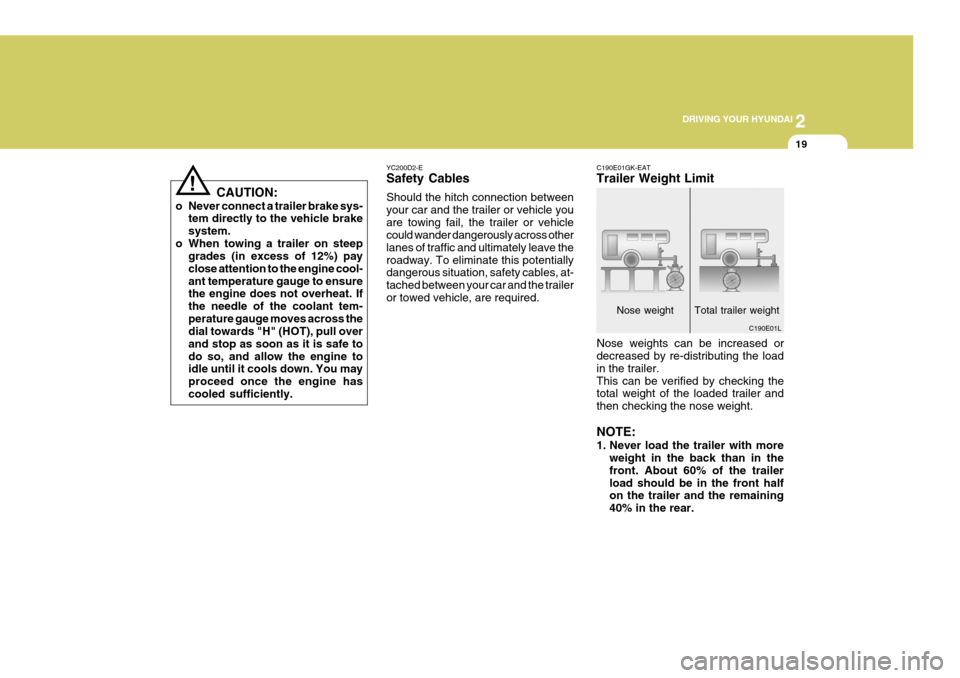
! YC200D2-E Safety Cables Should the hitch connection between your car and the trailer or vehicle youare towing fail, the trailer or vehicle could wander dangerously across other lanes of traffic and ultimately leave theroadway. To eliminate this potentially dangerous situation, safety cables, at- tached between your car and the traileror towed vehicle, are required.
Nose weight Total trailer weight
C190E01GK-EAT Trailer Weight Limit Nose weights can be increased or decreased by re-distributing the load in the trailer.This can be verified by checking the total weight of the loaded trailer and then checking the nose weight. NOTE:
1. Never load the trailer with more
weight in the back than in the front. About 60% of the trailerload should be in the front half on the trailer and the remaining 40% in the rear.
Page 296 of 389
2DRIVING YOUR HYUNDAI
20
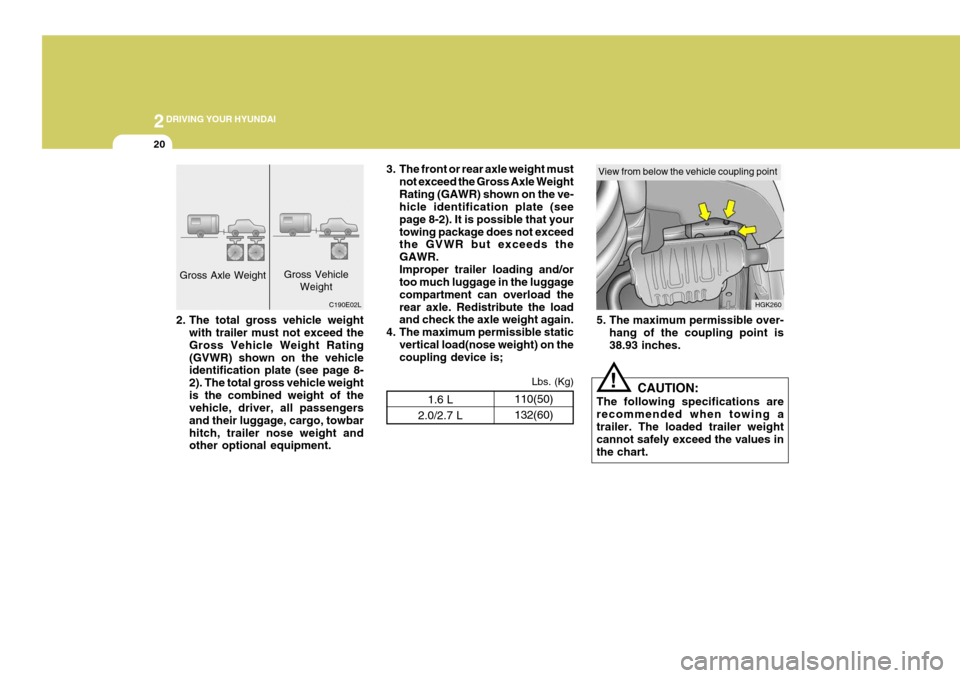
3. The front or rear axle weight must
not exceed the Gross Axle Weight Rating (GAWR) shown on the ve- hicle identification plate (see page 8-2). It is possible that yourtowing package does not exceed the GVWR but exceeds the GAWR.Improper trailer loading and/or too much luggage in the luggage compartment can overload therear axle. Redistribute the load and check the axle weight again.
4. The maximum permissible static vertical load(nose weight) on thecoupling device is;
2. The total gross vehicle weight
with trailer must not exceed the Gross Vehicle Weight Rating(GVWR) shown on the vehicle identification plate (see page 8- 2). The total gross vehicle weightis the combined weight of the vehicle, driver, all passengers and their luggage, cargo, towbarhitch, trailer nose weight and other optional equipment.
Gross Axle Weight
Gross Vehicle
Weight
C190E02L
1.6 L
2.0/2.7 L 110(50) 132(60)CAUTION:
The following specifications are recommended when towing a trailer. The loaded trailer weight cannot safely exceed the values inthe chart.!
5. The maximum permissible over-
hang of the coupling point is 38.93 inches.
Lbs. (Kg) View from below the vehicle coupling point
HGK260
Page 297 of 389
2
DRIVING YOUR HYUNDAI
21
!WARNING:
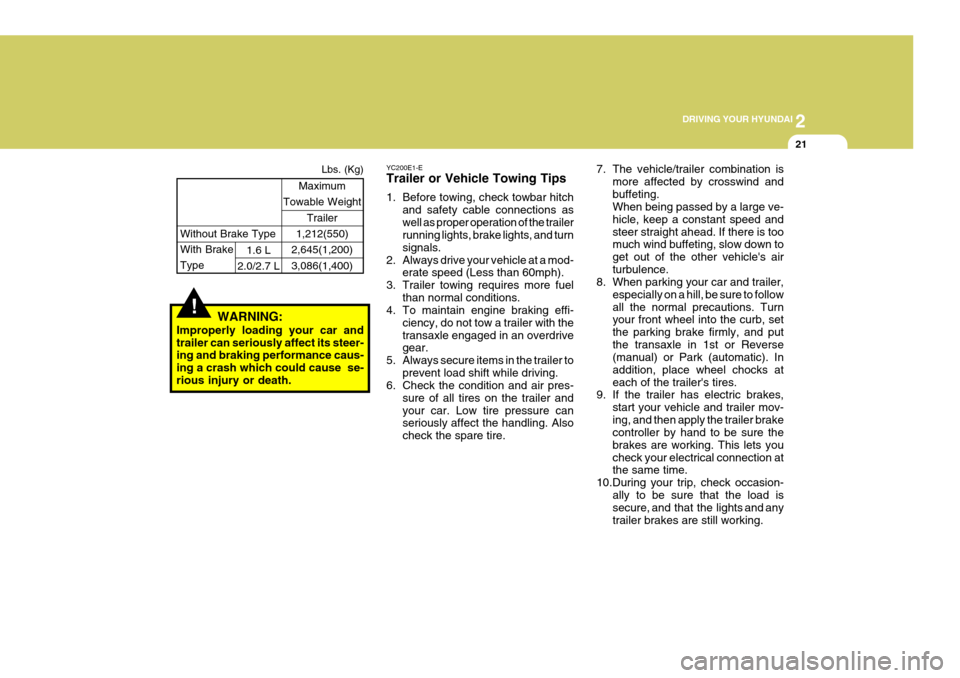
Improperly loading your car and trailer can seriously affect its steer- ing and braking performance caus- ing a crash which could cause se-rious injury or death. Without Brake Type
Maximum
Towable Weight
Trailer
1,212(550)
2,645(1,200) 3,086(1,400)
With Brake Type1.6 L
2.0/2.7 L Lbs. (Kg)
7. The vehicle/trailer combination is
more affected by crosswind and buffeting. When being passed by a large ve- hicle, keep a constant speed andsteer straight ahead. If there is too much wind buffeting, slow down to get out of the other vehicle's airturbulence.
8. When parking your car and trailer,
especially on a hill, be sure to followall the normal precautions. Turn your front wheel into the curb, set the parking brake firmly, and putthe transaxle in 1st or Reverse (manual) or Park (automatic). In addition, place wheel chocks ateach of the trailer's tires.
9. If the trailer has electric brakes,
start your vehicle and trailer mov-ing, and then apply the trailer brake controller by hand to be sure the brakes are working. This lets youcheck your electrical connection at the same time.
10.During your trip, check occasion- ally to be sure that the load issecure, and that the lights and any trailer brakes are still working.
YC200E1-E Trailer or Vehicle Towing Tips
1. Before towing, check towbar hitch
and safety cable connections as well as proper operation of the trailer running lights, brake lights, and turn signals.
2. Always drive your vehicle at a mod- erate speed (Less than 60mph).
3. Trailer towing requires more fuel than normal conditions.
4. To maintain engine braking effi-
ciency, do not tow a trailer with thetransaxle engaged in an overdrive gear.
5. Always secure items in the trailer to prevent load shift while driving.
6. Check the condition and air pres-
sure of all tires on the trailer and your car. Low tire pressure can seriously affect the handling. Also check the spare tire.
Page 298 of 389

2DRIVING YOUR HYUNDAI
22
11.Avoid jerky starts, sudden accel-eration or sudden stops.
12.Avoid sharp turns and rapid lane changes.
13.Avoid holding the brake pedal down
too long or too frequently. This could cause the brakes to overheat, re- sulting in reduced braking efficiency.
14.When going down a hill, shift into a lower gear and use the engine brak-ing effect.When ascending a long grade, downshift the transaxle to a lower gear and reduce speed to reducechances of engine overloading and/ or overheating.
15.If you have to stop while going uphill, do not hold the vehicle inplace by pressing on the accelera- tor. This can cause the automatictransaxle to overheat. Use the park- ing brake or footbrake.
NOTE: When towing check transaxle fluid more frequently. CAUTION:
If overheating should occur whentowing, (temperature gauge readsnear red zone), taking the following action may reduce or eliminate the problem.
1. Turn off the air conditioner.
2. Reduce highway speed.
3. Select a lower gear when going uphill.
4. While in stop and go traffic, place the gear selection in park or neu- tral and idle the engine at a higher speed.
!