tow Hyundai Coupe 2004 Owner's Guide
[x] Cancel search | Manufacturer: HYUNDAI, Model Year: 2004, Model line: Coupe, Model: Hyundai Coupe 2004Pages: 389, PDF Size: 10.22 MB
Page 111 of 389

DRIVING YOUR HYUNDAI
2- 16
9. If the trailer has electric brakes, start your
vehicle and trailer moving, and then apply the trailer brake controller by hand to be sure thebrakes are working. This lets you check yourelectrical connection at the same time.
10. During your trip, check occasionally to be sure that the load is secure, and that thelights and any trailer brakes are still working.
11. Avoid jerky starts, sudden acceleration or sudden stops.
12. Avoid sharp turns and rapid lane changes.
13. Avoid holding the brake pedal down too long or too frequently. This could cause the brakesto overheat, resulting in reduced braking effi-ciency.
14. When going down a hill, shift into a lower gear and use the engine braking effect.When ascending a long grade, downshift thetransmission to a lower gear and reducespeed to reduce chances of engine overload-ing and/or overheating.
15. If you have to stop while going uphill, do not hold the vehicle in place by pressing on theaccelerator. This can cause the automatictransmission to overheat. Use the parkingbrake or footbrake. NOTE:When towing check transaxle fluid more fre-quently. CAUTION: If overheating should occur when towing,(temperature gauge reads near red zone),taking the following action may reduce oreliminate the problem.
1. Turn off the air conditioner.
2. Reduce highway speed.
3. Select a lower gear when going uphill.
4. While in stop and go traffic, place the gear
selector in park or neutral and idle theengine at a higher speed.
Page 119 of 389

WHAT TO DO IN AN EMERGENCY
3-8 D080A02A-GAT IF YOUR CAR MUST BE TOWED CAUTION: Your car can be damaged if towed incorrect-ly! If your car has to be towed, it should be done by your Hyundai dealer or a commercial tow truckservice. This will help assure that your car is notdamaged in towing. Also, professionals are gen-erally aware of local laws governing towing. Inany case, rather than risk damage to your car, itis suggested that you show this information to thetow truck operator. Be sure that a safety chainsystem is used and that all local laws are ob-served.
D080B01A-AAT Towing a Car with a Manual Transaxle
o If the car is being towed with the rear wheels
on the ground, be sure the parking brake is released.
o If the car is being towed with the front wheels on the ground, be sure that the transaxle is inneutral. Also, be sure that the ignition key is inthe "ACC" position. This is necessary toprevent damage to the steering lock mecha-nism, which is not designed to hold the frontwheels straight while the car is being towed.
o If any of the loaded wheels or suspension components are damaged, a towing dollymust be used.
o OK FOR AUTOMATIC OR MANUAL
TRANSAXLE EQUIPPED VEHICLE o OK FOR AUTOMATIC OR MANUAL
TRANSAXLE EQUIPPED VEHICLEWITH NO DAMAGE
D080A01GKHGK199
D060J01FC-GAT After Changing Wheels If you have a tire gauge, remove the valve cap and check the air pressure. If the pressure islower than recommended, drive slowly to thenearest service station and inflate to the correctpressure. If it is too high, adjust it until it is correct.Always reinstall the valve cap after checking oradjusting tire pressure. If the cap is not replaced,air may leak from the tire. If you lose a valve cap,buy another and install it as soon as possible.After you have changed wheels, always securethe flat tire in its place in the luggage compart-ment and return the jack and tools to their properstorage locations.
HGK195
Page 120 of 389

WHAT TO DO IN AN EMERGENCY 3-9
D080C02A-GAT Towing a Car With an Automatic Transaxle CAUTION: A car with an automatic transaxle should never be towed from the rear with the frontwheels on the ground. This can cause seri-ous damage to the transaxle. If the car mustbe towed from the rear, a towing dolly mustbe used under the front wheels. If the car is being towed with the rear wheels on the ground, be sure the parking brake is re-leased.
o NOT OK FOR AUTOMATIC TRANSAXLE
EQUIPPED VEHICLE
o OK FOR MANUAL TRANSAXLE
D080D02A-AAT Emergency Towing For emergency towing when no commercial tow vehicle is available, attach a tow cable, chain orstrap to one of the towing hooks under the front/rear of your car. Do not attempt to tow yourvehicle in this manner on any unpaved surface.This could result in serious damage to your car.Nor should towing be attempted if the wheels,drive train, axles, steering or brakes are dam-aged. Before towing, be sure the transaxle is inneutral and the key is in "ACC" (with the engineoff) or in the "ON" position (with the enginerunning). A driver must be in the towed car tosteer it and operate the brakes. CAUTION:
o If the car is being towed with all four
wheels on the ground, it can be towedonly from the front. Be sure that thetransaxle is in neutral. Do not tow at speedsgreater than 50 km/h (30 mph) and formore than 25 km (15 miles).
o Be sure the steering is unlocked by plac- ing the key in the "ACC" position. A drivermust be in the towed vehicle to operatethe steering and brakes
o OK FOR AUTOMATIC OR MANUAL
TRANSAXLE EQUIPPED VEHICLE
HGK200
D080C01GK
HGK188
NOTE: Before towing, check the level of the transaxlefluid. If it is below the "HOT" range on thedipstick, add fluid. If you cannot add fluid, atowing dolly must be used.
Front
Rear
Page 129 of 389

VEHICLE MAINTENANCE REQUIREMENTS
5- 4 European Community Only Except European Community
ENGINE OIL AND FILTER AIR CLEANER FILTER SPARK PLUGSTIMING BELTBRAKE PADS, CALIPERS AND ROTORSREAR BRAKE DRUMS/LININGS/PADS, PARKING BRAKESTEERING GEAR BOX, LINKAGE& BOOTS/LOWER ARM BALL JOINTDRIVESHAFTS AND BOOTSMANUAL TRANSAXLE OILAUTOMATICTRANSAXLE FLUIDAIR CONDITIONER FILTER (FOR BLOWER UNIT)
F040A03GK-GAT
MAINTENANCE UNDER SEVERE USAGE CONDITIONS
The following items must be serviced more frequently on cars normally used under severe driving conditions. Refer to the chart below for the appropriate maintenance intervals. R : Replace I : Inspect and, after inspection, clean, adjust, repair or replace if necessary
DRIVING
CONDITIONMAINTENANCE INTERVALS
R R RR
II II
RRR
MAINTENANCE
OPERATION
MAINTENANCE ITEM
EVERY 7,500 KM OR 6 MONTHS EVERY 5,000 KM OR 6 MONTHSMORE FREQUENTLYMORE FREQUENTLYEVERY 60,000 KM OR 48 MONTHSMORE FREQUENTLYMORE FREQUENTLY MORE FREQUENTLYEVERY 15,000 KM OR 12 MONTHS EVERY 100,000 KMEVERY 45,000 KMEVERY 40,000 KMMORE FREQUENTLYA, B, C, F, H C, E B, HD, E, F, GC, D, G, HC, D, G, H C, D, E, FC, D, E, F, G A, C, D, E, F, G, H, I, J A, C, E, F, G, H, IC, E
SEVERE DRIVING CONDITIONS
A - Repeated short distance driving
B - Extensive idling
C - Driving in dusty, rough roads
D - Driving in areas using salt or other corrosive materials or in very cold weather
E - Driving in sandy areas F - More than 50% driving in heavy city traffic during hot weather
above 32°C (90°F)
G - Driving in mountainous areas
H - Towing a trailer
I - Driving as a patrol car, taxi, other commercial use car or vehicle towing
J - Driving over 170 km/h1.6 DOHC/2.7 V6 2.0 DOHC CVVT
Page 150 of 389

DO-IT-YOURSELF MAINTENANCE
6-18 4. Replace the blown fuse by pressing a new
fuse of the same rating into place. The fuse should be a snug fit. If it is not, have the fuseclip repaired or replaced by a Hyundai dealer.If you do not have a spare fuse, you may beable to borrow a fuse of the same or lowerrating from an accessory you can tempo-rarily get along without (the radio or cigarettelighter, for example). Always remember toreplace the borrowed fuse.
AXA6201B
G200B02A-AAT
Replacing Accessory Fuse The fuse box for the lights and other electrical accessories will be found low on the dashboardon the driver's side. Inside the box you will find alist showing the circuits protected by each fuse. If any of your car's lights or other electrical
accessories stop working, a blown fuse couldbe the reason. If the fuse has burned out, youwill see that the metal strip inside the fuse hasburned through. If you suspect a blown fuse,follow this procedure:
1. Turn off the ignition and all other switches.
2. Open the fuse box and examine each fuse. Remove each fuse by pulling it toward you (a small "fuse puller" tool is contained in thefuse box to simplify this operation).
3. Be sure to check all other fuses even if you find one that appears to have burned out.
HGK185
G200A01A-AAT
CHECKING AND REPLACING FUSES Replacing a Fusible Link
A fusible link will melt if the electrical circuits
from the battery are ever overloaded, thus pre- venting damage to the entire wiring harness.(This could be caused by a short in the systemdrawing too much current.) If this ever happens,have a Hyundai dealer determine the cause,repair the system and replace the fusible link.The fusible links are located in a relay box foreasy inspection.
CAUTION: When replacing a fusible link, never use
anything but a new fusible link with the same or lower amperage rating. Never use apiece of wire or a higher-rated fusible link.This could result in serious damage andcreate a fire hazard.
AS60310A
Good
Bad
Page 169 of 389

INDEX
10-4
Tires
Balancing ........................................................................................ 8-3
Chains ............................................................................................ 8-2
Changing a flat tire ......................................................................... 3-4
If you have a fl at tire ...................................................................... 3-4
Information ...................................................................................... 8-1
Pressure ......................................................................................... 8-1
Replacement ................................................................................... 8-3
Rotation .......................................................................................... 8-2
Snow tires ....................................................................................... 8-2
Spare ti re ........................................................................................ 3-3
Traction ........................................................................................... 8-3
Towing Emergency ..................................................................................... 3-9
If your car must be towed .............................................................. 3-8
Trailer or vehicle towing ............................................................... 2-13
Transaxle Automatic ........................................................................................ 2-6
Automatic transaxle fluid checking ...............................................6-11
Manual ............................................................................................ 2-4
Manual transaxle oil checking ...................................................... 6-11
Trip Computer ................................................................................... 1-31
Trip Odometer ................................................................................... 1-30
V Vehicle Identificat ion Number (VIN) .................................................... 8-1
Vehicle Specification ........................................................................... 9-1Ventilation Center ventilator ........................................................................... 1-50
Side ventilator ............................................................................... 1-50WWasher fluid
...................................................................................... 6-10
Warning Lights ....................................................................... 1-28 ~ 1-29
Windows Glass ................................................................................... 1-7
Windshield Wiper and Washer ......................................................... 1-34
Windshield Wiper Blades .................................................................. 6-10
Page 170 of 389

NAME: STREET:TOWN: COUNTRY: P.CODE: NAME: STREET: TOWN:COUNTRY: P.CODE:
A000A01A-EAT This Owner's Manual should be considered a part of the car and remain with it when it is sold for the use of the next owner.OWNER I.D.
ORIGINAL: ADDRESS: DATE OF SALE: SUBSEQUENT: ADDRESS: TRANSFER DATE:
Page 184 of 389
1CONTROLS AND EQUIPMENT
4
!
IMMOBILISER SYSTEM
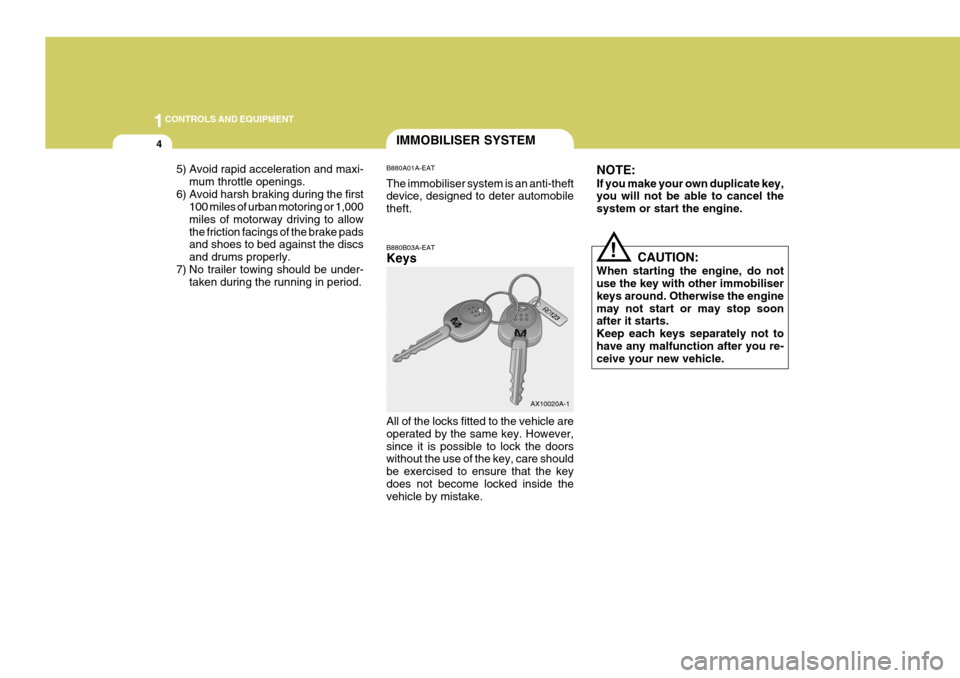
B880B03A-EAT Keys All of the locks fitted to the vehicle are operated by the same key. However,since it is possible to lock the doors without the use of the key, care should be exercised to ensure that the keydoes not become locked inside the vehicle by mistake. AX10020A-1
5) Avoid rapid acceleration and maxi-
mum throttle openings.
6) Avoid harsh braking during the first 100 miles of urban motoring or 1,000 miles of motorway driving to allowthe friction facings of the brake pads and shoes to bed against the discs and drums properly.
7) No trailer towing should be under- taken during the running in period. B880A01A-EAT The immobiliser system is an anti-theft device, designed to deter automobile theft.
NOTE: If you make your own duplicate key, you will not be able to cancel the system or start the engine.
CAUTION:
When starting the engine, do not use the key with other immobiliser keys around. Otherwise the enginemay not start or may stop soon after it starts. Keep each keys separately not tohave any malfunction after you re- ceive your new vehicle.
Page 186 of 389
1CONTROLS AND EQUIPMENT
6
!
DOOR LOCKS
B040A02Y-EAT
WARNING:
o Unlocked doors can be danger- ous. Before you drive away (es- pecially if there are children inthe car), be sure that all the doors are securely closed and locked so that the doors cannot be inad-vertently opened from the inside. This helps ensure that doors will not be opened accidentally. Also,when combined with the proper use of seat belts, locking the doors helps keep occupants frombeing ejected from the car in case of an accident.
o Before opening the door, always look for and avoid oncoming traf-fic.
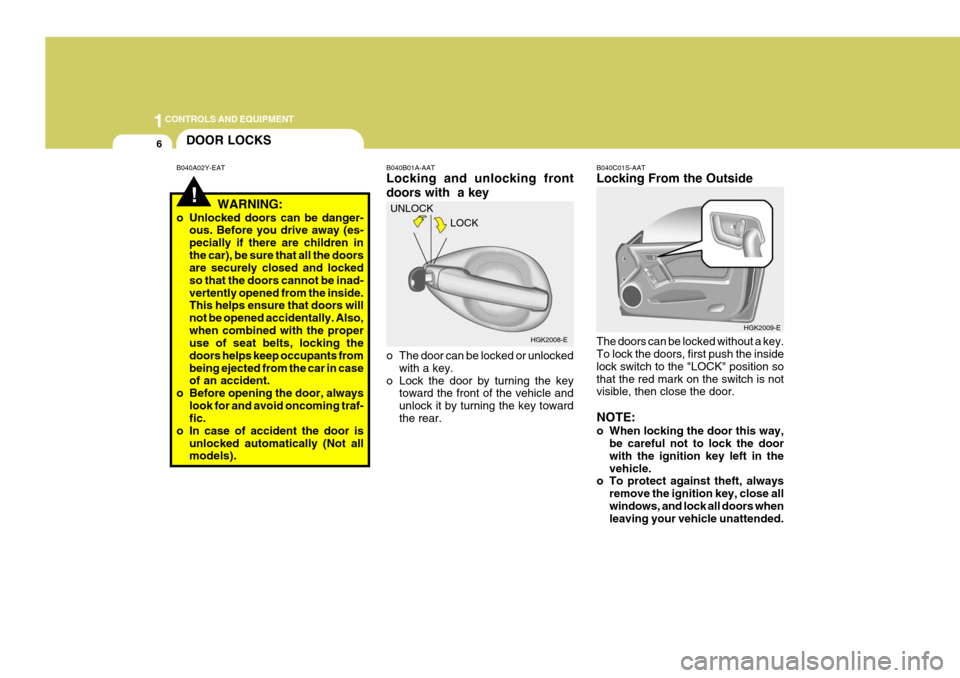
o In case of accident the door is unlocked automatically (Not allmodels). B040B01A-AAT Locking and unlocking front doors with a key
o The door can be locked or unlocked
with a key.
o Lock the door by turning the key toward the front of the vehicle and unlock it by turning the key towardthe rear. HGK2008-E
UNLOCK
LOCK B040C01S-AAT Locking From the Outside The doors can be locked without a key. To lock the doors, first push the inside lock switch to the "LOCK" position sothat the red mark on the switch is not visible, then close the door. NOTE:
o When locking the door this way,
be careful not to lock the door with the ignition key left in thevehicle.
o To protect against theft, always
remove the ignition key, close allwindows, and lock all doors when leaving your vehicle unattended. HGK2009-E
Page 187 of 389
1
CONTROLS AND EQUIPMENT
7
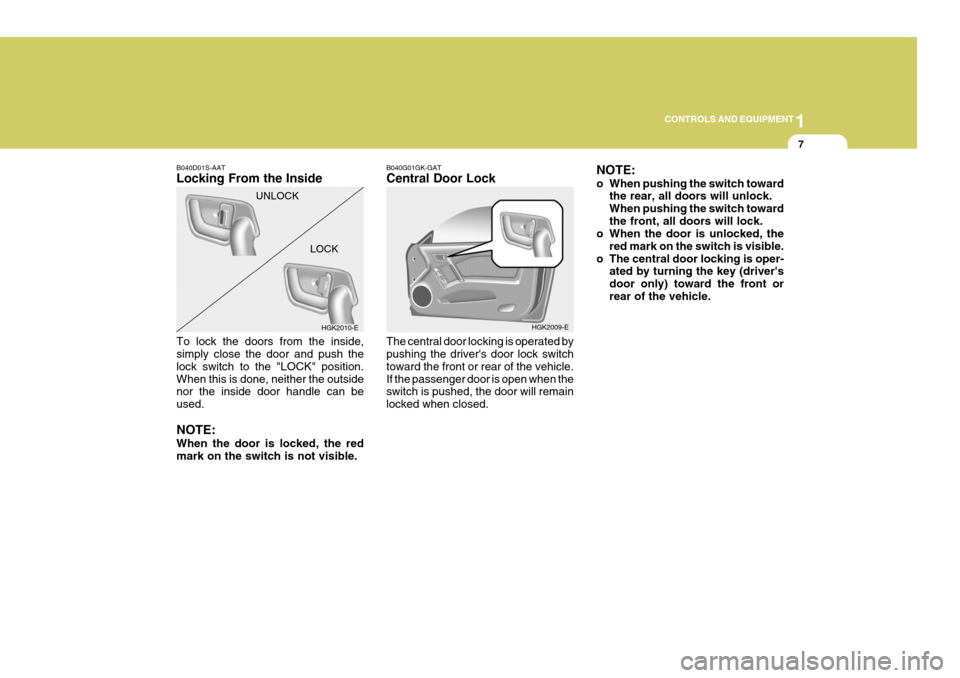
B040G01GK-GAT Central Door Lock The central door locking is operated by pushing the driver's door lock switch toward the front or rear of the vehicle.If the passenger door is open when the switch is pushed, the door will remain locked when closed. NOTE:
o When pushing the switch toward
the rear, all doors will unlock. When pushing the switch towardthe front, all doors will lock.
o When the door is unlocked, the
red mark on the switch is visible.
o The central door locking is oper- ated by turning the key (driver'sdoor only) toward the front orrear of the vehicle.
HGK2009-E
B040D01S-AAT Locking From the Inside To lock the doors from the inside, simply close the door and push the lock switch to the "LOCK" position.When this is done, neither the outside nor the inside door handle can be used. NOTE: When the door is locked, the red mark on the switch is not visible. UNLOCK
HGK2010-E
LOCK