height Hyundai Coupe 2005 User Guide
[x] Cancel search | Manufacturer: HYUNDAI, Model Year: 2005, Model line: Coupe, Model: Hyundai Coupe 2005Pages: 478, PDF Size: 13.44 MB
Page 286 of 478
1
CONTROLS AND EQUIPMENT
15
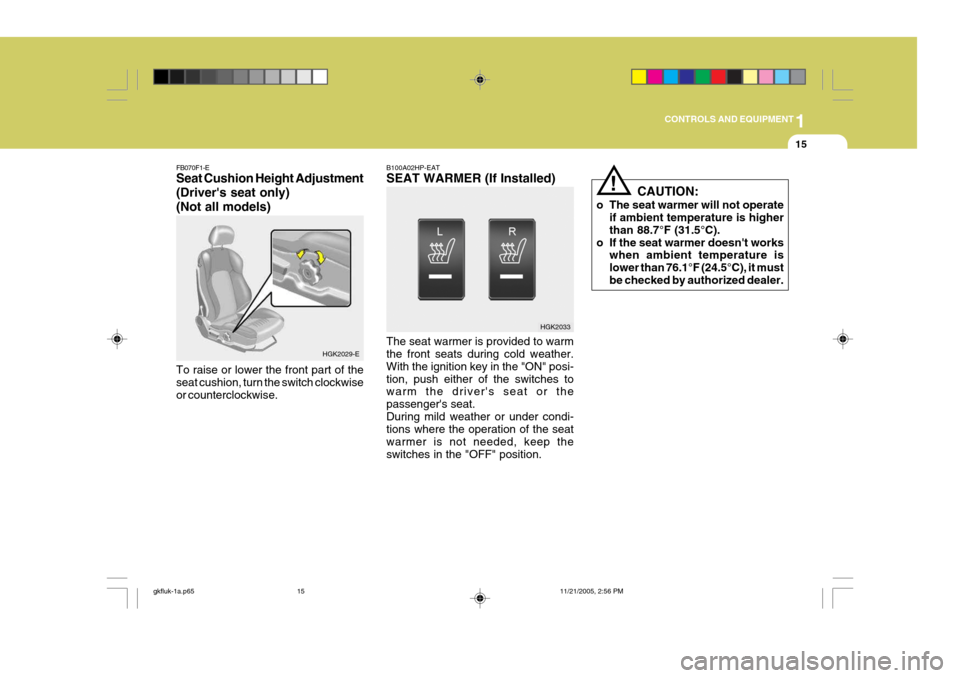
FB070F1-E Seat Cushion Height Adjustment (Driver's seat only)(Not all models) To raise or lower the front part of the seat cushion, turn the switch clockwiseor counterclockwise. B100A02HP-EAT SEAT WARMER (If Installed) The seat warmer is provided to warm the front seats during cold weather. With the ignition key in the "ON" posi-tion, push either of the switches to warm the driver's seat or the passenger's seat.During mild weather or under condi- tions where the operation of the seat warmer is not needed, keep theswitches in the "OFF" position.
HGK2029-E
HGK2033
!
CAUTION:
o The seat warmer will not operate if ambient temperature is higher than 88.7°F (31.5°C).
o If the seat warmer doesn't works when ambient temperature islower than 76.1°F (24.5°C), it mustbe checked by authorized dealer.
gkfluk-1a.p65
11/21/2005, 2:56 PM
15
Page 291 of 478
1CONTROLS AND EQUIPMENT
20
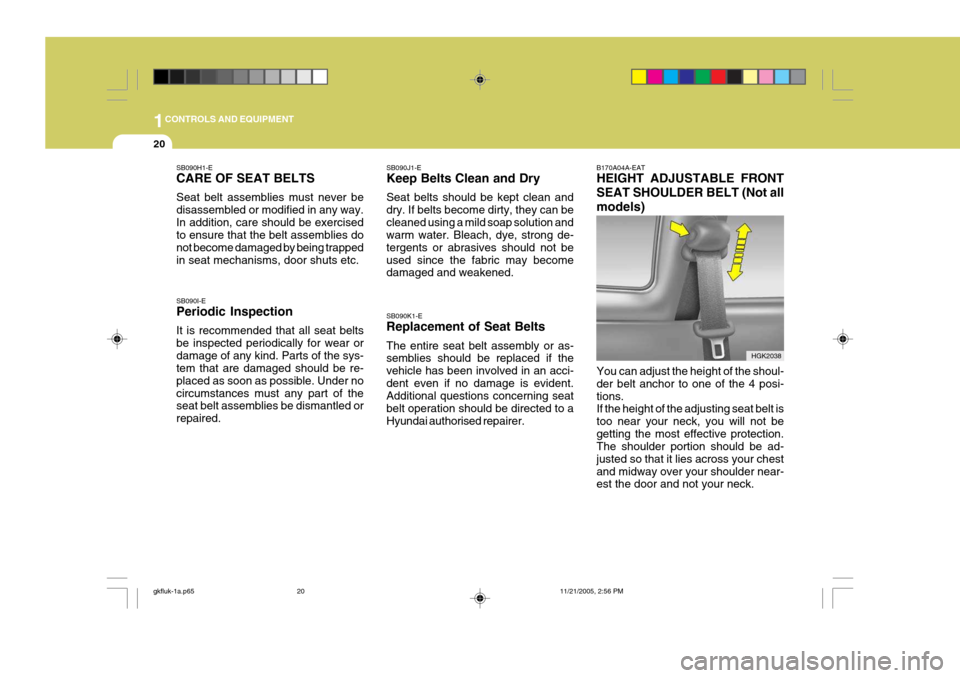
B170A04A-EAT HEIGHT ADJUSTABLE FRONT SEAT SHOULDER BELT (Not allmodels)
HGK2038
You can adjust the height of the shoul- der belt anchor to one of the 4 posi-tions. If the height of the adjusting seat belt is too near your neck, you will not begetting the most effective protection. The shoulder portion should be ad- justed so that it lies across your chestand midway over your shoulder near- est the door and not your neck.
SB090H1-E CARE OF SEAT BELTS Seat belt assemblies must never be disassembled or modified in any way.In addition, care should be exercised to ensure that the belt assemblies do not become damaged by being trappedin seat mechanisms, door shuts etc. SB090I-E Periodic Inspection It is recommended that all seat belts be inspected periodically for wear ordamage of any kind. Parts of the sys- tem that are damaged should be re- placed as soon as possible. Under nocircumstances must any part of the seat belt assemblies be dismantled or repaired.
SB090J1-E Keep Belts Clean and Dry Seat belts should be kept clean and dry. If belts become dirty, they can becleaned using a mild soap solution and warm water. Bleach, dye, strong de- tergents or abrasives should not beused since the fabric may become damaged and weakened. SB090K1-E Replacement of Seat Belts The entire seat belt assembly or as- semblies should be replaced if the vehicle has been involved in an acci-dent even if no damage is evident. Additional questions concerning seat belt operation should be directed to aHyundai authorised repairer.
gkfluk-1a.p65
11/21/2005, 2:56 PM
20
Page 292 of 478
1
CONTROLS AND EQUIPMENT
21
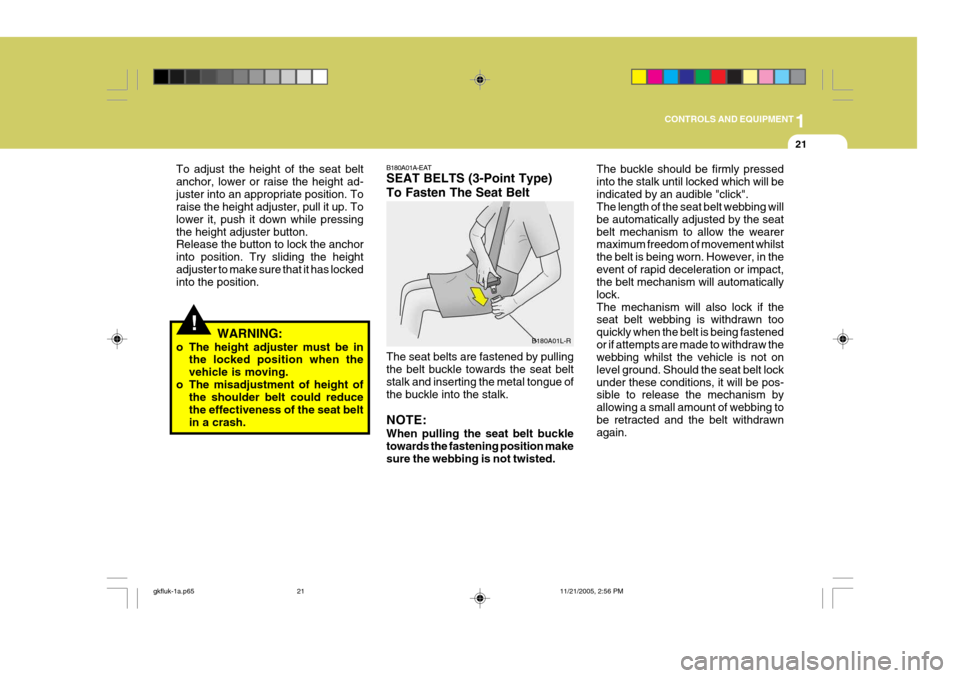
B180A01A-EAT SEAT BELTS (3-Point Type) To Fasten The Seat Belt The seat belts are fastened by pulling the belt buckle towards the seat belt stalk and inserting the metal tongue ofthe buckle into the stalk. NOTE: When pulling the seat belt buckle towards the fastening position make sure the webbing is not twisted. B180A01L-R
!
To adjust the height of the seat belt anchor, lower or raise the height ad-juster into an appropriate position. To raise the height adjuster, pull it up. To lower it, push it down while pressingthe height adjuster button. Release the button to lock the anchor into position. Try sliding the heightadjuster to make sure that it has locked into the position.
WARNING:
o The height adjuster must be in the locked position when the vehicle is moving.
o The misadjustment of height of the shoulder belt could reducethe effectiveness of the seat beltin a crash. The buckle should be firmly pressedinto the stalk until locked which will beindicated by an audible "click". The length of the seat belt webbing will be automatically adjusted by the seatbelt mechanism to allow the wearer maximum freedom of movement whilst the belt is being worn. However, in theevent of rapid deceleration or impact, the belt mechanism will automatically lock.The mechanism will also lock if the seat belt webbing is withdrawn too quickly when the belt is being fastenedor if attempts are made to withdraw the webbing whilst the vehicle is not on level ground. Should the seat belt lockunder these conditions, it will be pos- sible to release the mechanism by allowing a small amount of webbing tobe retracted and the belt withdrawn again.
gkfluk-1a.p65
11/21/2005, 2:56 PM
21
Page 294 of 478
1
CONTROLS AND EQUIPMENT
23
!WARNING:
o A child restraint system must be placed in the rear seat. Never install a child or infant seat on the front passenger's seat.Should an accident occur and cause the passenger side airbag to deploy, it could severely in-jure or kill an infant or child seated in an infant or child seat. Thus, only use a child restraint in therear seat of your vehicle.
o Since a safety belt or child re-
straint system can become very hot if it is left in a closed vehicle, be sure to check the seat coverand buckles before placing a child there.
o When the child restraint system is not in use, store it in the lug-gage compartment or fasten it with a safety belt so that it willnot be thrown forward in the case of a sudden stop or an accident. o Never use an infant carrier or child
safety seat that "hooks" over aseatback; it may not provide ad- equate security in an accident.
o Never allow a child to be held in a person's arms whilst they are in amoving vehicle, as this could re-sult in serious injury to the child in the event of an accident or a sudden stop. Holding a child in amoving vehicle does not provide the child with any means of pro- tection during an accident, even ifthe person holding the child is wearing a seat belt.
o If the child restraint seat is not
anchored properly, the risk of achild being seriously injured or killed in a collision greatly in-creases.
o Children who are too large to be in
a child restraint should sit in therear seat and be restrained with the available lap/shoulder belts. Never allow children to ride in thefront passanger seat.
o Always make sure that the shoul-
der belt portion of the outboardlap/shoulder belt is positioned midway over the shoulder, never across the neck. Moving the childcloser to the centre of the vehicle may help provide a good shoul- der belt fit. The lap belt portion ofthe lap/shoulder belt or the cen- tre seat lap belt must always be positioned as low as possible onthe child's hips and as snug as possible.
o If the seat belt will not properly fit the child, we recommend the useof an approved booster seat in the rear seat in order to raise thechild's seating height so that the seat belt will properly fit the child.
o Never allow a child to stand up or kneel on the seat.
gkfluk-1a.p65 11/21/2005, 2:56 PM
23
Page 380 of 478
2
DRIVING YOUR HYUNDAI
13
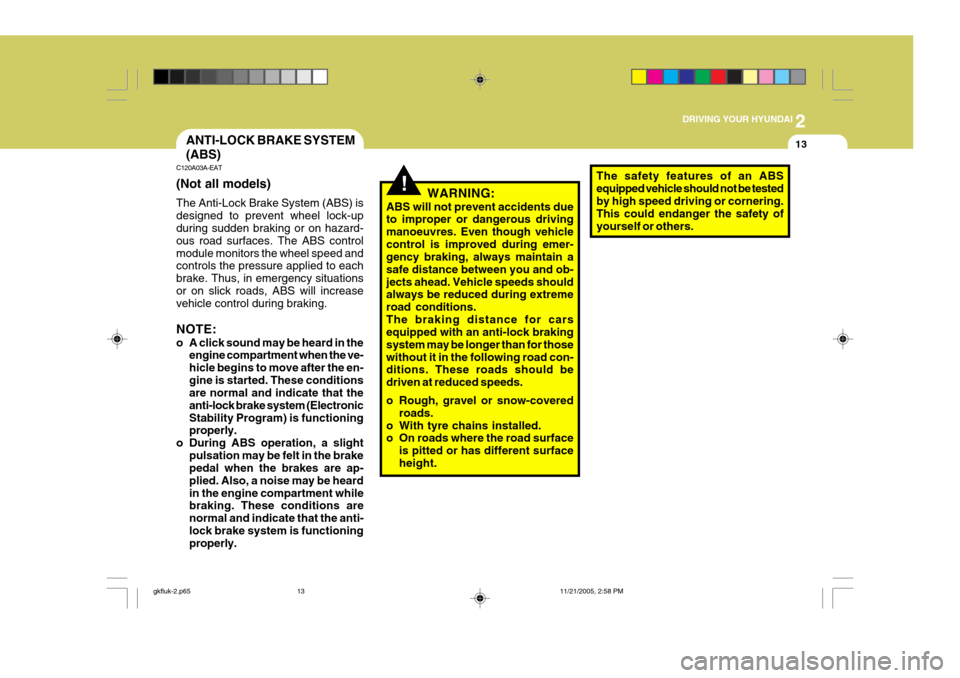
WARNING:
ABS will not prevent accidents due to improper or dangerous driving manoeuvres. Even though vehiclecontrol is improved during emer- gency braking, always maintain a safe distance between you and ob-jects ahead. Vehicle speeds should always be reduced during extreme road conditions.The braking distance for cars equipped with an anti-lock braking system may be longer than for thosewithout it in the following road con- ditions. These roads should be driven at reduced speeds.
o Rough, gravel or snow-covered roads.
o With tyre chains installed.
o On roads where the road surface
is pitted or has different surface height.!The safety features of an ABS equipped vehicle should not be tested by high speed driving or cornering. This could endanger the safety ofyourself or others.
ANTI-LOCK BRAKE SYSTEM (ABS)
C120A03A-EAT (Not all models) The Anti-Lock Brake System (ABS) is designed to prevent wheel lock-up during sudden braking or on hazard- ous road surfaces. The ABS controlmodule monitors the wheel speed and controls the pressure applied to each brake. Thus, in emergency situationsor on slick roads, ABS will increase vehicle control during braking. NOTE:
o A click sound may be heard in the
engine compartment when the ve- hicle begins to move after the en-gine is started. These conditions are normal and indicate that the anti-lock brake system (ElectronicStability Program) is functioning properly.
o During ABS operation, a slight
pulsation may be felt in the brakepedal when the brakes are ap- plied. Also, a noise may be heardin the engine compartment while braking. These conditions are normal and indicate that the anti-lock brake system is functioning properly.
gkfluk-2.p65 11/21/2005, 2:58 PM
13
Page 397 of 478
3
IN CASE OF EMERGENCY
7
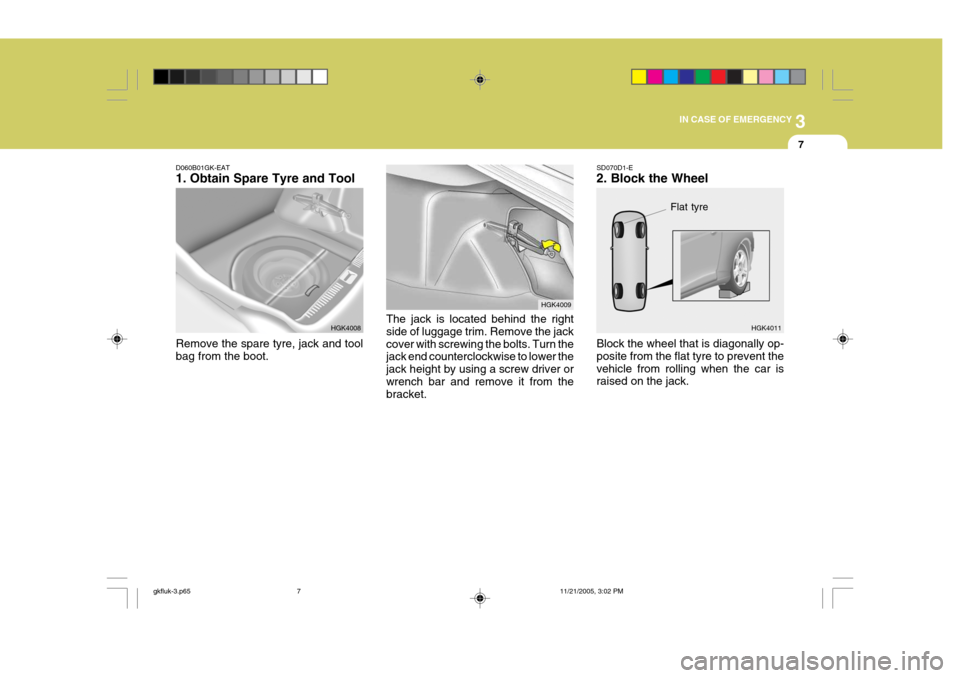
D060B01GK-EAT 1. Obtain Spare Tyre and Tool Remove the spare tyre, jack and tool bag from the boot. HGK4008
HGK4009
The jack is located behind the right side of luggage trim. Remove the jackcover with screwing the bolts. Turn the jack end counterclockwise to lower the jack height by using a screw driver orwrench bar and remove it from the bracket.
Flat tyre
SD070D1-E 2. Block the Wheel Block the wheel that is diagonally op- posite from the flat tyre to prevent thevehicle from rolling when the car is raised on the jack. HGK4011
gkfluk-3.p65
11/21/2005, 3:02 PM
7
Page 471 of 478
9 VEHICLE SPECIFICATIONS
2
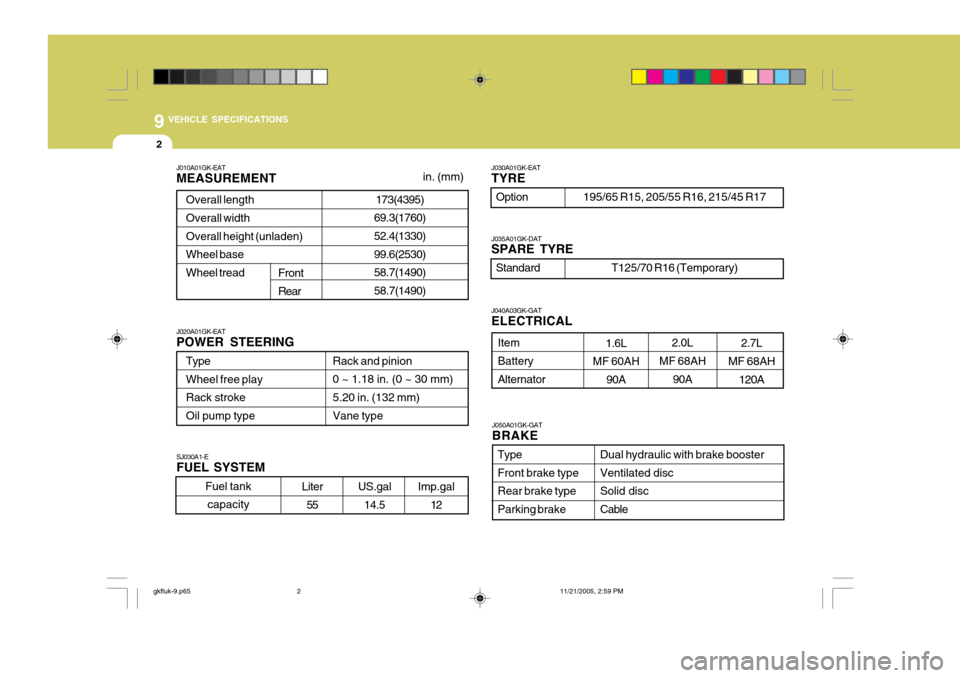
J010A01GK-EAT MEASUREMENT 173(4395)
69.3(1760) 52.4(1330) 99.6(2530)58.7(1490) 58.7(1490)
Overall length Overall width Overall height (unladen)Wheel base Wheel tread FrontRear
Type Wheel free play Rack strokeOil pump type Rack and pinion0 ~ 1.18 in. (0 ~ 30 mm) 5.20 in. (132 mm) Vane type
Option
Item Battery Alternator
in. (mm)
Fuel tank
capacity Imp.gal
12 2.7L
MF 68AH
120A
195/65 R15, 205/55 R16, 215/45 R17
2.0L
MF 68AH 90A
Dual hydraulic with brake booster Ventilated disc Solid discCable
Type Front brake type Rear brake typeParking brake
US.gal
14.5Liter55
Standard T125/70 R16 (Temporary)
1.6L
MF 60AH
90A
SJ030A1-E FUEL SYSTEM
J020A01GK-EATPOWER STEERING J030A01GK-EAT TYRE J040A03GK-GAT ELECTRICAL
J050A01GK-GAT BRAKE
J035A01GK-DATSPARE TYRE
gkfluk-9.p65
11/21/2005, 2:59 PM
2
Page 476 of 478
10
INDEX
3
F Folding rear seat ....................................................... 1-17
Front ashtray ............................................................. 1-57
Front door edge warning lamp ................................. 1-65
Front fog light switch ................................................ 1-54
Front seat adjustment ............................................... 1-12
Fuel economy ............................................................. 2-5
Fuel gauge ................................................................ 1-44
Fuel recommendations ................................................ 1-2
Fuse panel description ............................................... 6-38
Fusible links ............................................................... 6-25
GGlove box .................................................................. 1-62
H Hatchback door ......................................................... 1-67
Rear window wiper and washer ...................................1-53
Hazard warning system .............................................. 1-55
Headlight aiming adjustment .......................................6-28
Headlight leveling device system ............................... 1-58
Head restraint adjustment ........................................... 1-13
Heated rear window .................................................... 1-55
Heating and cooling control ........................................ 1-75
Rotary type .................................................. 1-76 ~ 1-83
Automatic typ e ............................................ 1-84 ~ 1-91
Height adjustable front seat shoulder belt ..................1-20
Horn 1-69 I
If the engine cannot be cranked
................................ 3-2
If the engine overheats ............................................... 3-4
If the engine will not start ........................................... 3-2
If your vehicle must be towed .................................... 3-12
Immobilizer system ..................................................... 1-4
Individual ci rcuit fuses ................................................ 6-25
Instrument cluster and indicatorlight ...........................1-38
Instrument panel illumination control ..........................1-37
In the event of a puncture ........................................... 3-6
J Jump starting .............................................................. 3-3
K Key positions ............................................................... 2-3
Keys ............................................................................ 1-4 L Lighting switch .......................................................... 1-50
Luggage net .............................................................. 1-70
Lumbar support adj ustment...................................... 1-14
M Maintenance and servicing requirements ...................5-2
Maintenance under severe usage conditions ............. 5-6
Manual transaxle lubricant .......................................... 6-15
Manual transaxle ......................................................... 2-6
gkfluk-10.p65 11/21/2005, 2:58 PM
3
Page 477 of 478
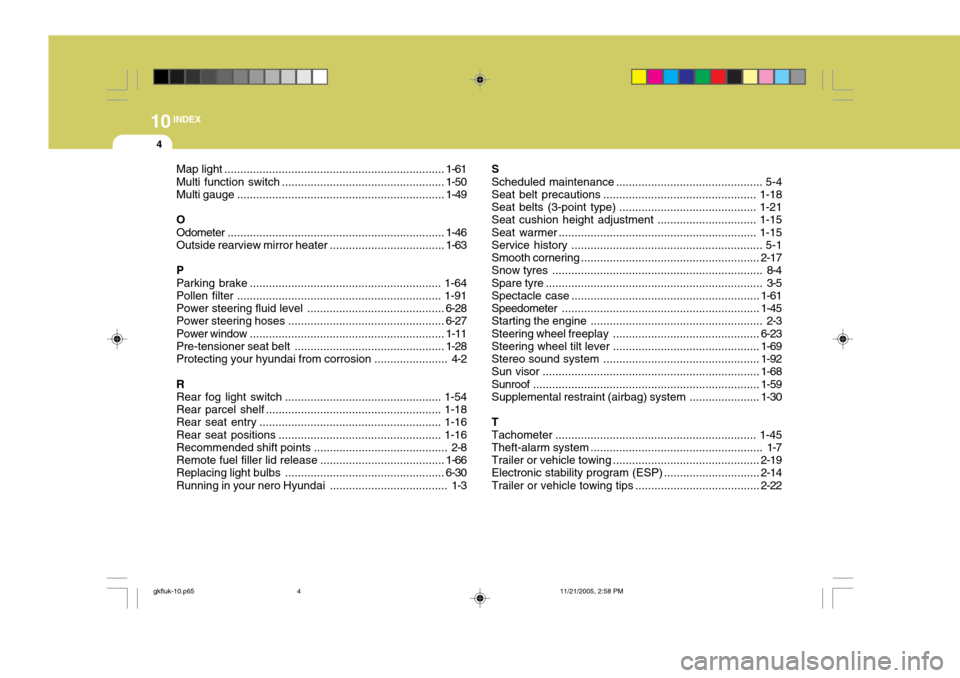
10INDEX
4
Map light ..................................................................... 1-61
Multi functio n switch ................................................... 1-50
Multi gauge ................................................................. 1-49
O Odometer .................................................................... 1-46
Outside rearview mirror heater ....................................1-63
PParking brake ............................................................ 1-64
Pollen filter ................................................................ 1-91
Power steering fluid level ........................................... 6-28
Power steering hoses ................................................. 6-27
Power window ............................................................. 1-11
Pre-tensioner seat belt ............................................... 1-28
Protecting your hyundai from corr osion ....................... 4-2
R Rear fog light switch ................................................. 1-54
Rear parcel shelf ....................................................... 1-18
Rear seat entry ......................................................... 1-16
Rear seat pos itions................................................... 1-16
Recommended shift points .......................................... 2-8 Remote fuel filler lid release ....................................... 1-66
Replacing light bulbs .................................................. 6-30
Running in your nero Hyundai ..................................... 1-3 SScheduled maintenance
.............................................. 5-4
Seat belt pr ecautions................................................ 1-18
Seat belts (3-point type) .... .......................................1-21
Seat cushion height adjustm ent ...............................1-15
Seat warmer .............................................................. 1-15
Service history ............................................................ 5-1
Smooth corneri ng ........................................................ 2-17
Snow tyres .................................................................. 8-4
Spare tyre .................................................................... 3-5
Spectacle case ........................................................... 1-61
Speedometer .............................................................. 1-45
Starting t he engine ...................................................... 2-3
Steering wheel freep lay .............................................. 6-23
Steering wheel tilt lever .............................................. 1-69
Stereo sound system ................................................. 1-92
Sun visor .................................................................... 1-68
Sunroof ....................................................................... 1-59
Supplemental restraint (airbag) system ...................... 1-30
TTachometer ............................................................... 1-45
Theft-alarm system ...................................................... 1-7
Trailer or vehicle towing .............................................. 2-19
Electronic stability program (ESP) ..............................2-14
Trailer or vehicle towing tips ....................................... 2-22
gkfluk-10.p65 11/21/2005, 2:58 PM
4