Oil Hyundai Coupe 2005 Service Manual
[x] Cancel search | Manufacturer: HYUNDAI, Model Year: 2005, Model line: Coupe, Model: Hyundai Coupe 2005Pages: 478, PDF Size: 13.44 MB
Page 237 of 478
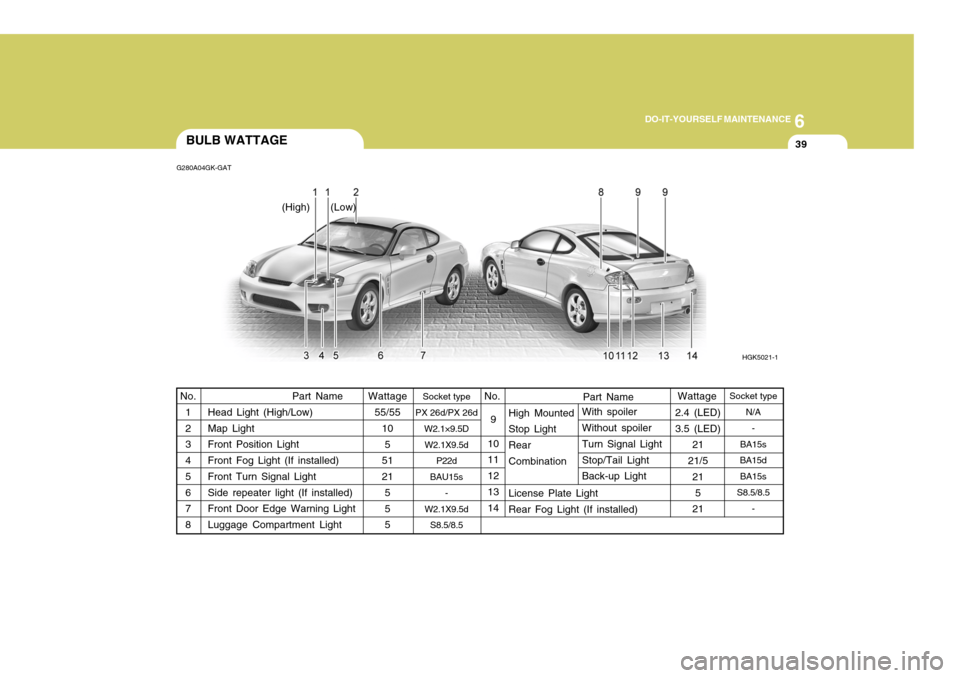
6
DO-IT-YOURSELF MAINTENANCE
39
Part Name
High Mounted Stop Light Rear Combination License Plate Light Rear Fog Light (If installed) With spoilerWithout spoiler Turn Signal Light Stop/Tail Light Back-up Light
9
10 11 12 13 14
Part Name
Head Light (High/Low) Map Light Front Position Light Front Fog Light (If installed) Front Turn Signal Light Side repeater light (If installed) Front Door Edge Warning Light Luggage Compartment Light
BULB WATTAGE
Socket type
PX 26d/PX 26d W2.1×9.5D
W2.1X9.5d P22d
BAU15s -
W2.1X9.5d S8.5/8.5
G280A04GK-GAT
Wattage
No.No.
1 2 3 4 5 6 7 8
HGK5021-1
(High) (Low)
Wattage55/55 10
5
51 21 55 5
2.4 (LED) 3.5 (LED)
21
21/5 21
5
21
Socket type
N/A-
BA15s
BA15d
BA15s
S8.5/8.5
-
Page 241 of 478

6
DO-IT-YOURSELF MAINTENANCE
43
DESCRIPTION IG COIL
AMP
B/UP LAMP
A/BAG IND A/BAG
HTD MIR HAZARD
R/WIPER TAIL-RH
F/WIPER A/C SW
RR DEFOG STOP
TAIL-LH A/CON
ECU
CLUSTER
ROOM LP
P/WINDOW
T/GATE IGN
RR FOG C/LIGHT
S/ROOF S/HTR
ABS
AUDIO
PROTECTED COMPONENTS
Ignition coil(1.6l/2.7L), Electronic chrome mirror AMP Back-up lamp switch,Transaxle range switch,Cruise control module,Stop lamp switch Instrument cluster (A/BAG IND.) SRS control module Mirror defogger Hazard relay Rear wiper motor,Rear intermittent wiper relay Right tail lamps,Glove box lamp Front wiper motor,Front wiper relay Blower relay,Blower motor Defogger relay Stop lamp switch,Burglar alarm horn relay,Folding/Unfolding relay Left tail lamps A/C control module, Blower relay ECM, Multi gauge unit, TCM, Vehicle speed sensor Instrument cluster (Power), Per-excitation resister, DRL Control module,Generator Room lamp,Clock,Audio,Data link connector,Multi gauge unit Power window relay Trunk lid switch AQS sensor,Head lamp relay,DRL Control module Rear fog lamp Cigarette lighter,Outside mirror switch Sunroof,Power door lock/Unlock relay Seat warmer ESP/ABS control module Audio,Digital clock
FUSERATING
20A20A 10A 10A 15A 10A 10A 15A 10A 20A 10A 30A 15A 10A 10A 10A 10A 10A 30A 15A 10A 10A 15A 15A 20A 10A 10A
Page 252 of 478

9 VEHICLE SPECIFICATIONS
2
4395(173)
1760(69.3) 1330(52.4)2530(99.6) 1490(58.7) 1490(58.7)
J010A01GK-GAT MEASUREMENT
Overall length Overall widthOverall height (unladen) Wheel base Wheel tread FrontRear
Type Wheel free play Rack strokeOil pump type Rack and pinion0 ~ 30 mm (0 ~ 1.18 in.) 132 mm (5.20 in.) Vane type
J060A01F-AAT FUEL SYSTEM
J020A01GK-GAT POWER STEERING J030A01GK-GATTIRE
Option
J040A03GK-GAT ELECTRICAL
Item Battery Alternator
mm (in.)
Fuel tank
capacity Imp.gal
12 2.7L
MF 68AH
120A
195/65 R15, 205/55 R16, 215/45 R17
2.0L
MF 68AH 90A
J050A01GK-GAT BRAKE
Dual hydraulic with brake booster Ventilated disc Solid discCable
Type Front brake type Rear brake typeParking brake
US.gal
14.5Liter55
J035A01GK-GAT SPARE TIRE
Standard T125/70 R16 (Temporary)
1.6L
MF 60AH
90A
Page 254 of 478
9 VEHICLE SPECIFICATIONS
4
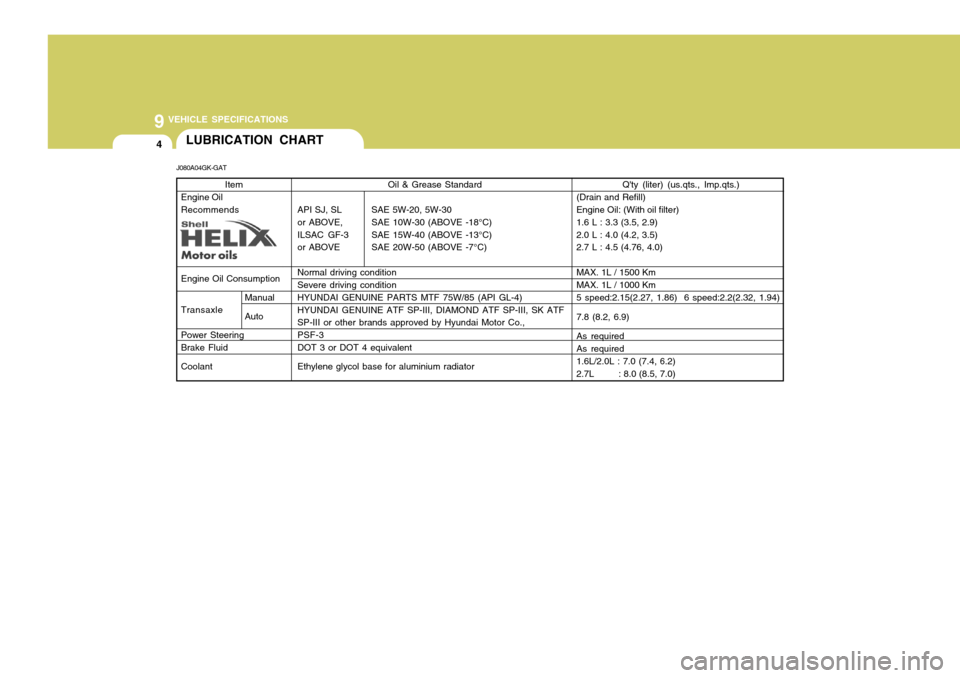
Q'ty (liter) (us.qts., Imp.qts.)
(Drain and Refill) Engine Oil: (With oil filter) 1.6 L : 3.3 (3.5, 2.9)2.0 L : 4.0 (4.2, 3.5) 2.7 L : 4.5 (4.76, 4.0) MAX. 1L / 1500 Km MAX. 1L / 1000 Km 5 speed:2.15(2.27, 1.86) 6 speed:2.2(2.32, 1.94) 7.8 (8.2, 6.9) As required As required1.6L/2.0L : 7.0 (7.4, 6.2) 2.7L : 8.0 (8.5, 7.0)
LUBRICATION CHART
J080A04GK-GAT Oil & Grease Standard
API SJ, SL SAE 5W-20, 5W-30
or ABOVE, SAE 10W-30 (ABOVE -18°C)
ILSAC GF-3 SAE 15W-40 (ABOVE -13°C)
or ABOVE SAE 20W-50 (ABOVE -7°C) Normal driving condition Severe driving condition HYUNDAI GENUINE PARTS MTF 75W/85 (API GL-4)HYUNDAI GENUINE ATF SP-III, DIAMOND ATF SP-III, SK ATF SP-III or other brands approved by Hyundai Motor Co., PSF-3DOT 3 or DOT 4 equivalent Ethylene glycol base for aluminium radiator
Item
Engine Oil Recommends Engine Oil Consumption Transaxle Power Steering Brake Fluid Coolant
Manual Auto
Page 257 of 478

10
INDEX
3
D Defrosting/Defogging ................................................... 1-82
Door
Central door lock ...................................................... 1-8
Door locks ................................................................ 1-7Locking and unlocking front door with a key ............ 1-7
Drink Holder ................................................................ 1-59
Drive Belts .................................................................. 6-24
Driving
Economical driving .................................................. 2-16
Smooth corneri ng ..................................................... 2-17
Winter driving ........................................................... 2-18
E
Emissions Control Systems ........................................ 7-2 Engine
Before starting the engine ........................................ 2-3
Changing the oil and filter ......................................... 6-8 Compartment (1.6L, 2.0L, 2.7L) ................................ 6-2
Coolant .................................................................... 6-10
Coolant temperature gauge ......................................1-46
If the engine overheats ............................................. 3-4
Number ..................................................................... 8-2
Oil ............................................................................. 6-6Oil consumption ........................................................ 6-7
Starting ..................................................................... 2-4
Engine Exhaust Can Be Dangerous ............................ 2-2 FFog Light
.................................................................... 1-56
Front Seats
Adjustable front seats .............................................. 1-13
Adjustable headrests ............................................... 1-14
Adjusting seat forward and rearward ........................1-13
Adjusting seatback angle .. ......................................1-14
Lumbar support control ............................................ 1-15
Seat cushion height adjustment .............................. 1-16
Seat warmer ............................................................ 1-16
Fuel
Capacity ................................................................... 9-2
Gauge ...................................................................... 1-46
Recommendations .................................................... 1-2
Fuel Filler Lid
Remote release ....................................................... 1-68
Fuse Panel Description .............................................. 6-40
Fuses ......................................................................... 6-25
G
General Everyday Checks ..... ...................................... 6-5
Glove box ................................................................... 1-64
Page 271 of 478

YOUR VEHICLE AT A GLANCE
B255A01GK-EAT INDICATOR SYMBOLS ON THE INSTRUMENT PANEL * More detailed explanations of these items will be found beginning on page 1-40.
Malfunction Indicator Light (Not all models)
SRS (Airbag) Service Reminder Indicator (SRI)(Not all models)
Hatchback Door Open Warning Light
Low Fuel Level Warning Light
Door Open (Ajar) Warning Light (Not all models)
ABS Service Reminder Indicator (Not all models)
Turn Signal Indicator Lights
High Beam Indicator Light Low Oil Pressure Warning Light Parking Brake/Brake Fluid Level Warning Light Charging System Warning Light
Cruise Indicator (Not all models)
Seat Belt Warning Light
CRUISE SET Indicator Light (Not all models)
Electronic Stability Program (ESP) Indicator Light (Not all models)
Immobiliser Warning Light
gkfluk-0.p65 11/21/2005, 3:03 PM
12
Page 274 of 478
1
CONTROLS AND EQUIPMENT
3RUNNING IN YOUR NEW HYUNDAI
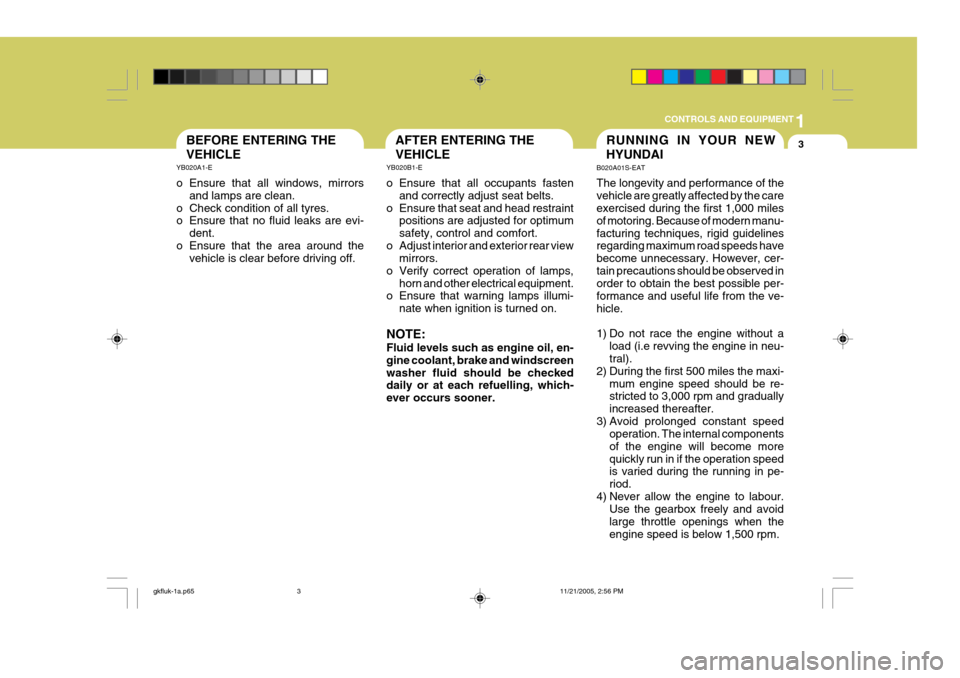
B020A01S-EAT The longevity and performance of the vehicle are greatly affected by the care exercised during the first 1,000 miles of motoring. Because of modern manu-facturing techniques, rigid guidelines regarding maximum road speeds have become unnecessary. However, cer-tain precautions should be observed in order to obtain the best possible per- formance and useful life from the ve-hicle.
1) Do not race the engine without a
load (i.e revving the engine in neu- tral).
2) During the first 500 miles the maxi- mum engine speed should be re-stricted to 3,000 rpm and gradually increased thereafter.
3) Avoid prolonged constant speed operation. The internal componentsof the engine will become morequickly run in if the operation speed is varied during the running in pe- riod.
4) Never allow the engine to labour. Use the gearbox freely and avoidlarge throttle openings when theengine speed is below 1,500 rpm.BEFORE ENTERING THE VEHICLEAFTER ENTERING THE VEHICLE
YB020A1-E
o Ensure that all windows, mirrors
and lamps are clean.
o Check condition of all tyres.
o Ensure that no fluid leaks are evi-
dent.
o Ensure that the area around the vehicle is clear before driving off. YB020B1-E
o Ensure that all occupants fasten
and correctly adjust seat belts.
o Ensure that seat and head restraint positions are adjusted for optimum safety, control and comfort.
o Adjust interior and exterior rear view mirrors.
o Verify correct operation of lamps, horn and other electrical equipment.
o Ensure that warning lamps illumi-
nate when ignition is turned on.
NOTE: Fluid levels such as engine oil, en- gine coolant, brake and windscreenwasher fluid should be checked daily or at each refuelling, which- ever occurs sooner.
gkfluk-1a.p65 11/21/2005, 2:56 PM
3
Page 310 of 478
1
CONTROLS AND EQUIPMENT
39
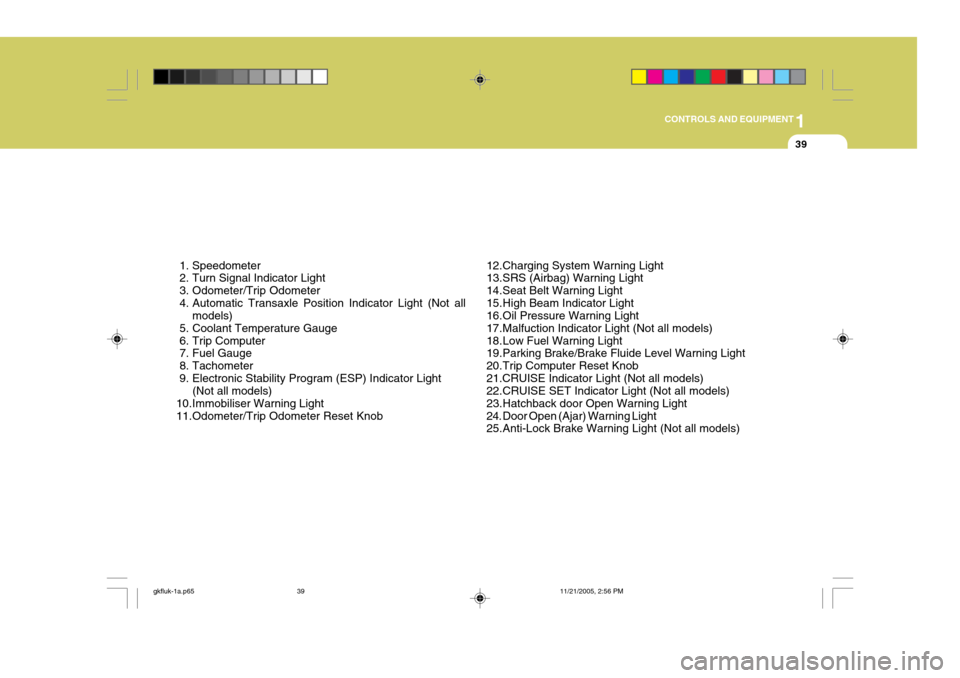
1. Speedometer
2. Turn Signal Indicator Light
3. Odometer/Trip Odometer
4. Automatic Transaxle Position Indicator Light (Not all models)
5. Coolant Temperature Gauge
6. Trip Computer
7. Fuel Gauge
8. Tachometer
9. Electronic Stability Program (ESP) Indicator Light (Not all models)
10.Immobiliser Warning Light
11.Odometer/Trip Odometer Reset Knob 12.Charging System Warning Light
13.SRS (Airbag) Warning Light
14.Seat Belt Warning Light
15.High Beam Indicator Light
16.Oil Pressure Warning Light
17.Malfuction Indicator Light (Not all models)
18.Low Fuel Warning Light
19.Parking Brake/Brake Fluide Level Warning Light
20.Trip Computer Reset Knob21.CRUISE Indicator Light (Not all models)
22.CRUISE SET Indicator Light (Not all models)
23.Hatchback door Open Warning Light
24. Door Open (Ajar) Warning Light
25.Anti-Lock Brake Warning Light (Not all models)
gkfluk-1a.p65
11/21/2005, 2:56 PM
39
Page 311 of 478
1CONTROLS AND EQUIPMENT
40
!
!
WARNING AND INDICATOR LIGHTS
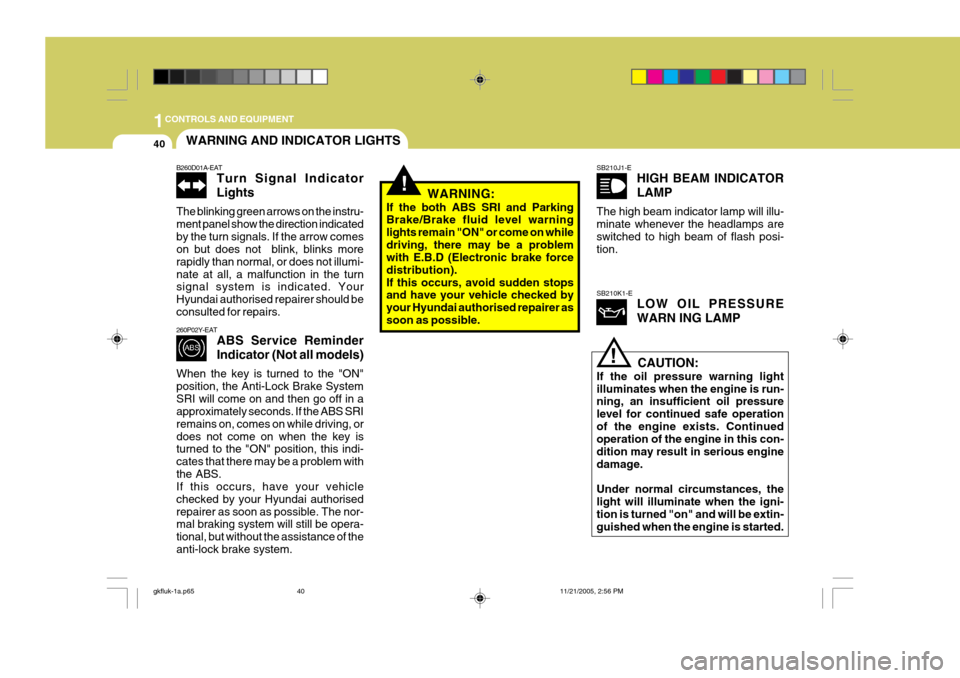
SB210K1-ELOW OIL PRESSURE WARN ING LAMP
260P02Y-EAT
ABS Service ReminderIndicator (Not all models)
When the key is turned to the "ON" position, the Anti-Lock Brake SystemSRI will come on and then go off in a approximately seconds. If the ABS SRI remains on, comes on while driving, ordoes not come on when the key is turned to the "ON" position, this indi- cates that there may be a problem withthe ABS. If this occurs, have your vehicle checked by your Hyundai authorisedrepairer as soon as possible. The nor- mal braking system will still be opera- tional, but without the assistance of theanti-lock brake system. WARNING:
If the both ABS SRI and Parking Brake/Brake fluid level warning lights remain "ON" or come on whiledriving, there may be a problem with E.B.D (Electronic brake force distribution).If this occurs, avoid sudden stops and have your vehicle checked by your Hyundai authorised repairer assoon as possible.
SB210J1-E HIGH BEAM INDICATOR LAMP
The high beam indicator lamp will illu- minate whenever the headlamps areswitched to high beam of flash posi- tion.
CAUTION:
If the oil pressure warning light illuminates when the engine is run- ning, an insufficient oil pressure level for continued safe operationof the engine exists. Continued operation of the engine in this con- dition may result in serious enginedamage. Under normal circumstances, the light will illuminate when the igni- tion is turned "on" and will be extin- guished when the engine is started.
B260D01A-EAT
Turn Signal Indicator Lights
The blinking green arrows on the instru- ment panel show the direction indicatedby the turn signals. If the arrow comes on but does not blink, blinks more rapidly than normal, or does not illumi-nate at all, a malfunction in the turn signal system is indicated. Your Hyundai authorised repairer should beconsulted for repairs.
gkfluk-1a.p65 11/21/2005, 2:56 PM
40
Page 312 of 478
1
CONTROLS AND EQUIPMENT
41
!
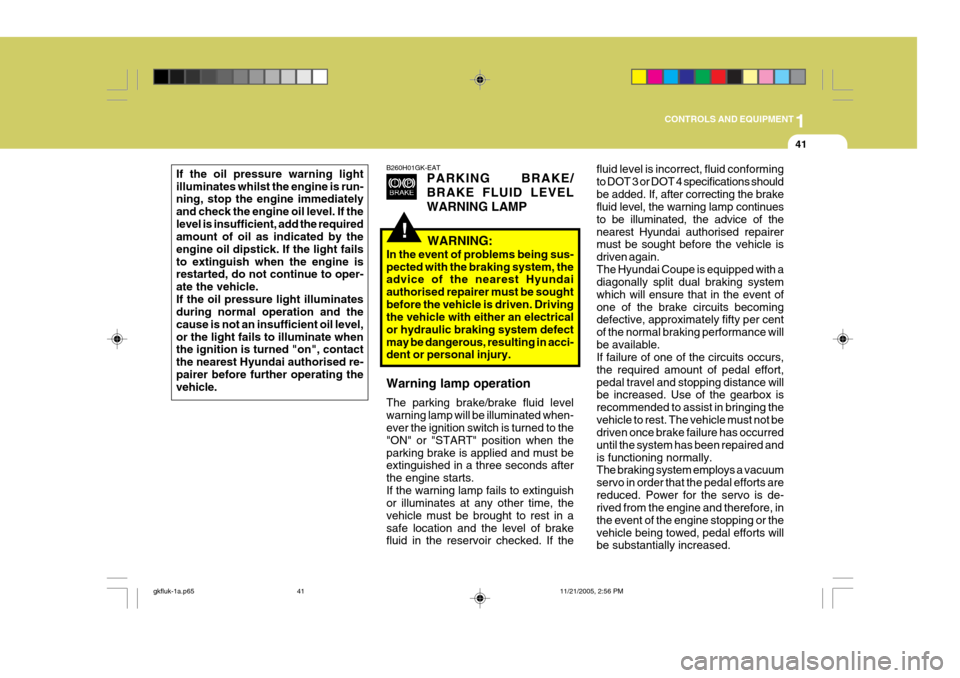
If the oil pressure warning light illuminates whilst the engine is run- ning, stop the engine immediately and check the engine oil level. If thelevel is insufficient, add the required amount of oil as indicated by the engine oil dipstick. If the light failsto extinguish when the engine is restarted, do not continue to oper- ate the vehicle.If the oil pressure light illuminates during normal operation and the cause is not an insufficient oil level,or the light fails to illuminate when the ignition is turned "on", contact the nearest Hyundai authorised re-pairer before further operating the vehicle. B260H01GK-EAT
PARKING BRAKE/ BRAKE FLUID LEVELWARNING LAMP
WARNING:
In the event of problems being sus- pected with the braking system, the advice of the nearest Hyundai authorised repairer must be soughtbefore the vehicle is driven. Driving the vehicle with either an electrical or hydraulic braking system defectmay be dangerous, resulting in acci- dent or personal injury. Warning lamp operation The parking brake/brake fluid level warning lamp will be illuminated when- ever the ignition switch is turned to the "ON" or "START" position when theparking brake is applied and must be extinguished in a three seconds after the engine starts.If the warning lamp fails to extinguish or illuminates at any other time, the vehicle must be brought to rest in asafe location and the level of brake fluid in the reservoir checked. If the fluid level is incorrect, fluid conforming to DOT 3 or DOT 4 specifications shouldbe added. If, after correcting the brake fluid level, the warning lamp continues to be illuminated, the advice of the
nearest Hyundai auth
orised repairer
must be sought b efore the vehicle is
driven again.The Hyundai Coupe is equipped with a diagonally split dual braking system which will ensure that in the event ofone of the brake circuits becoming defective, approximately fifty per cent of the normal braking performance willbe available. If failure of one of the circuits occurs, the required amount of pedal effort,pedal travel and stopping distance will be increased. Use of the gearbox is recommended to assist in bringing thevehicle to rest. The vehicle must not be driven once brake failure has occurred until the system has been repaired andis functioning normally. The braking system employs a vacuum servo in order that the pedal efforts arereduced. Power for the servo is de- rived from the engine and therefore, in the event of the engine stopping or thevehicle being towed, pedal efforts will be substantially increased.
gkfluk-1a.p65 11/21/2005, 2:56 PM
41