Oil Hyundai Coupe 2005 Owner's Guide
[x] Cancel search | Manufacturer: HYUNDAI, Model Year: 2005, Model line: Coupe, Model: Hyundai Coupe 2005Pages: 478, PDF Size: 13.44 MB
Page 205 of 478
6
DO-IT-YOURSELF MAINTENANCE
7
!
HGK5005
!WARNING:
Be very careful not to touch the
radiator hose when checking the engine oil as it may be hot enoughto burn you. G030D01A-GAT
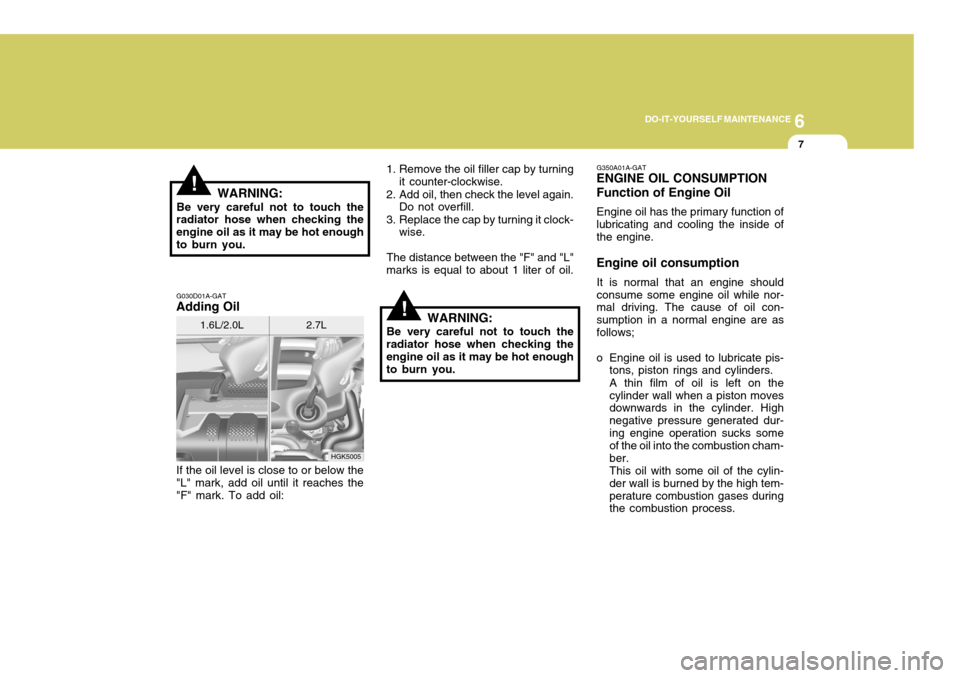
Adding Oil 1. Remove the oil filler cap by turning
it counter-clockwise.
2. Add oil, then check the level again. Do not overfill.
3. Replace the cap by turning it clock- wise.
The distance between the "F" and "L"
marks is equal to about 1 liter of oil.
1.6L/2.0L G350A01A-GAT
ENGINE OIL CONSUMPTION Function of Engine Oil
Engine oil has the primary function of lubricating and cooling the inside of the engine.
Engine oil consumption It is normal that an engine should consume some engine oil while nor- mal driving. The cause of oil con- sumption in a normal engine are asfollows;
o Engine oil is used to lubricate pis- tons, piston rings and cylinders. A thin film of oil is left on the cylinder wall when a piston moves downwards in the cylinder. High negative pressure generated dur-ing engine operation sucks some of the oil into the combustion cham- ber.This oil with some oil of the cylin-der wall is burned by the high tem-perature combustion gases during the combustion process.
2.7L
If the oil level is close to or below the "L" mark, add oil until it reaches the "F" mark. To add oil: WARNING:
Be very careful not to touch the
radiator hose when checking the engine oil as it may be hot enough to burn you.
Page 206 of 478
6 DO-IT-YOURSELF MAINTENANCE
8CHANGING THE OIL AND FIL- TER
G040A04GK-GAT
o The engine oil consumption is
strongly effected by the viscosity and quality of oil, engine rpm and driving condition etc. More engine oil may be consumed under severedriving conditions such as high speeds, frequent acceleration and deceleration, compared to normaldriving condition.
F040A02TB
G040A03E G040A01B
The engine oil and filter should be
changed at those intervals specifiedin the maintenance schedule in Sec- tion 5. If the car is being driven in severe conditions, more frequent oiland filter changes are required.
The procedure for changing the oil
and filter is as follows:
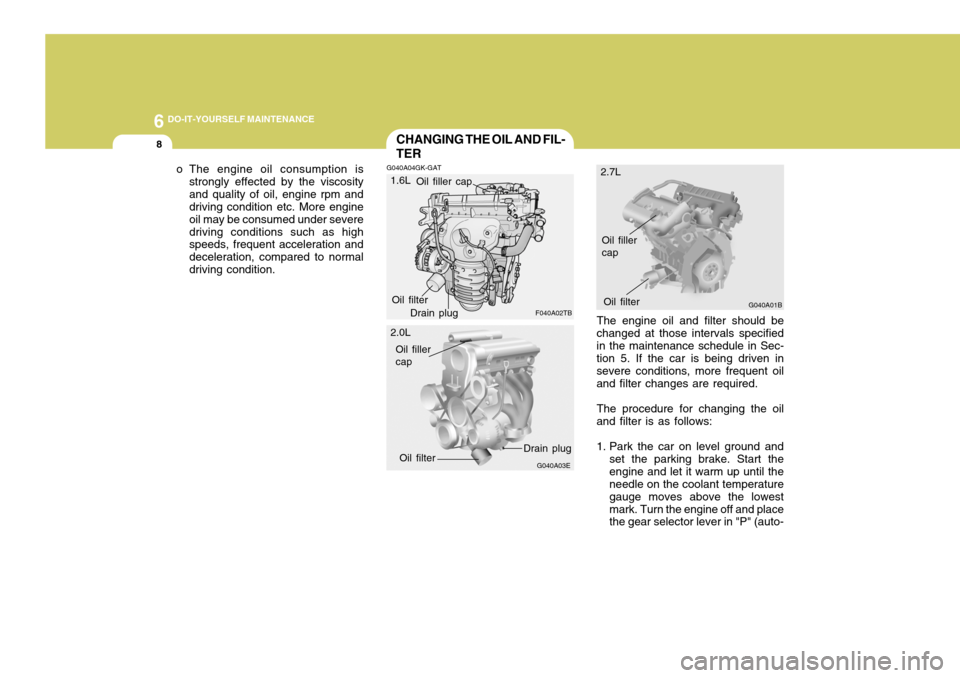
1. Park the car on level ground and
set the parking brake. Start the engine and let it warm up until the needle on the coolant temperature gauge moves above the lowestmark. Turn the engine off and place the gear selector lever in "P" (auto-
Oil filler cap
1.6L 2.0L 2.7L
Oil filter Drain plug
Oil filler cap
Oil filter Drain plug
Oil filler cap
Oil filter
Page 207 of 478

6
DO-IT-YOURSELF MAINTENANCE
9
!
matic) or reverse gear (manual transaxle).
2. Open the hood and remove the engine oil filler cap.
3. Slide underneath the car and loosen the drain plug by turning it counter-clockwise with a wrench of theproper size. Be sure that a drain pan is in position to catch the oil as it drains out, then remove the drainplug.
WARNING:
Be very careful when draining the
engine oil as it may be hot enoughto burn you! 5. Remove the oil filter by turning it
counterclockwise with a oil filterwrench of the proper size. A cer- tain amount of oil will come out when you remove the filter. So besure to have your drain pan in place underneath it.
6. Install a new oil filter in accordance with the instructions on the cartonor on the filter itself. Do not over- tighten. Tightening torque: 1.2 ~ 1.6 kgf.m.
Be sure that the mounting surface on
the engine is clean and that the oldgasket is removed completely. Lubri- cate the new gasket on the filter with clean engine oil before installation.
7. Remove the engine oil level dip- stick.
8. Refill the crankcase with the rec- ommended engine oil. Refer to the specification in chapter 9 for en- gine oil capacity.
4. When the oil has stopped draining,
replace the drain plug using a new gasket and retighten by turning it clockwise. Tightening torque: 4.5 ~ 4.0 kgf.m (1.6/2.0L) 4.5 ~ 3.5 kgf.m (2.7L) CAUTION:
Slowly pour the recommended oilusing by a funnel. Do not overfill not to damage engine.
9. Start the engine and check to be sure no oil is leaking from the drain plug or oil filter.
10.Shut off the engine and recheck the oil level.
NOTE: Always dispose of used engine oil in an environmentally acceptablemanner. It is suggested that it be placed in a sealed container and taken to a service station for maybereclaimation. Do not pour the oil on the ground or put it in with the household trash.
!
Page 208 of 478
6 DO-IT-YOURSELF MAINTENANCE
10
!
G050B01A-AAT
Recommended Engine Coolant
Use a high quality ethylene-glycol
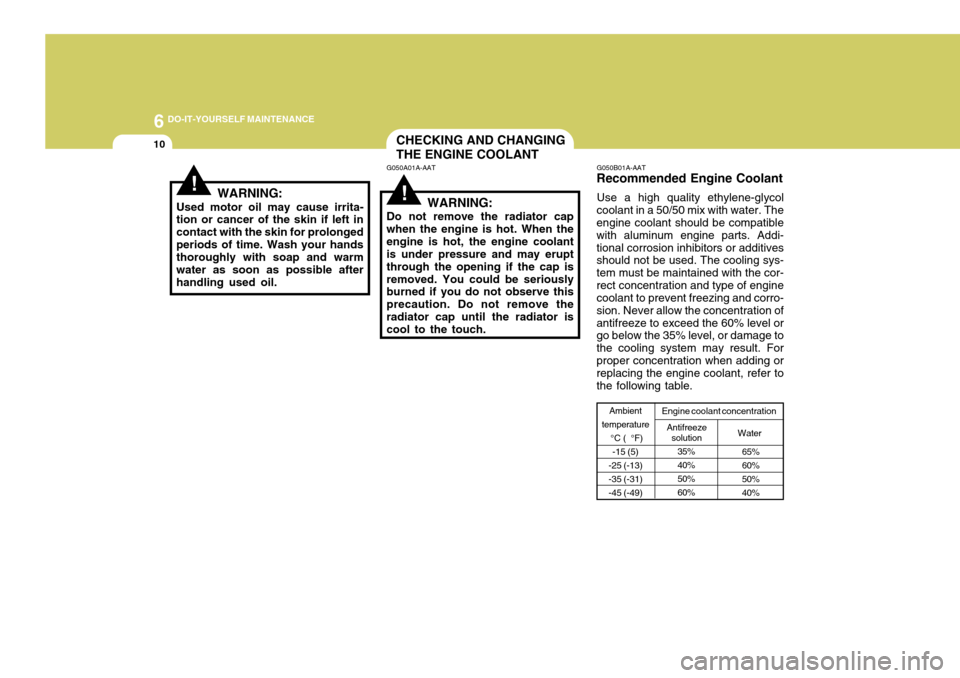
coolant in a 50/50 mix with water. The engine coolant should be compatible with aluminum engine parts. Addi-tional corrosion inhibitors or additives should not be used. The cooling sys- tem must be maintained with the cor-rect concentration and type of engine coolant to prevent freezing and corro- sion. Never allow the concentration ofantifreeze to exceed the 60% level or go below the 35% level, or damage to the cooling system may result. Forproper concentration when adding or replacing the engine coolant, refer to the following table.
Water
65% 60%50%40%
35%40%50%60%
Ambient
temperature °C ( °F)-15 (5)
-25 (-13) -35 (-31)-45 (-49) Engine coolant concentration
Antifreezesolution
!
CHECKING AND CHANGING THE ENGINE COOLANT
G050A01A-AAT
WARNING:
Do not remove the radiator cap when the engine is hot. When theengine is hot, the engine coolant is under pressure and may erupt through the opening if the cap isremoved. You could be seriously burned if you do not observe this precaution. Do not remove theradiator cap until the radiator is cool to the touch.
WARNING:
Used motor oil may cause irrita-tion or cancer of the skin if left in contact with the skin for prolongedperiods of time. Wash your hands thoroughly with soap and warm water as soon as possible afterhandling used oil.
Page 211 of 478
6
DO-IT-YOURSELF MAINTENANCE
13
!
CAUTION:
o Operating your vehicle without a proper air cleaner filter in place can result in excessive engine wear.
o When removing the air cleaner filter, be careful that dust or dirt does not enter the air intake.These may result in damage to the air cleaner filter.
G080A02GK
G080A03A-AATWINDSHIELD WIPER BLADES
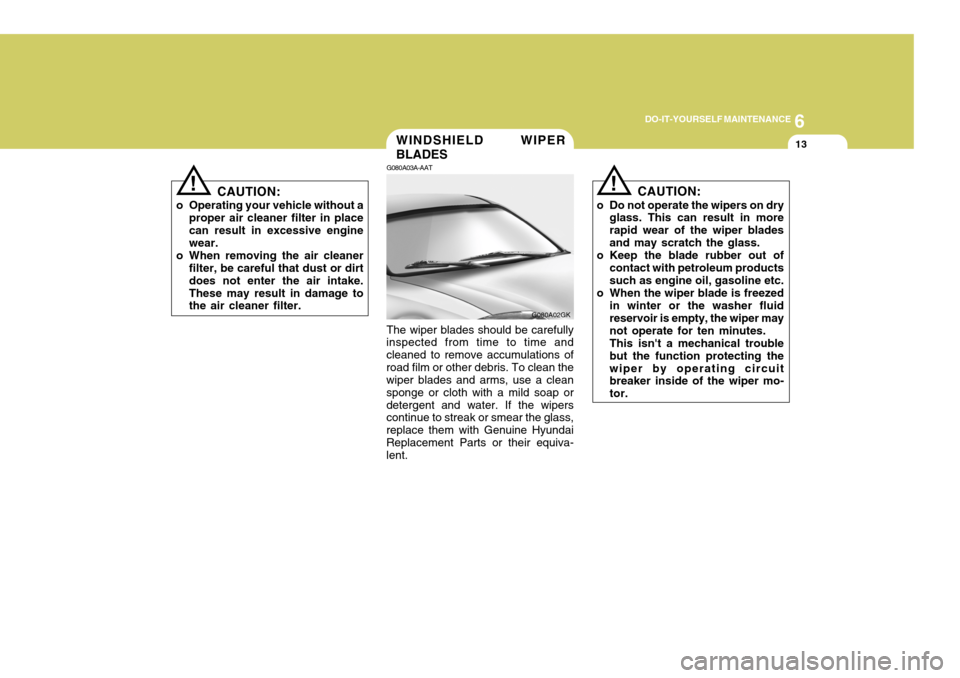
The wiper blades should be carefully
inspected from time to time and cleaned to remove accumulations ofroad film or other debris. To clean the wiper blades and arms, use a clean sponge or cloth with a mild soap ordetergent and water. If the wipers continue to streak or smear the glass, replace them with Genuine HyundaiReplacement Parts or their equiva- lent.
! CAUTION:
o Do not operate the wipers on dry glass. This can result in more rapid wear of the wiper bladesand may scratch the glass.
o Keep the blade rubber out of contact with petroleum products such as engine oil, gasoline etc.
o When the wiper blade is freezed in winter or the washer fluidreservoir is empty, the wiper may not operate for ten minutes.This isn't a mechanical troublebut the function protecting thewiper by operating circuit breaker inside of the wiper mo- tor.
Page 214 of 478
6 DO-IT-YOURSELF MAINTENANCE
16CHECKING THE TRANSAXLE OIL (MANUAL)
HGK5009
!
G100A04GK-GAT
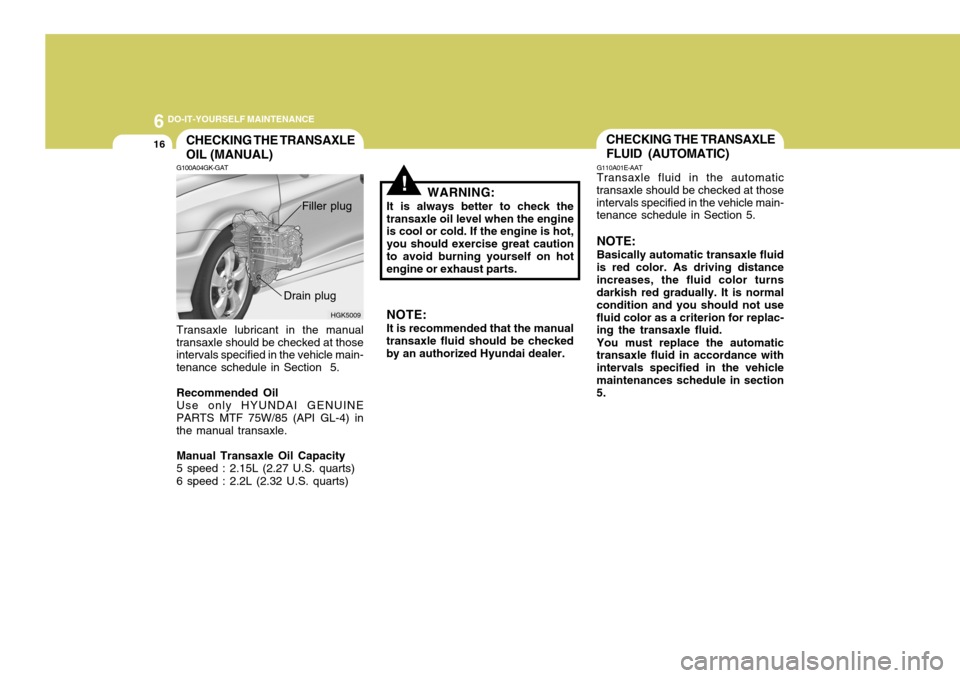
Transaxle lubricant in the manual
transaxle should be checked at those intervals specified in the vehicle main- tenance schedule in Section 5.
Recommended OilUse only HYUNDAI GENUINE
PARTS MTF 75W/85 (API GL-4) inthe manual transaxle.
Manual Transaxle Oil Capacity5 speed : 2.15L (2.27 U.S. quarts) 6 speed : 2.2L (2.32 U.S. quarts) WARNING:
It is always better to check the transaxle oil level when the engine is cool or cold. If the engine is hot, you should exercise great cautionto avoid burning yourself on hot engine or exhaust parts.
Drain plugG110A01E-AAT Transaxle fluid in the automatic
transaxle should be checked at those intervals specified in the vehicle main- tenance schedule in Section 5.
NOTE: Basically automatic transaxle fluid
is red color. As driving distance increases, the fluid color turns darkish red gradually. It is normal condition and you should not usefluid color as a criterion for replac- ing the transaxle fluid.
You must replace the automatic
transaxle fluid in accordance with intervals specified in the vehiclemaintenances schedule in section 5. CHECKING THE TRANSAXLE FLUID (AUTOMATIC)
Filler plug
NOTE: It is recommended that the manual
transaxle fluid should be checked by an authorized Hyundai dealer.
Page 225 of 478
6
DO-IT-YOURSELF MAINTENANCE
27
!
CHECKING THE BATTERY
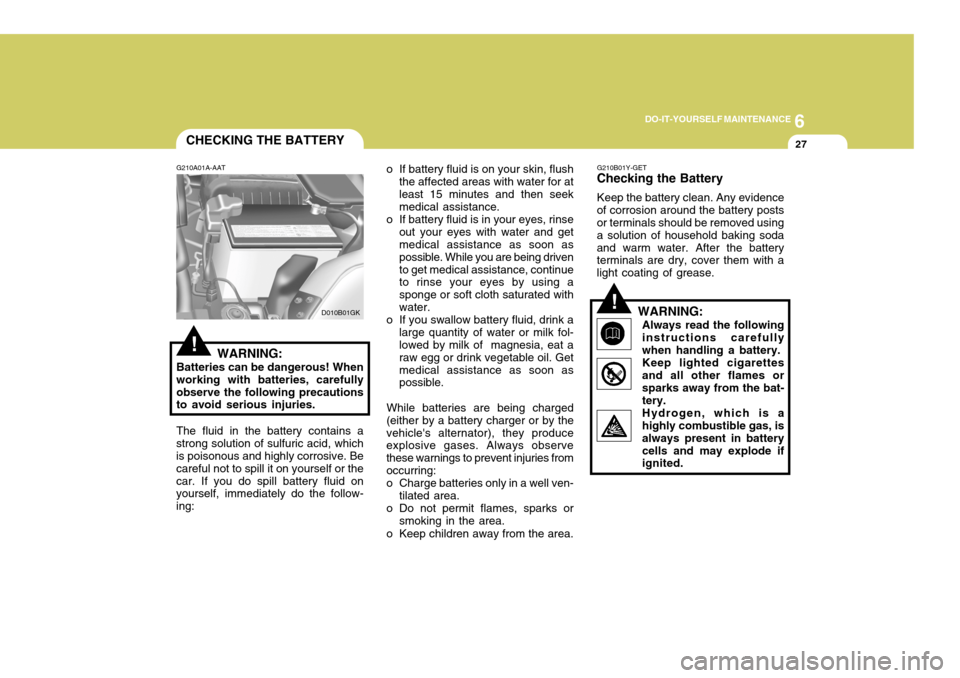
G210A01A-AAT
WARNING:
Batteries can be dangerous! When working with batteries, carefullyobserve the following precautions to avoid serious injuries. The fluid in the battery contains a
strong solution of sulfuric acid, which is poisonous and highly corrosive. Be careful not to spill it on yourself or thecar. If you do spill battery fluid on yourself, immediately do the follow- ing: o If battery fluid is on your skin, flush
the affected areas with water for atleast 15 minutes and then seek medical assistance.
o If battery fluid is in your eyes, rinse out your eyes with water and getmedical assistance as soon as possible. While you are being drivento get medical assistance, continue to rinse your eyes by using a sponge or soft cloth saturated withwater.
o If you swallow battery fluid, drink a large quantity of water or milk fol- lowed by milk of magnesia, eat a raw egg or drink vegetable oil. Getmedical assistance as soon as possible.
While batteries are being charged
(either by a battery charger or by the vehicle's alternator), they produce explosive gases. Always observe these warnings to prevent injuries fromoccurring:
o Charge batteries only in a well ven- tilated area.
o Do not permit flames, sparks or
smoking in the area.
o Keep children away from the area.
!
G210B01Y-GET
Checking the Battery
Keep the battery clean. Any evidence
of corrosion around the battery posts or terminals should be removed using a solution of household baking sodaand warm water. After the battery terminals are dry, cover them with a light coating of grease.
WARNING:Always read the followinginstructions carefullywhen handling a battery.Keep lighted cigarettesand all other flames orsparks away from the bat- tery. Hydrogen, which is a highly combustible gas, is always present in batterycells and may explode if ignited.
D010B01GK
Page 227 of 478
6
DO-IT-YOURSELF MAINTENANCE
29
G220B01A-AAT
Checking Engine Cooling Fan
The engine coolant fan should come on automatically if the engine coolant temperature is high. G220C01A-AAT
Checking Condenser Cooling Fan
The condenser coolant fan should come on automatically whenever the air conditioning is in operation. G230A03A-GAT
POWER STEERING FLUID LEVEL
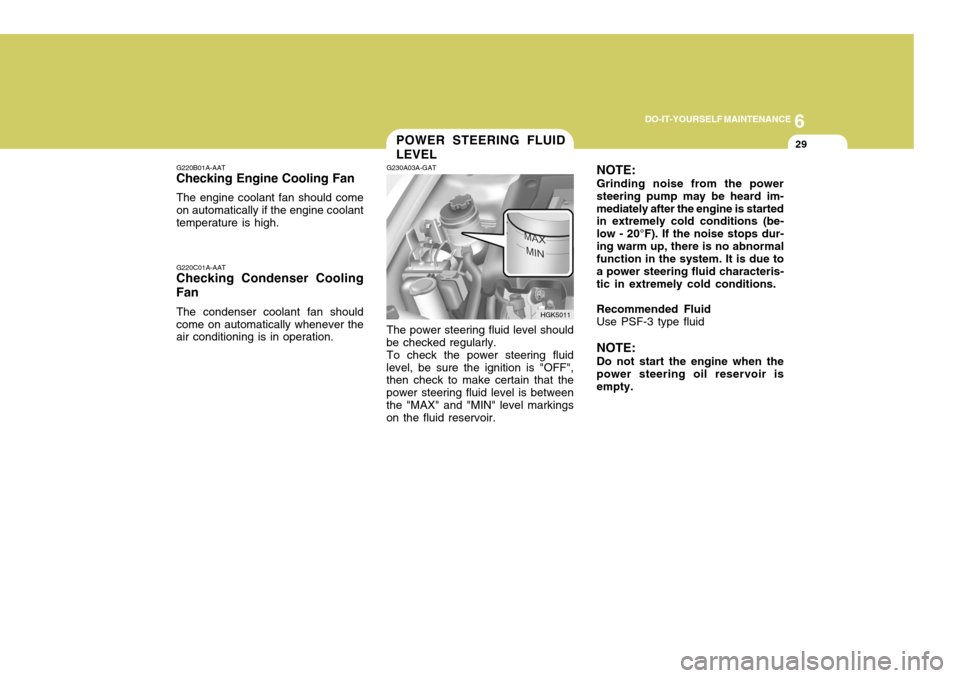
The power steering fluid level should
be checked regularly.
To check the power steering fluid
level, be sure the ignition is "OFF", then check to make certain that the power steering fluid level is betweenthe "MAX" and "MIN" level markings on the fluid reservoir. NOTE: Grinding noise from the power steering pump may be heard im-mediately after the engine is started in extremely cold conditions (be- low - 20°F). If the noise stops dur-ing warm up, there is no abnormal function in the system. It is due to a power steering fluid characteris-tic in extremely cold conditions. Recommended Fluid Use PSF-3 type fluid NOTE: Do not start the engine when the power steering oil reservoir isempty.
HGK5011
Page 228 of 478
6 DO-IT-YOURSELF MAINTENANCE
30
High Beam
G290A01GK
G240A01A-AAT POWER STEERING HOSES It is suggested that you check the power steering hose connections for fluid leakage daily. The power steer- ing hoses should be replaced if thereis severe surface cracking, pulling, scuffing or worn spots. Deterioration of the hose could cause prematurefailure. G290A02GK-GAT
HEADLIGHT AIMING AD- JUSTMENT
1. Keep all tires inflated to the correctpressure.
2. Place the vehicle on level ground and press the front bumper & rear bumper down several times. Placevehicle at a distance of 3m (118 in.) from the test wall.
3. See that the vehicle is unloaded (except for full levels of coolant, engine oil and fuel, and spare tire,jack, and tools).
4. Clean the head light lenses and
turn on the headlights.
5. Open the hood.
6. Draw the vertical line (through the center of each headlight beam pat- tern) and the horizontal line (through the center of each headlight beampattern) on the aiming screen.And then, draw a parallel line at 30mm (1.18 in.) under the horizontal line.
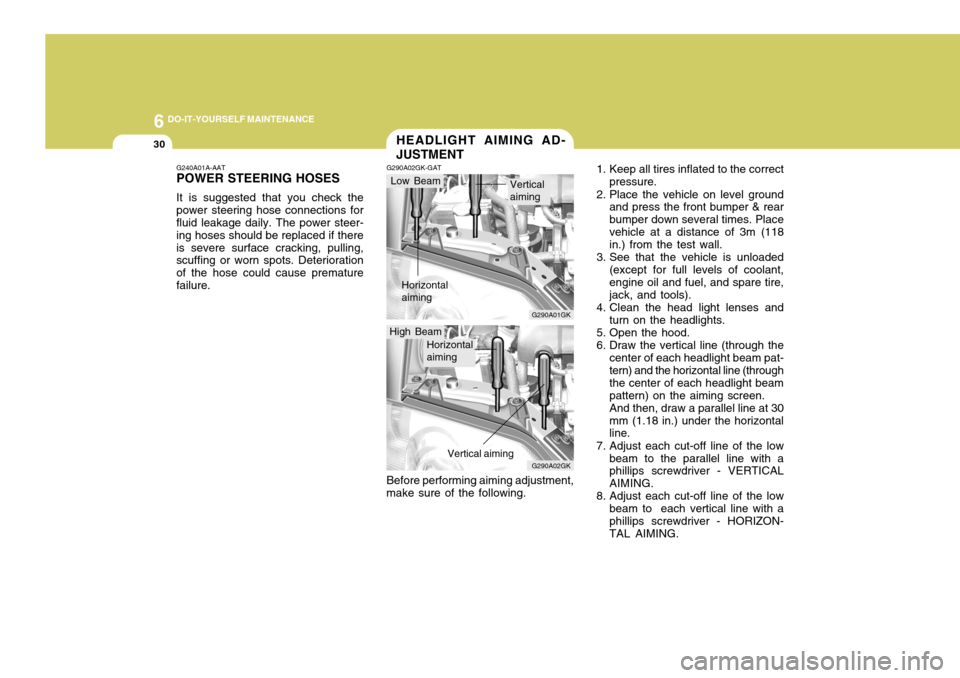
7. Adjust each cut-off line of the low beam to the parallel line with aphillips screwdriver - VERTICAL AIMING.
8. Adjust each cut-off line of the low
beam to each vertical line with aphillips screwdriver - HORIZON- TAL AIMING.
Before performing aiming adjustment,
make sure of the following.
G290A02GK
Low Beam
Horizontal aiming Vertical aiming
Horizontal aiming Vertical aiming
Page 229 of 478
6
DO-IT-YOURSELF MAINTENANCE
31
G290B01GK-GAT
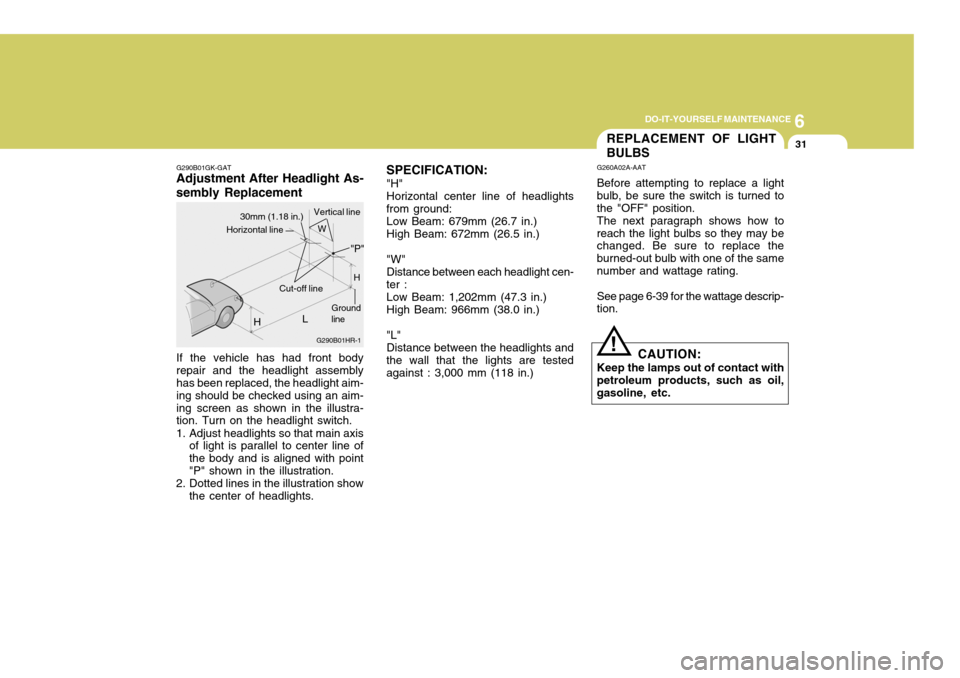
Adjustment After Headlight As- sembly Replacement
If the vehicle has had front body repair and the headlight assembly has been replaced, the headlight aim- ing should be checked using an aim-ing screen as shown in the illustra- tion. Turn on the headlight switch.
1. Adjust headlights so that main axis of light is parallel to center line of the body and is aligned with point"P" shown in the illustration.
2. Dotted lines in the illustration show the center of headlights. SPECIFICATION:
"H" Horizontal center line of headlights
from ground:
Low Beam: 679mm (26.7 in.) High Beam: 672mm (26.5 in.) "W" Distance between each headlight cen-
ter :
Low Beam: 1,202mm (47.3 in.) High Beam: 966mm (38.0 in.) "L" Distance between the headlights and
the wall that the lights are tested against : 3,000 mm (118 in.)
REPLACEMENT OF LIGHT BULBS
!
G260A02A-AAT Before attempting to replace a light bulb, be sure the switch is turned tothe "OFF" position.The next paragraph shows how toreach the light bulbs so they may be changed. Be sure to replace the burned-out bulb with one of the samenumber and wattage rating. See page 6-39 for the wattage descrip- tion.
CAUTION:
Keep the lamps out of contact with petroleum products, such as oil, gasoline, etc.
G290B01HR-1
H
Ground line
30mm (1.18 in.)
L
Cut-off line "P"
Horizontal line
H
W
Vertical line