warning Hyundai Coupe 2006 Owner's Manual
[x] Cancel search | Manufacturer: HYUNDAI, Model Year: 2006, Model line: Coupe, Model: Hyundai Coupe 2006Pages: 483, PDF Size: 12.73 MB
Page 341 of 483
1CONTROLS AND EQUIPMENT
74SUNVISOR
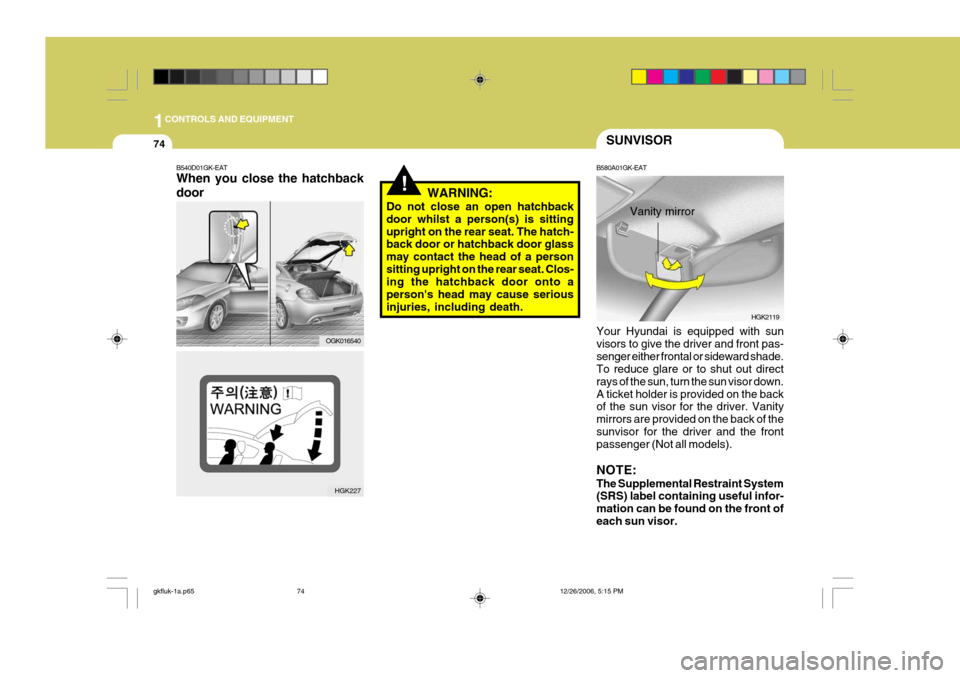
B580A01GK-EAT Your Hyundai is equipped with sun visors to give the driver and front pas-senger either frontal or sideward shade. To reduce glare or to shut out direct rays of the sun, turn the sun visor down.A ticket holder is provided on the back of the sun visor for the driver. Vanity mirrors are provided on the back of thesunvisor for the driver and the front passenger (Not all models). NOTE: The Supplemental Restraint System (SRS) label containing useful infor- mation can be found on the front ofeach sun visor. Vanity mirror
HGK2119
!WARNING:
Do not close an open hatchback door whilst a person(s) is sittingupright on the rear seat. The hatch- back door or hatchback door glass may contact the head of a personsitting upright on the rear seat. Clos- ing the hatchback door onto a person's head may cause seriousinjuries, including death.
B540D01GK-EAT When you close the hatchback door
OGK016540
HGK227
gkfluk-1a.p65 12/26/2006, 5:15 PM
74
Page 342 of 483
1
CONTROLS AND EQUIPMENT
75
!WARNING:
Do not place the sunvisor in such a manner that it obscures visibility ofthe roadway, traffic or the objects.
!
STEERING WHEEL TILT LEVER
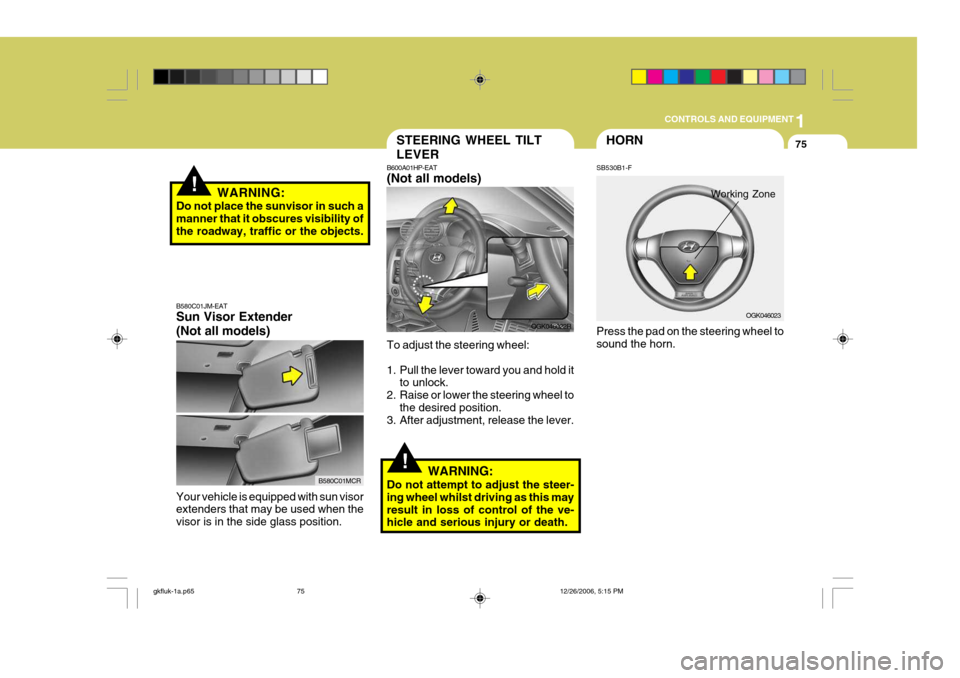
B600A01HP-EAT (Not all models) To adjust the steering wheel:
1. Pull the lever toward you and hold it
to unlock.
2. Raise or lower the steering wheel to
the desired position.
3. After adjustment, release the lever.
WARNING:
Do not attempt to adjust the steer- ing wheel whilst driving as this mayresult in loss of control of the ve- hicle and serious injury or death. OGK046022R
OGK046023
HORN
SB530B1-F Press the pad on the steering wheel to sound the horn.
Working Zone
B580C01JM-EAT Sun Visor Extender (Not all models) Your vehicle is equipped with sun visor extenders that may be used when the visor is in the side glass position.
B580C01MCR
gkfluk-1a.p65 12/26/2006, 5:15 PM
75
Page 343 of 483
1CONTROLS AND EQUIPMENT
76CRUISE CONTROL
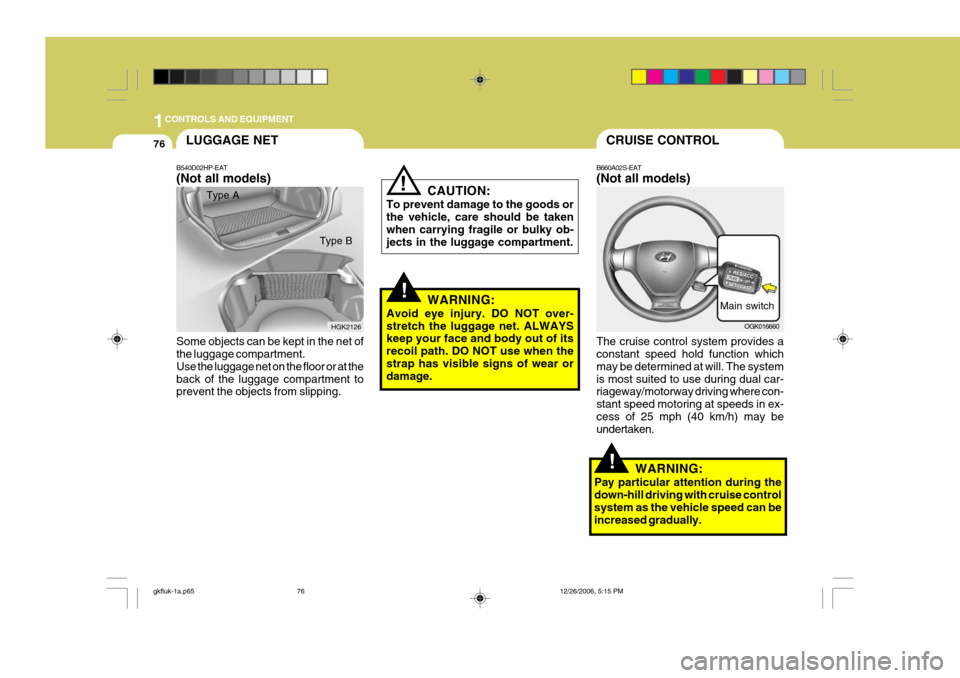
B660A02S-EAT (Not all models) The cruise control system provides a constant speed hold function which may be determined at will. The systemis most suited to use during dual car- riageway/motorway driving where con- stant speed motoring at speeds in ex-cess of 25 mph (40 km/h) may be undertaken. Main switch
OGK016660
!
! CAUTION:
To prevent damage to the goods or the vehicle, care should be taken when carrying fragile or bulky ob- jects in the luggage compartment.
WARNING:
Avoid eye injury. DO NOT over-stretch the luggage net. ALWAYS keep your face and body out of its recoil path. DO NOT use when thestrap has visible signs of wear or damage.
LUGGAGE NET
B540D02HP-EAT (Not all models) Type A
Some objects can be kept in the net of the luggage compartment. Use the luggage net on the floor or at theback of the luggage compartment to prevent the objects from slipping. HGK2126
Type B
!WARNING:
Pay particular attention during the down-hill driving with cruise control system as the vehicle speed can beincreased gradually.
gkfluk-1a.p65 12/26/2006, 5:15 PM
76
Page 344 of 483
1
CONTROLS AND EQUIPMENT
77
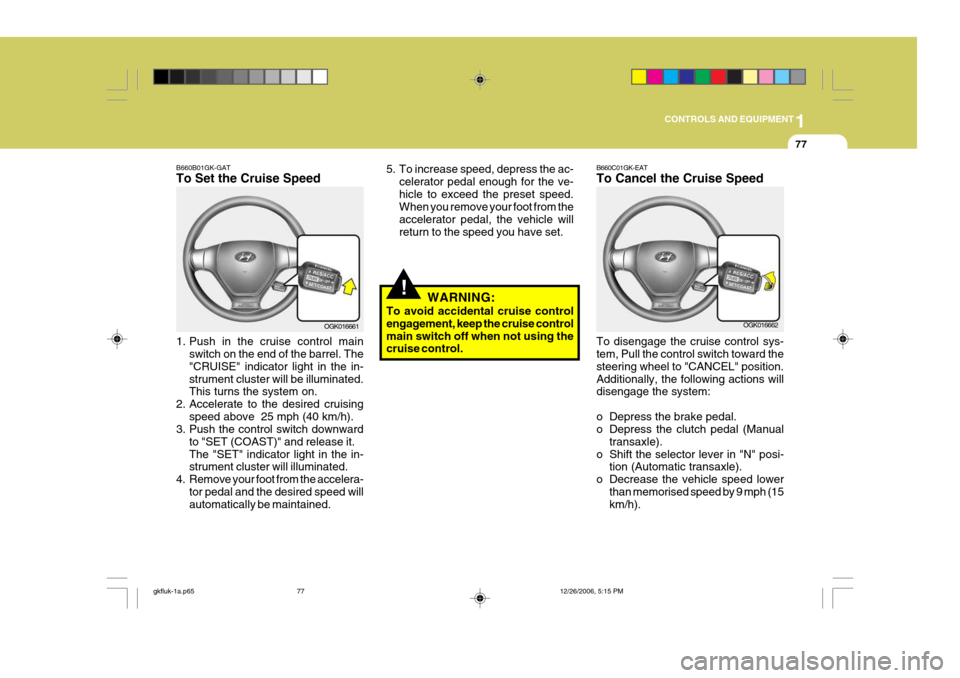
B660B01GK-GAT To Set the Cruise Speed
1. Push in the cruise control main
switch on the end of the barrel. The "CRUISE" indicator light in the in-strument cluster will be illuminated. This turns the system on.
2. Accelerate to the desired cruising speed above 25 mph (40 km/h).
3. Push the control switch downward
to "SET (COAST)" and release it. The "SET" indicator light in the in- strument cluster will illuminated.
4. Remove your foot from the accelera- tor pedal and the desired speed willautomatically be maintained. OGK016661
!
5. To increase speed, depress the ac-
celerator pedal enough for the ve- hicle to exceed the preset speed. When you remove your foot from the accelerator pedal, the vehicle willreturn to the speed you have set.
WARNING:
To avoid accidental cruise control engagement, keep the cruise control main switch off when not using the cruise control.B660C01GK-EAT To Cancel the Cruise Speed To disengage the cruise control sys- tem, Pull the control switch toward the steering wheel to "CANCEL" position.Additionally, the following actions will disengage the system:
o Depress the brake pedal.
o Depress the clutch pedal (Manual transaxle).
o Shift the selector lever in "N" posi- tion (Automatic transaxle).
o Decrease the vehicle speed lower than memorised speed by 9 mph (15km/h). OGK016662
gkfluk-1a.p65
12/26/2006, 5:15 PM
77
Page 346 of 483
1
CONTROLS AND EQUIPMENT
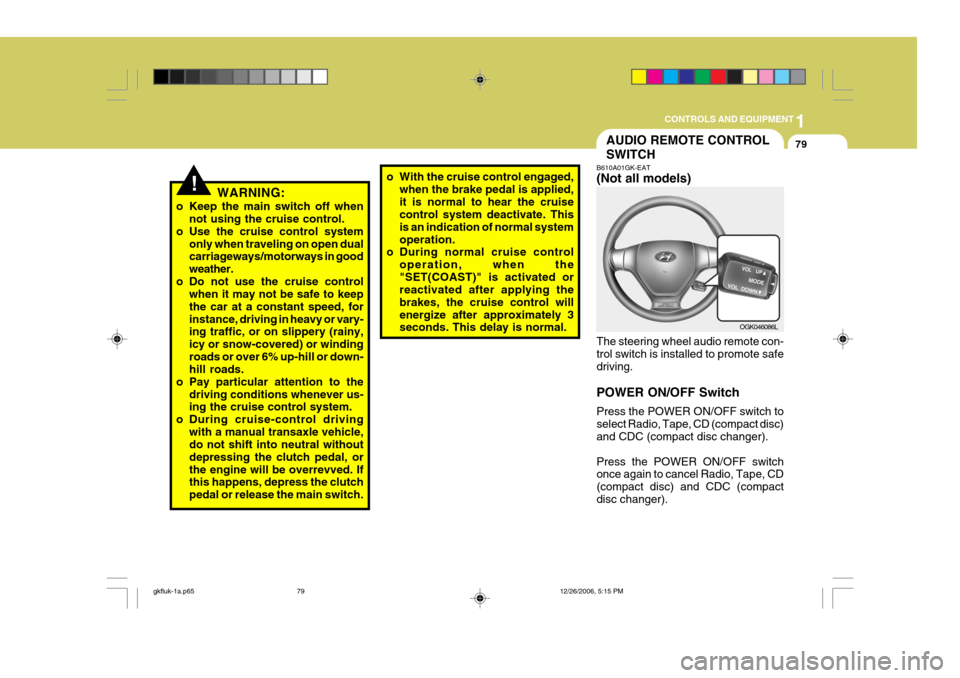
79AUDIO REMOTE CONTROL SWITCH
!WARNING:
o Keep the main switch off when not using the cruise control.
o Use the cruise control system only when traveling on open dual carriageways/motorways in good weather.
o Do not use the cruise control when it may not be safe to keepthe car at a constant speed, forinstance, driving in heavy or vary- ing traffic, or on slippery (rainy, icy or snow-covered) or windingroads or over 6% up-hill or down- hill roads.
o Pay particular attention to the
driving conditions whenever us-ing the cruise control system.
o During cruise-control driving
with a manual transaxle vehicle,do not shift into neutral without depressing the clutch pedal, orthe engine will be overrevved. If this happens, depress the clutch pedal or release the main switch. o With the cruise control engaged,
when the brake pedal is applied,it is normal to hear the cruise control system deactivate. This is an indication of normal systemoperation.
o During normal cruise control
operation, when the"SET(COAST)" is activated or reactivated after applying the brakes, the cruise control willenergize after approximately 3 seconds. This delay is normal. B610A01GK-EAT (Not all models) The steering wheel audio remote con- trol switch is installed to promote safe driving. POWER ON/OFF Switch Press the POWER ON/OFF switch to select Radio, Tape, CD (compact disc) and CDC (compact disc changer). Press the POWER ON/OFF switch once again to cancel Radio, Tape, CD (compact disc) and CDC (compactdisc changer).OGK046086L
gkfluk-1a.p65
12/26/2006, 5:15 PM
79
Page 369 of 483
1FEATURES OF YOUR HYUNDAI
102
!
B750A04L
B750A05L
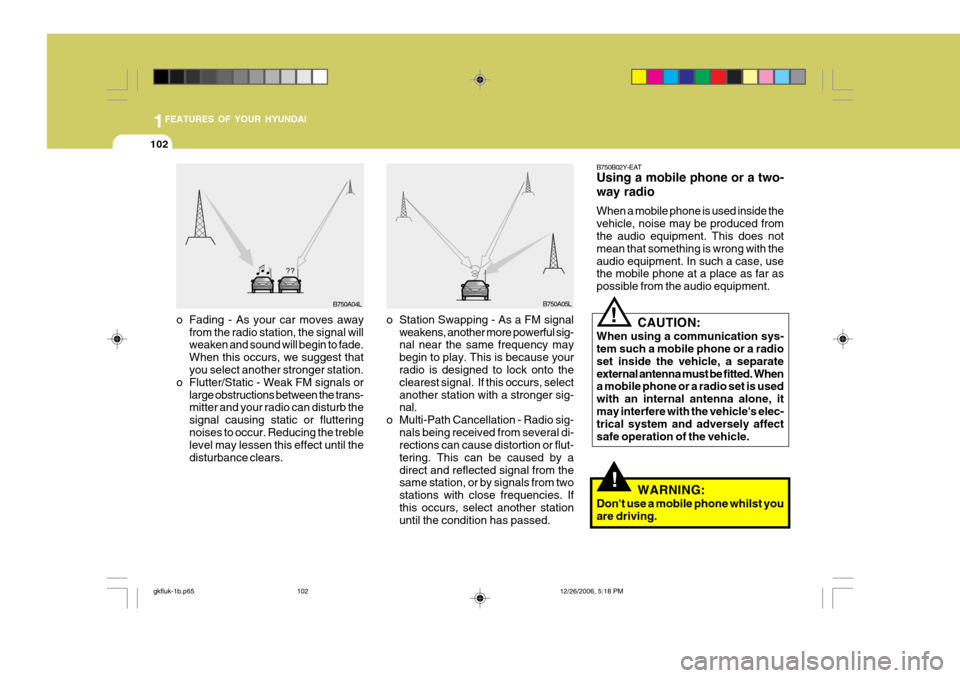
o Station Swapping - As a FM signal weakens, another more powerful sig- nal near the same frequency may begin to play. This is because your radio is designed to lock onto the clearest signal. If this occurs, selectanother station with a stronger sig- nal.
o Multi-Path Cancellation - Radio sig- nals being received from several di-rections can cause distortion or flut- tering. This can be caused by adirect and reflected signal from the same station, or by signals from two stations with close frequencies. Ifthis occurs, select another station until the condition has passed.
o Fading - As your car moves away
from the radio station, the signal willweaken and sound will begin to fade. When this occurs, we suggest that you select another stronger station.
o Flutter/Static - Weak FM signals or large obstructions between the trans-mitter and your radio can disturb the signal causing static or flutteringnoises to occur. Reducing the treble level may lessen this effect until the disturbance clears. B750B02Y-EAT Using a mobile phone or a two- way radio When a mobile phone is used inside the vehicle, noise may be produced from the audio equipment. This does not mean that something is wrong with theaudio equipment. In such a case, use the mobile phone at a place as far as possible from the audio equipment.
!
CAUTION:
When using a communication sys- tem such a mobile phone or a radio set inside the vehicle, a separateexternal antenna must be fitted. When a mobile phone or a radio set is used with an internal antenna alone, itmay interfere with the vehicle's elec- trical system and adversely affect safe operation of the vehicle.
WARNING:
Don't use a mobile phone whilst youare driving.
gkfluk-1b.p65 12/26/2006, 5:18 PM
102
Page 374 of 483
2DRIVING YOUR HYUNDAI
2
C010A02O-EAT
WARNING: ENGINE EXHAUST CAN BE DANGEROUS!
Engine exhaust gases are potentially lethal. If at any time engine exhaust gas is detected within the passenger compartment, move the vehicle to an open area and open all windows. o Never inhale exhaust gas. Exhaust gases contain Carbon Monoxide which is colourless and odourless. Carbon Monoxide is poisonous and can cause unconsciousness and death by asphyxiation. o Exhaust System Maintenance. Ensure that the exhaust system is maintained in good condition and is free from excessive corrosion anddamage which may result in leakage. If the vehicle is driven over an object which strikes the exhaust system, ensure that the exhaust system is inspected at the first available opportunity to ensure that no leakage exists. o Confined Areas. Do not run the engine in confined spaces, allowing the engine to idle in a garage, even when the doors are open is dangerous practice. Only start the engine immediately prior to moving the vehicle out of the garage. o Prolonged Idling. If it is necessary to allow the vehicle to idle for prolonged periods, ensure that the heating system air intakecontrol is set to the "Fresh" position, the blower is set to high speed operation and that the vehicle is standing in an open area. To ensure correct operation of the heater system, the air intake grilles at the base of the windscreen must not be obstructed by snow leaves etc..
!
gkfluk-2.p65 12/26/2006, 5:19 PM
2
Page 375 of 483
2
DRIVING YOUR HYUNDAI
3TO START THE ENGINEBEFORE STARTING THE ENGINE
SC030A2-E Before you start the engine, you should always:
1. Look around the vehicle to be sure
there are no flat tyres, puddles of oil or water or other indications of pos- sible trouble.
2. After entering the car, check to be sure the parking brake is engaged.
3. Check that all windows, and lights
are clean.
4. Check that the interior and exterior mirrors are clean and in position.
5. Check your seat, seatback and head restraint to be sure they are intheir proper positions.
6. Close all the doors.
7. Fasten your seat belt and be sure that all other occupants have fas-tened theirs.
8. Turn off all lights and accessories that are not needed.
9. When you turn the ignition switch to "ON" check that all appropriate warn- ing lights are operating and that you have sufficient fuel.
10.Check the operation of warning lights and all bulbs when key is inthe "ON" position.
!WARNING:
Always wear appropriate shoes when operating your vehicle.Unsuitable shoes (high heels, ski boots, etc.) may interfere with your ability to use the brake and accelera-tor pedal, and the clutch (Not all models). C030A01A-EAT COMBINATION IGNITION SWITCH AND STEERING LOCK
o If your Hyundai is equipped with a
manual transaxle, place the gear- shift lever in neutral and depress the clutch pedal fully.
o If your Hyundai has an automatic
transaxle, place the selector lever in"P" (park).
o To start the engine, insert the ignition key and turn it to the "START" posi-tion. Release it as soon as the en- gine starts. Do not hold the key in the"START" position for more than 15 seconds.
NOTE: For safety, the engine will not start if the shift lever is not in "P" or "N" position (Automatic Transaxle).
gkfluk-2.p65 12/26/2006, 5:19 PM
3
Page 376 of 483
2DRIVING YOUR HYUNDAI
4KEY POSITIONS
!
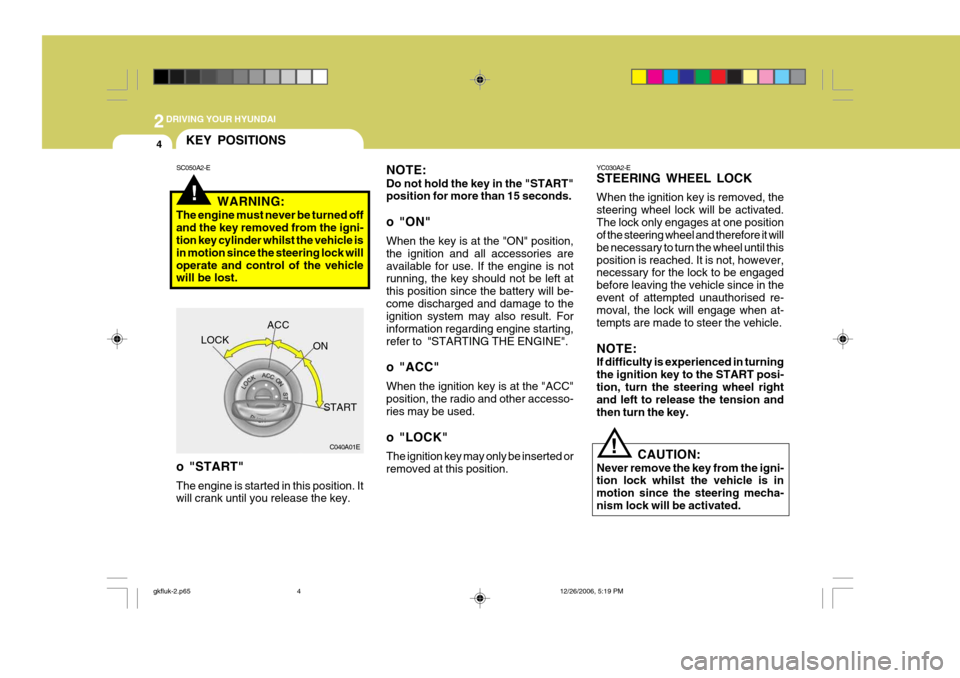
NOTE: Do not hold the key in the "START" position for more than 15 seconds.
o "ON" When the key is at the "ON" position, the ignition and all accessories areavailable for use. If the engine is not running, the key should not be left at this position since the battery will be-come discharged and damage to the ignition system may also result. For information regarding engine starting,refer to "STARTING THE ENGINE".
o "ACC" When the ignition key is at the "ACC" position, the radio and other accesso- ries may be used.
o "LOCK" The ignition key may only be inserted or removed at this position.
SC050A2-E
WARNING:
The engine must never be turned offand the key removed from the igni- tion key cylinder whilst the vehicle is in motion since the steering lock willoperate and control of the vehicle will be lost.
C040A01E
LOCK
ACC
ON
START
o "START" The engine is started in this position. It will crank until you release the key. YC030A2-E STEERING WHEEL LOCK When the ignition key is removed, the steering wheel lock will be activated.The lock only engages at one position of the steering wheel and therefore it will be necessary to turn the wheel until thisposition is reached. It is not, however, necessary for the lock to be engaged before leaving the vehicle since in theevent of attempted unauthorised re- moval, the lock will engage when at- tempts are made to steer the vehicle. NOTE: If difficulty is experienced in turning the ignition key to the START posi-tion, turn the steering wheel right and left to release the tension and then turn the key.
!
CAUTION:
Never remove the key from the igni- tion lock whilst the vehicle is in motion since the steering mecha-nism lock will be activated.
gkfluk-2.p65 12/26/2006, 5:19 PM
4
Page 378 of 483
2DRIVING YOUR HYUNDAI
6FUEL ECONOMY
4. Turn the ignition key to the "START" position and release it when the en- gine starts. SC060B1-E The following suggestions are made to assist in achieving the greatest degree of fuel economy.
o Maintaining a constant check on fuel
consumption will enable the most economical use pattern and drivingstyle to be adopted.
o Avoid using the vehicle for very short journeys if possible, particularly whena cold start is involved.
o Ensure that tyre pressures are main- tained at the correct level.
o Use only the recommended grade of
fuel.
o Avoid carrying unnecessary weight, and if a roof rack is in use, remove itas soon as possible after use.
o Anticipate the road and conditions ahead to enable adjustments in speedto be made smoothly. Avoid heavyacceleration and sharp braking.
o Avoid cruising at unnecessary high speeds.
o Always ensure that the periodic main- tenance services are performed by aHyundai authorised repairer at the
time and/or mileage intervals speci-fied.
o Use the air conditioning only when necessary.
!
C050B01A-EAT Normal Conditions The Starting Procedure:
1. Insert key, and fasten the seat belt.
2. Depress the clutch pedal fully and
place the gearshift lever (manual transaxle) in neutral or the selector lever (automatic transaxle) in "P" (park) position.
3. After turning the ignition key to the "ON" position, make certain all warn-ing lights and gauges are function-ing properly before starting the en- gine.
WARNING:
Be sure that the clutch is fully de- pressed when starting a manual transaxle vehicle. This will prevent sudden movement should the ve-hicle be started in gear without the clutch depressed. Otherwise there is the potential tocause damage to the vehicle or in- jury to a person inside or outside of the vehicle as a result of this suddenvehicle movement.
gkfluk-2.p65 12/26/2006, 5:19 PM
6