warning Hyundai Coupe 2006 Owners Manual
[x] Cancel search | Manufacturer: HYUNDAI, Model Year: 2006, Model line: Coupe, Model: Hyundai Coupe 2006Pages: 483, PDF Size: 12.73 MB
Page 270 of 483
1
CONTROLS AND EQUIPMENT
3RUNNING IN YOUR NEW HYUNDAI
B020A01S-EAT The longevity and performance of the vehicle are greatly affected by the care exercised during the first 1,000 miles of motoring. Because of modern manu-facturing techniques, rigid guidelines regarding maximum road speeds have become unnecessary. However, cer-tain precautions should be observed in order to obtain the best possible per- formance and useful life from the ve-hicle.
1) Do not race the engine without a
load (i.e revving the engine in neu- tral).
2) During the first 500 miles the maxi- mum engine speed should be re-stricted to 3,000 rpm and gradually increased thereafter.
3) Avoid prolonged constant speed operation. The internal componentsof the engine will become morequickly run in if the operation speed is varied during the running in pe- riod.
4) Never allow the engine to labour. Use the gearbox freely and avoidlarge throttle openings when theengine speed is below 1,500 rpm.BEFORE ENTERING THE VEHICLEAFTER ENTERING THE VEHICLE
YB020A1-E
o Ensure that all windows, mirrors
and lamps are clean.
o Check condition of all tyres.
o Ensure that no fluid leaks are evi-
dent.
o Ensure that the area around the vehicle is clear before driving off. YB020B1-E
o Ensure that all occupants fasten
and correctly adjust seat belts.
o Ensure that seat and head restraint positions are adjusted for optimum safety, control and comfort.
o Adjust interior and exterior rear view mirrors.
o Verify correct operation of lamps, horn and other electrical equipment.
o Ensure that warning lamps illumi-
nate when ignition is turned on.
NOTE: Fluid levels such as engine oil, en- gine coolant, brake and windscreenwasher fluid should be checked daily or at each refuelling, which- ever occurs sooner.
gkfluk-1a.p65 12/26/2006, 5:11 PM
3
Page 273 of 483
1CONTROLS AND EQUIPMENT
6
!
DOOR LOCKS
B040A01GK-EAT
WARNING:
o Unlocked doors can be danger- ous. Before you drive away (es- pecially if there are children in the car), be sure that all the doorsare securely closed and locked so that the doors cannot be inad- vertently opened from the inside.This helps ensure that doors will not be opened accidentally. Also, when combined with the properuse of seat belts, locking the doors helps keep occupants from being ejected from the car in caseof an accident.
o Before opening the door, always
look for and avoid oncoming traf-fic.
o A locked-up vehicle can become
extremely hot, causing death orsevere injury to unattended chil- dren, handicapped persons or animals who cannot escape thevehicle. Never leave children, handicapped persons or animals unattended in your vehicle.
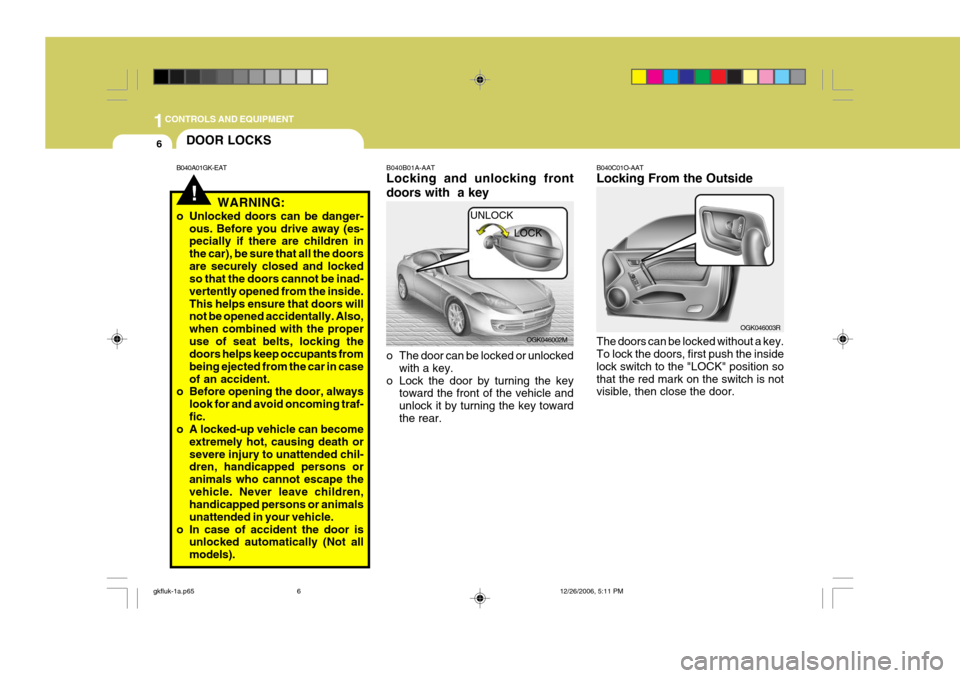
o In case of accident the door is unlocked automatically (Not allmodels). B040B01A-AAT Locking and unlocking front doors with a key
o The door can be locked or unlocked
with a key.
o Lock the door by turning the key toward the front of the vehicle and unlock it by turning the key towardthe rear. OGK046002M
UNLOCK
LOCK B040C01O-AAT Locking From the Outside The doors can be locked without a key. To lock the doors, first push the inside lock switch to the "LOCK" position sothat the red mark on the switch is not visible, then close the door.
OGK046003R
gkfluk-1a.p65
12/26/2006, 5:11 PM
6
Page 276 of 483
1
CONTROLS AND EQUIPMENT
9
!
CAUTION:
Avoid trying to start the engine whilst the system is armed.
B070C02GK-EAT Alarm Stage The alarm will be activated if any of the following occur while the car is parkedand the system is armed.
1) A front door is unlocked and opened
without using the transmitter.
2) The hatchback door is opened with-
out using the key.
3) The engine bonnet is opened.The alarming horn will sound and the turn signal lights will blink continuously for approximately 27 seconds. To turn off the system, unlock the door with thetransmitter.
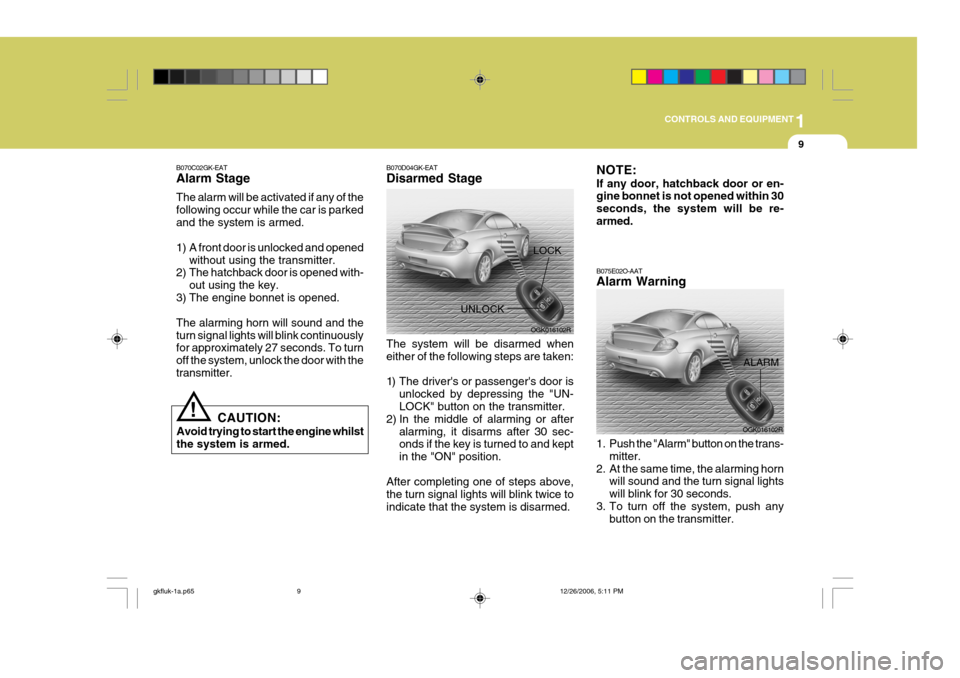
B070D04GK-EAT Disarmed Stage
UNLOCK
The system will be disarmed when either of the following steps are taken:
1) The driver's or passenger's door is unlocked by depressing the "UN- LOCK" button on the transmitter.
2) In the middle of alarming or after
alarming, it disarms after 30 sec-onds if the key is turned to and kept in the "ON" position.
After completing one of steps above,the turn signal lights will blink twice toindicate that the system is disarmed. OGK016102R
LOCK
B075E02O-AAT Alarm Warning
1. Push the "Alarm" button on the trans-mitter.
2. At the same time, the alarming horn will sound and the turn signal lights will blink for 30 seconds.
3. To turn off the system, push any button on the transmitter. OGK016102R
ALARMNOTE: If any door, hatchback door or en- gine bonnet is not opened within 30 seconds, the system will be re-armed.
gkfluk-1a.p65
12/26/2006, 5:11 PM
9
Page 279 of 483
1CONTROLS AND EQUIPMENT
12
!
SEATS
!
WARNING:
o Be careful that someone's head, hands and body are not trapped by a closing window.
o Never try to operate the main switch on the driver's door and theindividual door window switch in opposing directions at the sametime. If this is done, the window will stop and cannot be opened or closed.
o Always remove the ignition key prior to exiting the car.
o Do not leave children alone in the car. B080A01FC-EAT SEAT ADJUSTMENT
WARNING:
Front seat adjustments must not be undertaken whilst the vehicle is in motion. Loss of control of the ve-hicle may result if seat adjustments are made whilst the vehicle is in motion.
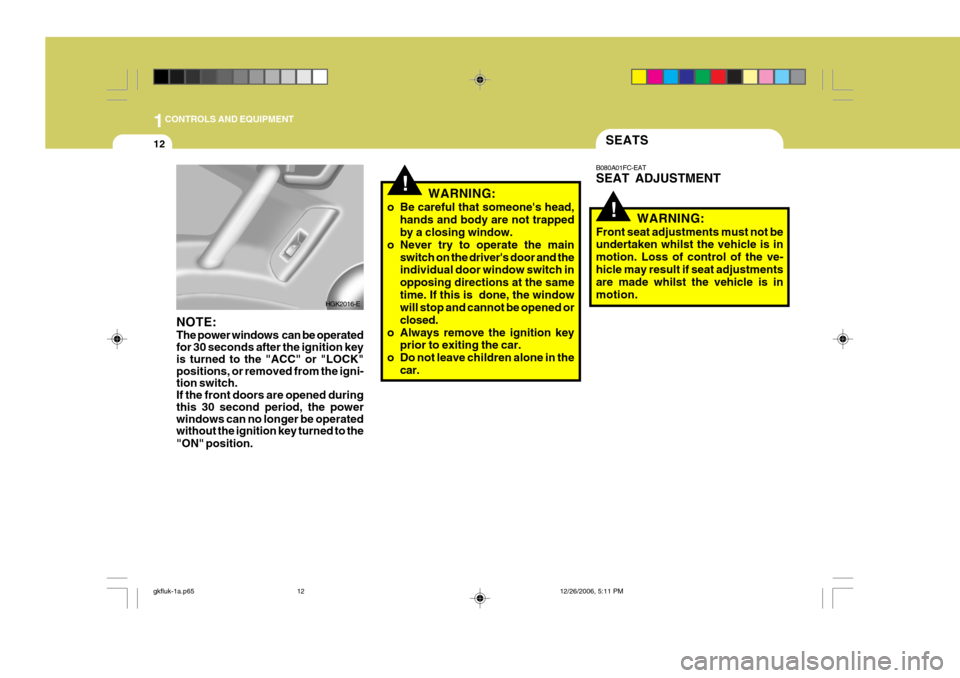
NOTE: The power windows can be operated for 30 seconds after the ignition key is turned to the "ACC" or "LOCK" positions, or removed from the igni- tion switch. If the front doors are opened during this 30 second period, the power windows can no longer be operated without the ignition key turned to the "ON" position. HGK2016-E
gkfluk-1a.p65
12/26/2006, 5:11 PM
12
Page 280 of 483
1
CONTROLS AND EQUIPMENT
13
!WARNING:
o Seat adjustment should not be made whilst the vehicle is in mo- tion since loss of control of the vehicle may occur.
o To ensure the seat is locked se- curely, attempt to move the seatforward or rearward without using the lever.
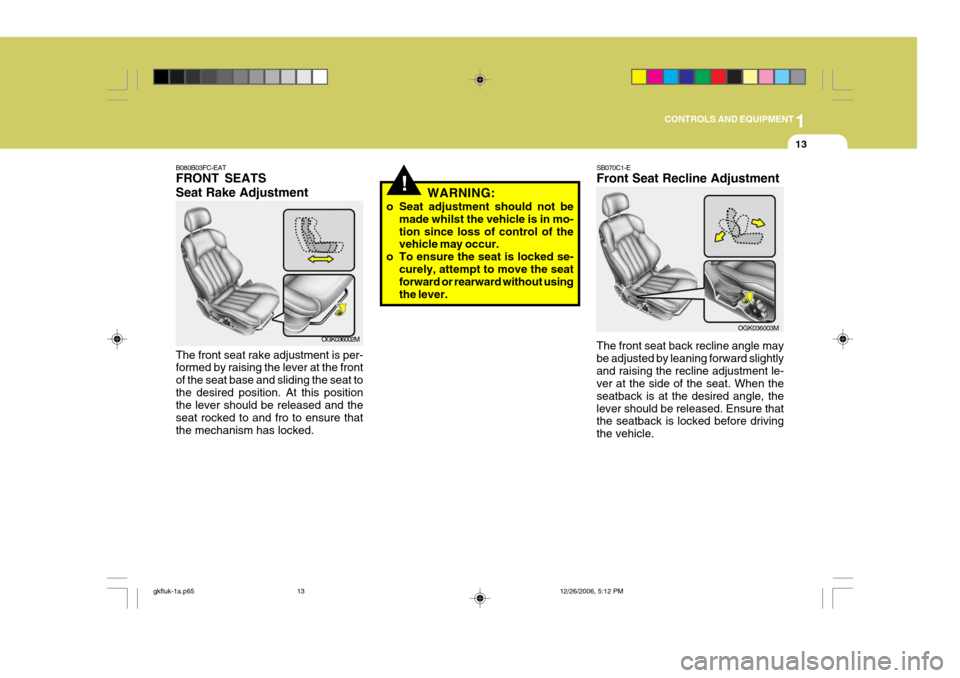
B080B03FC-EAT FRONT SEATS Seat Rake Adjustment The front seat rake adjustment is per- formed by raising the lever at the front of the seat base and sliding the seat tothe desired position. At this position the lever should be released and the seat rocked to and fro to ensure thatthe mechanism has locked.
OGK036002M
SB070C1-E Front Seat Recline Adjustment
OGK036003M
The front seat back recline angle may be adjusted by leaning forward slightlyand raising the recline adjustment le- ver at the side of the seat. When the seatback is at the desired angle, thelever should be released. Ensure that the seatback is locked before driving the vehicle.
gkfluk-1a.p65 12/26/2006, 5:12 PM
13
Page 281 of 483
1CONTROLS AND EQUIPMENT
14
!WARNING:
o For maximum effectiveness in case of an accident the head restraint should be adjusted so the middle of the head restraint is at the same height as the top of the occupant'seyes. For this reason, the use of a cushion that holds the body away from the seatback is not recom-mended. B080D01JM!
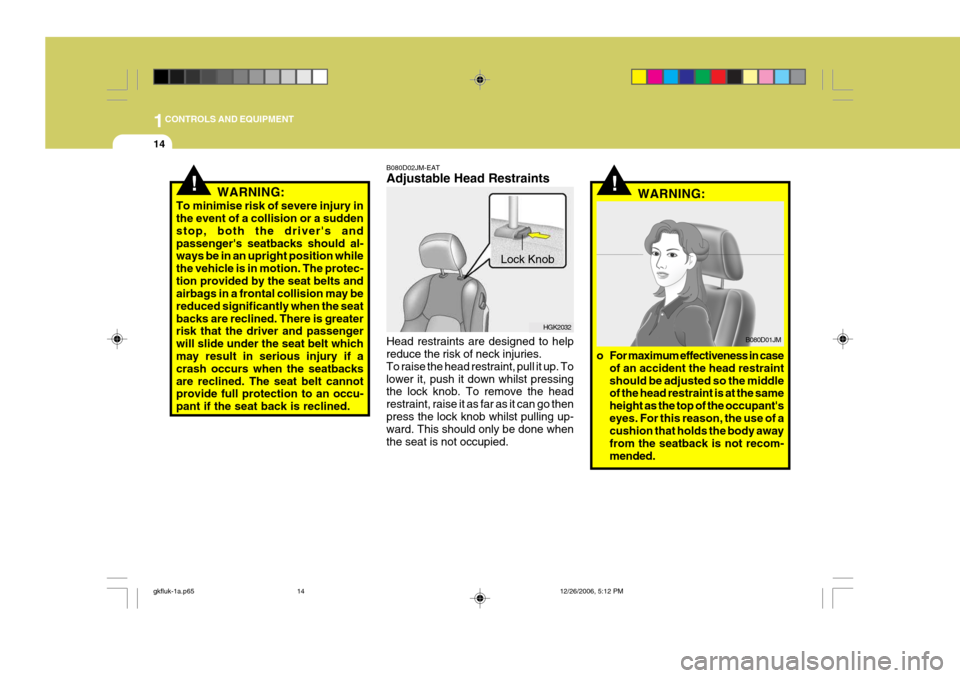
B080D02JM-EAT Adjustable Head Restraints Head restraints are designed to help reduce the risk of neck injuries. To raise the head restraint, pull it up. Tolower it, push it down whilst pressing the lock knob. To remove the head restraint, raise it as far as it can go thenpress the lock knob whilst pulling up- ward. This should only be done when the seat is not occupied.Lock Knob
HGK2032
WARNING:
To minimise risk of severe injury in the event of a collision or a sudden stop, both the driver's andpassenger's seatbacks should al- ways be in an upright position while the vehicle is in motion. The protec-tion provided by the seat belts and airbags in a frontal collision may be reduced significantly when the seatbacks are reclined. There is greater risk that the driver and passenger will slide under the seat belt which may result in serious injury if a crash occurs when the seatbacksare reclined. The seat belt cannot provide full protection to an occu- pant if the seat back is reclined.
gkfluk-1a.p65 12/26/2006, 5:12 PM
14
Page 283 of 483
1CONTROLS AND EQUIPMENT
16
!
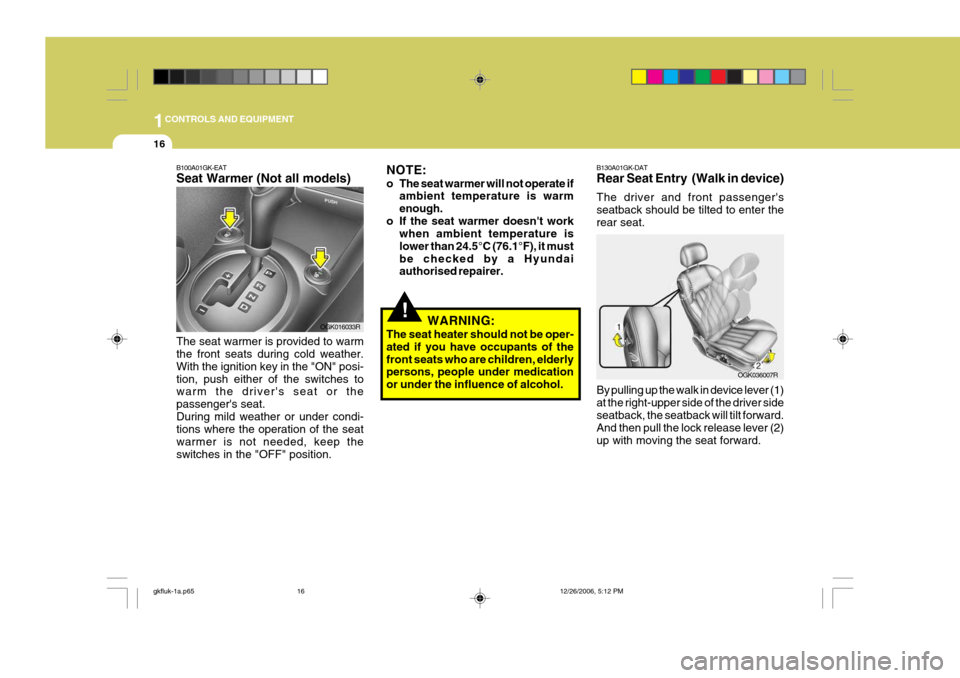
B130A01GK-DAT Rear Seat Entry (Walk in device) The driver and front passenger's seatback should be tilted to enter therear seat. By pulling up the walk in device lever (1) at the right-upper side of the driver sideseatback, the seatback will tilt forward. And then pull the lock release lever (2) up with moving the seat forward. OGK036007RB100A01GK-EAT Seat Warmer (Not all models) The seat warmer is provided to warm the front seats during cold weather. With the ignition key in the "ON" posi-tion, push either of the switches to warm the driver's seat or the passenger's seat.During mild weather or under condi- tions where the operation of the seat warmer is not needed, keep theswitches in the "OFF" position. OGK016033RNOTE:
o The seat warmer will not operate if
ambient temperature is warm enough.
o If the seat warmer doesn't work when ambient temperature islower than 24.5°C (76.1°F), it mustbe checked by a Hyundai authorised repairer.
WARNING:
The seat heater should not be oper-ated if you have occupants of the front seats who are children, elderly persons, people under medication or under the influence of alcohol.
gkfluk-1a.p65 12/26/2006, 5:12 PM
16
Page 284 of 483
1
CONTROLS AND EQUIPMENT
17
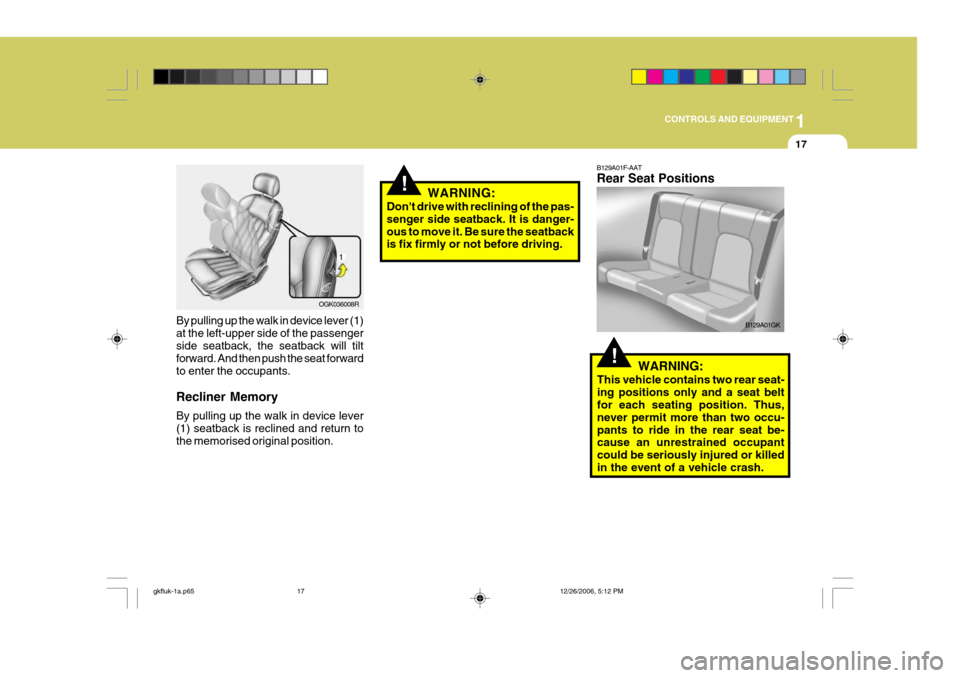
By pulling up the walk in device lever (1) at the left-upper side of the passengerside seatback, the seatback will tilt forward. And then push the seat forward to enter the occupants. Recliner Memory By pulling up the walk in device lever (1) seatback is reclined and return to the memorised original position. OGK036008R
!WARNING:
Don't drive with reclining of the pas- senger side seatback. It is danger-ous to move it. Be sure the seatback is fix firmly or not before driving.
B129A01F-AAT Rear Seat Positions
!WARNING:
This vehicle contains two rear seat- ing positions only and a seat belt for each seating position. Thus, never permit more than two occu-pants to ride in the rear seat be- cause an unrestrained occupant could be seriously injured or killedin the event of a vehicle crash. B129A01GK
gkfluk-1a.p65
12/26/2006, 5:12 PM
17
Page 286 of 483
1
CONTROLS AND EQUIPMENT
19
SB090B1-E Babies/Small Children Babies and small children must be restrained using a restraint system specifically designed for this purpose. Under no circumstances should a childbe carried in the vehicle without the use of a suitable restraint which meets the regulations in force in the countrywhere the vehicle is in operation.
SEAT BELTS
!WARNING:
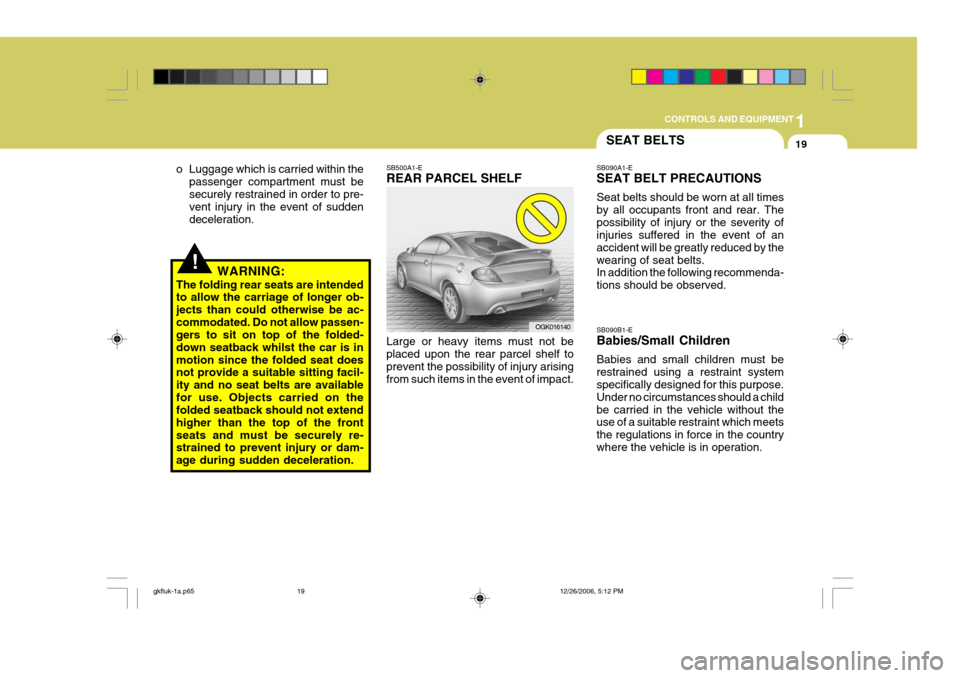
The folding rear seats are intended to allow the carriage of longer ob- jects than could otherwise be ac-commodated. Do not allow passen- gers to sit on top of the folded- down seatback whilst the car is inmotion since the folded seat does not provide a suitable sitting facil- ity and no seat belts are availablefor use. Objects carried on the folded seatback should not extend higher than the top of the frontseats and must be securely re- strained to prevent injury or dam- age during sudden deceleration. SB500A1-E REAR PARCEL SHELF Large or heavy items must not be placed upon the rear parcel shelf to prevent the possibility of injury arisingfrom such items in the event of impact.
SB090A1-E SEAT BELT PRECAUTIONS Seat belts should be worn at all times by all occupants front and rear. Thepossibility of injury or the severity of injuries suffered in the event of an accident will be greatly reduced by thewearing of seat belts. In addition the following recommenda- tions should be observed.
OGK016140
o Luggage which is carried within the
passenger compartment must besecurely restrained in order to pre- vent injury in the event of sudden deceleration.
gkfluk-1a.p65 12/26/2006, 5:12 PM
19
Page 287 of 483
1CONTROLS AND EQUIPMENT
20
WARNING:
Sitting in a reclined position or ly- ing down when your vehicle is in motion can be dangerous. Even if you buckle up, your seat belts can'tdo their job when you're reclined. The shoulder belt can't do its job because it won't be against yourbody. Instead, it will be in front of you. In a crash you could go into it with great force, receiving seriousneck or other injuries. The lap belt can't do its job either. In a crash the belt could go up overyour abdomen. The belt forces would be applied there, not at your strong pelvic bones. This couldcause serious internal injuries. For proper protection when the ve- hicle is in motion, have the seatbackupright. Then sit back in the seat and wear your seat belt properly.
SB090C1-E Larger Children Larger children should occupy the rear seat and be restrained at all times. Therestraint may take the form of a special safety belt or the original factory fitted seat belt used in conjunction with anapproved booster cushion depending upon the size and weight of the child. Under no circumstances should chil-dren be allowed to travel standing, kneeling or lying on the seat. Never allow children to ride in the frontpassenger seat. SB090O1-E Pregnant Women The use of a seat belt is recommended for pregnant women. The seat belt should be worn as low and snugly as possible across the hips, not acrossthe abdomen. A qualified Medical Prac- titioner should be consulted for further information. SB090E1-E Injured Persons A seat belt should be used when an injured person is being transported.For specific recommendations, the advice of a qualified Medical Practioner should be sought. SB090F1-E Seat Belt Occupancy The seat belts are designed to be used by one seat occupant only. The use of a seat belt by more than one person increases the levels of injury which may be sustained in the event of anaccident.!
SE090G1-E Do Not Lie Down To ensure that the maximum level of protection may be afforded by the seatbelt system, all passengers should be sitting in an upright position throughout the journey. The seat belt will be un-able to afford maximum protection if the front seats are at or near the fully reclined position.
gkfluk-1a.p65
12/26/2006, 5:12 PM
20