coolant Hyundai Coupe 2006 Owner's Guide
[x] Cancel search | Manufacturer: HYUNDAI, Model Year: 2006, Model line: Coupe, Model: Hyundai Coupe 2006Pages: 483, PDF Size: 12.73 MB
Page 223 of 483
6 DO-IT-YOURSELF MAINTENANCE
24
!
CHECKING ELECTRIC COOLING FANS
G220A01A-AAT
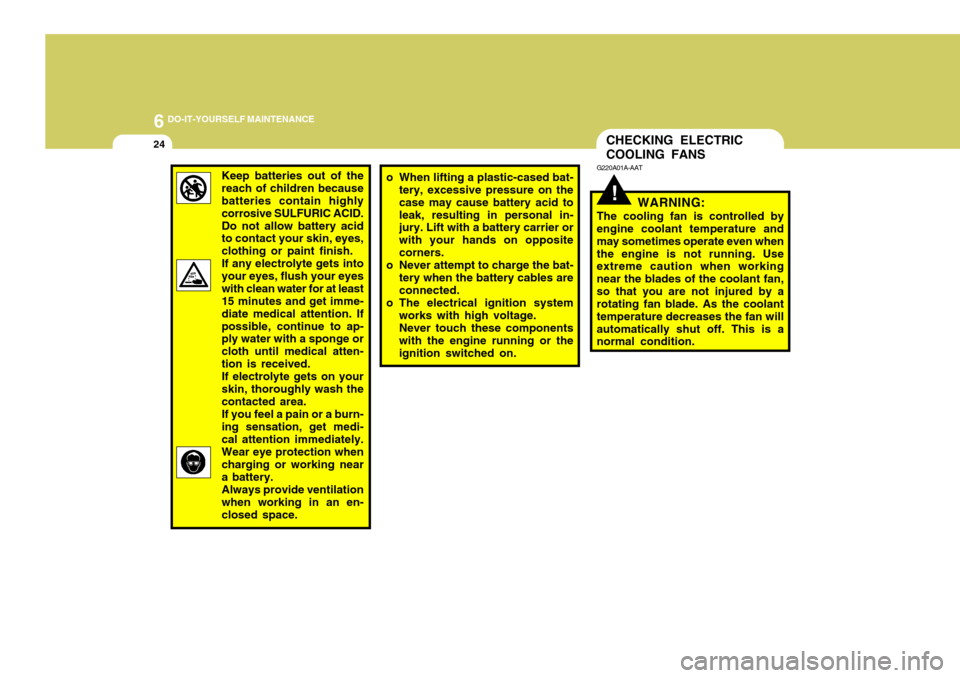
WARNING:
The cooling fan is controlled by engine coolant temperature and may sometimes operate even whenthe engine is not running. Use extreme caution when working near the blades of the coolant fan,so that you are not injured by a rotating fan blade. As the coolant temperature decreases the fan willautomatically shut off. This is a normal condition.
Keep batteries out of the reach of children because batteries contain highly corrosive SULFURIC ACID.Do not allow battery acid to contact your skin, eyes, clothing or paint finish.If any electrolyte gets intoyour eyes, flush your eyeswith clean water for at least 15 minutes and get imme- diate medical attention. Ifpossible, continue to ap- ply water with a sponge or cloth until medical atten-tion is received.If electrolyte gets on yourskin, thoroughly wash thecontacted area.If you feel a pain or a burn-ing sensation, get medi- cal attention immediately. Wear eye protection when charging or working near a battery. Always provide ventilation when working in an en- closed space.o When lifting a plastic-cased bat- tery, excessive pressure on the case may cause battery acid toleak, resulting in personal in- jury. Lift with a battery carrier or with your hands on oppositecorners.
o Never attempt to charge the bat- tery when the battery cables are connected.
o The electrical ignition system works with high voltage. Never touch these componentswith the engine running or the ignition switched on.
Page 224 of 483
6
DO-IT-YOURSELF MAINTENANCE
25
G220B01A-AAT
Checking Engine Cooling Fan
The engine coolant fan should come on automatically if the engine coolant temperature is high. G220C01A-AAT
Checking Condenser Cooling Fan
The condenser coolant fan should come on automatically whenever the air conditioning is in operation. G230A01GK-GAT
POWER STEERING FLUID LEVEL
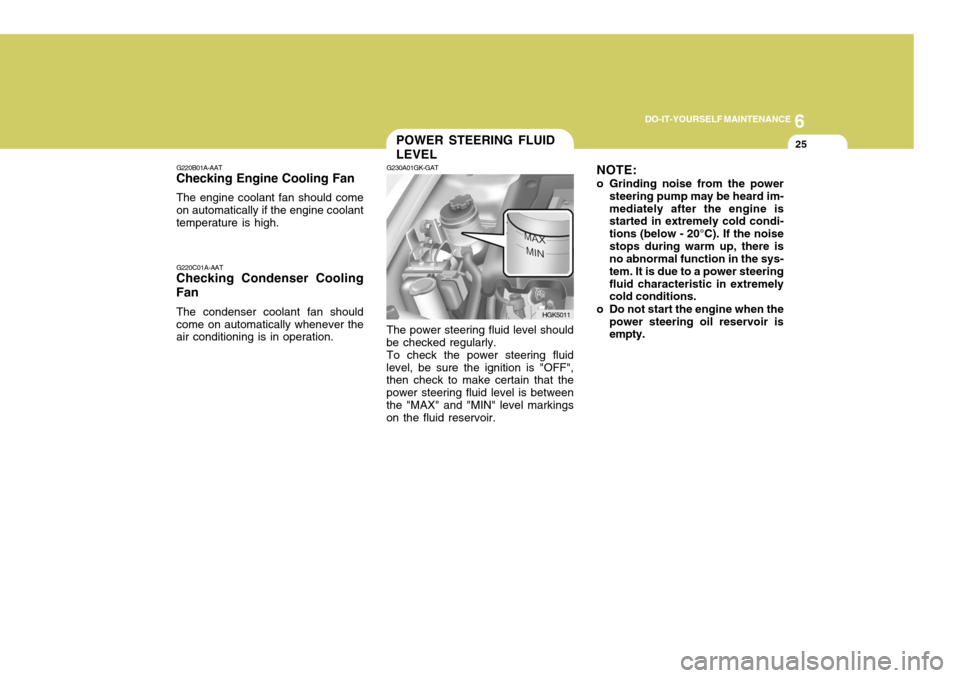
The power steering fluid level should
be checked regularly.
To check the power steering fluid
level, be sure the ignition is "OFF", then check to make certain that the power steering fluid level is betweenthe "MAX" and "MIN" level markings on the fluid reservoir. NOTE:
o Grinding noise from the power
steering pump may be heard im- mediately after the engine is started in extremely cold condi- tions (below - 20°C). If the noisestops during warm up, there is no abnormal function in the sys- tem. It is due to a power steeringfluid characteristic in extremely cold conditions.
o Do not start the engine when the power steering oil reservoir isempty.
HGK5011
Page 225 of 483
6 DO-IT-YOURSELF MAINTENANCE
26
OGK076068N
G240A01A-AAT Power Steering Hoses It is suggested that you check the power steering hose connections for fluid leakage daily. The power steer- ing hoses should be replaced if thereis severe surface cracking, pulling, scuffing or worn spots. Deterioration of the hose could cause prematurefailure. G290A02GK-GAT
HEADLIGHT AIMING ADJUSTMENT
1. Keep all tires inflated to the correctpressure.
2. Place the vehicle on level ground and press the front bumper & rearbumper down several times. Placevehicle at a distance of 3m (118 in.) from the test wall.
3. See that the vehicle is unloaded (except for full levels of coolant, engine oil and fuel, and spare tire,jack, and tools).
4. Clean the head light lenses and
turn on the headlights.
5. Open the hood.
6. Draw the vertical line (through the center of each headlight beam pat- tern) and the horizontal line (through the center of each headlight beampattern) on the aiming screen.And then, draw a parallel line at 30mm (1.18 in.) under the horizontal line.
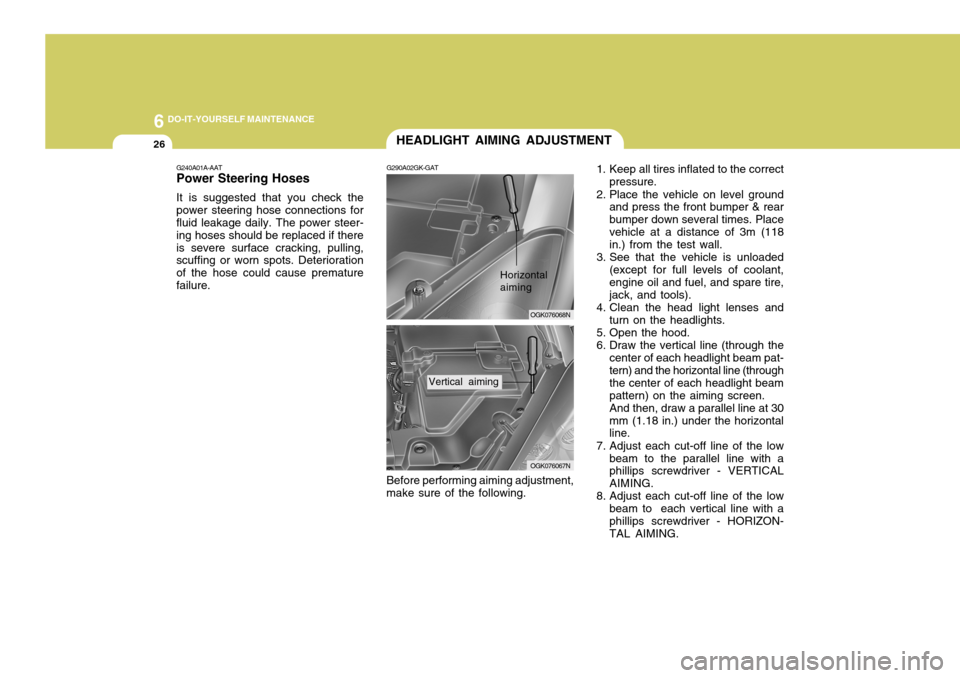
7. Adjust each cut-off line of the low beam to the parallel line with aphillips screwdriver - VERTICAL AIMING.
8. Adjust each cut-off line of the low
beam to each vertical line with aphillips screwdriver - HORIZON- TAL AIMING.
Before performing aiming adjustment,
make sure of the following.
OGK076067N
Horizontal aiming
Vertical aiming
Page 241 of 483

7EMISSION CONTROL SYSTEMS
2
H010A01A-GAT (If Installed) Your Hyundai is equipped with an emission control system to meet all requirements of the Emission prohibi- tion rules of your province.There are three emission control sys-tems which are as follows.
(1) Crankcase emission control sys-
tem
(2) Evaporative emission control sys-
tem
(3) Exhaust emission control systemIn order to assure the proper function of the emission control systems, it isrecommended that you have your car inspected and maintained by an au- thorized Hyundai dealer in accordancewith the maintenance schedule in this manual. EMISSION CONTROL SYSTEMS
H010B01F-GAT 1. Crankcase Emission ControlSystem
The positive crankcase ventilation system is employed to prevent air pollution caused by blow-by gases being emitted from the crankcase.This system supplies fresh air to the crankcase through the air cleaner. Inside the crankcase, the fresh airmixes with blow-by gases, then passes through the PCV valve into the induction system.
H010C01F-GAT
2. Evaporative Emission Control
System (If Installed)
The evaporative emission control sys-
tem is designed to prevent fuel va-pors from escaping into the atmo-sphere. H010D01A-AAT
3. Exhaust Emission Control
System
The exhaust emission control system is a highly effective system which controls exhaust emissions while maintaining good vehicle performace.
Canister While the engine is inoperative, fuel vapors generated inside the fuel tank are absorbed and stored in the canis-ter. When the engine is running, the fuel vapors absorbed in the canister are drawn into the induction systemthrough the purge control solenoid valve. Purge Control Solenoid Valve The purge control solenoid valve is controlled by the ECM; when the en- gine coolant temperature is low, and during idling, it closes, so that evapo- rated fuel is not taken into the engine. After engine warm-up, during ordi-nary driving, it opens so as to intro- duce evaporated fuel to the engine.
Page 252 of 483
9 VEHICLE SPECIFICATIONS
4
Q'ty (liter) (us.qts., Imp.qts.)
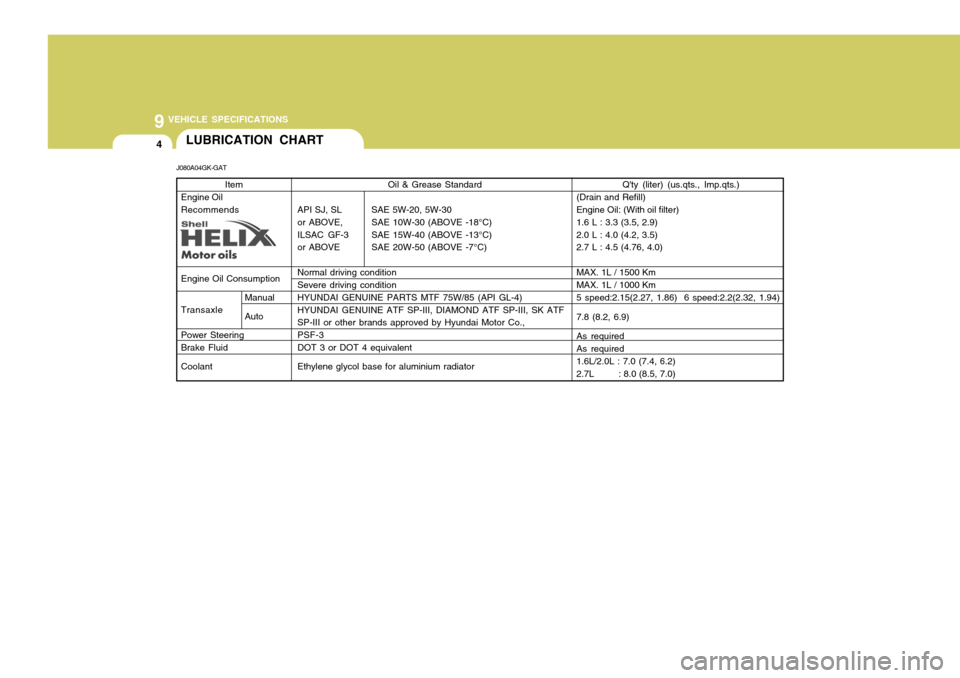
(Drain and Refill) Engine Oil: (With oil filter) 1.6 L : 3.3 (3.5, 2.9)2.0 L : 4.0 (4.2, 3.5) 2.7 L : 4.5 (4.76, 4.0) MAX. 1L / 1500 Km MAX. 1L / 1000 Km 5 speed:2.15(2.27, 1.86) 6 speed:2.2(2.32, 1.94) 7.8 (8.2, 6.9) As required As required1.6L/2.0L : 7.0 (7.4, 6.2) 2.7L : 8.0 (8.5, 7.0)
LUBRICATION CHART
J080A04GK-GAT Oil & Grease Standard
API SJ, SL SAE 5W-20, 5W-30
or ABOVE, SAE 10W-30 (ABOVE -18°C)
ILSAC GF-3 SAE 15W-40 (ABOVE -13°C)
or ABOVE SAE 20W-50 (ABOVE -7°C) Normal driving condition Severe driving condition HYUNDAI GENUINE PARTS MTF 75W/85 (API GL-4)HYUNDAI GENUINE ATF SP-III, DIAMOND ATF SP-III, SK ATF SP-III or other brands approved by Hyundai Motor Co., PSF-3DOT 3 or DOT 4 equivalent Ethylene glycol base for aluminium radiator
Item
Engine Oil Recommends Engine Oil Consumption Transaxle Power Steering Brake Fluid Coolant
Manual Auto
Page 255 of 483

10
INDEX
3
Driving Economical driving .................................................. 2-16
Smooth corneri ng ..................................................... 2-17
Winter driving ........................................................... 2-17
E Electronic Stability Program (ESP) ............................2-13
Emissions Control Systems ........................................ 7-2 Engine Before starting the engine ........................................ 2-3
Changing the oil and filter ......................................... 6-6Compartment (1.6L, 2.0L, 2.7L) ................................ 6-2
Coolant ..................................................................... 6-9
Coolant temperature gauge ......................................1-50
If the engine overheats ............................................. 3-4
Number ..................................................................... 8-2
Oil ............................................................................. 6-6Oil consumption ........................................................ 6-8
Starting ..................................................................... 2-5
Engine Exhaust Can Be Dangerous ............................ 2-2
FFog Light .................................................................... 1-60
Front Seats Adjustable front seats .............................................. 1-13
Adjustable headrests ............................................... 1-14
Adjusting seat forward and rearward ........................ 1-13
Adjusting seatback angle ........................................ 1-14
Lumbar support control ............................................ 1-16
Seat cushion height adjustment .............................. 1-16Seat warmer
............................................................ 1-16
Fuel Capacity ................................................................... 9-2
Gauge ...................................................................... 1-50
Recommendations .................................................... 1-2
Fuel Filler Lid Remote release ....................................................... 1-74
Fuse Panel Description .............................................. 6-37
Fuses ......................................................................... 6-21
G
General Everyday Checks ..... ...................................... 6-5
Glove box ................................................................... 1-69
H Hazard Warning System ............................................. 1-61
Headlight Leveling Device S ystem .............................1-64
Heating and Air Conditioning Control Rotary type .............................................................. 1-84
Automatic type ........................................................ 1-93
High-mounted rear stoplight .. ......................................1-72
Hood Release ............................................................. 1-73
Horn ............................................................................ 1-78
I Ignition Switch ............................................................. 2-4
Immobilizer System ..................................................... 1-4
Instrument Cluster and Indicator Lights ...................... 1-42
Instrument Panel Light Control (Rheostat) .................. 1-62
Intermittent Wiper ....................................................... 1-59
Page 270 of 483
1
CONTROLS AND EQUIPMENT
3RUNNING IN YOUR NEW HYUNDAI
B020A01S-EAT The longevity and performance of the vehicle are greatly affected by the care exercised during the first 1,000 miles of motoring. Because of modern manu-facturing techniques, rigid guidelines regarding maximum road speeds have become unnecessary. However, cer-tain precautions should be observed in order to obtain the best possible per- formance and useful life from the ve-hicle.
1) Do not race the engine without a
load (i.e revving the engine in neu- tral).
2) During the first 500 miles the maxi- mum engine speed should be re-stricted to 3,000 rpm and gradually increased thereafter.
3) Avoid prolonged constant speed operation. The internal componentsof the engine will become morequickly run in if the operation speed is varied during the running in pe- riod.
4) Never allow the engine to labour. Use the gearbox freely and avoidlarge throttle openings when theengine speed is below 1,500 rpm.BEFORE ENTERING THE VEHICLEAFTER ENTERING THE VEHICLE
YB020A1-E
o Ensure that all windows, mirrors
and lamps are clean.
o Check condition of all tyres.
o Ensure that no fluid leaks are evi-
dent.
o Ensure that the area around the vehicle is clear before driving off. YB020B1-E
o Ensure that all occupants fasten
and correctly adjust seat belts.
o Ensure that seat and head restraint positions are adjusted for optimum safety, control and comfort.
o Adjust interior and exterior rear view mirrors.
o Verify correct operation of lamps, horn and other electrical equipment.
o Ensure that warning lamps illumi-
nate when ignition is turned on.
NOTE: Fluid levels such as engine oil, en- gine coolant, brake and windscreenwasher fluid should be checked daily or at each refuelling, which- ever occurs sooner.
gkfluk-1a.p65 12/26/2006, 5:11 PM
3
Page 308 of 483
1
CONTROLS AND EQUIPMENT
41
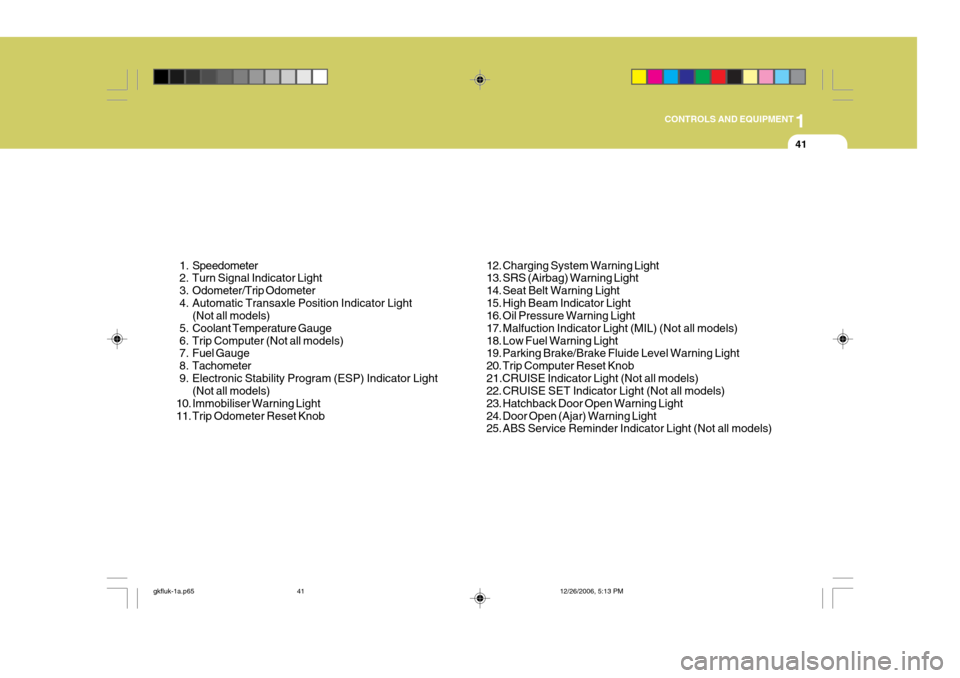
1. Speedometer
2. Turn Signal Indicator Light
3. Odometer/Trip Odometer
4. Automatic Transaxle Position Indicator Light (Not all models)
5. Coolant Temperature Gauge
6. Trip Computer (Not all models)
7. Fuel Gauge
8. Tachometer
9. Electronic Stability Program (ESP) Indicator Light (Not all models)
10. Immobiliser Warning Light
11. Trip Odometer Reset Knob 12. Charging System Warning Light
13. SRS (Airbag) Warning Light
14. Seat Belt Warning Light
15. High Beam Indicator Light
16. Oil Pressure Warning Light
17. Malfuction Indicator Light (MIL) (Not all models)
18. Low Fuel Warning Light
19. Parking Brake/Brake Fluide Level Warning Light
20. Trip Computer Reset Knob21.CRUISE Indicator Light (Not all models)
22. CRUISE SET Indicator Light (Not all models)
23. Hatchback Door Open Warning Light
24. Door Open (Ajar) Warning Light
25. ABS Service Reminder Indicator Light (Not all models)
gkfluk-1a.p65
12/26/2006, 5:13 PM
41
Page 314 of 483
1
CONTROLS AND EQUIPMENT
47
!
INSTRUMENT CLUSTER
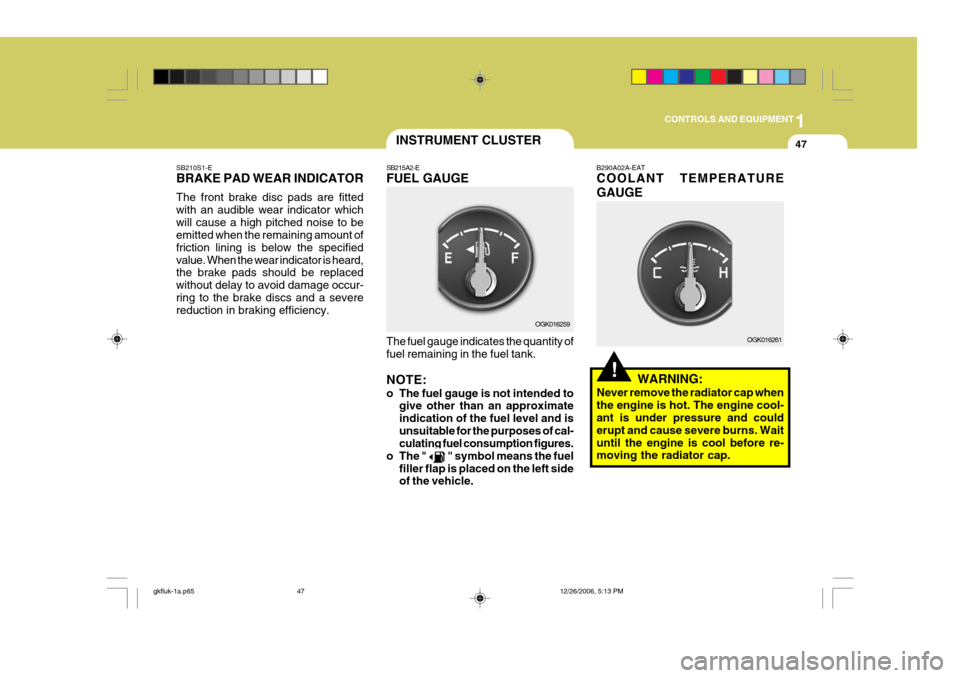
SB210S1-E BRAKE PAD WEAR INDICATOR The front brake disc pads are fitted with an audible wear indicator whichwill cause a high pitched noise to be emitted when the remaining amount of friction lining is below the specifiedvalue. When the wear indicator is heard, the brake pads should be replaced without delay to avoid damage occur-ring to the brake discs and a severe reduction in braking efficiency. SB215A2-E FUEL GAUGE The fuel gauge indicates the quantity of fuel remaining in the fuel tank. NOTE:
o The fuel gauge is not intended to
give other than an approximate indication of the fuel level and isunsuitable for the purposes of cal- culating fuel consumption figures.
o The "
" symbol means the fuel
filler flap is placed on the left side of the vehicle. B290A02A-EAT COOLANT TEMPERATURE GAUGE
WARNING:
Never remove the radiator cap when the engine is hot. The engine cool- ant is under pressure and could erupt and cause severe burns. Waituntil the engine is cool before re- moving the radiator cap.
OGK016259
OGK016261
gkfluk-1a.p65 12/26/2006, 5:13 PM
47
Page 315 of 483
1CONTROLS AND EQUIPMENT
48
!
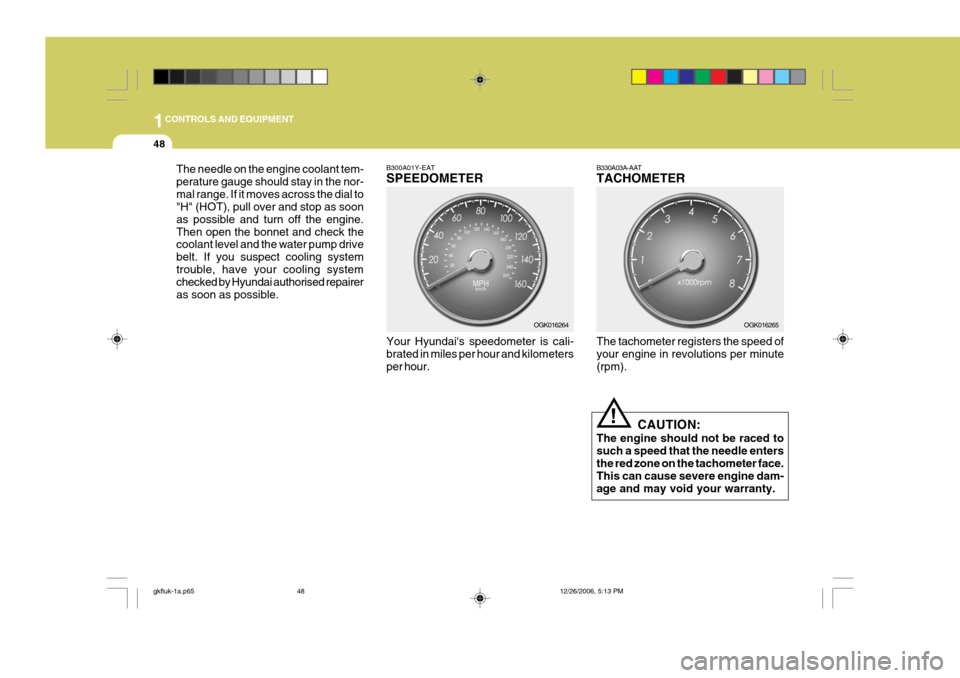
The needle on the engine coolant tem- perature gauge should stay in the nor-mal range. If it moves across the dial to "H" (HOT), pull over and stop as soon as possible and turn off the engine.Then open the bonnet and check the coolant level and the water pump drive belt. If you suspect cooling systemtrouble, have your cooling system checked by Hyundai authorised repairer as soon as possible.
B300A01Y-EAT SPEEDOMETER Your Hyundai's speedometer is cali- brated in miles per hour and kilometers per hour. B330A03A-AAT TACHOMETER The tachometer registers the speed of your engine in revolutions per minute (rpm).
CAUTION:
The engine should not be raced tosuch a speed that the needle entersthe red zone on the tachometer face. This can cause severe engine dam- age and may void your warranty.
OGK016264
OGK016265
gkfluk-1a.p65 12/26/2006, 5:13 PM
48