coolant Hyundai Coupe 2006 Service Manual
[x] Cancel search | Manufacturer: HYUNDAI, Model Year: 2006, Model line: Coupe, Model: Hyundai Coupe 2006Pages: 483, PDF Size: 12.73 MB
Page 432 of 483
6
OWNER MAINTENANCE
5
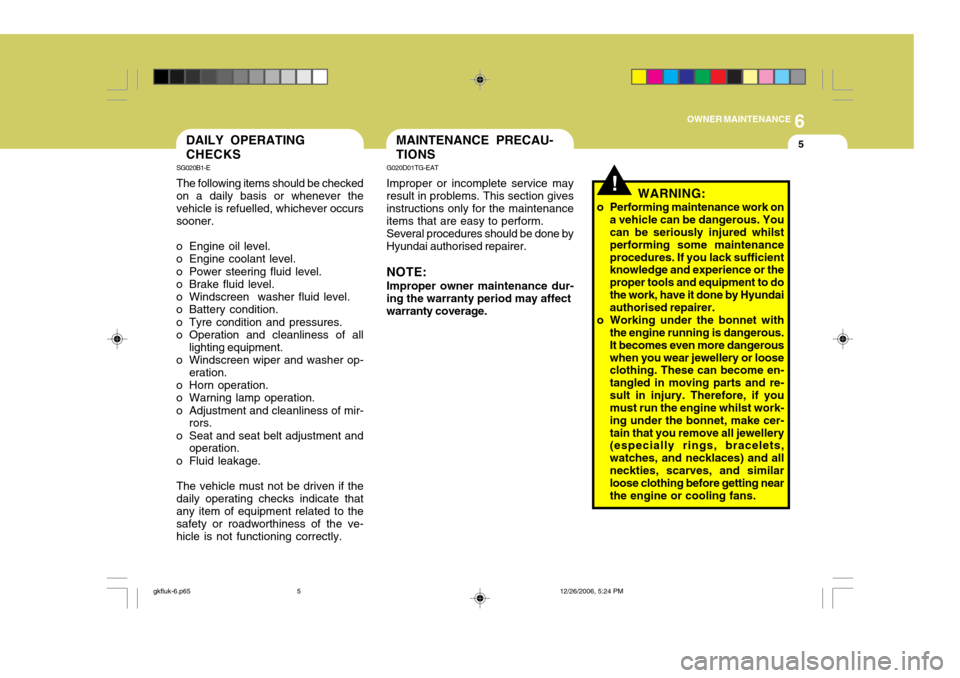
SG020B1-E The following items should be checked on a daily basis or whenever the vehicle is refuelled, whichever occurssooner.
o Engine oil level.
o Engine coolant level.
o Power steering fluid level.
o Brake fluid level.
o Windscreen washer fluid level.
o Battery condition.
o Tyre condition and pressures.
o Operation and cleanliness of all lighting equipment.
o Windscreen wiper and washer op-
eration.
o Horn operation.
o Warning lamp operation.
o Adjustment and cleanliness of mir- rors.
o Seat and seat belt adjustment and operation.
o Fluid leakage.
The vehicle must not be driven if the daily operating checks indicate that any item of equipment related to the safety or roadworthiness of the ve-hicle is not functioning correctly. DAILY OPERATING CHECKS
MAINTENANCE PRECAU- TIONS
!
G020D01TG-EAT Improper or incomplete service may result in problems. This section gives instructions only for the maintenanceitems that are easy to perform.Several procedures should be done byHyundai authorised repairer. NOTE: Improper owner maintenance dur- ing the warranty period may affectwarranty coverage.
WARNING:
o Performing maintenance work on a vehicle can be dangerous. You can be seriously injured whilst performing some maintenanceprocedures. If you lack sufficient knowledge and experience or the proper tools and equipment to dothe work, have it done by Hyundai authorised repairer.
o Working under the bonnet with the engine running is dangerous. It becomes even more dangerouswhen you wear jewellery or loose clothing. These can become en- tangled in moving parts and re-sult in injury. Therefore, if you must run the engine whilst work- ing under the bonnet, make cer-tain that you remove all jewellery (especially rings, bracelets, watches, and necklaces) and allneckties, scarves, and similar loose clothing before getting near the engine or cooling fans.
gkfluk-6.p65 12/26/2006, 5:24 PM
5
Page 436 of 483
6
OWNER MAINTENANCE
9
!
ENGINE COOLANT CHECKING AND REPLACING
SG050A1-E
WARNING:
Do not remove the radiator cap
when the engine is hot, since the system is pressurised and coolant may be ejected from the radiator resulting in scalding. NOTE: It is imperative that vehicles fitted with an air conditioning systemhave a coolant concentration of the recommended strength at all times. The use of the air condition-ing system when the cooling sys- tem is filled with water only will result in the heater matrix freezingand subsequently bursting.
SG050B1-E
Coolant recommendations
Only ethylene glycol based coolantwith a corrosion inhibitor suited to aluminium alloy engine components should be used in the cooling system.No further additives or inhibitors should be used. The coolant specific gravity should be checked as pre-scribed in the maintenance schedule to ensure adequate frost and corro- sion protection. In addition, the en-gine coolant must be replaced at the specified interval since the corrosion inhibitor properties deteriorate withtime.It is important to note that whilst anincrease in the concentration of anti freeze gives an increase in the level of frost protection, a solution which isin excess of 65% anti freeze will result in reduced frost protection and engine overheating. Therefore therecommended concentration of 50% should not be exceeded for general use. The use of methanol based anti freeze compounds may result in engine over- heating and will invalidate the vehiclewarranty.
gkfluk-6.p65 12/26/2006, 5:24 PM
9
Page 437 of 483
6OWNER MAINTENANCE
10
HGK4006
SG050C1-E Engine Coolant Level
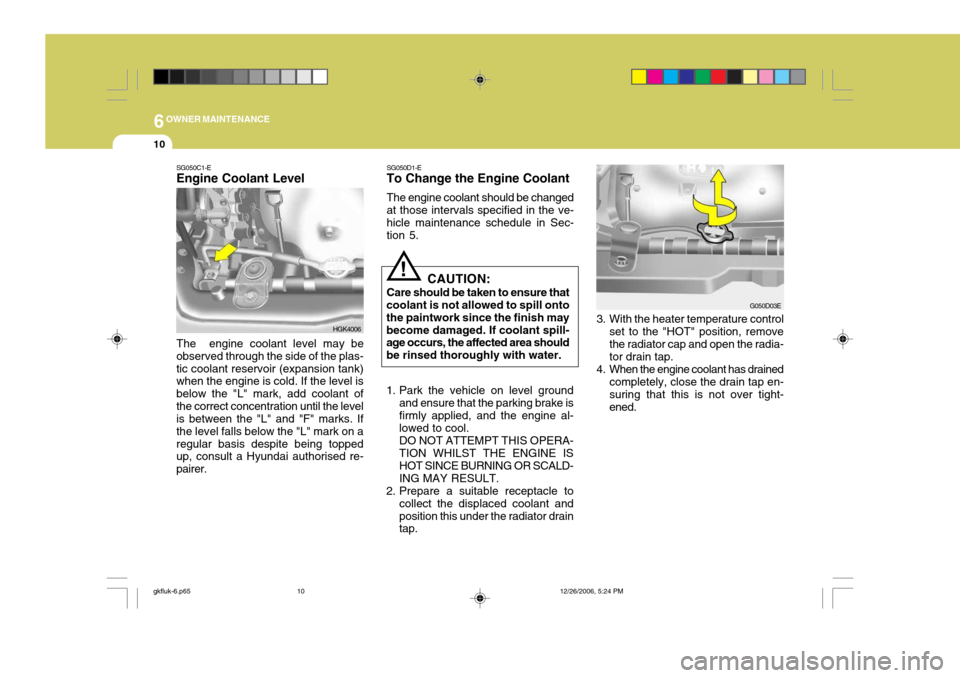
The engine coolant level may be
observed through the side of the plas- tic coolant reservoir (expansion tank) when the engine is cold. If the level is below the "L" mark, add coolant ofthe correct concentration until the level is between the "L" and "F" marks. If the level falls below the "L" mark on aregular basis despite being topped up, consult a Hyundai authorised re- pairer. SG050D1-E To Change the Engine Coolant The engine coolant should be changed at those intervals specified in the ve- hicle maintenance schedule in Sec- tion 5.
3. With the heater temperature controlset to the "HOT" position, removethe radiator cap and open the radia- tor drain tap.
4. When the engine coolant has drained completely, close the drain tap en- suring that this is not over tight-ened. G050D03E
CAUTION:
Care should be taken to ensure that
coolant is not allowed to spill ontothe paintwork since the finish maybecome damaged. If coolant spill- age occurs, the affected area should be rinsed thoroughly with water.
!
1. Park the vehicle on level ground and ensure that the parking brake is firmly applied, and the engine al- lowed to cool. DO NOT ATTEMPT THIS OPERA- TION WHILST THE ENGINE IS HOT SINCE BURNING OR SCALD-ING MAY RESULT.
2. Prepare a suitable receptacle to
collect the displaced coolant andposition this under the radiator drain tap.
gkfluk-6.p65 12/26/2006, 5:24 PM
10
Page 438 of 483
6
OWNER MAINTENANCE
11CHANGING THE AIR CLEANER FILTER
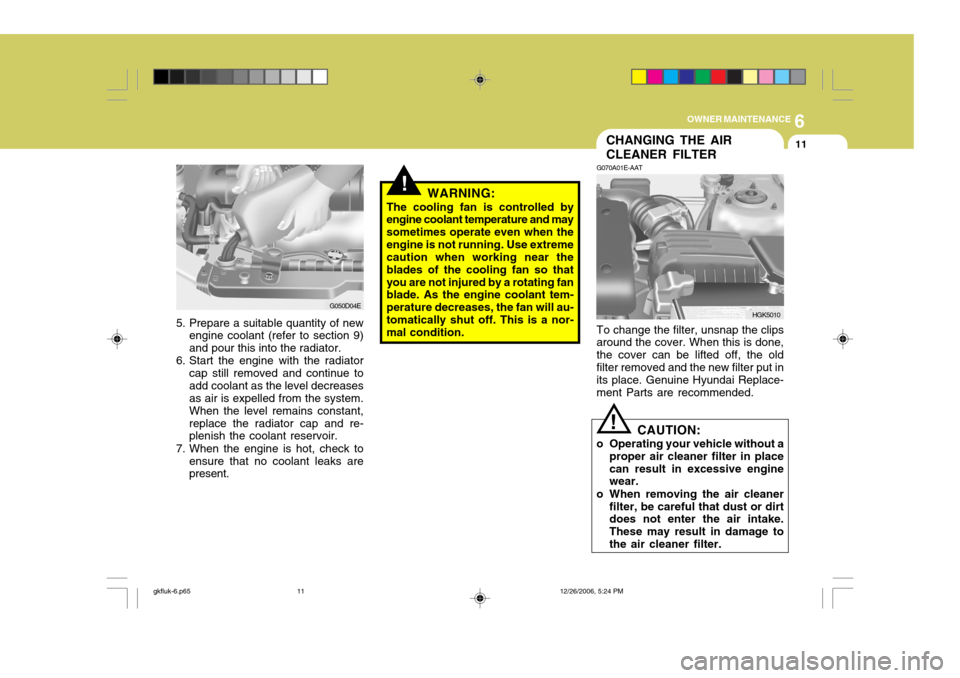
G070A01E-AAT To change the filter, unsnap the clips around the cover. When this is done, the cover can be lifted off, the oldfilter removed and the new filter put in its place. Genuine Hyundai Replace- ment Parts are recommended.
HGK5010
! CAUTION:
o Operating your vehicle without a proper air cleaner filter in place can result in excessive engine wear.
o When removing the air cleaner filter, be careful that dust or dirtdoes not enter the air intake. These may result in damage tothe air cleaner filter.
G050D04E
!WARNING:
The cooling fan is controlled by engine coolant temperature and may sometimes operate even when theengine is not running. Use extreme caution when working near the blades of the cooling fan so thatyou are not injured by a rotating fan blade. As the engine coolant tem- perature decreases, the fan will au-tomatically shut off. This is a nor- mal condition.
5. Prepare a suitable quantity of new
engine coolant (refer to section 9) and pour this into the radiator.
6. Start the engine with the radiator
cap still removed and continue toadd coolant as the level decreases as air is expelled from the system. When the level remains constant,replace the radiator cap and re- plenish the coolant reservoir.
7. When the engine is hot, check to ensure that no coolant leaks arepresent.
gkfluk-6.p65 12/26/2006, 5:24 PM
11
Page 440 of 483
6
OWNER MAINTENANCE
13
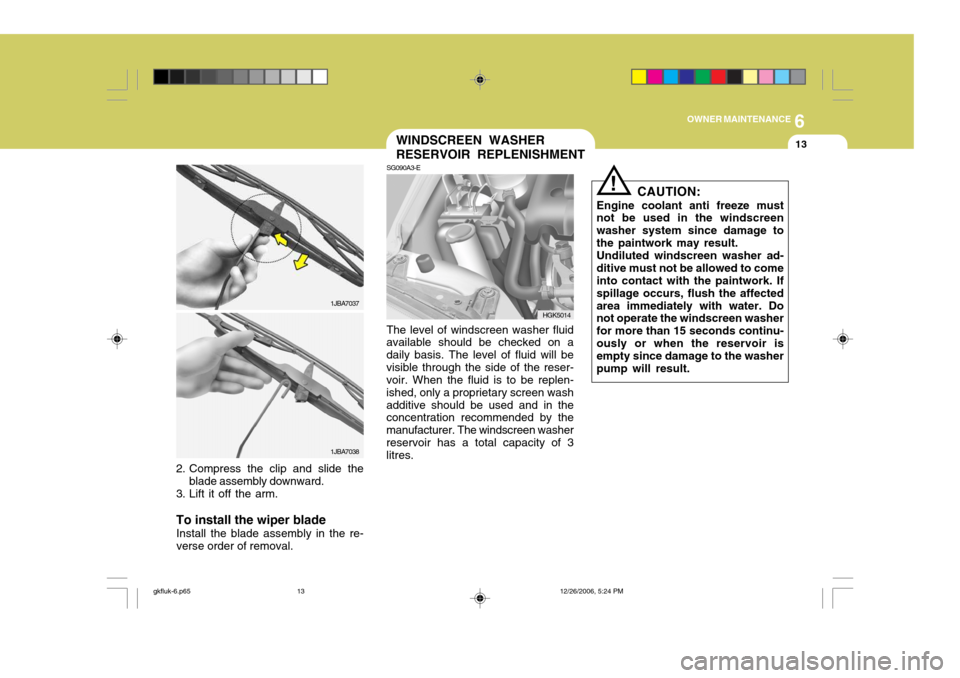
2. Compress the clip and slide the
blade assembly downward.
3. Lift it off the arm. To install the wiper blade
Install the blade assembly in the re- verse order of removal. 1JBA7037
1JBA7038
SG090A3-E The level of windscreen washer fluid
available should be checked on a daily basis. The level of fluid will bevisible through the side of the reser- voir. When the fluid is to be replen- ished, only a proprietary screen washadditive should be used and in the concentration recommended by the manufacturer. The windscreen washerreservoir has a total capacity of 3 litres. CAUTION:
Engine coolant anti freeze mustnot be used in the windscreen washer system since damage tothe paintwork may result.Undiluted windscreen washer ad-ditive must not be allowed to come into contact with the paintwork. If spillage occurs, flush the affectedarea immediately with water. Do not operate the windscreen washer for more than 15 seconds continu-ously or when the reservoir is empty since damage to the washer pump will result.
WINDSCREEN WASHER RESERVOIR REPLENISHMENT
!
HGK5014
gkfluk-6.p65
12/26/2006, 5:24 PM
13
Page 450 of 483
6
OWNER MAINTENANCE
23POWER STEERING FLUID LEVELELECTRIC COOLING FANS
!
YG210A1-E
WARNING:
The cooling fan is controlled by
engine coolant temperature and may sometimes operate even whenthe engine is not running. Do not touch the radiator fan until it is completely stopped.
As the coolant temperature de-
creases the fan will automaticallyshut off. This is a normal condi- tion. Checking Engine Cooling Fan
The engine cooling fan should auto-
matically come on if the engine cool- ant temperature is high. Checking Condenser Cooling Fan
The condenser cooling fan (in front of
the condenser) should come on auto- matically whenever the air conditioneris in operation. YG220A1-E Power Steering Hoses It is suggested that you check the power steering hose connections for fluid leakage at those intervals speci- fied in the vehicle maintenance sched-ule in Section 5. The power steering hoses should be replaced if there are severe surface cracking, pulling, scuff-ing or worn spots. Deterioration of the hoses could cause premature failure.
HGK5011
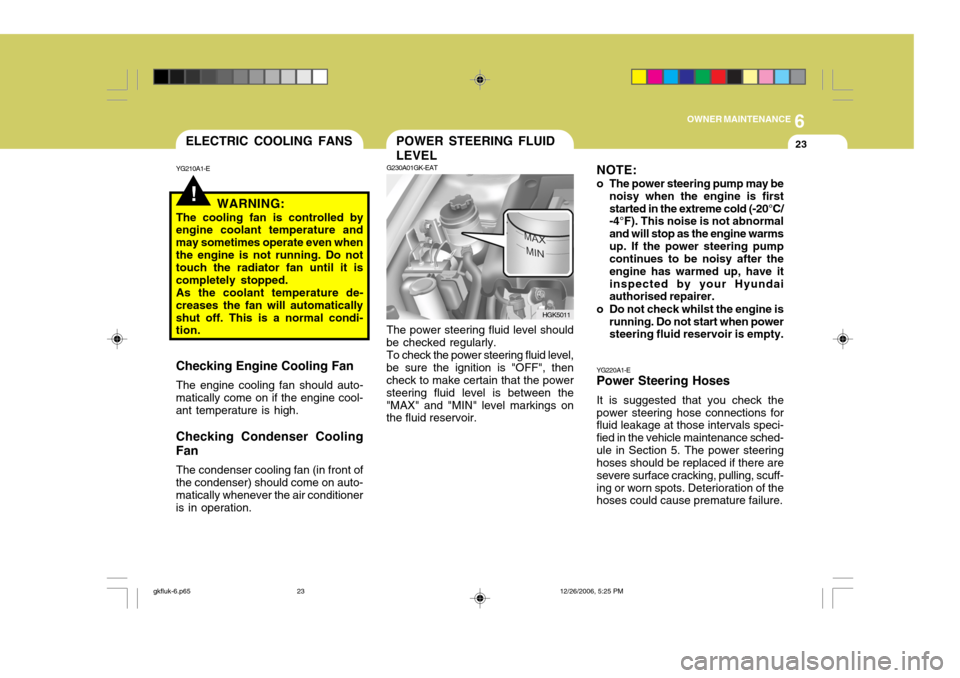
G230A01GK-EAT The power steering fluid level should
be checked regularly.
To check the power steering fluid level,
be sure the ignition is "OFF", then check to make certain that the power steering fluid level is between the"MAX" and "MIN" level markings on the fluid reservoir. NOTE:
o The power steering pump may be
noisy when the engine is first started in the extreme cold (-20°C/ -4°F). This noise is not abnormal and will stop as the engine warmsup. If the power steering pump continues to be noisy after the engine has warmed up, have itinspected by your Hyundai authorised repairer.
o Do not check whilst the engine is running. Do not start when powersteering fluid reservoir is empty.
gkfluk-6.p65 12/26/2006, 5:25 PM
23
Page 451 of 483
6OWNER MAINTENANCE
24
G290B01GK-EAT
Adjustment After Headlight As- sembly Replacement
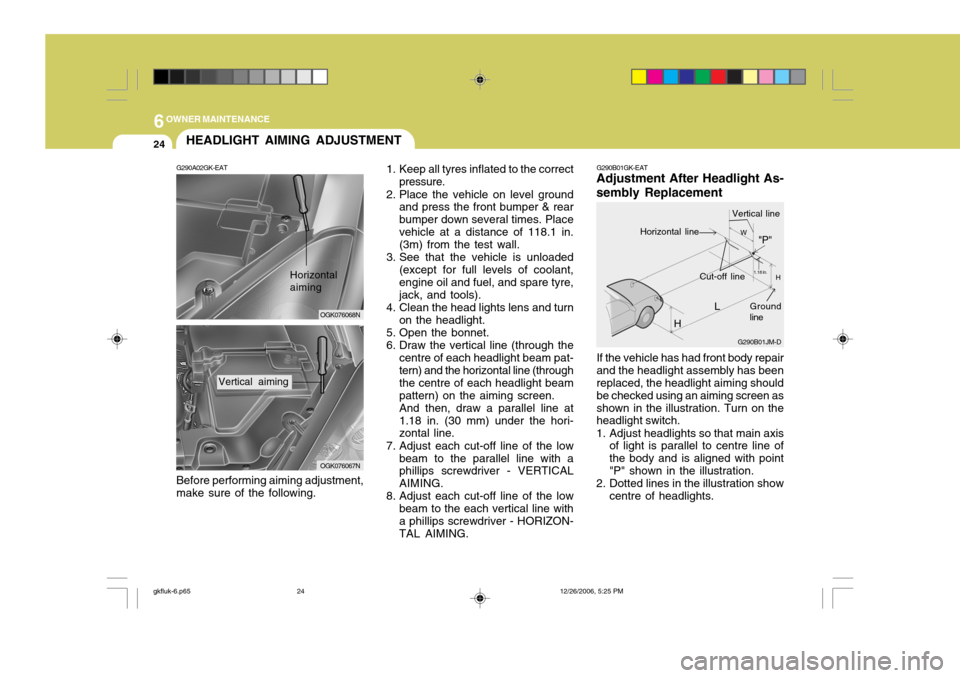
If the vehicle has had front body repair and the headlight assembly has been replaced, the headlight aiming should be checked using an aiming screen asshown in the illustration. Turn on the headlight switch.
1. Adjust headlights so that main axis of light is parallel to centre line of the body and is aligned with point"P" shown in the illustration.
2. Dotted lines in the illustration show centre of headlights.
1. Keep all tyres inflated to the correct
pressure.
2. Place the vehicle on level ground and press the front bumper & rearbumper down several times. Placevehicle at a distance of 118.1 in. (3m) from the test wall.
3. See that the vehicle is unloaded (except for full levels of coolant, engine oil and fuel, and spare tyre,jack, and tools).
4. Clean the head lights lens and turn
on the headlight.
5. Open the bonnet.
6. Draw the vertical line (through the centre of each headlight beam pat- tern) and the horizontal line (through the centre of each headlight beampattern) on the aiming screen.And then, draw a parallel line at1.18 in. (30 mm) under the hori- zontal line.
7. Adjust each cut-off line of the low beam to the parallel line with aphillips screwdriver - VERTICAL AIMING.
8. Adjust each cut-off line of the low
beam to the each vertical line witha phillips screwdriver - HORIZON- TAL AIMING. L
G290B01JM-D
W
H
H Cut-off line"P"
Vertical lineHorizontal line
Ground line
1.18 in.
G290A02GK-EAT
HEADLIGHT AIMING ADJUSTMENT
Before performing aiming adjustment, make sure of the following.
OGK076068N
OGK076067N
Horizontal aiming
Vertical aiming
gkfluk-6.p65 12/26/2006, 5:25 PM
24
Page 466 of 483
7EMISSION CONTROL SYSTEMS
2
SH010A1-E (Not all models) Depending upon the market for which the vehicle is destined, the emission control system will comprise one or more of the following emission controldevices.
(1) Crankcase emission control sys-
tem
(2) Evaporative emission control sys- tem
(3) Exhaust emission control systemIn order that the proper functioning of the emission control systems may be ensured, it is recommended that the vehicle is inspected and maintainedby a Hyundai authorised repairer in accordance with the maintenance schedule in this manual. EMISSION CONTROL SYS- TEMS
DH010B1-E
1. Crankcase Emission Control
System
The positive crankcase ventilation (PCV) system is employed to prevent air pollution caused by blow-by gases being emitted from the crankcase. This system supplies fresh air to the crankcase through the air cleaner. In- side the crankcase, the fresh air mixeswith blow-by gases, then passes through the PCV valve into the intake system. When the engine is running, the fuelvapors absorbed in the canister aredrawn into the induction system through the purge control solenoid valve. Purge Control Solenoid Valve The purge control solenoid valve is controlled by the ECU (Engine Control Unit); when the engine coolant tem- perature is low, and during idling, itcloses, so that evaporated fuel is not taken into the surge tank. After engine warm-up, during ordinary driving, itopens to introduce evaporated fuel to the surge tank.
JH010D1-E
3. Exhaust Emission Control
System
This system helps control oxides of
nitrogen by recirculating a portion of the exhaust gases into the intake manifold, thereby reducing cylinder combustion temperatures.
ZH010C1-E
2. Evaporative Emission
Control System
The Evaporative Emission Control System is designed to prevent fuelvapors from escaping into the atmo- sphere. Canister Whilst the engine is inoperative, fuel vapors generated inside the fuel tank are absorbed and stored in the canis- ter.
gkfluk-7.p65 12/26/2006, 5:26 PM
2
Page 478 of 483
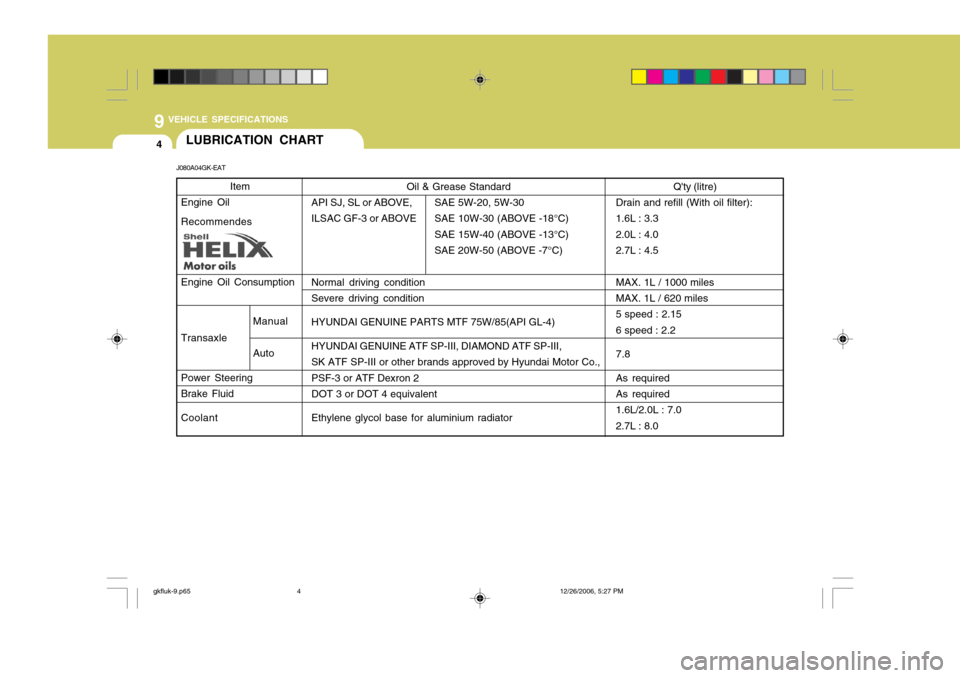
9 VEHICLE SPECIFICATIONS
4
Q'ty (litre)
Drain and refill (With oil filter): 1.6L : 3.32.0L : 4.0 2.7L : 4.5 MAX. 1L / 1000 miles MAX. 1L / 620 miles 5 speed : 2.156 speed : 2.2 7.8As required As required 1.6L/2.0L : 7.02.7L : 8.0
LUBRICATION CHART
J080A04GK-EAT Oil & Grease Standard
API SJ, SL or ABOVE, SAE 5W-20, 5W-30
ILSAC GF-3 or ABOVE SAE 10W-30 (ABOVE -18°C)
SAE 15W-40 (ABOVE -13°C) SAE 20W-50 (ABOVE -7°C)
Normal driving conditionSevere driving condition HYUNDAI GENUINE PARTS MTF 75W/85(API GL-4)HYUNDAI GENUINE ATF SP-III, DIAMOND ATF SP-III, SK ATF SP-III or other brands approved by Hyundai Motor Co.,PSF-3 or ATF Dexron 2 DOT 3 or DOT 4 equivalent Ethylene glycol base for aluminium radiator
Item
Engine Oil Recommendes Engine Oil Consumption Transaxle Power Steering Brake Fluid Coolant
Manual Auto
gkfluk-9.p65 12/26/2006, 5:27 PM
4
Page 481 of 483
10
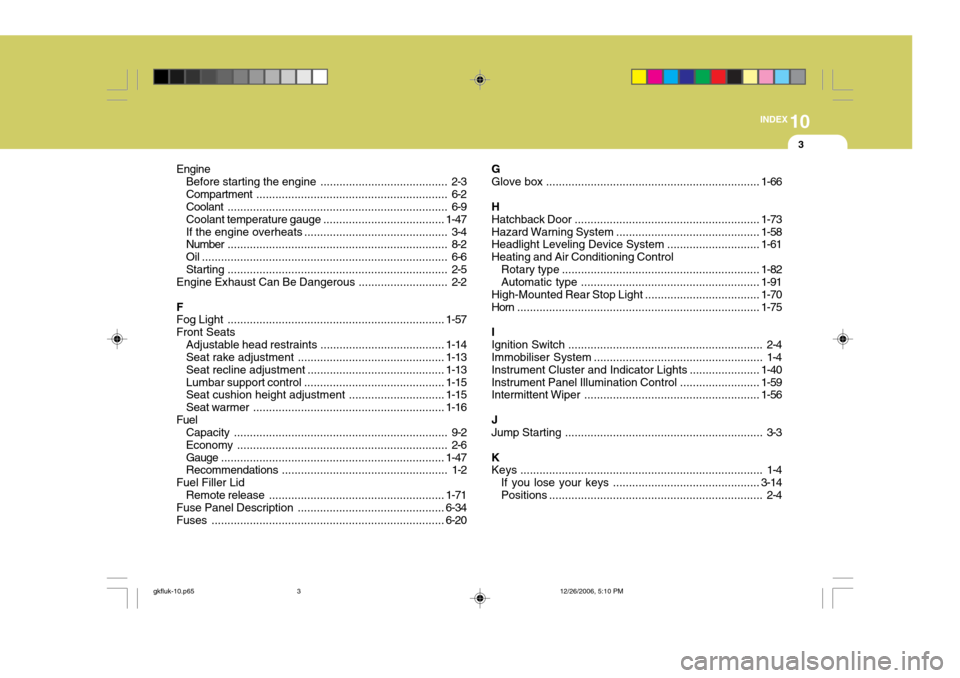
INDEX
3
Engine Before starting the engine ........................................ 2-3 Compartment ............................................................ 6-2
Coolant ..................................................................... 6-9
Coolant temperature gauge ......................................1-47
If the engine overheats ............................................. 3-4
Number ..................................................................... 8-2
Oil ............................................................................. 6-6Starting ..................................................................... 2-5
Engine Exhaust Can Be Dangerous ............................ 2-2
F Fog Light .................................................................... 1-57
Front Seats Adjustable head restraints ....................................... 1-14
Seat rake adjustment .............................................. 1-13
Seat recline adjustment ........................................... 1-13
Lumbar support control ............................................ 1-15
Seat cushion height adjustment .............................. 1-15
Seat warmer ............................................................ 1-16
Fuel Capacity ................................................................... 9-2
Economy .................................................................. 2-6
Gauge ...................................................................... 1-47
Recommendations .................................................... 1-2
Fuel Filler Lid Remote release ....................................................... 1-71
Fuse Panel Description .............................................. 6-34
Fuses ......................................................................... 6-20G
Glove box ...................................................................
1-66
HHatchback Door .......................................................... 1-73
Hazard Warning System ............................................. 1-58
Headlight Leveling Device S ystem .............................1-61
Heating and Air Conditioning Control Rotary type .............................................................. 1-82
Automatic type ........................................................ 1-91
High-Mounted Rear Stop Light .................................... 1-70
Horn ............................................................................ 1-75
IIgnition Switch ............................................................. 2-4
Immobiliser System ..................................................... 1-4
Instrument Cluster and Indicator Lights ...................... 1-40
Instrument Panel Illumination Control .........................1-59
Intermittent Wiper ....................................................... 1-56
J Jump Starting .............................................................. 3-3
KKeys ............................................................................ 1-4
If you lose your keys .............................................. 3-14
Positions ................................................................... 2-4
gkfluk-10.p65 12/26/2006, 5:10 PM
3