tow Hyundai Coupe 2006 Repair Manual
[x] Cancel search | Manufacturer: HYUNDAI, Model Year: 2006, Model line: Coupe, Model: Hyundai Coupe 2006Pages: 483, PDF Size: 12.73 MB
Page 399 of 483
3 IN CASE OF EMERGENCY
2IF THE ENGINE WILL NOT START
!
SD020A1-E Seek assistance from the nearest Hyundai authorised repairer with regard to the method of ignition and fuel sys- tem diagnosis.
WARNING:
If the engine refuses to start, noattempt should be made to push ortow start the vehicle. Vehicles with automatic transaxle or fuel injec- tion will not be able to be started in this manner since no drive is trans- mitted through the automatictransaxle whilst the engine is not running, and in the case of fuel injected derivatives, the fuel pumpwill not operate under tow start conditions. In addition, if the ve- hicle is equipped with an exhaustcatalyst, damage to the catalyst may result if the vehicle is tow started. SD020B1-E If the Engine Cannot be Cranked
1. If the vehicle is fitted with manual
transaxle, ensure that the clutch pedal is depressed whilst cranking the engine. If the vehicle is fitted with automatic transaxle, ensurethat the transaxle selector is at the "P" or"N" position.
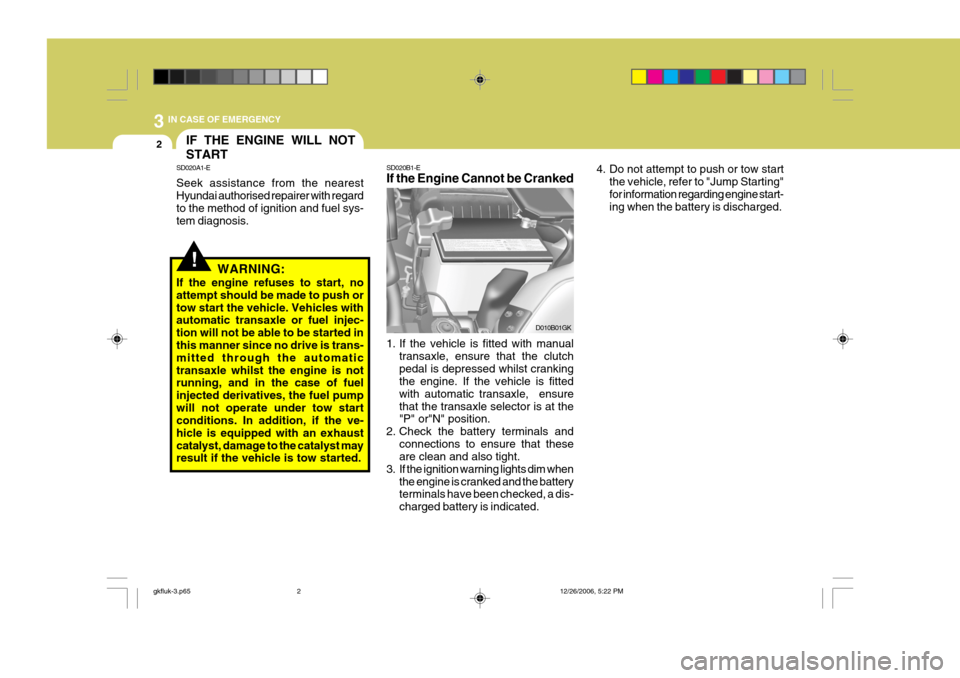
2. Check the battery terminals and connections to ensure that theseare clean and also tight.
3. If the ignition warning lights dim when the engine is cranked and the batteryterminals have been checked, a dis- charged battery is indicated. D010B01GK
4. Do not attempt to push or tow start
the vehicle, refer to "Jump Starting"for information regarding engine start- ing when the battery is discharged.
gkfluk-3.p65 12/26/2006, 5:22 PM
2
Page 408 of 483
3
IN CASE OF EMERGENCY
11
Go around the wheel tightening every other nut until they are all tight. Thendouble-check each nut for tightness. After changing wheels, have a techni- cian tighten the wheel nuts to theirproper torque as soon as possible. Wheel nut tightening torque Steel wheel & aluminium alloy wheel: 90-110 Nm. (65-80 lb.ft)
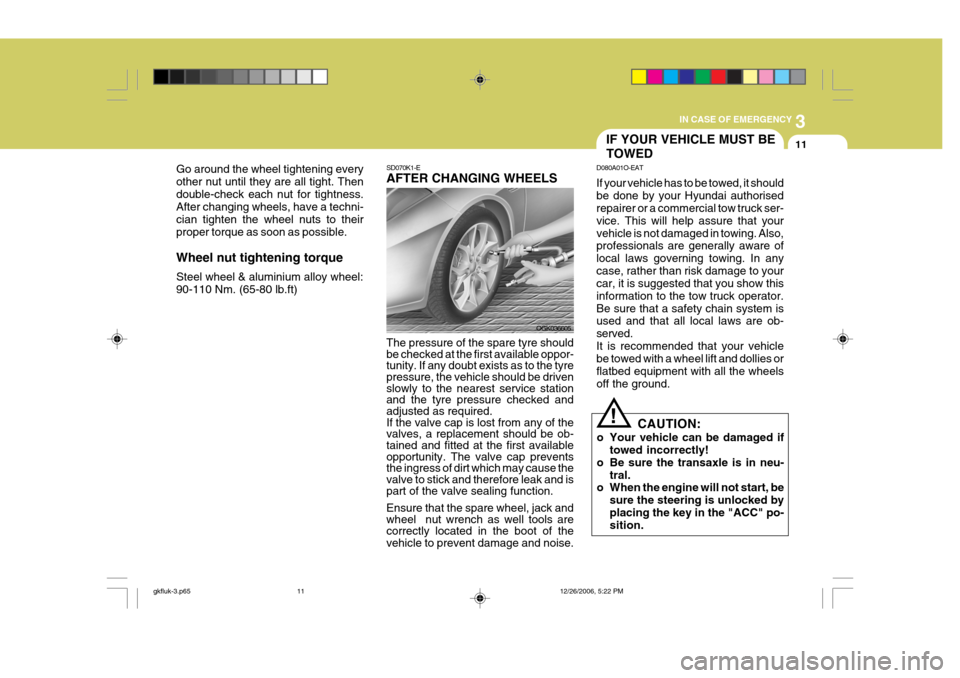
SD070K1-E AFTER CHANGING WHEELS The pressure of the spare tyre should be checked at the first available oppor-tunity. If any doubt exists as to the tyre pressure, the vehicle should be driven slowly to the nearest service stationand the tyre pressure checked and adjusted as required. If the valve cap is lost from any of thevalves, a replacement should be ob- tained and fitted at the first available opportunity. The valve cap preventsthe ingress of dirt which may cause the valve to stick and therefore leak and is part of the valve sealing function. Ensure that the spare wheel, jack and wheel nut wrench as well tools are correctly located in the boot of the vehicle to prevent damage and noise. OGK036605
IF YOUR VEHICLE MUST BE TOWED
D080A01O-EAT If your vehicle has to be towed, it should be done by your Hyundai authorised repairer or a commercial tow truck ser- vice. This will help assure that yourvehicle is not damaged in towing. Also, professionals are generally aware of local laws governing towing. In anycase, rather than risk damage to your car, it is suggested that you show this information to the tow truck operator.Be sure that a safety chain system is used and that all local laws are ob- served.It is recommended that your vehicle be towed with a wheel lift and dollies or flatbed equipment with all the wheelsoff the ground.
! CAUTION:
o Your vehicle can be damaged if towed incorrectly!
o Be sure the transaxle is in neu- tral.
o When the engine will not start, be
sure the steering is unlocked by placing the key in the "ACC" po- sition.
gkfluk-3.p65 12/26/2006, 5:22 PM
11
Page 409 of 483
3 IN CASE OF EMERGENCY
12
!
!
1) If the vehicle is being towed with the
rear wheels on the ground, be sure the parking brake is released.
NOTE: Before towing, check the level of the automatic transaxle fluid. If it is below the "HOT" range on the dip-stick, add fluid. If you cannot add fluid, a towing dolly must be used.
2) If any of the loaded wheels or sus- pension components are damaged or the vehicle is being towed with the front wheels on the ground, use a towing dolly under the front wheels.
o Manual Transaxle: If you do not use a towing dolly,place the ignition key in the "ACC"position and put the transaxle in "N (Neutral)".
CAUTION:
Do not tow with the key removed or in the "LOCK" position when tow- ing from the rear without a towing dolly.
CAUTION:
o When towing the vehicle, take care not to cause damage to the bumper or underbody of the ve- hicle.
o Do not tow with sling type truck as this may cause damage to thebumper or underbody of the ve-hicle. HGK4016
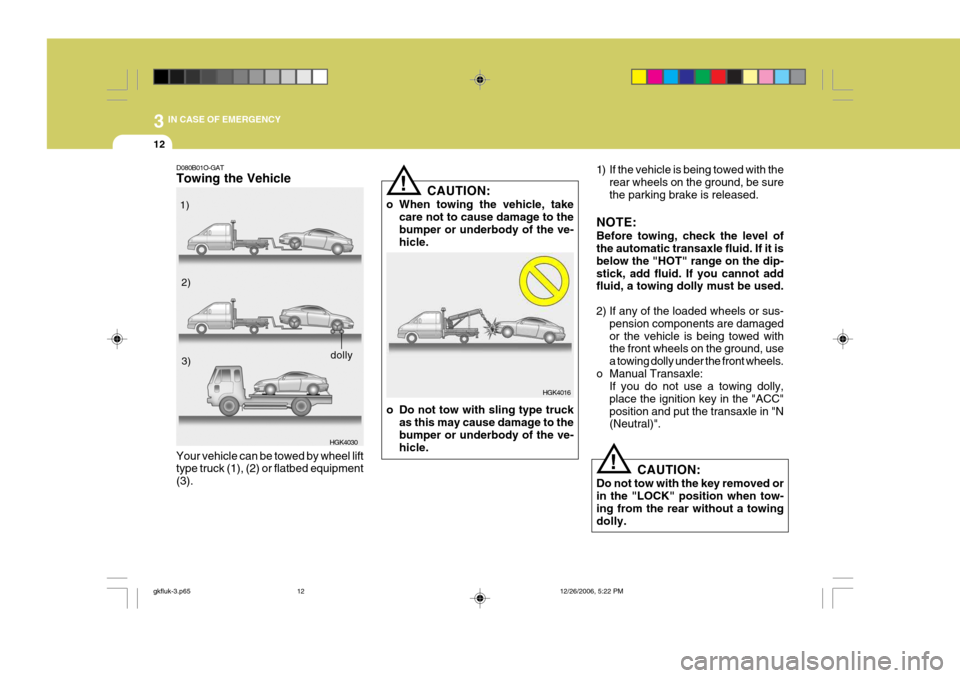
D080B01O-GAT Towing the Vehicle
HGK4030
Your vehicle can be towed by wheel lift type truck (1), (2) or flatbed equipment (3). 1)
2)
3)
dolly
gkfluk-3.p65 12/26/2006, 5:22 PM
12
Page 410 of 483
3
IN CASE OF EMERGENCY
13
HGK4017
!
o Automatic Transaxle:
Be sure to use a towing dolly under the front wheels.
CAUTION:
A vehicle with an automatic transaxleshould never be towed from the rear with the front wheels on the ground. This can cause serious damage tothe transaxle.
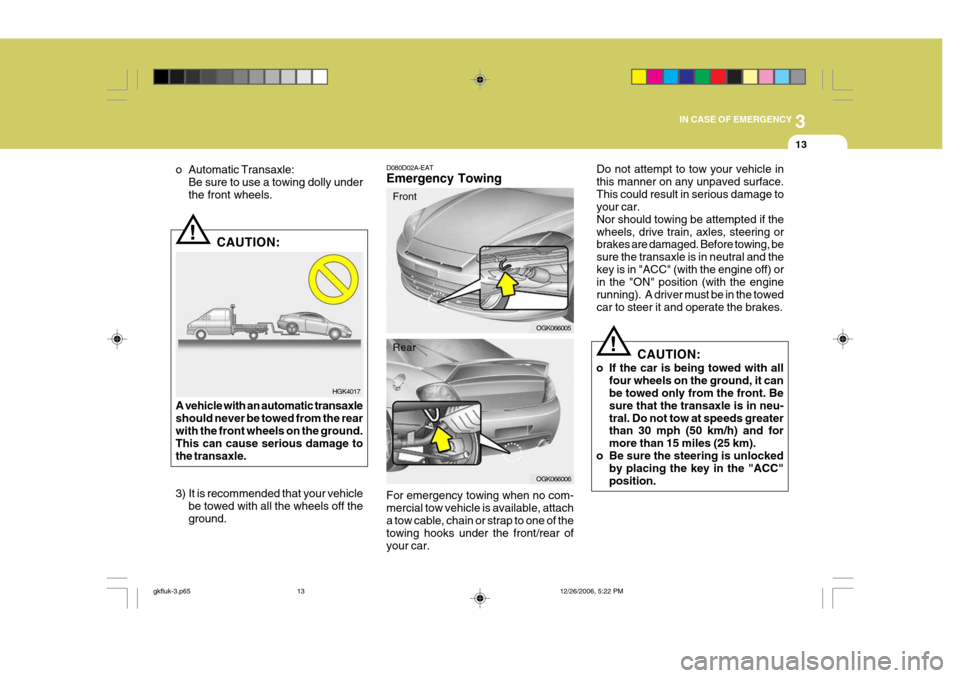
3) It is recommended that your vehicle be towed with all the wheels off the ground. D080D02A-EAT Emergency Towing For emergency towing when no com- mercial tow vehicle is available, attacha tow cable, chain or strap to one of the towing hooks under the front/rear of your car.
!
CAUTION:
o If the car is being towed with all four wheels on the ground, it can be towed only from the front. Be sure that the transaxle is in neu-tral. Do not tow at speeds greater than 30 mph (50 km/h) and for more than 15 miles (25 km).
o Be sure the steering is unlocked by placing the key in the "ACC"position.
OGK066005
Front
OGK066006
Rear Do not attempt to tow your vehicle in this manner on any unpaved surface.This could result in serious damage to your car. Nor should towing be attempted if thewheels, drive train, axles, steering or brakes are damaged. Before towing, be sure the transaxle is in neutral and thekey is in "ACC" (with the engine off) or in the "ON" position (with the engine running). A driver must be in the towedcar to steer it and operate the brakes.
gkfluk-3.p65
12/26/2006, 5:22 PM
13
Page 423 of 483
5
VEHICLE MAINTENANCE REQUIREMENTS
7
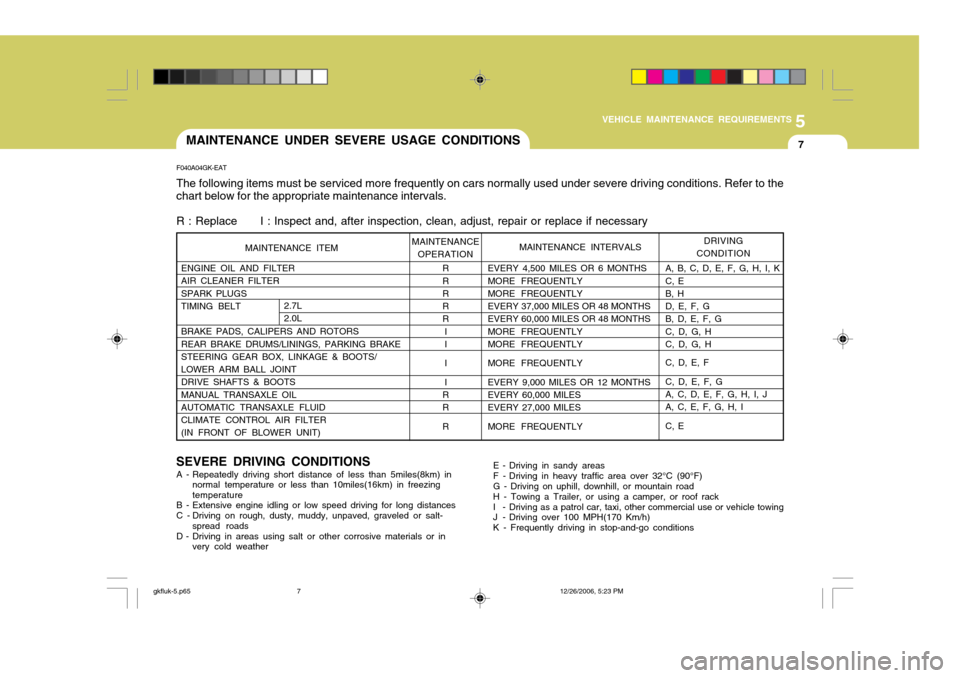
ENGINE OIL AND FILTER AIR CLEANER FILTER SPARK PLUGS TIMING BELT BRAKE PADS, CALIPERS AND ROTORS REAR BRAKE DRUMS/LININGS, PARKING BRAKE STEERING GEAR BOX, LINKAGE & BOOTS/ LOWER ARM BALL JOINT DRIVE SHAFTS & BOOTS MANUAL TRANSAXLE OIL AUTOMATIC TRANSAXLE FLUID CLIMATE CONTROL AIR FILTER (IN FRONT OF BLOWER UNIT)
F040A04GK-EAT The following items must be serviced more frequently on cars normally used under severe driving conditions. Refer to the chart below for the appropriate maintenance intervals. R : Replace I : Inspect and, after inspection, clean, adjust, repair or replace if necessary MAINTENANCE UNDER SEVERE USAGE CONDITIONS
MAINTENANCE INTERVALS
A, B, C, D, E, F, G, H, I, K C, E B, H D, E, F, G B, D, E, F, G C, D, G, H C, D, G, H C, D, E, F C, D, E, F, G A, C, D, E, F, G, H, I, J A, C, E, F, G, H, I C, E
MAINTENANCE ITEM
DRIVING
CONDITION
EVERY 4,500 MILES OR 6 MONTHS MORE FREQUENTLY MORE FREQUENTLY EVERY 37,000 MILES OR 48 MONTHS EVERY 60,000 MILES OR 48 MONTHS MORE FREQUENTLY MORE FREQUENTLY MORE FREQUENTLYEVERY 9,000 MILES OR 12 MONTHS EVERY 60,000 MILES EVERY 27,000 MILES MORE FREQUENTLYR R R R R II II
R R R
MAINTENANCE
OPERATION
SEVERE DRIVING CONDITIONSA - Repeatedly driving short distance of less than 5miles(8km) in normal temperature or less than 10miles(16km) in freezing temperature
B - Extensive engine idling or low speed driving for long distances
C - Driving on rough, dusty, muddy, unpaved, graveled or salt- spread roads
D - Driving in areas using salt or other corrosive materials or in very cold weather E - Driving in sandy areas
F - Driving in heavy traffic area over 32°C (90°F)G - Driving on uphill, downhill, or mountain roadH - Towing a Trailer, or using a camper, or roof rack
I - Driving as a patrol car, taxi, other commercial use or vehicle towing
J - Driving over 100 MPH(170 Km/h) K - Frequently driving in stop-and-go conditions
2.7L 2.0L
gkfluk-5.p65
12/26/2006, 5:23 PM
7
Page 467 of 483
7
EMISSION CONTROL SYSTEMS
3CATALYTIC CONVERTOR
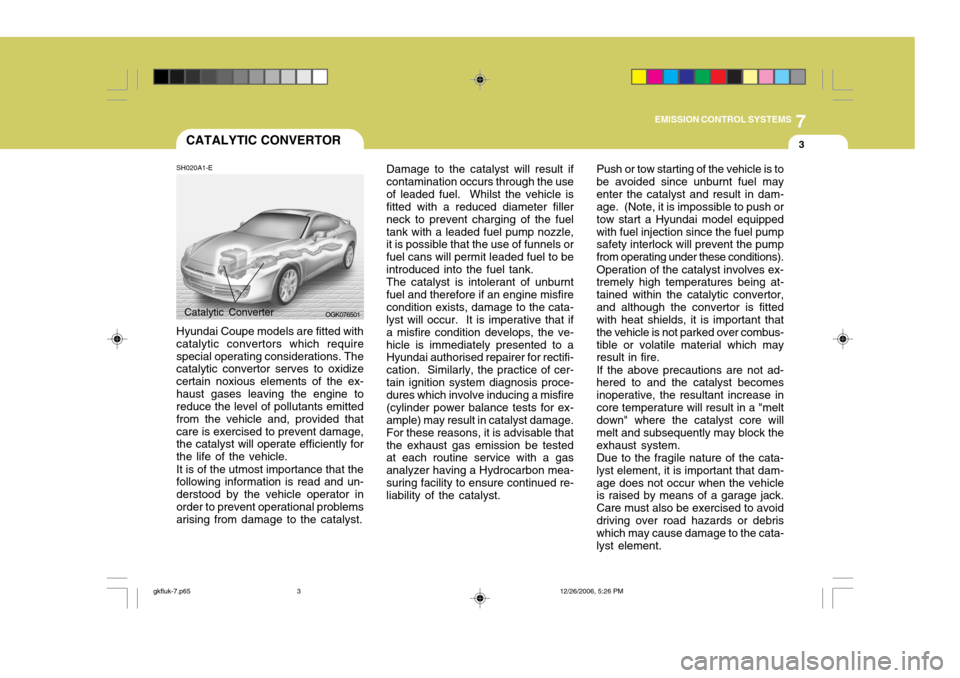
SH020A1-E Hyundai Coupe models are fitted with catalytic convertors which requirespecial operating considerations. The catalytic convertor serves to oxidize certain noxious elements of the ex-haust gases leaving the engine to reduce the level of pollutants emitted from the vehicle and, provided thatcare is exercised to prevent damage, the catalyst will operate efficiently for the life of the vehicle. It is of the utmost importance that the following information is read and un- derstood by the vehicle operator inorder to prevent operational problems arising from damage to the catalyst. Damage to the catalyst will result if contamination occurs through the useof leaded fuel. Whilst the vehicle is fitted with a reduced diameter filler neck to prevent charging of the fueltank with a leaded fuel pump nozzle, it is possible that the use of funnels or fuel cans will permit leaded fuel to beintroduced into the fuel tank.The catalyst is intolerant of unburntfuel and therefore if an engine misfirecondition exists, damage to the cata- lyst will occur. It is imperative that if a misfire condition develops, the ve-hicle is immediately presented to a Hyundai authorised repairer for rectifi- cation. Similarly, the practice of cer-tain ignition system diagnosis proce- dures which involve inducing a misfire (cylinder power balance tests for ex-ample) may result in catalyst damage.For these reasons, it is advisable thatthe exhaust gas emission be tested at each routine service with a gas analyzer having a Hydrocarbon mea-suring facility to ensure continued re- liability of the catalyst.
Catalytic Converter
OGK076501 Push or tow starting of the vehicle is to be avoided since unburnt fuel mayenter the catalyst and result in dam- age. (Note, it is impossible to push or tow start a Hyundai model equippedwith fuel injection since the fuel pump safety interlock will prevent the pump from operating under these conditions). Operation of the catalyst involves ex- tremely high temperatures being at- tained within the catalytic convertor,and although the convertor is fitted with heat shields, it is important that the vehicle is not parked over combus-tible or volatile material which may result in fire. If the above precautions are not ad- hered to and the catalyst becomes inoperative, the resultant increase incore temperature will result in a "melt down" where the catalyst core will melt and subsequently may block theexhaust system.Due to the fragile nature of the cata-lyst element, it is important that dam-age does not occur when the vehicle is raised by means of a garage jack. Care must also be exercised to avoiddriving over road hazards or debris which may cause damage to the cata- lyst element.
gkfluk-7.p65
12/26/2006, 5:26 PM
3
Page 482 of 483

10INDEX
4
L
Light Bulb Replacement .............................................. 6-25
Lubrication Chart .......................................................... 9-4
Luggage Net ............................................................... 1-76
M Maintenance Intervals Explanation of scheduled maintenance items
................................................................................. 5-8
Maintenance under severe usage conditions ............ 5-7
Scheduled maintenance ............................................ 5-4
Service requirements ................................................ 5-2
Map Light .................................................................... 1-65
Mirros Day-night inside rearview mirror ...............................1-68
Outside rearview mirror folding ................................1-68
Outsde rearview mirror heating ................................1-67
Multi Gauge ................................................................ 1-52
O Odometer .................................................................... 1-49
PParking Brake ............................................................. 1-69
Power Steering Fluid Level ......................................... 6-23
R Rear Seats Before folding the rear seats ................................... 1-18
Folding rear seatbacks ............................................ 1-18Rear seat entry ........................................................
1-16
Rear seat positions .................................................. 1-17
Rear Window Defogger ............................................... 1-58
Rear Window Wiper and Washer Switch ....................1-57
Running-In Your New Hyundai ..................................... 1-3
S Seats .......................................................................... 1-12
Seat Belts ................................................................... 1-19
3-Point type ............................................................. 1-22
Adjustable height ..................................................... 1-21
Adjusting your seat belt ........................................... 1-23
Care of seat belts .................................................... 1-21
Pre-tentioner seat belt ............................................. 1-29
Spectacle C ase .......................................................... 1-65
Speedometer ............................................................... 1-48
Starting Pr ocedures..................................................... 2-5
Steering Wheel Tilt Lever ........................................... 1-75
Stereo Sound System .............................................. 1-101
Sun Visor .................................................................... 1-74
Sunroof ....................................................................... 1-62
TTachometer ................................................................. 1-48
Theft Alarm System .................................................... 1-8
Towing
Emergency .............................................................. 3-13
If your vehicle must be towed ................................. 3-11
Trailer or vehicle towing ........................................... 2-20
gkfluk-10.p65 12/26/2006, 5:10 PM
4