tow Hyundai Coupe 2006 Owner's Guide
[x] Cancel search | Manufacturer: HYUNDAI, Model Year: 2006, Model line: Coupe, Model: Hyundai Coupe 2006Pages: 483, PDF Size: 12.73 MB
Page 195 of 483
5
VEHICLE MAINTENANCE REQUIREMENTS
7
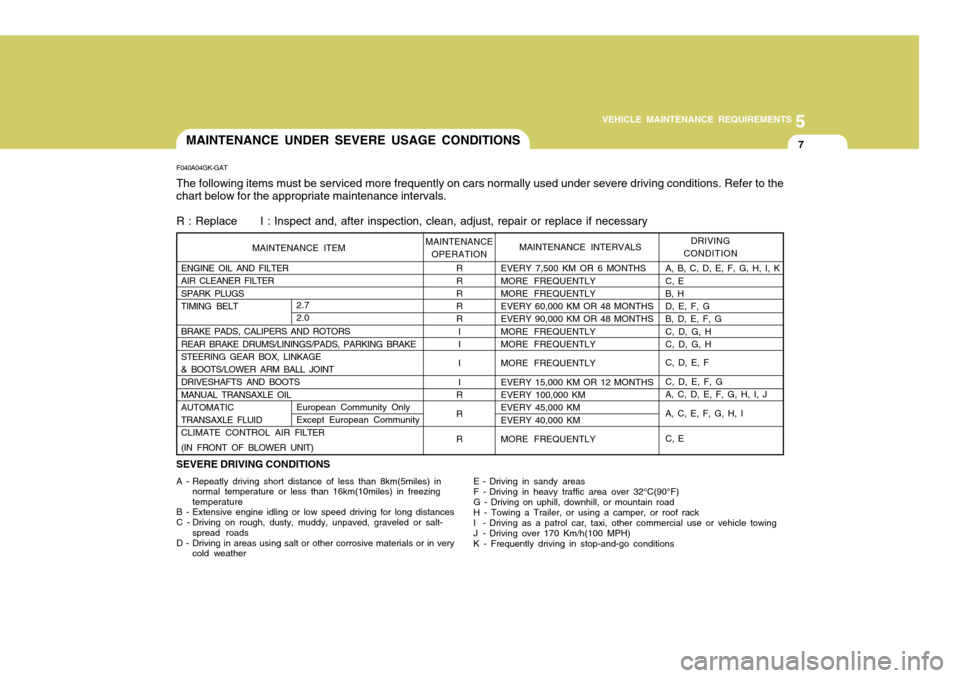
ENGINE OIL AND FILTER AIR CLEANER FILTER SPARK PLUGS TIMING BELT BRAKE PADS, CALIPERS AND ROTORS REAR BRAKE DRUMS/LININGS/PADS, PARKING BRAKE STEERING GEAR BOX, LINKAGE & BOOTS/LOWER ARM BALL JOINT DRIVESHAFTS AND BOOTS MANUAL TRANSAXLE OIL AUTOMATIC TRANSAXLE FLUID CLIMATE CONTROL AIR FILTER
(IN FRONT OF BLOWER UNIT) European Community OnlyExcept European Community
F040A04GK-GAT The following items must be serviced more frequently on cars normally used under severe driving conditions. Refer to the chart below for the appropriate maintenance intervals. R : Replace I : Inspect and, after inspection, clean, adjust, repair or replace if necessary
SEVERE DRIVING CONDITIONS A - Repeatly driving short distance of less than 8km(5miles) in normal temperature or less than 16km(10miles) in freezing temperature
B - Extensive engine idling or low speed driving for long distances
C - Driving on rough, dusty, muddy, unpaved, graveled or salt- spread roads
D - Driving in areas using salt or other corrosive materials or in very cold weather
MAINTENANCE UNDER SEVERE USAGE CONDITIONS
MAINTENANCE INTERVALS
A, B, C, D, E, F, G, H, I, K C, E B, H D, E, F, G B, D, E, F, G C, D, G, H C, D, G, H C, D, E, F C, D, E, F, G A, C, D, E, F, G, H, I, J A, C, E, F, G, H, I C, E
MAINTENANCE ITEM
DRIVING
CONDITION
EVERY 7,500 KM OR 6 MONTHS MORE FREQUENTLY MORE FREQUENTLY EVERY 60,000 KM OR 48 MONTHS EVERY 90,000 KM OR 48 MONTHS MORE FREQUENTLY MORE FREQUENTLY MORE FREQUENTLYEVERY 15,000 KM OR 12 MONTHS EVERY 100,000 KM EVERY 45,000 KM EVERY 40,000 KM MORE FREQUENTLYR R R R R II II
RR R
MAINTENANCE
OPERATION
E - Driving in sandy areas
F - Driving in heavy traffic area over 32°C(90°F)G - Driving on uphill, downhill, or mountain road H - Towing a Trailer, or using a camper, or roof rack
I - Driving as a patrol car, taxi, other commercial use or vehicle towing
J - Driving over 170 Km/h(100 MPH)K - Frequently driving in stop-and-go conditions
2.7 2.0
Page 221 of 483
6 DO-IT-YOURSELF MAINTENANCE
22
!
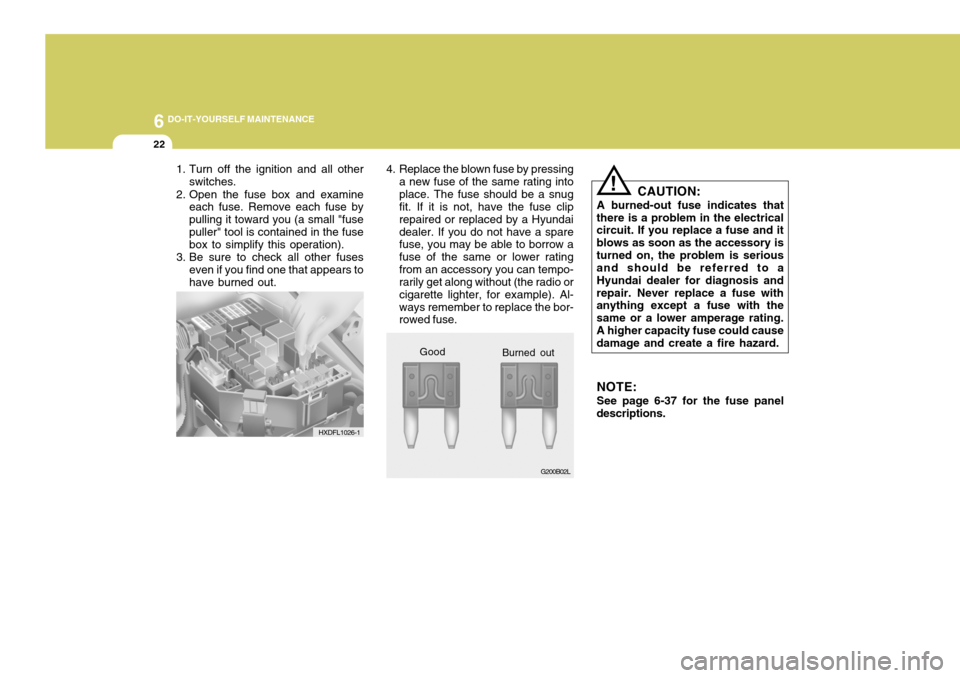
1. Turn off the ignition and all other
switches.
2. Open the fuse box and examine each fuse. Remove each fuse by pulling it toward you (a small "fusepuller" tool is contained in the fuse box to simplify this operation).
3. Be sure to check all other fuses even if you find one that appears to have burned out. 4. Replace the blown fuse by pressing
a new fuse of the same rating intoplace. The fuse should be a snug fit. If it is not, have the fuse clip repaired or replaced by a Hyundaidealer. If you do not have a spare fuse, you may be able to borrow a fuse of the same or lower ratingfrom an accessory you can tempo- rarily get along without (the radio or cigarette lighter, for example). Al-ways remember to replace the bor- rowed fuse. CAUTION:
A burned-out fuse indicates that
there is a problem in the electricalcircuit. If you replace a fuse and it blows as soon as the accessory isturned on, the problem is serious and should be referred to a Hyundai dealer for diagnosis andrepair. Never replace a fuse with anything except a fuse with the same or a lower amperage rating.A higher capacity fuse could cause damage and create a fire hazard.
NOTE: See page 6-37 for the fuse panel
descriptions.
Good
HXDFL1026-1
G200B02L
Burned out
Page 257 of 483

10
INDEX
5
T Tachometer ................................................................. 1-51
Tail Gate ..................................................................... 1-75
Theft Alarm System .................................................... 1-9
Tires
Balancing .................................................................. 8-5
Chains ...................................................................... 8-4
Changing a flat tire ................................................... 3-6
If you have a flat tire ................................................ 3-6
Information ................................................................ 8-3
Pressure ................................................................... 8-3
Replacement ............................................................. 8-6
Rotation .................................................................... 8-5
Snow tires ................................................................ 8-4
Spare tire .................................................................. 3-5
Traction ..................................................................... 8-5
Towing Emergency .............................................................. 3-14
If your car must be towed ....................................... 3-12
Trailer or vehicle towing ........................................... 2-21
Transaxle Automatic ................................................................. 2-8
Automatic transaxle fluid checking .......................... 6-15
Manual ...................................................................... 2-5
Trip Computer ............................................................. 1-53
Trip Odometer ............................................................. 1-52VVehicle Identification Number
(VIN) ............................. 8-2
Vehicle Specifi cation ................................................... 9-2
Ventilation
Center ventilator ...................................................... 1-83
Side ventilator .......................................................... 1-83
WWasher reservoir ......................................................... 6-14
Warning Lights ............................................................ 1-44
Windows Glass ........................................................... 1-12
Windshield Wiper and Washer ....................................1-58
Windshield Wiper Blades ............................................ 6-12
Page 271 of 483
1CONTROLS AND EQUIPMENT
4
!
IMMOBILISER SYSTEM
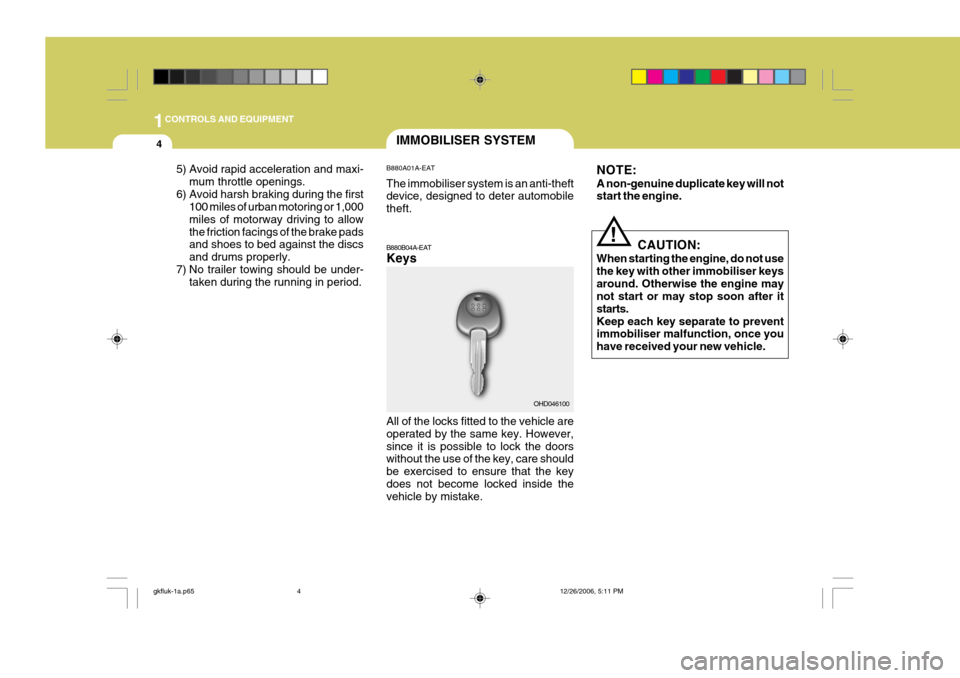
B880B04A-EAT Keys All of the locks fitted to the vehicle are operated by the same key. However,since it is possible to lock the doors without the use of the key, care should be exercised to ensure that the keydoes not become locked inside the vehicle by mistake. OHD046100
5) Avoid rapid acceleration and maxi-
mum throttle openings.
6) Avoid harsh braking during the first 100 miles of urban motoring or 1,000 miles of motorway driving to allowthe friction facings of the brake pads and shoes to bed against the discs and drums properly.
7) No trailer towing should be under- taken during the running in period. B880A01A-EAT The immobiliser system is an anti-theft device, designed to deter automobile theft.
NOTE: A non-genuine duplicate key will not start the engine.
CAUTION:
When starting the engine, do not use the key with other immobiliser keysaround. Otherwise the engine may not start or may stop soon after it starts.Keep each key separate to prevent immobiliser malfunction, once you have received your new vehicle.
gkfluk-1a.p65 12/26/2006, 5:11 PM
4
Page 273 of 483
1CONTROLS AND EQUIPMENT
6
!
DOOR LOCKS
B040A01GK-EAT
WARNING:
o Unlocked doors can be danger- ous. Before you drive away (es- pecially if there are children in the car), be sure that all the doorsare securely closed and locked so that the doors cannot be inad- vertently opened from the inside.This helps ensure that doors will not be opened accidentally. Also, when combined with the properuse of seat belts, locking the doors helps keep occupants from being ejected from the car in caseof an accident.
o Before opening the door, always
look for and avoid oncoming traf-fic.
o A locked-up vehicle can become
extremely hot, causing death orsevere injury to unattended chil- dren, handicapped persons or animals who cannot escape thevehicle. Never leave children, handicapped persons or animals unattended in your vehicle.
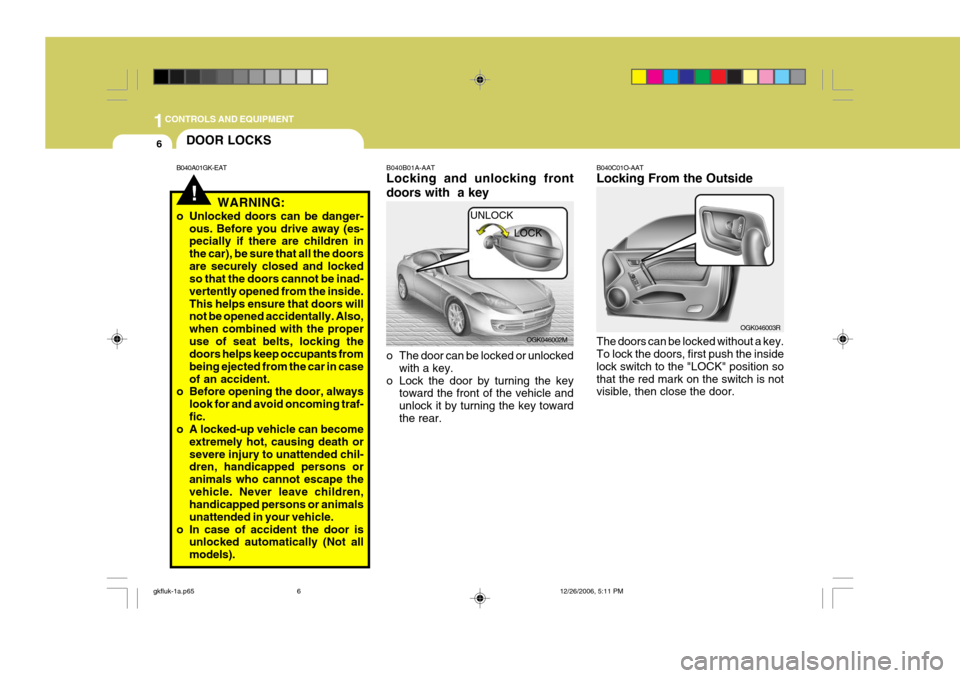
o In case of accident the door is unlocked automatically (Not allmodels). B040B01A-AAT Locking and unlocking front doors with a key
o The door can be locked or unlocked
with a key.
o Lock the door by turning the key toward the front of the vehicle and unlock it by turning the key towardthe rear. OGK046002M
UNLOCK
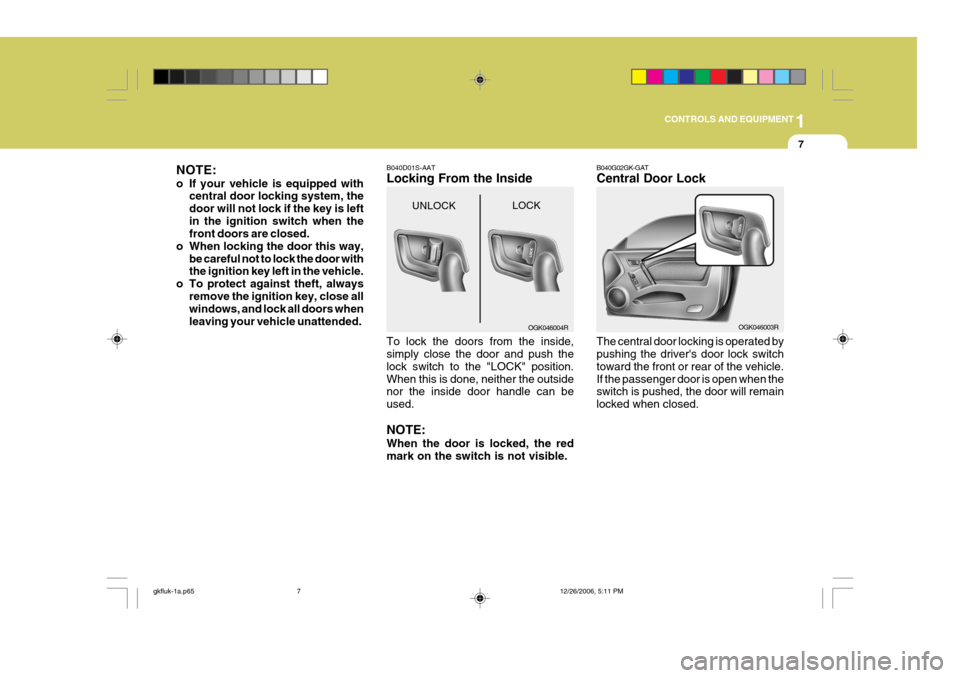
LOCK B040C01O-AAT Locking From the Outside The doors can be locked without a key. To lock the doors, first push the inside lock switch to the "LOCK" position sothat the red mark on the switch is not visible, then close the door.
OGK046003R
gkfluk-1a.p65
12/26/2006, 5:11 PM
6
Page 274 of 483
1
CONTROLS AND EQUIPMENT
7
B040G02GK-GAT Central Door Lock The central door locking is operated by pushing the driver's door lock switch toward the front or rear of the vehicle.If the passenger door is open when the switch is pushed, the door will remain locked when closed. OGK046003R
B040D01S-AAT Locking From the Inside To lock the doors from the inside, simply close the door and push the lock switch to the "LOCK" position.When this is done, neither the outside nor the inside door handle can be used. NOTE: When the door is locked, the red mark on the switch is not visible. LOCK
OGK046004R
UNLOCK
NOTE:
o If your vehicle is equipped with
central door locking system, the door will not lock if the key is leftin the ignition switch when the front doors are closed.
o When locking the door this way, be careful not to lock the door withthe ignition key left in the vehicle.
o To protect against theft, always remove the ignition key, close allwindows, and lock all doors when leaving your vehicle unattended.
gkfluk-1a.p65 12/26/2006, 5:11 PM
7
Page 275 of 483
1CONTROLS AND EQUIPMENT
8
!
B070B02GK-EAT Armed Stage Park the car and stop the engine. Arm the system as described below.
1) Remove the ignition key from the
ignition switch.
2) Make sure that the engine bonnet,
doors and hatchback door are closed.
3) Lock the doors using the transmitter
of the keyless entry system.
After completion of the steps above, the turn signal lamp will blink once toindicate that the system is armed. CAUTION:
Do not arm the system until all passengers have left the car. If the system is armed while apassenger(s) remains in the car, the alarm may be activated when the remaining passenger(s) leavesthe car. NOTE:
1) If any door, hatchback door or
engine bonnet remains open, the system will not be armed.
2) If this happens, rearm the system as described above.
3) Once the system is armed, only the hatchback door may be un- locked using the key without dis- arming the system.
ANTI-THEFT ALARM SYS- TEM
B070A01A-EAT (Not all models) This system is designed to provide protection from unauthorised entry intothe car. This system is operated in three stages: the first is the "Armed" stage, the second is the "Alarm" stage,and the third is the "Disarmed" stage. If triggered, the system provides an audible alarm with blinking of the turnsignal light.
NOTE:
o When pushing the switch toward
the rear, all doors will unlock. When pushing the switch towardthe front, all doors will lock.
o When the door is unlocked, the
red mark on the switch is visible.
o The central door locking is oper- ated by turning the key (driver'sdoor only) toward the front orrear of the vehicle.
o If the door is locked/unlocked mul-
tiple times in rapid successionwith either the vehicle key or door lock switch, the system may stop operating temporarily in order toprotect the circuit and prevent damage to system components.
gkfluk-1a.p65 12/26/2006, 5:11 PM
8
Page 289 of 483
1CONTROLS AND EQUIPMENT
22
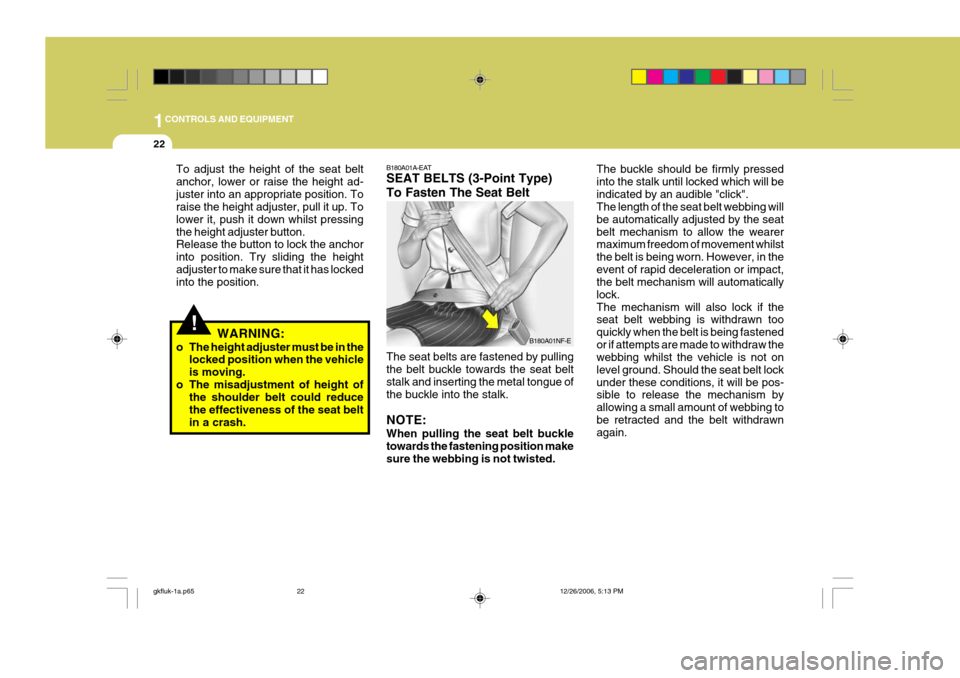
B180A01A-EAT SEAT BELTS (3-Point Type) To Fasten The Seat Belt The seat belts are fastened by pulling the belt buckle towards the seat belt stalk and inserting the metal tongue ofthe buckle into the stalk. NOTE: When pulling the seat belt buckle towards the fastening position make sure the webbing is not twisted. B180A01NF-E
!
To adjust the height of the seat belt anchor, lower or raise the height ad-juster into an appropriate position. To raise the height adjuster, pull it up. To lower it, push it down whilst pressingthe height adjuster button. Release the button to lock the anchor into position. Try sliding the heightadjuster to make sure that it has locked into the position.
WARNING:
o The height adjuster must be in the locked position when the vehicle is moving.
o The misadjustment of height of the shoulder belt could reducethe effectiveness of the seat beltin a crash. The buckle should be firmly pressedinto the stalk until locked which will beindicated by an audible "click". The length of the seat belt webbing will be automatically adjusted by the seatbelt mechanism to allow the wearer maximum freedom of movement whilst the belt is being worn. However, in theevent of rapid deceleration or impact, the belt mechanism will automatically lock.The mechanism will also lock if the seat belt webbing is withdrawn too quickly when the belt is being fastenedor if attempts are made to withdraw the webbing whilst the vehicle is not on level ground. Should the seat belt lockunder these conditions, it will be pos- sible to release the mechanism by allowing a small amount of webbing tobe retracted and the belt withdrawn again.
gkfluk-1a.p65
12/26/2006, 5:13 PM
22
Page 292 of 483
1
CONTROLS AND EQUIPMENT
25
!
If you need to tighten the belt, pull more webbing toward the retractor.When you unbuckle the seat belt and allow it to retract, the retractor will automatically revert back to its normalseated passenger emergency locking usage condition. NOTE:
o Before installing the child re-
straint system, read the instruc- tions supplied by the child re- straint system manufacturer.
o If the seat belt does not operate
as described, have the systemchecked immediately by your Hyundai authorised repairer.
WARNING:
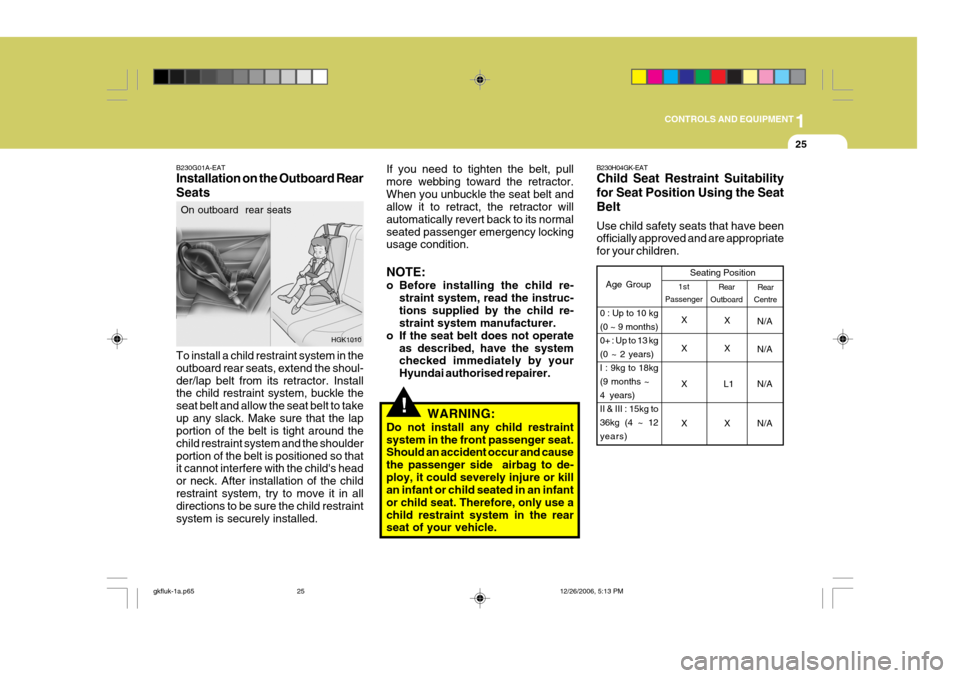
Do not install any child restraintsystem in the front passenger seat. Should an accident occur and cause the passenger side airbag to de-ploy, it could severely injure or kill an infant or child seated in an infant or child seat. Therefore, only use achild restraint system in the rear seat of your vehicle.B230G01A-EAT Installation on the Outboard Rear Seats To install a child restraint system in the outboard rear seats, extend the shoul-der/lap belt from its retractor. Install the child restraint system, buckle the seat belt and allow the seat belt to takeup any slack. Make sure that the lap portion of the belt is tight around the child restraint system and the shoulderportion of the belt is positioned so that it cannot interfere with the child's head or neck. After installation of the childrestraint system, try to move it in all directions to be sure the child restraint system is securely installed. On outboard rear seats
HGK1010 B230H04GK-EAT Child Seat Restraint Suitability for Seat Position Using the SeatBelt Use child safety seats that have been officially approved and are appropriate for your children.
Rear
Centre
Age Group Seating Position
X
N/A
XX N/A
X L1 N/A
X X N/A Rear
Outboard
1st
Passenger
0 : Up to 10 kg (0 ~ 9 months)0+ : Up to 13 kg(0 ~ 2 years)I : 9kg to 18kg(9 months ~4 years)II & III : 15kg to36kg (4 ~ 12years) X
gkfluk-1a.p65
12/26/2006, 5:13 PM
25
Page 306 of 483
1
CONTROLS AND EQUIPMENT
39
o Do not tamper with or disconnect
SRS wiring, or other components of the SRS system. Doing so couldresult in injury, due to accidental firing of the airbags or by render- ing the SRS inoperative.
o If components of the airbag sys- tem must be discarded, or if thevehicle must be scrapped, certainsafety precautions must be ob- served. Your Hyundai authorised repairer knows these precautionsand can give you the necessary information. Failure to follow these precautions and procedures couldincrease the risk of personal in- jury.
o If you sell your vehicle, make cer- tain that this manual is transferredto the new owner.
o If your car was flooded and has soaked carpeting or water on floor-ing, you shouldn't try to start en- gine; have the car towed to Hyundaiauthorised repairer.
gkfluk-1a.p65 12/26/2006, 5:13 PM
39