warning Hyundai Coupe 2006 Repair Manual
[x] Cancel search | Manufacturer: HYUNDAI, Model Year: 2006, Model line: Coupe, Model: Hyundai Coupe 2006Pages: 483, PDF Size: 12.73 MB
Page 164 of 483
2
DRIVING YOUR HYUNDAI
23
3. The front or rear axle weight must
not exceed the Gross Axle Weight Rating (GAWR) shown on the ve- hicle identification plate (see page 8-2). It is possible that your towingpackage does not exceed the GVWR but exceeds the GAWR. Improper trailer loading and/or toomuch luggage in the trunk can overload the rear axle. Redistrib- ute the load and check the axleweight again.
4. The maximum permissible static
vertical load on the coupling de-vice:
1.6 L
2.0/2.7 L 50kg 60kg
!
CAUTION:
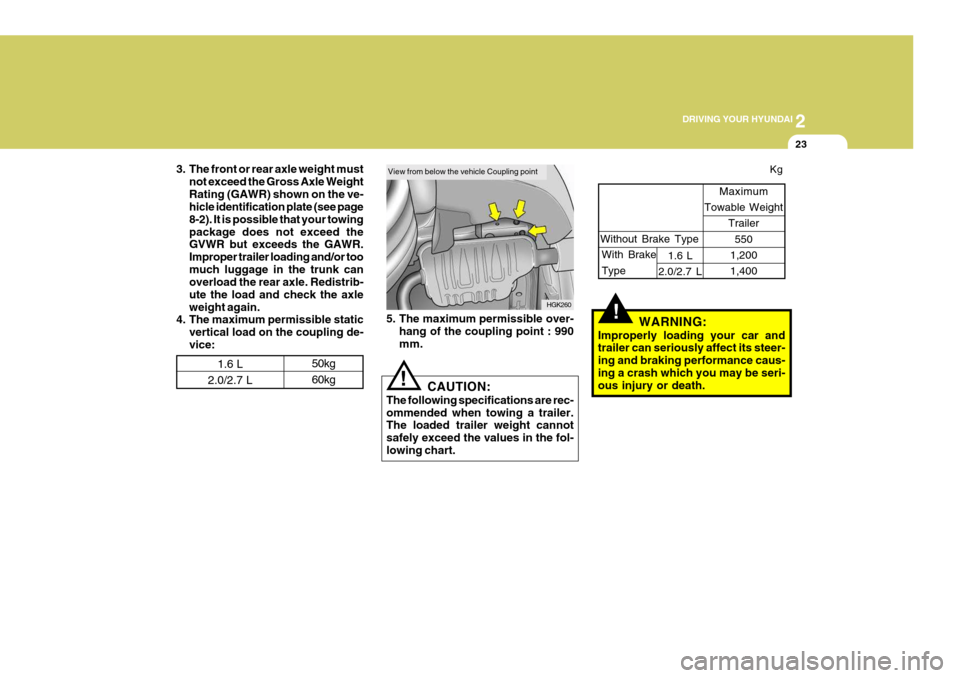
The following specifications are rec- ommended when towing a trailer. The loaded trailer weight cannot safely exceed the values in the fol-lowing chart.
HGK260
View from below the vehicle Coupling point
!WARNING:
Improperly loading your car and trailer can seriously affect its steer- ing and braking performance caus-ing a crash which you may be seri- ous injury or death. Without Brake Type
Maximum
Towable Weight Trailer
550
1,200 1,400
With Brake Type1.6 L
2.0/2.7 L Kg
5. The maximum permissible over- hang of the coupling point : 990 mm.
Page 168 of 483
3 WHAT TO DO IN AN EMERGENCY
2IF THE ENGINE WILL NOT START
!
D010A01A-AAT
WARNING:
If the engine will not start, do not push or pull the car to start it. This could result in a collision or cause other damage. In addition, push orpull starting may cause the cata- lytic converter to be overloaded and create a fire hazard. D010B02A-AAT If Engine Doesn't Turn Over or Turns Over Slowly
D010C01A-AAT If Engine Turns Over Normally but Does Not Start
1. Check fuel level.
2. With the key in the off position,
Check all connectors at ignition coils and spark plugs. Reconnect any that may be disconnected or loose.
3. Check the fuel line in the engine room.
4. If engine still refuses to start, call a Hyundai dealer or seek other quali- fied assistance.
D010D01A-AAT If Engine Stalls While Driving
1. Reduce your speed gradually, keep- ing a straight line. Move cautiously off the road to a safe place.
2. Turn on your emergency flashers.
3. Try to start the engine again. If your vehicle will not start, contact aHyundai dealer or seek other quali-fied assistance.
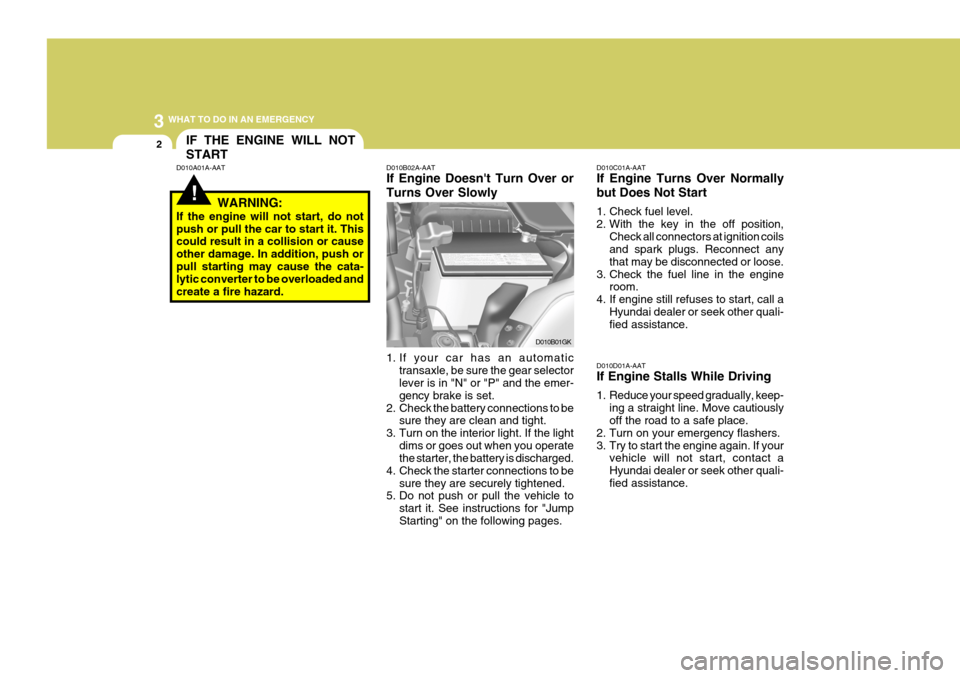
1. If your car has an automatic
transaxle, be sure the gear selector lever is in "N" or "P" and the emer- gency brake is set.
2. Check the battery connections to be sure they are clean and tight.
3. Turn on the interior light. If the light dims or goes out when you operate the starter, the battery is discharged.
4. Check the starter connections to be sure they are securely tightened.
5. Do not push or pull the vehicle to
start it. See instructions for "Jump Starting" on the following pages. D010B01GK
Page 169 of 483
3
WHAT TO DO IN AN EMERGENCY
3
!
D020A02A-AAT
WARNING:
The gas produced by the battery during the jump-start operation is highly explosive. If these instruc- tions are not followed exactly, seri-ous personal injury and damage to the vehicle may occur! If you are not sure how to follow this proce-dure, seek qualified assistance. Automobile batteries contain sul- furic acid. This is poisonous andhighly corrosive. When jump start- ing, wear protective glasses and be careful not to get acid on yourself, your clothing or on the car. o The gas produced by the battery
during the jump-start operation is highly explosive. Do not smoke or allow a spark or open flame in the vicinity.
o The battery being used to provide the jump start must be 12-volt. If youcannot determine that it is a 12-voltbattery, do not attempt to use it for the jump start.
o To jump start a car with a discharged battery, follow this procedure ex-actly:
1. If the booster battery is installed in another vehicle, be sure the two vehicles are not touching.
2. Turn off all unnecessary lights and accessories in both vehicles.
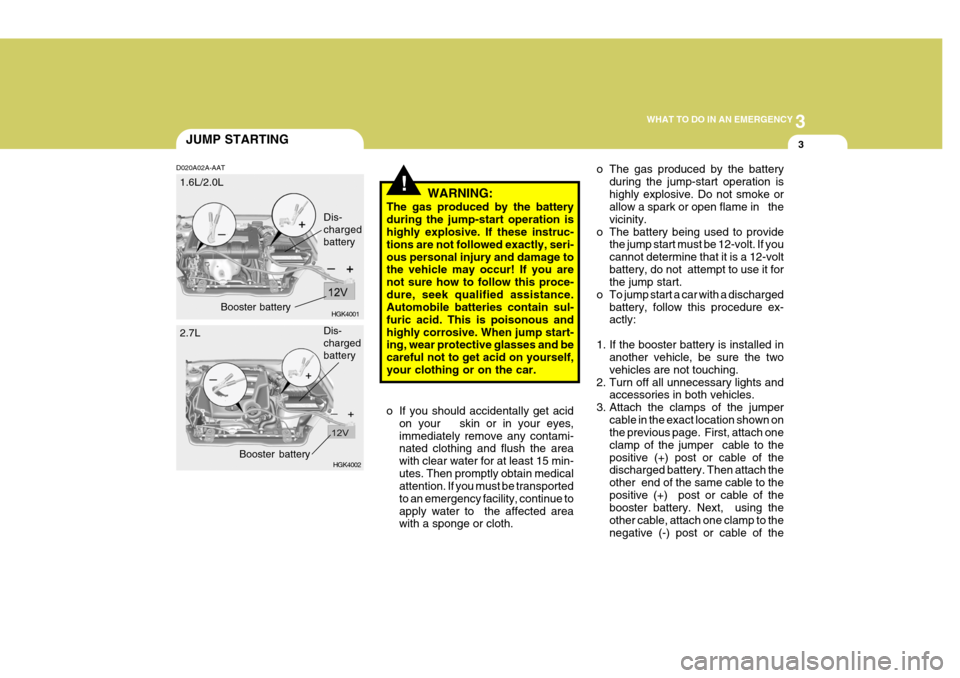
3. Attach the clamps of the jumper cable in the exact location shown on the previous page. First, attach one clamp of the jumper cable to thepositive (+) post or cable of the discharged battery. Then attach the other end of the same cable to thepositive (+) post or cable of the booster battery. Next, using the other cable, attach one clamp to thenegative (-) post or cable of the
JUMP STARTING
o If you should accidentally get acidon your skin or in your eyes,immediately remove any contami- nated clothing and flush the area with clear water for at least 15 min-utes. Then promptly obtain medical attention. If you must be transported to an emergency facility, continue toapply water to the affected area with a sponge or cloth.
1.6L/2.0L
HGK4001
HGK4002
Dis- chargedbattery
2.7L Booster battery
Dis- chargedbattery
Booster battery
Page 170 of 483
3 WHAT TO DO IN AN EMERGENCY
4
!
booster battery. Then attach the other end of that cable to a solidmetal part of the engine away from the battery. Do not connect the cable to any moving part.
4. Start the engine in the car with the booster battery and let it run for afew minutes. This will help to as-sure that the booster battery is fully charged. During the jumping opera- tion, run the engine in this vehicle atabout 2000 rpm.
5. Start the engine in the car with the
discharged battery using the nor-mal starting procedure. After the engine starts, leave the jumper cables connected and let the enginerun at fast idle or about 2000 rpm for several minutes.
6. carefully remove the jumper cables in the reverse order of attachment.
If you do not know why your battery became discharged (because the lights were left on, etc.), have the charging system checked by your Hyundaidealer. D030A02A-AAT If your temperature gauge indicates overheating, you experience a loss of power, or hear loud pinging or knock- ing, the engine is probably too hot. Ifthis happens to you, you should:
1. Pull off the road and stop as soon as
it is safe to do so.
2. Place the gear selector lever in "P"
(automatic), or neutral (manual transaxle) and set the parking brake. If the air conditioning is on, turn it off.
3. If engine coolant is running out un- der the car or steam is coming outfrom the hood, stop the engine. Donot open the hood until the engine coolant has stopped running or the steaming has stopped. If there is novisible loss of engine coolant and no steam, leave the engine running and check to be sure the enginecooling fan is operating. If the fan is not running, turn the engine off.
IF THE ENGINE OVERHEATS
4. Check to see if the water pump drivebelt is missing. If it is not missing, check to see that it is tight. If the drive belt seems to be satisfactory, check for engine coolant leakingfrom the radiator, hoses or under the car. (If the air conditioning had been in use, it is normal for coldwater to be draining from it when you stop).
WARNING:
While the engine is running, keephair, hands, and clothing away from moving parts such as the fan anddrive belts to prevent injury.
5. If the water pump drive belt is bro- ken or engine coolant is leaking out, stop the engine immediately andcall the nearest Hyundai dealer for assistance.
Page 171 of 483
3
WHAT TO DO IN AN EMERGENCY
5
!
!
!WARNING:
Do not remove the radiator cap when the engine is hot. This can allow coolant to be blown out of the open- ing and cause serious burns.
6. If you cannot find the cause of the overheating, wait until the engine temperature has returned to nor- mal. Then, if the engine coolant has been lost, carefully add coolant tothe reservoir (page 6-10) to bring the fluid level in the reservoir up to the halfway mark.
7. Proceed with caution, keeping alert for further signs of overheating. Ifoverheating happens again, call aHyundai dealer for assistance.
CAUTION:
Serious loss of engine coolant indi-cates there is a leak in the cooling system and this should be checked as soon as possible by a Hyundaidealer. D040A01GK-GAT The following instructions for the tem- porary spare tire should be observed:
1. Check inflation pressure as soon as
practical after installing the spare tire, and adjust to the specified pres- sure. The tire pressure should beperiodically checked and maintained at the specified pressure while the tire is stored.
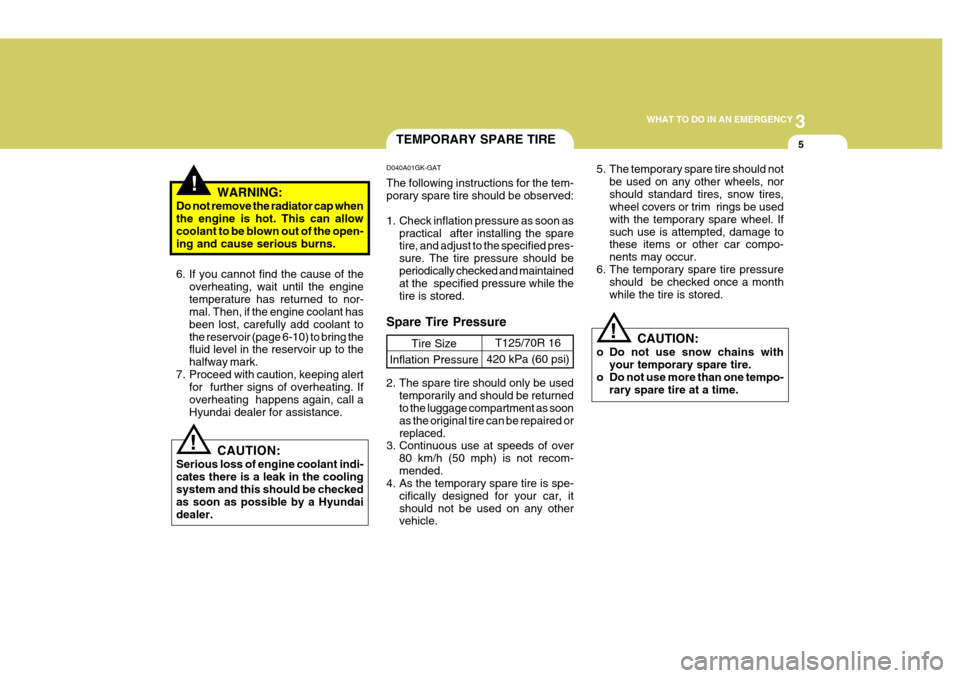
Spare Tire Pressure TEMPORARY SPARE TIRE
5. The temporary spare tire should notbe used on any other wheels, norshould standard tires, snow tires, wheel covers or trim rings be used with the temporary spare wheel. Ifsuch use is attempted, damage to these items or other car compo- nents may occur.
6. The temporary spare tire pressure should be checked once a monthwhile the tire is stored.
Tire Size
Inflation Pressure T125/70R 16
420 kPa (60 psi)
2. The spare tire should only be used temporarily and should be returned to the luggage compartment as soon as the original tire can be repaired orreplaced.
3. Continuous use at speeds of over
80 km/h (50 mph) is not recom-mended.
4. As the temporary spare tire is spe-
cifically designed for your car, itshould not be used on any other vehicle. CAUTION:
o Do not use snow chains with your temporary spare tire.
o Do not use more than one tempo-
rary spare tire at a time.
Page 175 of 483
3
WHAT TO DO IN AN EMERGENCY
9
OGK036403
!WARNING:
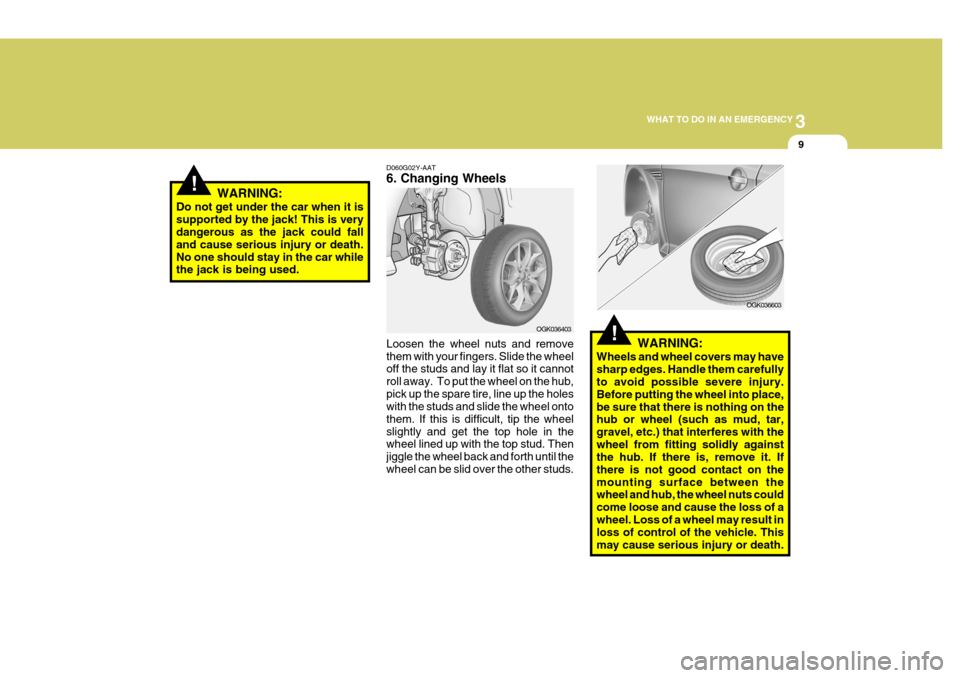
Do not get under the car when it is supported by the jack! This is very dangerous as the jack could fall and cause serious injury or death.No one should stay in the car while the jack is being used. D060G02Y-AAT 6. Changing Wheels Loosen the wheel nuts and remove them with your fingers. Slide the wheel off the studs and lay it flat so it cannot roll away. To put the wheel on the hub,pick up the spare tire, line up the holes with the studs and slide the wheel onto them. If this is difficult, tip the wheelslightly and get the top hole in the wheel lined up with the top stud. Then jiggle the wheel back and forth until thewheel can be slid over the other studs.
!WARNING:
Wheels and wheel covers may have sharp edges. Handle them carefully to avoid possible severe injury. Before putting the wheel into place,be sure that there is nothing on the hub or wheel (such as mud, tar, gravel, etc.) that interferes with thewheel from fitting solidly against the hub. If there is, remove it. If there is not good contact on themounting surface between the wheel and hub, the wheel nuts could come loose and cause the loss of awheel. Loss of a wheel may result in loss of control of the vehicle. This may cause serious injury or death. OGK036603
Page 205 of 483
6 DO-IT-YOURSELF MAINTENANCE
6CHECKING THE ENGINE OIL
G030A02O-GAT
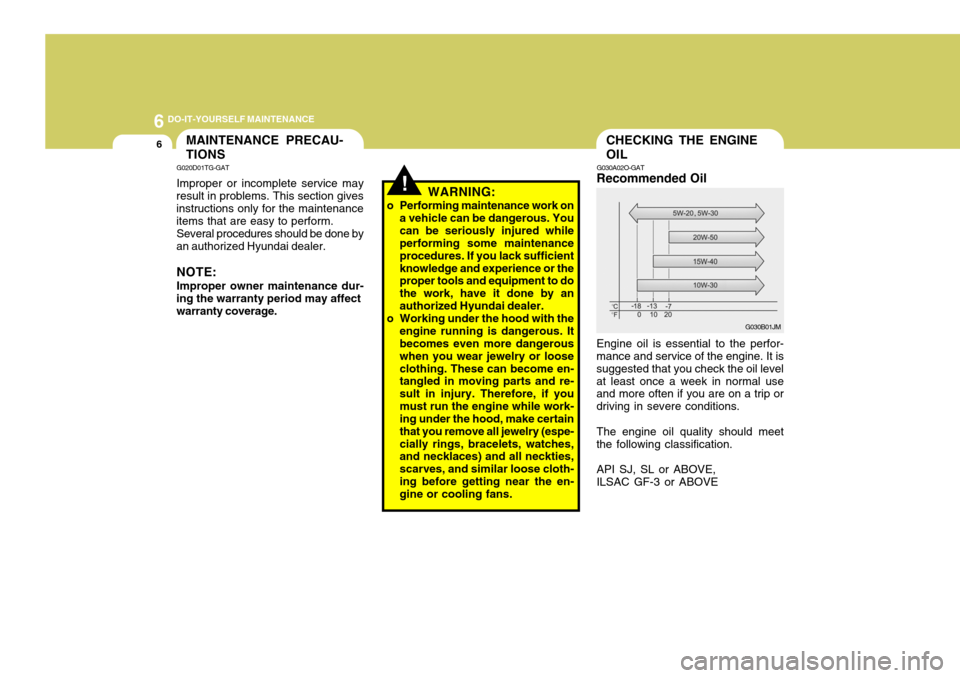
Recommended Oil Engine oil is essential to the perfor-
mance and service of the engine. It is suggested that you check the oil levelat least once a week in normal use and more often if you are on a trip or driving in severe conditions.
The engine oil quality should meet
the following classification.
API SJ, SL or ABOVE,ILSAC GF-3 or ABOVE G030B01JMMAINTENANCE PRECAU- TIONS
!
G020D01TG-GAT Improper or incomplete service may
result in problems. This section gives instructions only for the maintenanceitems that are easy to perform.
Several procedures should be done by
an authorized Hyundai dealer.
NOTE: Improper owner maintenance dur-
ing the warranty period may affect warranty coverage. WARNING:
o Performing maintenance work on a vehicle can be dangerous. You can be seriously injured while performing some maintenance procedures. If you lack sufficientknowledge and experience or the proper tools and equipment to do the work, have it done by anauthorized Hyundai dealer.
o Working under the hood with the engine running is dangerous. It becomes even more dangerous when you wear jewelry or looseclothing. These can become en- tangled in moving parts and re- sult in injury. Therefore, if youmust run the engine while work- ing under the hood, make certain that you remove all jewelry (espe-cially rings, bracelets, watches, and necklaces) and all neckties, scarves, and similar loose cloth-ing before getting near the en- gine or cooling fans.
Page 206 of 483
6
DO-IT-YOURSELF MAINTENANCE
7
G030C02A-AAT
To Check the Oil Level
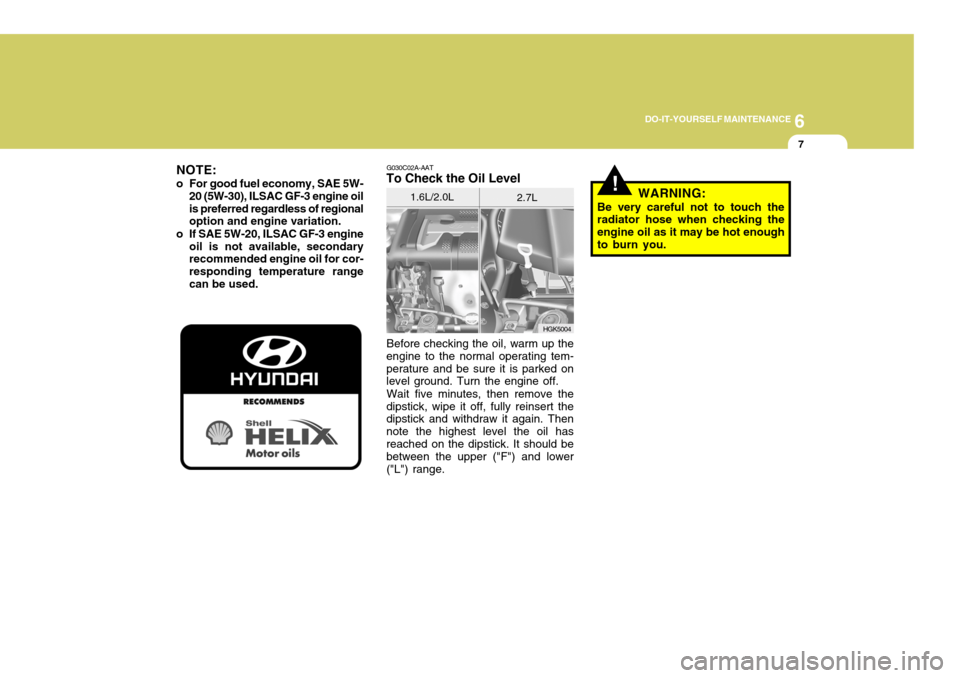
Before checking the oil, warm up the
engine to the normal operating tem- perature and be sure it is parked on level ground. Turn the engine off.
Wait five minutes, then remove the
dipstick, wipe it off, fully reinsert thedipstick and withdraw it again. Then note the highest level the oil hasreached on the dipstick. It should be between the upper ("F") and lower ("L") range. HGK5004
NOTE:
o For good fuel economy, SAE 5W- 20 (5W-30), ILSAC GF-3 engine oilis preferred regardless of regional option and engine variation.
o If SAE 5W-20, ILSAC GF-3 engine oil is not available, secondaryrecommended engine oil for cor- responding temperature rangecan be used. 1.6L/2.0L
2.7L
!WARNING:
Be very careful not to touch the radiator hose when checking the engine oil as it may be hot enoughto burn you.
Page 207 of 483
6 DO-IT-YOURSELF MAINTENANCE
8
!
HGK5005
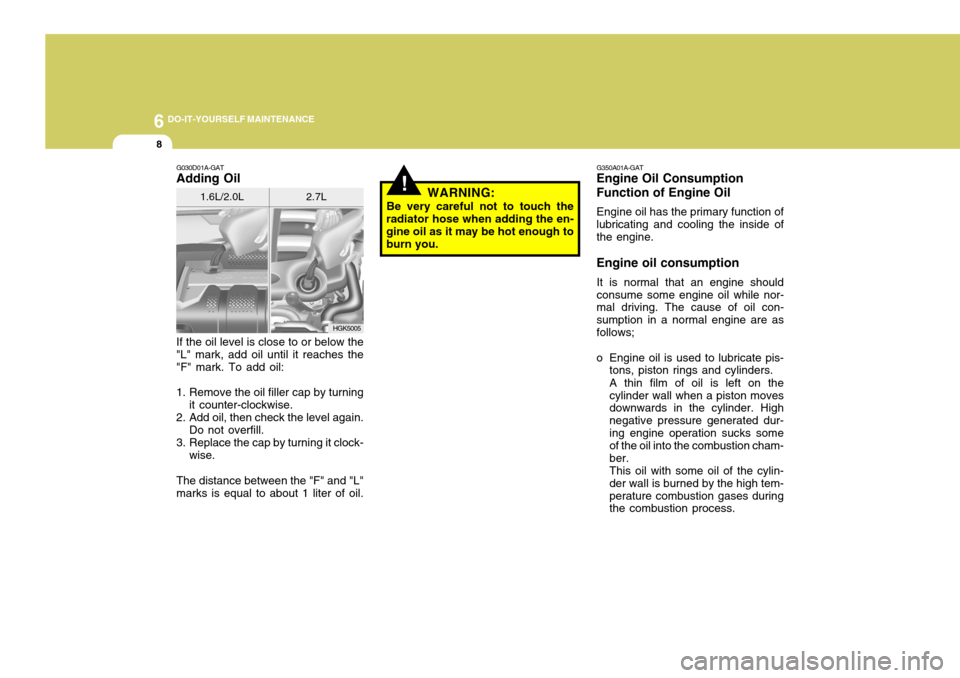
G030D01A-GAT Adding Oil
1.6L/2.0L G350A01A-GAT
Engine Oil Consumption Function of Engine Oil
Engine oil has the primary function of lubricating and cooling the inside of the engine.
Engine oil consumption It is normal that an engine should consume some engine oil while nor- mal driving. The cause of oil con- sumption in a normal engine are asfollows;
o Engine oil is used to lubricate pis- tons, piston rings and cylinders. A thin film of oil is left on the cylinder wall when a piston moves downwards in the cylinder. High negative pressure generated dur-ing engine operation sucks some of the oil into the combustion cham- ber.This oil with some oil of the cylin-der wall is burned by the high tem-perature combustion gases during the combustion process.
2.7L
If the oil level is close to or below the"L" mark, add oil until it reaches the "F" mark. To add oil:
1. Remove the oil filler cap by turning it counter-clockwise.
2. Add oil, then check the level again.
Do not overfill.
3. Replace the cap by turning it clock- wise.
The distance between the "F" and "L" marks is equal to about 1 liter of oil. WARNING:
Be very careful not to touch the
radiator hose when adding the en- gine oil as it may be hot enough to burn you.
Page 208 of 483
6
DO-IT-YOURSELF MAINTENANCE
9
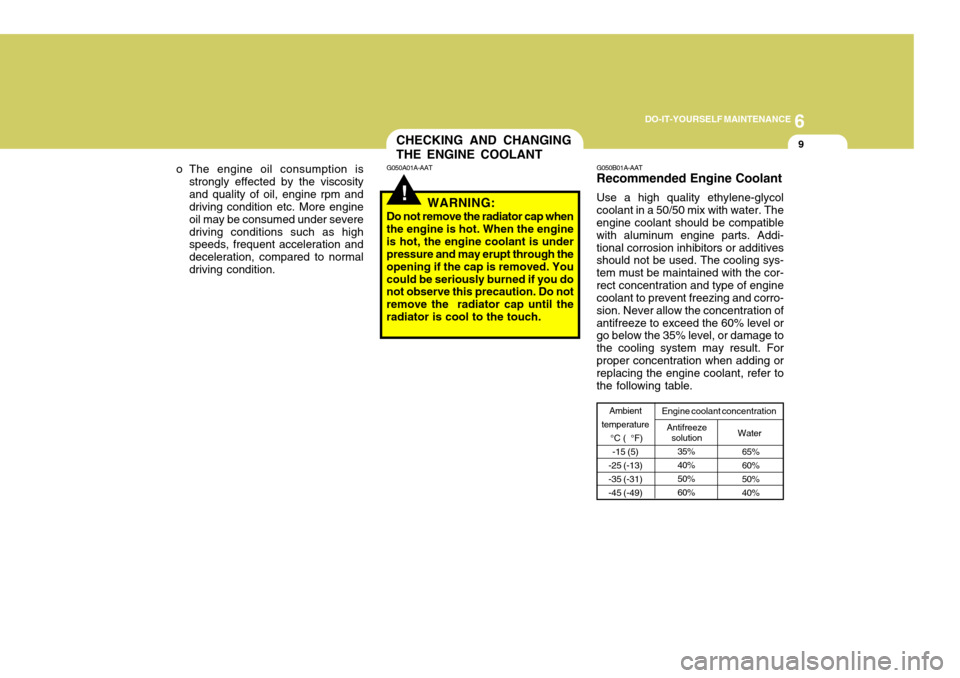
o The engine oil consumption is strongly effected by the viscosity and quality of oil, engine rpm and driving condition etc. More engine oil may be consumed under severedriving conditions such as high speeds, frequent acceleration and deceleration, compared to normaldriving condition. G050B01A-AAT Recommended Engine Coolant Use a high quality ethylene-glycol coolant in a 50/50 mix with water. The engine coolant should be compatible with aluminum engine parts. Addi-tional corrosion inhibitors or additives should not be used. The cooling sys- tem must be maintained with the cor-rect concentration and type of engine coolant to prevent freezing and corro- sion. Never allow the concentration ofantifreeze to exceed the 60% level or go below the 35% level, or damage to the cooling system may result. Forproper concentration when adding or replacing the engine coolant, refer to the following table.
Water
65% 60%50%40%
35%40%50%60%
Ambient
temperature °C ( °F)-15 (5)
-25 (-13) -35 (-31)-45 (-49) Engine coolant concentration
Antifreezesolution
!
CHECKING AND CHANGING THE ENGINE COOLANT
G050A01A-AAT
WARNING:
Do not remove the radiator cap when the engine is hot. When the engineis hot, the engine coolant is under pressure and may erupt through the opening if the cap is removed. Youcould be seriously burned if you do not observe this precaution. Do not remove the radiator cap until theradiator is cool to the touch.