radiator Hyundai Coupe 2007 Owner's Guide
[x] Cancel search | Manufacturer: HYUNDAI, Model Year: 2007, Model line: Coupe, Model: Hyundai Coupe 2007Pages: 487, PDF Size: 12.96 MB
Page 402 of 487
3 IN CASE OF EMERGENCY
4
7. Switch "ON" the main beam
headlamps before carefully remov- ing the jumper cables have been removed, switch "OFF" the main beam headlamps. SD040A2-E If the temperature gauge indicates overheating:
1. Pull off the road and stop as soon as
it is safe to do so.
2. Place the gear selector lever in "P"
(automatic), or neutral (manual transaxle) and set the parking brake. If the air conditioning is on, turn it off.
3. If coolant is running out under the car or steam is coming out fromunder the bonnet stop the engine. Do not open the bonnet until thecoolant has stopped running or the steaming has stopped. If there is no visible loss of coolant and no steam,leave the engine running and check to be sure the engine cooling fan is operating.If the fan is not running, turn the engine off.
4. Check to see if the water pump drive belt is broken. If it is not missing,check to see that it is tight. If the drive belt seems to be satisfactory,check for coolant leaking from the radiator, hoses or under the car. (If the air conditioning had been in use,it is normal for cold water to be draining from it).
IF THE ENGINE OVERHEATS
1. Ensure that the booster battery is 12 volt type. If the booster battery is installed in another vehicle, ensure that the two vehicles are not touch- ing.
2. Turn off all unnecessary electrical equipment in both vehicles.
3. Ensure that the engine of the ve- hicle providing the jump start is run- ning prior to connection of the jump cables.
4. Connect the red jump cable to the positive (+) terminal of the boosterbattery and the other end to thepositive (+) terminal of the dis- charged battery.
5. Attach the black jump cable to the negative (-) terminal of the boosterbattery, and the other end to a ground point within the engine compartmentof the vehicle with the flat battery. Do not connect to the negative battery terminal of the flat battery sincesparks may be generated with the subsequent risk of explosion.
6. Raise the booster vehicle engine speed to 2,000 r.p.m. and start theengine of the vehicle with the flat battery. CAUTION:
If the jump cables are incorrectlyinstalled, damage to the vehicle elec-trical system may occur, in particu- lar the electronic components such as the Fuel Injection system com- puter and the Automatic Transaxle computer. The battery must neverbe disconnected whilst the engine is running.
!
Page 403 of 487
3
IN CASE OF EMERGENCY
5
!
!WARNING:
Whilst the engine is running, keep hands and clothing away from mov- ing parts such as the fan and drive belts to prevent injury.
5. If the water pump drive belt is broken or coolant is leaking out, stop the engine immediately and call the near- est Hyundai authorised repairer forassistance.
WARNING:
Do not remove the radiator cap when the engine is hot since steam and boiling water may be ejected fromthe radiator resulting in burns or scalding.
!
6. If the cause of the overheating can- not be found, wait until the engine temperature has returned to normal. Then, if coolant has been lost, care- fully add coolant to the reservoir(page 6-10) to bring the fluid level in the reservoir up to the base of the radiator fill opening. Fill the coolantexpansion tank to the halfway mark. To ensure the correct water to cool- ant mix is obtained after top up,testing by an authorised repairer is required.
7. Proceed with caution until it is estab- lished that the engine is operatingnormally. If the engine overheats repeatedly, the advice of a Hyundaiauthorised repairer should be sought.
CAUTION:
Serious loss of coolant indicates there is a leak in the cooling system and this should be checked as soonas possible by a Hyundai authorised repairer.D040A01GK-EAT The following instructions for the tem- porary spare tyre should be observed:
1. Check inflation pressure as soon as practical after installing the spare tyre, and adjust to the specified pressure. The tyre pressure shouldbe periodically checked and main- tained at the specified pressure whilst the tyre is stored.
TEMPORARY SPARE TYRE
Tyre Size
Inflation Pressure T125/70 R16
420 kPa (60 psi)
Spare Tyre Pressure
2. The spare tyre should only be used temporarily and should be returned to the luggage compartment as soonas the original tyre can be repaired or replaced.
3. Continuous use at speeds of over 50 mph (80 km/h) is not recom-mended.
4. As the temporary spare tyre is spe- cifically designed for your car, itshould not be used on any other vehicle.
Page 427 of 487

5
VEHICLE MAINTENANCE REQUIREMENTS
9
6ZF060F2-A
o Crankcase ventilation hoses
Inspect the surface of hoses for evi- dence of heat and/or mechanical dam- age. Hard and brittle rubber, cracking, tears, cuts, abrasions, and excessiveswelling indicate deterioration. Particu- lar attention should be paid to examin- ing those hose surfaces nearest tohigh heat sources, such as the ex- haust manifold. Inspect the hose routing to assure that the hoses do not come in contact with any heat source, sharp edges or mov-ing component which might cause heat damage or mechanical wear. Inspect all hose connections, such as clampsand couplings, to make sure they are secure, and that no leaks are present. Hoses should be replaced immedi-ately if there is any evidence of dete- rioration or damage. 6ZF060H1-A
o Air cleaner filter
A Genuine Hyundai air cleaner filter is
recommended when the filter is re-placed.
6ZF060J1-A
o Spark plugs
Make sure to install new spark plugs
of the correct heat range.
F060N02E-AAT
o Valve clearance
Inspect excessive valve noise and/or
engine vibration and adjust if neces- sary. A qualified technician should perform the operation. 6ZF070B1-A
o Cooling system Check the cooling system part, such as radiator, coolant reservoir, hoses and connections for leakage and dam- age. Replace any damaged parts. 6ZF070C1-A
o Coolant The coolant should be changed at the intervals specified in the mainte-nance schedule. 6ZF070D1-A
o Manual transaxle oil Inspect the manual transaxle oil ac- cording to the maintenance schedule. NOTE: If the oil level is low, check for possible leaks before adding oil. Do not overfill.
Page 431 of 487
6OWNER MAINTENANCE
2
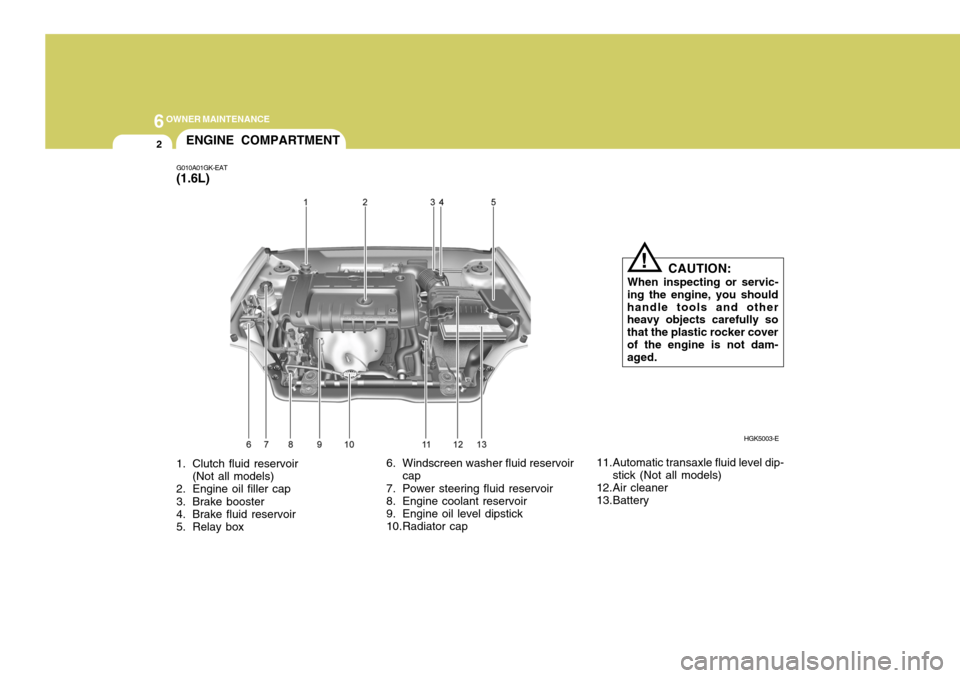
1. Clutch fluid reservoir
(Not all models)
2. Engine oil filler cap
3. Brake booster
4. Brake fluid reservoir
5. Relay box
G010A01GK-EAT (1.6L)
ENGINE COMPARTMENT
HGK5003-E
CAUTION:
When inspecting or servic-
ing the engine, you should handle tools and other heavy objects carefully so that the plastic rocker coverof the engine is not dam- aged.
!
6. Windscreen washer fluid reservoir cap
7. Power steering fluid reservoir
8. Engine coolant reservoir
9. Engine oil level dipstick
10.Radiator cap 11.Automatic transaxle fluid level dip-
stick (Not all models)
12.Air cleaner
13.Battery
Page 432 of 487
6
OWNER MAINTENANCE
3
G010B01GK-EAT
(2.0L)
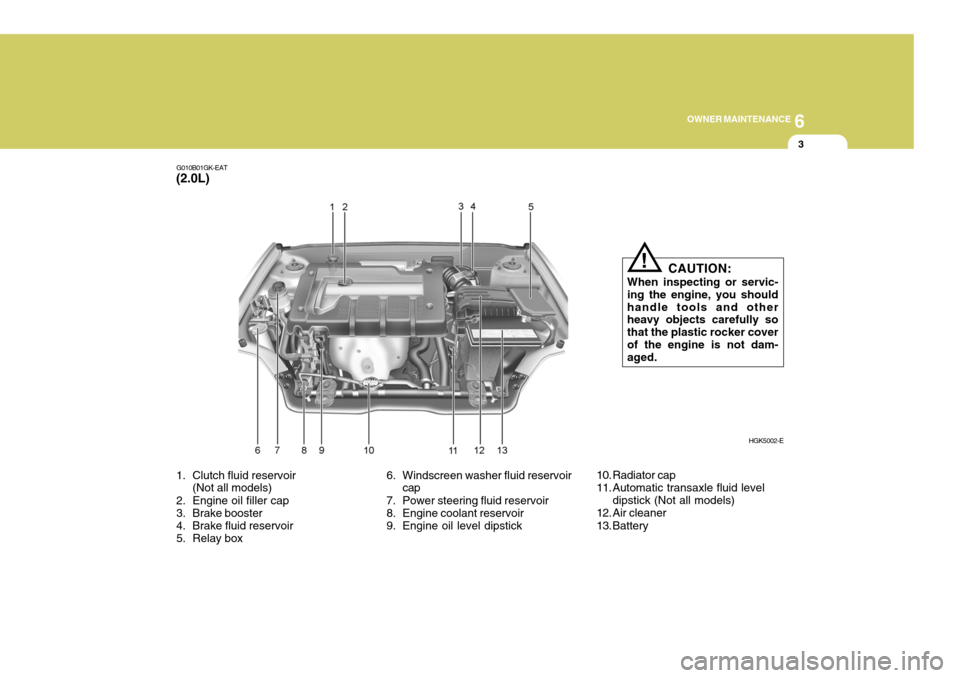
1. Clutch fluid reservoir (Not all models)
2. Engine oil filler cap
3. Brake booster
4. Brake fluid reservoir
5. Relay box 6. Windscreen washer fluid reservoir
cap
7. Power steering fluid reservoir
8. Engine coolant reservoir
9. Engine oil level dipstick 10. Radiator cap
11. Automatic transaxle fluid level
dipstick (Not all models)
12. Air cleaner
13. Battery CAUTION:
When inspecting or servic- ing the engine, you shouldhandle tools and other heavy objects carefully so that the plastic rocker coverof the engine is not dam- aged.
!
HGK5002-E
Page 433 of 487
6OWNER MAINTENANCE
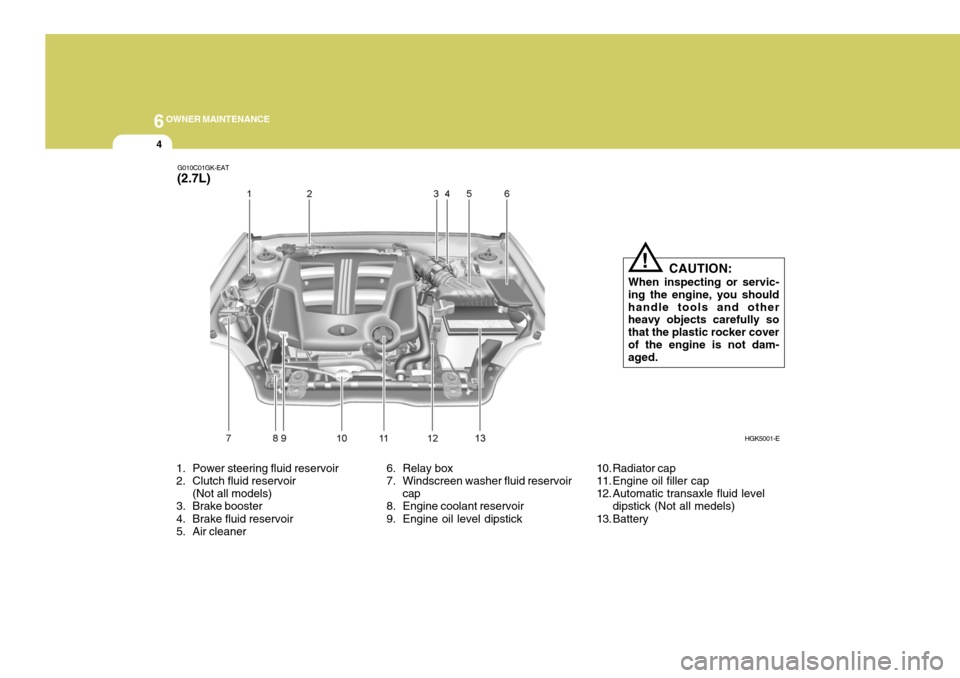
4
1. Power steering fluid reservoir
2. Clutch fluid reservoir(Not all models)
3. Brake booster
4. Brake fluid reservoir
5. Air cleaner 6. Relay box
7. Windscreen washer fluid reservoir
cap
8. Engine coolant reservoir
9. Engine oil level dipstick 10. Radiator cap
11. Engine oil filler cap
12. Automatic transaxle fluid level
dipstick (Not all medels)
13. Battery
G010C01GK-EAT
(2.7L)
HGK5001-E
CAUTION:
When inspecting or servic-ing the engine, you shouldhandle tools and other heavy objects carefully so that the plastic rocker coverof the engine is not dam- aged.
!
Page 436 of 487
6
OWNER MAINTENANCE
7
JMG030C2-E
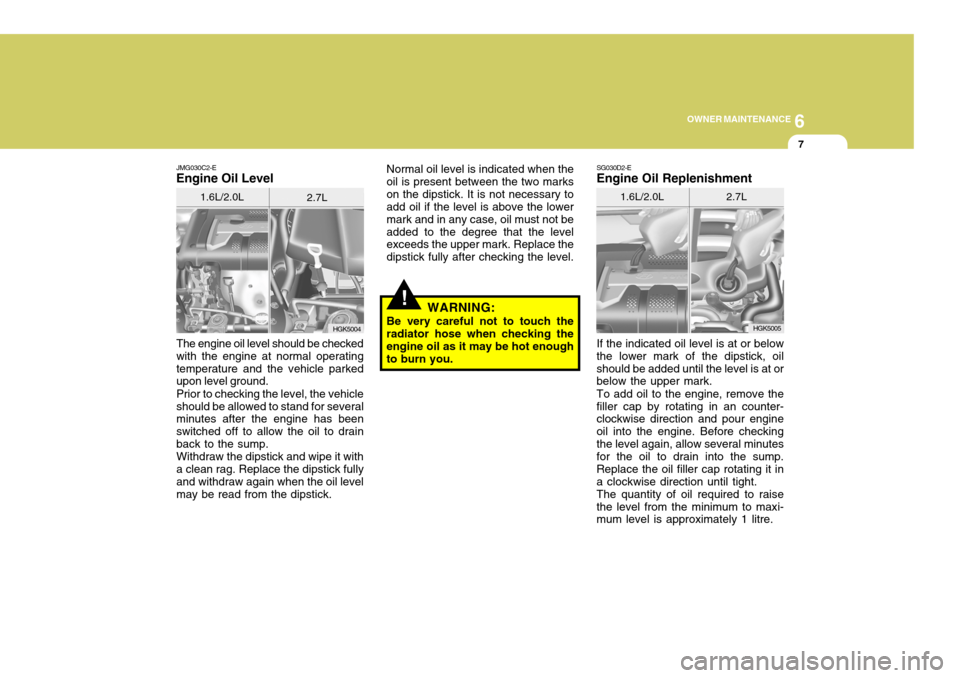
Engine Oil Level
The engine oil level should be checked with the engine at normal operatingtemperature and the vehicle parked upon level ground. Prior to checking the level, the vehicle should be allowed to stand for several minutes after the engine has been switched off to allow the oil to drainback to the sump.Withdraw the dipstick and wipe it witha clean rag. Replace the dipstick fully and withdraw again when the oil level may be read from the dipstick.
!
HGK5004
1.6L/2.0L
2.7LNormal oil level is indicated when the oil is present between the two markson the dipstick. It is not necessary to add oil if the level is above the lower mark and in any case, oil must not beadded to the degree that the level exceeds the upper mark. Replace the dipstick fully after checking the level.
WARNING:
Be very careful not to touch theradiator hose when checking the engine oil as it may be hot enough to burn you.HGK5005
SG030D2-E Engine Oil Replenishment If the indicated oil level is at or below the lower mark of the dipstick, oilshould be added until the level is at or below the upper mark. To add oil to the engine, remove the filler cap by rotating in an counter- clockwise direction and pour engine oil into the engine. Before checkingthe level again, allow several minutes for the oil to drain into the sump. Replace the oil filler cap rotating it ina clockwise direction until tight.The quantity of oil required to raisethe level from the minimum to maxi- mum level is approximately 1 litre. 1.6L/2.0L
2.7L
Page 437 of 487
6OWNER MAINTENANCE
8
o The engine oil consumption isstrongly effected by the viscosity and quality of oil, engine rpm and driving condition etc. More engine oil may be consumed under severe driving conditions such as high speeds, frequent acceleration and deceleration,compared to normal driving.
G350A01A-EAT
ENGINE OIL CONSUMPTION Function of engine oil
Engine oil has the primary function of
lubricating and cooling the inside of the engine. Engine oil consumption
It is normal that an engine should
consume some engine oil in the course of normal driving. The cause of oil consumption in a normal engine are asfollows;
o Engine oil is used to lubricate pis- tons, piston rings and cylinders. A thin film of oil is left on the cylinder wall when a piston moves downwards in the cylinder. High negative pressure generated dur-ing engine operation sucks some of the oil into the combustion cham- ber.This oil with some oil of the cylin-der wall is burned by the high tem-perature combustion gases during the combustion process.
!WARNING:
Be very careful not to touch the radiator hose when adding the en- gine oil as it may be hot enough to burn you.
Page 438 of 487
6
OWNER MAINTENANCE
9
!
ENGINE COOLANT CHECKING AND REPLACING
SG050A1-E
WARNING:
Do not remove the radiator cap
when the engine is hot, since the system is pressurised and coolant may be ejected from the radiator resulting in scalding. NOTE: It is imperative that vehicles fitted with an air conditioning systemhave a coolant concentration of the recommended strength at all times. The use of the air condition-ing system when the cooling sys- tem is filled with water only will result in the heater matrix freezingand subsequently bursting.
SG050B1-E
Coolant recommendations
Only ethylene glycol based coolantwith a corrosion inhibitor suited to aluminium alloy engine components should be used in the cooling system.No further additives or inhibitors should be used. The coolant specific gravity should be checked as pre-scribed in the maintenance schedule to ensure adequate frost and corro- sion protection. In addition, the en-gine coolant must be replaced at the specified interval since the corrosion inhibitor properties deteriorate withtime.It is important to note that whilst anincrease in the concentration of anti freeze gives an increase in the level of frost protection, a solution which isin excess of 65% anti freeze will result in reduced frost protection and engine overheating. Therefore therecommended concentration of 50% should not be exceeded for general use. The use of methanol based anti freeze compounds may result in engine over- heating and will invalidate the vehiclewarranty.
Page 439 of 487
6OWNER MAINTENANCE
10
HGK4006
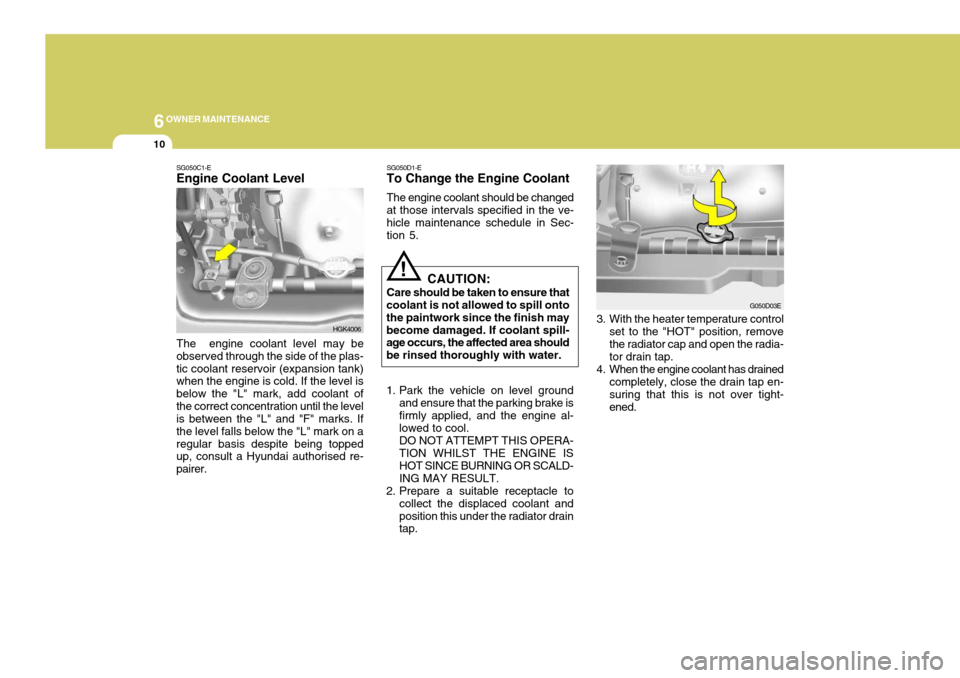
SG050C1-E Engine Coolant Level
The engine coolant level may be
observed through the side of the plas- tic coolant reservoir (expansion tank) when the engine is cold. If the level is below the "L" mark, add coolant ofthe correct concentration until the level is between the "L" and "F" marks. If the level falls below the "L" mark on aregular basis despite being topped up, consult a Hyundai authorised re- pairer. SG050D1-E To Change the Engine Coolant The engine coolant should be changed at those intervals specified in the ve- hicle maintenance schedule in Sec- tion 5.
3. With the heater temperature controlset to the "HOT" position, removethe radiator cap and open the radia- tor drain tap.
4. When the engine coolant has drained completely, close the drain tap en- suring that this is not over tight-ened. G050D03E
CAUTION:
Care should be taken to ensure that
coolant is not allowed to spill ontothe paintwork since the finish maybecome damaged. If coolant spill- age occurs, the affected area should be rinsed thoroughly with water.
!
1. Park the vehicle on level ground and ensure that the parking brake is firmly applied, and the engine al- lowed to cool. DO NOT ATTEMPT THIS OPERA- TION WHILST THE ENGINE IS HOT SINCE BURNING OR SCALD-ING MAY RESULT.
2. Prepare a suitable receptacle to
collect the displaced coolant andposition this under the radiator drain tap.