tool Hyundai Coupe 2007 Owner's Manual
[x] Cancel search | Manufacturer: HYUNDAI, Model Year: 2007, Model line: Coupe, Model: Hyundai Coupe 2007Pages: 487, PDF Size: 12.96 MB
Page 172 of 487
3
WHAT TO DO IN AN EMERGENCY
7
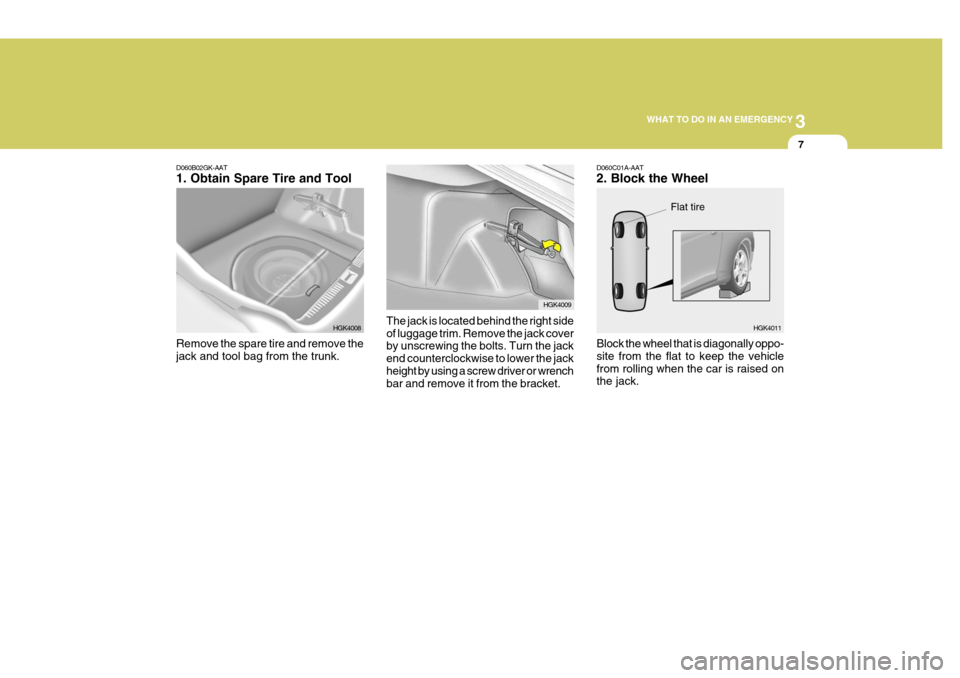
D060B02GK-AAT 1. Obtain Spare Tire and Tool Remove the spare tire and remove the jack and tool bag from the trunk. The jack is located behind the right sideof luggage trim. Remove the jack cover by unscrewing the bolts. Turn the jack end counterclockwise to lower the jackheight by using a screw driver or wrench bar and remove it from the bracket.
HGK4008
HGK4009
Flat tire
D060C01A-AAT 2. Block the Wheel Block the wheel that is diagonally oppo- site from the flat to keep the vehiclefrom rolling when the car is raised on the jack. HGK4011
Page 176 of 487

3
WHAT TO DO IN AN EMERGENCY
11
D060J01FC-GAT After Changing Wheels If you have a tire gauge, remove the valve cap and check the air pressure.If the pressure is lower than recom- mended, drive slowly to the nearest service station and inflate to the cor-rect pressure. If it is too high, adjust it until it is correct. Always reinstall the valve cap after checking or adjustingtire pressure. If the cap is not replaced, air mayleak from the tire. If you lose a valve cap, buy another and install it assoon as possible. After you have changed wheels, al- ways secure the flat tire in its place inthe luggage compartment and return the jack and tools to their proper stor- age locations. OGK036605
EMERGENCY COMMODITY
D070A01GK
D070A01GK-GET (If Installed) There are some emergency commodi- ties in the vehicle to help you respondto the emergency situation. Fire extinguisher The fire extinguisher is located in the tray under the luggage mat. If there is small fire and you know how to use the fire extinguisher, take the following steps carefully. 1. Pull the pin at the top of the extin-
guisher that keeps the handle from being accidentally pressed.
2. Aim the nozzle toward the base of
the fire.
3. Stand approximately 2.5 m (8 ft) away from the fire and squeeze thehandle to discharge the extinguisher.If you release the handle, the dis- charge will stop.
4. Sweep the nozzle back and forth at the base of the fire. After the fireappears to be out, watch it carefully since it may re-ignite.
Triangle Reflector Placed the triangle reflector on the road to warn oncoming vehicles during emer-gencies, such as when the vehicle is parked by the roadside due to any problems. First Aid Kit There are some items such as scis- sors, bandage and adhesive tape and etc. in the kit to give first aid to an injured person.
Page 177 of 487
3 WHAT TO DO IN AN EMERGENCY
12IF YOUR VEHICLE MUST BE TOWED
D080A01O-GAT If your vehicle has to be towed, it should be done by your Hyundai dealeror a commercial tow truck service. This will help assure that your vehicle is not damaged in towing. Also, profes-sionals are generally aware of local laws governing towing. In any case, rather than risk damage to your car, itis suggested that you show this infor- mation to the tow truck operator. Be sure that a safety chain system is usedand that all local laws are observed. It is recommended that your vehicle be towed with a wheel lift and dollies orflatbed equipment with all the wheels off the ground.
! CAUTION:
o Your vehicle can be damaged if towed incorrectly!
o Be sure the transaxle is in neu-
tral.
o When the engine will not start, be
sure the steering is unlocked by placing the key in the "ACC" po- sition.
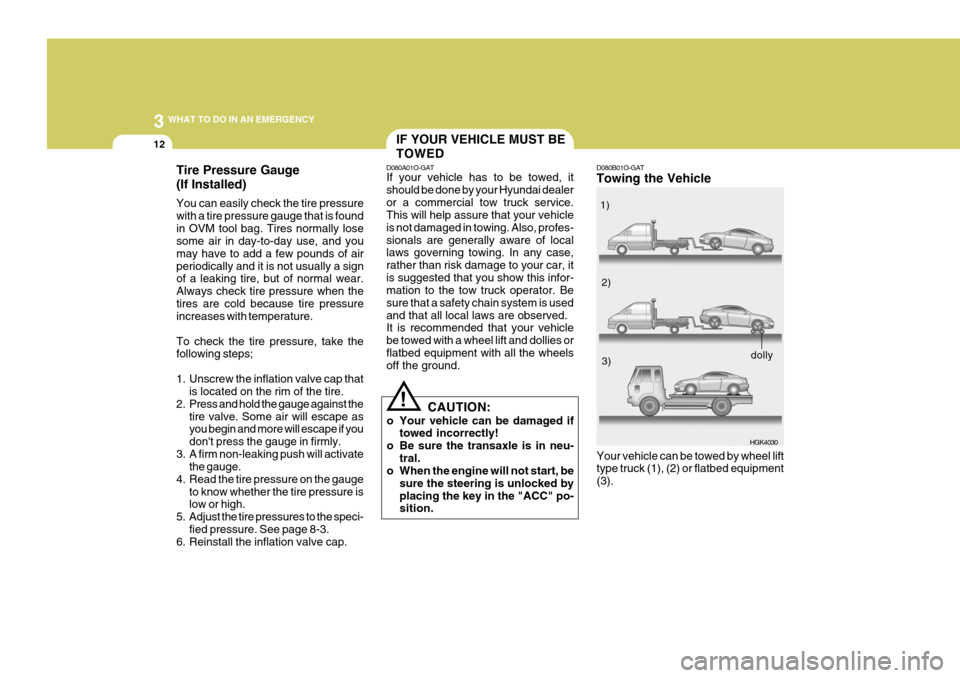
D080B01O-GAT Towing the Vehicle
HGK4030
Your vehicle can be towed by wheel lift type truck (1), (2) or flatbed equipment (3). 1)
2)
3)
dolly
Tire Pressure Gauge (If Installed) You can easily check the tire pressure with a tire pressure gauge that is foundin OVM tool bag. Tires normally lose some air in day-to-day use, and you may have to add a few pounds of airperiodically and it is not usually a sign of a leaking tire, but of normal wear. Always check tire pressure when thetires are cold because tire pressure increases with temperature. To check the tire pressure, take the following steps;
1. Unscrew the inflation valve cap that
is located on the rim of the tire.
2. Press and hold the gauge against the tire valve. Some air will escape as you begin and more will escape if you don't press the gauge in firmly.
3. A firm non-leaking push will activate the gauge.
4. Read the tire pressure on the gauge
to know whether the tire pressure is low or high.
5. Adjust the tire pressures to the speci-
fied pressure. See page 8-3.
6. Reinstall the inflation valve cap.
Page 180 of 487
3
WHAT TO DO IN AN EMERGENCY
15IF YOU LOSE YOUR KEYS
D120A01A-GAT If you lose your keys, many Hyundai dealers can make you a new key if you have your key number. If you lock the keys inside your car and you cannotobtain a new key, many Hyundai deal- ers can use special tools to open the door for you. Information about the keyof immobilizer system (If Installed) will be found on page 1-4.
Page 189 of 487
5VEHICLE MAINTENANCE REQUIREMENTS
2MAINTENANCE INTERVALS
F010A01A-GAT Service Requirements To assure that you receive the great- est number of kilometers of satisfyingoperation from your Hyundai, certain maintenance procedures must be per- formed. Although careful design andengineering have reduced these to a minimum, those that are required are of the utmost importance. It is your responsibility to have these maintenance procedures performed to comply with the terms of the warran-ties covering your new Hyundai. The Service Passport supplied with your new vehicle provides further informa-tion about these warranties. F010B01A-AAT
Maintenance Requirements
The maintenance required for your Hyundai can be divided into three main areas:
o Specified scheduled procedures o General checks o Do-it-yourself maintenance F010C01A-GAT
Specified Scheduled Procedures
These are the procedures such asinspections, adjustments and replace-ments that are listed in the mainte- nance charts starting on page 5-4. These procedures must be performedat the intervals shown in the mainte- nance schedule to assure that your warranty remains in effect. Although itis strongly recommended that they be performed by the factory-trained or distributor-trained technicians at yourHyundai dealer, these procedures may be performed at any qualified service facility. It is suggested that genuine Hyundai service parts be used for any required repairs or replacements. Other parts ofequivalent quality such as engine oil, engine coolant, manual or auto transaxle oil, brake fluid and so onwhich are not supplied by Hyundai Motor Company or its distributor may be used without affecting your war-ranty coverage but you should always be sure these are equivalent to the quality of the original Hyundai parts.Your Service Passport provides fur- ther information about your warranty coverage. F010D01A-AAT
General Checks
These are the regular checks you
should perform when you drive yourHyundai or you fill the fuel tank. A list of these items will be found on page 6- 5. F010E01A-AAT
Do-It-Yourself Maintenance
If you are mechanically inclined, own a few tools that are required and want to take the time to do so, you can inspect and service a number of items. Formore information about doing it your- self, see Section 6.
Page 200 of 487
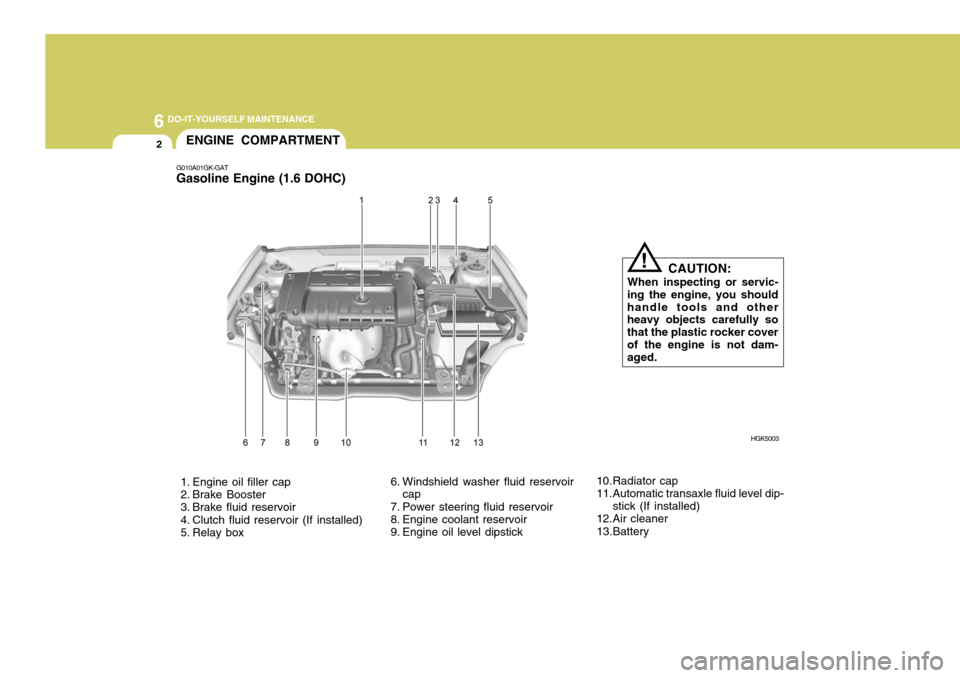
6 DO-IT-YOURSELF MAINTENANCE
2
1. Engine oil filler cap
2. Brake Booster
3. Brake fluid reservoir
4. Clutch fluid reservoir (If installed)
5. Relay box
G010A01GK-GAT Gasoline Engine (1.6 DOHC)
ENGINE COMPARTMENT
HGK5003
CAUTION:
When inspecting or servic-
ing the engine, you should handle tools and other heavy objects carefully so that the plastic rocker coverof the engine is not dam- aged.
!
6. Windshield washer fluid reservoir cap
7. Power steering fluid reservoir
8. Engine coolant reservoir
9. Engine oil level dipstick 10.Radiator cap
11.Automatic transaxle fluid level dip-
stick (If installed)
12.Air cleaner
13.Battery
Page 201 of 487
6
DO-IT-YOURSELF MAINTENANCE
3
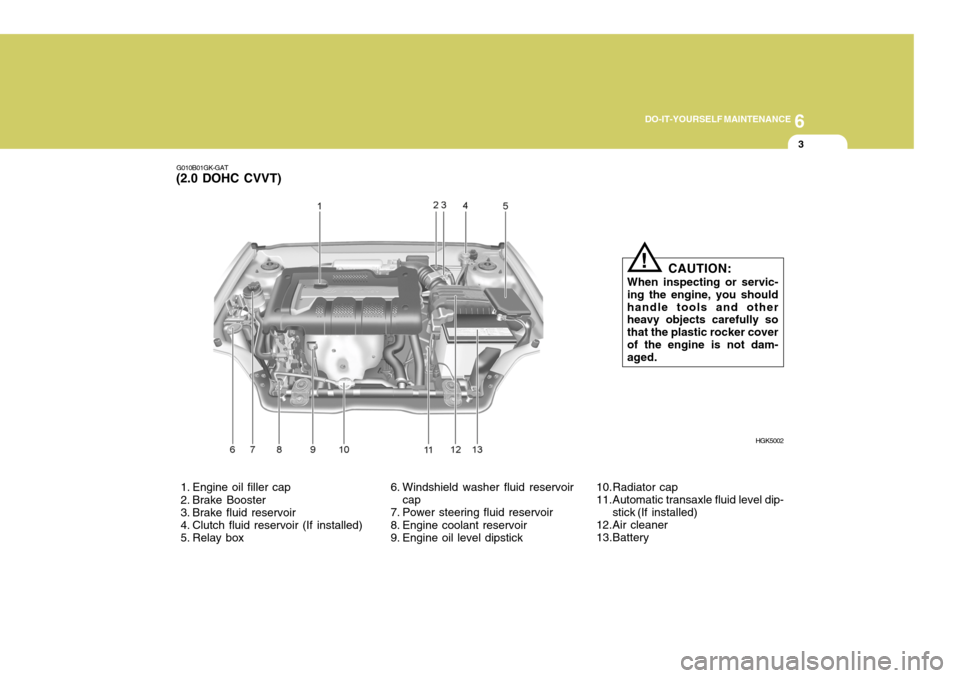
G010B01GK-GAT
(2.0 DOHC CVVT)
1. Engine oil filler cap
2. Brake Booster
3. Brake fluid reservoir
4. Clutch fluid reservoir (If installed)
5. Relay box 6. Windshield washer fluid reservoir
cap
7. Power steering fluid reservoir
8. Engine coolant reservoir
9. Engine oil level dipstick 10.Radiator cap
11.Automatic transaxle fluid level dip-
stick (If installed)
12.Air cleaner
13.Battery CAUTION:
When inspecting or servic-ing the engine, you shouldhandle tools and other heavy objects carefully so that the plastic rocker coverof the engine is not dam- aged.
!
HGK5002
Page 202 of 487
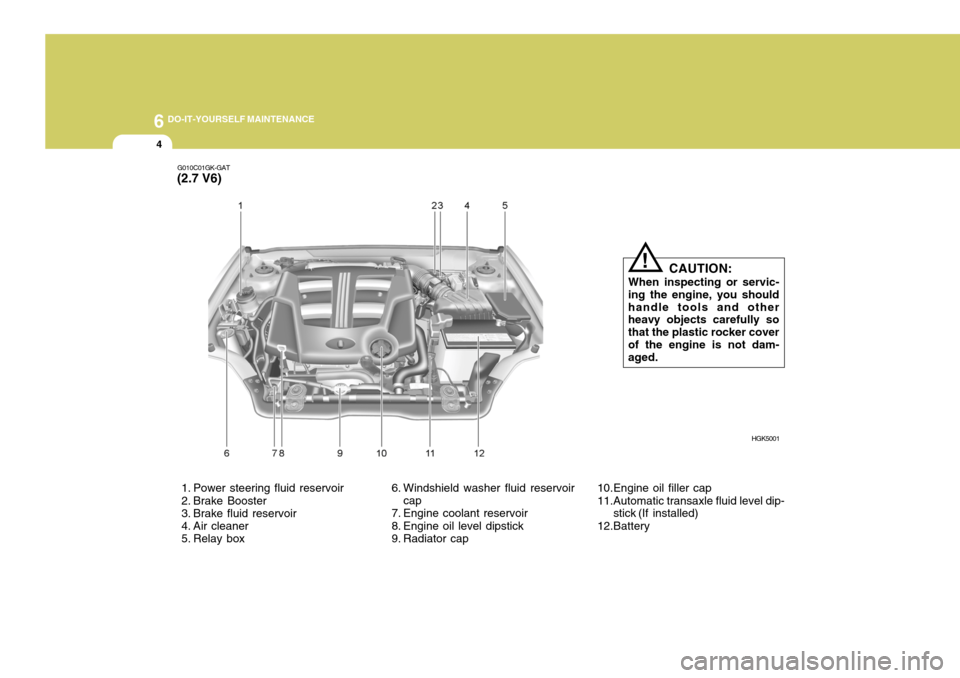
6 DO-IT-YOURSELF MAINTENANCE
4
1. Power steering fluid reservoir
2. Brake Booster
3. Brake fluid reservoir
4. Air cleaner
5. Relay box 6. Windshield washer fluid reservoir
cap
7. Engine coolant reservoir
8. Engine oil level dipstick
9. Radiator cap 10.Engine oil filler cap
11.Automatic transaxle fluid level dip-
stick (If installed)
12.Battery
G010C01GK-GAT
(2.7 V6)
HGK5001
CAUTION:
When inspecting or servic- ing the engine, you shouldhandle tools and other heavy objects carefully so that the plastic rocker coverof the engine is not dam- aged.
!
Page 204 of 487
6 DO-IT-YOURSELF MAINTENANCE
6CHECKING THE ENGINE OIL
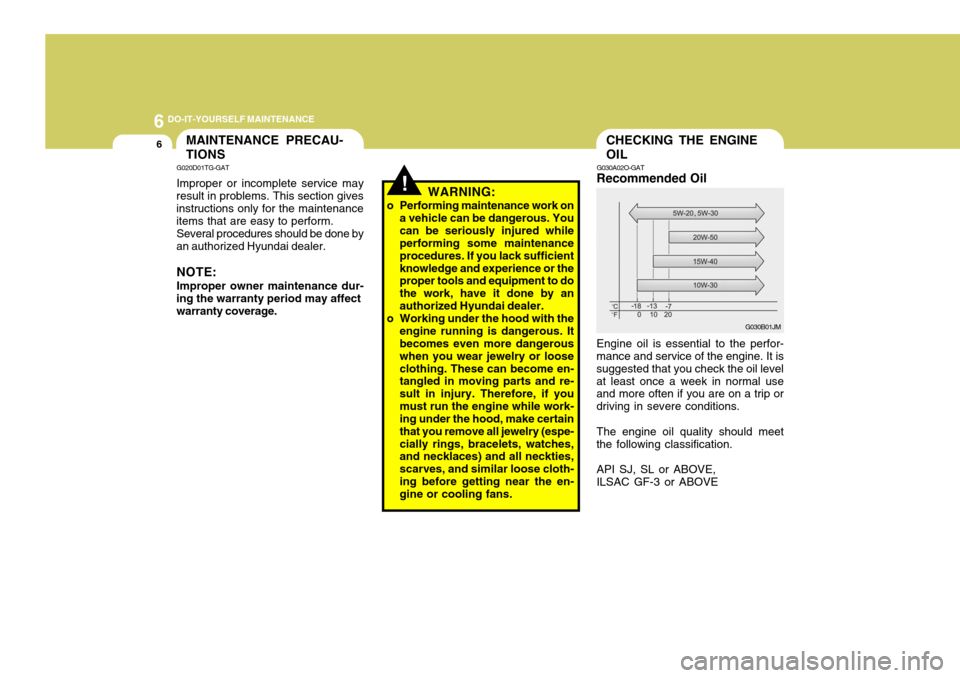
G030A02O-GAT
Recommended Oil Engine oil is essential to the perfor-
mance and service of the engine. It is suggested that you check the oil levelat least once a week in normal use and more often if you are on a trip or driving in severe conditions.
The engine oil quality should meet
the following classification.
API SJ, SL or ABOVE,ILSAC GF-3 or ABOVE G030B01JMMAINTENANCE PRECAU- TIONS
!
G020D01TG-GAT Improper or incomplete service may
result in problems. This section gives instructions only for the maintenanceitems that are easy to perform.
Several procedures should be done by
an authorized Hyundai dealer.
NOTE: Improper owner maintenance dur-
ing the warranty period may affect warranty coverage. WARNING:
o Performing maintenance work on a vehicle can be dangerous. You can be seriously injured while performing some maintenance procedures. If you lack sufficientknowledge and experience or the proper tools and equipment to do the work, have it done by anauthorized Hyundai dealer.
o Working under the hood with the engine running is dangerous. It becomes even more dangerous when you wear jewelry or looseclothing. These can become en- tangled in moving parts and re- sult in injury. Therefore, if youmust run the engine while work- ing under the hood, make certain that you remove all jewelry (espe-cially rings, bracelets, watches, and necklaces) and all neckties, scarves, and similar loose cloth-ing before getting near the en- gine or cooling fans.
Page 220 of 487
6 DO-IT-YOURSELF MAINTENANCE
22
!
1. Turn off the ignition and all other
switches.
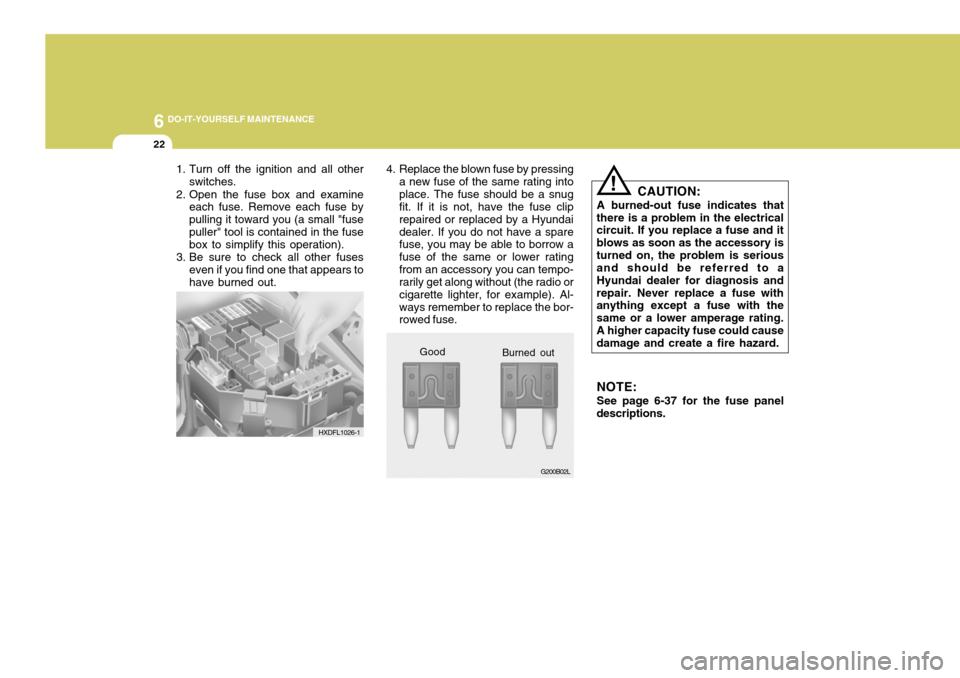
2. Open the fuse box and examine each fuse. Remove each fuse by pulling it toward you (a small "fusepuller" tool is contained in the fuse box to simplify this operation).
3. Be sure to check all other fuses even if you find one that appears to have burned out. 4. Replace the blown fuse by pressing
a new fuse of the same rating intoplace. The fuse should be a snug fit. If it is not, have the fuse clip repaired or replaced by a Hyundaidealer. If you do not have a spare fuse, you may be able to borrow a fuse of the same or lower ratingfrom an accessory you can tempo- rarily get along without (the radio or cigarette lighter, for example). Al-ways remember to replace the bor- rowed fuse. CAUTION:
A burned-out fuse indicates that
there is a problem in the electricalcircuit. If you replace a fuse and it blows as soon as the accessory isturned on, the problem is serious and should be referred to a Hyundai dealer for diagnosis andrepair. Never replace a fuse with anything except a fuse with the same or a lower amperage rating.A higher capacity fuse could cause damage and create a fire hazard.
NOTE: See page 6-37 for the fuse panel
descriptions.
Good
HXDFL1026-1
G200B02L
Burned out