warning lights Hyundai Coupe 2008 User Guide
[x] Cancel search | Manufacturer: HYUNDAI, Model Year: 2008, Model line: Coupe, Model: Hyundai Coupe 2008Pages: 407, PDF Size: 11.03 MB
Page 146 of 407
2
DRIVING YOUR HYUNDAI
3TO START THE ENGINEBEFORE STARTING THE ENGINE
C020A03A-AAT Before you start the engine, you should always:
1. Look around the vehicle to be sure there are no flat tires, puddles of oil, water or other indications of pos- sible trouble.
2. After entering the car, check to be sure the parking brake is engaged.
3. Check that all windows, and lights are clean.
4. Check that the interior and exterior
mirrors are clean and in position.
5. Check your seat, seatback and headrest to be sure they are in theirproper positions.
6. Close all the doors.
7. Fasten your seat belt and be sure
that all other occupants have fas- tened theirs.
8. Turn off all lights and accessories
that are not needed.
9. When you turn the ignition switch to "ON", check that all appropriatewarning lights are operating andthat you have sufficient fuel.
10.Check the operation of warning
lights and all bulbs when key is inthe "ON" position. C030A01A-GAT COMBINATION IGNITION SWITCH
o If your Hyundai is equipped with a
manual transaxle, place the shift lever in neutral and depress the clutch pedal fully.
o If your Hyundai has an automatic
transaxle, place the shift lever in "P"(park).
o To start the engine, insert the igni- tion key and turn it to the "START"position. Release it as soon as the engine starts. Do not hold the key inthe "START" position for more than 15 seconds.
NOTE: For safety, the engine will not start if the shift lever is not in "P" or "N" Position (Automatic Transaxle).
!WARNING:
Always wear appropriate shoes when operating your vehicle.Unsuitable shoes (high heels, ski boots, etc.) may interfere with your ability to use the brake and accelera-tor pedal, and the clutch (if installed).
!WARNING:
When you intend to park or stop the vehicle with the engine on, be care- ful not to depress the accelerator pedal for a long period of time. It mayoverheat the engine or exhaust sys- tem and cause fire.
Page 148 of 407
2
DRIVING YOUR HYUNDAI
5STARTING
!
!
C050A01A-AAT
WARNING:
Never run the engine in a closed or poorly ventilated area any longer than is needed to move your car inor out of the area. The carbon mon- oxide gas emitted is odorless and can cause serious injury or death. LOCK
C050B01A-GAT Normal Conditions: The Starting Procedure:
1. Insert key, and fasten the seat belt.
2. Depress the clutch pedal fully and
place the gearshift lever (manual transaxle) in neutral or the selector lever (automatic transaxle) in "P" (park) position.
3. After turning the ignition key to the "ON" position, make certain all warn-ing lights and gauges are functioningproperly before starting the engine.
WARNING:
Be sure that the clutch is fully de- pressed when starting a manual transaxle vehicle. Otherwise, thereis the potential to cause damage to the vehicle or injury to someone inside or outside the vehicle as aresult of the forward or backward movement of the vehicle that will occur if the clutch is not depressedwhen the vehicle is started.
4. Turn the ignition key to the "Start" position and release it when the en- gine starts.
C050A01E
ON
START
OPERATING THE MANUAL TRANSAXLE
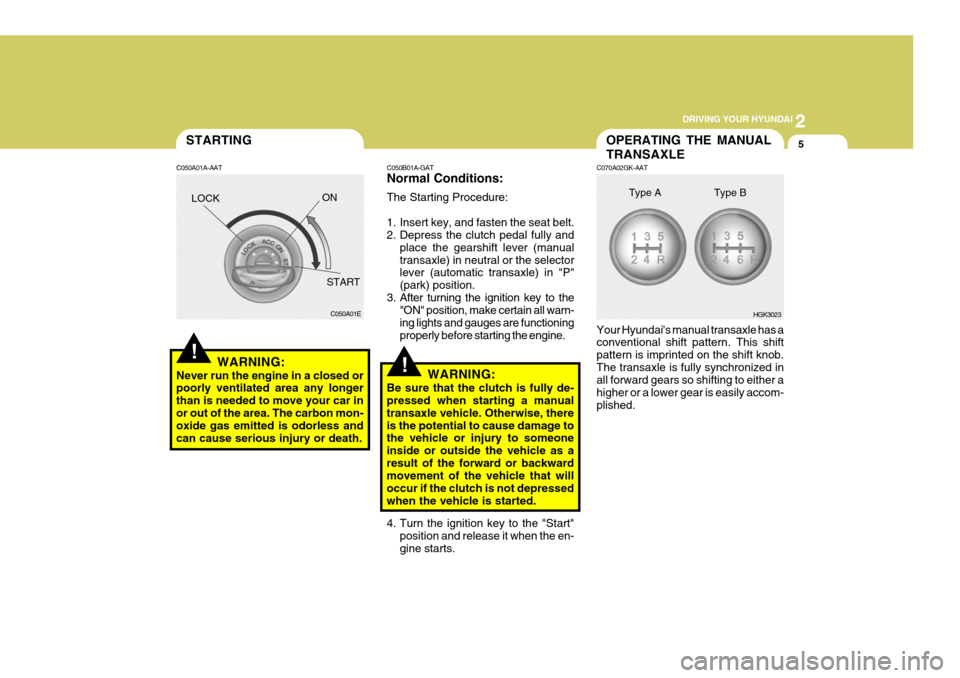
C070A02GK-AAT Your Hyundai's manual transaxle has a conventional shift pattern. This shift pattern is imprinted on the shift knob.The transaxle is fully synchronized in all forward gears so shifting to either a higher or a lower gear is easily accom-plished. HGK3023
Type A Type B
Page 171 of 407
3
WHAT TO DO IN AN EMERGENCY
3
!
D020A02A-AAT
WARNING:
The gas produced by the battery during the jump-start operation is highly explosive. If these instruc- tions are not followed exactly, seri-ous personal injury and damage to the vehicle may occur! If you are not sure how to follow this proce-dure, seek qualified assistance. Automobile batteries contain sul- furic acid. This is poisonous andhighly corrosive. When jump start- ing, wear protective glasses and be careful not to get acid on yourself, your clothing or on the car. o The gas produced by the battery
during the jump-start operation is highly explosive. Do not smoke or allow a spark or open flame in the vicinity.
o The battery being used to provide the jump start must be 12-volt. If youcannot determine that it is a 12-voltbattery, do not attempt to use it for the jump start.
o To jump start a car with a discharged battery, follow this procedure ex-actly:
1. If the booster battery is installed in another vehicle, be sure the two vehicles are not touching.
2. Turn off all unnecessary lights and accessories in both vehicles.
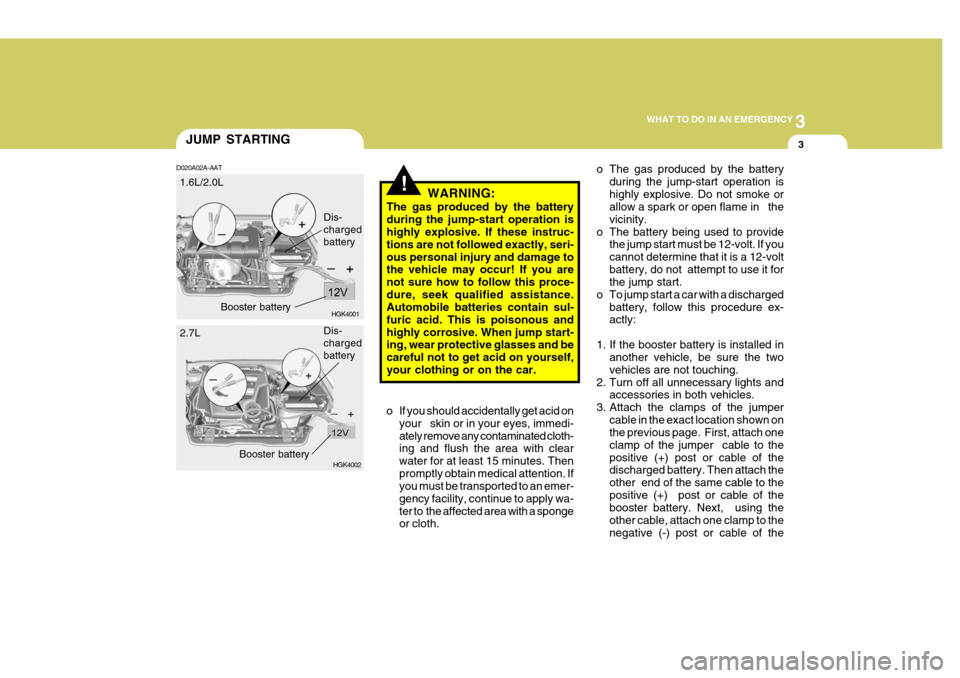
3. Attach the clamps of the jumper cable in the exact location shown on the previous page. First, attach one clamp of the jumper cable to thepositive (+) post or cable of the discharged battery. Then attach the other end of the same cable to thepositive (+) post or cable of the booster battery. Next, using the other cable, attach one clamp to thenegative (-) post or cable of the
JUMP STARTING
o If you should accidentally get acid onyour skin or in your eyes, immedi-ately remove any contaminated cloth- ing and flush the area with clear water for at least 15 minutes. Thenpromptly obtain medical attention. If you must be transported to an emer- gency facility, continue to apply wa-ter to the affected area with a sponge or cloth.
1.6L/2.0L
HGK4001
HGK4002
Dis- chargedbattery
2.7L Booster battery
Dis- chargedbattery
Booster battery
Page 172 of 407
3 WHAT TO DO IN AN EMERGENCY
4
!
booster battery. Then attach the other end of that cable to a solid metal partof the engine away from the battery. Do not connect the cable to any moving part.
4. Start the engine in the car with the booster battery and let it run for afew minutes. This will help to as-sure that the booster battery is fully charged. During the jumping opera- tion, run the engine in this vehicle atabout 2000 rpm.
5. Start the engine in the car with the
discharged battery using the nor-mal starting procedure. After the engine starts, leave the jumper cables connected and let the enginerun at fast idle or about 2000 rpm for several minutes.
6. carefully remove the jumper cables in the reverse order of attachment.
If you do not know why your battery became discharged (because the lights were left on, etc.), have the charging system checked by your Hyundaidealer. D030A02A-AAT If your temperature gauge indicates overheating, you experience a loss of power, or hear loud pinging or knock- ing, the engine is probably too hot. Ifthis happens to you, you should:
1. Pull off the road and stop as soon as
it is safe to do so.
2. Place the gear selector lever in "P"
(automatic), or neutral (manual transaxle) and set the parking brake. If the air conditioning is on, turn it off.
3. If engine coolant is running out un- der the car or steam is coming outfrom the hood, stop the engine. Donot open the hood until the engine coolant has stopped running or the steaming has stopped. If there is novisible loss of engine coolant and no steam, leave the engine running and check to be sure the enginecooling fan is operating. If the fan is not running, turn the engine off.
IF THE ENGINE OVERHEATS
4. Check to see if the water pump drivebelt is missing. If it is not missing, check to see that it is tight. If the drive belt seems to be satisfactory, check for engine coolant leakingfrom the radiator, hoses or under the car. (If the air conditioning had been in use, it is normal for coldwater to be draining from it when you stop).
WARNING:
While the engine is running, keephair, hands, and clothing away from moving parts such as the fan anddrive belts to prevent injury.
5. If the water pump drive belt is broken or engine coolant is leaking out, stop the engine immediately and call thenearest Hyundai dealer for assis- tance.
Page 257 of 407

10
INDEX
3
Driving Economical driving .................................................. 2-16
Smooth corneri ng ..................................................... 2-17
Winter driving ........................................................... 2-17
E Electronic Stability Program (ESP) ............................2-13
Emissions Control Systems ........................................ 7-2 Engine Before starting the engine ........................................ 2-3
Changing the oil and filter ......................................... 6-6Compartment (1.6L, 2.0L, 2.7L) ................................ 6-2
Coolant ..................................................................... 6-9
Coolant temperature gauge ......................................1-50
If the engine overheats ............................................. 3-4
Number ..................................................................... 8-2
Oil ............................................................................. 6-6Oil consumption ........................................................ 6-8
Starting ..................................................................... 2-5
Engine Exhaust Can Be Dangerous ............................ 2-2
FFog Light .................................................................... 1-62
Front Seats Adjustable front seats .............................................. 1-13
Adjustable headrests ............................................... 1-14
Adjusting seat forward and rearward ........................ 1-13
Adjusting seatback angle ........................................ 1-14
Lumbar support control ............................................ 1-16
Seat cushion height adjustment .............................. 1-16Seat warmer
............................................................ 1-16
Fuel Capacity ................................................................... 9-2
Gauge ...................................................................... 1-49
Recommendations .................................................... 1-2
Fuel Filler Lid Remote release ....................................................... 1-76
Fuse Panel Description .............................................. 6-37
Fuses ......................................................................... 6-21
G
General Everyday Checks ..... ...................................... 6-5
Glove box ................................................................... 1-71
H Hazard Warning System ............................................. 1-62
Headlight Leveling Device S ystem .............................1-66
Heating and Air Conditioning Control Rotary type .............................................................. 1-87
Automatic type ........................................................ 1-96
High-mounted rear stoplight .. ......................................1-74
Hood Release ............................................................. 1-75
Horn ............................................................................ 1-80
I Ignition Switch ............................................................. 2-4
Immobilizer System ..................................................... 1-4
Instrument Cluster and Indicator Lights ...................... 1-42
Instrument Panel Light Control (Rheostat) .................. 1-64
Intermittent Wiper ....................................................... 1-61
Page 259 of 407

10
INDEX
5
T Tachometer ................................................................. 1-51
Tail Gate ..................................................................... 1-77
Theft Alarm System .................................................... 1-9
Tires
Balancing .................................................................. 8-5
Chains ...................................................................... 8-4
Changing a flat tire ................................................... 3-6
If you have a flat tire ................................................ 3-6
Information ................................................................ 8-3
Pressure ................................................................... 8-3
Replacement ............................................................. 8-6
Rotation .................................................................... 8-5
Snow tires ................................................................ 8-4
Spare tire .................................................................. 3-5
Traction ..................................................................... 8-5
Towing Emergency .............................................................. 3-14
If your car must be towed ....................................... 3-12
Trailer or vehicle towing ........................................... 2-21
Transaxle Automatic ................................................................. 2-8
Automatic transaxle fluid checking .......................... 6-15
Manual ...................................................................... 2-5
Trip Computer ............................................................. 1-52
Trip Odometer ............................................................. 1-51VVehicle Identification Number
(VIN) ............................. 8-2
Vehicle Specifi cation ................................................... 9-2
Ventilation
Center ventilator ...................................................... 1-86
Side ventilator .......................................................... 1-86
WWasher reservoir ......................................................... 6-14
Warning Lights ............................................................ 1-44
Windows Glass ........................................................... 1-12
Windshield Wiper and Washer ....................................1-59
Windshield Wiper Blades ............................................ 6-12
Page 269 of 407

YOUR VEHICLE AT A GLANCE
F10B255A02GK-EAT INDICATOR SYMBOLS ON THE INSTRUMENT PANEL
* More detailed explanations of these items will be found beginning on page 1-42.
Turn Signal Indicator Lights Electronic Stability Program (ESP) Indicator Lights (Not all models)Malfunction Indicator Light (Not all models)
SRS (Airbag) Service Reminder Indicator (SRI)
Low Fuel Level Warning Light
High Beam Indicator Light Low Oil Pressure Warning Light
Charging System Warning Light
Seat Belt Warning Light
Immobiliser Warning Light
Hatchback Door Open Warning Light
Door Open (Ajar) Warning Light
ABS Service Reminder Indicator (Not all models)
Parking Brake/Low Brake Fluid Level Warning Light
CRUISE Indicator Light (Not all models)
CRUISE SET Indicator Light (Not all models)
Page 296 of 407
2
DRIVING YOUR HYUNDAI
3TO START THE ENGINEBEFORE STARTING THE ENGINE
SC030A3-E Before you start the engine, you should always:
1. Look around the vehicle to be sure
there are no flat tyres, puddles of oil or water or other indications of pos- sible trouble.
2. After entering the car, check to be sure the parking brake is engaged.
3. Check that all windows, and lights
are clean.
4. Check that the interior and exterior mirrors are clean and in position.
5. Check your seat, seatback and head restraint to be sure they are intheir proper positions.
6. Close all the doors.
7. Fasten your seat belt and be sure that all other occupants have fas-tened theirs.
8. Turn off all lights and accessories that are not needed.
9. When you turn the ignition switch to "ON" check that all appropriate warn- ing lights are operating and that you have sufficient fuel.
10.Check the operation of warning lights and all bulbs when key is inthe "ON" position.
!WARNING:
Always wear appropriate shoes when operating your vehicle.Unsuitable shoes (high heels, ski boots, etc.) may interfere with your ability to use the brake and accelera-tor pedal, and the clutch (Not all models). C030A01A-EAT COMBINATION IGNITION SWITCH AND STEERING LOCK
o If your Hyundai is equipped with a
manual transaxle, place the gear- shift lever in neutral and depress the clutch pedal fully.
o If your Hyundai has an automatic
transaxle, place the selector lever in"P" (park).
o To start the engine, insert the ignition key and turn it to the "START" posi-tion. Release it as soon as the en- gine starts. Do not hold the key in the"START" position for more than 15 seconds.
NOTE: For safety, the engine will not start if the shift lever is not in "P" or "N" position (Automatic Transaxle).
!WARNING:
When you intend to park or stop the vehicle with the engine on, be care-ful not to depress the accelerator pedal for a long period of time. It may overheat the engine or exhaust sys-tem and cause fire.
Page 299 of 407
2DRIVING YOUR HYUNDAI
6FUEL ECONOMY
4. Turn the ignition key to the "START" position and release it when the en- gine starts. SC060B1-E The following suggestions are made to assist in achieving the greatest degree of fuel economy.
o Maintaining a constant check on fuel
consumption will enable the most economical use pattern and drivingstyle to be adopted.
o Avoid using the vehicle for very short journeys if possible, particularly whena cold start is involved.
o Ensure that tyre pressures are main- tained at the correct level.
o Use only the recommended grade of
fuel.
o Avoid carrying unnecessary weight, and if a roof rack is in use, remove itas soon as possible after use.
o Anticipate the road and conditions ahead to enable adjustments in speedto be made smoothly. Avoid heavyacceleration and sharp braking.
o Avoid cruising at unnecessary high speeds.
o Always ensure that the periodic main- tenance services are performed by aHyundai authorised repairer at the
time and/or mileage intervals speci-fied.
o Use the air conditioning only when necessary.
!
C050B01A-EAT Normal Conditions The Starting Procedure:
1. Insert key, and fasten the seat belt.
2. Depress the clutch pedal fully and
place the gearshift lever (manual transaxle) in neutral or the selector lever (automatic transaxle) in "P" (park) position.
3. After turning the ignition key to the "ON" position, make certain all warn-ing lights and gauges are function-ing properly before starting the en- gine.
WARNING:
Be sure that the clutch is fully de- pressed when starting a manual transaxle vehicle. This will prevent sudden movement should the ve-hicle be started in gear without the clutch depressed. Otherwise there is the potential tocause damage to the vehicle or in- jury to a person inside or outside of the vehicle as a result of this suddenvehicle movement.
Page 320 of 407
3 IN CASE OF EMERGENCY
2IF THE ENGINE WILL NOT START
!
SD020A1-E Seek assistance from the nearest Hyundai authorised repairer with regard to the method of ignition and fuel sys- tem diagnosis.
WARNING:
If the engine refuses to start, noattempt should be made to push ortow start the vehicle. Vehicles with automatic transaxle or fuel injec- tion will not be able to be started in this manner since no drive is trans- mitted through the automatictransaxle whilst the engine is not running, and in the case of fuel injected derivatives, the fuel pumpwill not operate under tow start conditions. In addition, if the ve- hicle is equipped with an exhaustcatalyst, damage to the catalyst may result if the vehicle is tow started. SD020B1-E If the Engine Cannot be Cranked
D010C01A-EATIf Engine Turns Over Normally but Does Not Start
1. Check fuel level.
2. With the key in the off position,Check all connectors at ignition coils and spark plugs. Reconnect any that may be disconnected or loose.
3. Check the fuel line in the engine room.
4. If engine still refuses to start, call a Hyundai authorised repairer or seek other qualified assistance.
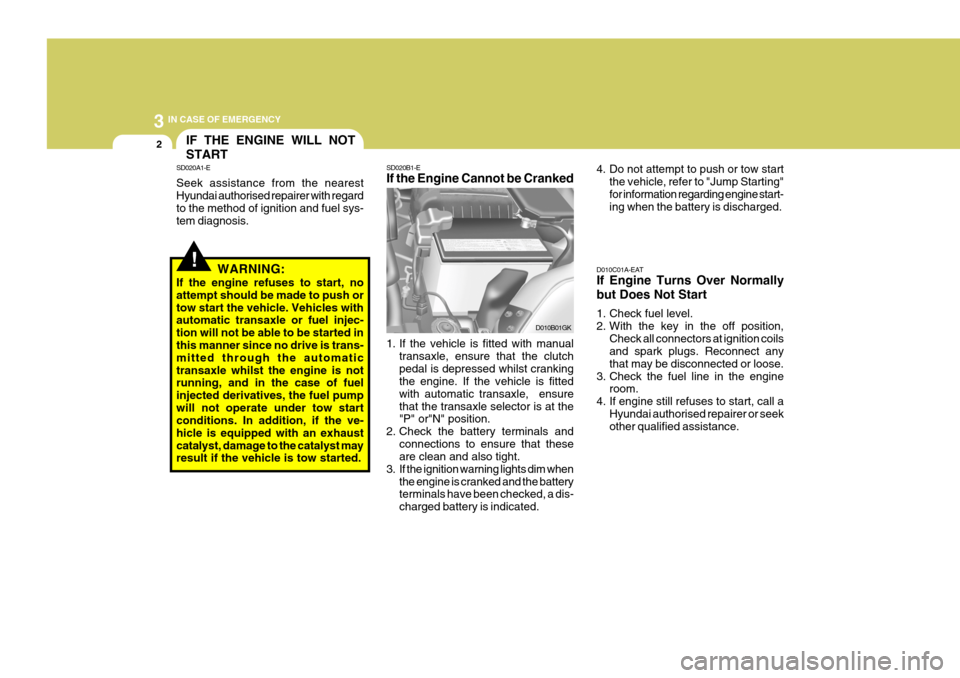
1. If the vehicle is fitted with manual
transaxle, ensure that the clutch pedal is depressed whilst cranking the engine. If the vehicle is fitted with automatic transaxle, ensurethat the transaxle selector is at the "P" or"N" position.
2. Check the battery terminals and connections to ensure that theseare clean and also tight.
3. If the ignition warning lights dim when the engine is cranked and the batteryterminals have been checked, a dis- charged battery is indicated. D010B01GK
4. Do not attempt to push or tow start
the vehicle, refer to "Jump Starting"for information regarding engine start- ing when the battery is discharged.