maintenance Hyundai Coupe 2008 Repair Manual
[x] Cancel search | Manufacturer: HYUNDAI, Model Year: 2008, Model line: Coupe, Model: Hyundai Coupe 2008Pages: 407, PDF Size: 11.03 MB
Page 243 of 407
7EMISSION CONTROL SYSTEMS
2
H010A01A-GAT (If Installed) Your Hyundai is equipped with an emission control system to meet all requirements of the Emission prohibi- tion rules of your province.There are three emission control sys-tems which are as follows.
(1) Crankcase emission control sys-
tem
(2) Evaporative emission control sys-
tem
(3) Exhaust emission control systemIn order to assure the proper function of the emission control systems, it isrecommended that you have your car inspected and maintained by an au- thorized Hyundai dealer in accordancewith the maintenance schedule in this manual. EMISSION CONTROL SYSTEMS
H010B01F-GAT 1. Crankcase Emission ControlSystem
The positive crankcase ventilation system is employed to prevent air pollution caused by blow-by gases being emitted from the crankcase.This system supplies fresh air to the crankcase through the air cleaner. Inside the crankcase, the fresh airmixes with blow-by gases, then passes through the PCV valve into the induction system.
H010C01F-GAT
2. Evaporative Emission Control
System (If Installed)
The evaporative emission control sys-
tem is designed to prevent fuel va-pors from escaping into the atmo-sphere. H010D01A-AAT
3. Exhaust Emission Control
System
The exhaust emission control system is a highly effective system which controls exhaust emissions while maintaining good vehicle performace.
Canister While the engine is inoperative, fuel vapors generated inside the fuel tank are absorbed and stored in the canis-ter. When the engine is running, the fuel vapors absorbed in the canister are drawn into the induction systemthrough the purge control solenoid valve. Purge Control Solenoid Valve The purge control solenoid valve is controlled by the ECM; when the en- gine coolant temperature is low, and during idling, it closes, so that evapo- rated fuel is not taken into the engine. After engine warm-up, during ordi-nary driving, it opens so as to intro- duce evaporated fuel to the engine.
Page 258 of 407

10INDEX
4
J Jump Starting .............................................................. 3-3
KKeys ............................................................................ 1-4
If you lose y our keys .............................................. 3-15
Positions ................................................................... 2-3
L
Light Bulb Replacement .............................................. 6-27
Lubrication Chart .......................................................... 9-4
Luggage Net ............................................................... 1-80
M Maintenance Intervals Explanation of scheduled maintenance items
................................................................................. 5-8
Maintenance under severe usage conditions ............ 5-7
Scheduled maintenance ............................................ 5-4
Service requirements ................................................ 5-2
Map Light .................................................................... 1-70
Mirros
Day-night inside rearview ......................................... 1-73
Outside rearview folding ............... ...........................1-72
Outsde rearview heating ....... ...................................1-72
Multi gauge ................................................................. 1-54
OOdometer .................................................................... 1-51PParking
Brake ............................................................. 1-73
Power Steering Fluid Level ......................................... 6-25
RRear Seats Before Folding the Rear Seats ................................ 1-18
Fold down ................................................................ 1-19
Rear seat entry ........................................................ 1-17
Rear Seat Positions ................................................ 1-18
Rear Window Defroster Switch ................................... 1-63
Rear Window Wiper and Washer Switch ....................1-61
SSeat Belts 3-Point type ............................................................. 1-23
Adjustable height ..................................................... 1-23
Adjusting your seat belt ........................................... 1-24
Care of seat belts .................................................... 1-22
Precautions .............................................................. 1-20
Pre-tentioner Seat Belt ............................................ 1-31
Spectacle C ase .......................................................... 1-70
Speedometer ............................................................... 1-50
Starting Pr ocedures..................................................... 2-5
Steering Wheel Tilt lever ............................................ 1-80
Stereo Radio Operation (H280, H265, H465)
........................................................ 1-107, 1-116, 1-121
Stereo Sound System .............................................. 1-105
Sun Visor .................................................................... 1-79
Sunroof ....................................................................... 1-67
Page 260 of 407
F1
The information in this Owner's Manual is current at the time of publica- tion. However, the right to amend specifications without notice or obligation to incorporate such amendments into vehicles already pro- duced is reserved. This manual applies to all markets and includes descriptions and expla- nations of optional as well as standard equipment. As a result, some ofthe equipment operating descriptions referred to may not apply to the particular vehicle with which this manual is supplied. Please refer to the nearest Hyundai authorised repairer for information regarding current standard and optional equipment levels.
SA010A1-E OWNER'S MANUAL Operation MaintenanceSpecifications
Page 261 of 407

F2
Responsibilty For Maintenance
It is the responsibility of the vehicle owner/driver to ensure that all routine mainte- nance services are undertaken in line with the recommendations specified in Section 5 of this manual. In addition, in order to ensure continued validity of the new vehiclewarranty and safe operation of the vehicle, non scheduled maintenance/running repairs should be undertaken at the earliest available opportunity. Under severe operating conditions, more frequent maintenance is required. Detailsof the maintenance schedule for such conditions are also given in section 5. It is recommended that all maintenance operations and repairs are entrusted to a Hyundai authorised repairer to ensure that the latest repair methods, specialised toolingand genuine Hyundai parts are used to ensure the continued reliability and safety of the vehicle.
SA020A1-E
Page 262 of 407

F3
SA030A1-E
FOREWORD
Hyundai Motor Company wish to take this opportunity to thank you for purchasing a Hyundai product and to welcome you to the ever increasing number of discriminating motorists who drive Hyundai vehicles. The advanced engineering and construction methods employed during both design and production of the Hyundaimarque are something of which we are proud, and this commitment to providing a high quality product is supported by a comprehensive after sales and warranty service of which we are equally proud. This owner's manual will introduce the operating and maintenance requirements for the vehicle and it is recommended that it is carefully read to ensure that the maximum performance and durability along with safe and satisfactory operation are obtained. The recommended routine maintenance servicing along with anyrunning repairs that may be required should be entrusted to a Hyundai authorised repairer to ensure that only the latest methods and genuine Hyundai replacement parts are used for the continued reliability, safety and performance of the vehicle. Should any question or query exist regarding any aspect of your Hyundai please contact the nearest Hyundai authorised repairer who will be only too pleased to assist wherever possible. Note: This owners manual should be considered as part of the vehicle and should be kept in the vehicle at
all times for ease of reference. In the event of the vehicle being sold please ensure that this manual is left in the vehicle for the reference of the new owner.
CAUTION:
Severe engine and transaxle damage may result from the use of poor quality fuels and lubricants that do not meet Hyundai specifications. You must always use high quality fuels and lubricants that meet the specifications listed on Page 9-4 in the Vehicle Specifications section of the Owner's Manual. Copyright 2008 Hyundai Motor Company. All rights reserved. No part of this publication may be reproduced, stored in any retrieval system or transmitted in any form or by any means without the prior written permissionof Hyundai Motor Company.
!
Page 266 of 407
F7
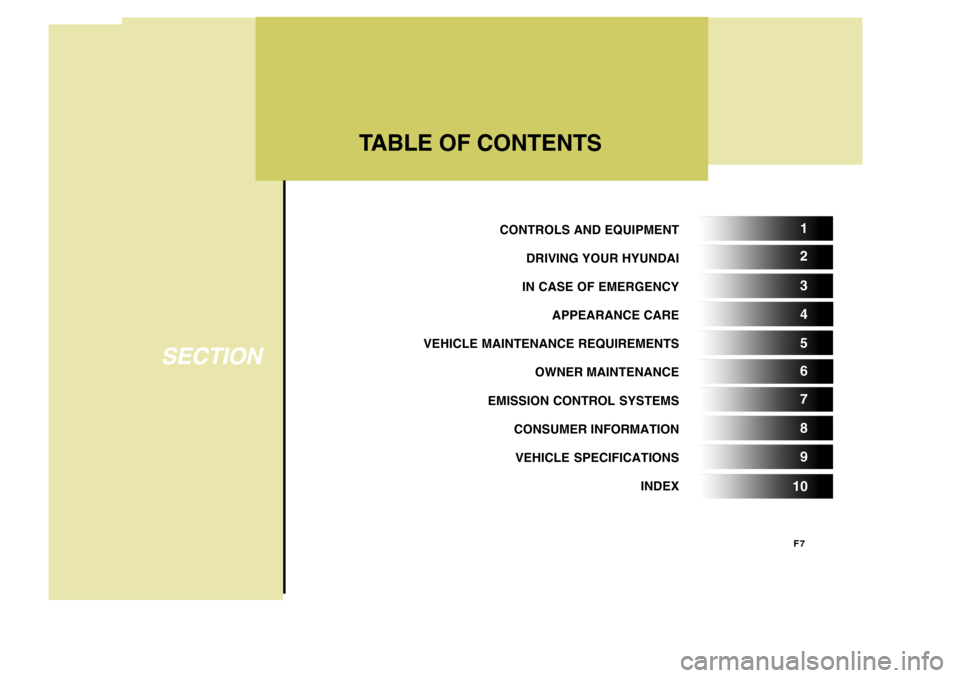
CONTROLS AND EQUIPMENT
DRIVING YOUR HYUNDAI
IN CASE OF EMERGENCY
APPEARANCE CARE
VEHICLE MAINTENANCE REQUIREMENTS OWNER MAINTENANCE
EMISSION CONTROL SYSTEMS CONSUMER INFORMATIONVEHICLE SPECIFICATIONS
INDEX
TABLE OF CONTENTS
SECTION
5
1 2 3 4 6 7 8 9
10
Page 295 of 407
2DRIVING YOUR HYUNDAI
2
C010A02O-EAT
WARNING: ENGINE EXHAUST CAN BE DANGEROUS!
Engine exhaust gases are potentially lethal. If at any time engine exhaust gas is detected within the passenger compartment, move the vehicle to an open area and open all windows. o Never inhale exhaust gas. Exhaust gases contain Carbon Monoxide which is colourless and odourless. Carbon Monoxide is poisonous and can cause unconsciousness and death by asphyxiation. o Exhaust System Maintenance. Ensure that the exhaust system is maintained in good condition and is free from excessive corrosion anddamage which may result in leakage. If the vehicle is driven over an object which strikes the exhaust system, ensure that the exhaust system is inspected at the first available opportunity to ensure that no leakage exists. o Confined Areas. Do not run the engine in confined spaces, allowing the engine to idle in a garage, even when the doors are open is dangerous practice. Only start the engine immediately prior to moving the vehicle out of the garage. o Prolonged Idling. If it is necessary to allow the vehicle to idle for prolonged periods, ensure that the heating system air intakecontrol is set to the "Fresh" position, the blower is set to high speed operation and that the vehicle is standing in an open area. To ensure correct operation of the heater system, the air intake grilles at the base of the windscreen must not be obstructed by snow leaves etc..
!
Page 306 of 407

2
DRIVING YOUR HYUNDAI
13
o Check the automatic transaxle fluid level regularly, and add fluid as necessary.
o See the maintenance schedule for
the proper fluid recommendation.
C090N05O-EAT General Operating Instructions
o The engine may only be started when
the selector lever is at position "P".
o Ensure that the footbrake is firmly applied when shifting from "P" or "N", to "R" or "D" and vice versa.
o Always engage the parking brake when the vehicle is unattended, neveruse the "P" or "R" position in place ofthe parking brake.
o Under normal circumstances, the
selector lever should be placed in the"D" position and the transaxle al- lowed to select the most ideal ratio for the circumstances. In this posi-tion maximum fuel economy will be achieved.
o When descending steep gradients where engine braking is required, theselector lever should be shifted into 1st gear whilst in sport mode de-pending upon the vehicle speed.
o When climbing steep gradients and
using large throttle openings, thetransaxle may repeatedly change between two adjacent ratios. This is a normal characteristic and may beprevented by shifting into 1st gear whilst in sport mode depending upon the vehicle speed. o Never move the selector lever to or
from the "P" or "N" position with theaccelerator depressed.
o If rapid acceleration is required, fully
depress the accelerator pedal. Inthis condition, the kickdown mecha- nism will be operated and the transaxle will automatically down-shift according to the vehicle speed.
o Do not depress the accelerator pedal
with the brakes applied and the se-lector at the "R" or "D" position.
o The automatic transaxle may be used
to great effect if the vehicle becomesstuck in snow or mud by allowing the vehicle to be rocked to and fro. The engine speed should be held at ap-proximately 1,000rpm by means of the accelerator pedal and the selec- tor lever moved between the "D" and"R" positions to induce a rocking motion.
o Optimum vehicle performance and economy is obtained by smoothlydepressing and releasing the accel- erator pedal.
Page 310 of 407
2
DRIVING YOUR HYUNDAI
17
o Apply the parking brake only when the vehicle is at rest.
o Since the power assistance provided by the brake servo is derived from the engine, coasting with the engineturned off or towing of the vehicle with the engine turned off will result in greatly increased pedal pressuresbeing required to stop the vehicle.
o Do not hold the vehicle on an incline
with the accelerator pedal. This cancause the transmission to overheat. Always use the brake pedal or park- ing brake.
o Use caution when parking on a hill. Engage the parking brake and placethe gear selector lever in "P" (auto-matic transaxle) or in first or reverse gear (manual transaxle). If your car is facing downhill, turn the frontwheels into the curb to help keep the car from rolling. If your car is facing uphill, turn the front wheels awayfrom the curb to help keep the car from rolling. If there is no curb or if it is required by other conditions tokeep the car from rolling, block the wheels.DRIVING FOR ECONOMY
C140A02A-EAT You can save fuel and get more miles from your car if you follow these sug- gestions:
o Drive smoothly. Accelerate at a moderate rate. Don't make "jack- rabbit" starts or full-throttle shiftsand maintain a steady cruising speed. Don't race between stoplights. Try to adjust your speed to that of the othertraffic so you don't have to change speeds unnecessarily. Avoid heavy traffic whenever possible. Alwaysmaintain a safe distance from other vehicles so you can avoid unneces- sary braking. This also reduces brakewear.
o Drive at a moderate speed. The faster
you drive, the more fuel your caruses. Driving at a moderate speed, especially on the motorway, is one of the most effective ways to reducefuel consumption.
o Don't "ride" the brake or clutch pedal.
This can increase fuel consumptionand also increase wear on these components. In addition, driving with your foot resting on the brake pedalmay cause the brakes to overheat, which reduces their effectivenessand may lead to more serious conse-quences.
o Take care of your tyres. Keep them
inflated to the recommended pres-sure. Incorrect inflation, either too much or too little, results in unneces- sary tyre wear. Check the tyre pres-sures at least once a month.
o Be sure that the wheels are aligned
correctly. Improper alignment canresult from hitting curbs or driving too fast over irregular surfaces. Poor alignment causes faster tyre wearand may also result in other prob- lems as well as greater fuel con- sumption.
o Keep your car in good condition. For better fuel economy and reducedmaintenance costs, maintain yourcar in accordance with the mainte- nance schedule in Section 5. If you drive your car in severe conditions,more frequent maintenance is re- quired (see Section 5 for details).
Page 314 of 407

2
DRIVING YOUR HYUNDAI
21
YC200C4-E Trailer Brakes If your trailer is equipped with a braking system, make sure it conforms to localregulations and that it is properly in- stalled and operating correctly. NOTE: If you tow a trailer or vehicle, your car will require more frequent main- tenance due to the additional load.See Maintenance Under Severe Us- age Conditions" on page 5-7.
YC200B2-E Trailer Towbars Select the proper towbar and ball com- bination, making sure that its location is compatible with that of the trailer or vehicle being towed.Use a quality non-equalizing towbar which distributes the nose weight uni- formly throughout the chassis. The towbar should be bolted securely to the car and installed by a qualifiedtechnician.
CAUTION:
o Never connect a trailer brake sys- tem directly to the vehicle brakesystem.
o When towing a trailer on steep grades (in excess of 6%) pay closeattention to the engine coolanttemperature gauge to ensure the engine does not overheat. If the needle of the coolant temperaturegauge moves across the dial to- wards "H" (HOT), pull over and stop as soon as it is safe to do so,and allow the engine to idle until it cools down. You may proceed once the engine has cooled suffi-ciently.
!