door lock HYUNDAI COUPE 2012 Owner's Manual
[x] Cancel search | Manufacturer: HYUNDAI, Model Year: 2012, Model line: COUPE, Model: HYUNDAI COUPE 2012Pages: 391, PDF Size: 6.88 MB
Page 134 of 391
457
Features of your vehicle
D150325ABH
Cruise indicator (if equipped)
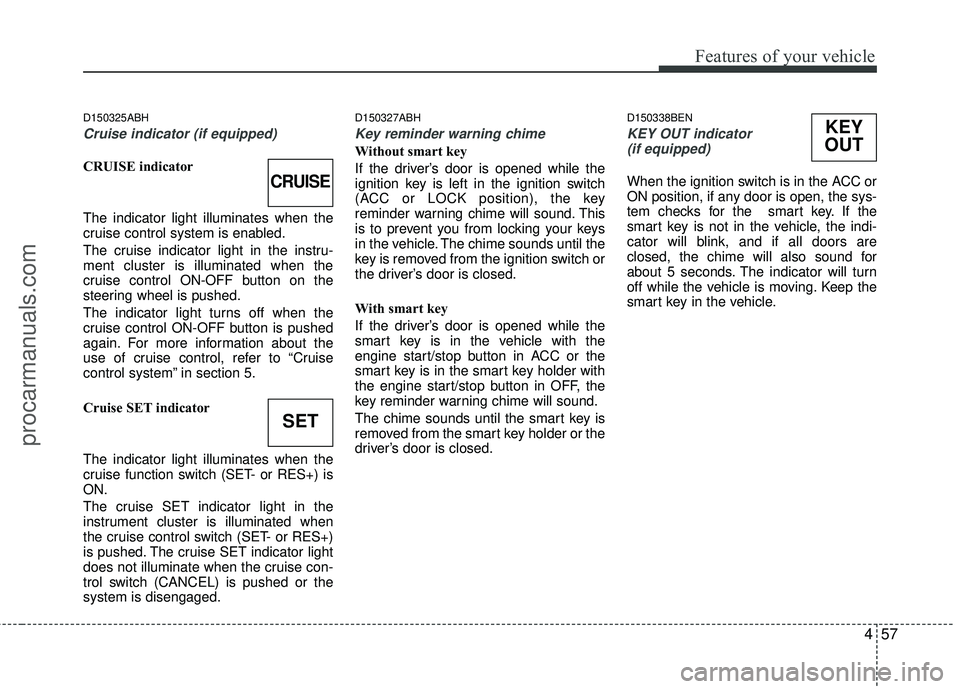
CRUISE indicator
The indicator light illuminates when the
cruise control system is enabled.
The cruise indicator light in the instru-
ment cluster is illuminated when the
cruise control ON-OFF button on the
steering wheel is pushed.
The indicator light turns off when the
cruise control ON-OFF button is pushed
again. For more information about the
use of cruise control, refer to “Cruise
control system” in section 5.
Cruise SET indicator
The indicator light illuminates when the
cruise function switch (SET- or RES+) is
ON.
The cruise SET indicator light in the
instrument cluster is illuminated when
the cruise control switch (SET- or RES+)
is pushed. The cruise SET indicator light
does not illuminate when the cruise con-
trol switch (CANCEL) is pushed or the
system is disengaged.
D150327ABH
Key reminder warning chime
Without smart key
If the driver’s door is opened while the
ignition key is left in the ignition switch
(ACC or LOCK position), the key
reminder warning chime will sound. This
is to prevent you from locking your keys
in the vehicle. The chime sounds until the
key is removed from the ignition switch or
the driver’s door is closed.
With smart key
If the driver’s door is opened while the
smart key is in the vehicle with the
engine start/stop button in ACC or the
smart key is in the smart key holder with
the engine start/stop button in OFF, the
key reminder warning chime will sound.
The chime sounds until the smart key is
removed from the smart key holder or the
driver’s door is closed.
D150338BEN
KEY OUT indicator (if equipped)
When the ignition switch is in the ACC or
ON position, if any door is open, the sys-
tem checks for the smart key. If the
smart key is not in the vehicle, the indi-
cator will blink, and if all doors are
closed, the chime will also sound for
about 5 seconds. The indicator will turn
off while the vehicle is moving. Keep the
smart key in the vehicle.
SET
CRUISE
KEY
OUT
procarmanuals.com
Page 138 of 391
461
Features of your vehicle
D190100ABH
Battery saver function
The purpose of this feature is to pre-vent the battery from being dis-
charged. The system automatically
turns off the exterior lights when the
driver removes the ignition key (smart
key : turns off the engine) and opens
the driver-side door. (in that order)
With this feature, the parking lights will be turned off automatically if the driver
parks on the side of road at night.
If necessary, to keep the lights on
when the ignition key is removed
(smart key : turns off the engine), per-
form the following:
1) Open the driver-side door.
2) Turn the parking lights OFF and ON again using the light switch on the
steering column.
Headlight escort function
(if equipped)
If you turn the ignition switch to the ACC
or OFF position with the headlights ON,
the headlights (and/or tail lights) remain
on for about 20 minutes. However, if the
driver’s door is opened and closed, the
headlights are turned off after 30 sec-
onds.
The headlights can be turned off by
pressing the lock button on the transmit-
ter (or smart key) twice or turning the
light switch to the OFF or Auto position.
However, if you turn the light switch to the
Auto position when it is dark outside, the
headlights will not be turned off.
Headlamp welcome function
(if equipped)
When the headlight switch is in the ON or
AUTO position and all doors (and trunk)
are closed and locked, if you press the
door unlock button on the transmitter (or
the smart key), the parking light will come
on for about 15 seconds. At this time, if
you press the door lock button on the
transmitter (or smart key) the parking
light will turn off immediately.
LIGHTING
CAUTION
If the driver gets out of the vehicle
through other doors (except dri-ver’s door), the battery saver func-tion does not operate and the head-light escort function does not turn off automatically. Therefore, it caus-es the battery to be discharged. Inthis case, make sure to turn off the lamp before getting out of the vehi-cle.
procarmanuals.com
Page 144 of 391
467
Features of your vehicle
D210000AEND210100ABK
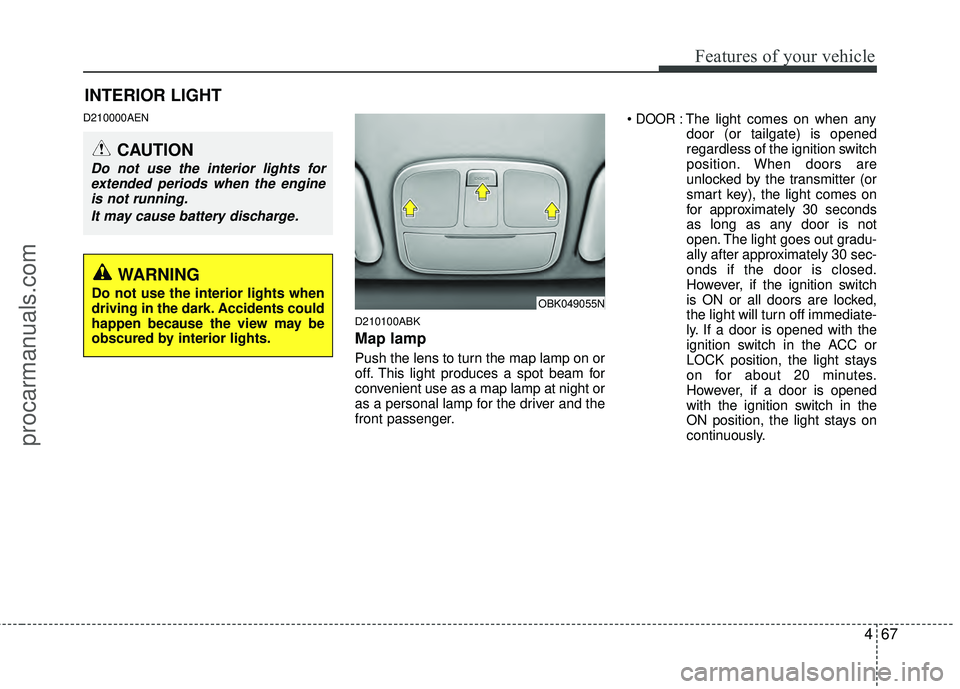
Map lamp
Push the lens to turn the map lamp on or
off. This light produces a spot beam for
convenient use as a map lamp at night or
as a personal lamp for the driver and the
front passenger.
DOOR: The light comes on when any
door (or tailgate) is opened
regardless of the ignition switch
position. When doors are
unlocked by the transmitter (or
smart key), the light comes on
for approximately 30 seconds
as long as any door is not
open. The light goes out gradu-
ally after approximately 30 sec-
onds if the door is closed.
However, if the ignition switch
is ON or all doors are locked,
the light will turn off immediate-
ly. If a door is opened with the
ignition switch in the ACC or
LOCK position, the light stays
on for about 20 minutes.
However, if a door is opened
with the ignition switch in the
ON position, the light stays on
continuously.
INTERIOR LIGHT
CAUTION
Do not use the interior lights forextended periods when the engineis not running.
It may cause battery discharge.
OBK049055N
WARNING
Do not use the interior lights when
driving in the dark. Accidents could
happen because the view may be
obscured by interior lights.
procarmanuals.com
Page 170 of 391
493
Features of your vehicle
D270300AUN
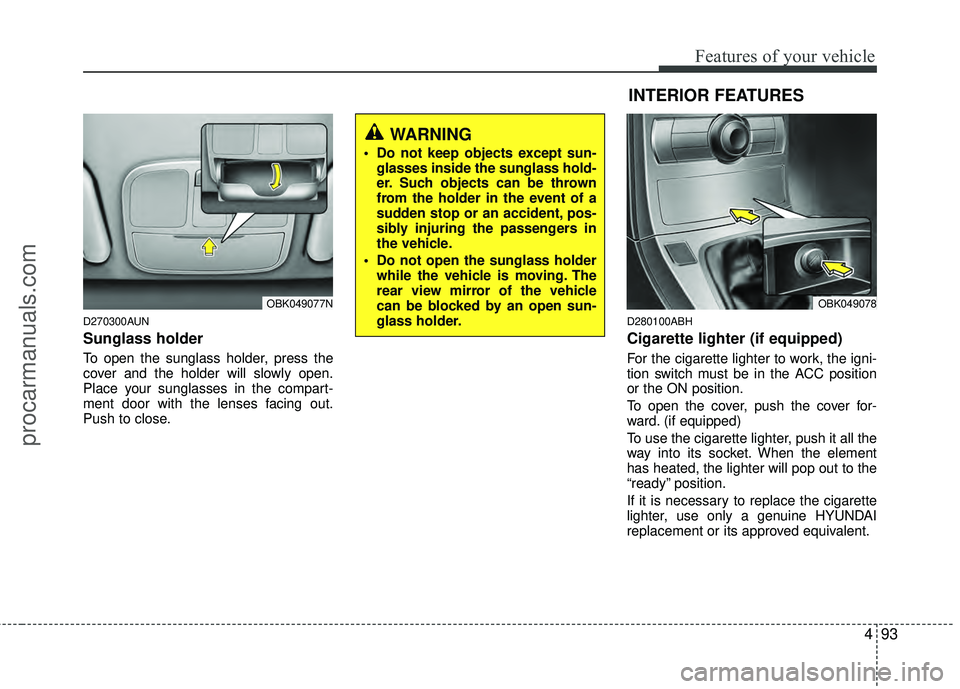
Sunglass holder
To open the sunglass holder, press the
cover and the holder will slowly open.
Place your sunglasses in the compart-
ment door with the lenses facing out.
Push to close.
D280100ABH
Cigarette lighter (if equipped)
For the cigarette lighter to work, the igni-
tion switch must be in the ACC position
or the ON position.
To open the cover, push the cover for-
ward. (if equipped)
To use the cigarette lighter, push it all the
way into its socket. When the element
has heated, the lighter will pop out to the
“ready” position.
If it is necessary to replace the cigarette
lighter, use only a genuine HYUNDAI
replacement or its approved equivalent.
OBK049077N
WARNING
Do not keep objects except sun-glasses inside the sunglass hold-
er. Such objects can be thrown
from the holder in the event of a
sudden stop or an accident, pos-
sibly injuring the passengers in
the vehicle.
Do not open the sunglass holder while the vehicle is moving. The
rear view mirror of the vehicle
can be blocked by an open sun-
glass holder.
INTERIOR FEATURES
OBK049078
procarmanuals.com
Page 230 of 391
53
Driving your vehicle
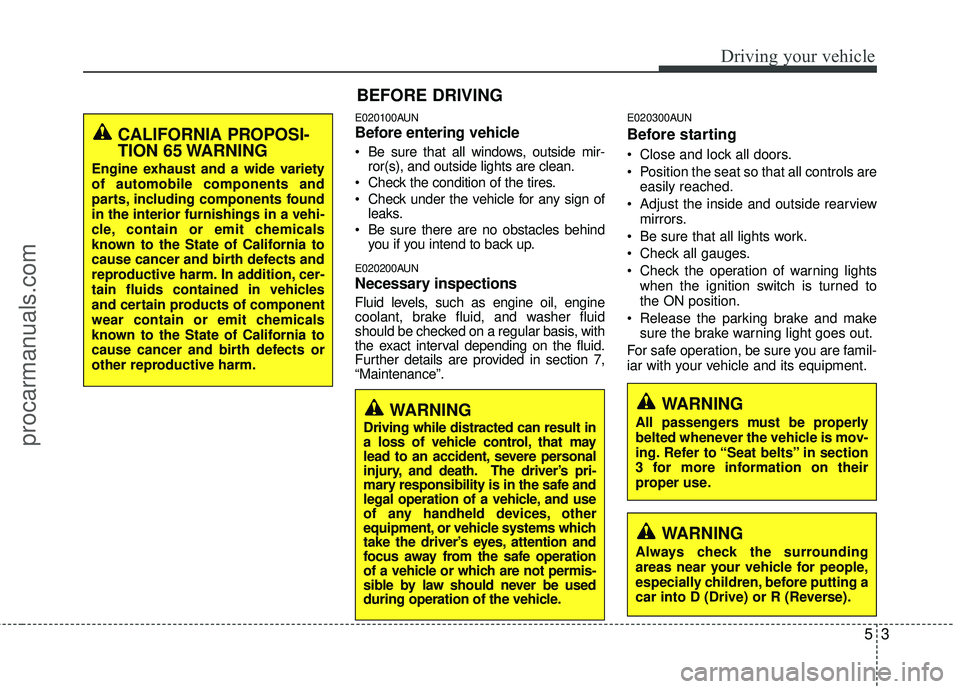
E020100AUN
Before entering vehicle
• Be sure that all windows, outside mir-ror(s), and outside lights are clean.
Check the condition of the tires.
Check under the vehicle for any sign of leaks.
Be sure there are no obstacles behind you if you intend to back up.
E020200AUN
Necessary inspections
Fluid levels, such as engine oil, engine
coolant, brake fluid, and washer fluid
should be checked on a regular basis, with
the exact interval depending on the fluid.
Further details are provided in section 7,
“Maintenance”.
E020300AUN
Before starting
Close and lock all doors.
Position the seat so that all controls are
easily reached.
Adjust the inside and outside rearview mirrors.
Be sure that all lights work.
Check all gauges.
Check the operation of warning lights when the ignition switch is turned to
the ON position.
Release the parking brake and make sure the brake warning light goes out.
For safe operation, be sure you are famil-
iar with your vehicle and its equipment.
BEFORE DRIVING
WARNING
All passengers must be properly
belted whenever the vehicle is mov-
ing. Refer to “Seat belts” in section
3 for more information on their
proper use.
CALIFORNIA PROPOSI-
TION 65 WARNING
Engine exhaust and a wide variety
of automobile components and
parts, including components found
in the interior furnishings in a vehi-
cle, contain or emit chemicals
known to the State of California to
cause cancer and birth defects and
reproductive harm. In addition, cer-
tain fluids contained in vehicles
and certain products of component
wear contain or emit chemicals
known to the State of California to
cause cancer and birth defects or
other reproductive harm.
WARNING
Always check the surrounding
areas near your vehicle for people,
especially children, before putting a
car into D (Drive) or R (Reverse).
WARNING
Driving while distracted can result in
a loss of vehicle control, that may
lead to an accident, severe personal
injury, and death. The driver’s pri-
mary responsibility is in the safe and
legal operation of a vehicle, and use
of any handheld devices, other
equipment, or vehicle systems which
take the driver’s eyes, attention and
focus away from the safe operation
of a vehicle or which are not permis-
sible by law should never be used
during operation of the vehicle.
procarmanuals.com
Page 234 of 391
57
Driving your vehicle
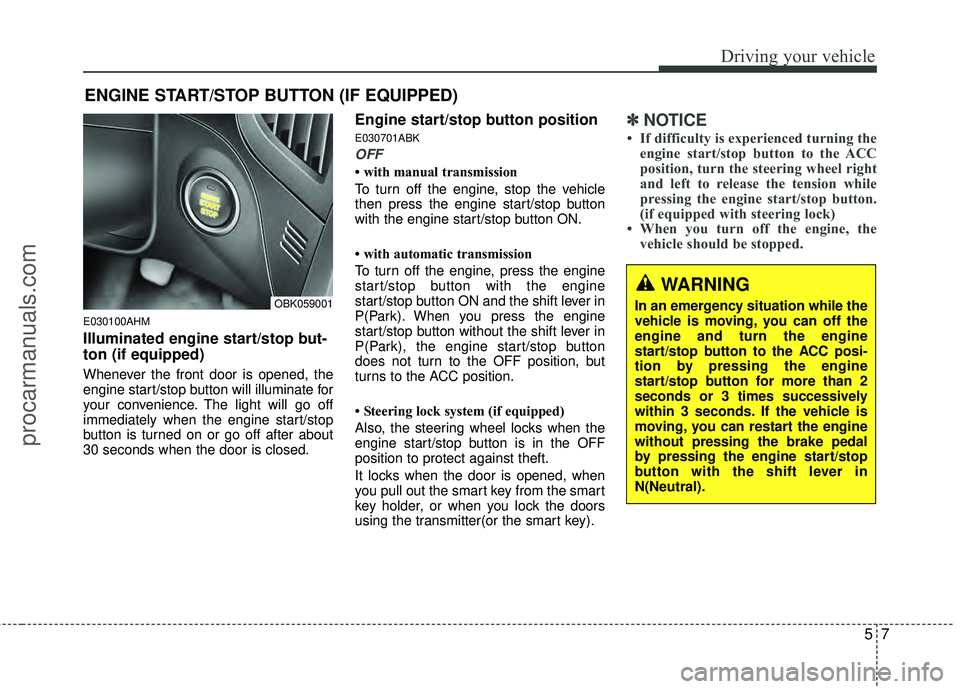
E030100AHM
Illuminated engine start/stop but-
ton (if equipped)
Whenever the front door is opened, the
engine start/stop button will illuminate for
your convenience. The light will go off
immediately when the engine start/stop
button is turned on or go off after about
30 seconds when the door is closed.
Engine start/stop button position
E030701ABK
OFF
• with manual transmission
To turn off the engine, stop the vehicle
then press the engine start/stop button
with the engine start/stop button ON.
• with automatic transmission
To turn off the engine, press the engine
start/stop button with the engine
start/stop button ON and the shift lever in
P(Park). When you press the engine
start/stop button without the shift lever in
P(Park), the engine start/stop button
does not turn to the OFF position, but
turns to the ACC position.
• Steering lock system (if equipped)
Also, the steering wheel locks when the
engine start/stop button is in the OFF
position to protect against theft.
It locks when the door is opened, when
you pull out the smart key from the smart
key holder, or when you lock the doors
using the transmitter(or the smart key).
✽ ✽NOTICE
• If difficulty is experienced turning the
engine start/stop button to the ACC
position, turn the steering wheel right
and left to release the tension while
pressing the engine start/stop button.
(if equipped with steering lock)
• When you turn off the engine, the vehicle should be stopped.
ENGINE START/STOP BUTTON (IF EQUIPPED)
OBK059001
WARNING
In an emergency situation while the
vehicle is moving, you can off the
engine and turn the engine
start/stop button to the ACC posi-
tion by pressing the engine
start/stop button for more than 2
seconds or 3 times successively
within 3 seconds. If the vehicle is
moving, you can restart the engine
without pressing the brake pedal
by pressing the engine start/stop
button with the shift lever in
N(Neutral).
procarmanuals.com
Page 309 of 391
77
Maintenance
SCHEDULED MAINTENANCE SERVICE
G030105AHM
At least once a year:
Clean the body and door drain holes.
Lubricate the door hinges and checks,and hood hinges.
Lubricate the door and hood locks and latches.
Lubricate the door rubber weather- strips.
Check the air conditioning system.
Check the power steering fluid level.
Inspect and lubricate the automatic transmission linkage and controls.
Clean the battery and terminals.
Check the brake fluid level.
G040000AUN-EU
Follow Normal Maintenance Schedule if
the vehicle is usually operated where
none of the following conditions apply. If
any of the following conditions apply, fol-
low Maintenance Under Severe Usage
Conditions.
Repeated short distance driving.
Driving in dusty conditions or sandy areas.
Extensive use of brakes.
Driving in areas where salt or other corrosive materials are being used.
Driving on rough or muddy roads.
Driving in mountainous areas.
Extended periods of idling or low speed operation.
Driving for a prolonged period in cold temperatures and/or extremely humid
climates.
More than 50% driving in heavy city traffic during hot weather above 90°F
(32°C).If your vehicle is operated under theabove conditions, you should inspect, replace or refill more frequently than thefollowing Normal Maintenance Schedule. After 120 months or 150,000 miles(240,000 km) continue to follow the pre-scribed maintenance intervals.
procarmanuals.com
Page 384 of 391

I3
Index
CareExterior care ··················\
··················\
··················\
········7-61
Interior care ··················\
··················\
··················\
·········7-66
Tire care··················\
··················\
··················\
···············7-33
Cargo capacity ··················\
··················\
··················\
·········5-47
Cargo weight ··················\
··················\
··················\
············5-51
Center console storage ··················\
··················\
···············4-92
Central door lock switch··················\
··················\
············4-17
Certification label ··················\
··················\
··················\
····5-49
Changing a tire with TPMS ··················\
··················\
·········6-7
Changing tires ··················\
··················\
··················\
··········6-13
Chains Tire chains··················\
··················\
··················\
··5-43, 7-45
Checking tire inflation pressure··················\
··················\
·7-34
Child restraint system ··················\
··················\
················3-25 Auto lock mode (Passenger seat belt) ··················\
·····3-27
Lower anchor system ··················\
··················\
············3-31
Tether anchor system··················\
··················\
·············3-29
Climate control system (Automatic) ··················\
···········4-79 Air conditioning ··················\
··················\
··················\
··4-84
Automatic heating and air conditioning··················\
··4-80
Manual heating and air conditioning ··················\
······4-81
Climate control system (Manual) ··················\
···············4-70 Air conditioning ··················\
··················\
··················\
··4-75
Heating and air conditioning··················\
··················\
·4-71 Climate control air filter··················\
··················\
···4-77, 7-25
Clock (Digital) ··················\
··················\
··················\
·········4-96
Combined instrument, see instrument cluster ···············4-42
Compact spare tire ··················\
··················\
··················\
···6-18
Compact spare tire replacement ··················\
··················\
7-38
Consumer information ··················\
··················\
·················8-8
Coolant ··················\
··················\
··················\
··················\
···7-17
Cooling fluid, see engine coolant ··················\
················7-18
Crankcase emission control system ··················\
·············7-67
Cruise control system ··················\
··················\
················5-32
Cup holder ··················\
··················\
··················\
···············4-94
Curtain air bag ··················\
··················\
··················\
·········3-50
Dashboard, see instrument cluster ··················\
···············4-42
Dashboard illumination, see instrument
panel illumination··················\
··················\
··················\
4-43
Defogging (Windshield) ··················\
··················\
············4-90
Defogging logic (Windshield) ··················\
··················\
···4-91
Defroster (Rear window) ··················\
··················\
···········4-69
Defrosting (Windshield) ··················\
··················\
············4-90
Digital clock··················\
··················\
··················\
·············4-96
Dimensions ··················\
··················\
··················\
················8-2
Display illumination, see instrument panel illumination··················\
··················\
··················\
4-43
Displays, see instrument cluster ··················\
··················\
4-42
D
procarmanuals.com
Page 385 of 391

Index
4I
Door locks··················\
··················\
··················\
················4-15Central door lock switch ··················\
··················\
·······4-17
Driver's air bag··············\
··················\
··················\
·············3-44
Driving at night··················\
··················\
··················\
········5-39
Driving in flooded areas ··················\
··················\
············5-40
Driving in the rain ··················\
··················\
··················\
···5-40
Economical operation ··················\
··················\
················5-56
Electric chromic mirror (ECM) ··················\
··················\
·4-33
Electronic stability control (ESC) ··················\
···············5-27
Emergency starting ··················\
··················\
··················\
····6-4 Jump starting ··················\
··················\
··················\
·········6-4
Push starting ··················\
··················\
··················\
··········6-5
Emergency trunk safety release ··················\
··················\
·4-19
Emergency towing ··················\
··················\
··················\
···6-22
Emergency while driving··················\
··················\
·············6-2
Emission control system ··················\
··················\
············7-67 Crankcase emission control system ··················\
········7-67
Evaporative emission control (including ORVR) System ··················\
··················\
··················\
··············7-67
Exhaust emission control system ··················\
············7-68
Engine compartment ··················\
··················\
············2-4, 7-2
Engine coolant ··················\
··················\
··················\
·········7-17
Engine number ··················\
··················\
··················\
···········8-7
Engine oil ··················\
··················\
··················\
·················7-16\
Engine overheats··················\
··················\
··················\
········6-6 Engine start/stop button ··················\
··················\
···············5-7
Engine temperature gauge ··················\
··················\
·········4-44
Engine will not start··················\
··················\
··················\
···6-3
Evaporative emission control (including ORVR)
System ··················\
··················\
··················\
·················7-67\
Exhaust emission control system··················\
·················7-68\
Explanation of scheduled maintenance items ···············7-13
Exterior care··················\
··················\
··················\
·············7-61
Flat tire ··················\
··················\
··················\
··················\
···6-12 Changing tires ··················\
··················\
··················\
·····6-13
Compact spare tire ··················\
··················\
················6-18
Jack and tools ··················\
··················\
··················\
······6-12
Removing and storing the spare tire ··················\
·······6-13
Floor mat anchor(s) ··················\
··················\
··················\
·4-97
Fluid Brake/clutch fluid ··················\
··················\
··················\
7-20
Power steering fluid ··················\
··················\
··············7-21
Washer fluid ··················\
··················\
··················\
········7-22
Folding the rear seat ··················\
··················\
··················\
3-11
Front fog light bulb replacement ··················\
·················7-56\
Front seat adjustment - manual ··················\
··················\
···3-4
Front seat adjustment - power ··················\
··················\
·····3-9
Fuel filler door ··················\
··················\
··················\
·········4-25
Fuel gauge··················\
··················\
··················\
················4-45
Fuel requirements ··················\
··················\
··················\
······1-3
E
F
procarmanuals.com