fuel HYUNDAI COUPE 2016 Owner's Guide
[x] Cancel search | Manufacturer: HYUNDAI, Model Year: 2016, Model line: COUPE, Model: HYUNDAI COUPE 2016Pages: 475, PDF Size: 14.78 MB
Page 344 of 475
557
Driving your vehicle
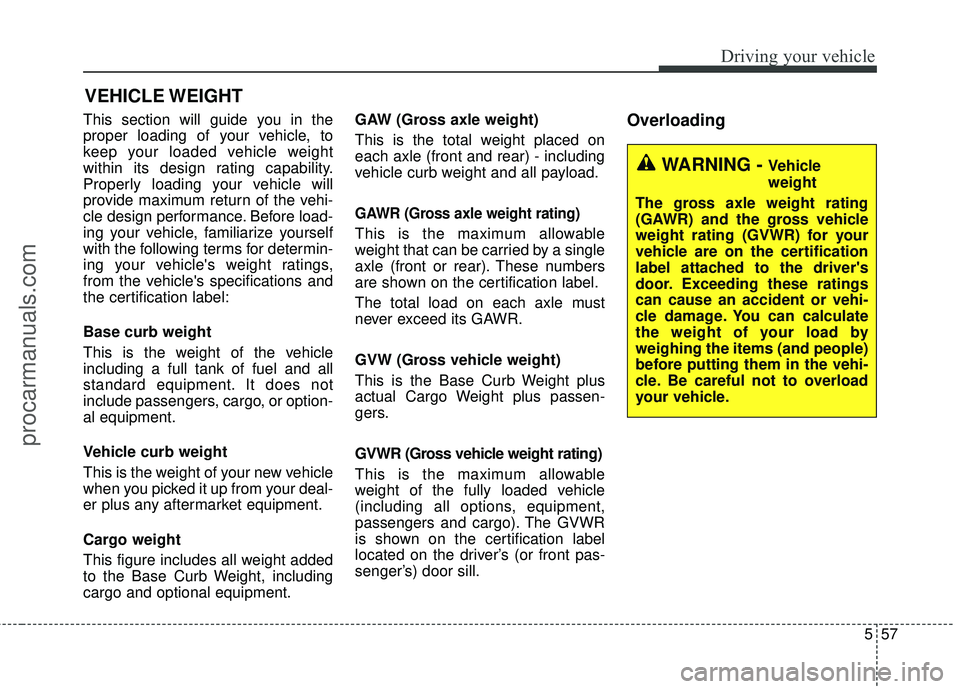
This section will guide you in the
proper loading of your vehicle, to
keep your loaded vehicle weight
within its design rating capability.
Properly loading your vehicle will
provide maximum return of the vehi-
cle design performance. Before load-
ing your vehicle, familiarize yourself
with the following terms for determin-
ing your vehicle's weight ratings,
from the vehicle's specifications and
the certification label:
Base curb weight
This is the weight of the vehicle
including a full tank of fuel and all
standard equipment. It does not
include passengers, cargo, or option-
al equipment.
Vehicle curb weight
This is the weight of your new vehicle
when you picked it up from your deal-
er plus any aftermarket equipment.
Cargo weight
This figure includes all weight added
to the Base Curb Weight, including
cargo and optional equipment.GAW (Gross axle weight)
This is the total weight placed on
each axle (front and rear) - including
vehicle curb weight and all payload.
GAWR (Gross axle weight rating)
This is the maximum allowable
weight that can be carried by a single
axle (front or rear). These numbers
are shown on the certification label.
The total load on each axle must
never exceed its GAWR.
GVW (Gross vehicle weight)
This is the Base Curb Weight plus
actual Cargo Weight plus passen-
gers.
GVWR (Gross vehicle weight rating)
This is the maximum allowable
weight of the fully loaded vehicle
(including all options, equipment,
passengers and cargo). The GVWR
is shown on the certification label
located on the driver’s (or front pas-
senger’s) door sill.
Overloading
VEHICLE WEIGHT
WARNING - Vehicle
weight
The gross axle weight rating
(GAWR) and the gross vehicle
weight rating (GVWR) for your
vehicle are on the certification
label attached to the driver's
door. Exceeding these ratings
can cause an accident or vehi-
cle damage. You can calculate
the weight of your load by
weighing the items (and people)
before putting them in the vehi-
cle. Be careful not to overload
your vehicle.
procarmanuals.com
Page 348 of 475
63
What to do in an emergency
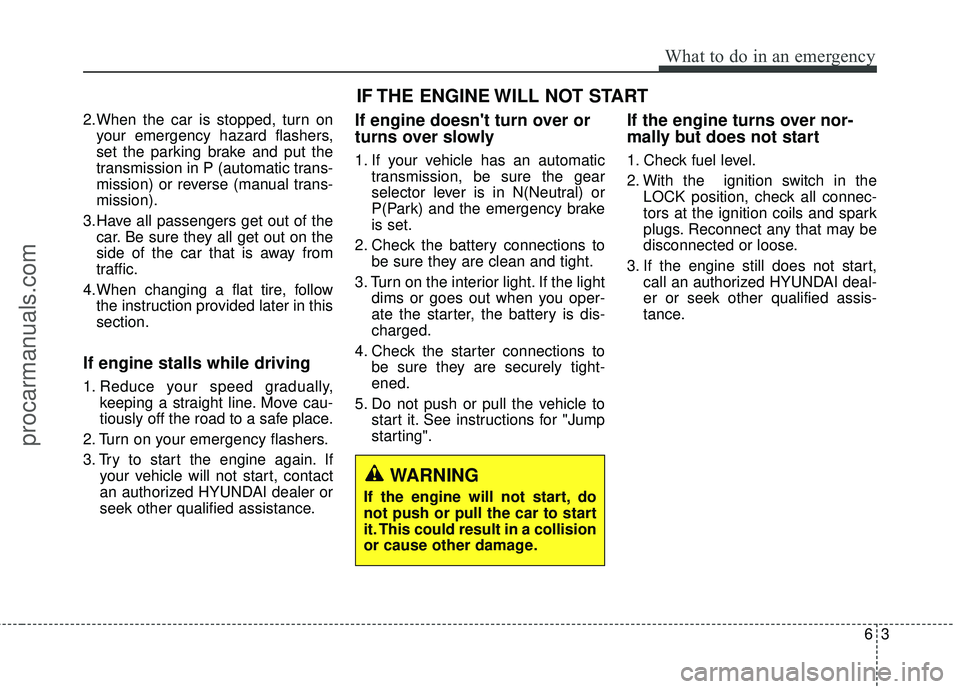
2.When the car is stopped, turn onyour emergency hazard flashers,
set the parking brake and put the
transmission in P (automatic trans-
mission) or reverse (manual trans-
mission).
3.Have all passengers get out of the car. Be sure they all get out on the
side of the car that is away from
traffic.
4.When changing a flat tire, follow the instruction provided later in this
section.
If engine stalls while driving
1. Reduce your speed gradually, keeping a straight line. Move cau-
tiously off the road to a safe place.
2. Turn on your emergency flashers.
3. Try to start the engine again. If your vehicle will not start, contact
an authorized HYUNDAI dealer or
seek other qualified assistance.
If engine doesn't turn over or
turns over slowly
1. If your vehicle has an automatictransmission, be sure the gear
selector lever is in N(Neutral) or
P(Park) and the emergency brake
is set.
2. Check the battery connections to be sure they are clean and tight.
3. Turn on the interior light. If the light dims or goes out when you oper-
ate the starter, the battery is dis-
charged.
4. Check the starter connections to be sure they are securely tight-
ened.
5. Do not push or pull the vehicle to start it. See instructions for "Jump
starting".
If the engine turns over nor-
mally but does not start
1. Check fuel level.
2. With the ignition switch in theLOCK position, check all connec-
tors at the ignition coils and spark
plugs. Reconnect any that may be
disconnected or loose.
3. If the engine still does not start, call an authorized HYUNDAI deal-
er or seek other qualified assis-
tance.
IF THE ENGINE WILL NOT START
WARNING
If the engine will not start, do
not push or pull the car to start
it. This could result in a collision
or cause other damage.
procarmanuals.com
Page 352 of 475
67
What to do in an emergency
TIRE PRESSURE MONITORING SYSTEM (TPMS)
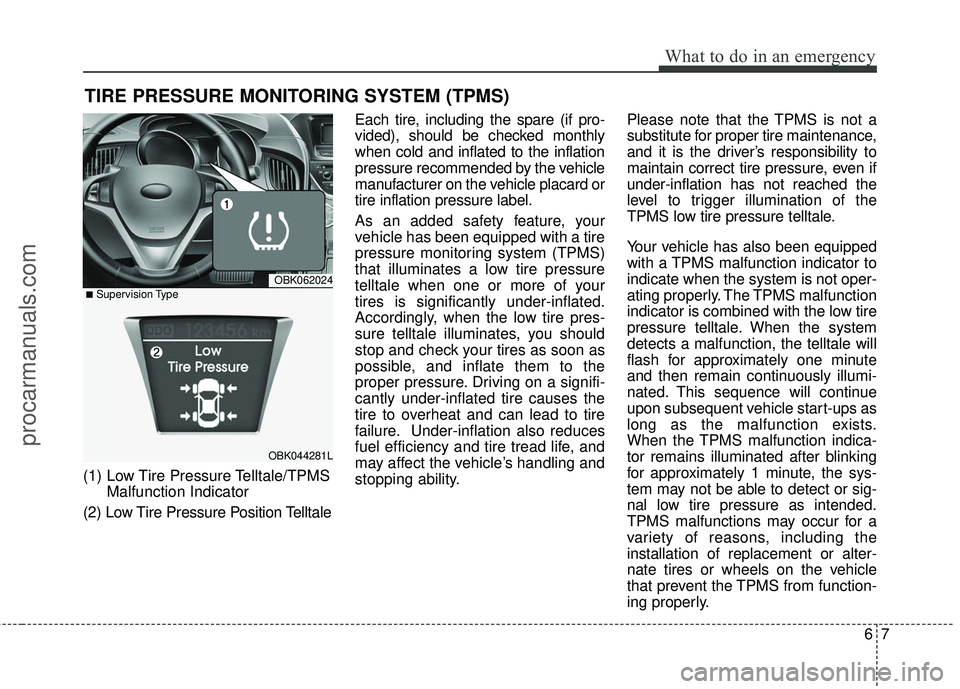
(1) Low Tire Pressure Telltale/TPMSMalfunction Indicator
(2) Low Tire Pressure Position Telltale Each tire, including the spare (if pro-
vided), should be checked monthly
when cold and inflated to the inflation
pressure recommended by the vehicle
manufacturer on the vehicle placard or
tire inflation pressure label.
As an added safety feature, your
vehicle has been equipped with a tire
pressure monitoring system (TPMS)
that illuminates a low tire pressure
telltale when one or more of your
tires is significantly under-inflated.
Accordingly, when the low tire pres-
sure telltale illuminates, you should
stop and check your tires as soon as
possible, and inflate them to the
proper pressure. Driving on a signifi-
cantly under-inflated tire causes the
tire to overheat and can lead to tire
failure. Under-inflation also reduces
fuel efficiency and tire tread life, and
may affect the vehicle’s handling and
stopping ability.
Please note that the TPMS is not a
substitute for proper tire maintenance,
and it is the driver’s responsibility to
maintain correct tire pressure, even if
under-inflation has not reached the
level to trigger illumination of the
TPMS low tire pressure telltale.
Your vehicle has also been equipped
with a TPMS malfunction indicator to
indicate when the system is not oper-
ating properly. The TPMS malfunction
indicator is combined with the low tire
pressure telltale. When the system
detects a malfunction, the telltale will
flash for approximately one minute
and then remain continuously illumi-
nated. This sequence will continue
upon subsequent vehicle start-ups as
long as the malfunction exists.
When the TPMS malfunction indica-
tor remains illuminated after blinking
for approximately 1 minute, the sys-
tem may not be able to detect or sig-
nal low tire pressure as intended.
TPMS malfunctions may occur for a
variety of reasons, including the
installation of replacement or alter-
nate tires or wheels on the vehicle
that prevent the TPMS from function-
ing properly.
OBK062024
OBK044281L
■Supervision Type
procarmanuals.com
Page 374 of 475
75
Maintenance
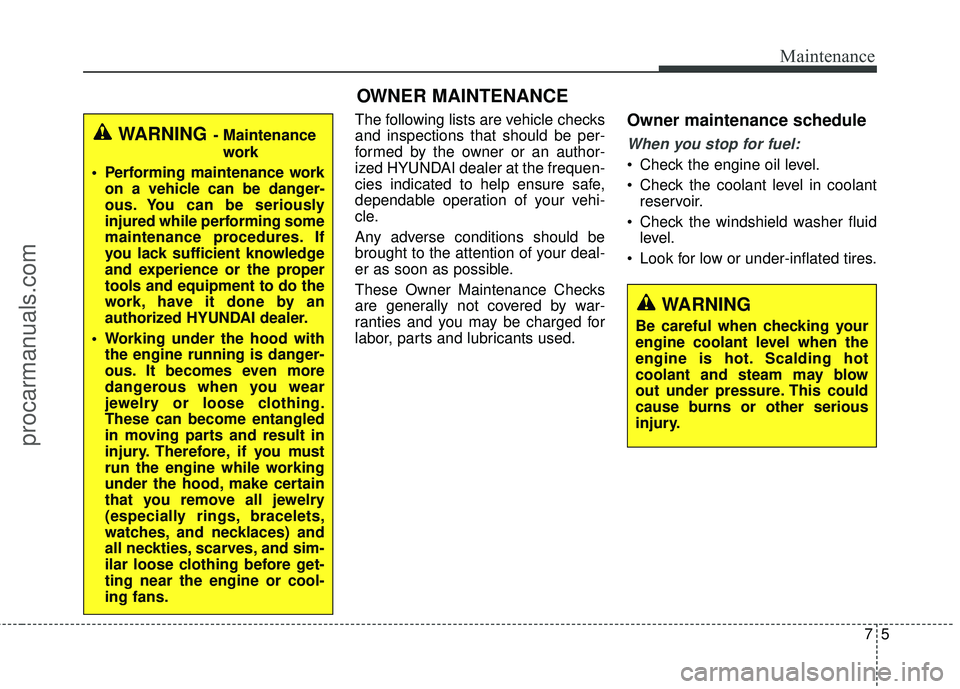
OWNER MAINTENANCE
The following lists are vehicle checks
and inspections that should be per-
formed by the owner or an author-
ized HYUNDAI dealer at the frequen-
cies indicated to help ensure safe,
dependable operation of your vehi-
cle.
Any adverse conditions should be
brought to the attention of your deal-
er as soon as possible.
These Owner Maintenance Checks
are generally not covered by war-
ranties and you may be charged for
labor, parts and lubricants used.Owner maintenance schedule
When you stop for fuel:
Check the engine oil level.
Check the coolant level in coolantreservoir.
Check the windshield washer fluid level.
Look for low or under-inflated tires.
WARNING- Maintenance work
Performing maintenance work on a vehicle can be danger-
ous. You can be seriously
injured while performing some
maintenance procedures. If
you lack sufficient knowledge
and experience or the proper
tools and equipment to do the
work, have it done by an
authorized HYUNDAI dealer.
Working under the hood with the engine running is danger-
ous. It becomes even more
dangerous when you wear
jewelry or loose clothing.
These can become entangled
in moving parts and result in
injury. Therefore, if you must
run the engine while working
under the hood, make certain
that you remove all jewelry
(especially rings, bracelets,
watches, and necklaces) and
all neckties, scarves, and sim-
ilar loose clothing before get-
ting near the engine or cool-
ing fans.
WARNING
Be careful when checking your
engine coolant level when the
engine is hot. Scalding hot
coolant and steam may blow
out under pressure. This could
cause burns or other serious
injury.
procarmanuals.com
Page 377 of 475
Maintenance
87
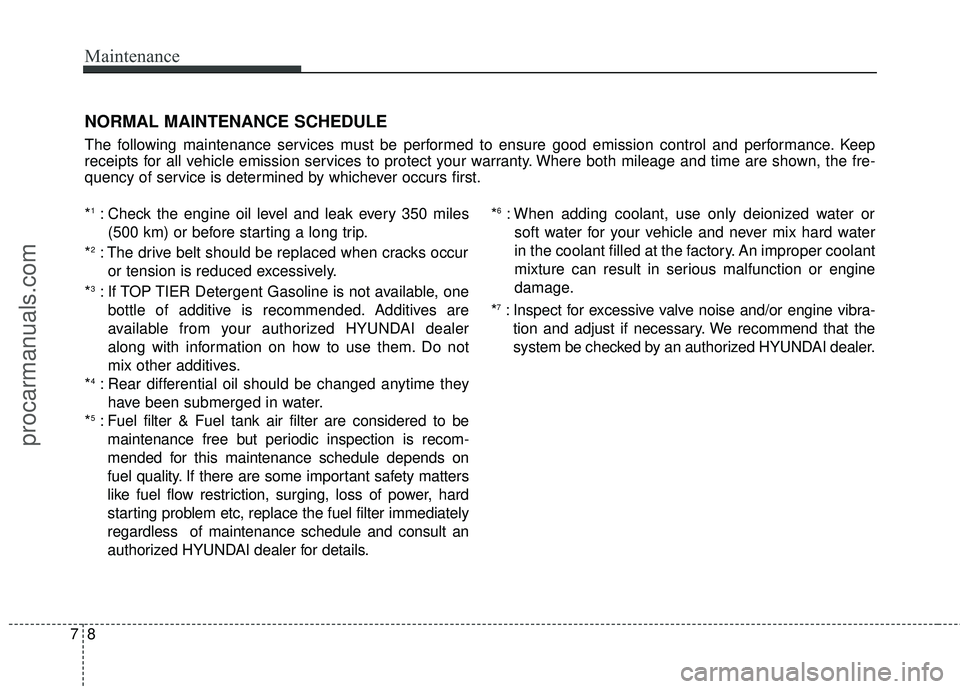
NORMAL MAINTENANCE SCHEDULE
The following maintenance services must be performed to ensure good emission control and performance. Keep
receipts for all vehicle emission services to protect your warranty. Where both mileage and time are shown, the fre-
quency of service is determined by whichever occurs first.
*
1: Check the engine oil level and leak every 350 miles(500 km) or before starting a long trip.
*
2: The drive belt should be replaced when cracks occur or tension is reduced excessively.
*
3: If TOP TIER Detergent Gasoline is not available, one bottle of additive is recommended. Additives are
available from your authorized HYUNDAI dealer
along with information on how to use them. Do not
mix other additives.
*
4: Rear differential oil should be changed anytime they have been submerged in water.
*
5: Fuel filter & Fuel tank air filter are considered to be maintenance free but periodic inspection is recom-
mended for this maintenance schedule depends on
fuel quality. If there are some important safety matters
like fuel flow restriction, surging, loss of power, hard
starting problem etc, replace the fuel filter immediately
regardless of maintenance schedule and consult an
authorized HYUNDAI dealer for details. *
6: When adding coolant, use only deionized water or
soft water for your vehicle and never mix hard water
in the coolant filled at the factory. An improper coolant
mixture can result in serious malfunction or engine
damage.
*
7: Inspect for excessive valve noise and/or engine vibra- tion and adjust if necessary. We recommend that the
system be checked by an authorized HYUNDAI dealer.
procarmanuals.com
Page 378 of 475
79
Maintenance
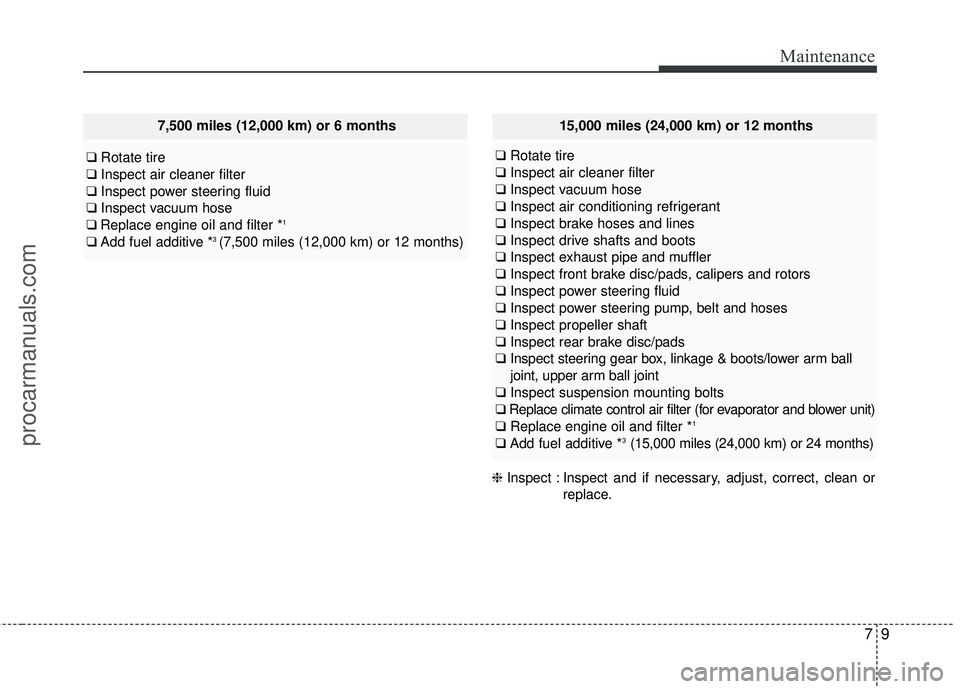
7,500 miles (12,000 km) or 6 months
❑ Rotate tire
❑ Inspect air cleaner filter
❑ Inspect power steering fluid
❑ Inspect vacuum hose
❑ Replace engine oil and filter *
1
❑Add fuel additive *3 (7,500 miles (12,000 km) or 12 months)
15,000 miles (24,000 km) or 12 months
❑ Rotate tire
❑ Inspect air cleaner filter
❑ Inspect vacuum hose
❑ Inspect air conditioning refrigerant
❑ Inspect brake hoses and lines
❑ Inspect drive shafts and boots
❑ Inspect exhaust pipe and muffler
❑ Inspect front brake disc/pads, calipers and rotors
❑ Inspect power steering fluid
❑ Inspect power steering pump, belt and hoses
❑ Inspect propeller shaft
❑ Inspect rear brake disc/pads
❑ Inspect steering gear box, linkage & boots/lower arm ball
joint, upper arm ball joint
❑ Inspect suspension mounting bolts
❑ Replace climate control air filter (for evaporator and blower unit)
❑ Replace engine oil and filter *
1
❑Add fuel additive *3 (15,000 miles (24,000 km) or 24 months)
❈ Inspect : Inspect and if necessary, adjust, correct, clean or
replace.
procarmanuals.com
Page 379 of 475
Maintenance
10
7
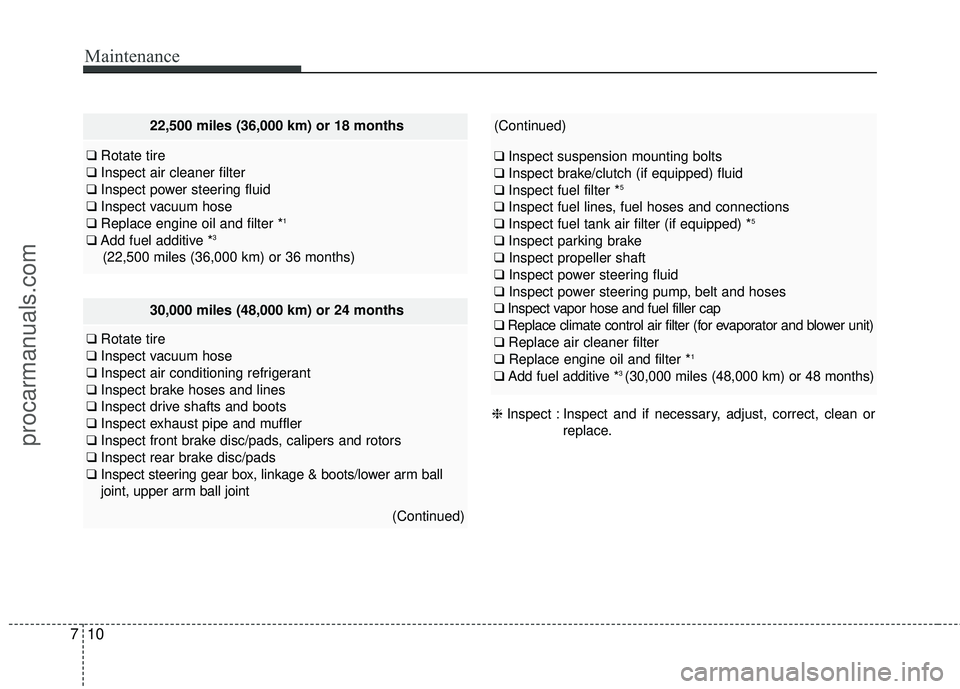
22,500 miles (36,000 km) or 18 months
❑ Rotate tire
❑ Inspect air cleaner filter
❑ Inspect power steering fluid
❑ Inspect vacuum hose
❑ Replace engine oil and filter *
1
❑Add fuel additive *3
(22,500 miles (36,000 km) or 36 months)
30,000 miles (48,000 km) or 24 months
❑ Rotate tire
❑ Inspect vacuum hose
❑ Inspect air conditioning refrigerant
❑ Inspect brake hoses and lines
❑ Inspect drive shafts and boots
❑ Inspect exhaust pipe and muffler
❑ Inspect front brake disc/pads, calipers and rotors
❑ Inspect rear brake disc/pads
❑ Inspect steering gear box, linkage & boots/lower arm ball
joint, upper arm ball joint
(Continued)
(Continued)
❑Inspect suspension mounting bolts
❑ Inspect brake/clutch (if equipped) fluid
❑ Inspect fuel filter *
5
❑Inspect fuel lines, fuel hoses and connections
❑ Inspect fuel tank air filter (if equipped) *5
❑Inspect parking brake
❑ Inspect propeller shaft
❑ Inspect power steering fluid
❑ Inspect power steering pump, belt and hoses
❑ Inspect vapor hose and fuel filler cap
❑ Replace climate control air filter (for evaporator and blower unit)
❑ Replace air cleaner filter
❑ Replace engine oil and filter *
1
❑Add fuel additive *3 (30,000 miles (48,000 km) or 48 months)
❈ Inspect : Inspect and if necessary, adjust, correct, clean or
replace.
procarmanuals.com
Page 380 of 475
711
Maintenance
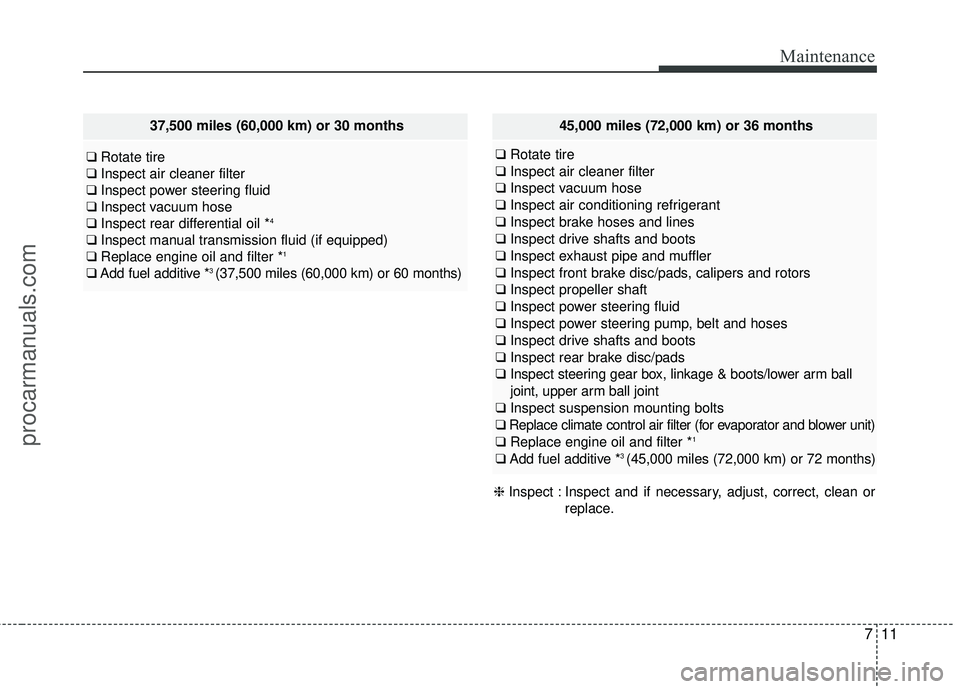
37,500 miles (60,000 km) or 30 months
❑Rotate tire
❑ Inspect air cleaner filter
❑ Inspect power steering fluid
❑ Inspect vacuum hose
❑ Inspect rear differential oil *
4
❑Inspect manual transmission fluid (if equipped)
❑ Replace engine oil and filter *1
❑Add fuel additive *3 (37,500 miles (60,000 km) or 60 months)
45,000 miles (72,000 km) or 36 months
❑ Rotate tire
❑ Inspect air cleaner filter
❑ Inspect vacuum hose
❑ Inspect air conditioning refrigerant
❑ Inspect brake hoses and lines
❑ Inspect drive shafts and boots
❑ Inspect exhaust pipe and muffler
❑ Inspect front brake disc/pads, calipers and rotors
❑ Inspect propeller shaft
❑ Inspect power steering fluid
❑ Inspect power steering pump, belt and hoses
❑ Inspect drive shafts and boots
❑ Inspect rear brake disc/pads
❑ Inspect steering gear box, linkage & boots/lower arm ball
joint, upper arm ball joint
❑ Inspect suspension mounting bolts
❑ Replace climate control air filter (for evaporator and blower unit)
❑ Replace engine oil and filter *
1
❑Add fuel additive *3 (45,000 miles (72,000 km) or 72 months)
❈ Inspect : Inspect and if necessary, adjust, correct, clean or
replace.
procarmanuals.com
Page 381 of 475
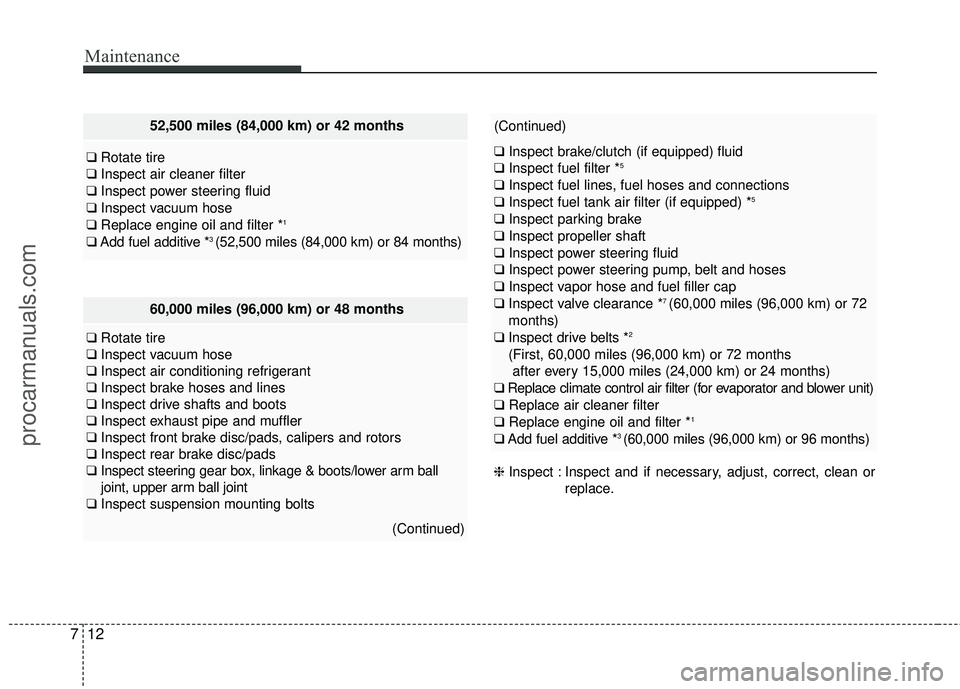
Maintenance
12
7
60,000 miles (96,000 km) or 48 months
❑ Rotate tire
❑ Inspect vacuum hose
❑ Inspect air conditioning refrigerant
❑ Inspect brake hoses and lines
❑ Inspect drive shafts and boots
❑ Inspect exhaust pipe and muffler
❑ Inspect front brake disc/pads, calipers and rotors
❑ Inspect rear brake disc/pads
❑ Inspect steering gear box, linkage & boots/lower arm ball
joint, upper arm ball joint
❑ Inspect suspension mounting bolts
(Continued)
(Continued)
❑Inspect brake/clutch (if equipped) fluid
❑ Inspect fuel filter *5
❑Inspect fuel lines, fuel hoses and connections
❑ Inspect fuel tank air filter (if equipped) *5
❑Inspect parking brake
❑ Inspect propeller shaft
❑ Inspect power steering fluid
❑ Inspect power steering pump, belt and hoses
❑ Inspect vapor hose and fuel filler cap
❑ Inspect valve clearance *
7 (60,000 miles (96,000 km) or 72
months)
❑ Inspect drive belts *
2
(First, 60,000 miles (96,000 km) or 72 months
after every 15,000 miles (24,000 km) or 24 months)
❑ Replace climate control air filter (for evaporator and blower unit)
❑ Replace air cleaner filter
❑ Replace engine oil and filter *
1
❑Add fuel additive *3 (60,000 miles (96,000 km) or 96 months)
52,500 miles (84,000 km) or 42 months
❑ Rotate tire
❑ Inspect air cleaner filter
❑ Inspect power steering fluid
❑ Inspect vacuum hose
❑ Replace engine oil and filter *
1
❑Add fuel additive *3 (52,500 miles (84,000 km) or 84 months)
❈ Inspect : Inspect and if necessary, adjust, correct, clean or
replace.
procarmanuals.com
Page 382 of 475
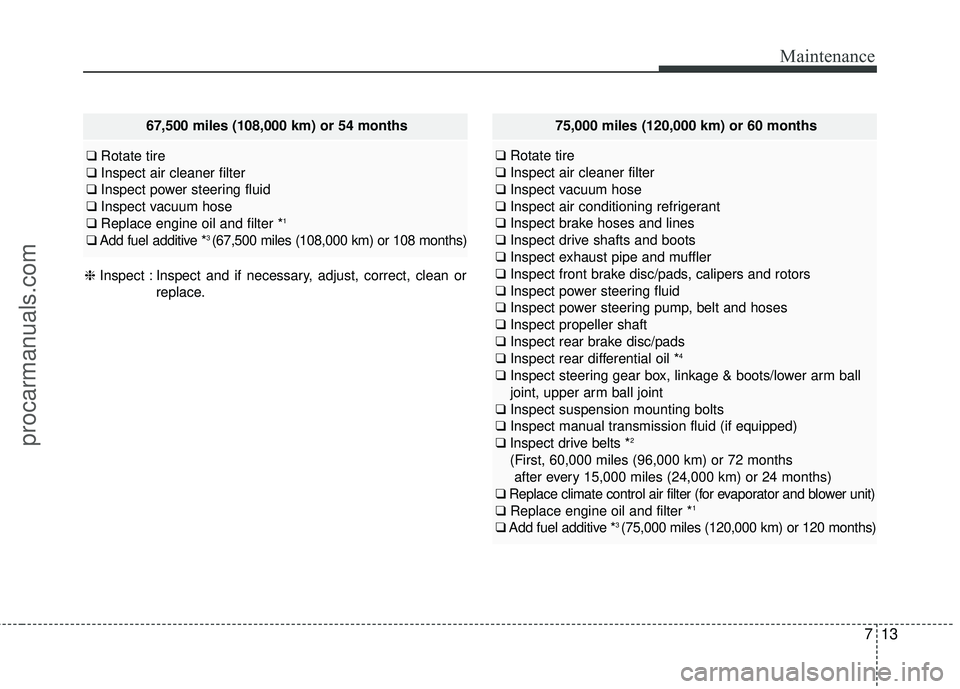
713
Maintenance
67,500 miles (108,000 km) or 54 months
❑Rotate tire
❑ Inspect air cleaner filter
❑ Inspect power steering fluid
❑ Inspect vacuum hose
❑ Replace engine oil and filter *
1
❑Add fuel additive *3 (67,500 miles (108,000 km) or 108 months)
75,000 miles (120,000 km) or 60 months
❑ Rotate tire
❑ Inspect air cleaner filter
❑ Inspect vacuum hose
❑ Inspect air conditioning refrigerant
❑ Inspect brake hoses and lines
❑ Inspect drive shafts and boots
❑ Inspect exhaust pipe and muffler
❑ Inspect front brake disc/pads, calipers and rotors
❑ Inspect power steering fluid
❑ Inspect power steering pump, belt and hoses
❑ Inspect propeller shaft
❑ Inspect rear brake disc/pads
❑ Inspect rear differential oil *
4
❑Inspect steering gear box, linkage & boots/lower arm ball
joint, upper arm ball joint
❑ Inspect suspension mounting bolts
❑ Inspect manual transmission fluid (if equipped)
❑ Inspect drive belts *
2
(First, 60,000 miles (96,000 km) or 72 months
after every 15,000 miles (24,000 km) or 24 months)
❑ Replace climate control air filter (for evaporator and blower unit)
❑ Replace engine oil and filter *
1
❑Add fuel additive *3 (75,000 miles (120,000 km) or 120 months)
❈ Inspect : Inspect and if necessary, adjust, correct, clean or
replace.
procarmanuals.com