wheel Hyundai Creta 2016 Service Manual
[x] Cancel search | Manufacturer: HYUNDAI, Model Year: 2016, Model line: Creta, Model: Hyundai Creta 2016Pages: 512, PDF Size: 11.54 MB
Page 337 of 512
5-25
Driving your vehicle
5
R (Reverse)
Use this position to drive the vehicle
backward.
Always come to a complete stop
before shifting into or out of R
(Reverse); you may damage the
transaxle if you shift into R (Reverse)
while the vehicle is in motion.
N (Neutral)
The wheels and transaxle are not
engaged.
Use N (Neutral) if you need to restart
a stalled engine, or if it is necessary
to stop with the engine ON. Shift into
P (Park) if you need to leave your
vehicle for any reason.
Always depress the brake pedal
when you are shifting from N
(Neutral) to another gear.
NOTICE
•Shifting into P (Park) while the
vehicle is in motion may cause
you to lose control of the vehi
cle.
•After the vehicle has stopped,
always make sure the shift lever
is in P (Park), apply the parking
brake, and turn the engine off.
•Do not use the P (Park) position
in place of the parking brake.
WARNING
Do not shift into gear unless your
foot is firmly on the brake pedal.
Shifting into gear when the engine
is running at high speed can
cause the vehicle to move very
rapidly. You could lose control of
the vehicle and hit people or
objects.
WARNING
Page 341 of 512
5-29
Driving your vehicle
5
•When driving in Sports Mode, slow
down before shifting to a lower
gear. Otherwise, the lower gear
may not be engaged if the engine
rpms are outside of the allowable
range.
• Always apply the parking brake when leaving the vehicle. Do not
depend on placing the transmis
sion in P (Park) to keep the vehicle
from moving.
• Exercise extreme caution when driving on a slippery surface. Be
especially careful when braking,
accelerating or shifting gears. On a
slippery surface, an abrupt change
in vehicle speed can cause the
drive wheels to lose traction and
may cause loss of vehicle control
resulting in an accident
• Optimum vehicle performance and economy is obtained by smoothly
depressing and releasing the
accelerator.
To reduce the risk of SERIOUS
INJURY or DEATH:
•ALWAYS wear your seatbelt. In
a collision, an unbelted occu
pant is significantly more likely
to be seriously injured or killed
than a properly belted occupant.
•Avoid high speeds when corner
ing or turning.
•Do not make quick steering
wheel movements, such as
sharp lane changes or fast,
sharp turns.
•The risk of rollover is greatly
increased if you lose control of
your vehicle at highway speeds.
•Loss of control often occurs if
two or more wheels drop off the
roadway and the driver over
steers to reenter the roadway.
(Continued)
(Continued)
•In the event your vehicle leaves
the roadway, do not steer
sharply. Instead, slow down
before pulling back into the trav
el lanes.
•HYUNDAI recommends you fol
low all posted speed limits.
WARNING
Page 347 of 512
5-35
Driving your vehicle
5
Using ABS
To obtain the maximum benefit from
your ABS in an emergency situation,
do not attempt to modulate your
brake pressure and do not try to
pump your brakes. Depress your
brake pedal as hard as possible.
When you apply your brakes under
conditions which may lock the
wheels, you may hear sounds from
the brakes, or feel a corresponding
sensation in the brake pedal. This is
normal and it means your ABS is
active.
ABS does not reduce the time or dis
tance it takes to stop the vehicle.
Always maintain a safe distance from
the vehicle in front of you.
ABS will not prevent a skid that
results from sudden changes in
direction, such as trying to take a
corner too fast or making a sudden
lane change. Always drive at a safe
speed for the road and weather con
ditions. ABS cannot prevent a loss of stabili
ty. Always steer moderately when
braking hard. Severe or sharp steer
ing wheel movement can still cause
your vehicle to veer into oncoming
traffic or off the road.
On loose or uneven road surfaces,
operation of the antilock brake sys
tem may result in a longer stopping
distance than for vehicles equipped
with a conventional brake system.
The ABS warning light ( ) will stay
on for several seconds after the igni
tion switch is in the ON position.
During that time, the ABS will go
through selfdiagnosis and the light
will go off if everything is normal. If
the light stays on, you may have a
problem with your ABS. We recom
mend that you contact an authorized
HYUNDAI dealer as soon as possi
ble.
If the ABS warning light () is on
and stays on, you may have a
problem with the ABS. Your power
brakes will work normally. To
reduce the risk of serious injury or
death, we recommend that you
contact your HYUNDAI dealer as
soon as possible.
WARNING
Page 349 of 512
ESC operation
ESC ON condition
When the ignition switch is in the ON
position, the ESC and the ESC OFF
indicator lights illuminate for approxi
mately three seconds and goes off,
then the ESC is turned on.
When operating
When the ESC is in opera
tion, the ESC indicator light
blinks:
• When you apply yourbrakes under conditions
which may lock the
wheels, you may hear
sounds from the brakes, or
feel a corresponding sen
sation in the brake pedal.
This is normal and it
means your ESC is active.
• If the Cruise Control was in use when the ESC activates, the Cruise
Control automatically disengages.
The Cruise Control can be reen
gaged when the road conditions
allow. See “Cruise Control System”
later in this chapter. (if equipped).
• When moving out of the mud or driving on a slippery road, the
engine rpm (revolutions per minute)
may not increase even if you press
the accelerator pedal deeply. This is
to maintain the stability and traction
of the vehicle and does not indicate
a problem.
5-37
Driving your vehicle
5
Never drive too fast for the road
conditions or too quickly when cor
nering. The ESC system will not
prevent accidents.
Excessive speed in turns, abrupt
maneuvers, and hydroplaning on
wet surfaces can result in severe
accidents.
WARNING
Page 351 of 512
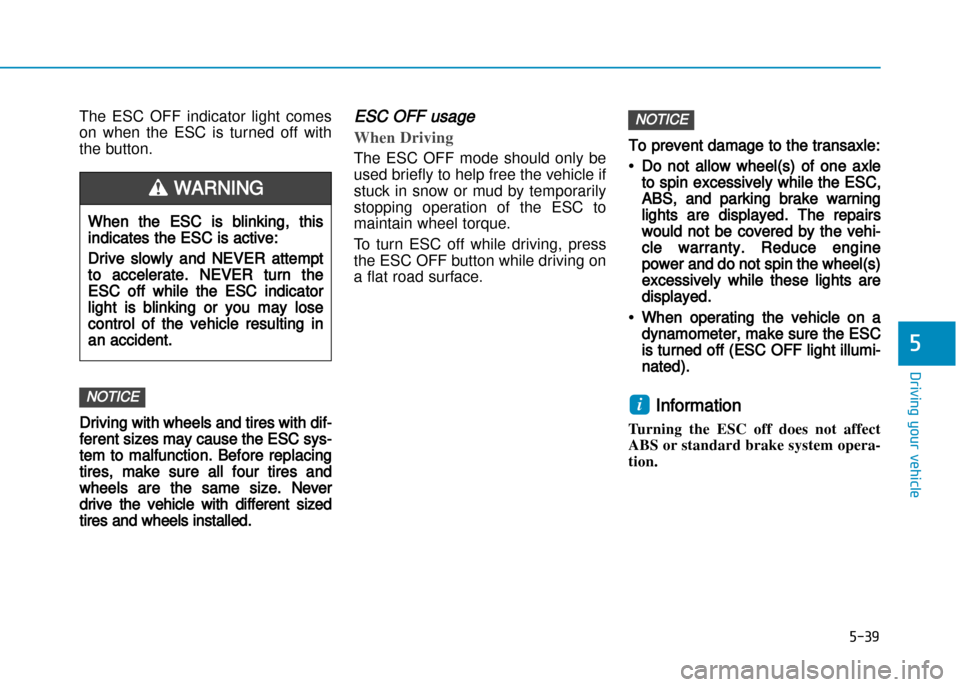
The ESC OFF indicator light comes
on when the ESC is turned off with
the button.
Driving with wheels and tires with dif
ferent sizes may cause the ESC sys
tem to malfunction. Before replacing
tires, make sure all four tires and
wheels are the same size. Never
drive the vehicle with different sized
tires and wheels installed.
ESC OFF usage
When Driving
The ESC OFF mode should only be
used briefly to help free the vehicle if
stuck in snow or mud by temporarily
stopping operation of the ESC to
maintain wheel torque.
To turn ESC off while driving, press
the ESC OFF button while driving on
a flat road surface.To prevent damage to the transaxle:
•Do not allow wheel(s) of one axle
to spin excessively while the ESC,
ABS, and parking brake warning
lights are displayed. The repairs
would not be covered by the vehi
cle warranty. Reduce engine
power and do not spin the wheel(s)
excessively while these lights are
displayed.
•When operating the vehicle on a
dynamometer, make sure the ESC
is turned off (ESC OFF light illumi
nated).
Information
Turning the ESC off does not affect
ABS or standard brake system operation.NOTICEi
NOTICE
5-39
Driving your vehicle
5
When the ESC is blinking, this
indicates the ESC is active:
Drive slowly and NEVER attempt
to accelerate. NEVER turn the
ESC off while the ESC indicator
light is blinking or you may lose
control of the vehicle resulting in
an accident.
WARNING
Page 353 of 512
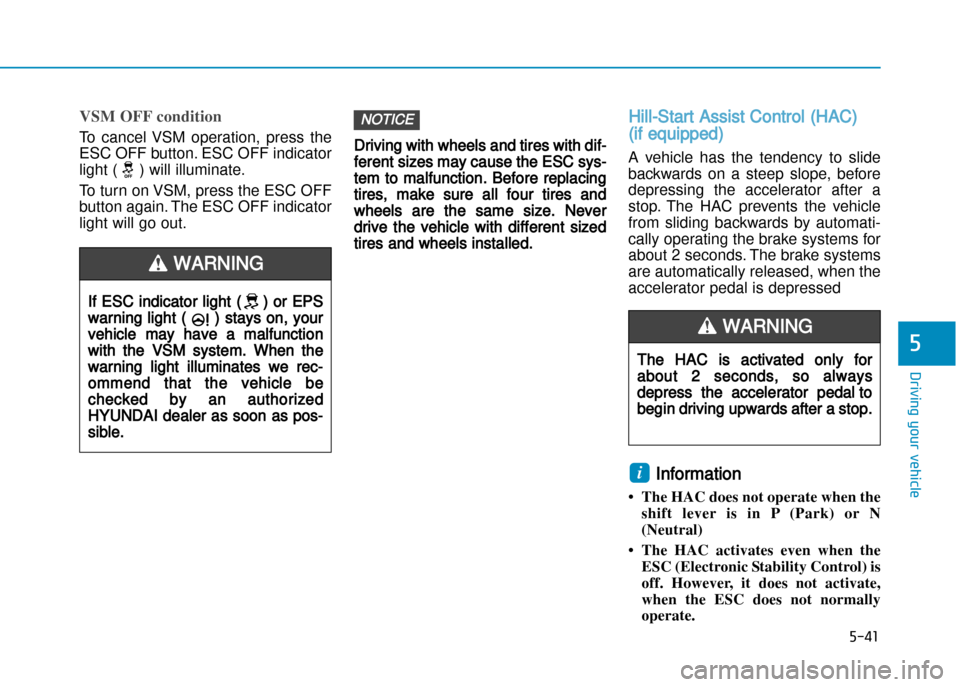
VSM OFF condition
To cancel VSM operation, press the
ESC OFF button. ESC OFF indicator
light ( ) will illuminate.
To turn on VSM, press the ESC OFF
button again. The ESC OFF indicator
light will go out. Driving with wheels and tires with dif
ferent sizes may cause the ESC sys
tem to malfunction. Before replacing
tires, make sure all four tires and
wheels are the same size. Never
drive the vehicle with different sized
tires and wheels installed.
HillStart Assist Control (HAC)
(if equipped)
A vehicle has the tendency to slide
backwards on a steep slope, before
depressing the accelerator after a
stop. The HAC prevents the vehicle
from sliding backwards by automati
cally operating the brake systems for
about 2 seconds. The brake systems
are automatically released, when the
accelerator pedal is depressed
Information
• The HAC does not operate when the shift lever is in P (Park) or N
(Neutral)
• The HAC activates even when the ESC (Electronic Stability Control) is
off. However, it does not activate,
when the ESC does not normallyoperate.i
NOTICE
5-41
Driving your vehicle
5
If ESC indicator light () or EPS
warning light () stays on, your
vehicle may have a malfunction
with the VSM system. When the
warning light illuminates we rec
ommend that the vehicle be
checked by an authorized
HYUNDAI dealer as soon as pos
sible.
WARNING
The HAC is activated only for
about 2 seconds, so always
depress the accelerator pedal to
begin driving upwards after a stop.
WARNING
Page 356 of 512
5-44
Driving your vehicle
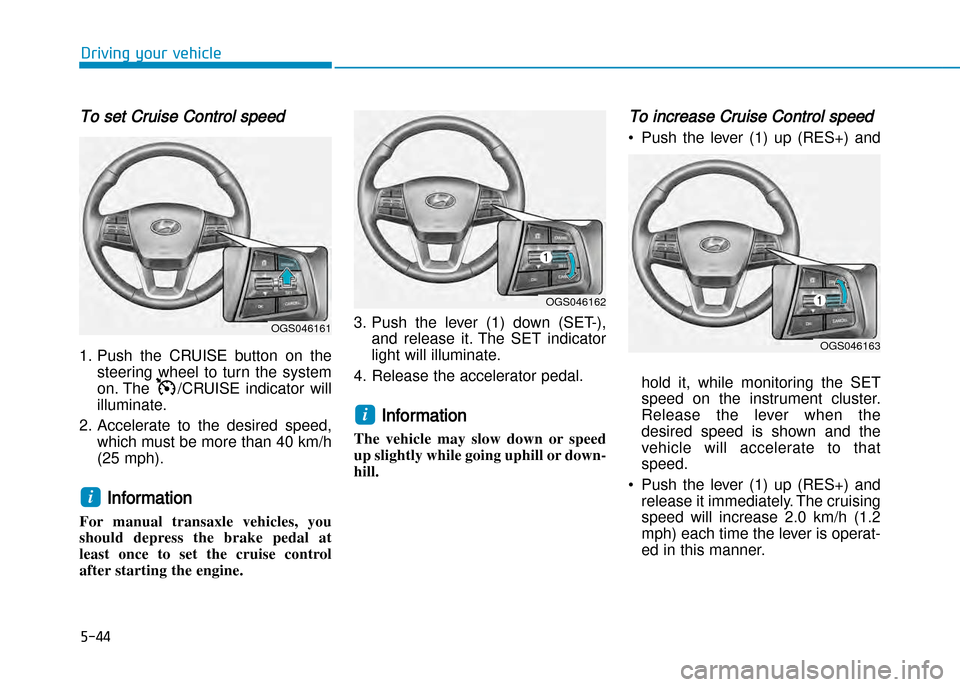
To set Cruise Control speed
1. Push the CRUISE button on thesteering wheel to turn the system
on. The /CRUISE indicator will
illuminate.
2. Accelerate to the desired speed, which must be more than 40 km/h
(25 mph).
Information
For manual transaxle vehicles, you
should depress the brake pedal at
least once to set the cruise control
after starting the engine. 3. Push the lever (1) down (SET),
and release it. The SET indicator
light will illuminate.
4. Release the accelerator pedal.
Information
The vehicle may slow down or speed
up slightly while going uphill or down
hill.
To increase Cruise Control speed
• Push the lever (1) up (RES+) and
hold it, while monitoring the SET
speed on the instrument cluster.
Release the lever when the
desired speed is shown and the
vehicle will accelerate to thatspeed.
• Push the lever (1) up (RES+) and release it immediately. The cruising
speed will increase 2.0 km/h (1.2
mph) each time the lever is operat
ed in this manner.
i
i
OGS046162
OGS046163
OGS046161
Page 358 of 512
5-46
Driving your vehicle
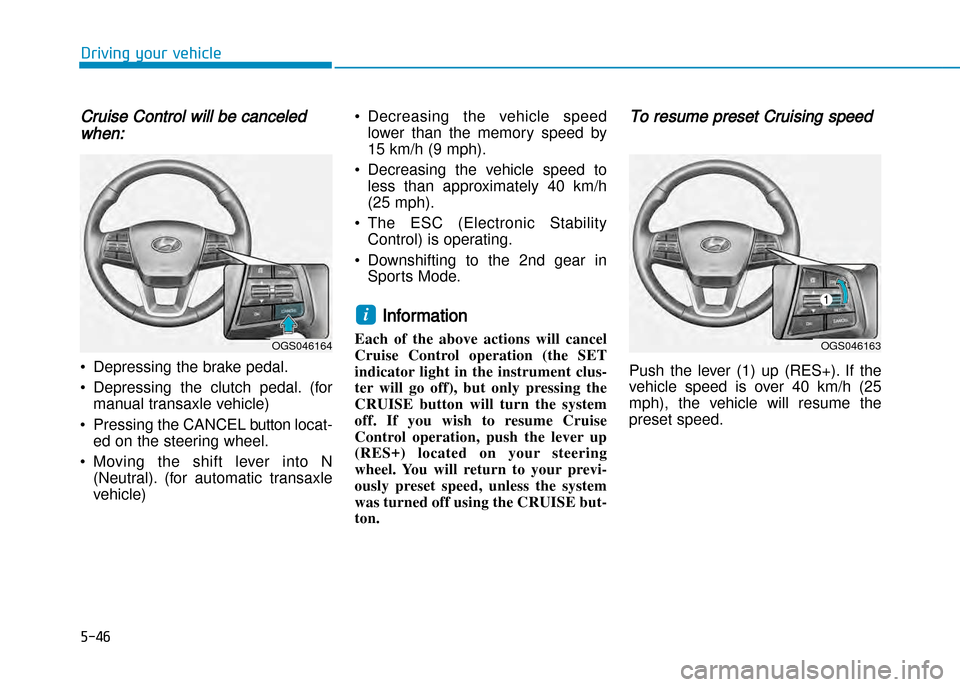
Cruise Control will be canceled
when:
• Depressing the brake pedal.
• Depressing the clutch pedal. (formanual transaxle vehicle)
• Pressing the CANCEL button locat ed on the steering wheel.
• Moving the shift lever into N (Neutral). (for automatic transaxle
vehicle) • Decreasing the vehicle speed
lower than the memory speed by
15 km/h (9 mph).
• Decreasing the vehicle speed to less than approximately 40 km/h
(25 mph).
• The ESC (Electronic Stability Control) is operating.
• Downshifting to the 2nd gear in Sports Mode.
Information
Each of the above actions will cancel
Cruise Control operation (the SET
indicator light in the instrument clus
ter will go off), but only pressing the
CRUISE button will turn the system
off. If you wish to resume Cruise
Control operation, push the lever up
(RES+) located on your steering
wheel. You will return to your previ
ously preset speed, unless the system
was turned off using the CRUISE button.
To resume preset Cruising speed
Push the lever (1) up (RES+). If the
vehicle speed is over 40 km/h (25
mph), the vehicle will resume the
preset speed.
i
OGS046163OGS046164
Page 360 of 512
5-48
Driving your vehicle
SpECIAL DRIVING CONDITIONS
Hazardous driving conditions
When hazardous driving conditions
are encountered such as water,
snow, ice, mud or sand:
Drive cautiously and allow extra dis
tance for braking.
Avoid sudden movements in braking
or steering.
If stuck in snow, mud, or sand, use
second gear. Accelerate slowly to
avoid spinning the drive wheels.
Use sand, rock salt, or other nonslip
material under the drive wheels to
provide traction when stalled in ice,
snow, or mud.
Rocking the vehicle
If it is necessary to rock the vehicle
to free it from snow, sand, or mud,
first turn the steering wheel right and
left to clear the area around your
front wheels. Then, shift back and
forth between 1st and R (Reverse,
for manual transaxle vehicle) or R
(Reverse) and a forward gear (for
automatic transaxle vehicle). Try to
avoid spinning the wheels, and do
not race the engine.
To prevent transaxle wear, wait until
the wheels stop spinning before
shifting gears. Release the accelera
tor pedal while shifting, and press
lightly on the accelerator pedal while
the transaxle is in gear. Slowly spin
ning the wheels in forward and
reverse directions causes a rocking
motion that may free the vehicle.
Downshifting with an automatic
transaxle, while driving on slippery
surfaces can cause an accident.
The sudden change in tire speed
could cause the tires to skid. Be
careful when downshifting on slip
pery surfaces.
WARNING
If the vehicle is stuck and exces
sive wheel spin occurs, the tem
perature in the tires can increase
very quickly. If the tires become
damaged, a tire blow out or tire
explosion can occur. This condi
tion is dangerous you and others
may be injured. Do not attempt
this procedure if people or objects
are anywhere near the vehicle.
If you attempt to free the vehicle,
the vehicle can overheat quickly,
possibly causing an engine com
partment fire or other damage. Try
to avoid spinning the wheels as
much as possible to prevent over
heating of either the tires or the
engine. DO NOT allow the vehicle
to spin the wheels above 35 mph
(56 km/h).
WARNING
Page 362 of 512
5-50
Driving your vehicle
Driving in the rain
Rain and wet roads can make driving
dangerous. Here are a few things to
consider when driving in the rain or
on slick pavement:
• Slow down and allow extra following distance. A heavy rainfall
makes it harder to see and increas
es the distance needed to stop
your vehicle.
• Replace your windshield wiper blades when they show signs of
streaking or missing areas on thewindshield.
• Be sure your tires have enough tread. If your tires do not have
enough tread, making a quick stop
on wet pavement can cause a skid
and possibly lead to an accident.
See “Tire Tread
”in chapter 7.
• Turn on your headlights to make it easier for others to see you. • Driving too fast through large pud
dles can affect your brakes. If you
must go through puddles, try to
drive through them slowly.
• If you believe your brakes may be wet, apply them lightly while driv
ing until normal braking operation
returns.
Hydroplaning
If the road is wet enough and you are
going fast enough, your vehicle may
have little or no contact with the road
surface and actually ride on the
water. The best advice is SLOWDOWN when the road is wet. The
risk of hydroplaning increases as the
depth of tire tread decreases, refer to
“Tire Tread” in chapter 7.
Driving in flooded areas
Avoid driving through flooded areas
unless you are sure the water is no
higher than the bottom of the wheel
hub. Drive through any water slowly.
Allow adequate stopping distance
because brake performance may bereduced.
After driving through water, dry the
brakes by gently applying them sev
eral times while the vehicle is moving
slowly.