Drive Hyundai Creta 2019 Owner's Manual
[x] Cancel search | Manufacturer: HYUNDAI, Model Year: 2019, Model line: Creta, Model: Hyundai Creta 2019Pages: 472, PDF Size: 13.39 MB
Page 398 of 472
7-41
7
Maintenance
A AI
IR
R
C
CL
LE
EA
AN
NE
ER
R
Filter replacement
You can clean the filter when inspect-
ing the air cleaner element.
Clean the filter by using compressed
air.
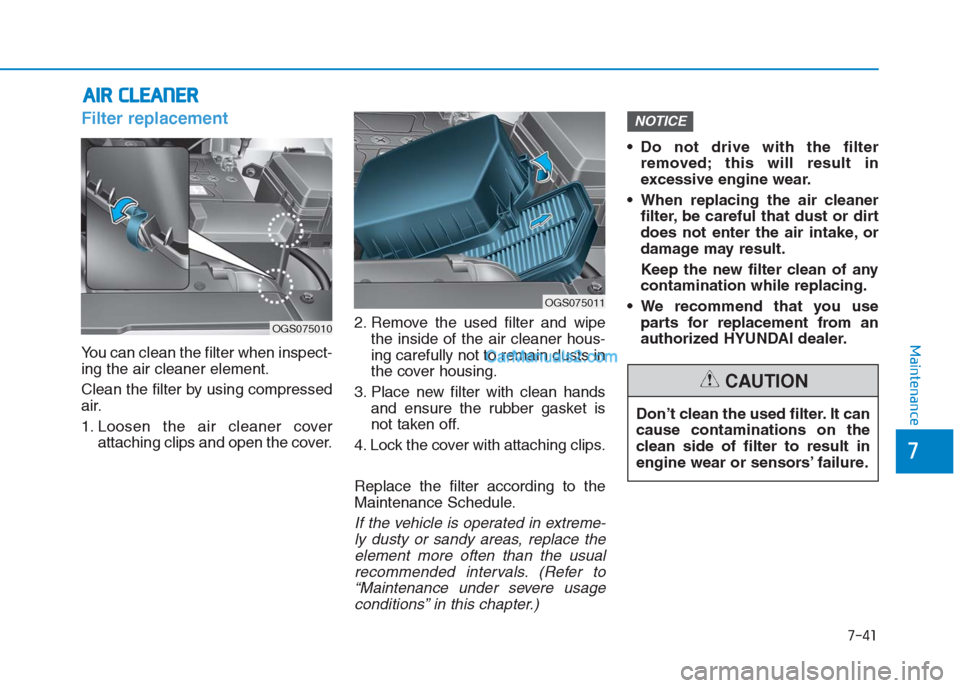
1. Loosen the air cleaner cover
attaching clips and open the cover.2. Remove the used filter and wipe
the inside of the air cleaner hous-
ing carefully not to remain dusts in
the cover housing.
3. Place new filter with clean hands
and ensure the rubber gasket is
not taken off.
4. Lock the cover with attaching clips.
Replace the filter according to the
Maintenance Schedule.
If the vehicle is operated in extreme-
ly dusty or sandy areas, replace the
element more often than the usual
recommended intervals. (Refer to
“Maintenance under severe usage
conditions” in this chapter.)
Do not drive with the filter
removed; this will result in
excessive engine wear.
When replacing the air cleaner
filter, be careful that dust or dirt
does not enter the air intake, or
damage may result.
Keep the new filter clean of any
contamination while replacing.
We recommend that you use
parts for replacement from an
authorized HYUNDAI dealer.
NOTICE
OGS075010
OGS075011
Don’t clean the used filter. It can
cause contaminations on the
clean side of filter to result in
engine wear or sensors’ failure.
CAUTION
Page 408 of 472
7-51
7
Maintenance
T TI
IR
RE
ES
S
A
AN
ND
D
W
WH
HE
EE
EL
LS
S
Tire care
For proper maintenance, safety, and
maximum fuel economy, you must
always maintain recommended tire
inflation pressures and stay within
the load limits and weight distribution
recommended for your vehicle.
Recommended cold tire infla-
tion pressures
All tire pressures (including the
spare) should be checked when the
tires are cold. “Cold Tires” means the
vehicle has not been driven for at
least three hours or driven less than
1.6 km (one mile).
Recommended pressures must be
maintained for the best ride, top vehi-
cle handling, and minimum tire wear.
For recommended inflation pres-
sure, refer to “Tire and wheels” in
chapter 8.
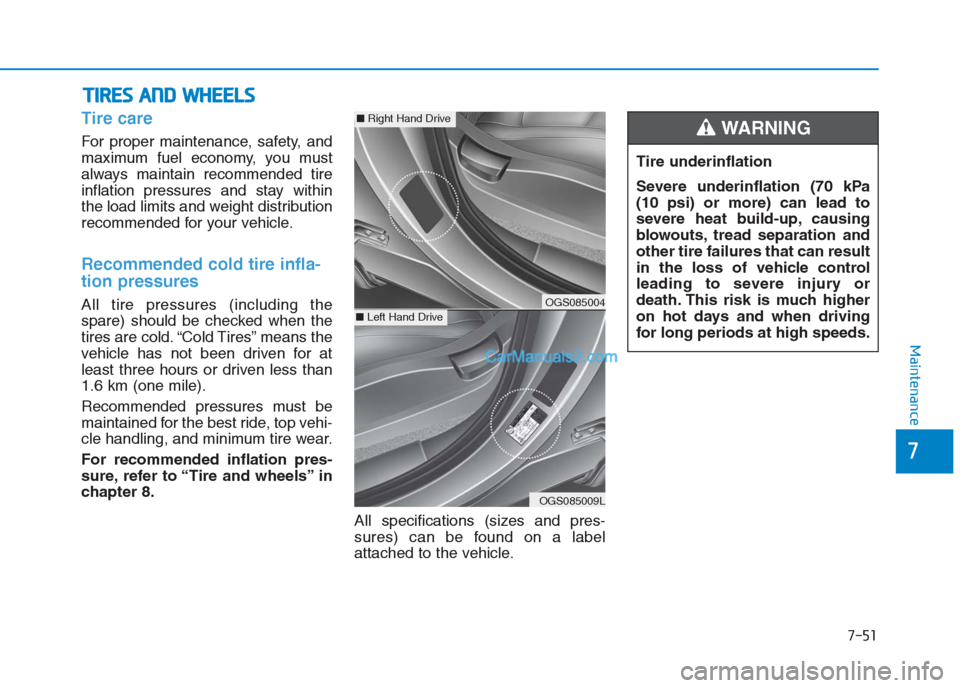
All specifications (sizes and pres-
sures) can be found on a label
attached to the vehicle.Tire underinflation
Severe underinflation (70 kPa
(10 psi) or more) can lead to
severe heat build-up, causing
blowouts, tread separation and
other tire failures that can result
in the loss of vehicle control
leading to severe injury or
death. This risk is much higher
on hot days and when driving
for long periods at high speeds.
WARNING
OGS085004
OGS085009L
■Right Hand Drive
■Left Hand Drive
Page 409 of 472
7-52
Maintenance
Underinflation also results in
excessive wear, poor handling
and reduced fuel economy.
Wheel deformation also is pos-
sible. Keep your tire pressures
at the proper levels. If a tire fre-
quently needs refilling, we rec-
ommend that the system be
checked by an authorized
HYUNDAI dealer.
Overinflation produces a harsh
ride, excessive wear at the cen-
ter of the tire tread, and a greater
possibility of damage from road
hazards. Warm tires normally exceed rec-
ommended cold tire pressures
by 28 to 41 kPa (4 to 6 psi). Do
not release air from warm tires
to adjust the pressure or the
tires will be underinflated.
Be sure to reinstall the tire infla-
tion valve caps. Without the
valve cap, dirt or moisture could
get into the valve core and
cause air leakage. If a valve cap
is missing, install a new one as
soon as possible.- Tire pressure
Always observe the following:
Check tire pressure when the
tires are cold. (After vehicle has
been parked for at least three
hours or hasn't been driven
more than 1.6 km (one mile)
since startup.)
Check the pressure of your
spare tire each time you check
the pressure of other tires.
Never overload your vehicle. Be
careful not to overload a vehicle
luggage rack if your vehicle is
equipped with one.
Worn, old tires can cause acci-
dents. If your tread is badly
worn, or if your tires have been
damaged, replace them.
NOTICENOTICENOTICE
Tire Inflation
Overinflation or underinflation
can reduce tire life, adversely
affect vehicle handling, and
lead to sudden tire failure. This
could result in loss of vehicle
control and potential injury.
WARNING
Page 410 of 472
7-53
7
Maintenance
Checking tire inflation pres-
sure
Check your tires once a month or
more.
Also, check the tire pressure of the
spare tire.
How to check
Use a good quality gage to check tire
pressure. You can not tell if your tires
are properly inflated simply by look-
ing at them. Radial tires may look
properly inflated even when they're
underinflated.
Check the tire's inflation pressure
when the tires are cold. - "Cold"
means your vehicle has been sitting
for at least three hours or driven no
more than 1.6 km (1 mile).Remove the valve cap from the tire
valve stem. Press the tire gage firm-
ly onto the valve to get a pressure
measurement. If the cold tire inflation
pressure matches the recommended
pressure on the tire and loading
information label, no further adjust-
ment is necessary. If the pressure is
low, add air until you reach the rec-
ommended amount.
If you overfill the tire, release air by
pushing on the metal stem in the
center of the tire valve. Recheck the
tire pressure with the tire gage. Be
sure to put the valve caps back on
the valve stems. They help prevent
leaks by keeping out dirt and mois-
ture.
Inspect your tires frequently
for proper inflation as well as
wear and damage. Always use
a tire pressure gauge.
Tires with too much or too lit-
tle pressure wear unevenly
causing poor handling, loss of
vehicle control, and sudden
tire failure leading to acci-
dents, injuries, and even
death. The recommended cold
tire pressure for your vehicle
can be found in this manual
and on the tire label located
on the driver's side center pil-
lar.
Worn tires can cause acci-
dents. Replace tires that are
worn, show uneven wear, or
are damaged.
Remember to check the pres-
sure of your spare tire.
HYUNDAI recommends that
you check the spare every
time you check the pressure
of the other tires on your vehi-
cle.
WARNING
Page 413 of 472
7-56
Maintenance
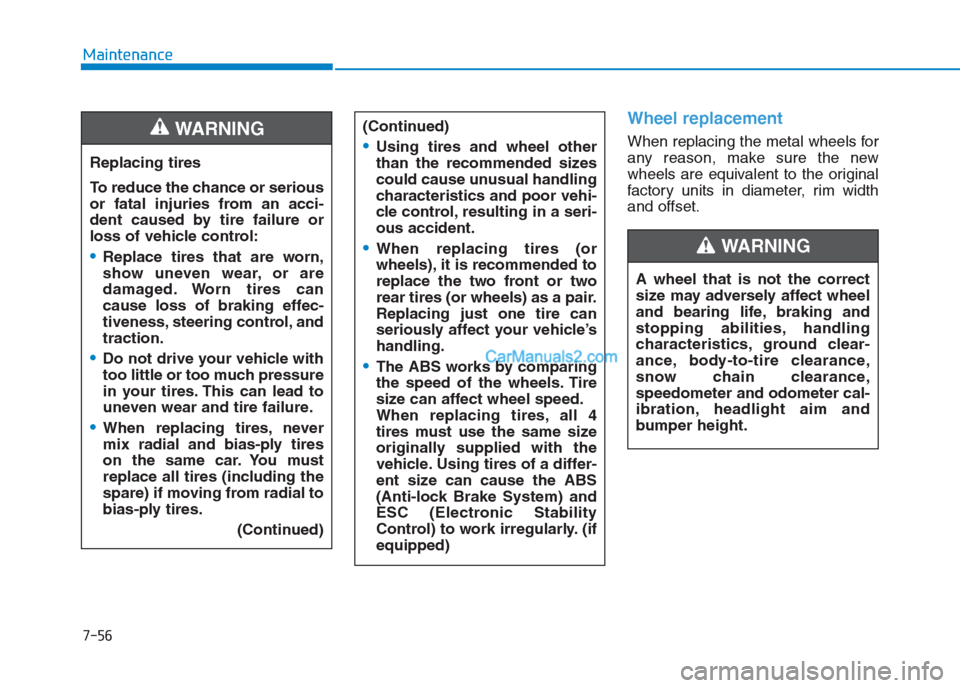
Wheel replacement
When replacing the metal wheels for
any reason, make sure the new
wheels are equivalent to the original
factory units in diameter, rim width
and offset. Replacing tires
To reduce the chance or serious
or fatal injuries from an acci-
dent caused by tire failure or
loss of vehicle control:
Replace tires that are worn,
show uneven wear, or are
damaged. Worn tires can
cause loss of braking effec-
tiveness, steering control, and
traction.
Do not drive your vehicle with
too little or too much pressure
in your tires. This can lead to
uneven wear and tire failure.
When replacing tires, never
mix radial and bias-ply tires
on the same car. You must
replace all tires (including the
spare) if moving from radial to
bias-ply tires.
(Continued)
WARNING (Continued)
Using tires and wheel other
than the recommended sizes
could cause unusual handling
characteristics and poor vehi-
cle control, resulting in a seri-
ous accident.
When replacing tires (or
wheels), it is recommended to
replace the two front or two
rear tires (or wheels) as a pair.
Replacing just one tire can
seriously affect your vehicle’s
handling.
The ABS works by comparing
the speed of the wheels. Tire
size can affect wheel speed.
When replacing tires, all 4
tires must use the same size
originally supplied with the
vehicle. Using tires of a differ-
ent size can cause the ABS
(Anti-lock Brake System) and
ESC (Electronic Stability
Control) to work irregularly. (if
equipped)
A wheel that is not the correct
size may adversely affect wheel
and bearing life, braking and
stopping abilities, handling
characteristics, ground clear-
ance, body-to-tire clearance,
snow chain clearance,
speedometer and odometer cal-
ibration, headlight aim and
bumper height.
WARNING
Page 414 of 472
7-57
7
Maintenance
Tire traction
Tire traction can be reduced if you
drive on worn tires, tires that are
improperly inflated or on slippery
road surfaces. Tires should be
replaced when tread wear indicators
appear. Slow down whenever there
is rain, snow or ice on the road, to
reduce the possibility of losing con-
trol of the vehicle.
Tire maintenance
In addition to proper inflation, correct
wheel alignment helps decrease tire
wear. If you find a tire worn unevenly,
have your dealer check the wheel
alignment.
When you have new tires installed,
make sure they are balanced. This
will increase vehicle ride comfort and
tire life. Additionally, a tire should
always be rebalanced if it is removed
from the wheel.
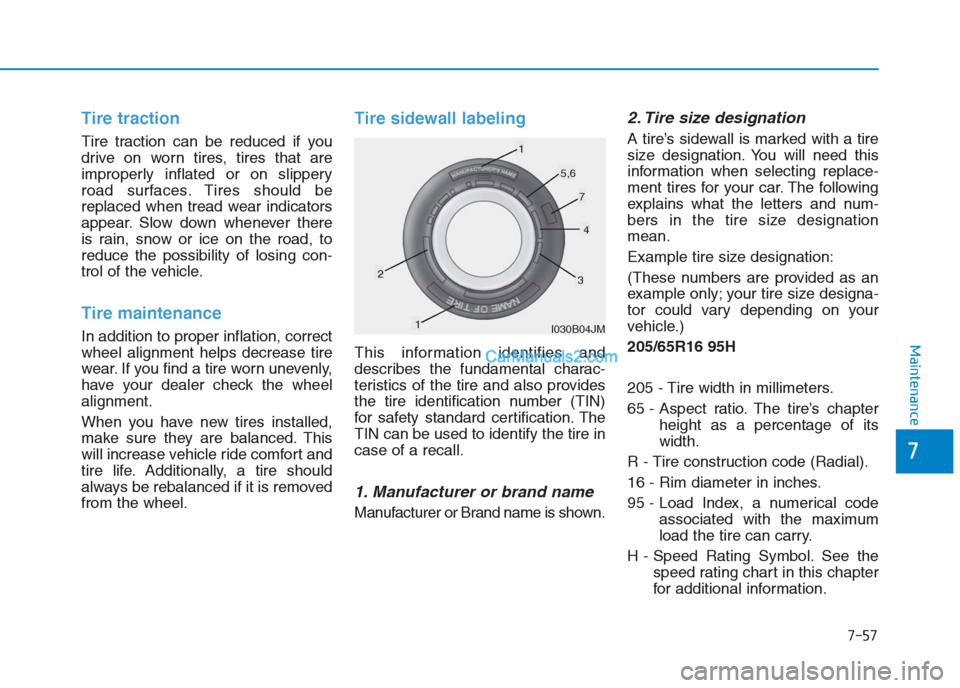
Tire sidewall labeling
This information identifies and
describes the fundamental charac-
teristics of the tire and also provides
the tire identification number (TIN)
for safety standard certification. The
TIN can be used to identify the tire in
case of a recall.
1. Manufacturer or brand name
Manufacturer or Brand name is shown.
2. Tire size designation
A tire’s sidewall is marked with a tire
size designation. You will need this
information when selecting replace-
ment tires for your car. The following
explains what the letters and num-
bers in the tire size designation
mean.
Example tire size designation:
(These numbers are provided as an
example only; your tire size designa-
tor could vary depending on your
vehicle.)
205/65R16 95H
205 - Tire width in millimeters.
65 - Aspect ratio. The tire’s chapter
height as a percentage of its
width.
R - Tire construction code (Radial).
16 - Rim diameter in inches.
95 - Load Index, a numerical code
associated with the maximum
load the tire can carry.
H - Speed Rating Symbol. See the
speed rating chart in this chapter
for additional information.
I030B04JM
1
1
23
4
5,6
7
Page 418 of 472
7-61
7
Maintenance
Low aspect ratio tire
(if equipped)
The low aspect ratio tires, of which
aspect ratio is below 50, are
equipped with for the sporty look.
Riding with high aspect ratio tires
may be uncomfortable with unpleas-
ant noises, because the low aspect
ratio tires are optimized for handling
and breaking.The sidewall of the low aspect
ratio tire is thinner than the high
aspect ratio tire. Thus, the wheel
and the tire may be easily dam-
aged. Thus, follow the below
instructions.
- Cautiously drive the vehicle on a
rough road or off the road.
Otherwise, the tires and wheels
may be damaged. After driving
those areas, inspect the tires
and wheels.
- Slowly drive the vehicle to pass
over a pothole, speed bump,
manhole, or curb stone.
Otherwise, the tires and wheels
may be damaged.
- Upon having an impact on the
tire, we recommend you to have
the tires inspected by an author-
ized HYUNDAI dealer.
- Inspect the tires every 3,000 km
to prevent damage.
NOTICE
Tire temperature
The temperature grade for this
tire is established for a tire that
is properly inflated and not
overloaded. Excessive speed,
underinflation, or excessive
loading, either separately or in
combination, can cause heat
build-up and sudden tire failure.
This can cause loss of vehicle
control and serious injury or
death.
WARNING
Page 420 of 472
7-63
7
Maintenance
F FU
US
SE
ES
S
A vehicle’s electrical system is pro-
tected from electrical overload dam-
age by fuses.
This vehicle has 2 fuse panels, one
located in the driver’s side panel bol-
ster, the other in the engine compart-
ment near the battery.
If any of your vehicle’s lights, acces-
sories, or controls do not work, check
the appropriate circuit fuse. If a fuse
has blown, the element inside the
fuse will be melted.
If the electrical system does not
work, first check the driver’s side
fuse panel.
Before replacing a blown fuse, dis-
connect the negative battery cable.
Always replace a blown fuse with
one of the same rating.
If the replacement fuse blows, this
indicates an electrical problem. Avoid
using the system involved and imme-
diately consult an authorized
HYUNDAI dealer.
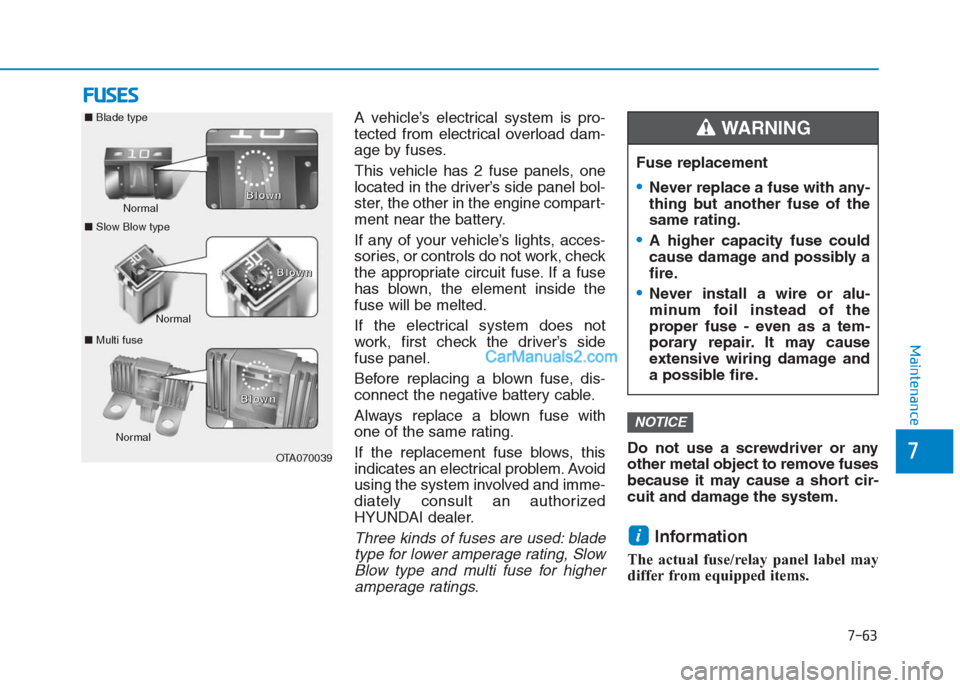
Three kinds of fuses are used: blade
type for lower amperage rating, Slow
Blow type and multi fuse for higher
amperage ratings.
Do not use a screwdriver or any
other metal object to remove fuses
because it may cause a short cir-
cuit and damage the system.
Information
The actual fuse/relay panel label may
differ from equipped items.
i
NOTICE
OTA070039 Normal Normal
■Slow Blow type
■Multi fuseB B B B
l l l l
o o o o
w w w w
n n n n
Normal ■Blade type
B B B B
l l l l
o o o o
w w w w
n n n n
B B B B
l l l l
o o o o
w w w w
n n n n
Fuse replacement
Never replace a fuse with any-
thing but another fuse of the
same rating.
A higher capacity fuse could
cause damage and possibly a
fire.
Never install a wire or alu-
minum foil instead of the
proper fuse - even as a tem-
porary repair. It may cause
extensive wiring damage and
a possible fire.
WARNING
Page 421 of 472
7-64
Maintenance
When replacing a blown fuse or
relay with a new one, make sure
the new fuse or relay fits tightly
into the clips. The incomplete
fastening fuse or relay may
cause the vehicle wiring and
electric systems damage and a
possible fire.
Do not remove fuses, relays and
terminals fastened with bolts or
nuts. The fuses, relays and ter-
minals may be fastened incom-
pletely, and it may cause a pos-
sible fire. If fuses, relays and ter-
minals fastened with bolts or
nuts are blown, consult with an
authorized HYUNDAI dealer.
Do not input any other objects
except fuses or relays into
fuse/relay terminals such as a
driver or wiring. It may cause
contact failure and system mal-
function.
(Continued)(Continued)
Check the blown fuse with the
fuse information on the fuse box
cover.
Replace the blown fuse on the
same place after turning off the
ignition switch and all electric
switches and disconnecting the
negative battery cable.
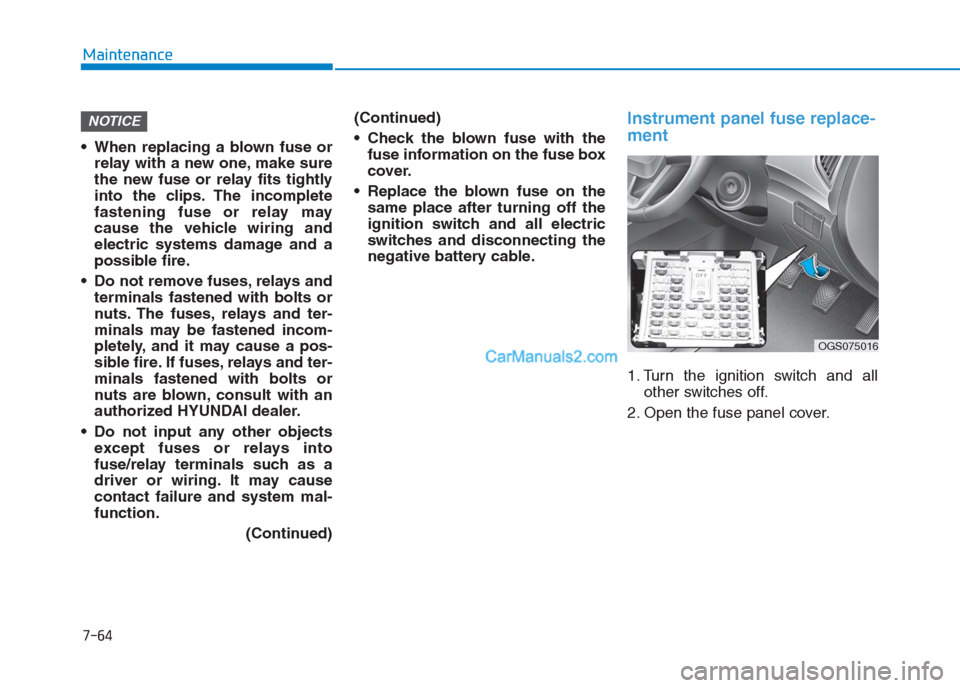
Instrument panel fuse replace-
ment
1. Turn the ignition switch and all
other switches off.
2. Open the fuse panel cover.
NOTICE
OGS075016
Page 428 of 472
7-71
7
Maintenance
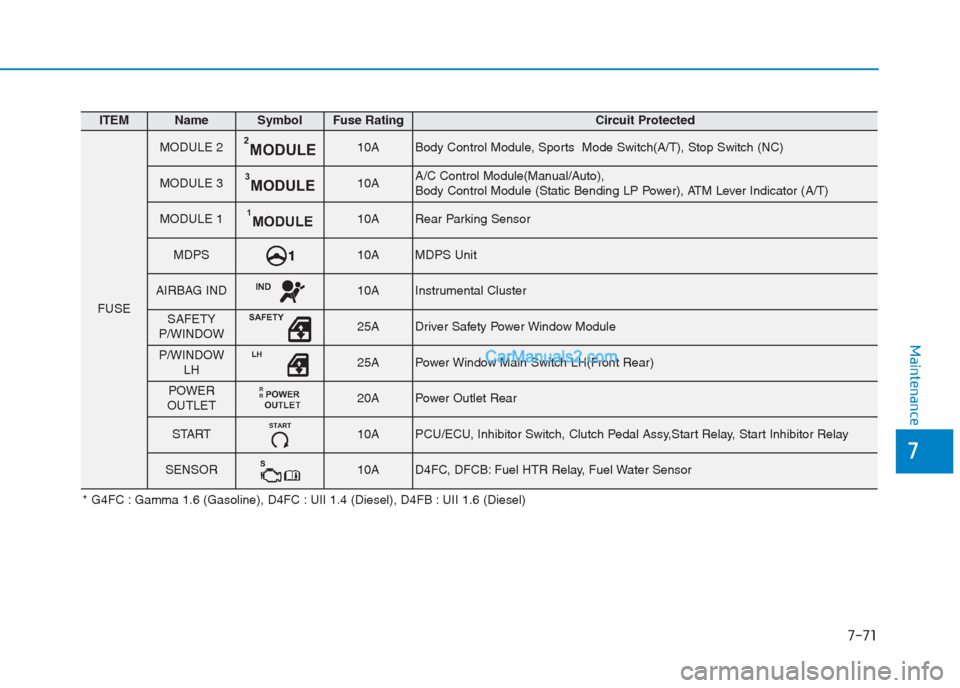
ITEMNameSymbolFuse RatingCircuit Protected
FUSE
MODULE 2MODULE210ABody Control Module, Sports Mode Switch(A/T), Stop Switch (NC)
MODULE 3MODULE310AA/C Control Module(Manual/Auto),
Body Control Module (Static Bending LP Power), ATM Lever Indicator (A/T)
MODULE 1MODULE110ARear Parking Sensor
MDPS10AMDPS Unit
AIRBAG INDIND10AInstrumental Cluster
SAFETY
P/WINDOWSAFETY25ADriver Safety Power Window Module
P/WINDOW
LHLH25APower Window Main Switch LH(Front Rear)
POWER
OUTLETPOWER
OUTLETR
R20APower Outlet Rear
STARTSTART10APCU/ECU, Inhibitor Switch, Clutch Pedal Assy,Start Relay, Start Inhibitor Relay
SENSORS10AD4FC, DFCB: Fuel HTR Relay, Fuel Water Sensor
* G4FC : Gamma 1.6 (Gasoline), D4FC : UII 1.4 (Diesel), D4FB : UII 1.6 (Diesel)