Drive Hyundai Creta 2019 Owner's Manual
[x] Cancel search | Manufacturer: HYUNDAI, Model Year: 2019, Model line: Creta, Model: Hyundai Creta 2019Pages: 472, PDF Size: 13.39 MB
Page 441 of 472
7-84
Maintenance
Outside light
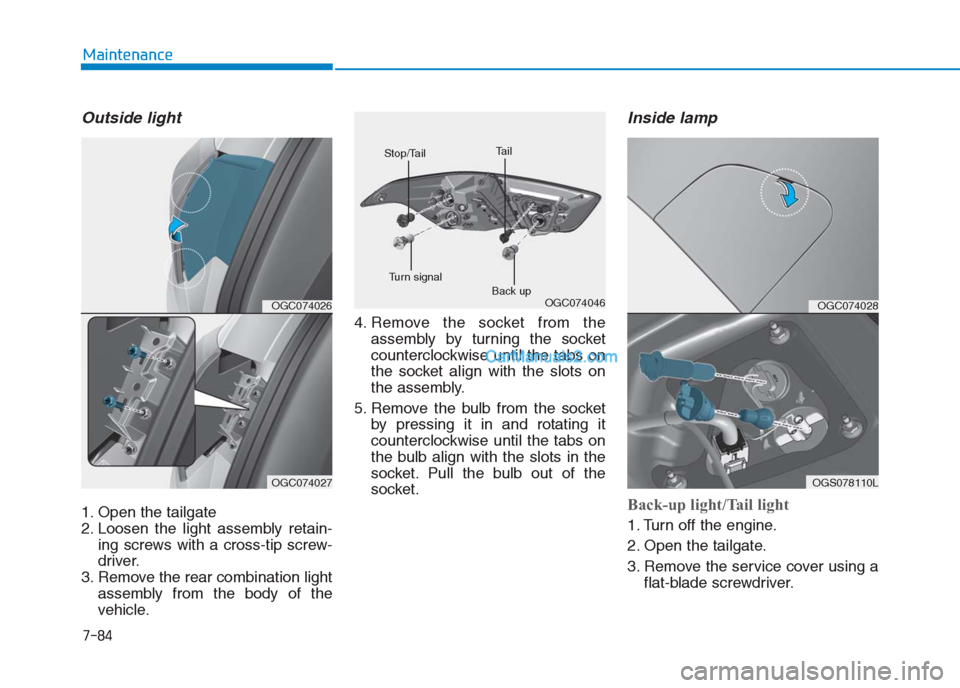
1. Open the tailgate
2. Loosen the light assembly retain-
ing screws with a cross-tip screw-
driver.
3. Remove the rear combination light
assembly from the body of the
vehicle.4. Remove the socket from the
assembly by turning the socket
counterclockwise until the tabs on
the socket align with the slots on
the assembly.
5. Remove the bulb from the socket
by pressing it in and rotating it
counterclockwise until the tabs on
the bulb align with the slots in the
socket. Pull the bulb out of the
socket.
Inside lamp
Back-up light/Tail light
1. Turn off the engine.
2. Open the tailgate.
3. Remove the service cover using a
flat-blade screwdriver.
OGC074046
Turn signal Stop/TailTailBack upOGC074026
OGC074027
OGC074028
OGS078110L
Page 444 of 472
7-87
7
Maintenance
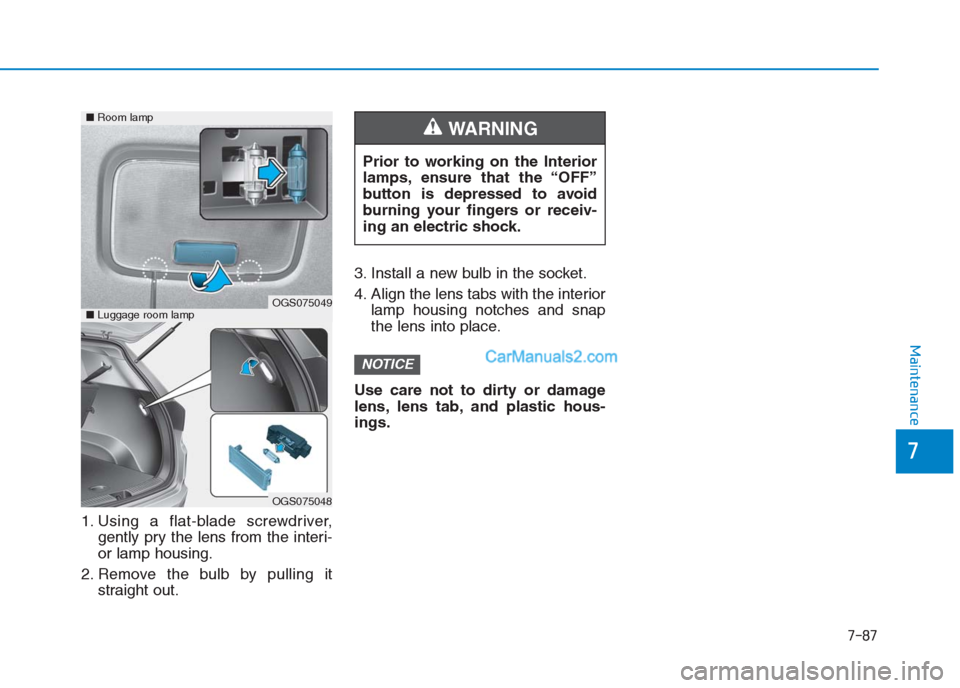
1. Using a flat-blade screwdriver,
gently pry the lens from the interi-
or lamp housing.
2. Remove the bulb by pulling it
straight out.3. Install a new bulb in the socket.
4. Align the lens tabs with the interior
lamp housing notches and snap
the lens into place.
Use care not to dirty or damage
lens, lens tab, and plastic hous-
ings.
NOTICE
Prior to working on the Interior
lamps, ensure that the “OFF”
button is depressed to avoid
burning your fingers or receiv-
ing an electric shock.
WARNING ■Room lamp
■Luggage room lamp OGS075049
OGS075048
Page 450 of 472
7-93
7
Maintenance
Keep your garage dry
Don't park your vehicle in a damp,
poorly ventilated garage. This cre-
ates a favorable environment for cor-
rosion. This is particularly true if you
wash your vehicle in the garage or
drive it into the garage when it is still
wet or covered with snow, ice or
mud. Even a heated garage can con-
tribute to corrosion unless it is well
ventilated so moisture is dispersed.
Keep paint and trim in good con-
dition
Scratches or chips in the finish
should be covered with "touch-up"
paint as soon as possible to reduce
the possibility of corrosion. If bare
metal is showing through, the atten-
tion of a qualified body and paint
shop is recommended.
Bird droppings : Bird droppings are
highly corrosive and may damage
painted surfaces in just a few hours.
Always remove bird droppings as
soon as possible.Don't neglect the interior
Moisture can collect under the floor
mats and carpeting and cause corro-
sion. Check under the mats periodi-
cally to be sure the carpeting is dry.
Use particular care if you carry fertil-
izers, cleaning materials or chemi-
cals in the vehicle.
These should be carried only in
proper containers and any spills or
leaks should be cleaned up, flushed
with clean water and thoroughly
dried.Interior care
Interior general precautions
Prevent chemicals such as perfume,
cosmetic oil, sun cream, hand clean-
er, and air freshener from contacting
the interior parts because they may
cause damage or discoloration. If
they do contact the interior parts,
wipe them off immediately. See the
instructions that follow for the proper
way to clean vinyl.
Never allow water or other liquids
to come in contact with electrical/
electronic components inside the
vehicle as this may damage them.
When cleaning leather products
(steering wheel, seats etc.), use
neutral detergents or low alcohol
content solutions. If you use high
alcohol content solutions or
acid/alkaline detergents, the color
of the leather may fade or the sur-
face may get stripped off.
NOTICE
NOTICE
Page 453 of 472
7-96
Maintenance
3. Exhaust emission control
system
The Exhaust Emission Control
System is a highly effective system
which controls exhaust emissions
while maintaining good vehicle per-
formance.
Vehicle modifications
This vehicle should not be modi-
fied. Modification of your vehicle
could affect its performance, safety
or durability and may even violate
governmental safety and emis-
sions regulations.
In addition, damage or perform-
ance problems resulting from any
modification may not be covered
under warranty.
If you use unauthorized electronic
devices, it may cause the vehicle to
operate abnormally, wire damage,
battery discharge and fire. For your
safety, do not use unauthorized
electronic devices.
Engine exhaust gas precautions
(carbon monoxide)
Carbon monoxide can be present
with other exhaust fumes.
Therefore, if you smell exhaust
fumes of any kind inside your vehi-
cle, have it inspected and repaired
immediately. If you ever suspect
exhaust fumes are coming into
your vehicle, drive it only with all
the windows fully open. Have your
vehicle checked and repaired
immediately. Do not operate the engine in con-
fined or closed areas (such as
garages) any more than what is
necessary to move the vehicle in or
out of the area.
When the vehicle is stopped in an
open area for more than a short
time with the engine running,
adjust the ventilation system (as
needed) to draw outside air into the
vehicle.
Never sit in a parked or stopped
vehicle for any extended time with
the engine running.
When the engine stalls or fails to
start, excessive attempts to restart
the engine may cause damage to
the emission control system. Exhaust
Engine exhaust gases contain
carbon monoxide (CO). Though
colorless and odorless, it is
dangerous and could be lethal if
inhaled. Follow the instructions
on this page to avoid CO poi-
soning.
WARNING
Page 454 of 472
7-97
7
Maintenance
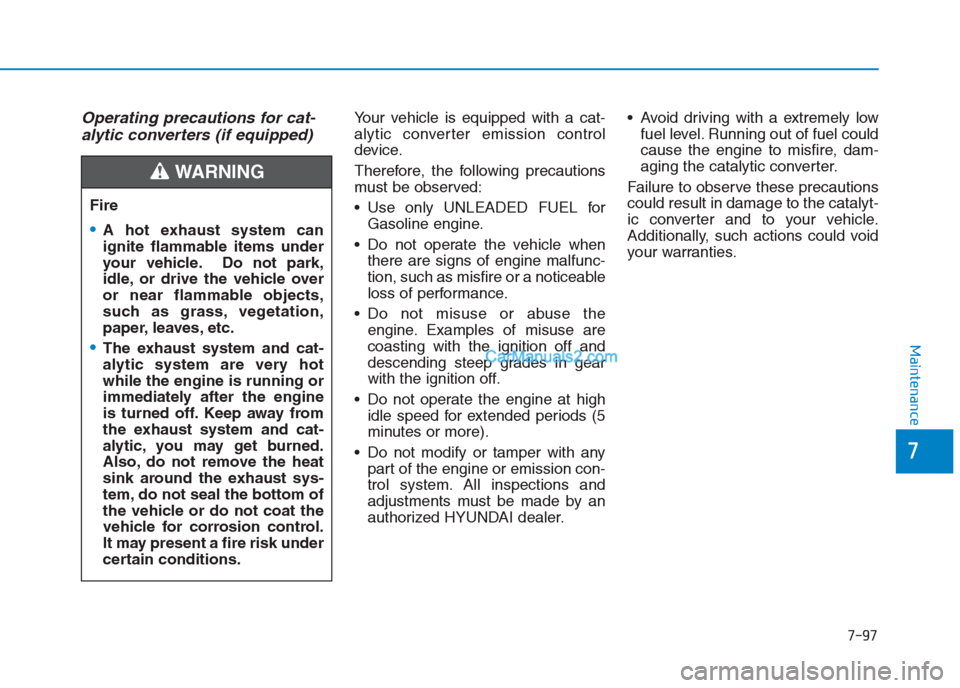
Operating precautions for cat-
alytic converters (if equipped)Your vehicle is equipped with a cat-
alytic converter emission control
device.
Therefore, the following precautions
must be observed:
Use only UNLEADED FUEL for
Gasoline engine.
Do not operate the vehicle when
there are signs of engine malfunc-
tion, such as misfire or a noticeable
loss of performance.
Do not misuse or abuse the
engine. Examples of misuse are
coasting with the ignition off and
descending steep grades in gear
with the ignition off.
Do not operate the engine at high
idle speed for extended periods (5
minutes or more).
Do not modify or tamper with any
part of the engine or emission con-
trol system. All inspections and
adjustments must be made by an
authorized HYUNDAI dealer. Avoid driving with a extremely low
fuel level. Running out of fuel could
cause the engine to misfire, dam-
aging the catalytic converter.
Failure to observe these precautions
could result in damage to the catalyt-
ic converter and to your vehicle.
Additionally, such actions could void
your warranties. Fire
A hot exhaust system can
ignite flammable items under
your vehicle. Do not park,
idle, or drive the vehicle over
or near flammable objects,
such as grass, vegetation,
paper, leaves, etc.
The exhaust system and cat-
alytic system are very hot
while the engine is running or
immediately after the engine
is turned off. Keep away from
the exhaust system and cat-
alytic, you may get burned.
Also, do not remove the heat
sink around the exhaust sys-
tem, do not seal the bottom of
the vehicle or do not coat the
vehicle for corrosion control.
It may present a fire risk under
certain conditions.
WARNING
Page 458 of 472
8-4
Specifications & Consumer information
T TI
IR
RE
ES
S
A
AN
ND
D
W
WH
HE
EE
EL
LS
S
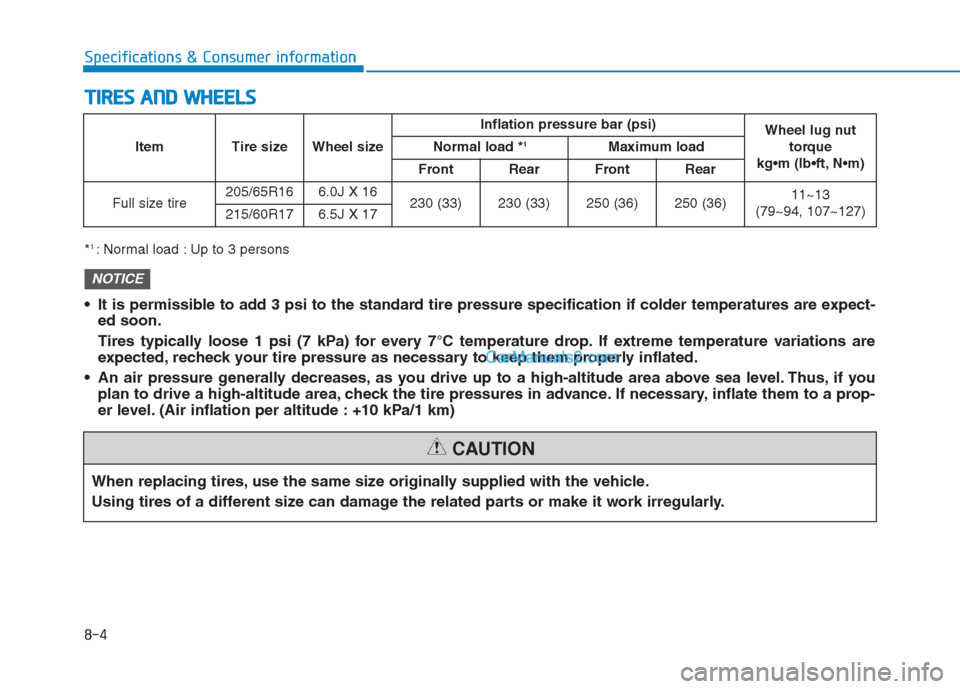
When replacing tires, use the same size originally supplied with the vehicle.
Using tires of a different size can damage the related parts or make it work irregularly.
CAUTION
*1 : Normal load : Up to 3 personsItem Tire size Wheel sizeInflation pressure bar (psi)
Wheel lug nut
torque
kg•m (lb N Normal load *
1Maximum load
Front Rear Front Rear
Full size tire205/65R16 6.0J X 16
230 (33) 230 (33) 250 (36) 250 (36)11~13
(79~94, 107~127)
215/60R17 6.5J X 17
It is permissible to add 3 psi to the standard tire pressure specification if colder temperatures are expect-
ed soon.
Tires typically loose 1 psi (7 kPa) for every 7°C temperature drop. If extreme temperature variations are
expected, recheck your tire pressure as necessary to keep them properly inflated.
An air pressure generally decreases, as you drive up to a high-altitude area above sea level. Thus, if you
plan to drive a high-altitude area, check the tire pressures in advance. If necessary, inflate them to a prop-
er level. (Air inflation per altitude : +10 kPa/1 km)
NOTICE
Page 462 of 472
8-8
Specifications & Consumer information
V VE
EH
HI
IC
CL
LE
E
I
ID
DE
EN
NT
TI
IF
FI
IC
CA
AT
TI
IO
ON
N
N
NU
UM
MB
BE
ER
R
(
(V
VI
IN
N)
)
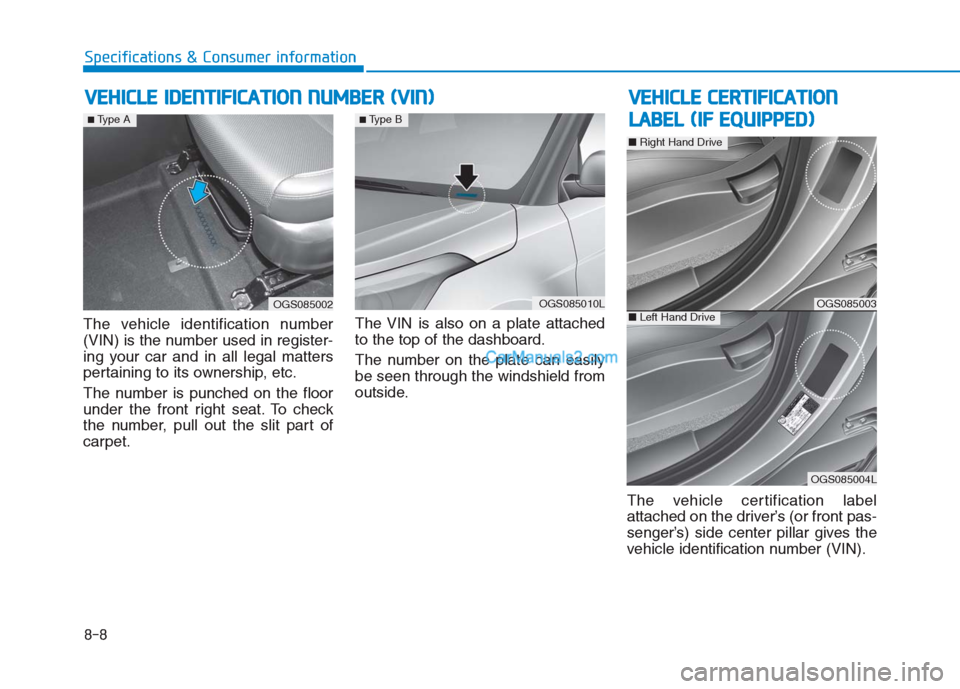
The vehicle identification number
(VIN) is the number used in register-
ing your car and in all legal matters
pertaining to its ownership, etc.
The number is punched on the floor
under the front right seat. To check
the number, pull out the slit part of
carpet.The VIN is also on a plate attached
to the top of the dashboard.
The number on the plate can easily
be seen through the windshield from
outside.
The vehicle certification label
attached on the driver’s (or front pas-
senger’s) side center pillar gives the
vehicle identification number (VIN).
OGS085002
V VE
EH
HI
IC
CL
LE
E
C
CE
ER
RT
TI
IF
FI
IC
CA
AT
TI
IO
ON
N
L LA
AB
BE
EL
L
(
(I
IF
F
E
EQ
QU
UI
IP
PP
PE
ED
D)
)
OGS085010L
■ Type A■ Type B
OGS085003
OGS085004L
■Right Hand Drive
■Left Hand Drive
Page 463 of 472

The tires supplied on your new vehi-
cle are chosen to provide the best
performance for normal driving.
The tire label located on the driver's
side (or front passenger’s side) cen-
ter pillar gives the tire pressures rec-
ommended for your car.The engine number is stamped on
the engine block as shown in the
drawing.
8-9
8
Specifications & Consumer information
T TI
IR
RE
E
S
SP
PE
EC
CI
IF
FI
IC
CA
AT
TI
IO
ON
N
A
AN
ND
D
P PR
RE
ES
SS
SU
UR
RE
E
L
LA
AB
BE
EL
L
OGS085004
OGS085009L
■Right Hand Drive
■Left Hand Drive
■Gamma 1.6 MPI
■U2 1.4 TCIOGS086011/OGS085007/OGS085001
■U2 1.6 TCI
E
EN
NG
GI
IN
NE
E
N
NU
UM
MB
BE
ER
R
Page 466 of 472
I-2
Accessing your vehicle ...................................................3-3
Immobilizer system ...................................................3-12
Remote key ..................................................................3-3
Remote key precautions...............................................3-5
Smart key .....................................................................3-7
Smart key precautions ...............................................3-10
Air bag-supplemental restraint system (SRS) ..............2-43
Air bag warning and indicator ...................................2-48
Air bag warning label ...............................................2-65
Curtain air bag ..........................................................2-56
Do not install a child restraint on the front
passenger's seat ........................................................2-47
Driver's and passenger's front air bag .......................2-52
How does the air bag system operate .......................2-45
Side impact air bag ...................................................2-55
SRS Care....................................................................2-63
SRS components and functions .................................2-48
Air cleaner ....................................................................7-41
Filter replacement ....................................................7-41
Air conditioner compressor label .................................8-10Appearance care ...........................................................7-88
Exterior care...............................................................7-88
Interior care................................................................7-93
Audio (With Touch Screen) ..........................................4-33
Feature of Your Audio ...............................................4-34
Media .........................................................................4-40
Phone ........................................................................4-49
Radio ..........................................................................4-38
Setup ..........................................................................4-57
Audio (Without Touch Screen).......................................4-8
Feature of Your Audio .................................................4-9
Media .........................................................................4-15
Phone .........................................................................4-22
Radio ..........................................................................4-14
Radio Mode ...............................................................4-14
Setup ..........................................................................4-30
Automatic transaxle ......................................................5-23
Automatic transaxle operation ...................................5-24
Good driving practices...............................................5-28
Parking .......................................................................5-28
Index
A
Page 468 of 472
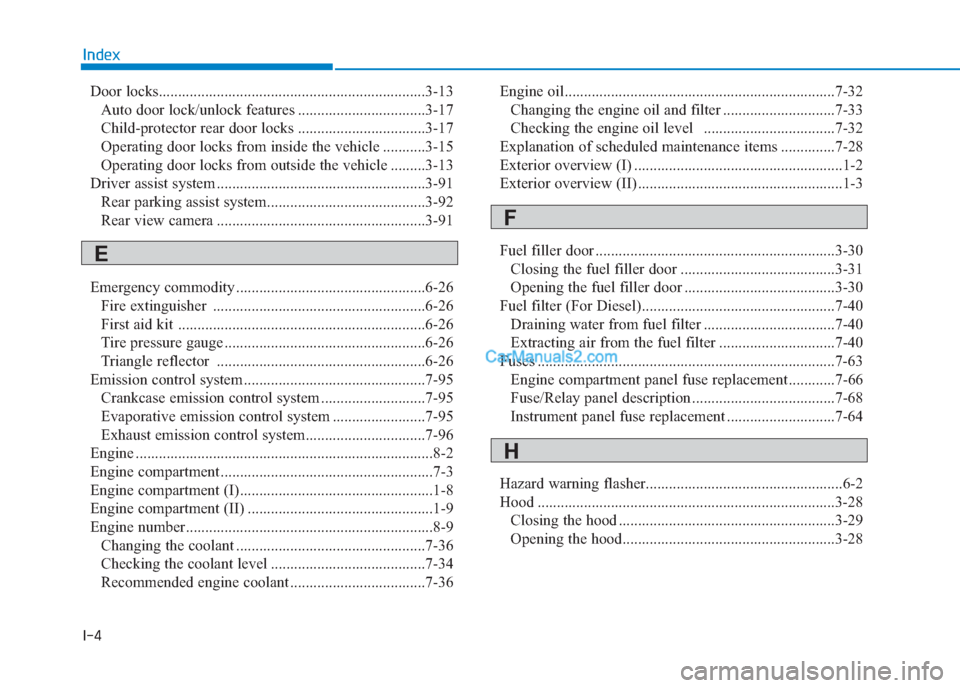
I-4
Door locks.....................................................................3-13
Auto door lock/unlock features .................................3-17
Child-protector rear door locks .................................3-17
Operating door locks from inside the vehicle ...........3-15
Operating door locks from outside the vehicle .........3-13
Driver assist system ......................................................3-91
Rear parking assist system.........................................3-92
Rear view camera ......................................................3-91
Emergency commodity .................................................6-26
Fire extinguisher .......................................................6-26
First aid kit ................................................................6-26
Tire pressure gauge ....................................................6-26
Triangle reflector ......................................................6-26
Emission control system ...............................................7-95
Crankcase emission control system ...........................7-95
Evaporative emission control system ........................7-95
Exhaust emission control system...............................7-96
Engine .............................................................................8-2
Engine compartment .......................................................7-3
Engine compartment (I)..................................................1-8
Engine compartment (II) ................................................1-9
Engine number................................................................8-9
Changing the coolant .................................................7-36
Checking the coolant level ........................................7-34
Recommended engine coolant ...................................7-36Engine oil......................................................................7-32
Changing the engine oil and filter .............................7-33
Checking the engine oil level ..................................7-32
Explanation of scheduled maintenance items ..............7-28
Exterior overview (I) ......................................................1-2
Exterior overview (II) .....................................................1-3
Fuel filler door ..............................................................3-30
Closing the fuel filler door ........................................3-31
Opening the fuel filler door .......................................3-30
Fuel filter (For Diesel)..................................................7-40
Draining water from fuel filter ..................................7-40
Extracting air from the fuel filter ..............................7-40
Fuses .............................................................................7-63
Engine compartment panel fuse replacement ............7-66
Fuse/Relay panel description .....................................7-68
Instrument panel fuse replacement ............................7-64
Hazard warning flasher...................................................6-2
Hood .............................................................................3-28
Closing the hood ........................................................3-29
Opening the hood.......................................................3-28
Index
E
F
H