battery Hyundai Elantra 2003 User Guide
[x] Cancel search | Manufacturer: HYUNDAI, Model Year: 2003, Model line: Elantra, Model: Hyundai Elantra 2003Pages: 172, PDF Size: 2.82 MB
Page 112 of 172

DRIVING YOUR HYUNDAI DRIVING YOUR HYUNDAIDRIVING YOUR HYUNDAI DRIVING YOUR HYUNDAI
DRIVING YOUR HYUNDAI
2- 11 accordance with the maintenance schedule in
Section 5. Before winter, have your coolant test-
ed to assure that its freezing point is sufficient for
the temperatures anticipated during the winter.
C160D01A-AAT
Check Battery and Cables Check Battery and CablesCheck Battery and Cables Check Battery and Cables
Check Battery and CablesWinter puts additional burdens on the battery
system. Visually inspect the battery and cables
as described in Section 6. The level of charge in
your battery can be checked by your Hyundai
dealer or a service station.
C160E01A-AATChange to "Winter Weight" Oil if Change to "Winter Weight" Oil ifChange to "Winter Weight" Oil if Change to "Winter Weight" Oil if
Change to "Winter Weight" Oil if
Necessary NecessaryNecessary Necessary
Necessary
In some climates it is recommended that a lower
viscosity "winter weight" oil be used during cold
weather. See Section 9 for recommendations. If
you aren't sure what weight oil you should use,
consult your Hyundai dealer.
C160F01A-AATCheck Spark Plugs and Ignition Check Spark Plugs and IgnitionCheck Spark Plugs and Ignition Check Spark Plugs and Ignition
Check Spark Plugs and Ignition
System SystemSystem System
System
Inspect your spark plugs as described in Section
6 and replace them if necessary. Also check all
ignition wiring and components to be sure they
are not cracked, worn or damaged in any way.
C160G01A-AAT
To Keep Locks from Freezing To Keep Locks from FreezingTo Keep Locks from Freezing To Keep Locks from Freezing
To Keep Locks from FreezingTo keep the locks from freezing, squirt an ap-
proved de-icer fluid or glycerine into the key
opening. If a lock is covered with ice, squirt it with
an approved de-icing fluid to remove the ice. If
the lock is frozen internally, you may be able to
thaw it out by using a heated key. Handle the
heated key with care to avoid burning the fingers.
C160H01A-AATUse Approved Anti-Freeze in Window Use Approved Anti-Freeze in WindowUse Approved Anti-Freeze in Window Use Approved Anti-Freeze in Window
Use Approved Anti-Freeze in Window
Washer System Washer SystemWasher System Washer System
Washer System
To keep the water in the window washer system
from freezing, add an approved anti-freeze solu-
tion in accordance with instructions on the con-
tainer. Window washer anti-freeze is available
from Hyundai dealers and most auto parts out-
lets. Do not use engine coolant or other types of
anti-freeze as these may damage the finish.
C160I01A-AAT
Don't Let Your Parking Brake Freeze Don't Let Your Parking Brake FreezeDon't Let Your Parking Brake Freeze Don't Let Your Parking Brake Freeze
Don't Let Your Parking Brake FreezeUnder some conditions your parking brake can
freeze in the engaged position. This is most likely
to happen when there is an accumulation of snow
or ice around or near the rear brakes or if the
brakes are wet. If there is a risk the parking brake
may freeze, apply it only temporarily while you
put the gear selector lever in "P" (automatic) or in
first or reverse gear (manual transaxle) and
block the rear wheels so the car cannot roll. Then
release the parking brake.
C160K01A-AAT
Carry Emergency Equipment Carry Emergency EquipmentCarry Emergency Equipment Carry Emergency Equipment
Carry Emergency EquipmentDepending on the severity of the weather where
you drive your car, you should carry appropriate
emergency equipment. Some of the items you
may want to carry include tire chains, tow straps
or chains, flashlight, emergency flares, sand, a
shovel, jumper cables, a window scraper, gloves,
ground cloth, coveralls, a blanket, etc.
C160J01A-AAT
Don't Let Ice and Snow Accumulate Don't Let Ice and Snow AccumulateDon't Let Ice and Snow Accumulate Don't Let Ice and Snow Accumulate
Don't Let Ice and Snow Accumulate
Underneath UnderneathUnderneath Underneath
Underneath
Under some conditions, snow and ice can build
up under the fenders and interfere with the steer-
ing. When driving in severe winter conditions
where this may happen, you should periodically
check underneath the car to be sure the move-
ment of the front wheels and the steering compo-
nents is not obstructed.
C170A01A-AAT
HIGHER SPEED MOTORING HIGHER SPEED MOTORINGHIGHER SPEED MOTORING HIGHER SPEED MOTORING
HIGHER SPEED MOTORING
Pre-Trip Inspections Pre-Trip InspectionsPre-Trip Inspections Pre-Trip Inspections
Pre-Trip Inspections
1. Tires:
Adjust the tire inflation pressures to specifica-
tion. Low tire inflation pressures will result in
overheating and possible failure of the tires.
Avoid using worn or damaged tires which may
result in reduced traction or tire failure.
Page 116 of 172
WHAT TO DO IN AN EMERGENCY WHAT TO DO IN AN EMERGENCYWHAT TO DO IN AN EMERGENCY WHAT TO DO IN AN EMERGENCY
WHAT TO DO IN AN EMERGENCY
3-1
3 . WHAT TO DO IN AN
EMERGENCY
D010A01A-AAT
IF THE ENGINE WILL NOT START IF THE ENGINE WILL NOT STARTIF THE ENGINE WILL NOT START IF THE ENGINE WILL NOT START
IF THE ENGINE WILL NOT START
WARNING: WARNING:WARNING: WARNING:
WARNING:
If the engine will not start, do not push or pull If the engine will not start, do not push or pullIf the engine will not start, do not push or pull If the engine will not start, do not push or pull
If the engine will not start, do not push or pull
the car to start it. This could result in a the car to start it. This could result in athe car to start it. This could result in a the car to start it. This could result in a
the car to start it. This could result in a
collision or cause other damage. In addition, collision or cause other damage. In addition,collision or cause other damage. In addition, collision or cause other damage. In addition,
collision or cause other damage. In addition,
push or pull starting may cause the catalytic push or pull starting may cause the catalyticpush or pull starting may cause the catalytic push or pull starting may cause the catalytic
push or pull starting may cause the catalytic
converter to be overloaded and create a fire converter to be overloaded and create a fireconverter to be overloaded and create a fire converter to be overloaded and create a fire
converter to be overloaded and create a fire
hazard. hazard.hazard. hazard.
hazard.
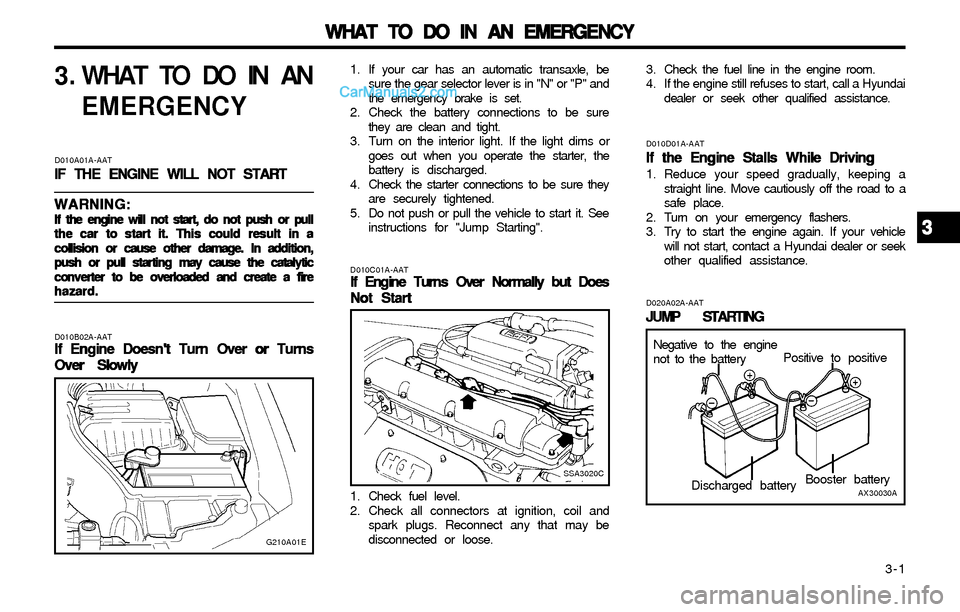
D010B02A-AATIf Engine Doesn't Turn Over or Turns If Engine Doesn't Turn Over or TurnsIf Engine Doesn't Turn Over or Turns If Engine Doesn't Turn Over or Turns
If Engine Doesn't Turn Over or Turns
Over Slowly Over SlowlyOver Slowly Over Slowly
Over Slowly
1. If your car has an automatic transaxle, be
sure the gear selector lever is in "N" or "P" and
the emergency brake is set.
2. Check the battery connections to be sure
they are clean and tight.
3. Turn on the interior light. If the light dims or
goes out when you operate the starter, the
battery is discharged.
4. Check the starter connections to be sure they
are securely tightened.
5. Do not push or pull the vehicle to start it. See
instructions for "Jump Starting".
SSA3020C D010C01A-AAT
If Engine Turns Over Normally but Does If Engine Turns Over Normally but DoesIf Engine Turns Over Normally but Does If Engine Turns Over Normally but Does
If Engine Turns Over Normally but Does
Not Start Not StartNot Start Not Start
Not Start
1. Check fuel level.
2. Check all connectors at ignition, coil and
spark plugs. Reconnect any that may be
disconnected or loose.
D010D01A-AAT
If the Engine Stalls While Driving If the Engine Stalls While DrivingIf the Engine Stalls While Driving If the Engine Stalls While Driving
If the Engine Stalls While Driving1. Reduce your speed gradually, keeping a
straight line. Move cautiously off the road to a
safe place.
2. Turn on your emergency flashers.
3. Try to start the engine again. If your vehicle
will not start, contact a Hyundai dealer or seek
other qualified assistance.
D020A02A-AAT
JUMP STARTING JUMP STARTINGJUMP STARTING JUMP STARTING
JUMP STARTING
G210A01E
Negative to the engine
not to the batteryPositive to positive
Booster battery
AX30030ADischarged battery
3 33 3
3
3. Check the fuel line in the engine room.
4. If the engine still refuses to start, call a Hyundai
dealer or seek other qualified assistance.
Page 117 of 172

WHAT TO DO IN AN EMERGENCY WHAT TO DO IN AN EMERGENCYWHAT TO DO IN AN EMERGENCY WHAT TO DO IN AN EMERGENCY
WHAT TO DO IN AN EMERGENCY
3-2
WARNING: WARNING:WARNING: WARNING:
WARNING:The gas produced by the battery during the The gas produced by the battery during theThe gas produced by the battery during the The gas produced by the battery during the
The gas produced by the battery during the
jump-start operation is highly explosive. If jump-start operation is highly explosive. Ifjump-start operation is highly explosive. If jump-start operation is highly explosive. If
jump-start operation is highly explosive. If
these instructions are not followed exactly, these instructions are not followed exactly,these instructions are not followed exactly, these instructions are not followed exactly,
these instructions are not followed exactly,
serious personal injury and damage to the serious personal injury and damage to theserious personal injury and damage to the serious personal injury and damage to the
serious personal injury and damage to the
vehicle may occur! If you are not sure how to vehicle may occur! If you are not sure how tovehicle may occur! If you are not sure how to vehicle may occur! If you are not sure how to
vehicle may occur! If you are not sure how to
follow this procedure, seek qualified assis- follow this procedure, seek qualified assis-follow this procedure, seek qualified assis- follow this procedure, seek qualified assis-
follow this procedure, seek qualified assis-
tance. Automobile batteries contain sulfuric tance. Automobile batteries contain sulfurictance. Automobile batteries contain sulfuric tance. Automobile batteries contain sulfuric
tance. Automobile batteries contain sulfuric
acid. This is poisonous and highly corrosive. acid. This is poisonous and highly corrosive.acid. This is poisonous and highly corrosive. acid. This is poisonous and highly corrosive.
acid. This is poisonous and highly corrosive.
When jump starting, wear protective glasses When jump starting, wear protective glassesWhen jump starting, wear protective glasses When jump starting, wear protective glasses
When jump starting, wear protective glasses
and be careful not to get acid on yourself, and be careful not to get acid on yourself,and be careful not to get acid on yourself, and be careful not to get acid on yourself,
and be careful not to get acid on yourself,
your clothing or on the car. your clothing or on the car.your clothing or on the car. your clothing or on the car.
your clothing or on the car.
o If you should accidentally get acid on your
skin or in your eyes, immediately remove any
contaminated clothing and flush the area with
clear water for at least 15 minutes. Then
promptly obtain medical attention. If you must
be transported to an emergency facility, con-
tinue to apply water to the affected area with
a sponge or cloth.
o The gas produced by the battery during the
jump-start operation is highly explosive. Do
not smoke or allow a spark or an open flame
in the vicinity.
o The battery being used to provide the jump
start must be 12-volt. If you cannot determine
that it is a 12-volt battery, do not attempt to
use it for the jump start.
o To jump start a car with a discharged battery,
follow this procedure exactly:1. If the booster battery is installed in another
vehicle, be sure the two vehicles are not
touching.
2. Turn off all unnecessary lights and acces-
sories in both vehicles.
3. Attach the clamps of the jumper cable in the
exact location shown in the illustration. First,
attach one clamp of the jumper cable to the
positive (+) post or cable of the discharged
battery. Then attach the other end of the
same cable to the positive (+) post or cable
of the booster battery. Next, using the other
cable, attach one clamp to the negative (-)
post or cable of the booster battery. Then
attach the other end of that cable to a solid
metal part of the engine away from the
battery. Do not connect the cable to any
moving part.
4. Start the engine in the car with the booster
battery and let it run for a few minutes. This
will help to assure that the booster battery is
fully charged. During the jumping operation,
run the engine in this vehicle at about 2,000
rpm.
5. Start the engine in the car with the discharged
battery using the normal starting procedure.
After the engine starts, leave the jumper
cables connected and let the engine run at
fast idle or about 2,000 rpm for several min-
utes.
6. Carefully remove the jumper cables in the
reverse order of attachment.
If you do not know why your battery became
discharged (because the lights were left on,
D030A01A-AAT
IF THE ENGINE OVERHEATS IF THE ENGINE OVERHEATSIF THE ENGINE OVERHEATS IF THE ENGINE OVERHEATS
IF THE ENGINE OVERHEATSIf your temperature gauge indicates overheating,
you experience a loss of power, or hear loud
pinging or knocking and the engine is probably
too hot. If this happens and, you should:
1. Pull off the road and stop as soon as it is safe
to do so.
2. Place the gear selector lever in "P" (auto-
matic), or neutral (manual transaxle) and set
the parking brake. If the air conditioning is on,
turn it off.
3. If engine coolant is running out under the car
or steam is coming out from the hood, stop
the engine. Do not open the hood until the
engine coolant has stopped running or the
steaming has stopped. If there is no visible
loss of engine coolant and no steam, leave
the engine running and check to be sure the
engine cooling fan is operating. If the fan is
not running, turn the engine off.
4. Check to see if the water pump drive belt is
missing. If it is not missing, check to see that
it is tight. If the drive belt seems to be satis-
factory, check for engine coolant leaking from
the radiator, hoses or under the car. (If the air
conditioning had been in use, it is normal for
cold water to be draining from it when you
stop).
etc.), have the charging system checked by your
Hyundai dealer.
Page 127 of 172
CORROSION PREVENTION AND APPEARANCE CARE CORROSION PREVENTION AND APPEARANCE CARECORROSION PREVENTION AND APPEARANCE CARE CORROSION PREVENTION AND APPEARANCE CARE
CORROSION PREVENTION AND APPEARANCE CARE
4-3 doors are open. Paint damage can be caused by
small accumulation of tar, industrial precipita-
tion, tree resin, insects and bird droppings, when
not removed immediately. If water alone is not
strong enough to remove the accumulated dirt,
use a mild car washing solution. Be sure to rinse
the surface after washing to remove the solution.
Never allow the solution to dry on the painted
surfaces.
E030D01A-AAT
When to Wax Again When to Wax AgainWhen to Wax Again When to Wax Again
When to Wax AgainYou should polish and wax the car again when
water no longer beads on a clean surface but
spreads out over a larger area.
E030E01A-AAT
Maintaining Bumpers Maintaining BumpersMaintaining Bumpers Maintaining Bumpers
Maintaining BumpersSpecial precautions must be observed to pre-
serve the appearance of the bumpers on your
Hyundai. They are:
o Be careful not to spill battery electrolyte or
hydraulic brake fluid on the bumpers. If you
do, wash it off immediately with clear water.
o Be gentle when cleaning the bumper sur-
faces. They are made of soft plastic and the
surface can be damaged if mistreated. Do not
use abrasive cleaners. Use warm water and
mild soap or car-washing solution.
o Do not expose the bumpers to high tem-
peratures. For example, if you have your car
repainted, do not leave the bumpers on the
car if the car is going to be placed in a high-
temperature paint booth.
E040A01A-AAT
CLEANING THE INTERIOR CLEANING THE INTERIORCLEANING THE INTERIOR CLEANING THE INTERIOR
CLEANING THE INTERIOR
To Clean the Vinyl Upholstery To Clean the Vinyl UpholsteryTo Clean the Vinyl Upholstery To Clean the Vinyl Upholstery
To Clean the Vinyl Upholstery
To clean the vinyl upholstery, first remove loose
dirt and dust with a vacuum cleaner. Then apply
a solution of mild soap or detergent and water
using a clean sponge or soft cloth. Allow this tostay on the surface to loosen the dirt, then wipe
with a clean damp sponge or cloth. If all the dirt
stains are not removed, repeat this procedure
until the upholstery is clean. Do not use gasoline,
solvent, paint thinner or other strong cleaners.
E030B01A-AAT
Spot Cleaning Spot CleaningSpot Cleaning Spot Cleaning
Spot CleaningDon't use gasoline, strong solvents or corrosive
cleaning agents. These can damage the finish of
the car. To remove road tar, use turpentine on a
clean, soft cloth or commercially available bug
and tar remover. Be gentle.
To remove dead insects or tree sap, use warm
water and mild soap or car-washing solution.
Soak the spot and rub gently. If the paint has lost
its luster, use a commercial car-cleaning polish.
E030C01A-AAT
Polishing and Waxing Polishing and WaxingPolishing and Waxing Polishing and Waxing
Polishing and WaxingAlways wash and dry the car before polishing or
waxing or using a combination cleaner and wax.
Use a good quality commercial product and
follow the manufacturer's directions on the con-
tainer. Polish and wax the bright trim pieces as
well as the paint.
E040D01A-AAT
Cleaning the Seat Belts Cleaning the Seat BeltsCleaning the Seat Belts Cleaning the Seat Belts
Cleaning the Seat BeltsTo clean the seat belts, use a cloth or sponge
with mild soap or detergent and warm water. Do
not use strong detergents, dye, bleach or abra-
sive materials on the seat belts as this may
weaken the fabric.
While cleaning the belts, inspect them for exces-
sive wear, cuts, fraying or other signs of damage
and replace them if necessary.
E040C01A-AAT
Cleaning the Carpets Cleaning the CarpetsCleaning the Carpets Cleaning the Carpets
Cleaning the CarpetsUse a foam-type carpet cleaner. Cleaners of this
type are available in aerosol cans in liquid form or
powder. Read the instructions and follow them
exactly. Using a vacuum cleaner with the appro-
priate attachment, remove as much dirt from the
carpets as possible. Apply the foam following the
manufacturer's directions, then rub in overlap-
ping circles. Do not add water. These cleaners
work best when the carpet is kept as dry as
possible.
Page 137 of 172
DO-IT-YOURSELF MAINTENANCE DO-IT-YOURSELF MAINTENANCEDO-IT-YOURSELF MAINTENANCE DO-IT-YOURSELF MAINTENANCE
DO-IT-YOURSELF MAINTENANCE
6-1
6. 6.6. 6.
6.
DO-IT DO-ITDO-IT DO-IT
DO-IT
-Y -Y-Y -Y
-Y
OURSELF MAINTENANCE OURSELF MAINTENANCEOURSELF MAINTENANCE OURSELF MAINTENANCE
OURSELF MAINTENANCE
G010A01E-GAT
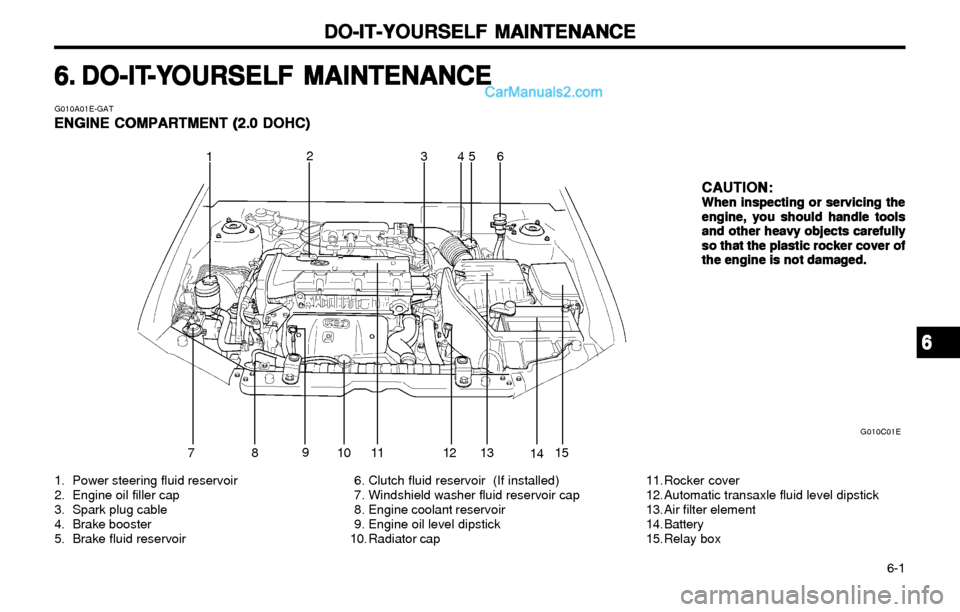
ENGINE COMPARTMENT (2.0 DOHC) ENGINE COMPARTMENT (2.0 DOHC)ENGINE COMPARTMENT (2.0 DOHC) ENGINE COMPARTMENT (2.0 DOHC)
ENGINE COMPARTMENT (2.0 DOHC)
G010C01E
2
13456
711
89
12 10 13
1415
1. Power steering fluid reservoir
2. Engine oil filler cap
3. Spark plug cable
4. Brake booster
5. Brake fluid reservoir 6. Clutch fluid reservoir (If installed)
7. Windshield washer fluid reservoir cap
8. Engine coolant reservoir
9. Engine oil level dipstick
10. Radiator cap11. Rocker cover
12. Automatic transaxle fluid level dipstick
13. Air filter element
14. Battery
15. Relay box
CAUTION: CAUTION:CAUTION: CAUTION:
CAUTION:When inspecting or servicing the When inspecting or servicing theWhen inspecting or servicing the When inspecting or servicing the
When inspecting or servicing the
engine, you should handle tools engine, you should handle toolsengine, you should handle tools engine, you should handle tools
engine, you should handle tools
and other heavy objects carefully and other heavy objects carefullyand other heavy objects carefully and other heavy objects carefully
and other heavy objects carefully
so that the plastic rocker cover of so that the plastic rocker cover ofso that the plastic rocker cover of so that the plastic rocker cover of
so that the plastic rocker cover of
the engine is not damaged. the engine is not damaged.the engine is not damaged. the engine is not damaged.
the engine is not damaged.
6 66 6
6
Page 138 of 172
DO-IT-YOURSELF MAINTENANCE DO-IT-YOURSELF MAINTENANCEDO-IT-YOURSELF MAINTENANCE DO-IT-YOURSELF MAINTENANCE
DO-IT-YOURSELF MAINTENANCE
6-2
G010A02E-GAT
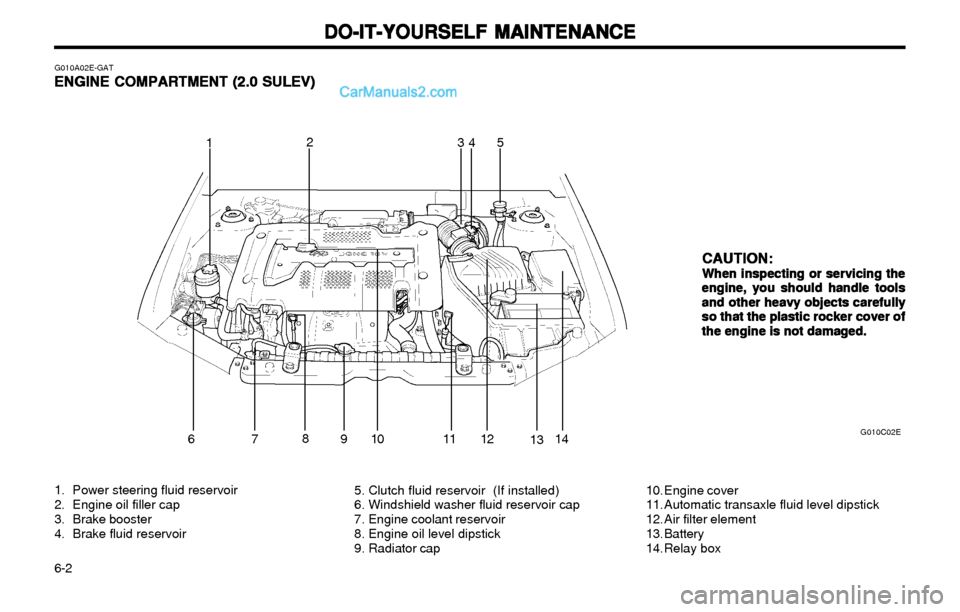
ENGINE COMPARTMENT (2.0 SULEV) ENGINE COMPARTMENT (2.0 SULEV)ENGINE COMPARTMENT (2.0 SULEV) ENGINE COMPARTMENT (2.0 SULEV)
ENGINE COMPARTMENT (2.0 SULEV)
G010C02E
2
134 5
610
78
11 912
1314
1. Power steering fluid reservoir
2. Engine oil filler cap
3. Brake booster
4. Brake fluid reservoir 5. Clutch fluid reservoir (If installed)
6. Windshield washer fluid reservoir cap
7. Engine coolant reservoir
8. Engine oil level dipstick
9. Radiator cap10. Engine cover
11. Automatic transaxle fluid level dipstick
12. Air filter element
13. Battery
14. Relay box
CAUTION: CAUTION:CAUTION: CAUTION:
CAUTION:When inspecting or servicing the When inspecting or servicing theWhen inspecting or servicing the When inspecting or servicing the
When inspecting or servicing the
engine, you should handle tools engine, you should handle toolsengine, you should handle tools engine, you should handle tools
engine, you should handle tools
and other heavy objects carefully and other heavy objects carefullyand other heavy objects carefully and other heavy objects carefully
and other heavy objects carefully
so that the plastic rocker cover of so that the plastic rocker cover ofso that the plastic rocker cover of so that the plastic rocker cover of
so that the plastic rocker cover of
the engine is not damaged. the engine is not damaged.the engine is not damaged. the engine is not damaged.
the engine is not damaged.
Page 139 of 172
DO-IT-YOURSELF MAINTENANCE DO-IT-YOURSELF MAINTENANCEDO-IT-YOURSELF MAINTENANCE DO-IT-YOURSELF MAINTENANCE
DO-IT-YOURSELF MAINTENANCE
6-3
G020B01A-AAT
Vehicle Exterior Vehicle ExteriorVehicle Exterior Vehicle Exterior
Vehicle ExteriorThe following should be checked monthly:
o Overall appearance and condition
o Wheel condition and wheel nut torque
o Exhaust system condition
o Light condition and operation
o Windshield glass condition
o Wiper blade condition
o Paint condition and body corrosion
o Fluid leaks
o Door and hood lock condition
o Tire pressure and condition (including spare
tire)
G020C01A-AAT
Vehicle Interior Vehicle InteriorVehicle Interior Vehicle Interior
Vehicle InteriorThe following should be checked each time
when the vehicle is driven:
o Lights operation
o Windshield wiper operation
o Horn operation
o Defroster, heating system operation (and air
conditioning, if installed)
o Steering operation and condition
o Mirror condition and operation
o Turn signal operation
o Accelerator pedal operation
o Brake operation, including parking brake
o Manual transaxle operation, including clutch
operation
o Automatic transaxle operation, including
"Park" mechanism operation
o Seat control condition and operation
o Seat belt condition and operation
o Sunvisor operation
If you notice anything that does not operate
correctly or appears to be functioning incorrect-
ly, inspect it carefully and seek assistance from
your Hyundai dealer if service is needed.
G030A01A-AAT
CHECKING THE ENGINE OIL CHECKING THE ENGINE OILCHECKING THE ENGINE OIL CHECKING THE ENGINE OIL
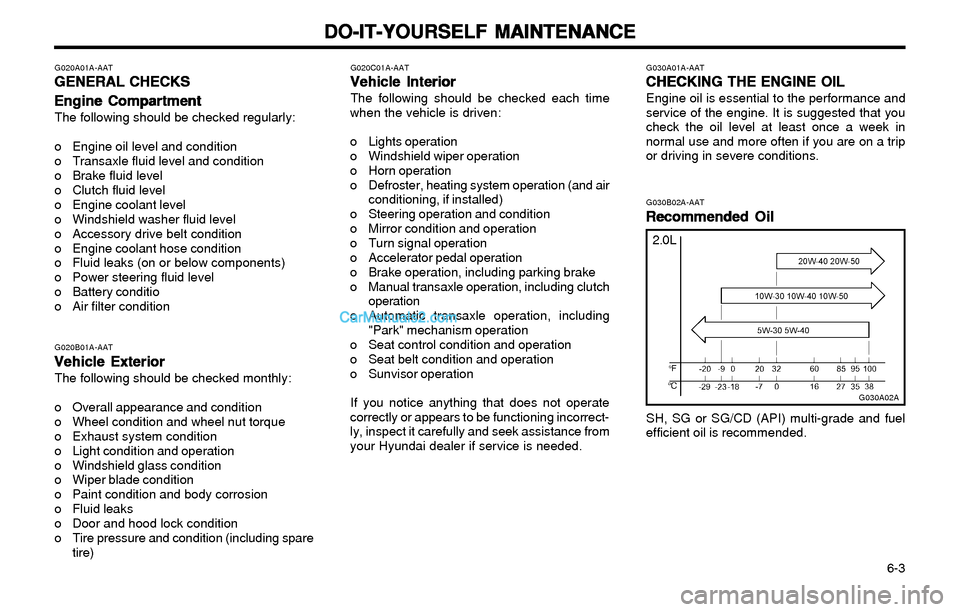
CHECKING THE ENGINE OILEngine oil is essential to the performance and
service of the engine. It is suggested that you
check the oil level at least once a week in
normal use and more often if you are on a trip
or driving in severe conditions.
G030B02A-AAT
Recommended Oil Recommended OilRecommended Oil Recommended Oil
Recommended Oil
G030A02A
2.0L
SH, SG or SG/CD (API) multi-grade and fuel
efficient oil is recommended.
G020A01A-AAT
GENERAL CHECKS GENERAL CHECKSGENERAL CHECKS GENERAL CHECKS
GENERAL CHECKS
Engine Compartment Engine CompartmentEngine Compartment Engine Compartment
Engine Compartment
The following should be checked regularly:
o Engine oil level and condition
o Transaxle fluid level and condition
o Brake fluid level
o Clutch fluid level
o Engine coolant level
o Windshield washer fluid level
o Accessory drive belt condition
o Engine coolant hose condition
o Fluid leaks (on or below components)
o Power steering fluid level
o Battery conditio
o Air filter condition
Page 151 of 172
DO-IT-YOURSELF MAINTENANCE DO-IT-YOURSELF MAINTENANCEDO-IT-YOURSELF MAINTENANCE DO-IT-YOURSELF MAINTENANCE
DO-IT-YOURSELF MAINTENANCE
6-15
G200B01E-AAT
Replacing Accessory Fuse Replacing Accessory FuseReplacing Accessory Fuse Replacing Accessory Fuse
Replacing Accessory Fuse
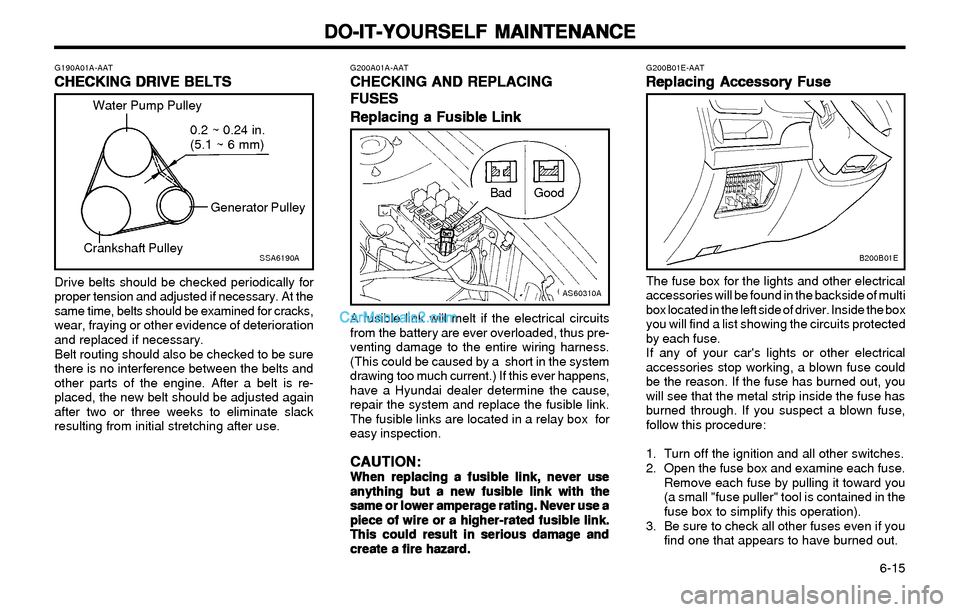
The fuse box for the lights and other electrical
accessories will be found in the backside of multi
box located in the left side of driver. Inside the box
you will find a list showing the circuits protected
by each fuse.
If any of your car's lights or other electrical
accessories stop working, a blown fuse could
be the reason. If the fuse has burned out, you
will see that the metal strip inside the fuse has
burned through. If you suspect a blown fuse,
follow this procedure:
1. Turn off the ignition and all other switches.
2. Open the fuse box and examine each fuse.
Remove each fuse by pulling it toward you
(a small "fuse puller" tool is contained in the
fuse box to simplify this operation).
3. Be sure to check all other fuses even if you
find one that appears to have burned out.
B200B01E
G190A01A-AAT
CHECKING DRIVE BELTS CHECKING DRIVE BELTSCHECKING DRIVE BELTS CHECKING DRIVE BELTS
CHECKING DRIVE BELTS
G200A01A-AAT
CHECKING AND REPLACING CHECKING AND REPLACINGCHECKING AND REPLACING CHECKING AND REPLACING
CHECKING AND REPLACING
FUSES FUSESFUSES FUSES
FUSES
Replacing a Fusible Link Replacing a Fusible LinkReplacing a Fusible Link Replacing a Fusible Link
Replacing a Fusible Link
Drive belts should be checked periodically for
proper tension and adjusted if necessary. At the
same time, belts should be examined for cracks,
wear, fraying or other evidence of deterioration
and replaced if necessary.
Belt routing should also be checked to be sure
there is no interference between the belts and
other parts of the engine. After a belt is re-
placed, the new belt should be adjusted again
after two or three weeks to eliminate slack
resulting from initial stretching after use.A fusible link will melt if the electrical circuits
from the battery are ever overloaded, thus pre-
venting damage to the entire wiring harness.
(This could be caused by a short in the system
drawing too much current.) If this ever happens,
have a Hyundai dealer determine the cause,
repair the system and replace the fusible link.
The fusible links are located in a relay box for
easy inspection.
CAUTION: CAUTION:CAUTION: CAUTION:
CAUTION:When replacing a fusible link, never use When replacing a fusible link, never useWhen replacing a fusible link, never use When replacing a fusible link, never use
When replacing a fusible link, never use
anything but a new fusible link with the anything but a new fusible link with theanything but a new fusible link with the anything but a new fusible link with the
anything but a new fusible link with the
same or lower amperage rating. Never use a same or lower amperage rating. Never use asame or lower amperage rating. Never use a same or lower amperage rating. Never use a
same or lower amperage rating. Never use a
piece of wire or a higher-rated fusible link. piece of wire or a higher-rated fusible link.piece of wire or a higher-rated fusible link. piece of wire or a higher-rated fusible link.
piece of wire or a higher-rated fusible link.
This could result in serious damage and This could result in serious damage andThis could result in serious damage and This could result in serious damage and
This could result in serious damage and
create a fire hazard. create a fire hazard.create a fire hazard. create a fire hazard.
create a fire hazard.
SSA6190A
Water Pump Pulley
Generator Pulley
Crankshaft Pulley0.2 ~ 0.24 in.
(5.1 ~ 6 mm)
GoodBad
AS60310A
Page 152 of 172
DO-IT-YOURSELF MAINTENANCE DO-IT-YOURSELF MAINTENANCEDO-IT-YOURSELF MAINTENANCE DO-IT-YOURSELF MAINTENANCE
DO-IT-YOURSELF MAINTENANCE
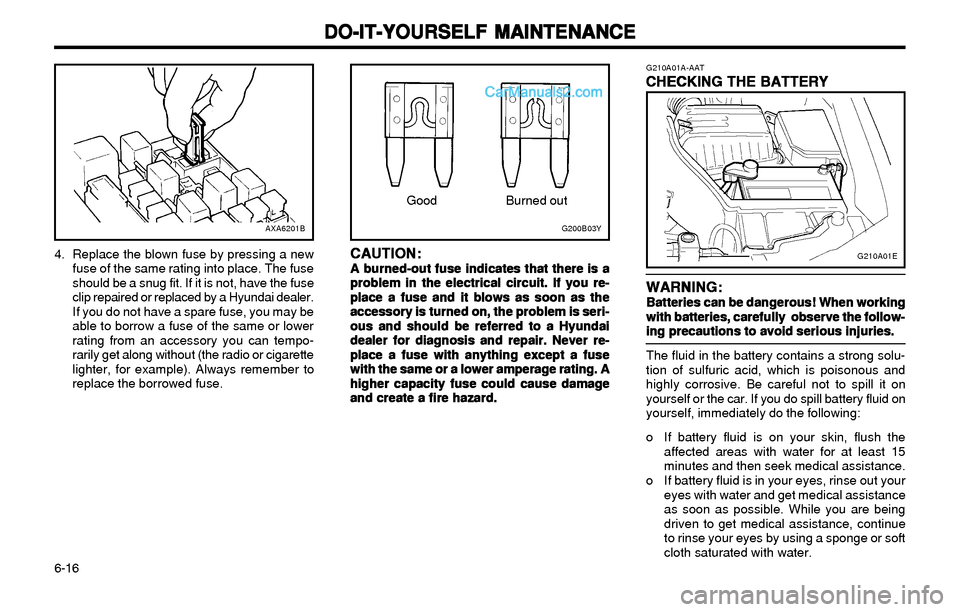
6-16 4. Replace the blown fuse by pressing a new
fuse of the same rating into place. The fuse
should be a snug fit. If it is not, have the fuse
clip repaired or replaced by a Hyundai dealer.
If you do not have a spare fuse, you may be
able to borrow a fuse of the same or lower
rating from an accessory you can tempo-
rarily get along without (the radio or cigarette
lighter, for example). Always remember to
replace the borrowed fuse.
CAUTION: CAUTION:CAUTION: CAUTION:
CAUTION:A burned-out fuse indicates that there is a A burned-out fuse indicates that there is aA burned-out fuse indicates that there is a A burned-out fuse indicates that there is a
A burned-out fuse indicates that there is a
problem in the electrical circuit. If you re- problem in the electrical circuit. If you re-problem in the electrical circuit. If you re- problem in the electrical circuit. If you re-
problem in the electrical circuit. If you re-
place a fuse and it blows as soon as the place a fuse and it blows as soon as theplace a fuse and it blows as soon as the place a fuse and it blows as soon as the
place a fuse and it blows as soon as the
accessory is turned on, the problem is seri- accessory is turned on, the problem is seri-accessory is turned on, the problem is seri- accessory is turned on, the problem is seri-
accessory is turned on, the problem is seri-
ous and should be referred to a Hyundai ous and should be referred to a Hyundaious and should be referred to a Hyundai ous and should be referred to a Hyundai
ous and should be referred to a Hyundai
dealer for diagnosis and repair. Never re- dealer for diagnosis and repair. Never re-dealer for diagnosis and repair. Never re- dealer for diagnosis and repair. Never re-
dealer for diagnosis and repair. Never re-
place a fuse with anything except a fuse place a fuse with anything except a fuseplace a fuse with anything except a fuse place a fuse with anything except a fuse
place a fuse with anything except a fuse
with the same or a lower amperage rating. A with the same or a lower amperage rating. Awith the same or a lower amperage rating. A with the same or a lower amperage rating. A
with the same or a lower amperage rating. A
higher capacity fuse could cause damage higher capacity fuse could cause damagehigher capacity fuse could cause damage higher capacity fuse could cause damage
higher capacity fuse could cause damage
and create a fire hazard. and create a fire hazard.and create a fire hazard. and create a fire hazard.
and create a fire hazard.
AXA6201B
Burned out
G200B03Y
Good
WARNING: WARNING:WARNING: WARNING:
WARNING:Batteries can be dangerous! When working Batteries can be dangerous! When workingBatteries can be dangerous! When working Batteries can be dangerous! When working
Batteries can be dangerous! When working
with batteries, carefully observe the follow- with batteries, carefully observe the follow-with batteries, carefully observe the follow- with batteries, carefully observe the follow-
with batteries, carefully observe the follow-
ing precautions to avoid serious injuries. ing precautions to avoid serious injuries.ing precautions to avoid serious injuries. ing precautions to avoid serious injuries.
ing precautions to avoid serious injuries.
The fluid in the battery contains a strong solu-
tion of sulfuric acid, which is poisonous and
highly corrosive. Be careful not to spill it on
yourself or the car. If you do spill battery fluid on
yourself, immediately do the following:
o If battery fluid is on your skin, flush the
affected areas with water for at least 15
minutes and then seek medical assistance.
o If battery fluid is in your eyes, rinse out your
eyes with water and get medical assistance
as soon as possible. While you are being
driven to get medical assistance, continue
to rinse your eyes by using a sponge or soft
cloth saturated with water.
G210A01A-AAT
CHECKING THE BATTERY CHECKING THE BATTERYCHECKING THE BATTERY CHECKING THE BATTERY
CHECKING THE BATTERY
G210A01E
Page 153 of 172
DO-IT-YOURSELF MAINTENANCE DO-IT-YOURSELF MAINTENANCEDO-IT-YOURSELF MAINTENANCE DO-IT-YOURSELF MAINTENANCE
DO-IT-YOURSELF MAINTENANCE
6-17
G230A03A-AAT
POWER STEERING FLUID LEVEL POWER STEERING FLUID LEVELPOWER STEERING FLUID LEVEL POWER STEERING FLUID LEVEL
POWER STEERING FLUID LEVEL
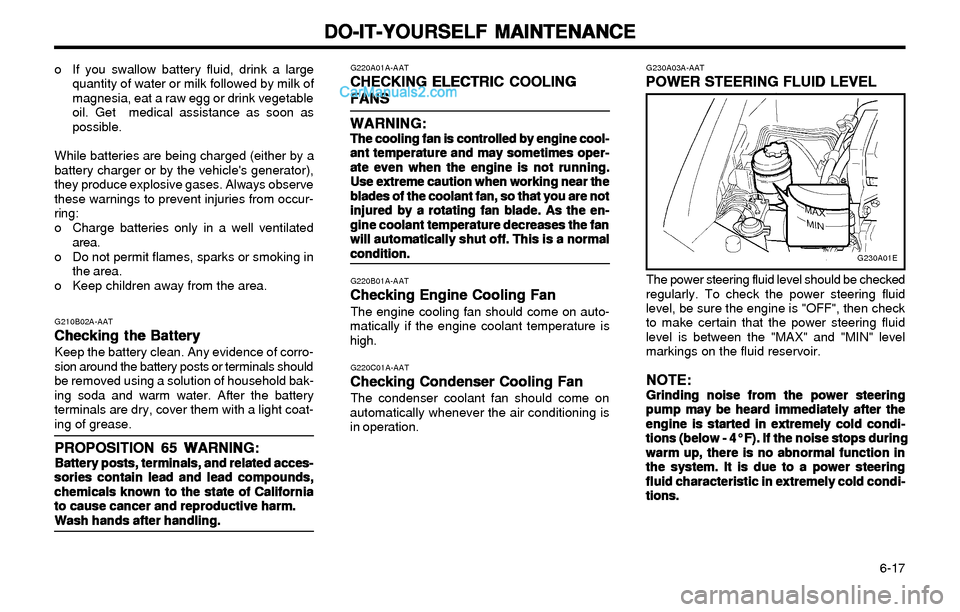
The power steering fluid level should be checked
regularly. To check the power steering fluid
level, be sure the engine is "OFF", then check
to make certain that the power steering fluid
level is between the "MAX" and "MIN" level
markings on the fluid reservoir.
NOTE: NOTE:NOTE: NOTE:
NOTE:Grinding noise from the power steering Grinding noise from the power steeringGrinding noise from the power steering Grinding noise from the power steering
Grinding noise from the power steering
pump may be heard immediately after the pump may be heard immediately after thepump may be heard immediately after the pump may be heard immediately after the
pump may be heard immediately after the
engine is started in extremely cold condi- engine is started in extremely cold condi-engine is started in extremely cold condi- engine is started in extremely cold condi-
engine is started in extremely cold condi-
tions (below - 4°F). If the noise stops during tions (below - 4°F). If the noise stops duringtions (below - 4°F). If the noise stops during tions (below - 4°F). If the noise stops during
tions (below - 4°F). If the noise stops during
warm up, there is no abnormal function in warm up, there is no abnormal function inwarm up, there is no abnormal function in warm up, there is no abnormal function in
warm up, there is no abnormal function in
the system. It is due to a power steering the system. It is due to a power steeringthe system. It is due to a power steering the system. It is due to a power steering
the system. It is due to a power steering
fluid characteristic in extremely cold condi- fluid characteristic in extremely cold condi-fluid characteristic in extremely cold condi- fluid characteristic in extremely cold condi-
fluid characteristic in extremely cold condi-
tions. tions.tions. tions.
tions.
G230A01E G220A01A-AAT
CHECKING ELECTRIC COOLING CHECKING ELECTRIC COOLINGCHECKING ELECTRIC COOLING CHECKING ELECTRIC COOLING
CHECKING ELECTRIC COOLING
FANS FANSFANS FANS
FANS
WARNING: WARNING:WARNING: WARNING:
WARNING:
The cooling fan is controlled by engine cool- The cooling fan is controlled by engine cool-The cooling fan is controlled by engine cool- The cooling fan is controlled by engine cool-
The cooling fan is controlled by engine cool-
ant temperature and may sometimes oper- ant temperature and may sometimes oper-ant temperature and may sometimes oper- ant temperature and may sometimes oper-
ant temperature and may sometimes oper-
ate even when the engine is not running. ate even when the engine is not running.ate even when the engine is not running. ate even when the engine is not running.
ate even when the engine is not running.
Use extreme caution when working near the Use extreme caution when working near theUse extreme caution when working near the Use extreme caution when working near the
Use extreme caution when working near the
blades of the coolant fan, so that you are not blades of the coolant fan, so that you are notblades of the coolant fan, so that you are not blades of the coolant fan, so that you are not
blades of the coolant fan, so that you are not
injured by a rotating fan blade. As the en- injured by a rotating fan blade. As the en-injured by a rotating fan blade. As the en- injured by a rotating fan blade. As the en-
injured by a rotating fan blade. As the en-
gine coolant temperature decreases the fan gine coolant temperature decreases the fangine coolant temperature decreases the fan gine coolant temperature decreases the fan
gine coolant temperature decreases the fan
will automatically shut off. This is a normal will automatically shut off. This is a normalwill automatically shut off. This is a normal will automatically shut off. This is a normal
will automatically shut off. This is a normal
condition. condition.condition. condition.
condition.
G220B01A-AAT
Checking Engine Cooling Fan Checking Engine Cooling FanChecking Engine Cooling Fan Checking Engine Cooling Fan
Checking Engine Cooling FanThe engine cooling fan should come on auto-
matically if the engine coolant temperature is
high.
G220C01A-AAT
Checking Condenser Cooling Fan Checking Condenser Cooling FanChecking Condenser Cooling Fan Checking Condenser Cooling Fan
Checking Condenser Cooling FanThe condenser coolant fan should come on
automatically whenever the air conditioning is
in operation.
G210B02A-AAT
Checking the Battery Checking the BatteryChecking the Battery Checking the Battery
Checking the BatteryKeep the battery clean. Any evidence of corro-
sion around the battery posts or terminals should
be removed using a solution of household bak-
ing soda and warm water. After the battery
terminals are dry, cover them with a light coat-
ing of grease.
PROPOSITION 65 WARNING: PROPOSITION 65 WARNING:PROPOSITION 65 WARNING: PROPOSITION 65 WARNING:
PROPOSITION 65 WARNING:Battery posts, terminals, and related acces- Battery posts, terminals, and related acces-Battery posts, terminals, and related acces- Battery posts, terminals, and related acces-
Battery posts, terminals, and related acces-
sories contain lead and lead compounds, sories contain lead and lead compounds,sories contain lead and lead compounds, sories contain lead and lead compounds,
sories contain lead and lead compounds,
chemicals known to the state of California chemicals known to the state of Californiachemicals known to the state of California chemicals known to the state of California
chemicals known to the state of California
to cause cancer and reproductive harm. to cause cancer and reproductive harm.to cause cancer and reproductive harm. to cause cancer and reproductive harm.
to cause cancer and reproductive harm.
Wash hands after handling. Wash hands after handling.Wash hands after handling. Wash hands after handling.
Wash hands after handling.
o If you swallow battery fluid, drink a large
quantity of water or milk followed by milk of
magnesia, eat a raw egg or drink vegetable
oil. Get medical assistance as soon as
possible.
While batteries are being charged (either by a
battery charger or by the vehicle's generator),
they produce explosive gases. Always observe
these warnings to prevent injuries from occur-
ring:
o Charge batteries only in a well ventilated
area.
o Do not permit flames, sparks or smoking in
the area.
o Keep children away from the area.