tow Hyundai Elantra 2003 User Guide
[x] Cancel search | Manufacturer: HYUNDAI, Model Year: 2003, Model line: Elantra, Model: Hyundai Elantra 2003Pages: 172, PDF Size: 2.82 MB
Page 55 of 172
FEATURES OF YOUR HYUNDAI FEATURES OF YOUR HYUNDAIFEATURES OF YOUR HYUNDAI FEATURES OF YOUR HYUNDAI
FEATURES OF YOUR HYUNDAI
1- 46
B510C01A-AATFOLDING THE OUTSIDE REARVIEW
MIRRORS
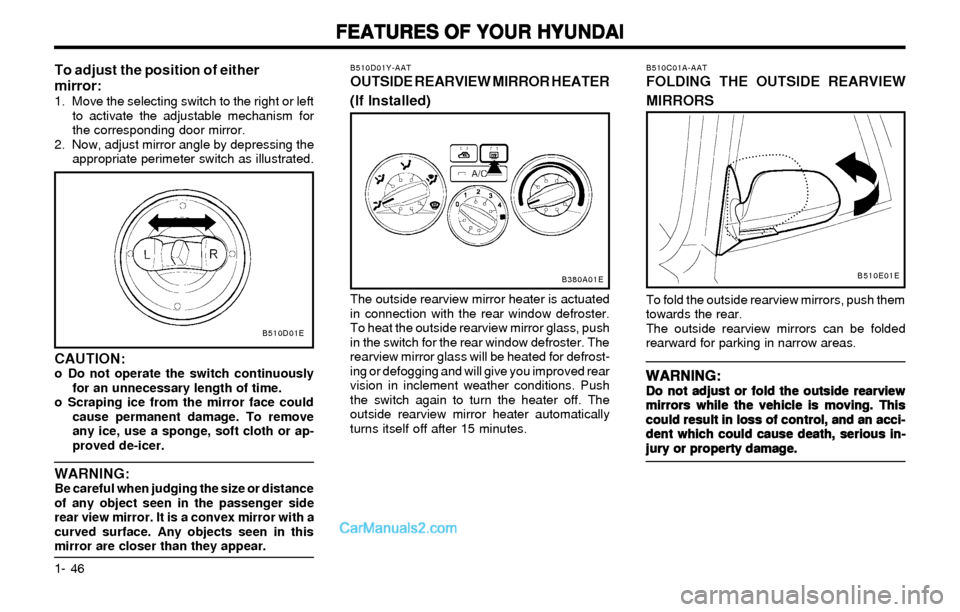
To fold the outside rearview mirrors, push them
towards the rear.
The outside rearview mirrors can be folded
rearward for parking in narrow areas.
WARNING: WARNING:WARNING: WARNING:
WARNING:Do not adjust or fold the outside rearview Do not adjust or fold the outside rearviewDo not adjust or fold the outside rearview Do not adjust or fold the outside rearview
Do not adjust or fold the outside rearview
mirrors while the vehicle is moving. This mirrors while the vehicle is moving. Thismirrors while the vehicle is moving. This mirrors while the vehicle is moving. This
mirrors while the vehicle is moving. This
could result in loss of control, and an acci- could result in loss of control, and an acci-could result in loss of control, and an acci- could result in loss of control, and an acci-
could result in loss of control, and an acci-
dent which could cause death, serious in- dent which could cause death, serious in-dent which could cause death, serious in- dent which could cause death, serious in-
dent which could cause death, serious in-
jury or property damage. jury or property damage.jury or property damage. jury or property damage.
jury or property damage.
B510D01Y-AATOUTSIDE REARVIEW MIRROR HEATER
(If Installed)
The outside rearview mirror heater is actuated
in connection with the rear window defroster.
To heat the outside rearview mirror glass, push
in the switch for the rear window defroster. The
rearview mirror glass will be heated for defrost-
ing or defogging and will give you improved rear
vision in inclement weather conditions. Push
the switch again to turn the heater off. The
outside rearview mirror heater automatically
turns itself off after 15 minutes.
B380A01EB510E01E
CAUTION:o Do not operate the switch continuously
for an unnecessary length of time.
o Scraping ice from the mirror face could
cause permanent damage. To remove
any ice, use a sponge, soft cloth or ap-
proved de-icer.
WARNING:Be careful when judging the size or distance
of any object seen in the passenger side
rear view mirror. It is a convex mirror with a
curved surface. Any objects seen in this
mirror are closer than they appear.
B510D01E
To adjust the position of either
mirror:
1. Move the selecting switch to the right or left
to activate the adjustable mechanism for
the corresponding door mirror.
2. Now, adjust mirror angle by depressing the
appropriate perimeter switch as illustrated.
Page 56 of 172
FEATURES OF YOUR HYUNDAI FEATURES OF YOUR HYUNDAIFEATURES OF YOUR HYUNDAI FEATURES OF YOUR HYUNDAI
FEATURES OF YOUR HYUNDAI
1- 47
B550A01S-GAT
HIGH-MOUNTED REAR STOP LIGHT HIGH-MOUNTED REAR STOP LIGHTHIGH-MOUNTED REAR STOP LIGHT HIGH-MOUNTED REAR STOP LIGHT
HIGH-MOUNTED REAR STOP LIGHT
(If Installed) (If Installed)(If Installed) (If Installed)
(If Installed)
In addition to the lower-mounted rear stoplights
on either side of the car, the high mounted rear
stoplight in the center of the rear window or
inserted in the rear spoiler also lights when the
brakes are applied. Always engage the parking brake before leav-
ing the car. This also turns on the parking brake
indicator light when the key is in the "ON" or
"START" position. Before driving away, be sure
that the parking brake is fully released and the
indicator light is off.
o To engage the parking brake, pull the lever
up as far as possible.
o To release the parking brake, pull up the
lever and press the thumb button. Then,
while holding the button in, lower the brake
lever.
B530A01A-AAT
PARKING BRAKE PARKING BRAKEPARKING BRAKE PARKING BRAKE
PARKING BRAKE
B550A01E-A
B530A01E
B520A01A-AATDAY/NIGHT INSIDE REARVIEW
MIRROR
B520A01E
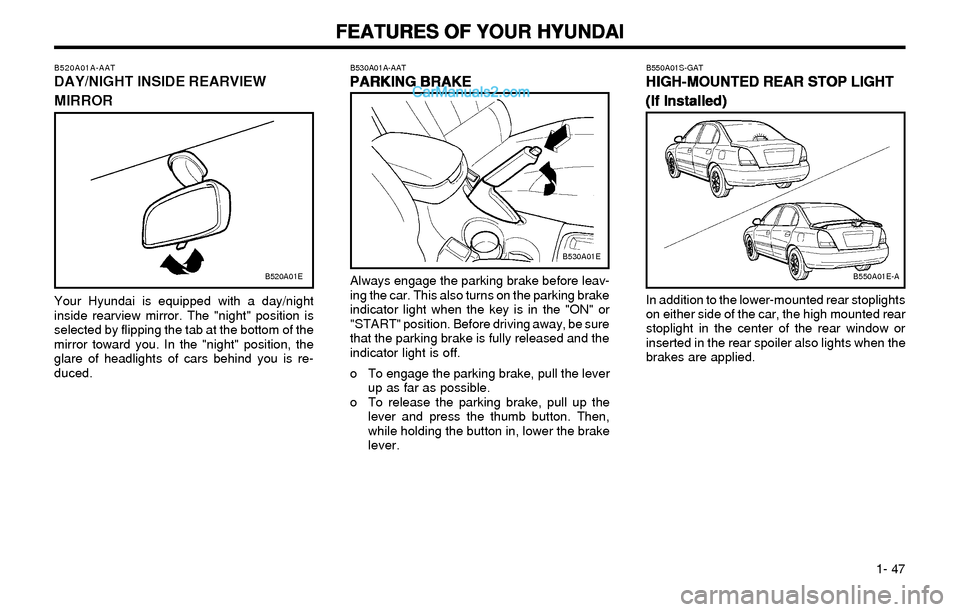
Your Hyundai is equipped with a day/night
inside rearview mirror. The "night" position is
selected by flipping the tab at the bottom of the
mirror toward you. In the "night" position, the
glare of headlights of cars behind you is re-
duced.
Page 60 of 172
FEATURES OF YOUR HYUNDAI FEATURES OF YOUR HYUNDAIFEATURES OF YOUR HYUNDAI FEATURES OF YOUR HYUNDAI
FEATURES OF YOUR HYUNDAI
1- 51
B580A01L-GATSUN VISOR
B580A01E
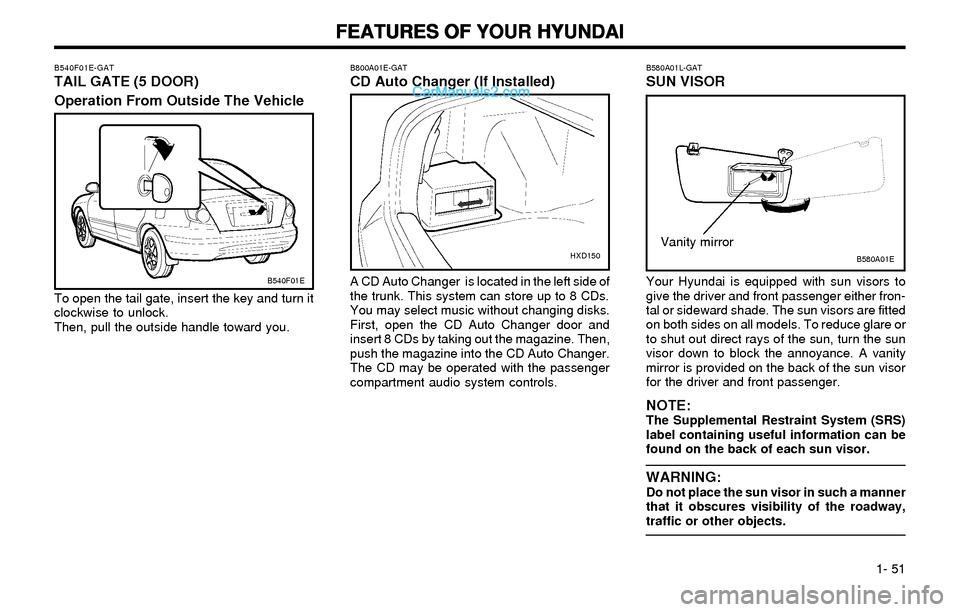
Your Hyundai is equipped with sun visors to
give the driver and front passenger either fron-
tal or sideward shade. The sun visors are fitted
on both sides on all models. To reduce glare or
to shut out direct rays of the sun, turn the sun
visor down to block the annoyance. A vanity
mirror is provided on the back of the sun visor
for the driver and front passenger.
NOTE:The Supplemental Restraint System (SRS)
label containing useful information can be
found on the back of each sun visor.
WARNING:Do not place the sun visor in such a manner
that it obscures visibility of the roadway,
traffic or other objects.
Vanity mirror
B800A01E-GATCD Auto Changer (If Installed)
A CD Auto Changer is located in the left side of
the trunk. This system can store up to 8 CDs.
You may select music without changing disks.
First, open the CD Auto Changer door and
insert 8 CDs by taking out the magazine. Then,
push the magazine into the CD Auto Changer.
The CD may be operated with the passenger
compartment audio system controls.
HXD150
B540F01E-GATTAIL GATE (5 DOOR)
Operation From Outside The Vehicle
B540F01E
To open the tail gate, insert the key and turn it
clockwise to unlock.
Then, pull the outside handle toward you.
Page 62 of 172
FEATURES OF YOUR HYUNDAI FEATURES OF YOUR HYUNDAIFEATURES OF YOUR HYUNDAI FEATURES OF YOUR HYUNDAI
FEATURES OF YOUR HYUNDAI
1- 53
B660D01E-AATTo Resume the Preset Speed
B660D01E
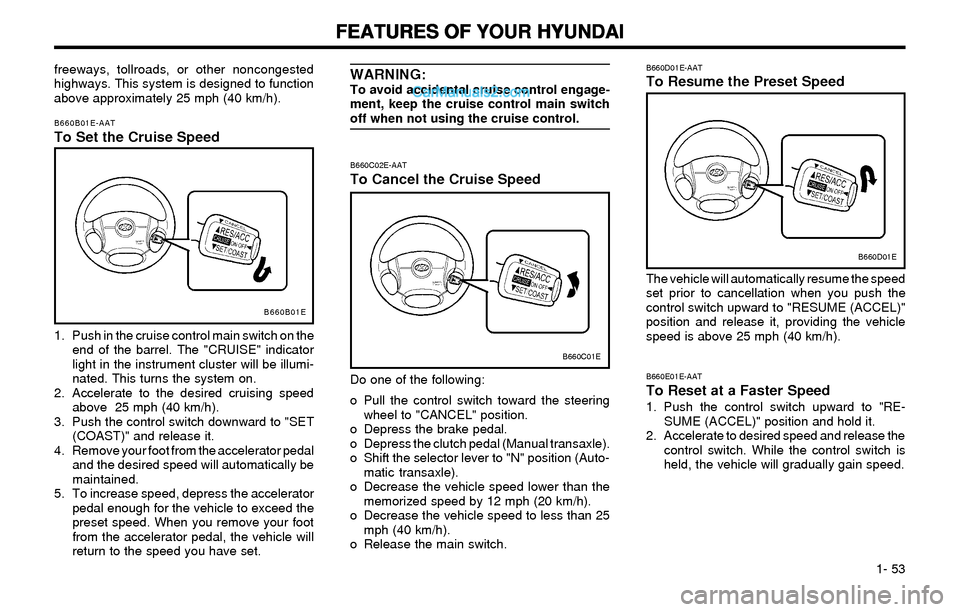
The vehicle will automatically resume the speed
set prior to cancellation when you push the
control switch upward to "RESUME (ACCEL)"
position and release it, providing the vehicle
speed is above 25 mph (40 km/h).
B660E01E-AAT
To Reset at a Faster Speed1. Push the control switch upward to "RE-
SUME (ACCEL)" position and hold it.
2. Accelerate to desired speed and release the
control switch. While the control switch is
held, the vehicle will gradually gain speed.
B660C02E-AAT
To Cancel the Cruise Speed
Do one of the following:
o Pull the control switch toward the steering
wheel to "CANCEL" position.
o Depress the brake pedal.
o Depress the clutch pedal (Manual transaxle).
o Shift the selector lever to "N" position (Auto-
matic transaxle).
o Decrease the vehicle speed lower than the
memorized speed by 12 mph (20 km/h).
o Decrease the vehicle speed to less than 25
mph (40 km/h).
o Release the main switch.
B660C01E
WARNING:To avoid accidental cruise control engage-
ment, keep the cruise control main switch
off when not using the cruise control.
B660B01E
B660B01E-AATTo Set the Cruise Speed
1. Push in the cruise control main switch on the
end of the barrel. The "CRUISE" indicator
light in the instrument cluster will be illumi-
nated. This turns the system on.
2. Accelerate to the desired cruising speed
above 25 mph (40 km/h).
3. Push the control switch downward to "SET
(COAST)" and release it.
4. Remove your foot from the accelerator pedal
and the desired speed will automatically be
maintained.
5. To increase speed, depress the accelerator
pedal enough for the vehicle to exceed the
preset speed. When you remove your foot
from the accelerator pedal, the vehicle will
return to the speed you have set. freeways, tollroads, or other noncongested
highways. This system is designed to function
above approximately 25 mph (40 km/h).
Page 68 of 172
FEATURES OF YOUR HYUNDAI FEATURES OF YOUR HYUNDAIFEATURES OF YOUR HYUNDAI FEATURES OF YOUR HYUNDAI
FEATURES OF YOUR HYUNDAI
1- 59
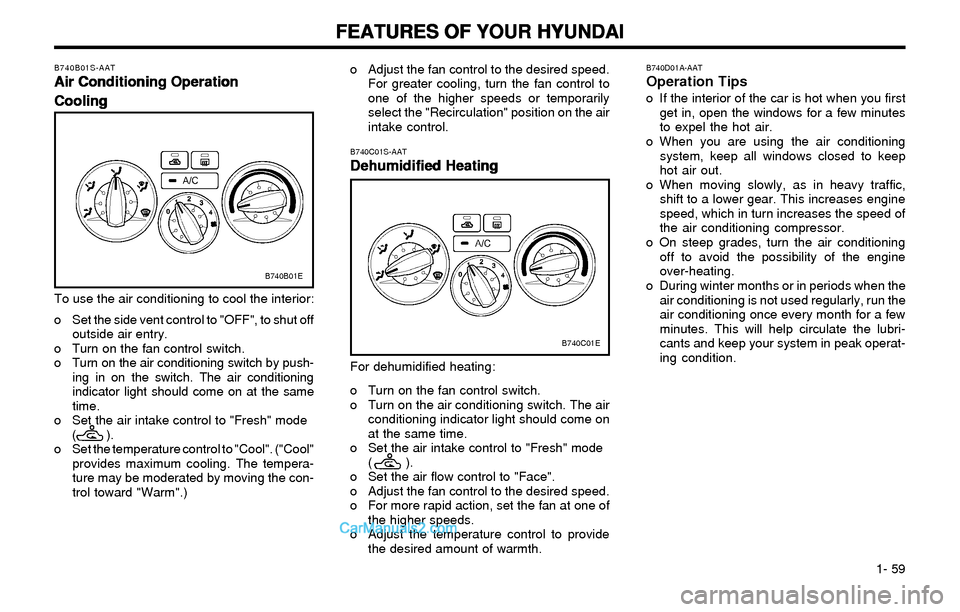
B740C01S-AAT
Dehumidified Heating Dehumidified HeatingDehumidified Heating Dehumidified Heating
Dehumidified Heating
B740C01E
For dehumidified heating:
o Turn on the fan control switch.
o Turn on the air conditioning switch. The air
conditioning indicator light should come on
at the same time.
o Set the air intake control to "Fresh" mode
( ).
o Set the air flow control to "Face".
o Adjust the fan control to the desired speed.
o For more rapid action, set the fan at one of
the higher speeds.
o Adjust the temperature control to provide
the desired amount of warmth.
B740D01A-AATOperation Tips
o If the interior of the car is hot when you first
get in, open the windows for a few minutes
to expel the hot air.
o When you are using the air conditioning
system, keep all windows closed to keep
hot air out.
o When moving slowly, as in heavy traffic,
shift to a lower gear. This increases engine
speed, which in turn increases the speed of
the air conditioning compressor.
o On steep grades, turn the air conditioning
off to avoid the possibility of the engine
over-heating.
o During winter months or in periods when the
air conditioning is not used regularly, run the
air conditioning once every month for a few
minutes. This will help circulate the lubri-
cants and keep your system in peak operat-
ing condition.
o Adjust the fan control to the desired speed.
For greater cooling, turn the fan control to
one of the higher speeds or temporarily
select the "Recirculation" position on the air
intake control.B740B01S-AAT
Air Conditioning Operation Air Conditioning OperationAir Conditioning Operation Air Conditioning Operation
Air Conditioning Operation
Cooling CoolingCooling Cooling
Cooling
B740B01E
To use the air conditioning to cool the interior:
o Set the side vent control to "OFF", to shut off
outside air entry.
o Turn on the fan control switch.
o Turn on the air conditioning switch by push-
ing in on the switch. The air conditioning
indicator light should come on at the same
time.
o Set the air intake control to "Fresh" mode
( ).
o Set the temperature control to "Cool". ("Cool"
provides maximum cooling. The tempera-
ture may be moderated by moving the con-
trol toward "Warm".)
Page 75 of 172
FEATURES OF YOUR HYUNDAI FEATURES OF YOUR HYUNDAIFEATURES OF YOUR HYUNDAI FEATURES OF YOUR HYUNDAI
FEATURES OF YOUR HYUNDAI
1- 66
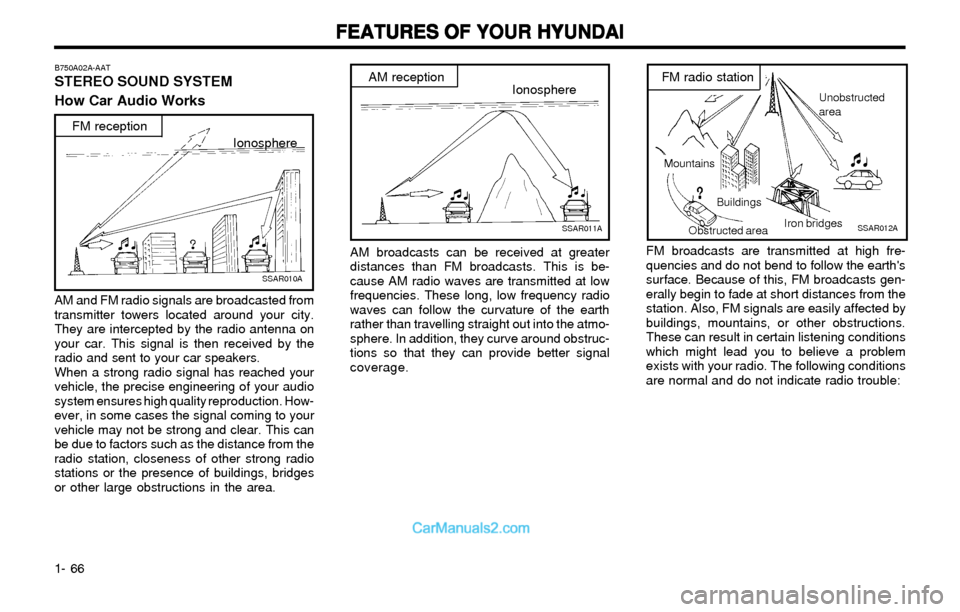
Ionosphere
SSAR011A
AM reception
AM broadcasts can be received at greater
distances than FM broadcasts. This is be-
cause AM radio waves are transmitted at low
frequencies. These long, low frequency radio
waves can follow the curvature of the earth
rather than travelling straight out into the atmo-
sphere. In addition, they curve around obstruc-
tions so that they can provide better signal
coverage.FM broadcasts are transmitted at high fre-
quencies and do not bend to follow the earth's
surface. Because of this, FM broadcasts gen-
erally begin to fade at short distances from the
station. Also, FM signals are easily affected by
buildings, mountains, or other obstructions.
These can result in certain listening conditions
which might lead you to believe a problem
exists with your radio. The following conditions
are normal and do not indicate radio trouble:
Buildings
Obstructed areaIron bridges
Unobstructed
area
FM radio station
SSAR012A
Mountains
B750A02A-AATSTEREO SOUND SYSTEM
How Car Audio Works
Ionosphere
FM reception
SSAR010A
AM and FM radio signals are broadcasted from
transmitter towers located around your city.
They are intercepted by the radio antenna on
your car. This signal is then received by the
radio and sent to your car speakers.
When a strong radio signal has reached your
vehicle, the precise engineering of your audio
system ensures high quality reproduction. How-
ever, in some cases the signal coming to your
vehicle may not be strong and clear. This can
be due to factors such as the distance from the
radio station, closeness of other strong radio
stations or the presence of buildings, bridges
or other large obstructions in the area.
Page 107 of 172
DRIVING YOUR HYUNDAI DRIVING YOUR HYUNDAIDRIVING YOUR HYUNDAI DRIVING YOUR HYUNDAI
DRIVING YOUR HYUNDAI
2- 6
C090G01A-AAT
o L (Low gear): o L (Low gear):o L (Low gear): o L (Low gear):
o L (Low gear):Use for driving up a very steep grade or for
engine braking when descending steep hills.
When downshifting to "L", the transaxle will tem-
porarily remain in second gear until the vehicle
has slowed enough for low gear to engage. Do
not exceed 31 mph (50 km/h) in low gear.
C090I02Y-AAT
CAUTION: CAUTION:CAUTION: CAUTION:
CAUTION:o oo o
o
Shift into "R" and "P" position only when Shift into "R" and "P" position only whenShift into "R" and "P" position only when Shift into "R" and "P" position only when
Shift into "R" and "P" position only when
the vehicle has completely stopped. the vehicle has completely stopped.the vehicle has completely stopped. the vehicle has completely stopped.
the vehicle has completely stopped.
o oo o
o
Do not accelerate the engine in reverse or Do not accelerate the engine in reverse orDo not accelerate the engine in reverse or Do not accelerate the engine in reverse or
Do not accelerate the engine in reverse or
any of the forward positions with the any of the forward positions with theany of the forward positions with the any of the forward positions with the
any of the forward positions with the
brakes applied. brakes applied.brakes applied. brakes applied.
brakes applied.
o oo o
o
Always apply the footbrake when shifting Always apply the footbrake when shiftingAlways apply the footbrake when shifting Always apply the footbrake when shifting
Always apply the footbrake when shifting
from "P" or "N", to "R", "D", "3", "2" or "L" from "P" or "N", to "R", "D", "3", "2" or "L"from "P" or "N", to "R", "D", "3", "2" or "L" from "P" or "N", to "R", "D", "3", "2" or "L"
from "P" or "N", to "R", "D", "3", "2" or "L"
position. position.position. position.
position.
o oo o
o
Do not use the "P" (Park) position in place Do not use the "P" (Park) position in placeDo not use the "P" (Park) position in place Do not use the "P" (Park) position in place
Do not use the "P" (Park) position in place
of the parking brake. Always set the park- of the parking brake. Always set the park-of the parking brake. Always set the park- of the parking brake. Always set the park-
of the parking brake. Always set the park-
ing brake, shift the transaxle into "P" (Park) ing brake, shift the transaxle into "P" (Park)ing brake, shift the transaxle into "P" (Park) ing brake, shift the transaxle into "P" (Park)
ing brake, shift the transaxle into "P" (Park)
position and turn off the ignition when position and turn off the ignition whenposition and turn off the ignition when position and turn off the ignition when
position and turn off the ignition when
you leave the vehicle, even momentarily. you leave the vehicle, even momentarily.you leave the vehicle, even momentarily. you leave the vehicle, even momentarily.
you leave the vehicle, even momentarily.
Never leave the vehicle unattended while Never leave the vehicle unattended whileNever leave the vehicle unattended while Never leave the vehicle unattended while
Never leave the vehicle unattended while
the engine is running. the engine is running.the engine is running. the engine is running.
the engine is running.
o oo o
o
Check the automatic transaxle fluid level Check the automatic transaxle fluid levelCheck the automatic transaxle fluid level Check the automatic transaxle fluid level
Check the automatic transaxle fluid level
regularly, and add fluid as necessary. regularly, and add fluid as necessary.regularly, and add fluid as necessary. regularly, and add fluid as necessary.
regularly, and add fluid as necessary.
See the maintenance schedule for the See the maintenance schedule for theSee the maintenance schedule for the See the maintenance schedule for the
See the maintenance schedule for the
proper fluid recommendation. proper fluid recommendation.proper fluid recommendation. proper fluid recommendation.
proper fluid recommendation.
C090H01Y-AAT
NOTE: NOTE:NOTE: NOTE:
NOTE:o oo o
o
For smooth and safe operation, depress For smooth and safe operation, depressFor smooth and safe operation, depress For smooth and safe operation, depress
For smooth and safe operation, depress
the brake pedal when shifting from "Neu- the brake pedal when shifting from "Neu-the brake pedal when shifting from "Neu- the brake pedal when shifting from "Neu-
the brake pedal when shifting from "Neu-
tral" position or "Park" position to a for- tral" position or "Park" position to a for-tral" position or "Park" position to a for- tral" position or "Park" position to a for-
tral" position or "Park" position to a for-
ward or reverse gear. ward or reverse gear.ward or reverse gear. ward or reverse gear.
ward or reverse gear.
o oo o
o
The ignition key must be in the "ON" The ignition key must be in the "ON"The ignition key must be in the "ON" The ignition key must be in the "ON"
The ignition key must be in the "ON"
position and the brake pedal fully de- position and the brake pedal fully de-position and the brake pedal fully de- position and the brake pedal fully de-
position and the brake pedal fully de-
pressed in order to move the shift lever pressed in order to move the shift leverpressed in order to move the shift lever pressed in order to move the shift lever
pressed in order to move the shift lever
from the "P" (Park) position to any of the from the "P" (Park) position to any of thefrom the "P" (Park) position to any of the from the "P" (Park) position to any of the
from the "P" (Park) position to any of the
other positions. other positions.other positions. other positions.
other positions.
C090F01A-AAT
o 2 (Second gear): o 2 (Second gear):o 2 (Second gear): o 2 (Second gear):
o 2 (Second gear):Use for driving on a slippery road, hill climbing or
engine braking downhill. "2" automatically shifts
between first and second gears.
This means that no shift-up to 3rd gear is per-
formed. However, the shift-up to third gear is
done when the car speed exceeds a certain
value to prevent the engine from over-revving.
Manually move the selector to "D" returning to
normal driving condition.
C090D02A-AAT
o N (Neutral): o N (Neutral):o N (Neutral): o N (Neutral):
o N (Neutral):In the "N" position, the transaxle is in neutral,
which means that no gears are engaged. The
engine can be started with the shift lever in "N"
position, although this is not recommended ex-
cept if the engine stalls while the car is moving.
C090E01A-AAT
o D (Drive): o D (Drive):o D (Drive): o D (Drive):
o D (Drive):Use for normal driving. The transaxle will auto-
matically shift through a four-gear sequence.
Never downshift manually to "2" position or "L"
position when vehicle speed is more than 60 mph
(96 km/h).
C090Q01A-GAT
o 3 (Third gear): o 3 (Third gear):o 3 (Third gear): o 3 (Third gear):
o 3 (Third gear):Use for towing a trailer during hill climbing or to
use engine braking downhill.
"3" automatically shifts between 1st, 2nd and 3rd
gears. This means that no shift-up to 4th gear is
performed. However, the shift-up to 4th gear is
done when the car speed exceeds a certain
value to prevent the engine from over-revving.
Manually move the selector to "D" when return-
ing to normal driving condition.o oo o
o
It is always possible to shift from "R", "N", It is always possible to shift from "R", "N",It is always possible to shift from "R", "N", It is always possible to shift from "R", "N",
It is always possible to shift from "R", "N",
"D", "3", "2", "L" position to "P" position. "D", "3", "2", "L" position to "P" position."D", "3", "2", "L" position to "P" position. "D", "3", "2", "L" position to "P" position.
"D", "3", "2", "L" position to "P" position.
The vehicle must be fully stopped to avoid The vehicle must be fully stopped to avoidThe vehicle must be fully stopped to avoid The vehicle must be fully stopped to avoid
The vehicle must be fully stopped to avoid
transaxle damage. transaxle damage.transaxle damage. transaxle damage.
transaxle damage.
Page 112 of 172

DRIVING YOUR HYUNDAI DRIVING YOUR HYUNDAIDRIVING YOUR HYUNDAI DRIVING YOUR HYUNDAI
DRIVING YOUR HYUNDAI
2- 11 accordance with the maintenance schedule in
Section 5. Before winter, have your coolant test-
ed to assure that its freezing point is sufficient for
the temperatures anticipated during the winter.
C160D01A-AAT
Check Battery and Cables Check Battery and CablesCheck Battery and Cables Check Battery and Cables
Check Battery and CablesWinter puts additional burdens on the battery
system. Visually inspect the battery and cables
as described in Section 6. The level of charge in
your battery can be checked by your Hyundai
dealer or a service station.
C160E01A-AATChange to "Winter Weight" Oil if Change to "Winter Weight" Oil ifChange to "Winter Weight" Oil if Change to "Winter Weight" Oil if
Change to "Winter Weight" Oil if
Necessary NecessaryNecessary Necessary
Necessary
In some climates it is recommended that a lower
viscosity "winter weight" oil be used during cold
weather. See Section 9 for recommendations. If
you aren't sure what weight oil you should use,
consult your Hyundai dealer.
C160F01A-AATCheck Spark Plugs and Ignition Check Spark Plugs and IgnitionCheck Spark Plugs and Ignition Check Spark Plugs and Ignition
Check Spark Plugs and Ignition
System SystemSystem System
System
Inspect your spark plugs as described in Section
6 and replace them if necessary. Also check all
ignition wiring and components to be sure they
are not cracked, worn or damaged in any way.
C160G01A-AAT
To Keep Locks from Freezing To Keep Locks from FreezingTo Keep Locks from Freezing To Keep Locks from Freezing
To Keep Locks from FreezingTo keep the locks from freezing, squirt an ap-
proved de-icer fluid or glycerine into the key
opening. If a lock is covered with ice, squirt it with
an approved de-icing fluid to remove the ice. If
the lock is frozen internally, you may be able to
thaw it out by using a heated key. Handle the
heated key with care to avoid burning the fingers.
C160H01A-AATUse Approved Anti-Freeze in Window Use Approved Anti-Freeze in WindowUse Approved Anti-Freeze in Window Use Approved Anti-Freeze in Window
Use Approved Anti-Freeze in Window
Washer System Washer SystemWasher System Washer System
Washer System
To keep the water in the window washer system
from freezing, add an approved anti-freeze solu-
tion in accordance with instructions on the con-
tainer. Window washer anti-freeze is available
from Hyundai dealers and most auto parts out-
lets. Do not use engine coolant or other types of
anti-freeze as these may damage the finish.
C160I01A-AAT
Don't Let Your Parking Brake Freeze Don't Let Your Parking Brake FreezeDon't Let Your Parking Brake Freeze Don't Let Your Parking Brake Freeze
Don't Let Your Parking Brake FreezeUnder some conditions your parking brake can
freeze in the engaged position. This is most likely
to happen when there is an accumulation of snow
or ice around or near the rear brakes or if the
brakes are wet. If there is a risk the parking brake
may freeze, apply it only temporarily while you
put the gear selector lever in "P" (automatic) or in
first or reverse gear (manual transaxle) and
block the rear wheels so the car cannot roll. Then
release the parking brake.
C160K01A-AAT
Carry Emergency Equipment Carry Emergency EquipmentCarry Emergency Equipment Carry Emergency Equipment
Carry Emergency EquipmentDepending on the severity of the weather where
you drive your car, you should carry appropriate
emergency equipment. Some of the items you
may want to carry include tire chains, tow straps
or chains, flashlight, emergency flares, sand, a
shovel, jumper cables, a window scraper, gloves,
ground cloth, coveralls, a blanket, etc.
C160J01A-AAT
Don't Let Ice and Snow Accumulate Don't Let Ice and Snow AccumulateDon't Let Ice and Snow Accumulate Don't Let Ice and Snow Accumulate
Don't Let Ice and Snow Accumulate
Underneath UnderneathUnderneath Underneath
Underneath
Under some conditions, snow and ice can build
up under the fenders and interfere with the steer-
ing. When driving in severe winter conditions
where this may happen, you should periodically
check underneath the car to be sure the move-
ment of the front wheels and the steering compo-
nents is not obstructed.
C170A01A-AAT
HIGHER SPEED MOTORING HIGHER SPEED MOTORINGHIGHER SPEED MOTORING HIGHER SPEED MOTORING
HIGHER SPEED MOTORING
Pre-Trip Inspections Pre-Trip InspectionsPre-Trip Inspections Pre-Trip Inspections
Pre-Trip Inspections
1. Tires:
Adjust the tire inflation pressures to specifica-
tion. Low tire inflation pressures will result in
overheating and possible failure of the tires.
Avoid using worn or damaged tires which may
result in reduced traction or tire failure.
Page 113 of 172
DRIVING YOUR HYUNDAI DRIVING YOUR HYUNDAIDRIVING YOUR HYUNDAI DRIVING YOUR HYUNDAI
DRIVING YOUR HYUNDAI
2- 12
CAUTION: CAUTION:CAUTION: CAUTION:
CAUTION:Do not do any towing with your car during its Do not do any towing with your car during itsDo not do any towing with your car during its Do not do any towing with your car during its
Do not do any towing with your car during its
first 1,200 miles (2,000 km) in order to allow first 1,200 miles (2,000 km) in order to allowfirst 1,200 miles (2,000 km) in order to allow first 1,200 miles (2,000 km) in order to allow
first 1,200 miles (2,000 km) in order to allow
the engine to properly break in. Failure to the engine to properly break in. Failure tothe engine to properly break in. Failure to the engine to properly break in. Failure to
the engine to properly break in. Failure to
heed this caution may result in serious en- heed this caution may result in serious en-heed this caution may result in serious en- heed this caution may result in serious en-
heed this caution may result in serious en-
gine or transaxle damage. gine or transaxle damage.gine or transaxle damage. gine or transaxle damage.
gine or transaxle damage.
C190B01S-AAT
Trailer Hitches Trailer HitchesTrailer Hitches Trailer Hitches
Trailer HitchesSelect the proper hitch and ball combination,
making sure that it's location is compatible with
that of the trailer or vehicle being towed.
Use a quality non-equalizing hitch which distrib-
utes the tongue load uniformly throughout the
chassis.
The hitch should be bolted securely to the car
and installed by a qualified technician. DO NOT
USE A HITCH DESIGNED FOR TEMPORARY
INSTALLATION AND NEVER USE ONE THAT
ATTACHES ONLY TO THE BUMPER.
C190C03S-AAT
Trailer Brakes Trailer BrakesTrailer Brakes Trailer Brakes
Trailer BrakesIf your trailer is equipped with a braking system,
make sure it conforms to federal and/or local
regulations and that it is properly installed and
operating correctly.
NOTE: NOTE:NOTE: NOTE:
NOTE:If you tow a trailer or vehicle, your car will If you tow a trailer or vehicle, your car willIf you tow a trailer or vehicle, your car will If you tow a trailer or vehicle, your car will
If you tow a trailer or vehicle, your car will
require more frequent maintenance due to require more frequent maintenance due torequire more frequent maintenance due to require more frequent maintenance due to
require more frequent maintenance due to
the additional load. See "Maintenance Under the additional load. See "Maintenance Underthe additional load. See "Maintenance Under the additional load. See "Maintenance Under
the additional load. See "Maintenance Under
Severe Usage Conditions" on page 5-5. Severe Usage Conditions" on page 5-5.Severe Usage Conditions" on page 5-5. Severe Usage Conditions" on page 5-5.
Severe Usage Conditions" on page 5-5.
CAUTION: CAUTION:CAUTION: CAUTION:
CAUTION:o oo o
o
Never connect a trailer brake system di- Never connect a trailer brake system di-Never connect a trailer brake system di- Never connect a trailer brake system di-
Never connect a trailer brake system di-
rectly to the vehicle brake system. rectly to the vehicle brake system.rectly to the vehicle brake system. rectly to the vehicle brake system.
rectly to the vehicle brake system.
o oo o
o
When towing a trailer on steep grades (in When towing a trailer on steep grades (inWhen towing a trailer on steep grades (in When towing a trailer on steep grades (in
When towing a trailer on steep grades (in
excess of 12%) pay close attention to the excess of 12%) pay close attention to theexcess of 12%) pay close attention to the excess of 12%) pay close attention to the
excess of 12%) pay close attention to the
engine coolant temperature gauge to en- engine coolant temperature gauge to en-engine coolant temperature gauge to en- engine coolant temperature gauge to en-
engine coolant temperature gauge to en-
sure the engine does not overheat. If the sure the engine does not overheat. If thesure the engine does not overheat. If the sure the engine does not overheat. If the
sure the engine does not overheat. If the
needle of the coolant temperature gauge needle of the coolant temperature gaugeneedle of the coolant temperature gauge needle of the coolant temperature gauge
needle of the coolant temperature gauge
moves across the dial towards "H" (HOT), moves across the dial towards "H" (HOT),moves across the dial towards "H" (HOT), moves across the dial towards "H" (HOT),
moves across the dial towards "H" (HOT),
pull over and stop as soon as it is safe to pull over and stop as soon as it is safe topull over and stop as soon as it is safe to pull over and stop as soon as it is safe to
pull over and stop as soon as it is safe to
do so, and allow the engine to idle until it do so, and allow the engine to idle until itdo so, and allow the engine to idle until it do so, and allow the engine to idle until it
do so, and allow the engine to idle until it
cools down. You may proceed once the cools down. You may proceed once thecools down. You may proceed once the cools down. You may proceed once the
cools down. You may proceed once the
engine has cooled sufficiently. engine has cooled sufficiently.engine has cooled sufficiently. engine has cooled sufficiently.
engine has cooled sufficiently.
C190D01S-AAT
Safety Chains Safety ChainsSafety Chains Safety Chains
Safety ChainsShould the hitch connection between your car
and the trailer or vehicle you are towing fail, the
trailer or vehicle could wander dangerously across
other lanes of traffic and ultimately leave the
roadway. To eliminate this potentially dangerous
situation, safety chains, attached between your
car and the trailer or towed vehicle, are required
in most states.
NOTE: NOTE:NOTE: NOTE:
NOTE:Never exceed the maximum tire inflation pres- Never exceed the maximum tire inflation pres-Never exceed the maximum tire inflation pres- Never exceed the maximum tire inflation pres-
Never exceed the maximum tire inflation pres-
sure shown on the tires. sure shown on the tires.sure shown on the tires. sure shown on the tires.
sure shown on the tires.
2. Fuel, engine coolant and engine oil:
High speed travel consumes 1.5 times more fuel
than urban motoring. Do not forget to check both
engine coolant and engine oil.
3. Drive belt:
A loose or damaged drive belt may result in
overheating of the engine.
C180A01A-AAT
USE OF LIGHTS USE OF LIGHTSUSE OF LIGHTS USE OF LIGHTS
USE OF LIGHTSCheck your lights regularly for correct operation
and always keep them clean. When driving dur-
ing the day in conditions of poor visibility, it is
helpful to drive with headlights on low beam. This
enables you to be seen as well as to see.
C190A02S-AAT
TRAILER OR VEHICLE TOWING TRAILER OR VEHICLE TOWINGTRAILER OR VEHICLE TOWING TRAILER OR VEHICLE TOWING
TRAILER OR VEHICLE TOWINGIf you are considering towing with your car, you
should first check with your State's Department
of Motor Vehicles to determine their legal re-
quirements.
Since laws vary from State to State, the require-
ments for towing trailers, cars, other types of
vehicles, or apparatus may differ. Ask your
Hyundai dealer for further details before towing.
Page 114 of 172

DRIVING YOUR HYUNDAI DRIVING YOUR HYUNDAIDRIVING YOUR HYUNDAI DRIVING YOUR HYUNDAI
DRIVING YOUR HYUNDAI
2- 13 Tongue
187.4 (85)
100 (45.3)
C190E01E-AAT
Trailer Weight Limit Trailer Weight LimitTrailer Weight Limit Trailer Weight Limit
Trailer Weight Limit
Tongue load Total trailer weightSSA2200B
o Keep the tongue load 10% of the total trailer
load.
Tongue load
Total trailer weight
o Tongue loads can be increased or decreased
by redistributing the load in the trailer.
This can be verified by checking the total
weight of the loaded trailer and then checking
the load on the tongue.
NOTE: NOTE:NOTE: NOTE:
NOTE:1. 1.1. 1.
1.
Never load the trailer with more weight in Never load the trailer with more weight inNever load the trailer with more weight in Never load the trailer with more weight in
Never load the trailer with more weight in
the back than in the front. About 60% of the back than in the front. About 60% ofthe back than in the front. About 60% of the back than in the front. About 60% of
the back than in the front. About 60% of
the trailer load should be in the front half the trailer load should be in the front halfthe trailer load should be in the front half the trailer load should be in the front half
the trailer load should be in the front half
on the trailer and the remaining 40% in the on the trailer and the remaining 40% in theon the trailer and the remaining 40% in the on the trailer and the remaining 40% in the
on the trailer and the remaining 40% in the
rear. rear.rear. rear.
rear.
2. 2.2. 2.
2.
The total gross vehicle weight with trailer The total gross vehicle weight with trailerThe total gross vehicle weight with trailer The total gross vehicle weight with trailer
The total gross vehicle weight with trailer
must not exceed the Gross Vehicle Weight must not exceed the Gross Vehicle Weightmust not exceed the Gross Vehicle Weight must not exceed the Gross Vehicle Weight
must not exceed the Gross Vehicle Weight
Rating (GVWR) shown on the vehicle iden- Rating (GVWR) shown on the vehicle iden-Rating (GVWR) shown on the vehicle iden- Rating (GVWR) shown on the vehicle iden-
Rating (GVWR) shown on the vehicle iden-tification plate (see page 8-1). The total tification plate (see page 8-1). The totaltification plate (see page 8-1). The total tification plate (see page 8-1). The total
tification plate (see page 8-1). The total
gross vehicle weight is the combined gross vehicle weight is the combinedgross vehicle weight is the combined gross vehicle weight is the combined
gross vehicle weight is the combined
weight of the vehicle, driver, all passen- weight of the vehicle, driver, all passen-weight of the vehicle, driver, all passen- weight of the vehicle, driver, all passen-
weight of the vehicle, driver, all passen-
gers and their luggage, cargo, hitch, trailer gers and their luggage, cargo, hitch, trailergers and their luggage, cargo, hitch, trailer gers and their luggage, cargo, hitch, trailer
gers and their luggage, cargo, hitch, trailer
tongue load and other optional equip- tongue load and other optional equip-tongue load and other optional equip- tongue load and other optional equip-
tongue load and other optional equip-
ment. ment.ment. ment.
ment.
3. 3.3. 3.
3.
The front or rear axle weight must not The front or rear axle weight must notThe front or rear axle weight must not The front or rear axle weight must not
The front or rear axle weight must not
exceed the Gross Axle Weight Rating exceed the Gross Axle Weight Ratingexceed the Gross Axle Weight Rating exceed the Gross Axle Weight Rating
exceed the Gross Axle Weight Rating
(GAWR) shown on the vehicle identifica- (GAWR) shown on the vehicle identifica-(GAWR) shown on the vehicle identifica- (GAWR) shown on the vehicle identifica-
(GAWR) shown on the vehicle identifica-
tion plate (see page 8-1). It is possible that tion plate (see page 8-1). It is possible thattion plate (see page 8-1). It is possible that tion plate (see page 8-1). It is possible that
tion plate (see page 8-1). It is possible that
your towing package does not exceed the your towing package does not exceed theyour towing package does not exceed the your towing package does not exceed the
your towing package does not exceed the
GVWR but exceeds the GAWR. GVWR but exceeds the GAWR.GVWR but exceeds the GAWR. GVWR but exceeds the GAWR.
GVWR but exceeds the GAWR.
Improper trailer loading and/or too much Improper trailer loading and/or too muchImproper trailer loading and/or too much Improper trailer loading and/or too much
Improper trailer loading and/or too much
luggage in the trunk can overload the rear luggage in the trunk can overload the rearluggage in the trunk can overload the rear luggage in the trunk can overload the rear
luggage in the trunk can overload the rear
axle. Redistribute the load and check the axle. Redistribute the load and check theaxle. Redistribute the load and check the axle. Redistribute the load and check the
axle. Redistribute the load and check the
axle weight again. axle weight again.axle weight again. axle weight again.
axle weight again.Gross axle weight Gross vehicle weightSSA2200D
CAUTION: CAUTION:CAUTION: CAUTION:
CAUTION:The following specifications are recommend- The following specifications are recommend-The following specifications are recommend- The following specifications are recommend-
The following specifications are recommend-
ed when towing a trailer. The loaded trailer ed when towing a trailer. The loaded trailered when towing a trailer. The loaded trailer ed when towing a trailer. The loaded trailer
ed when towing a trailer. The loaded trailer
weight cannot safely exceed the values in the weight cannot safely exceed the values in theweight cannot safely exceed the values in the weight cannot safely exceed the values in the
weight cannot safely exceed the values in the
following chart. following chart.following chart. following chart.
following chart.Lbs. (kg)
Maximum Towable Weight
Trailer
1874(850)
1000(453)
WARNING: WARNING:WARNING: WARNING:
WARNING:Improperly loading your car and trailer can Improperly loading your car and trailer canImproperly loading your car and trailer can Improperly loading your car and trailer can
Improperly loading your car and trailer can
seriously affect its steering and braking per- seriously affect its steering and braking per-seriously affect its steering and braking per- seriously affect its steering and braking per-
seriously affect its steering and braking per-
formance causing a crash which could cause formance causing a crash which could causeformance causing a crash which could cause formance causing a crash which could cause
formance causing a crash which could cause
serious injury or death. serious injury or death.serious injury or death. serious injury or death.
serious injury or death.
o x 100 = 10% (MAX)
C190F01S-AAT
Trailer or Vehicle Towing Tips Trailer or Vehicle Towing TipsTrailer or Vehicle Towing Tips Trailer or Vehicle Towing Tips
Trailer or Vehicle Towing Tips1. Before towing, check hitch and safety chain
connections as well as proper operation of
the trailer running lights, brake lights, and turn
signals.
2. Always drive your vehicle at a moderate
speed. (Less than 60 mph)
3. Trailer towing requires more fuel than normal
conditions.
4. To maintain engine braking efficiency and
electrical charging performance, do not use
fifth gear (manual transaxle) or overdrive
(automatic transaxle).
5. Always secure items in the trailer to prevent
load shift while driving.
6. Check the condition and air pressure of all
tires on the trailer and your car. Low tire
pressure can seriously affect the handling.
Also check the spare tire.
With Brake
Without Brake