tow Hyundai Elantra 2003 Owner's Guide
[x] Cancel search | Manufacturer: HYUNDAI, Model Year: 2003, Model line: Elantra, Model: Hyundai Elantra 2003Pages: 172, PDF Size: 2.82 MB
Page 115 of 172
DRIVING YOUR HYUNDAI DRIVING YOUR HYUNDAIDRIVING YOUR HYUNDAI DRIVING YOUR HYUNDAI
DRIVING YOUR HYUNDAI
2- 1415. If you have to stop while going uphill, do not
hold the vehicle in place by pressing on the
accelerator. This can cause the automatic
transaxle to overheat. Use the parking brake
or footbrake.
NOTE: NOTE:NOTE: NOTE:
NOTE:When towing check transaxle fluid more fre- When towing check transaxle fluid more fre-When towing check transaxle fluid more fre- When towing check transaxle fluid more fre-
When towing check transaxle fluid more fre-
quently. quently.quently. quently.
quently.
CAUTION: CAUTION:CAUTION: CAUTION:
CAUTION:If overheating should occur when towing, If overheating should occur when towing,If overheating should occur when towing, If overheating should occur when towing,
If overheating should occur when towing,
(the temperature gauge reads near red zone), (the temperature gauge reads near red zone),(the temperature gauge reads near red zone), (the temperature gauge reads near red zone),
(the temperature gauge reads near red zone),
taking the following action may reduce or taking the following action may reduce ortaking the following action may reduce or taking the following action may reduce or
taking the following action may reduce or
eliminate the problem. eliminate the problem.eliminate the problem. eliminate the problem.
eliminate the problem.
1. 1.1. 1.
1.
Turn off the air conditioner. Turn off the air conditioner.Turn off the air conditioner. Turn off the air conditioner.
Turn off the air conditioner.
2. 2.2. 2.
2.
Reduce highway speed. Reduce highway speed.Reduce highway speed. Reduce highway speed.
Reduce highway speed.
3. 3.3. 3.
3.
Select a lower gear when going uphill. Select a lower gear when going uphill.Select a lower gear when going uphill. Select a lower gear when going uphill.
Select a lower gear when going uphill.
4. 4.4. 4.
4.
While in stop and go traffic, place the gear While in stop and go traffic, place the gearWhile in stop and go traffic, place the gear While in stop and go traffic, place the gear
While in stop and go traffic, place the gear
selector in park or neutral and idle the selector in park or neutral and idle theselector in park or neutral and idle the selector in park or neutral and idle the
selector in park or neutral and idle the
engine at a higher speed. engine at a higher speed.engine at a higher speed. engine at a higher speed.
engine at a higher speed. 7. The vehicle/trailer combination is more af-
fected by crosswind and buffeting.
When being passed by a large vehicle, keep
a constant speed and steer straight ahead. If
there is too much wind buffeting slow down to
get out of the other vehicle's air turbulence.
8. When parking your car and trailer, especially
on a hill, be sure to follow all the normal
precautions. Turn your front wheel into the
curb, set the parking brake firmly, and put the
transaxle in 1st or Reverse (manual) or Park
(automatic). In addition, place wheel chocks
at each of the trailer's tires.
9. If the trailer has electric brakes, start your
vehicle and trailer moving, and then apply the
trailer brake controller by hand to be sure the
brakes are working. This lets you check your
electrical connection at the same time.
10. During your trip, occasionally check to be
sure that the load is secure, and that the
lights and any trailer brakes are still working.
11. Avoid jerky starts, sudden acceleration or
sudden stops.
12. Avoid sharp turns and rapid lane changes.
13. Avoid holding the brake pedal down too long
or too frequently. This could cause the brakes
to overheat, resulting in reduced braking effi-
ciency.
14. When going down a hill, shift into a lower gear
and use the engine braking effect.
When ascending a long grade, downshift the
transaxle to a lower gear and reduce speed to
reduce chances of engine overloading and/or
overheating.
Page 122 of 172
WHAT TO DO IN AN EMERGENCY WHAT TO DO IN AN EMERGENCYWHAT TO DO IN AN EMERGENCY WHAT TO DO IN AN EMERGENCY
WHAT TO DO IN AN EMERGENCY
3-7
D060J01E-AAT
After Changing Wheels After Changing WheelsAfter Changing Wheels After Changing Wheels
After Changing Wheels
If you have a tire gauge, remove the valve cap
and check the air pressure. If the pressure is
lower than recommended, drive slowly to the
nearest service station and inflate to the correct
pressure. If it is too high, adjust it until it is correct.
Always reinstall the valve cap after checking or
adjusting tire pressure. If the cap is not replaced,
air may leak from the tire. If you lose a valve cap,
buy another and install it as soon as possible.
After you have changed wheels, always secure
the flat tire in its place in the trunk and return the
jack and tools to their proper storage locations.
D080A01A-AAT
IF YOUR CAR MUST BE TOWED IF YOUR CAR MUST BE TOWEDIF YOUR CAR MUST BE TOWED IF YOUR CAR MUST BE TOWED
IF YOUR CAR MUST BE TOWED
CAUTION: CAUTION:CAUTION: CAUTION:
CAUTION:
Your car can be damaged if towed incor- Your car can be damaged if towed incor-Your car can be damaged if towed incor- Your car can be damaged if towed incor-
Your car can be damaged if towed incor-
rectly! rectly!rectly! rectly!
rectly!
If your car has to be towed, it should be done by
your Hyundai dealer or a commercial tow truck
service. This will help assure that your car is not
damaged in towing. Also, professionals are gen-
erally aware of state and local laws governing
towing. In any case, rather than risk damage to
your car, it is suggested that you show this
information to the tow truck operator. Be sure that
a safety chain system is used and that all state
and local laws are observed.
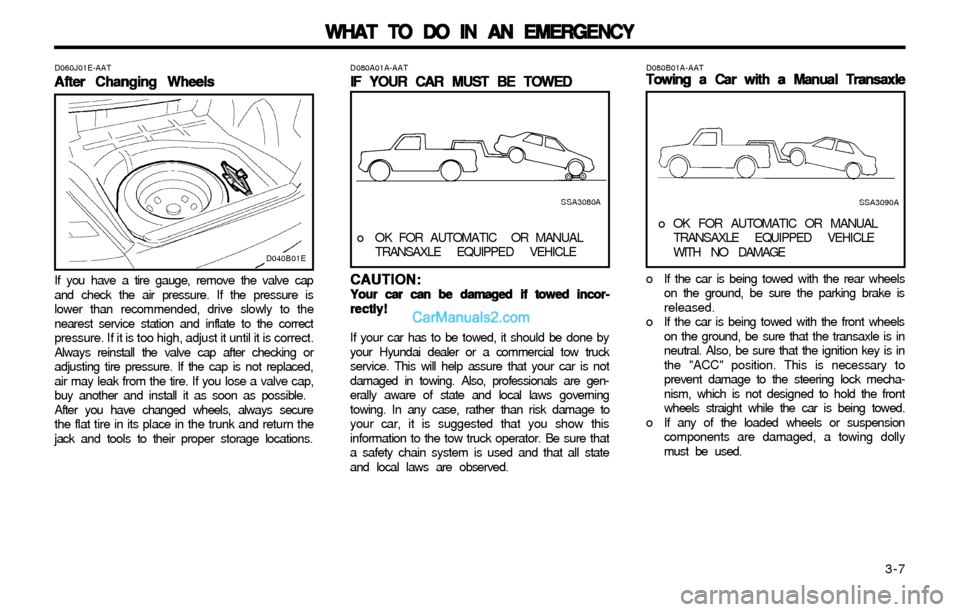
D080B01A-AATTowing a Car with a Manual Transaxle Towing a Car with a Manual TransaxleTowing a Car with a Manual Transaxle Towing a Car with a Manual Transaxle
Towing a Car with a Manual Transaxle
o If the car is being towed with the rear wheels
on the ground, be sure the parking brake is
released.
o If the car is being towed with the front wheels
on the ground, be sure that the transaxle is in
neutral. Also, be sure that the ignition key is in
the "ACC" position. This is necessary to
prevent damage to the steering lock mecha-
nism, which is not designed to hold the front
wheels straight while the car is being towed.
o If any of the loaded wheels or suspension
components are damaged, a towing dolly
must be used.
o OK FOR AUTOMATIC OR MANUAL
TRANSAXLE EQUIPPED VEHICLE
SSA3080A
o OK FOR AUTOMATIC OR MANUAL
TRANSAXLE EQUIPPED VEHICLE
WITH NO DAMAGE
SSA3090A
D040B01E
Page 123 of 172

WHAT TO DO IN AN EMERGENCY WHAT TO DO IN AN EMERGENCYWHAT TO DO IN AN EMERGENCY WHAT TO DO IN AN EMERGENCY
WHAT TO DO IN AN EMERGENCY
3-8
D080C02A-AATTowing a Car with an Automatic Towing a Car with an AutomaticTowing a Car with an Automatic Towing a Car with an Automatic
Towing a Car with an Automatic
Transaxle TransaxleTransaxle Transaxle
Transaxle
CAUTION: CAUTION:CAUTION: CAUTION:
CAUTION:
A car with an automatic transaxle should A car with an automatic transaxle shouldA car with an automatic transaxle should A car with an automatic transaxle should
A car with an automatic transaxle should
never be towed from the rear with the front never be towed from the rear with the frontnever be towed from the rear with the front never be towed from the rear with the front
never be towed from the rear with the front
wheels on the ground. This can cause seri- wheels on the ground. This can cause seri-wheels on the ground. This can cause seri- wheels on the ground. This can cause seri-
wheels on the ground. This can cause seri-
ous damage to the transaxle. If the car must ous damage to the transaxle. If the car mustous damage to the transaxle. If the car must ous damage to the transaxle. If the car must
ous damage to the transaxle. If the car must
be towed from the rear, a towing dolly must be towed from the rear, a towing dolly mustbe towed from the rear, a towing dolly must be towed from the rear, a towing dolly must
be towed from the rear, a towing dolly must
be used under the front wheels. be used under the front wheels.be used under the front wheels. be used under the front wheels.
be used under the front wheels.
If the car is being towed with the rear wheels on
the ground, be sure the parking brake is re-
leased.
o NOT OK FOR AUTOMATIC TRANSAXLE
EQUIPPED VEHICLE
o OK FOR MANUAL TRANSAXLE
SSA3100A o OK FOR AUTOMATIC OR MANUAL
TRANSAXLE EQUIPPED VEHICLE
SSA3101AD080D02A-AAT
Emergency Towing Emergency TowingEmergency Towing Emergency Towing
Emergency Towing
For emergency towing when no commercial tow
vehicle is available, attach a tow cable, chain or
strap to one of the tie-down hooks under the front
of your car. Do not attempt to tow your vehicle in
this manner on any unpaved surface. This could
result in serious damage to your car.
Nor should towing be attempted if the wheels,
drive train, axles, steering or brakes are dam-
aged. Before towing, be sure the transaxle is in
neutral and the key is in "ACC" (with the engine
off) or in the "ON" position (with the engine
running). A driver must be in the towed car to
steer it and operate the brakes.
D080D01ENOTE: NOTE:NOTE: NOTE:
NOTE:Before towing, check the level of the tran- Before towing, check the level of the tran-Before towing, check the level of the tran- Before towing, check the level of the tran-
Before towing, check the level of the tran-
saxle fluid. If it is below the "HOT" mark on saxle fluid. If it is below the "HOT" mark onsaxle fluid. If it is below the "HOT" mark on saxle fluid. If it is below the "HOT" mark on
saxle fluid. If it is below the "HOT" mark on
the dipstick, add fluid. If you cannot add fluid, the dipstick, add fluid. If you cannot add fluid,the dipstick, add fluid. If you cannot add fluid, the dipstick, add fluid. If you cannot add fluid,
the dipstick, add fluid. If you cannot add fluid,
a towing dolly must be used as described a towing dolly must be used as describeda towing dolly must be used as described a towing dolly must be used as described
a towing dolly must be used as described
above. above.above. above.
above.
Page 124 of 172

WHAT TO DO IN AN EMERGENCY WHAT TO DO IN AN EMERGENCYWHAT TO DO IN AN EMERGENCY WHAT TO DO IN AN EMERGENCY
WHAT TO DO IN AN EMERGENCY
3-9
D120A01A-AAT
IF YOU LOSE YOUR KEYS IF YOU LOSE YOUR KEYSIF YOU LOSE YOUR KEYS IF YOU LOSE YOUR KEYS
IF YOU LOSE YOUR KEYSIf you lose your keys, many Hyundai dealers can
make you a new key if you have your key
number.
If you lock the keys inside your car and you
cannot obtain a new key, many Hyundai dealers
can use special tools to open the door for you.
CAUTION: CAUTION:CAUTION: CAUTION:
CAUTION:If the car is being towed with all four wheels If the car is being towed with all four wheelsIf the car is being towed with all four wheels If the car is being towed with all four wheels
If the car is being towed with all four wheels
on the ground, it can be towed only from the on the ground, it can be towed only from theon the ground, it can be towed only from the on the ground, it can be towed only from the
on the ground, it can be towed only from the
front. Be sure that the transaxle is in neutral. front. Be sure that the transaxle is in neutral.front. Be sure that the transaxle is in neutral. front. Be sure that the transaxle is in neutral.
front. Be sure that the transaxle is in neutral.
Do not tow at speeds greater than 30 mph (50 Do not tow at speeds greater than 30 mph (50Do not tow at speeds greater than 30 mph (50 Do not tow at speeds greater than 30 mph (50
Do not tow at speeds greater than 30 mph (50
km/h) and for more than 15 miles (25 km). Be km/h) and for more than 15 miles (25 km). Bekm/h) and for more than 15 miles (25 km). Be km/h) and for more than 15 miles (25 km). Be
km/h) and for more than 15 miles (25 km). Be
sure the steering is unlocked by placing the sure the steering is unlocked by placing thesure the steering is unlocked by placing the sure the steering is unlocked by placing the
sure the steering is unlocked by placing the
key in the "ACC" position. A driver must be in key in the "ACC" position. A driver must be inkey in the "ACC" position. A driver must be in key in the "ACC" position. A driver must be in
key in the "ACC" position. A driver must be in
the towed vehicle to operate the steering and the towed vehicle to operate the steering andthe towed vehicle to operate the steering and the towed vehicle to operate the steering and
the towed vehicle to operate the steering and
brakes. brakes.brakes. brakes.
brakes.
Page 133 of 172
VEHICLE MAINTENANCE REQUIREMENTS VEHICLE MAINTENANCE REQUIREMENTSVEHICLE MAINTENANCE REQUIREMENTS VEHICLE MAINTENANCE REQUIREMENTS
VEHICLE MAINTENANCE REQUIREMENTS
5-5
MAINTENANCE UNDER SEVERE USAGE CONDITIONS MAINTENANCE UNDER SEVERE USAGE CONDITIONSMAINTENANCE UNDER SEVERE USAGE CONDITIONS MAINTENANCE UNDER SEVERE USAGE CONDITIONS
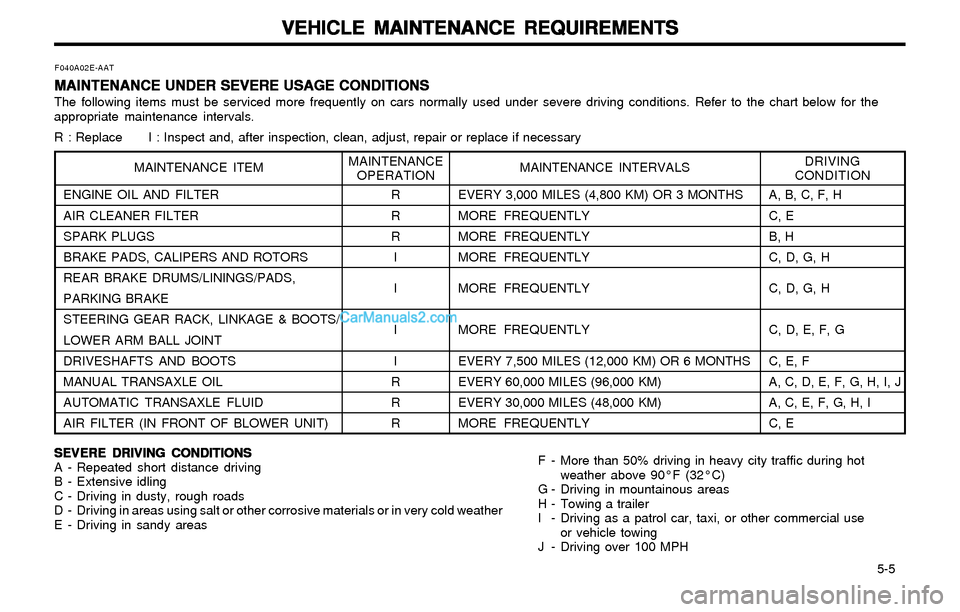
MAINTENANCE UNDER SEVERE USAGE CONDITIONSThe following items must be serviced more frequently on cars normally used under severe driving conditions. Refer to the chart below for the
appropriate maintenance intervals.
R : Replace I : Inspect and, after inspection, clean, adjust, repair or replace if necessary
F040A02E-AAT
MAINTENANCE ITEM
F - More than 50% driving in heavy city traffic during hot
weather above 90°F (32°C)
G - Driving in mountainous areas
H - Towing a trailer
I - Driving as a patrol car, taxi, or other commercial use
or vehicle towing
J - Driving over 100 MPH SEVERE DRIVING CONDITIONS SEVERE DRIVING CONDITIONSSEVERE DRIVING CONDITIONS SEVERE DRIVING CONDITIONS
SEVERE DRIVING CONDITIONS
A - Repeated short distance driving
B - Extensive idling
C - Driving in dusty, rough roads
D - Driving in areas using salt or other corrosive materials or in very cold weather
E - Driving in sandy areasMAINTENANCE INTERVALS
ENGINE OIL AND FILTER
AIR CLEANER FILTER
SPARK PLUGS
BRAKE PADS, CALIPERS AND ROTORS
REAR BRAKE DRUMS/LININGS/PADS,
PARKING BRAKE
STEERING GEAR RACK, LINKAGE & BOOTS/
LOWER ARM BALL JOINT
DRIVESHAFTS AND BOOTS
MANUAL TRANSAXLE OIL
AUTOMATIC TRANSAXLE FLUID
AIR FILTER (IN FRONT OF BLOWER UNIT)R
R
R
I
I
I
I
R
R
REVERY 3,000 MILES (4,800 KM) OR 3 MONTHS
MORE FREQUENTLY
MORE FREQUENTLY
MORE FREQUENTLY
MORE FREQUENTLY
MORE FREQUENTLY
EVERY 7,500 MILES (12,000 KM) OR 6 MONTHS
EVERY 60,000 MILES (96,000 KM)
EVERY 30,000 MILES (48,000 KM)
MORE FREQUENTLY MAINTENANCE
OPERATION
A, B, C, F, H
C, E
B, H
C, D, G, H
C, D, G, H
C, D, E, F, G
C, E, F
A, C, D, E, F, G, H, I, J
A, C, E, F, G, H, I
C, EDRIVING
CONDITION
Page 151 of 172
DO-IT-YOURSELF MAINTENANCE DO-IT-YOURSELF MAINTENANCEDO-IT-YOURSELF MAINTENANCE DO-IT-YOURSELF MAINTENANCE
DO-IT-YOURSELF MAINTENANCE
6-15
G200B01E-AAT
Replacing Accessory Fuse Replacing Accessory FuseReplacing Accessory Fuse Replacing Accessory Fuse
Replacing Accessory Fuse
The fuse box for the lights and other electrical
accessories will be found in the backside of multi
box located in the left side of driver. Inside the box
you will find a list showing the circuits protected
by each fuse.
If any of your car's lights or other electrical
accessories stop working, a blown fuse could
be the reason. If the fuse has burned out, you
will see that the metal strip inside the fuse has
burned through. If you suspect a blown fuse,
follow this procedure:
1. Turn off the ignition and all other switches.
2. Open the fuse box and examine each fuse.
Remove each fuse by pulling it toward you
(a small "fuse puller" tool is contained in the
fuse box to simplify this operation).
3. Be sure to check all other fuses even if you
find one that appears to have burned out.
B200B01E
G190A01A-AAT
CHECKING DRIVE BELTS CHECKING DRIVE BELTSCHECKING DRIVE BELTS CHECKING DRIVE BELTS
CHECKING DRIVE BELTS
G200A01A-AAT
CHECKING AND REPLACING CHECKING AND REPLACINGCHECKING AND REPLACING CHECKING AND REPLACING
CHECKING AND REPLACING
FUSES FUSESFUSES FUSES
FUSES
Replacing a Fusible Link Replacing a Fusible LinkReplacing a Fusible Link Replacing a Fusible Link
Replacing a Fusible Link
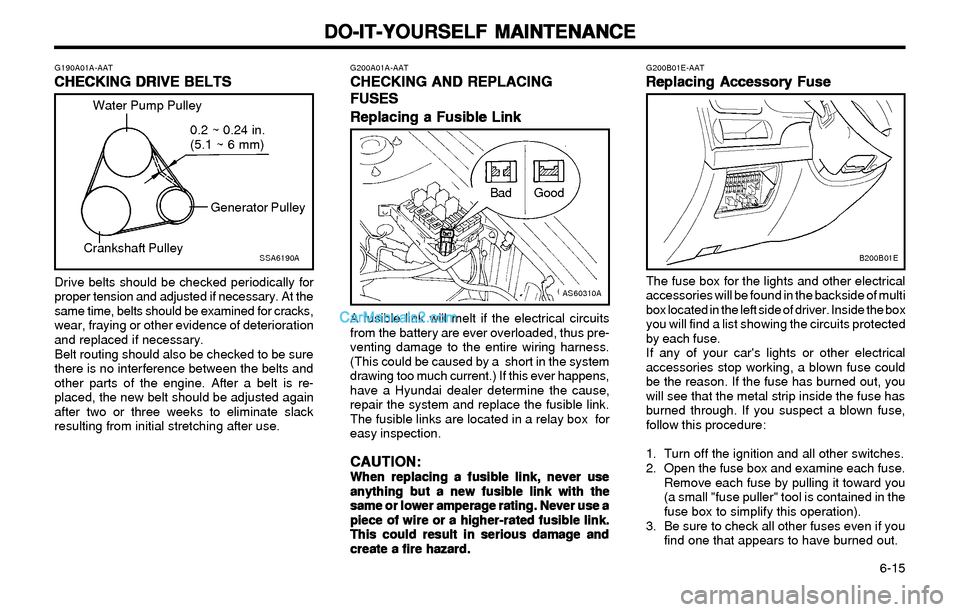
Drive belts should be checked periodically for
proper tension and adjusted if necessary. At the
same time, belts should be examined for cracks,
wear, fraying or other evidence of deterioration
and replaced if necessary.
Belt routing should also be checked to be sure
there is no interference between the belts and
other parts of the engine. After a belt is re-
placed, the new belt should be adjusted again
after two or three weeks to eliminate slack
resulting from initial stretching after use.A fusible link will melt if the electrical circuits
from the battery are ever overloaded, thus pre-
venting damage to the entire wiring harness.
(This could be caused by a short in the system
drawing too much current.) If this ever happens,
have a Hyundai dealer determine the cause,
repair the system and replace the fusible link.
The fusible links are located in a relay box for
easy inspection.
CAUTION: CAUTION:CAUTION: CAUTION:
CAUTION:When replacing a fusible link, never use When replacing a fusible link, never useWhen replacing a fusible link, never use When replacing a fusible link, never use
When replacing a fusible link, never use
anything but a new fusible link with the anything but a new fusible link with theanything but a new fusible link with the anything but a new fusible link with the
anything but a new fusible link with the
same or lower amperage rating. Never use a same or lower amperage rating. Never use asame or lower amperage rating. Never use a same or lower amperage rating. Never use a
same or lower amperage rating. Never use a
piece of wire or a higher-rated fusible link. piece of wire or a higher-rated fusible link.piece of wire or a higher-rated fusible link. piece of wire or a higher-rated fusible link.
piece of wire or a higher-rated fusible link.
This could result in serious damage and This could result in serious damage andThis could result in serious damage and This could result in serious damage and
This could result in serious damage and
create a fire hazard. create a fire hazard.create a fire hazard. create a fire hazard.
create a fire hazard.
SSA6190A
Water Pump Pulley
Generator Pulley
Crankshaft Pulley0.2 ~ 0.24 in.
(5.1 ~ 6 mm)
GoodBad
AS60310A
Page 171 of 172
INDEX INDEXINDEX INDEX
INDEX
10-4Snow tires ....................................................................................... 8-2
Spare tire ......................................................................................... 3-3
Traction ........................................................................................... 8-2
Towing
A trailer (or vehicle) ......................................................................2-12
Emergency ...................................................................................... 3-8
If your car must be towed ............................................................... 3-7
Traction Control System(TCS) ................................................... 2-8 ~ 2-9
Transaxle
Automatic ........................................................................................ 2-5
Automatic transaxle fluid checking .................................... 6-10 ~ 6-11
Manual............................................................................................. 2-4
Manual transaxle oil checking .......................................................6-10
Trip Computer ........................................................................ 1-35 ~ 1-36
Trip Odometer ...................................................................................1-34
Trunk Lid ...........................................................................................1-50
V VV V
V
Vehicle Identification Number (VIN) .................................................... 8-1
Vehicle Specification ........................................................................... 9-1
Ventilation
Center ventilator ............................................................................1-56
Side ventilator ...............................................................................1-58
W WW W
W
Warning Lights ....................................................................... 1-30 ~ 1-32
Windows
Manual............................................................................................. 1-6
Power ..................................................................................... 1-6 ~ 1-7
Windshield Wiper and Washer Switch ..............................................1-38
Windshield Wiper Blades .................................................................... 6-9
Page 172 of 172
Seoul Korea
Printing: JAN. 24, 2003
Publication No.: A2DO-EU31P
Printed in Korea
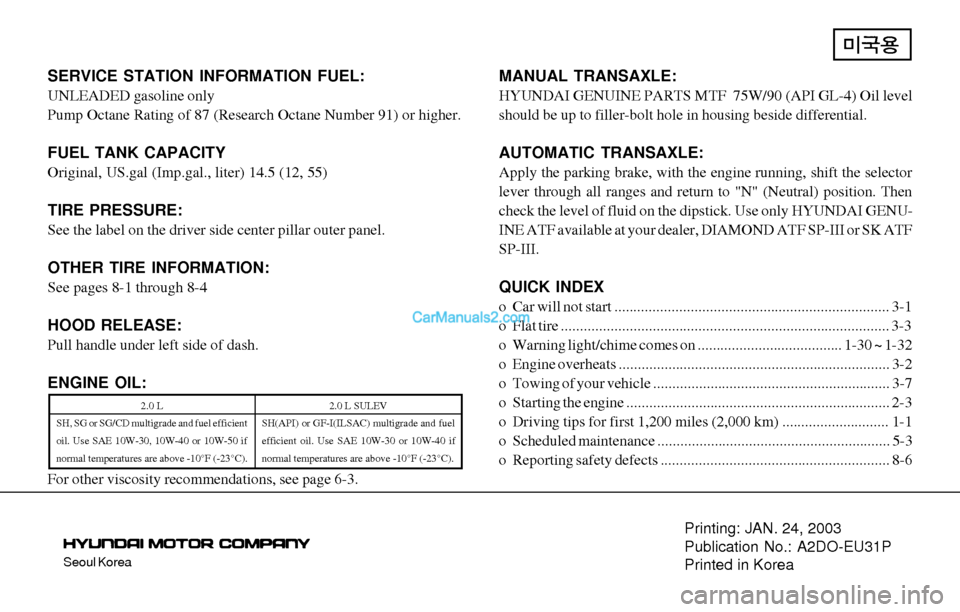
SERVICE STATION INFORMATION FUEL:
UNLEADED gasoline only
Pump Octane Rating of 87 (Research Octane Number 91) or higher.
FUEL TANK CAPACITY
Original, US.gal (Imp.gal., liter) 14.5 (12, 55)
TIRE PRESSURE:
See the label on the driver side center pillar outer panel.
OTHER TIRE INFORMATION:
See pages 8-1 through 8-4
HOOD RELEASE:
Pull handle under left side of dash.
ENGINE OIL:
For other viscosity recommendations, see page 6-3.
MANUAL TRANSAXLE:
HYUNDAI GENUINE PARTS MTF 75W/90 (API GL-4) Oil level
should be up to filler-bolt hole in housing beside differential.
AUTOMATIC TRANSAXLE:
Apply the parking brake, with the engine running, shift the selector
lever through all ranges and return to "N" (Neutral) position. Then
check the level of fluid on the dipstick. Use only HYUNDAI GENU-
INE ATF available at your dealer, DIAMOND ATF SP-III or SK ATF
SP-III.
QUICK INDEX
o Car will not start ........................................................................ 3-1
o Flat tire ...................................................................................... 3-3
o Warning light/chime comes on ...................................... 1-30 ~ 1-32
o Engine overheats ....................................................................... 3-2
o Towing of your vehicle .............................................................. 3-7
o Starting the engine ..................................................................... 2-3
o Driving tips for first 1,200 miles (2,000 km) ............................ 1-1
o Scheduled maintenance ............................................................. 5-3
o Reporting safety defects ............................................................ 8-6
2.0 L
SH, SG or SG/CD multigrade and fuel efficient
oil. Use SAE 10W-30, 10W-40 or 10W-50 if
normal temperatures are above -10°F (-23°C).2.0 L SULEV
SH(API) or GF-I(ILSAC) multigrade and fuel
efficient oil. Use SAE 10W-30 or 10W-40 if
normal temperatures are above -10°F (-23°C).