warning light Hyundai Elantra 2003 User Guide
[x] Cancel search | Manufacturer: HYUNDAI, Model Year: 2003, Model line: Elantra, Model: Hyundai Elantra 2003Pages: 172, PDF Size: 2.82 MB
Page 41 of 172
FEATURES OF YOUR HYUNDAI FEATURES OF YOUR HYUNDAIFEATURES OF YOUR HYUNDAI FEATURES OF YOUR HYUNDAI
FEATURES OF YOUR HYUNDAI
1- 32
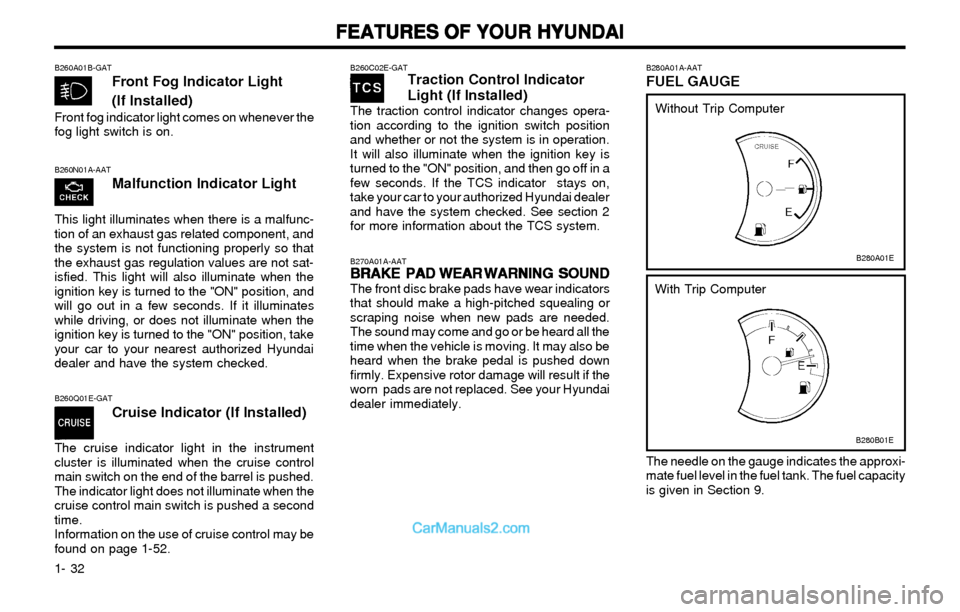
B260N01A-AATMalfunction Indicator Light
This light illuminates when there is a malfunc-
tion of an exhaust gas related component, and
the system is not functioning properly so that
the exhaust gas regulation values are not sat-
isfied. This light will also illuminate when the
ignition key is turned to the "ON" position, and
will go out in a few seconds. If it illuminates
while driving, or does not illuminate when the
ignition key is turned to the "ON" position, take
your car to your nearest authorized Hyundai
dealer and have the system checked.
B270A01A-AATBRAKE PAD WEAR WARNING SOUND BRAKE PAD WEAR WARNING SOUNDBRAKE PAD WEAR WARNING SOUND BRAKE PAD WEAR WARNING SOUND
BRAKE PAD WEAR WARNING SOUNDThe front disc brake pads have wear indicators
that should make a high-pitched squealing or
scraping noise when new pads are needed.
The sound may come and go or be heard all the
time when the vehicle is moving. It may also be
heard when the brake pedal is pushed down
firmly. Expensive rotor damage will result if the
worn pads are not replaced. See your Hyundai
dealer immediately.
B260Q01E-GATCruise Indicator (If Installed)
The cruise indicator light in the instrument
cluster is illuminated when the cruise control
main switch on the end of the barrel is pushed.
The indicator light does not illuminate when the
cruise control main switch is pushed a second
time.
Information on the use of cruise control may be
found on page 1-52.
B260A01B-GATFront Fog Indicator Light
(If Installed)
Front fog indicator light comes on whenever the
fog light switch is on.
B280B01E
B280A01E
Without Trip Computer
With Trip Computer
CRUISE
B280A01A-AATFUEL GAUGE
The needle on the gauge indicates the approxi-
mate fuel level in the fuel tank. The fuel capacity
is given in Section 9.
B260C02E-GATTraction Control Indicator
Light (If Installed)
The traction control indicator changes opera-
tion according to the ignition switch position
and whether or not the system is in operation.
It will also illuminate when the ignition key is
turned to the "ON" position, and then go off in a
few seconds. If the TCS indicator stays on,
take your car to your authorized Hyundai dealer
and have the system checked. See section 2
for more information about the TCS system.
Page 48 of 172
FEATURES OF YOUR HYUNDAI FEATURES OF YOUR HYUNDAIFEATURES OF YOUR HYUNDAI FEATURES OF YOUR HYUNDAI
FEATURES OF YOUR HYUNDAI
1- 39
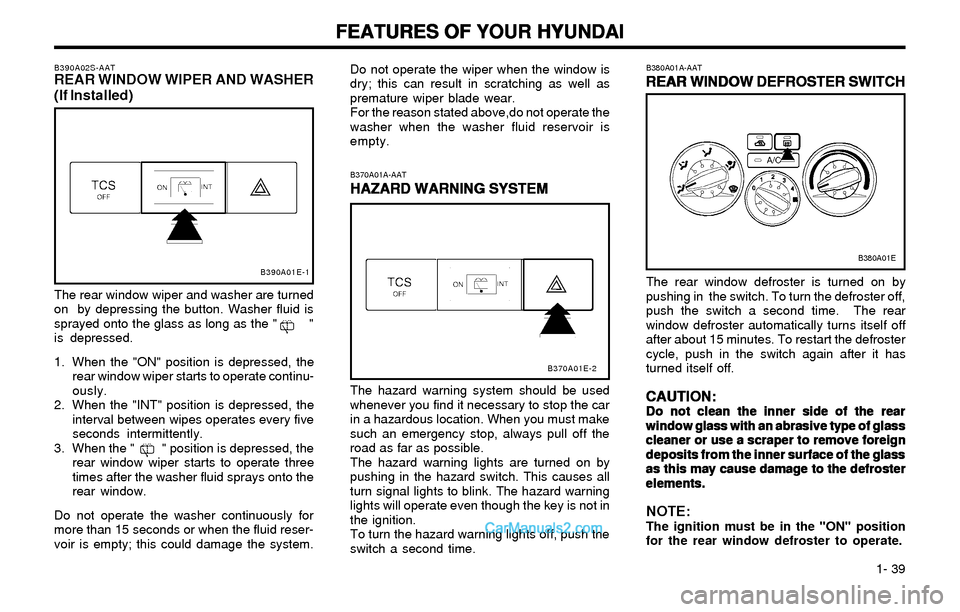
B380A01A-AAT
REAR WINDOW DEFROSTER SWITCH REAR WINDOW DEFROSTER SWITCHREAR WINDOW DEFROSTER SWITCH REAR WINDOW DEFROSTER SWITCH
REAR WINDOW DEFROSTER SWITCH
The rear window defroster is turned on by
pushing in the switch. To turn the defroster off,
push the switch a second time. The rear
window defroster automatically turns itself off
after about 15 minutes. To restart the defroster
cycle, push in the switch again after it has
turned itself off.
CAUTION: CAUTION:CAUTION: CAUTION:
CAUTION:Do not clean the inner side of the rear Do not clean the inner side of the rearDo not clean the inner side of the rear Do not clean the inner side of the rear
Do not clean the inner side of the rear
window glass with an abrasive type of glass window glass with an abrasive type of glasswindow glass with an abrasive type of glass window glass with an abrasive type of glass
window glass with an abrasive type of glass
cleaner or use a scraper to remove foreign cleaner or use a scraper to remove foreigncleaner or use a scraper to remove foreign cleaner or use a scraper to remove foreign
cleaner or use a scraper to remove foreign
deposits from the inner surface of the glass deposits from the inner surface of the glassdeposits from the inner surface of the glass deposits from the inner surface of the glass
deposits from the inner surface of the glass
as this may cause damage to the defroster as this may cause damage to the defrosteras this may cause damage to the defroster as this may cause damage to the defroster
as this may cause damage to the defroster
elements. elements.elements. elements.
elements.
NOTE:The ignition must be in the "ON" position
for the rear window defroster to operate.
B370A01A-AAT
HAZARD WARNING SYSTEM HAZARD WARNING SYSTEMHAZARD WARNING SYSTEM HAZARD WARNING SYSTEM
HAZARD WARNING SYSTEM
The hazard warning system should be used
whenever you find it necessary to stop the car
in a hazardous location. When you must make
such an emergency stop, always pull off the
road as far as possible.
The hazard warning lights are turned on by
pushing in the hazard switch. This causes all
turn signal lights to blink. The hazard warning
lights will operate even though the key is not in
the ignition.
To turn the hazard warning lights off, push the
switch a second time.
B380A01E
B370A01E-2
Do not operate the wiper when the window is
dry; this can result in scratching as well as
premature wiper blade wear.
For the reason stated above,do not operate the
washer when the washer fluid reservoir is
empty.B390A02S-AATREAR WINDOW WIPER AND WASHER
(If Installed)
B390A01E-1
The rear window wiper and washer are turned
on by depressing the button. Washer fluid is
sprayed onto the glass as long as the " "
is depressed.
1. When the "ON" position is depressed, the
rear window wiper starts to operate continu-
ously.
2. When the "INT" position is depressed, the
interval between wipes operates every five
seconds intermittently.
3. When the " " position is depressed, the
rear window wiper starts to operate three
times after the washer fluid sprays onto the
rear window.
Do not operate the washer continuously for
more than 15 seconds or when the fluid reser-
voir is empty; this could damage the system.
Page 53 of 172
FEATURES OF YOUR HYUNDAI FEATURES OF YOUR HYUNDAIFEATURES OF YOUR HYUNDAI FEATURES OF YOUR HYUNDAI
FEATURES OF YOUR HYUNDAI
1- 44
B500A01S-AAT
GLOVE BOX GLOVE BOXGLOVE BOX GLOVE BOX
GLOVE BOX
WARNING: WARNING:WARNING: WARNING:
WARNING:
To avoid the possibility of injury in case of To avoid the possibility of injury in case ofTo avoid the possibility of injury in case of To avoid the possibility of injury in case of
To avoid the possibility of injury in case of
an accident or a sudden stop, the glove box an accident or a sudden stop, the glove boxan accident or a sudden stop, the glove box an accident or a sudden stop, the glove box
an accident or a sudden stop, the glove box
door should be kept closed when the car is door should be kept closed when the car isdoor should be kept closed when the car is door should be kept closed when the car is
door should be kept closed when the car is
in motion. in motion.in motion. in motion.
in motion.
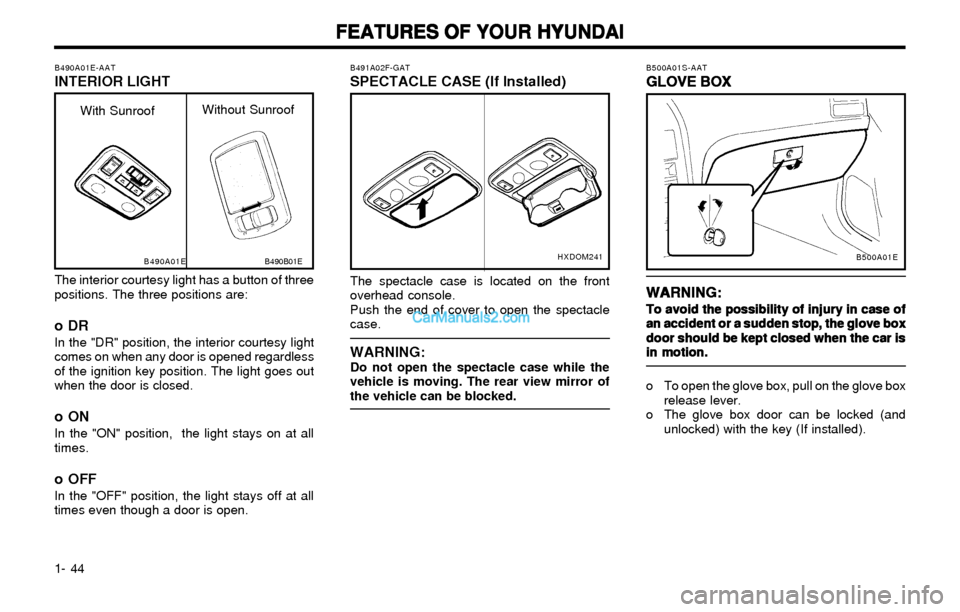
o To open the glove box, pull on the glove box
release lever.
o The glove box door can be locked (and
unlocked) with the key (If installed).
B491A02F-GATSPECTACLE CASE (If Installed)
HXDOM241
The spectacle case is located on the front
overhead console.
Push the end of cover to open the spectacle
case.
WARNING:Do not open the spectacle case while the
vehicle is moving. The rear view mirror of
the vehicle can be blocked.
B500A01E
The interior courtesy light has a button of three
positions. The three positions are:
oDR
In the "DR" position, the interior courtesy light
comes on when any door is opened regardless
of the ignition key position. The light goes out
when the door is closed.
oON
In the "ON" position, the light stays on at all
times.
o OFF
In the "OFF" position, the light stays off at all
times even though a door is open.
B490A01E-AATINTERIOR LIGHT
B490A01E
With SunroofWithout Sunroof
B490B01E
Page 57 of 172
FEATURES OF YOUR HYUNDAI FEATURES OF YOUR HYUNDAIFEATURES OF YOUR HYUNDAI FEATURES OF YOUR HYUNDAI
FEATURES OF YOUR HYUNDAI
1- 48
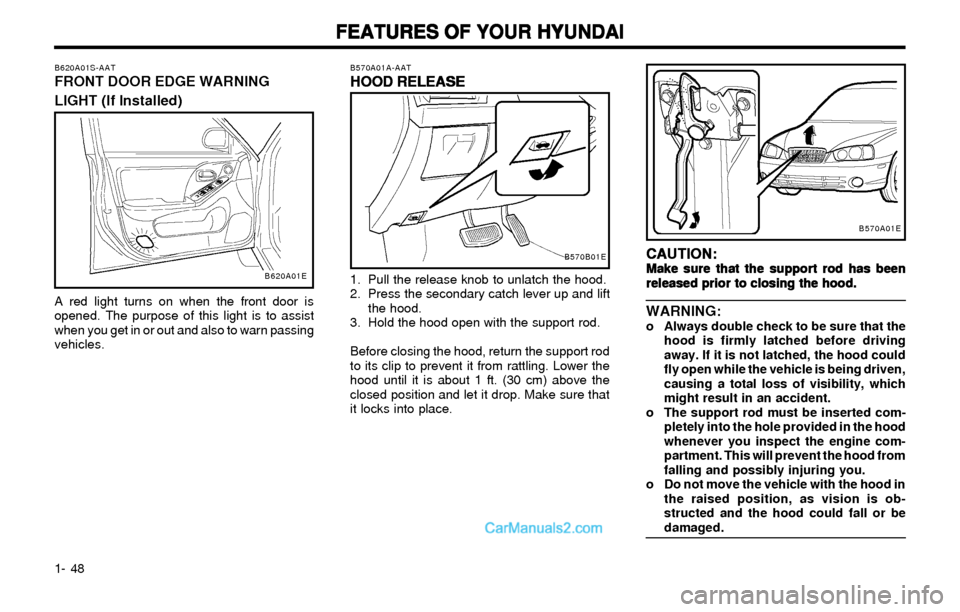
B570A01A-AAT
HOOD RELEASE HOOD RELEASEHOOD RELEASE HOOD RELEASE
HOOD RELEASE
1. Pull the release knob to unlatch the hood.
2. Press the secondary catch lever up and lift
the hood.
3. Hold the hood open with the support rod.
Before closing the hood, return the support rod
to its clip to prevent it from rattling. Lower the
hood until it is about 1 ft. (30 cm) above the
closed position and let it drop. Make sure that
it locks into place.
CAUTION: CAUTION:CAUTION: CAUTION:
CAUTION:Make sure that the support rod has been Make sure that the support rod has beenMake sure that the support rod has been Make sure that the support rod has been
Make sure that the support rod has been
released prior to closing the hood. released prior to closing the hood.released prior to closing the hood. released prior to closing the hood.
released prior to closing the hood.
WARNING:o Always double check to be sure that the
hood is firmly latched before driving
away. If it is not latched, the hood could
fly open while the vehicle is being driven,
causing a total loss of visibility, which
might result in an accident.
o The support rod must be inserted com-
pletely into the hole provided in the hood
whenever you inspect the engine com-
partment. This will prevent the hood from
falling and possibly injuring you.
o Do not move the vehicle with the hood in
the raised position, as vision is ob-
structed and the hood could fall or be
damaged.
B570A01E
B570B01E
B620A01S-AATFRONT DOOR EDGE WARNING
LIGHT (If Installed)
A red light turns on when the front door is
opened. The purpose of this light is to assist
when you get in or out and also to warn passing
vehicles.
B620A01E
Page 58 of 172
FEATURES OF YOUR HYUNDAI FEATURES OF YOUR HYUNDAIFEATURES OF YOUR HYUNDAI FEATURES OF YOUR HYUNDAI
FEATURES OF YOUR HYUNDAI
1- 49
WARNING: WARNING:WARNING: WARNING:
WARNING:o oo o
o
The fuel cap must be tightened at least 3 The fuel cap must be tightened at least 3The fuel cap must be tightened at least 3 The fuel cap must be tightened at least 3
The fuel cap must be tightened at least 3
clicks, otherwise light will illuminate. clicks, otherwise light will illuminate.clicks, otherwise light will illuminate. clicks, otherwise light will illuminate.
clicks, otherwise light will illuminate.
o oo o
o
Gasoline vapors are dangerous. Before Gasoline vapors are dangerous. BeforeGasoline vapors are dangerous. Before Gasoline vapors are dangerous. Before
Gasoline vapors are dangerous. Before
refueling, always stop the engine and refueling, always stop the engine andrefueling, always stop the engine and refueling, always stop the engine and
refueling, always stop the engine and
never allow sparks or open flames near never allow sparks or open flames nearnever allow sparks or open flames near never allow sparks or open flames near
never allow sparks or open flames near
the filler area. If you need to replace the the filler area. If you need to replace thethe filler area. If you need to replace the the filler area. If you need to replace the
the filler area. If you need to replace the
filler cap, use a genuine Hyundai re- filler cap, use a genuine Hyundai re-filler cap, use a genuine Hyundai re- filler cap, use a genuine Hyundai re-
filler cap, use a genuine Hyundai re-
placement part. placement part.placement part. placement part.
placement part.
o oo o
o
If you open the fuel filler cap during high If you open the fuel filler cap during highIf you open the fuel filler cap during high If you open the fuel filler cap during high
If you open the fuel filler cap during high
ambient temperatures, a slight "pres- ambient temperatures, a slight "pres-ambient temperatures, a slight "pres- ambient temperatures, a slight "pres-
ambient temperatures, a slight "pres-
sure sound" may be heard. This is nor- sure sound" may be heard. This is nor-sure sound" may be heard. This is nor- sure sound" may be heard. This is nor-
sure sound" may be heard. This is nor-
mal and not a cause for concern. mal and not a cause for concern.mal and not a cause for concern. mal and not a cause for concern.
mal and not a cause for concern.
Whenever you open the fuel filler cap, Whenever you open the fuel filler cap,Whenever you open the fuel filler cap, Whenever you open the fuel filler cap,
Whenever you open the fuel filler cap,
turn it slowly. turn it slowly.turn it slowly. turn it slowly.
turn it slowly.
o oo o
o
Make sure the fuel filler cap is replaced and Make sure the fuel filler cap is replaced andMake sure the fuel filler cap is replaced and Make sure the fuel filler cap is replaced and
Make sure the fuel filler cap is replaced and
securely seated after fueling. Failure to securely seated after fueling. Failure tosecurely seated after fueling. Failure to securely seated after fueling. Failure to
securely seated after fueling. Failure to
replace or fully seat the fuel filler cap will replace or fully seat the fuel filler cap willreplace or fully seat the fuel filler cap will replace or fully seat the fuel filler cap will
replace or fully seat the fuel filler cap will
result in fuel vapors escaping into the atmo- result in fuel vapors escaping into the atmo-result in fuel vapors escaping into the atmo- result in fuel vapors escaping into the atmo-
result in fuel vapors escaping into the atmo-
sphere and the MIL indicator sphere and the MIL indicator sphere and the MIL indicator sphere and the MIL indicator
sphere and the MIL indicator
illu illuillu illu
illu
- -- -
-
minating. minating.minating. minating.
minating.
B560B01E
B560A02S-AAT
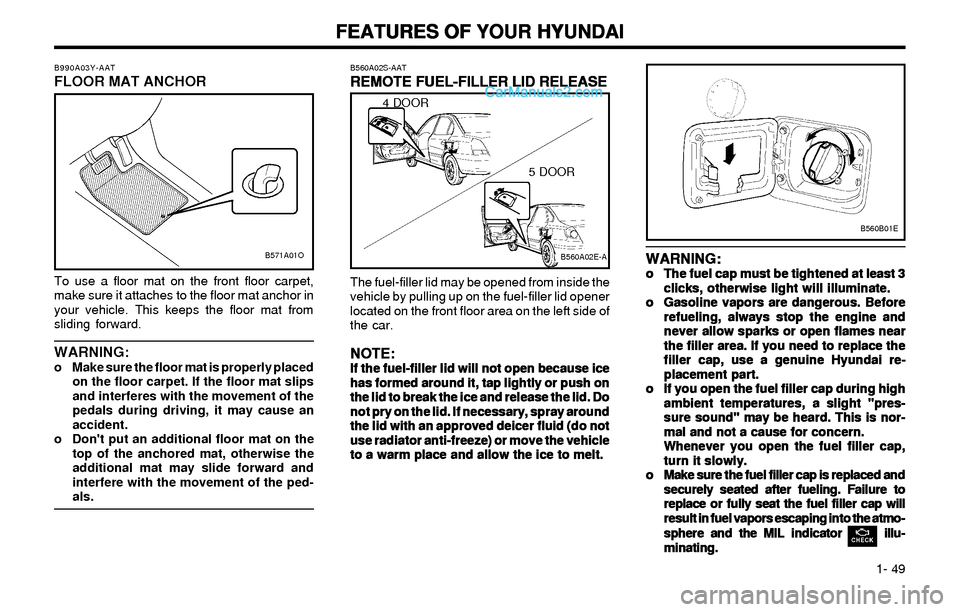
REMOTE FUEL-FILLER LID RELEASE REMOTE FUEL-FILLER LID RELEASEREMOTE FUEL-FILLER LID RELEASE REMOTE FUEL-FILLER LID RELEASE
REMOTE FUEL-FILLER LID RELEASE
The fuel-filler lid may be opened from inside the
vehicle by pulling up on the fuel-filler lid opener
located on the front floor area on the left side of
the car.
NOTE: NOTE:NOTE: NOTE:
NOTE:If the fuel-filler lid will not open because ice If the fuel-filler lid will not open because iceIf the fuel-filler lid will not open because ice If the fuel-filler lid will not open because ice
If the fuel-filler lid will not open because ice
has formed around it, tap lightly or push on has formed around it, tap lightly or push onhas formed around it, tap lightly or push on has formed around it, tap lightly or push on
has formed around it, tap lightly or push on
the lid to break the ice and release the lid. Do the lid to break the ice and release the lid. Dothe lid to break the ice and release the lid. Do the lid to break the ice and release the lid. Do
the lid to break the ice and release the lid. Do
not pry on the lid. If necessary, spray around not pry on the lid. If necessary, spray aroundnot pry on the lid. If necessary, spray around not pry on the lid. If necessary, spray around
not pry on the lid. If necessary, spray around
the lid with an approved deicer fluid (do not the lid with an approved deicer fluid (do notthe lid with an approved deicer fluid (do not the lid with an approved deicer fluid (do not
the lid with an approved deicer fluid (do not
use radiator anti-freeze) or move the vehicle use radiator anti-freeze) or move the vehicleuse radiator anti-freeze) or move the vehicle use radiator anti-freeze) or move the vehicle
use radiator anti-freeze) or move the vehicle
to a warm place and allow the ice to melt. to a warm place and allow the ice to melt.to a warm place and allow the ice to melt. to a warm place and allow the ice to melt.
to a warm place and allow the ice to melt.
B560A02E-A
4 DOOR
5 DOOR
B571A01O B990A03Y-AAT
FLOOR MAT ANCHOR
To use a floor mat on the front floor carpet,
make sure it attaches to the floor mat anchor in
your vehicle. This keeps the floor mat from
sliding forward.
WARNING:o Make sure the floor mat is properly placed
on the floor carpet. If the floor mat slips
and interferes with the movement of the
pedals during driving, it may cause an
accident.
o Don't put an additional floor mat on the
top of the anchored mat, otherwise the
additional mat may slide forward and
interfere with the movement of the ped-
als.
Page 59 of 172
FEATURES OF YOUR HYUNDAI FEATURES OF YOUR HYUNDAIFEATURES OF YOUR HYUNDAI FEATURES OF YOUR HYUNDAI
FEATURES OF YOUR HYUNDAI
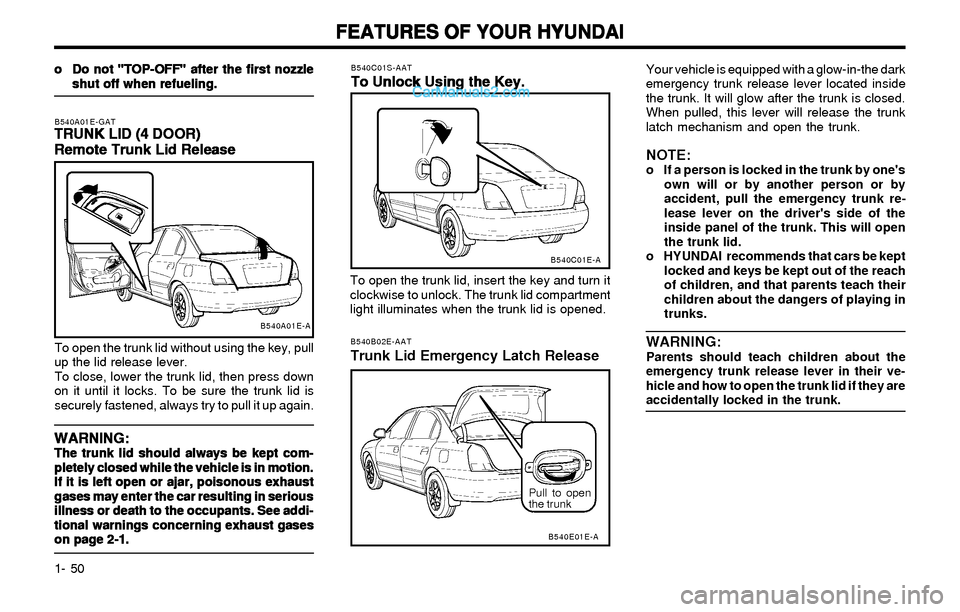
1- 50Your vehicle is equipped with a glow-in-the dark
emergency trunk release lever located inside
the trunk. It will glow after the trunk is closed.
When pulled, this lever will release the trunk
latch mechanism and open the trunk.
NOTE:o If a person is locked in the trunk by one's
own will or by another person or by
accident, pull the emergency trunk re-
lease lever on the driver's side of the
inside panel of the trunk. This will open
the trunk lid.
o HYUNDAI recommends that cars be kept
locked and keys be kept out of the reach
of children, and that parents teach their
children about the dangers of playing in
trunks.
WARNING:Parents should teach children about the
emergency trunk release lever in their ve-
hicle and how to open the trunk lid if they are
accidentally locked in the trunk.
B540C01S-AAT
To Unlock Using the Key. To Unlock Using the Key.To Unlock Using the Key. To Unlock Using the Key.
To Unlock Using the Key.
To open the trunk lid, insert the key and turn it
clockwise to unlock. The trunk lid compartment
light illuminates when the trunk lid is opened.
B540C01E-A
B540B02E-AAT
Trunk Lid Emergency Latch Release
B540E01E-A
Pull to open
the trunk
B540A01E-GATTRUNK LID (4 DOOR) TRUNK LID (4 DOOR)TRUNK LID (4 DOOR) TRUNK LID (4 DOOR)
TRUNK LID (4 DOOR)
Remote Trunk Lid Release Remote Trunk Lid ReleaseRemote Trunk Lid Release Remote Trunk Lid Release
Remote Trunk Lid Release
To open the trunk lid without using the key, pull
up the lid release lever.
To close, lower the trunk lid, then press down
on it until it locks. To be sure the trunk lid is
securely fastened, always try to pull it up again.
WARNING: WARNING:WARNING: WARNING:
WARNING:The trunk lid should always be kept com- The trunk lid should always be kept com-The trunk lid should always be kept com- The trunk lid should always be kept com-
The trunk lid should always be kept com-
pletely closed while the vehicle is in motion. pletely closed while the vehicle is in motion.pletely closed while the vehicle is in motion. pletely closed while the vehicle is in motion.
pletely closed while the vehicle is in motion.
If it is left open or ajar, poisonous exhaust If it is left open or ajar, poisonous exhaustIf it is left open or ajar, poisonous exhaust If it is left open or ajar, poisonous exhaust
If it is left open or ajar, poisonous exhaust
gases may enter the car resulting in serious gases may enter the car resulting in seriousgases may enter the car resulting in serious gases may enter the car resulting in serious
gases may enter the car resulting in serious
illness or death to the occupants. See addi- illness or death to the occupants. See addi-illness or death to the occupants. See addi- illness or death to the occupants. See addi-
illness or death to the occupants. See addi-
tional warnings concerning exhaust gases tional warnings concerning exhaust gasestional warnings concerning exhaust gases tional warnings concerning exhaust gases
tional warnings concerning exhaust gases
on page 2-1. on page 2-1.on page 2-1. on page 2-1.
on page 2-1.
B540A01E-A
o oo o
o
Do not "TOP-OFF" after the first nozzle Do not "TOP-OFF" after the first nozzleDo not "TOP-OFF" after the first nozzle Do not "TOP-OFF" after the first nozzle
Do not "TOP-OFF" after the first nozzle
shut off when refueling. shut off when refueling.shut off when refueling. shut off when refueling.
shut off when refueling.
Page 62 of 172
FEATURES OF YOUR HYUNDAI FEATURES OF YOUR HYUNDAIFEATURES OF YOUR HYUNDAI FEATURES OF YOUR HYUNDAI
FEATURES OF YOUR HYUNDAI
1- 53
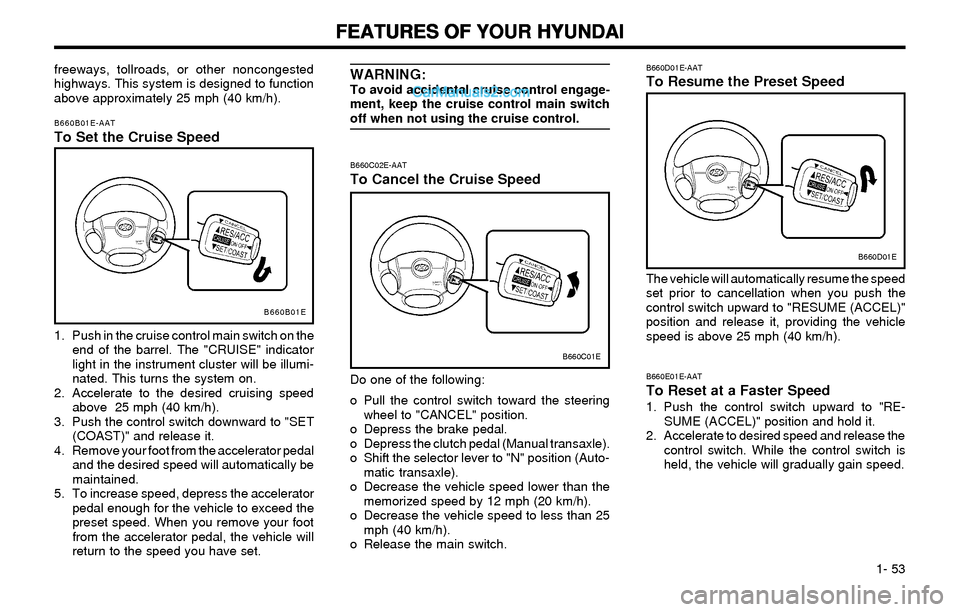
B660D01E-AATTo Resume the Preset Speed
B660D01E
The vehicle will automatically resume the speed
set prior to cancellation when you push the
control switch upward to "RESUME (ACCEL)"
position and release it, providing the vehicle
speed is above 25 mph (40 km/h).
B660E01E-AAT
To Reset at a Faster Speed1. Push the control switch upward to "RE-
SUME (ACCEL)" position and hold it.
2. Accelerate to desired speed and release the
control switch. While the control switch is
held, the vehicle will gradually gain speed.
B660C02E-AAT
To Cancel the Cruise Speed
Do one of the following:
o Pull the control switch toward the steering
wheel to "CANCEL" position.
o Depress the brake pedal.
o Depress the clutch pedal (Manual transaxle).
o Shift the selector lever to "N" position (Auto-
matic transaxle).
o Decrease the vehicle speed lower than the
memorized speed by 12 mph (20 km/h).
o Decrease the vehicle speed to less than 25
mph (40 km/h).
o Release the main switch.
B660C01E
WARNING:To avoid accidental cruise control engage-
ment, keep the cruise control main switch
off when not using the cruise control.
B660B01E
B660B01E-AATTo Set the Cruise Speed
1. Push in the cruise control main switch on the
end of the barrel. The "CRUISE" indicator
light in the instrument cluster will be illumi-
nated. This turns the system on.
2. Accelerate to the desired cruising speed
above 25 mph (40 km/h).
3. Push the control switch downward to "SET
(COAST)" and release it.
4. Remove your foot from the accelerator pedal
and the desired speed will automatically be
maintained.
5. To increase speed, depress the accelerator
pedal enough for the vehicle to exceed the
preset speed. When you remove your foot
from the accelerator pedal, the vehicle will
return to the speed you have set. freeways, tollroads, or other noncongested
highways. This system is designed to function
above approximately 25 mph (40 km/h).
Page 103 of 172
DRIVING YOUR HYUNDAI DRIVING YOUR HYUNDAIDRIVING YOUR HYUNDAI DRIVING YOUR HYUNDAI
DRIVING YOUR HYUNDAI
2- 2
C020A01A-AAT
BEFORE STARTING THE ENGINE BEFORE STARTING THE ENGINEBEFORE STARTING THE ENGINE BEFORE STARTING THE ENGINE
BEFORE STARTING THE ENGINEBefore you start the engine, you should always:
1. Look around the vehicle to be sure there are
no flat tires, puddles of oil, water or other
indications of possible trouble.
2. After entering the car, check to be sure the
parking brake is engaged.
3. Check that all windows, and lights are clean.
4. Check that the interior and exterior mirrors
are clean and in position.
5. Check your seat, seatback and headrest to
be sure they are in their proper positions.
6. Lock all the doors.
7. Fasten your seat belt and be sure that all
other occupants have fastened theirs.
8. Turn off all lights and accessories that are not
needed.
9. When you turn the ignition switch to "ON",
check that all appropriate warning lights are
operating and that you have sufficient fuel.
10. Check the operation of warning lights and all
bulbs when key is in the "ON" position.o To start the engine, insert the ignition key and
turn it to the "START" position. Release it as
soon as the engine starts. Do not hold the key
in the "START" position for more than 15
seconds.
NOTE: NOTE:NOTE: NOTE:
NOTE:o oo o
o
For safety, the engine will not start if the For safety, the engine will not start if theFor safety, the engine will not start if the For safety, the engine will not start if the
For safety, the engine will not start if the
clutch pedal is not depressed fully (Manual clutch pedal is not depressed fully (Manualclutch pedal is not depressed fully (Manual clutch pedal is not depressed fully (Manual
clutch pedal is not depressed fully (Manual
Transaxle) or the shift lever is not in "P" or Transaxle) or the shift lever is not in "P" orTransaxle) or the shift lever is not in "P" or Transaxle) or the shift lever is not in "P" or
Transaxle) or the shift lever is not in "P" or
"N" Position (Automatic Transaxle). "N" Position (Automatic Transaxle)."N" Position (Automatic Transaxle). "N" Position (Automatic Transaxle).
"N" Position (Automatic Transaxle).
o oo o
o
The ignition key cannot be turned from The ignition key cannot be turned fromThe ignition key cannot be turned from The ignition key cannot be turned from
The ignition key cannot be turned from
"ACC" position to "LOCK" position un- "ACC" position to "LOCK" position un-"ACC" position to "LOCK" position un- "ACC" position to "LOCK" position un-
"ACC" position to "LOCK" position un-
less the shift lever is in the "P" (Park) less the shift lever is in the "P" (Park)less the shift lever is in the "P" (Park) less the shift lever is in the "P" (Park)
less the shift lever is in the "P" (Park)
position or the negative battery terminal is position or the negative battery terminal isposition or the negative battery terminal is position or the negative battery terminal is
position or the negative battery terminal is
disconnected from the battery. To remove disconnected from the battery. To removedisconnected from the battery. To remove disconnected from the battery. To remove
disconnected from the battery. To remove
the key, always confirm that the shift lever the key, always confirm that the shift leverthe key, always confirm that the shift lever the key, always confirm that the shift lever
the key, always confirm that the shift lever
is securely positioned in "P" (Park) (For is securely positioned in "P" (Park) (Foris securely positioned in "P" (Park) (For is securely positioned in "P" (Park) (For
is securely positioned in "P" (Park) (For
Automatic Transaxle) Automatic Transaxle)Automatic Transaxle) Automatic Transaxle)
Automatic Transaxle)
o oo o
o
For additional information about starting, For additional information about starting,For additional information about starting, For additional information about starting,
For additional information about starting,
see page 2-3. see page 2-3.see page 2-3. see page 2-3.
see page 2-3.
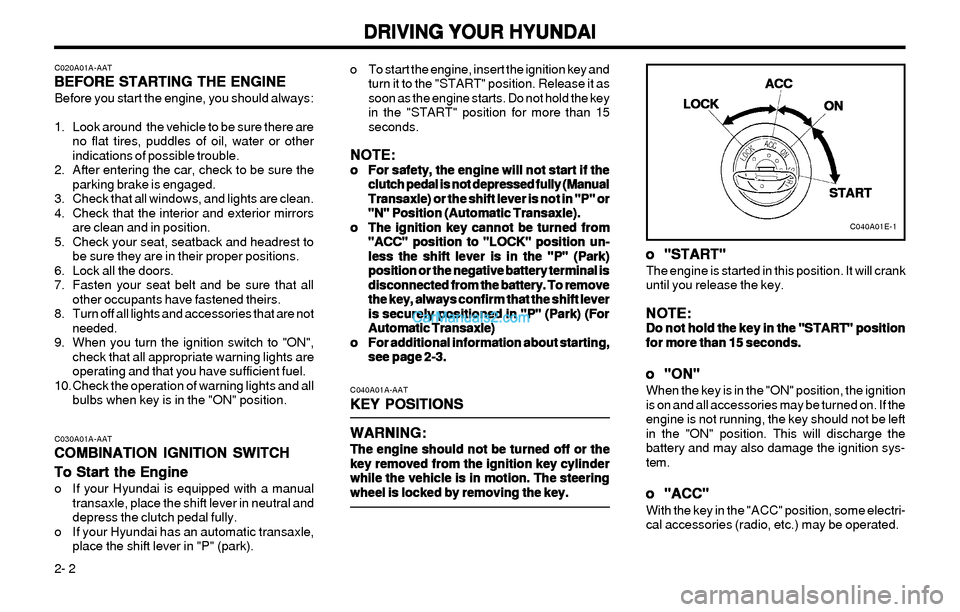
C040A01A-AAT
KEY POSITIONS KEY POSITIONSKEY POSITIONS KEY POSITIONS
KEY POSITIONS
WARNING: WARNING:WARNING: WARNING:
WARNING:
The engine should not be turned off or the The engine should not be turned off or theThe engine should not be turned off or the The engine should not be turned off or the
The engine should not be turned off or the
key removed from the ignition key cylinder key removed from the ignition key cylinderkey removed from the ignition key cylinder key removed from the ignition key cylinder
key removed from the ignition key cylinder
while the vehicle is in motion. The steering while the vehicle is in motion. The steeringwhile the vehicle is in motion. The steering while the vehicle is in motion. The steering
while the vehicle is in motion. The steering
wheel is locked by removing the key. wheel is locked by removing the key.wheel is locked by removing the key. wheel is locked by removing the key.
wheel is locked by removing the key.C030A01A-AAT
COMBINATION IGNITION SWITCH COMBINATION IGNITION SWITCHCOMBINATION IGNITION SWITCH COMBINATION IGNITION SWITCH
COMBINATION IGNITION SWITCH
To Start the Engine To Start the EngineTo Start the Engine To Start the Engine
To Start the Engine
o If your Hyundai is equipped with a manual
transaxle, place the shift lever in neutral and
depress the clutch pedal fully.
o If your Hyundai has an automatic transaxle,
place the shift lever in "P" (park).
C040A01E-1
LOCK LOCKLOCK LOCK
LOCKACC ACCACC ACC
ACC
ON ONON ON
ON
START STARTSTART START
START
o oo o
o
"START" "START""START" "START"
"START"The engine is started in this position. It will crank
until you release the key.
NOTE: NOTE:NOTE: NOTE:
NOTE:Do not hold the key in the "START" position Do not hold the key in the "START" positionDo not hold the key in the "START" position Do not hold the key in the "START" position
Do not hold the key in the "START" position
for more than 15 seconds. for more than 15 seconds.for more than 15 seconds. for more than 15 seconds.
for more than 15 seconds.
o oo o
o
"ON" "ON""ON" "ON"
"ON"When the key is in the "ON" position, the ignition
is on and all accessories may be turned on. If the
engine is not running, the key should not be left
in the "ON" position. This will discharge the
battery and may also damage the ignition sys-
tem.
o oo o
o
"ACC" "ACC""ACC" "ACC"
"ACC"With the key in the "ACC" position, some electri-
cal accessories (radio, etc.) may be operated.
Page 104 of 172
DRIVING YOUR HYUNDAI DRIVING YOUR HYUNDAIDRIVING YOUR HYUNDAI DRIVING YOUR HYUNDAI
DRIVING YOUR HYUNDAI
2- 3
C070C01E-1
o oo o
o
"LOCK" "LOCK""LOCK" "LOCK"
"LOCK"The key can be removed or inserted in this
position. To protect against theft, the steering
wheel locks by removing the key.
NOTE: NOTE:NOTE: NOTE:
NOTE:To unlock the steering wheel, insert the key, To unlock the steering wheel, insert the key,To unlock the steering wheel, insert the key, To unlock the steering wheel, insert the key,
To unlock the steering wheel, insert the key,
and then turn the steering wheel and key and then turn the steering wheel and keyand then turn the steering wheel and key and then turn the steering wheel and key
and then turn the steering wheel and key
simultaneously. simultaneously.simultaneously. simultaneously.
simultaneously.
C070C01A-AAT
To Remove the Ignition Key To Remove the Ignition KeyTo Remove the Ignition Key To Remove the Ignition Key
To Remove the Ignition Key
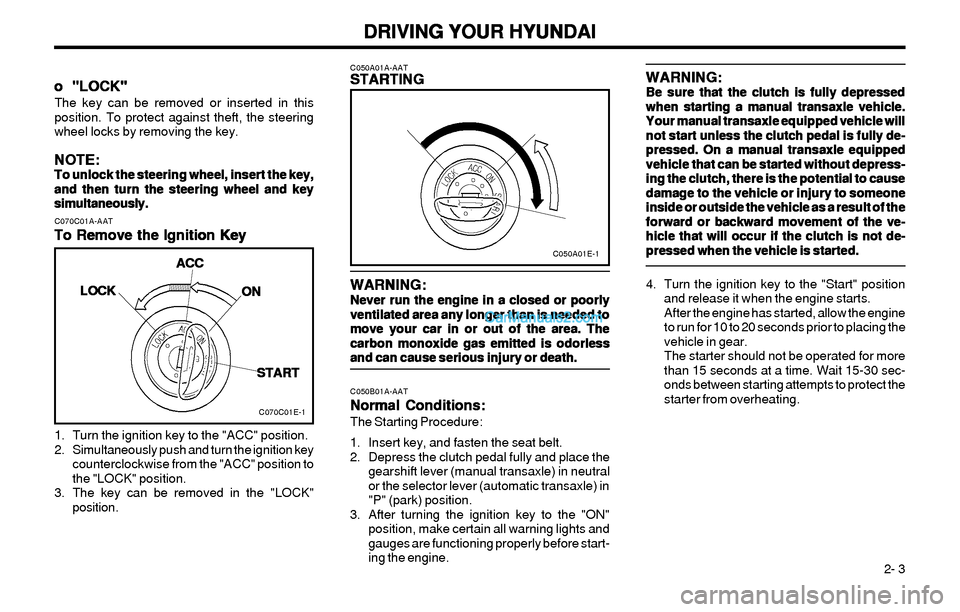
1. Turn the ignition key to the "ACC" position.
2. Simultaneously push and turn the ignition key
counterclockwise from the "ACC" position to
the "LOCK" position.
3. The key can be removed in the "LOCK"
position.
C050A01A-AATSTARTING STARTINGSTARTING STARTING
STARTING
WARNING: WARNING:WARNING: WARNING:
WARNING:
Never run the engine in a closed or poorly Never run the engine in a closed or poorlyNever run the engine in a closed or poorly Never run the engine in a closed or poorly
Never run the engine in a closed or poorly
ventilated area any longer than is needed to ventilated area any longer than is needed toventilated area any longer than is needed to ventilated area any longer than is needed to
ventilated area any longer than is needed to
move your car in or out of the area. The move your car in or out of the area. Themove your car in or out of the area. The move your car in or out of the area. The
move your car in or out of the area. The
carbon monoxide gas emitted is odorless carbon monoxide gas emitted is odorlesscarbon monoxide gas emitted is odorless carbon monoxide gas emitted is odorless
carbon monoxide gas emitted is odorless
and can cause serious injury or death. and can cause serious injury or death.and can cause serious injury or death. and can cause serious injury or death.
and can cause serious injury or death.
WARNING: WARNING:WARNING: WARNING:
WARNING:Be sure that the clutch is fully depressed Be sure that the clutch is fully depressedBe sure that the clutch is fully depressed Be sure that the clutch is fully depressed
Be sure that the clutch is fully depressed
when starting a manual transaxle vehicle. when starting a manual transaxle vehicle.when starting a manual transaxle vehicle. when starting a manual transaxle vehicle.
when starting a manual transaxle vehicle.
Your manual transaxle equipped vehicle will Your manual transaxle equipped vehicle willYour manual transaxle equipped vehicle will Your manual transaxle equipped vehicle will
Your manual transaxle equipped vehicle will
not start unless the clutch pedal is fully de- not start unless the clutch pedal is fully de-not start unless the clutch pedal is fully de- not start unless the clutch pedal is fully de-
not start unless the clutch pedal is fully de-
pressed. On a manual transaxle equipped pressed. On a manual transaxle equippedpressed. On a manual transaxle equipped pressed. On a manual transaxle equipped
pressed. On a manual transaxle equipped
vehicle that can be started without depress- vehicle that can be started without depress-vehicle that can be started without depress- vehicle that can be started without depress-
vehicle that can be started without depress-
ing the clutch, there is the potential to cause ing the clutch, there is the potential to causeing the clutch, there is the potential to cause ing the clutch, there is the potential to cause
ing the clutch, there is the potential to cause
damage to the vehicle or injury to someone damage to the vehicle or injury to someonedamage to the vehicle or injury to someone damage to the vehicle or injury to someone
damage to the vehicle or injury to someone
inside or outside the vehicle as a result of the inside or outside the vehicle as a result of theinside or outside the vehicle as a result of the inside or outside the vehicle as a result of the
inside or outside the vehicle as a result of the
forward or backward movement of the ve- forward or backward movement of the ve-forward or backward movement of the ve- forward or backward movement of the ve-
forward or backward movement of the ve-
hicle that will occur if the clutch is not de- hicle that will occur if the clutch is not de-hicle that will occur if the clutch is not de- hicle that will occur if the clutch is not de-
hicle that will occur if the clutch is not de-
pressed when the vehicle is started. pressed when the vehicle is started.pressed when the vehicle is started. pressed when the vehicle is started.
pressed when the vehicle is started.
4. Turn the ignition key to the "Start" position
and release it when the engine starts.
After the engine has started, allow the engine
to run for 10 to 20 seconds prior to placing the
vehicle in gear.
The starter should not be operated for more
than 15 seconds at a time. Wait 15-30 sec-
onds between starting attempts to protect the
starter from overheating.
C050A01E-1
C050B01A-AAT
Normal Conditions: Normal Conditions:Normal Conditions: Normal Conditions:
Normal Conditions:The Starting Procedure:
1. Insert key, and fasten the seat belt.
2. Depress the clutch pedal fully and place the
gearshift lever (manual transaxle) in neutral
or the selector lever (automatic transaxle) in
"P" (park) position.
3. After turning the ignition key to the "ON"
position, make certain all warning lights and
gauges are functioning properly before start-
ing the engine.
LOCK LOCKLOCK LOCK
LOCKACC ACCACC ACC
ACC
ON ONON ON
ON
START STARTSTART START
START
Page 106 of 172
DRIVING YOUR HYUNDAI DRIVING YOUR HYUNDAIDRIVING YOUR HYUNDAI DRIVING YOUR HYUNDAI
DRIVING YOUR HYUNDAI
2- 5
C090B01E
C090A02Y-AAT
AUTOMATIC TRANSAXLE AUTOMATIC TRANSAXLEAUTOMATIC TRANSAXLE AUTOMATIC TRANSAXLE
AUTOMATIC TRANSAXLE
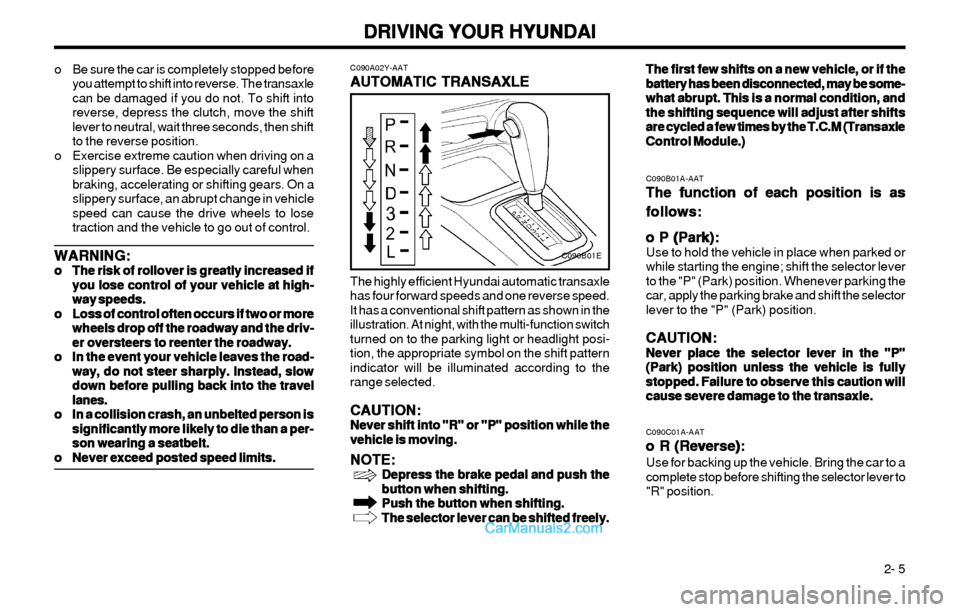
The highly efficient Hyundai automatic transaxle
has four forward speeds and one reverse speed.
It has a conventional shift pattern as shown in the
illustration. At night, with the multi-function switch
turned on to the parking light or headlight posi-
tion, the appropriate symbol on the shift pattern
indicator will be illuminated according to the
range selected.
CAUTION: CAUTION:CAUTION: CAUTION:
CAUTION:Never shift into "R" or "P" position while the Never shift into "R" or "P" position while theNever shift into "R" or "P" position while the Never shift into "R" or "P" position while the
Never shift into "R" or "P" position while the
vehicle is moving. vehicle is moving.vehicle is moving. vehicle is moving.
vehicle is moving.
NOTE: NOTE:NOTE: NOTE:
NOTE:Depress the brake pedal and push the Depress the brake pedal and push theDepress the brake pedal and push the Depress the brake pedal and push the
Depress the brake pedal and push the
button when shifting. button when shifting.button when shifting. button when shifting.
button when shifting.
Push the button when shifting. Push the button when shifting.Push the button when shifting. Push the button when shifting.
Push the button when shifting.
The selector lever can be shifted freely. The selector lever can be shifted freely.The selector lever can be shifted freely. The selector lever can be shifted freely.
The selector lever can be shifted freely.
C090B01A-AAT
The function of each position is as The function of each position is asThe function of each position is as The function of each position is as
The function of each position is as
follows: follows:follows: follows:
follows:
o P (Park): o P (Park):o P (Park): o P (Park):
o P (Park):
Use to hold the vehicle in place when parked or
while starting the engine; shift the selector lever
to the "P" (Park) position. Whenever parking the
car, apply the parking brake and shift the selector
lever to the "P" (Park) position.
CAUTION: CAUTION:CAUTION: CAUTION:
CAUTION:Never place the selector lever in the "P" Never place the selector lever in the "P"Never place the selector lever in the "P" Never place the selector lever in the "P"
Never place the selector lever in the "P"
(Park) position unless the vehicle is fully (Park) position unless the vehicle is fully(Park) position unless the vehicle is fully (Park) position unless the vehicle is fully
(Park) position unless the vehicle is fully
stopped. Failure to observe this caution will stopped. Failure to observe this caution willstopped. Failure to observe this caution will stopped. Failure to observe this caution will
stopped. Failure to observe this caution will
cause severe damage to the transaxle. cause severe damage to the transaxle.cause severe damage to the transaxle. cause severe damage to the transaxle.
cause severe damage to the transaxle.
C090C01A-AAT
o R (Reverse): o R (Reverse):o R (Reverse): o R (Reverse):
o R (Reverse):Use for backing up the vehicle. Bring the car to a
complete stop before shifting the selector lever to
"R" position.The first few shifts on a new vehicle, or if the The first few shifts on a new vehicle, or if theThe first few shifts on a new vehicle, or if the The first few shifts on a new vehicle, or if the
The first few shifts on a new vehicle, or if the
battery has been disconnected, may be some- battery has been disconnected, may be some-battery has been disconnected, may be some- battery has been disconnected, may be some-
battery has been disconnected, may be some-
what abrupt. This is a normal condition, and what abrupt. This is a normal condition, andwhat abrupt. This is a normal condition, and what abrupt. This is a normal condition, and
what abrupt. This is a normal condition, and
the shifting sequence will adjust after shifts the shifting sequence will adjust after shiftsthe shifting sequence will adjust after shifts the shifting sequence will adjust after shifts
the shifting sequence will adjust after shifts
are cycled a few times by the T.C.M (Transaxle are cycled a few times by the T.C.M (Transaxleare cycled a few times by the T.C.M (Transaxle are cycled a few times by the T.C.M (Transaxle
are cycled a few times by the T.C.M (Transaxle
Control Module.) Control Module.)Control Module.) Control Module.)
Control Module.) o Be sure the car is completely stopped before
you attempt to shift into reverse. The transaxle
can be damaged if you do not. To shift into
reverse, depress the clutch, move the shift
lever to neutral, wait three seconds, then shift
to the reverse position.
o Exercise extreme caution when driving on a
slippery surface. Be especially careful when
braking, accelerating or shifting gears. On a
slippery surface, an abrupt change in vehicle
speed can cause the drive wheels to lose
traction and the vehicle to go out of control.
WARNING: WARNING:WARNING: WARNING:
WARNING:o oo o
o
The risk of rollover is greatly increased if The risk of rollover is greatly increased ifThe risk of rollover is greatly increased if The risk of rollover is greatly increased if
The risk of rollover is greatly increased if
you lose control of your vehicle at high- you lose control of your vehicle at high-you lose control of your vehicle at high- you lose control of your vehicle at high-
you lose control of your vehicle at high-
way speeds. way speeds.way speeds. way speeds.
way speeds.
o oo o
o
Loss of control often occurs if two or more Loss of control often occurs if two or moreLoss of control often occurs if two or more Loss of control often occurs if two or more
Loss of control often occurs if two or more
wheels drop off the roadway and the driv- wheels drop off the roadway and the driv-wheels drop off the roadway and the driv- wheels drop off the roadway and the driv-
wheels drop off the roadway and the driv-
er oversteers to reenter the roadway. er oversteers to reenter the roadway.er oversteers to reenter the roadway. er oversteers to reenter the roadway.
er oversteers to reenter the roadway.
o oo o
o
In the event your vehicle leaves the road- In the event your vehicle leaves the road-In the event your vehicle leaves the road- In the event your vehicle leaves the road-
In the event your vehicle leaves the road-
way, do not steer sharply. Instead, slow way, do not steer sharply. Instead, slowway, do not steer sharply. Instead, slow way, do not steer sharply. Instead, slow
way, do not steer sharply. Instead, slow
down before pulling back into the travel down before pulling back into the traveldown before pulling back into the travel down before pulling back into the travel
down before pulling back into the travel
lanes. lanes.lanes. lanes.
lanes.
o oo o
o
In a collision crash, an unbelted person is In a collision crash, an unbelted person isIn a collision crash, an unbelted person is In a collision crash, an unbelted person is
In a collision crash, an unbelted person is
significantly more likely to die than a per- significantly more likely to die than a per-significantly more likely to die than a per- significantly more likely to die than a per-
significantly more likely to die than a per-
son wearing a seatbelt. son wearing a seatbelt.son wearing a seatbelt. son wearing a seatbelt.
son wearing a seatbelt.
o oo o
o
Never exceed posted speed limits. Never exceed posted speed limits.Never exceed posted speed limits. Never exceed posted speed limits.
Never exceed posted speed limits.