warning light Hyundai Elantra 2003 Owner's Guide
[x] Cancel search | Manufacturer: HYUNDAI, Model Year: 2003, Model line: Elantra, Model: Hyundai Elantra 2003Pages: 172, PDF Size: 2.82 MB
Page 108 of 172
DRIVING YOUR HYUNDAI DRIVING YOUR HYUNDAIDRIVING YOUR HYUNDAI DRIVING YOUR HYUNDAI
DRIVING YOUR HYUNDAI
2- 7 o Driving through water may get the brakes
wet. They can also get wet when the car is
washed. Wet brakes can be dangerous! Your
car will not stop as quickly if the brakes are
wet. Wet brakes may cause the car to pull to
one side. To dry the brakes, apply the brakes
lightly until the braking action returns to nor-
mal, taking care to keep the car under control
at all times. If the braking action does not
return to normal, stop as soon as it is safe to
do so and call your Hyundai dealer for assis-
tance.
o Don't coast down hills with the car out of gear.
This is extremely hazardous. Keep the car in
gear at all times, use the brakes to slow down,
then shift to a lower gear so that engine
braking will help you maintain a safe speed.
o Don't "ride" the brake pedal. Resting your foot
on the brake pedal while driving can be dan-
gerous because it can result in the brakes
overheating and losing their effectiveness. It
also increases the wear of the brake compo-
nents.
o If a tire goes flat while you are driving, apply
the brakes gently and keep the car pointed
straight ahead while you slow down. When
you are moving slowly enough for it to be safe
to do so, pull off the road and stop in a safe
place.
o If your car is equipped with an automatic
transaxle, don't let your car creep forward. To
avoid creeping forward, keep your foot on the
brake pedal when the car is stopped.
C130A01A-AAT
GOOD BRAKING PRACTICES GOOD BRAKING PRACTICESGOOD BRAKING PRACTICES GOOD BRAKING PRACTICES
GOOD BRAKING PRACTICES
WARNING: WARNING:WARNING: WARNING:
WARNING:
Nothing should be carried on top of the shelf Nothing should be carried on top of the shelfNothing should be carried on top of the shelf Nothing should be carried on top of the shelf
Nothing should be carried on top of the shelf
panel behind the rear seat. If there were an panel behind the rear seat. If there were anpanel behind the rear seat. If there were an panel behind the rear seat. If there were an
panel behind the rear seat. If there were an
accident or a sudden stop, such objects could accident or a sudden stop, such objects couldaccident or a sudden stop, such objects could accident or a sudden stop, such objects could
accident or a sudden stop, such objects could
move forward and cause damage to the ve- move forward and cause damage to the ve-move forward and cause damage to the ve- move forward and cause damage to the ve-
move forward and cause damage to the ve-
hicle or injure the occupants. hicle or injure the occupants.hicle or injure the occupants. hicle or injure the occupants.
hicle or injure the occupants.
o After being parked, check to be sure the
parking brake is not engaged and that the
parking brake indicator light is out before
driving away. gentle slope, it is recommended that the over-
drive switch be turned off. Turn the overdrive
switch back on immediately afterward.
WARNING: WARNING:WARNING: WARNING:
WARNING:o oo o
o
The risk of rollover is greatly increased if The risk of rollover is greatly increased ifThe risk of rollover is greatly increased if The risk of rollover is greatly increased if
The risk of rollover is greatly increased if
you lose control of your vehicle at high- you lose control of your vehicle at high-you lose control of your vehicle at high- you lose control of your vehicle at high-
you lose control of your vehicle at high-
way speeds. way speeds.way speeds. way speeds.
way speeds.
o oo o
o
Loss of control often occurs if two or more Loss of control often occurs if two or moreLoss of control often occurs if two or more Loss of control often occurs if two or more
Loss of control often occurs if two or more
wheels drop off the roadway and the driver wheels drop off the roadway and the driverwheels drop off the roadway and the driver wheels drop off the roadway and the driver
wheels drop off the roadway and the driver
oversteers to reenter the roadway. oversteers to reenter the roadway.oversteers to reenter the roadway. oversteers to reenter the roadway.
oversteers to reenter the roadway.
o oo o
o
In the event your vehicle leaves the road- In the event your vehicle leaves the road-In the event your vehicle leaves the road- In the event your vehicle leaves the road-
In the event your vehicle leaves the road-
way, do not steer sharply. Instead, slow way, do not steer sharply. Instead, slowway, do not steer sharply. Instead, slow way, do not steer sharply. Instead, slow
way, do not steer sharply. Instead, slow
down before pulling back into the travel down before pulling back into the traveldown before pulling back into the travel down before pulling back into the travel
down before pulling back into the travel
lanes. lanes.lanes. lanes.
lanes.
o oo o
o
In a collision crash, an unbelted person is In a collision crash, an unbelted person isIn a collision crash, an unbelted person is In a collision crash, an unbelted person is
In a collision crash, an unbelted person is
significantly more likely to die than a per- significantly more likely to die than a per-significantly more likely to die than a per- significantly more likely to die than a per-
significantly more likely to die than a per-
son wearing a seatbelt. son wearing a seatbelt.son wearing a seatbelt. son wearing a seatbelt.
son wearing a seatbelt.
o oo o
o
Never exceed posted speed limits. Never exceed posted speed limits.Never exceed posted speed limits. Never exceed posted speed limits.
Never exceed posted speed limits.
C090N03A-AAT
Good Driving Practices Good Driving PracticesGood Driving Practices Good Driving Practices
Good Driving Practiceso Never move the gear selector lever from "P"
or "N" to any other position with the acceler-
ator pedal depressed.
o Never move the gear selector lever into "P"
when the vehicle is in motion.
o Be sure the car is completely stopped before
you attempt to shift into "R".
o Never take the car out of gear and coast down
a hill. This may be extremely hazardous.
Always leave the car in gear when moving.
o Do not "ride" the brakes. This can cause them
to overheat and malfunction. Instead, when
you are driving down a long hill, slow down
and shift to a lower gear. When you do this,
engine braking will help slow the car.
o Slow down before shifting to a lower gear.
Otherwise, the lower gear may not be en-
gaged.
o Always use the parking brake. Do not depend
on placing the transaxle in "P" to keep the car
from moving.
o Exercise extreme caution when driving on a
slippery surface. Be especially careful when
braking, accelerating or shifting gears. On a
slippery surface, an abrupt change in vehicle
speed can cause the drive wheels to lose
traction and the vehicle to go out of control.
o Turn the overdrive switch on for good fuel
economy and smooth driving. If engine brak-
ing is needed in the "D" range or if repeated
upshifting and downshifting between the 3rd
and 4th gear is needed when climbing a
Page 109 of 172

DRIVING YOUR HYUNDAI DRIVING YOUR HYUNDAIDRIVING YOUR HYUNDAI DRIVING YOUR HYUNDAI
DRIVING YOUR HYUNDAI
2- 8
C120A02A-AATANTI-LOCK BRAKE SYSTEM ANTI-LOCK BRAKE SYSTEMANTI-LOCK BRAKE SYSTEM ANTI-LOCK BRAKE SYSTEM
ANTI-LOCK BRAKE SYSTEM
(If Installed) (If Installed)(If Installed) (If Installed)
(If Installed)
The Anti-Lock Brake System (ABS) is designed
to prevent wheel lock-up during sudden braking
or on hazardous road surfaces. The ABS control
module monitors the wheel speed and controls
the pressure applied to each brake. Thus, in
emergency situations or on slick roads, ABS will
increase vehicle control during braking.
NOTE: NOTE:NOTE: NOTE:
NOTE:During ABS operation, a slight pulsation may During ABS operation, a slight pulsation mayDuring ABS operation, a slight pulsation may During ABS operation, a slight pulsation may
During ABS operation, a slight pulsation may
be felt in the brake pedal when the brakes are be felt in the brake pedal when the brakes arebe felt in the brake pedal when the brakes are be felt in the brake pedal when the brakes are
be felt in the brake pedal when the brakes are
applied. Also, a noise may be heard in the applied. Also, a noise may be heard in theapplied. Also, a noise may be heard in the applied. Also, a noise may be heard in the
applied. Also, a noise may be heard in the
engine compartment while braking. These engine compartment while braking. Theseengine compartment while braking. These engine compartment while braking. These
engine compartment while braking. These
conditions are normal and indicate that the conditions are normal and indicate that theconditions are normal and indicate that the conditions are normal and indicate that the
conditions are normal and indicate that the
anti-lock brake system is functioning prop- anti-lock brake system is functioning prop-anti-lock brake system is functioning prop- anti-lock brake system is functioning prop-
anti-lock brake system is functioning prop-
erly. erly.erly. erly.
erly.
WARNING: WARNING:WARNING: WARNING:
WARNING:ABS will not prevent accidents due to im- ABS will not prevent accidents due to im-ABS will not prevent accidents due to im- ABS will not prevent accidents due to im-
ABS will not prevent accidents due to im-
proper or dangerous driving maneuvers. Even proper or dangerous driving maneuvers. Evenproper or dangerous driving maneuvers. Even proper or dangerous driving maneuvers. Even
proper or dangerous driving maneuvers. Even
though vehicle control is improved during though vehicle control is improved duringthough vehicle control is improved during though vehicle control is improved during
though vehicle control is improved during
emergency braking, always maintain a safe emergency braking, always maintain a safeemergency braking, always maintain a safe emergency braking, always maintain a safe
emergency braking, always maintain a safe
distance between you and objects ahead. distance between you and objects ahead.distance between you and objects ahead. distance between you and objects ahead.
distance between you and objects ahead.
Vehicle speeds should always be reduced Vehicle speeds should always be reducedVehicle speeds should always be reduced Vehicle speeds should always be reduced
Vehicle speeds should always be reduced
during extreme road conditions. during extreme road conditions.during extreme road conditions. during extreme road conditions.
during extreme road conditions.
The braking distance for cars equipped with The braking distance for cars equipped withThe braking distance for cars equipped with The braking distance for cars equipped with
The braking distance for cars equipped with
an anti-lock braking system may be longer an anti-lock braking system may be longeran anti-lock braking system may be longer an anti-lock braking system may be longer
an anti-lock braking system may be longer
than for those without it in the following road than for those without it in the following roadthan for those without it in the following road than for those without it in the following road
than for those without it in the following road
conditions. conditions.conditions. conditions.
conditions.o oo o
o
Driving on rough, gravel or snow-covered Driving on rough, gravel or snow-coveredDriving on rough, gravel or snow-covered Driving on rough, gravel or snow-covered
Driving on rough, gravel or snow-covered
roads. roads.roads. roads.
roads.
o oo o
o
Driving with tire chains installed. Driving with tire chains installed.Driving with tire chains installed. Driving with tire chains installed.
Driving with tire chains installed.
o oo o
o
Driving on roads where the road surface is Driving on roads where the road surface isDriving on roads where the road surface is Driving on roads where the road surface is
Driving on roads where the road surface is
pitted or has different surface height. pitted or has different surface height.pitted or has different surface height. pitted or has different surface height.
pitted or has different surface height.
During these conditions the vehicle should During these conditions the vehicle shouldDuring these conditions the vehicle should During these conditions the vehicle should
During these conditions the vehicle should
be driven at reduced speeds. The safety fea- be driven at reduced speeds. The safety fea-be driven at reduced speeds. The safety fea- be driven at reduced speeds. The safety fea-
be driven at reduced speeds. The safety fea-
tures of an ABS equipped vehicle should not tures of an ABS equipped vehicle should nottures of an ABS equipped vehicle should not tures of an ABS equipped vehicle should not
tures of an ABS equipped vehicle should not
be tested by high speed driving or cornering. be tested by high speed driving or cornering.be tested by high speed driving or cornering. be tested by high speed driving or cornering.
be tested by high speed driving or cornering.
This could endanger the safety of yourself or This could endanger the safety of yourself orThis could endanger the safety of yourself or This could endanger the safety of yourself or
This could endanger the safety of yourself or
others. others.others. others.
others.
C300A02Y-GATTRACTION CONTROL SYSTEM (TCS) TRACTION CONTROL SYSTEM (TCS)TRACTION CONTROL SYSTEM (TCS) TRACTION CONTROL SYSTEM (TCS)
TRACTION CONTROL SYSTEM (TCS)
(If Installed) (If Installed)(If Installed) (If Installed)
(If Installed)
C370A01E-2
On slippery road surfaces, the traction control
system (TCS) limits the drive wheels from spin-
ning excessively, thus helping the car to acceler-
ate. It also provides sufficient driving force and
steering performance as the car turns at acceler-
ated speeds. o Use caution when parking on a hill. Engage
the parking brake and place the gear selector
lever in "P" (automatic transaxle) or in first or
reverse gear (manual transaxle). If your car is
facing downhill, turn the front wheels into the
curb to help keep the car from rolling. If your
car is facing uphill, turn the front wheels away
from the curb to help keep the car from rolling.
If there is no curb or if it is required by other
conditions to keep the car from rolling, block
the wheels.
o Under some conditions your parking brake
can freeze in the engaged position. This is
most likely to happen when there is an accu-
mulation of snow or ice around or near the
rear brakes or if the brakes are wet. If there is
a risk that the parking brake may freeze,
apply it only temporarily while you put the
gear selector lever in "P" (automatic) or in first
or reverse gear (manual transaxle) and block
the rear wheels so the car cannot roll. Then
release the parking brake.
o Do not hold the vehicle on the upgrade with
the accelerator pedal. This can cause the
transmission to overheat. Always use the
brake pedal or parking brake.
Page 110 of 172
DRIVING YOUR HYUNDAI DRIVING YOUR HYUNDAIDRIVING YOUR HYUNDAI DRIVING YOUR HYUNDAI
DRIVING YOUR HYUNDAI
2- 9
C300B01E-GAT
TCS ON/OFF Mode TCS ON/OFF ModeTCS ON/OFF Mode TCS ON/OFF Mode
TCS ON/OFF ModeIn the TCS ON mode, the indicator in the instru-
ment cluster will not be illuminated.
To switch the TCS OFF mode, press the TCS
switch . And the SLIP control will be deactivated
and the TCS indicator in the instrument cluster
will be illuminated.
SLIP Control SLIP ControlSLIP Control SLIP Control
SLIP ControlLimits the drive wheels from spinning exces-
sively during starting or while making accelerat-
ed turns on slippery roads to avoid losing the
driving force of the front wheels.
Driving hints Driving hintsDriving hints Driving hints
Driving hintsTCS does not actively apply brakes. Be sure to
decelerate the car sufficiently before entering
curves.
CAUTION: CAUTION:CAUTION: CAUTION:
CAUTION:When the TCS indicator blinks, SLIP control When the TCS indicator blinks, SLIP controlWhen the TCS indicator blinks, SLIP control When the TCS indicator blinks, SLIP control
When the TCS indicator blinks, SLIP control
has been activated. It also means that the has been activated. It also means that thehas been activated. It also means that the has been activated. It also means that the
has been activated. It also means that the
road is slippery or your car is accelerating road is slippery or your car is acceleratingroad is slippery or your car is accelerating road is slippery or your car is accelerating
road is slippery or your car is accelerating
excessively. In this situation, release foot excessively. In this situation, release footexcessively. In this situation, release foot excessively. In this situation, release foot
excessively. In this situation, release foot
pressure from the accelerator pedal and main- pressure from the accelerator pedal and main-pressure from the accelerator pedal and main- pressure from the accelerator pedal and main-
pressure from the accelerator pedal and main-
tain moderate speed. tain moderate speed.tain moderate speed. tain moderate speed.
tain moderate speed.
WARNING: WARNING:WARNING: WARNING:
WARNING:Traction control is only a driving aid; all Traction control is only a driving aid; allTraction control is only a driving aid; all Traction control is only a driving aid; all
Traction control is only a driving aid; all
normal precautions for driving in inclement normal precautions for driving in inclementnormal precautions for driving in inclement normal precautions for driving in inclement
normal precautions for driving in inclement
weather and on slippery driving surfaces weather and on slippery driving surfacesweather and on slippery driving surfaces weather and on slippery driving surfaces
weather and on slippery driving surfaces
should be observed. should be observed.should be observed. should be observed.
should be observed.
C300D02L-GAT
Indicator and Warning Indicator and WarningIndicator and Warning Indicator and Warning
Indicator and WarningThe indicator should illuminate when the ignition
key is turned to "ON" or "START", but should go
out after three seconds.
If the indicator does not illuminate, have it checked
by an authorized Hyundai dealer.
Should there be any unusual conditions in the
device, TCS illuminates as a warning.
If TCS illuminates, pull your car to a safe place
and stop the engine.
Then, start the engine again to check if the TCS
indicator goes out.
If the indicator remains lit even after the engine
has been started, have your car checked by an
authorized Hyundai dealer.
NOTE: NOTE:NOTE: NOTE:
NOTE:1) 1)1) 1)
1)
Turn off the engine. Then restart the en- Turn off the engine. Then restart the en-Turn off the engine. Then restart the en- Turn off the engine. Then restart the en-
Turn off the engine. Then restart the en-
gine, and the TCS mode will automatically gine, and the TCS mode will automaticallygine, and the TCS mode will automatically gine, and the TCS mode will automatically
gine, and the TCS mode will automatically
turn "ON". turn "ON".turn "ON". turn "ON".
turn "ON".
2) 2)2) 2)
2)
When the traction control is operating When the traction control is operatingWhen the traction control is operating When the traction control is operating
When the traction control is operating
properly, you can feel a slight pulsation in properly, you can feel a slight pulsation inproperly, you can feel a slight pulsation in properly, you can feel a slight pulsation in
properly, you can feel a slight pulsation in
the vehicle. This is only the effect of brake the vehicle. This is only the effect of brakethe vehicle. This is only the effect of brake the vehicle. This is only the effect of brake
the vehicle. This is only the effect of brake
control and indicates nothing unusual. control and indicates nothing unusual.control and indicates nothing unusual. control and indicates nothing unusual.
control and indicates nothing unusual.
3) 3)3) 3)
3)
When the engine starts, a click is heard When the engine starts, a click is heardWhen the engine starts, a click is heard When the engine starts, a click is heard
When the engine starts, a click is heard
from the engine compartment; however, from the engine compartment; however,from the engine compartment; however, from the engine compartment; however,
from the engine compartment; however,
this is only the sound of traction control this is only the sound of traction controlthis is only the sound of traction control this is only the sound of traction control
this is only the sound of traction control
being checked. being checked.being checked. being checked.
being checked.
4) 4)4) 4)
4)
When moving out of the mud or fresh When moving out of the mud or freshWhen moving out of the mud or fresh When moving out of the mud or fresh
When moving out of the mud or fresh
snow, pressing the accelerator pedal may snow, pressing the accelerator pedal maysnow, pressing the accelerator pedal may snow, pressing the accelerator pedal may
snow, pressing the accelerator pedal may
not cause the engine speed to increase. not cause the engine speed to increase.not cause the engine speed to increase. not cause the engine speed to increase.
not cause the engine speed to increase.NOTE: NOTE:NOTE: NOTE:
NOTE:1) 1)1) 1)
1)
When TCS illuminates, traction control is When TCS illuminates, traction control isWhen TCS illuminates, traction control is When TCS illuminates, traction control is
When TCS illuminates, traction control is
automatically deactivated for safety. automatically deactivated for safety.automatically deactivated for safety. automatically deactivated for safety.
automatically deactivated for safety.
2) 2)2) 2)
2)
This warning function is not provided when This warning function is not provided whenThis warning function is not provided when This warning function is not provided when
This warning function is not provided when
the driver selects the TCS-OFF mode. the driver selects the TCS-OFF mode.the driver selects the TCS-OFF mode. the driver selects the TCS-OFF mode.
the driver selects the TCS-OFF mode.
C140A01A-AAT
DRIVING FOR ECONOMY DRIVING FOR ECONOMYDRIVING FOR ECONOMY DRIVING FOR ECONOMY
DRIVING FOR ECONOMYYou can save fuel and get more miles from your
car if you follow these suggestions:
o Drive smoothly. Accelerate at a moderate
rate. Don't make "jack-rabbit" starts or full-
throttle shifts and maintain a steady cruising
speed. Don't race between stoplights. Try to
adjust your speed to that of the other traffic so
you don't have to change speeds unneces-
sarily. Avoid heavy traffic whenever possible.
Always maintain a safe distance from other
vehicles so you can avoid unnecessary brak-
ing. This also reduces brake wear.
o Drive at a moderate speed. The faster you
drive, the more fuel your car uses. Driving at
a moderate speed, especially on the high-
way, is one of the most effective ways to
reduce fuel consumption.
o Don't "ride" the brake or clutch pedal. This
can increase fuel consumption and also in-
crease wear on these components. In addi-
tion, driving with your foot resting on the brake
pedal may cause the brakes to overheat,
which reduces their effectiveness and may
lead to more serious consequences.
Page 114 of 172

DRIVING YOUR HYUNDAI DRIVING YOUR HYUNDAIDRIVING YOUR HYUNDAI DRIVING YOUR HYUNDAI
DRIVING YOUR HYUNDAI
2- 13 Tongue
187.4 (85)
100 (45.3)
C190E01E-AAT
Trailer Weight Limit Trailer Weight LimitTrailer Weight Limit Trailer Weight Limit
Trailer Weight Limit
Tongue load Total trailer weightSSA2200B
o Keep the tongue load 10% of the total trailer
load.
Tongue load
Total trailer weight
o Tongue loads can be increased or decreased
by redistributing the load in the trailer.
This can be verified by checking the total
weight of the loaded trailer and then checking
the load on the tongue.
NOTE: NOTE:NOTE: NOTE:
NOTE:1. 1.1. 1.
1.
Never load the trailer with more weight in Never load the trailer with more weight inNever load the trailer with more weight in Never load the trailer with more weight in
Never load the trailer with more weight in
the back than in the front. About 60% of the back than in the front. About 60% ofthe back than in the front. About 60% of the back than in the front. About 60% of
the back than in the front. About 60% of
the trailer load should be in the front half the trailer load should be in the front halfthe trailer load should be in the front half the trailer load should be in the front half
the trailer load should be in the front half
on the trailer and the remaining 40% in the on the trailer and the remaining 40% in theon the trailer and the remaining 40% in the on the trailer and the remaining 40% in the
on the trailer and the remaining 40% in the
rear. rear.rear. rear.
rear.
2. 2.2. 2.
2.
The total gross vehicle weight with trailer The total gross vehicle weight with trailerThe total gross vehicle weight with trailer The total gross vehicle weight with trailer
The total gross vehicle weight with trailer
must not exceed the Gross Vehicle Weight must not exceed the Gross Vehicle Weightmust not exceed the Gross Vehicle Weight must not exceed the Gross Vehicle Weight
must not exceed the Gross Vehicle Weight
Rating (GVWR) shown on the vehicle iden- Rating (GVWR) shown on the vehicle iden-Rating (GVWR) shown on the vehicle iden- Rating (GVWR) shown on the vehicle iden-
Rating (GVWR) shown on the vehicle iden-tification plate (see page 8-1). The total tification plate (see page 8-1). The totaltification plate (see page 8-1). The total tification plate (see page 8-1). The total
tification plate (see page 8-1). The total
gross vehicle weight is the combined gross vehicle weight is the combinedgross vehicle weight is the combined gross vehicle weight is the combined
gross vehicle weight is the combined
weight of the vehicle, driver, all passen- weight of the vehicle, driver, all passen-weight of the vehicle, driver, all passen- weight of the vehicle, driver, all passen-
weight of the vehicle, driver, all passen-
gers and their luggage, cargo, hitch, trailer gers and their luggage, cargo, hitch, trailergers and their luggage, cargo, hitch, trailer gers and their luggage, cargo, hitch, trailer
gers and their luggage, cargo, hitch, trailer
tongue load and other optional equip- tongue load and other optional equip-tongue load and other optional equip- tongue load and other optional equip-
tongue load and other optional equip-
ment. ment.ment. ment.
ment.
3. 3.3. 3.
3.
The front or rear axle weight must not The front or rear axle weight must notThe front or rear axle weight must not The front or rear axle weight must not
The front or rear axle weight must not
exceed the Gross Axle Weight Rating exceed the Gross Axle Weight Ratingexceed the Gross Axle Weight Rating exceed the Gross Axle Weight Rating
exceed the Gross Axle Weight Rating
(GAWR) shown on the vehicle identifica- (GAWR) shown on the vehicle identifica-(GAWR) shown on the vehicle identifica- (GAWR) shown on the vehicle identifica-
(GAWR) shown on the vehicle identifica-
tion plate (see page 8-1). It is possible that tion plate (see page 8-1). It is possible thattion plate (see page 8-1). It is possible that tion plate (see page 8-1). It is possible that
tion plate (see page 8-1). It is possible that
your towing package does not exceed the your towing package does not exceed theyour towing package does not exceed the your towing package does not exceed the
your towing package does not exceed the
GVWR but exceeds the GAWR. GVWR but exceeds the GAWR.GVWR but exceeds the GAWR. GVWR but exceeds the GAWR.
GVWR but exceeds the GAWR.
Improper trailer loading and/or too much Improper trailer loading and/or too muchImproper trailer loading and/or too much Improper trailer loading and/or too much
Improper trailer loading and/or too much
luggage in the trunk can overload the rear luggage in the trunk can overload the rearluggage in the trunk can overload the rear luggage in the trunk can overload the rear
luggage in the trunk can overload the rear
axle. Redistribute the load and check the axle. Redistribute the load and check theaxle. Redistribute the load and check the axle. Redistribute the load and check the
axle. Redistribute the load and check the
axle weight again. axle weight again.axle weight again. axle weight again.
axle weight again.Gross axle weight Gross vehicle weightSSA2200D
CAUTION: CAUTION:CAUTION: CAUTION:
CAUTION:The following specifications are recommend- The following specifications are recommend-The following specifications are recommend- The following specifications are recommend-
The following specifications are recommend-
ed when towing a trailer. The loaded trailer ed when towing a trailer. The loaded trailered when towing a trailer. The loaded trailer ed when towing a trailer. The loaded trailer
ed when towing a trailer. The loaded trailer
weight cannot safely exceed the values in the weight cannot safely exceed the values in theweight cannot safely exceed the values in the weight cannot safely exceed the values in the
weight cannot safely exceed the values in the
following chart. following chart.following chart. following chart.
following chart.Lbs. (kg)
Maximum Towable Weight
Trailer
1874(850)
1000(453)
WARNING: WARNING:WARNING: WARNING:
WARNING:Improperly loading your car and trailer can Improperly loading your car and trailer canImproperly loading your car and trailer can Improperly loading your car and trailer can
Improperly loading your car and trailer can
seriously affect its steering and braking per- seriously affect its steering and braking per-seriously affect its steering and braking per- seriously affect its steering and braking per-
seriously affect its steering and braking per-
formance causing a crash which could cause formance causing a crash which could causeformance causing a crash which could cause formance causing a crash which could cause
formance causing a crash which could cause
serious injury or death. serious injury or death.serious injury or death. serious injury or death.
serious injury or death.
o x 100 = 10% (MAX)
C190F01S-AAT
Trailer or Vehicle Towing Tips Trailer or Vehicle Towing TipsTrailer or Vehicle Towing Tips Trailer or Vehicle Towing Tips
Trailer or Vehicle Towing Tips1. Before towing, check hitch and safety chain
connections as well as proper operation of
the trailer running lights, brake lights, and turn
signals.
2. Always drive your vehicle at a moderate
speed. (Less than 60 mph)
3. Trailer towing requires more fuel than normal
conditions.
4. To maintain engine braking efficiency and
electrical charging performance, do not use
fifth gear (manual transaxle) or overdrive
(automatic transaxle).
5. Always secure items in the trailer to prevent
load shift while driving.
6. Check the condition and air pressure of all
tires on the trailer and your car. Low tire
pressure can seriously affect the handling.
Also check the spare tire.
With Brake
Without Brake
Page 116 of 172
WHAT TO DO IN AN EMERGENCY WHAT TO DO IN AN EMERGENCYWHAT TO DO IN AN EMERGENCY WHAT TO DO IN AN EMERGENCY
WHAT TO DO IN AN EMERGENCY
3-1
3 . WHAT TO DO IN AN
EMERGENCY
D010A01A-AAT
IF THE ENGINE WILL NOT START IF THE ENGINE WILL NOT STARTIF THE ENGINE WILL NOT START IF THE ENGINE WILL NOT START
IF THE ENGINE WILL NOT START
WARNING: WARNING:WARNING: WARNING:
WARNING:
If the engine will not start, do not push or pull If the engine will not start, do not push or pullIf the engine will not start, do not push or pull If the engine will not start, do not push or pull
If the engine will not start, do not push or pull
the car to start it. This could result in a the car to start it. This could result in athe car to start it. This could result in a the car to start it. This could result in a
the car to start it. This could result in a
collision or cause other damage. In addition, collision or cause other damage. In addition,collision or cause other damage. In addition, collision or cause other damage. In addition,
collision or cause other damage. In addition,
push or pull starting may cause the catalytic push or pull starting may cause the catalyticpush or pull starting may cause the catalytic push or pull starting may cause the catalytic
push or pull starting may cause the catalytic
converter to be overloaded and create a fire converter to be overloaded and create a fireconverter to be overloaded and create a fire converter to be overloaded and create a fire
converter to be overloaded and create a fire
hazard. hazard.hazard. hazard.
hazard.
D010B02A-AATIf Engine Doesn't Turn Over or Turns If Engine Doesn't Turn Over or TurnsIf Engine Doesn't Turn Over or Turns If Engine Doesn't Turn Over or Turns
If Engine Doesn't Turn Over or Turns
Over Slowly Over SlowlyOver Slowly Over Slowly
Over Slowly
1. If your car has an automatic transaxle, be
sure the gear selector lever is in "N" or "P" and
the emergency brake is set.
2. Check the battery connections to be sure
they are clean and tight.
3. Turn on the interior light. If the light dims or
goes out when you operate the starter, the
battery is discharged.
4. Check the starter connections to be sure they
are securely tightened.
5. Do not push or pull the vehicle to start it. See
instructions for "Jump Starting".
SSA3020C D010C01A-AAT
If Engine Turns Over Normally but Does If Engine Turns Over Normally but DoesIf Engine Turns Over Normally but Does If Engine Turns Over Normally but Does
If Engine Turns Over Normally but Does
Not Start Not StartNot Start Not Start
Not Start
1. Check fuel level.
2. Check all connectors at ignition, coil and
spark plugs. Reconnect any that may be
disconnected or loose.
D010D01A-AAT
If the Engine Stalls While Driving If the Engine Stalls While DrivingIf the Engine Stalls While Driving If the Engine Stalls While Driving
If the Engine Stalls While Driving1. Reduce your speed gradually, keeping a
straight line. Move cautiously off the road to a
safe place.
2. Turn on your emergency flashers.
3. Try to start the engine again. If your vehicle
will not start, contact a Hyundai dealer or seek
other qualified assistance.
D020A02A-AAT
JUMP STARTING JUMP STARTINGJUMP STARTING JUMP STARTING
JUMP STARTING
G210A01E
Negative to the engine
not to the batteryPositive to positive
Booster battery
AX30030ADischarged battery
3 33 3
3
3. Check the fuel line in the engine room.
4. If the engine still refuses to start, call a Hyundai
dealer or seek other qualified assistance.
Page 117 of 172

WHAT TO DO IN AN EMERGENCY WHAT TO DO IN AN EMERGENCYWHAT TO DO IN AN EMERGENCY WHAT TO DO IN AN EMERGENCY
WHAT TO DO IN AN EMERGENCY
3-2
WARNING: WARNING:WARNING: WARNING:
WARNING:The gas produced by the battery during the The gas produced by the battery during theThe gas produced by the battery during the The gas produced by the battery during the
The gas produced by the battery during the
jump-start operation is highly explosive. If jump-start operation is highly explosive. Ifjump-start operation is highly explosive. If jump-start operation is highly explosive. If
jump-start operation is highly explosive. If
these instructions are not followed exactly, these instructions are not followed exactly,these instructions are not followed exactly, these instructions are not followed exactly,
these instructions are not followed exactly,
serious personal injury and damage to the serious personal injury and damage to theserious personal injury and damage to the serious personal injury and damage to the
serious personal injury and damage to the
vehicle may occur! If you are not sure how to vehicle may occur! If you are not sure how tovehicle may occur! If you are not sure how to vehicle may occur! If you are not sure how to
vehicle may occur! If you are not sure how to
follow this procedure, seek qualified assis- follow this procedure, seek qualified assis-follow this procedure, seek qualified assis- follow this procedure, seek qualified assis-
follow this procedure, seek qualified assis-
tance. Automobile batteries contain sulfuric tance. Automobile batteries contain sulfurictance. Automobile batteries contain sulfuric tance. Automobile batteries contain sulfuric
tance. Automobile batteries contain sulfuric
acid. This is poisonous and highly corrosive. acid. This is poisonous and highly corrosive.acid. This is poisonous and highly corrosive. acid. This is poisonous and highly corrosive.
acid. This is poisonous and highly corrosive.
When jump starting, wear protective glasses When jump starting, wear protective glassesWhen jump starting, wear protective glasses When jump starting, wear protective glasses
When jump starting, wear protective glasses
and be careful not to get acid on yourself, and be careful not to get acid on yourself,and be careful not to get acid on yourself, and be careful not to get acid on yourself,
and be careful not to get acid on yourself,
your clothing or on the car. your clothing or on the car.your clothing or on the car. your clothing or on the car.
your clothing or on the car.
o If you should accidentally get acid on your
skin or in your eyes, immediately remove any
contaminated clothing and flush the area with
clear water for at least 15 minutes. Then
promptly obtain medical attention. If you must
be transported to an emergency facility, con-
tinue to apply water to the affected area with
a sponge or cloth.
o The gas produced by the battery during the
jump-start operation is highly explosive. Do
not smoke or allow a spark or an open flame
in the vicinity.
o The battery being used to provide the jump
start must be 12-volt. If you cannot determine
that it is a 12-volt battery, do not attempt to
use it for the jump start.
o To jump start a car with a discharged battery,
follow this procedure exactly:1. If the booster battery is installed in another
vehicle, be sure the two vehicles are not
touching.
2. Turn off all unnecessary lights and acces-
sories in both vehicles.
3. Attach the clamps of the jumper cable in the
exact location shown in the illustration. First,
attach one clamp of the jumper cable to the
positive (+) post or cable of the discharged
battery. Then attach the other end of the
same cable to the positive (+) post or cable
of the booster battery. Next, using the other
cable, attach one clamp to the negative (-)
post or cable of the booster battery. Then
attach the other end of that cable to a solid
metal part of the engine away from the
battery. Do not connect the cable to any
moving part.
4. Start the engine in the car with the booster
battery and let it run for a few minutes. This
will help to assure that the booster battery is
fully charged. During the jumping operation,
run the engine in this vehicle at about 2,000
rpm.
5. Start the engine in the car with the discharged
battery using the normal starting procedure.
After the engine starts, leave the jumper
cables connected and let the engine run at
fast idle or about 2,000 rpm for several min-
utes.
6. Carefully remove the jumper cables in the
reverse order of attachment.
If you do not know why your battery became
discharged (because the lights were left on,
D030A01A-AAT
IF THE ENGINE OVERHEATS IF THE ENGINE OVERHEATSIF THE ENGINE OVERHEATS IF THE ENGINE OVERHEATS
IF THE ENGINE OVERHEATSIf your temperature gauge indicates overheating,
you experience a loss of power, or hear loud
pinging or knocking and the engine is probably
too hot. If this happens and, you should:
1. Pull off the road and stop as soon as it is safe
to do so.
2. Place the gear selector lever in "P" (auto-
matic), or neutral (manual transaxle) and set
the parking brake. If the air conditioning is on,
turn it off.
3. If engine coolant is running out under the car
or steam is coming out from the hood, stop
the engine. Do not open the hood until the
engine coolant has stopped running or the
steaming has stopped. If there is no visible
loss of engine coolant and no steam, leave
the engine running and check to be sure the
engine cooling fan is operating. If the fan is
not running, turn the engine off.
4. Check to see if the water pump drive belt is
missing. If it is not missing, check to see that
it is tight. If the drive belt seems to be satis-
factory, check for engine coolant leaking from
the radiator, hoses or under the car. (If the air
conditioning had been in use, it is normal for
cold water to be draining from it when you
stop).
etc.), have the charging system checked by your
Hyundai dealer.
Page 120 of 172
WHAT TO DO IN AN EMERGENCY WHAT TO DO IN AN EMERGENCYWHAT TO DO IN AN EMERGENCY WHAT TO DO IN AN EMERGENCY
WHAT TO DO IN AN EMERGENCY
3-5 The wheel nuts should be loosened slightly be-
fore raising the car. To loosen the nuts, turn the
wrench handle counterclockwise. When doing
this, be sure that the socket is seated completely
over the nut so it cannot slip off. For maximum
leverage, position the wrench so the handle is to
the right as shown in the drawing. Then, while
holding the wrench near the end of the handle,
push down on it with steady pressure. Do not
remove the nuts at this time. Just loosen them
about one-half turn.
D060E01A-AAT
4. Put the Jack in Place 4. Put the Jack in Place4. Put the Jack in Place 4. Put the Jack in Place
4. Put the Jack in Place
The base of the jack should be placed on firm,
level ground. The jack should be positioned as
shown in the drawing.
D060F02E-AAT
5. Raising the Car 5. Raising the Car5. Raising the Car 5. Raising the Car
5. Raising the Car
After inserting a wrench bar into the wheel nut
wrench, install the wrench bar into the jack as
shown in the drawing. To raise the vehicle, turn
the wheel nut wrench clockwise. As the jack
begins to raise the vehicle, double check that it is
properly positioned and will not slip. If the jack is
on soft ground or sand, place a board, brick, flat
stone or other object under the base of the jack
to keep it from sinking.
Raise the car high enough so that the fully
inflated spare tire can be installed. To do this, you
will need more ground clearance than is required
to remove the flat tire.
WARNING: WARNING:WARNING: WARNING:
WARNING:Do not get under the car when it is supported Do not get under the car when it is supportedDo not get under the car when it is supported Do not get under the car when it is supported
Do not get under the car when it is supported
by the jack! This is very dangerous as the by the jack! This is very dangerous as theby the jack! This is very dangerous as the by the jack! This is very dangerous as the
by the jack! This is very dangerous as the
vehicle could fall and cause serious injury or vehicle could fall and cause serious injury orvehicle could fall and cause serious injury or vehicle could fall and cause serious injury or
vehicle could fall and cause serious injury or
death. No one should stay in the car while the death. No one should stay in the car while thedeath. No one should stay in the car while the death. No one should stay in the car while the
death. No one should stay in the car while the
jack is being used. jack is being used.jack is being used. jack is being used.
jack is being used.
D060G02Y-AAT
6. Changing Wheels 6. Changing Wheels6. Changing Wheels 6. Changing Wheels
6. Changing Wheels
Loosen the wheel nuts and remove them with
your fingers. Slide the wheel off the studs and lay
it flat so it cannot roll away. To put the wheel on
the hub, pick up the spare tire, line up the holes
with the studs and slide the wheel onto them. If
this is difficult, tip the wheel slightly and get the
top hole in the wheel lined up with the top stud.
Then jiggle the wheel back and forth until the
wheel can be slid over the other studs.
D060E01E
D060G01E-AHFC4022
Wrench bar
Wheel nut wrench
Page 152 of 172
DO-IT-YOURSELF MAINTENANCE DO-IT-YOURSELF MAINTENANCEDO-IT-YOURSELF MAINTENANCE DO-IT-YOURSELF MAINTENANCE
DO-IT-YOURSELF MAINTENANCE
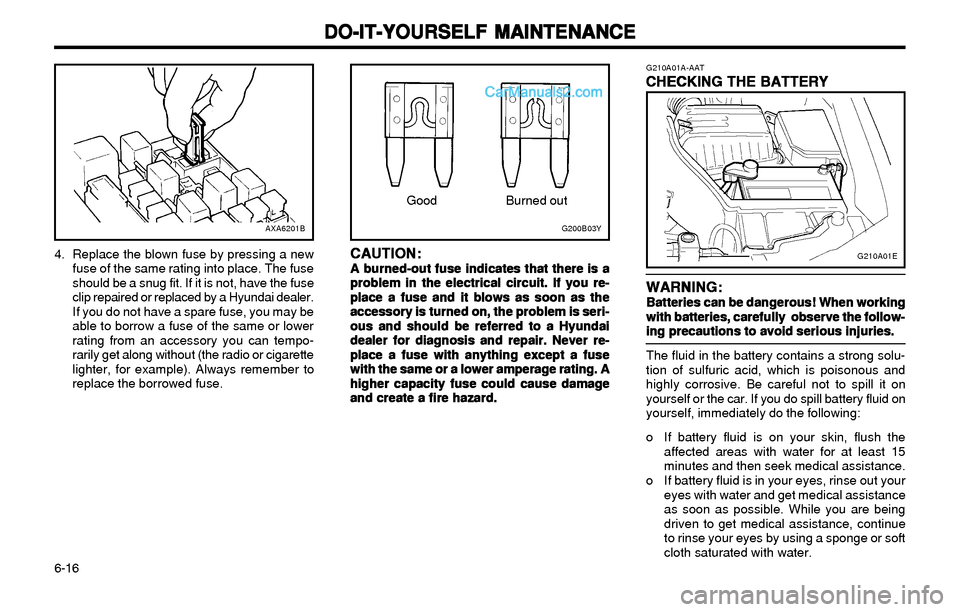
6-16 4. Replace the blown fuse by pressing a new
fuse of the same rating into place. The fuse
should be a snug fit. If it is not, have the fuse
clip repaired or replaced by a Hyundai dealer.
If you do not have a spare fuse, you may be
able to borrow a fuse of the same or lower
rating from an accessory you can tempo-
rarily get along without (the radio or cigarette
lighter, for example). Always remember to
replace the borrowed fuse.
CAUTION: CAUTION:CAUTION: CAUTION:
CAUTION:A burned-out fuse indicates that there is a A burned-out fuse indicates that there is aA burned-out fuse indicates that there is a A burned-out fuse indicates that there is a
A burned-out fuse indicates that there is a
problem in the electrical circuit. If you re- problem in the electrical circuit. If you re-problem in the electrical circuit. If you re- problem in the electrical circuit. If you re-
problem in the electrical circuit. If you re-
place a fuse and it blows as soon as the place a fuse and it blows as soon as theplace a fuse and it blows as soon as the place a fuse and it blows as soon as the
place a fuse and it blows as soon as the
accessory is turned on, the problem is seri- accessory is turned on, the problem is seri-accessory is turned on, the problem is seri- accessory is turned on, the problem is seri-
accessory is turned on, the problem is seri-
ous and should be referred to a Hyundai ous and should be referred to a Hyundaious and should be referred to a Hyundai ous and should be referred to a Hyundai
ous and should be referred to a Hyundai
dealer for diagnosis and repair. Never re- dealer for diagnosis and repair. Never re-dealer for diagnosis and repair. Never re- dealer for diagnosis and repair. Never re-
dealer for diagnosis and repair. Never re-
place a fuse with anything except a fuse place a fuse with anything except a fuseplace a fuse with anything except a fuse place a fuse with anything except a fuse
place a fuse with anything except a fuse
with the same or a lower amperage rating. A with the same or a lower amperage rating. Awith the same or a lower amperage rating. A with the same or a lower amperage rating. A
with the same or a lower amperage rating. A
higher capacity fuse could cause damage higher capacity fuse could cause damagehigher capacity fuse could cause damage higher capacity fuse could cause damage
higher capacity fuse could cause damage
and create a fire hazard. and create a fire hazard.and create a fire hazard. and create a fire hazard.
and create a fire hazard.
AXA6201B
Burned out
G200B03Y
Good
WARNING: WARNING:WARNING: WARNING:
WARNING:Batteries can be dangerous! When working Batteries can be dangerous! When workingBatteries can be dangerous! When working Batteries can be dangerous! When working
Batteries can be dangerous! When working
with batteries, carefully observe the follow- with batteries, carefully observe the follow-with batteries, carefully observe the follow- with batteries, carefully observe the follow-
with batteries, carefully observe the follow-
ing precautions to avoid serious injuries. ing precautions to avoid serious injuries.ing precautions to avoid serious injuries. ing precautions to avoid serious injuries.
ing precautions to avoid serious injuries.
The fluid in the battery contains a strong solu-
tion of sulfuric acid, which is poisonous and
highly corrosive. Be careful not to spill it on
yourself or the car. If you do spill battery fluid on
yourself, immediately do the following:
o If battery fluid is on your skin, flush the
affected areas with water for at least 15
minutes and then seek medical assistance.
o If battery fluid is in your eyes, rinse out your
eyes with water and get medical assistance
as soon as possible. While you are being
driven to get medical assistance, continue
to rinse your eyes by using a sponge or soft
cloth saturated with water.
G210A01A-AAT
CHECKING THE BATTERY CHECKING THE BATTERYCHECKING THE BATTERY CHECKING THE BATTERY
CHECKING THE BATTERY
G210A01E
Page 153 of 172
DO-IT-YOURSELF MAINTENANCE DO-IT-YOURSELF MAINTENANCEDO-IT-YOURSELF MAINTENANCE DO-IT-YOURSELF MAINTENANCE
DO-IT-YOURSELF MAINTENANCE
6-17
G230A03A-AAT
POWER STEERING FLUID LEVEL POWER STEERING FLUID LEVELPOWER STEERING FLUID LEVEL POWER STEERING FLUID LEVEL
POWER STEERING FLUID LEVEL
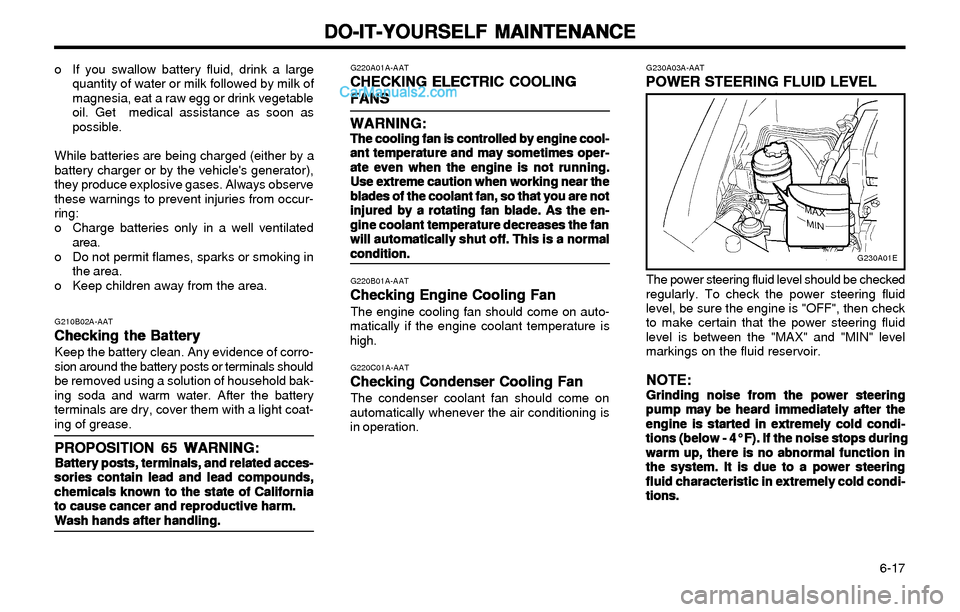
The power steering fluid level should be checked
regularly. To check the power steering fluid
level, be sure the engine is "OFF", then check
to make certain that the power steering fluid
level is between the "MAX" and "MIN" level
markings on the fluid reservoir.
NOTE: NOTE:NOTE: NOTE:
NOTE:Grinding noise from the power steering Grinding noise from the power steeringGrinding noise from the power steering Grinding noise from the power steering
Grinding noise from the power steering
pump may be heard immediately after the pump may be heard immediately after thepump may be heard immediately after the pump may be heard immediately after the
pump may be heard immediately after the
engine is started in extremely cold condi- engine is started in extremely cold condi-engine is started in extremely cold condi- engine is started in extremely cold condi-
engine is started in extremely cold condi-
tions (below - 4°F). If the noise stops during tions (below - 4°F). If the noise stops duringtions (below - 4°F). If the noise stops during tions (below - 4°F). If the noise stops during
tions (below - 4°F). If the noise stops during
warm up, there is no abnormal function in warm up, there is no abnormal function inwarm up, there is no abnormal function in warm up, there is no abnormal function in
warm up, there is no abnormal function in
the system. It is due to a power steering the system. It is due to a power steeringthe system. It is due to a power steering the system. It is due to a power steering
the system. It is due to a power steering
fluid characteristic in extremely cold condi- fluid characteristic in extremely cold condi-fluid characteristic in extremely cold condi- fluid characteristic in extremely cold condi-
fluid characteristic in extremely cold condi-
tions. tions.tions. tions.
tions.
G230A01E G220A01A-AAT
CHECKING ELECTRIC COOLING CHECKING ELECTRIC COOLINGCHECKING ELECTRIC COOLING CHECKING ELECTRIC COOLING
CHECKING ELECTRIC COOLING
FANS FANSFANS FANS
FANS
WARNING: WARNING:WARNING: WARNING:
WARNING:
The cooling fan is controlled by engine cool- The cooling fan is controlled by engine cool-The cooling fan is controlled by engine cool- The cooling fan is controlled by engine cool-
The cooling fan is controlled by engine cool-
ant temperature and may sometimes oper- ant temperature and may sometimes oper-ant temperature and may sometimes oper- ant temperature and may sometimes oper-
ant temperature and may sometimes oper-
ate even when the engine is not running. ate even when the engine is not running.ate even when the engine is not running. ate even when the engine is not running.
ate even when the engine is not running.
Use extreme caution when working near the Use extreme caution when working near theUse extreme caution when working near the Use extreme caution when working near the
Use extreme caution when working near the
blades of the coolant fan, so that you are not blades of the coolant fan, so that you are notblades of the coolant fan, so that you are not blades of the coolant fan, so that you are not
blades of the coolant fan, so that you are not
injured by a rotating fan blade. As the en- injured by a rotating fan blade. As the en-injured by a rotating fan blade. As the en- injured by a rotating fan blade. As the en-
injured by a rotating fan blade. As the en-
gine coolant temperature decreases the fan gine coolant temperature decreases the fangine coolant temperature decreases the fan gine coolant temperature decreases the fan
gine coolant temperature decreases the fan
will automatically shut off. This is a normal will automatically shut off. This is a normalwill automatically shut off. This is a normal will automatically shut off. This is a normal
will automatically shut off. This is a normal
condition. condition.condition. condition.
condition.
G220B01A-AAT
Checking Engine Cooling Fan Checking Engine Cooling FanChecking Engine Cooling Fan Checking Engine Cooling Fan
Checking Engine Cooling FanThe engine cooling fan should come on auto-
matically if the engine coolant temperature is
high.
G220C01A-AAT
Checking Condenser Cooling Fan Checking Condenser Cooling FanChecking Condenser Cooling Fan Checking Condenser Cooling Fan
Checking Condenser Cooling FanThe condenser coolant fan should come on
automatically whenever the air conditioning is
in operation.
G210B02A-AAT
Checking the Battery Checking the BatteryChecking the Battery Checking the Battery
Checking the BatteryKeep the battery clean. Any evidence of corro-
sion around the battery posts or terminals should
be removed using a solution of household bak-
ing soda and warm water. After the battery
terminals are dry, cover them with a light coat-
ing of grease.
PROPOSITION 65 WARNING: PROPOSITION 65 WARNING:PROPOSITION 65 WARNING: PROPOSITION 65 WARNING:
PROPOSITION 65 WARNING:Battery posts, terminals, and related acces- Battery posts, terminals, and related acces-Battery posts, terminals, and related acces- Battery posts, terminals, and related acces-
Battery posts, terminals, and related acces-
sories contain lead and lead compounds, sories contain lead and lead compounds,sories contain lead and lead compounds, sories contain lead and lead compounds,
sories contain lead and lead compounds,
chemicals known to the state of California chemicals known to the state of Californiachemicals known to the state of California chemicals known to the state of California
chemicals known to the state of California
to cause cancer and reproductive harm. to cause cancer and reproductive harm.to cause cancer and reproductive harm. to cause cancer and reproductive harm.
to cause cancer and reproductive harm.
Wash hands after handling. Wash hands after handling.Wash hands after handling. Wash hands after handling.
Wash hands after handling.
o If you swallow battery fluid, drink a large
quantity of water or milk followed by milk of
magnesia, eat a raw egg or drink vegetable
oil. Get medical assistance as soon as
possible.
While batteries are being charged (either by a
battery charger or by the vehicle's generator),
they produce explosive gases. Always observe
these warnings to prevent injuries from occur-
ring:
o Charge batteries only in a well ventilated
area.
o Do not permit flames, sparks or smoking in
the area.
o Keep children away from the area.
Page 154 of 172
DO-IT-YOURSELF MAINTENANCE DO-IT-YOURSELF MAINTENANCEDO-IT-YOURSELF MAINTENANCE DO-IT-YOURSELF MAINTENANCE
DO-IT-YOURSELF MAINTENANCE
6-18Recommended Fluid Recommended FluidRecommended Fluid Recommended Fluid
Recommended Fluid
Use PSF-3 type fluid
NOTE: NOTE:NOTE: NOTE:
NOTE:Do not start the engine when the power Do not start the engine when the powerDo not start the engine when the power Do not start the engine when the power
Do not start the engine when the power
steering oil reservoir is empty. steering oil reservoir is empty.steering oil reservoir is empty. steering oil reservoir is empty.
steering oil reservoir is empty.
G240A01A-AAT
POWER STEERING HOSES POWER STEERING HOSESPOWER STEERING HOSES POWER STEERING HOSES
POWER STEERING HOSESIt is suggested that you check the power steer-
ing hose connections for fluid leakage at regular
intervals. The power steering hoses should be
replaced if there is severe surface cracking,
scuffing or worn spots. Deterioration of the
hose could cause premature failure.
G250A01A-AAT
FOR MORE INFORMATION ABOUT FOR MORE INFORMATION ABOUTFOR MORE INFORMATION ABOUT FOR MORE INFORMATION ABOUT
FOR MORE INFORMATION ABOUT
YOUR HYUNDAI YOUR HYUNDAIYOUR HYUNDAI YOUR HYUNDAI
YOUR HYUNDAI
If you desire additional information about main-
taining and servicing your Hyundai, you may
purchase a factory Shop Manual at your Hyundai
dealer's parts department. This is the same
manual used by dealership technicians and
while it is highly technical it can be useful in
obtaining a better understanding of your car
and how it works.
G260A03A-AAT
REPLACING HEADLIGHT BULBS REPLACING HEADLIGHT BULBSREPLACING HEADLIGHT BULBS REPLACING HEADLIGHT BULBS
REPLACING HEADLIGHT BULBSBefore attempting to replace a headlight bulb,
be sure the switch is turned to the "OFF"
position.
The next paragraph shows how to reach the
headlight bulbs so they may be changed. Be
sure to replace the burned-out bulb with one of
the same number and wattage rating.
CAUTION: CAUTION:CAUTION: CAUTION:
CAUTION:Keep the lamps out of contact with petro- Keep the lamps out of contact with petro-Keep the lamps out of contact with petro- Keep the lamps out of contact with petro-
Keep the lamps out of contact with petro-
leum products, such as oil, gasoline, etc. leum products, such as oil, gasoline, etc.leum products, such as oil, gasoline, etc. leum products, such as oil, gasoline, etc.
leum products, such as oil, gasoline, etc.
G270A02S-AATHEADLIGHT BULB HEADLIGHT BULBHEADLIGHT BULB HEADLIGHT BULB
HEADLIGHT BULB
Replacement instructions: Replacement instructions:Replacement instructions: Replacement instructions:
Replacement instructions:
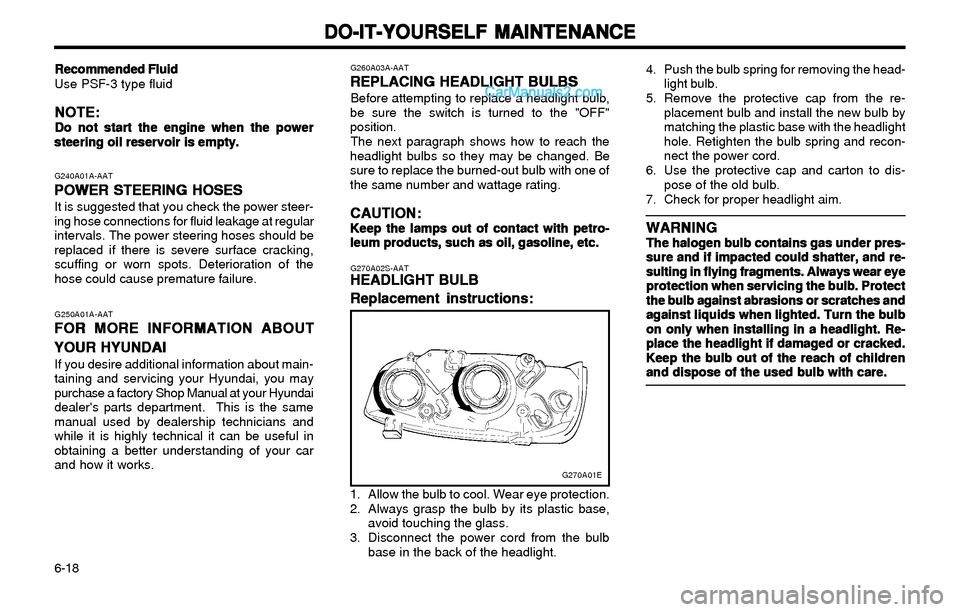
1. Allow the bulb to cool. Wear eye protection.
2. Always grasp the bulb by its plastic base,
avoid touching the glass.
3. Disconnect the power cord from the bulb
base in the back of the headlight.
G270A01E
4. Push the bulb spring for removing the head-
light bulb.
5. Remove the protective cap from the re-
placement bulb and install the new bulb by
matching the plastic base with the headlight
hole. Retighten the bulb spring and recon-
nect the power cord.
6. Use the protective cap and carton to dis-
pose of the old bulb.
7. Check for proper headlight aim.
WARNING WARNINGWARNING WARNING
WARNINGThe halogen bulb contains gas under pres- The halogen bulb contains gas under pres-The halogen bulb contains gas under pres- The halogen bulb contains gas under pres-
The halogen bulb contains gas under pres-
sure and if impacted could shatter, and re- sure and if impacted could shatter, and re-sure and if impacted could shatter, and re- sure and if impacted could shatter, and re-
sure and if impacted could shatter, and re-
sulting in flying fragments. Always wear eye sulting in flying fragments. Always wear eyesulting in flying fragments. Always wear eye sulting in flying fragments. Always wear eye
sulting in flying fragments. Always wear eye
protection when servicing the bulb. Protect protection when servicing the bulb. Protectprotection when servicing the bulb. Protect protection when servicing the bulb. Protect
protection when servicing the bulb. Protect
the bulb against abrasions or scratches and the bulb against abrasions or scratches andthe bulb against abrasions or scratches and the bulb against abrasions or scratches and
the bulb against abrasions or scratches and
against liquids when lighted. Turn the bulb against liquids when lighted. Turn the bulbagainst liquids when lighted. Turn the bulb against liquids when lighted. Turn the bulb
against liquids when lighted. Turn the bulb
on only when installing in a headlight. Re- on only when installing in a headlight. Re-on only when installing in a headlight. Re- on only when installing in a headlight. Re-
on only when installing in a headlight. Re-
place the headlight if damaged or cracked. place the headlight if damaged or cracked.place the headlight if damaged or cracked. place the headlight if damaged or cracked.
place the headlight if damaged or cracked.
Keep the bulb out of the reach of children Keep the bulb out of the reach of childrenKeep the bulb out of the reach of children Keep the bulb out of the reach of children
Keep the bulb out of the reach of children
and dispose of the used bulb with care. and dispose of the used bulb with care.and dispose of the used bulb with care. and dispose of the used bulb with care.
and dispose of the used bulb with care.