IAT Hyundai Elantra 2003 Owner's Guide
[x] Cancel search | Manufacturer: HYUNDAI, Model Year: 2003, Model line: Elantra, Model: Hyundai Elantra 2003Pages: 172, PDF Size: 2.82 MB
Page 127 of 172
CORROSION PREVENTION AND APPEARANCE CARE CORROSION PREVENTION AND APPEARANCE CARECORROSION PREVENTION AND APPEARANCE CARE CORROSION PREVENTION AND APPEARANCE CARE
CORROSION PREVENTION AND APPEARANCE CARE
4-3 doors are open. Paint damage can be caused by
small accumulation of tar, industrial precipita-
tion, tree resin, insects and bird droppings, when
not removed immediately. If water alone is not
strong enough to remove the accumulated dirt,
use a mild car washing solution. Be sure to rinse
the surface after washing to remove the solution.
Never allow the solution to dry on the painted
surfaces.
E030D01A-AAT
When to Wax Again When to Wax AgainWhen to Wax Again When to Wax Again
When to Wax AgainYou should polish and wax the car again when
water no longer beads on a clean surface but
spreads out over a larger area.
E030E01A-AAT
Maintaining Bumpers Maintaining BumpersMaintaining Bumpers Maintaining Bumpers
Maintaining BumpersSpecial precautions must be observed to pre-
serve the appearance of the bumpers on your
Hyundai. They are:
o Be careful not to spill battery electrolyte or
hydraulic brake fluid on the bumpers. If you
do, wash it off immediately with clear water.
o Be gentle when cleaning the bumper sur-
faces. They are made of soft plastic and the
surface can be damaged if mistreated. Do not
use abrasive cleaners. Use warm water and
mild soap or car-washing solution.
o Do not expose the bumpers to high tem-
peratures. For example, if you have your car
repainted, do not leave the bumpers on the
car if the car is going to be placed in a high-
temperature paint booth.
E040A01A-AAT
CLEANING THE INTERIOR CLEANING THE INTERIORCLEANING THE INTERIOR CLEANING THE INTERIOR
CLEANING THE INTERIOR
To Clean the Vinyl Upholstery To Clean the Vinyl UpholsteryTo Clean the Vinyl Upholstery To Clean the Vinyl Upholstery
To Clean the Vinyl Upholstery
To clean the vinyl upholstery, first remove loose
dirt and dust with a vacuum cleaner. Then apply
a solution of mild soap or detergent and water
using a clean sponge or soft cloth. Allow this tostay on the surface to loosen the dirt, then wipe
with a clean damp sponge or cloth. If all the dirt
stains are not removed, repeat this procedure
until the upholstery is clean. Do not use gasoline,
solvent, paint thinner or other strong cleaners.
E030B01A-AAT
Spot Cleaning Spot CleaningSpot Cleaning Spot Cleaning
Spot CleaningDon't use gasoline, strong solvents or corrosive
cleaning agents. These can damage the finish of
the car. To remove road tar, use turpentine on a
clean, soft cloth or commercially available bug
and tar remover. Be gentle.
To remove dead insects or tree sap, use warm
water and mild soap or car-washing solution.
Soak the spot and rub gently. If the paint has lost
its luster, use a commercial car-cleaning polish.
E030C01A-AAT
Polishing and Waxing Polishing and WaxingPolishing and Waxing Polishing and Waxing
Polishing and WaxingAlways wash and dry the car before polishing or
waxing or using a combination cleaner and wax.
Use a good quality commercial product and
follow the manufacturer's directions on the con-
tainer. Polish and wax the bright trim pieces as
well as the paint.
E040D01A-AAT
Cleaning the Seat Belts Cleaning the Seat BeltsCleaning the Seat Belts Cleaning the Seat Belts
Cleaning the Seat BeltsTo clean the seat belts, use a cloth or sponge
with mild soap or detergent and warm water. Do
not use strong detergents, dye, bleach or abra-
sive materials on the seat belts as this may
weaken the fabric.
While cleaning the belts, inspect them for exces-
sive wear, cuts, fraying or other signs of damage
and replace them if necessary.
E040C01A-AAT
Cleaning the Carpets Cleaning the CarpetsCleaning the Carpets Cleaning the Carpets
Cleaning the CarpetsUse a foam-type carpet cleaner. Cleaners of this
type are available in aerosol cans in liquid form or
powder. Read the instructions and follow them
exactly. Using a vacuum cleaner with the appro-
priate attachment, remove as much dirt from the
carpets as possible. Apply the foam following the
manufacturer's directions, then rub in overlap-
ping circles. Do not add water. These cleaners
work best when the carpet is kept as dry as
possible.
Page 133 of 172
VEHICLE MAINTENANCE REQUIREMENTS VEHICLE MAINTENANCE REQUIREMENTSVEHICLE MAINTENANCE REQUIREMENTS VEHICLE MAINTENANCE REQUIREMENTS
VEHICLE MAINTENANCE REQUIREMENTS
5-5
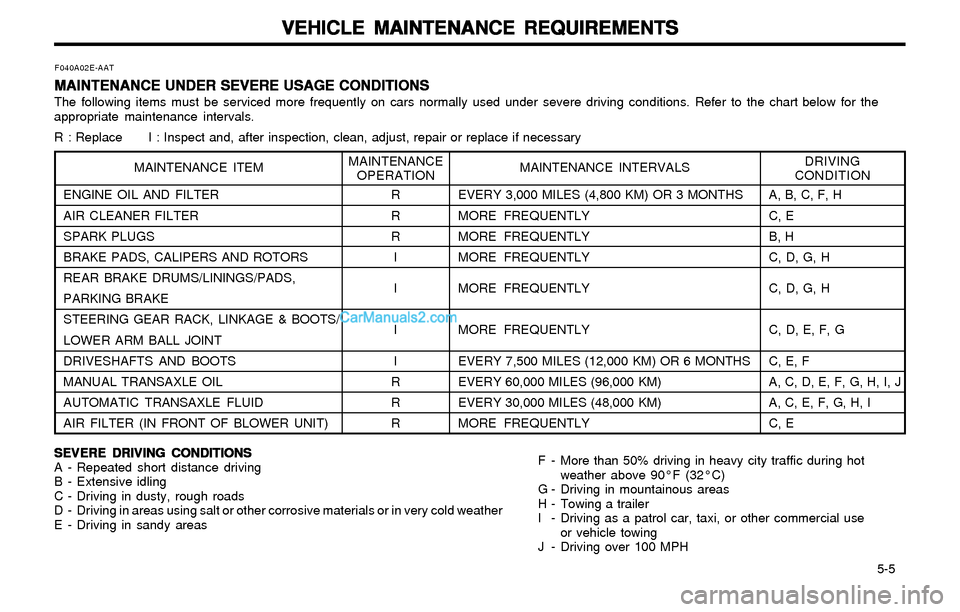
MAINTENANCE UNDER SEVERE USAGE CONDITIONS MAINTENANCE UNDER SEVERE USAGE CONDITIONSMAINTENANCE UNDER SEVERE USAGE CONDITIONS MAINTENANCE UNDER SEVERE USAGE CONDITIONS
MAINTENANCE UNDER SEVERE USAGE CONDITIONSThe following items must be serviced more frequently on cars normally used under severe driving conditions. Refer to the chart below for the
appropriate maintenance intervals.
R : Replace I : Inspect and, after inspection, clean, adjust, repair or replace if necessary
F040A02E-AAT
MAINTENANCE ITEM
F - More than 50% driving in heavy city traffic during hot
weather above 90°F (32°C)
G - Driving in mountainous areas
H - Towing a trailer
I - Driving as a patrol car, taxi, or other commercial use
or vehicle towing
J - Driving over 100 MPH SEVERE DRIVING CONDITIONS SEVERE DRIVING CONDITIONSSEVERE DRIVING CONDITIONS SEVERE DRIVING CONDITIONS
SEVERE DRIVING CONDITIONS
A - Repeated short distance driving
B - Extensive idling
C - Driving in dusty, rough roads
D - Driving in areas using salt or other corrosive materials or in very cold weather
E - Driving in sandy areasMAINTENANCE INTERVALS
ENGINE OIL AND FILTER
AIR CLEANER FILTER
SPARK PLUGS
BRAKE PADS, CALIPERS AND ROTORS
REAR BRAKE DRUMS/LININGS/PADS,
PARKING BRAKE
STEERING GEAR RACK, LINKAGE & BOOTS/
LOWER ARM BALL JOINT
DRIVESHAFTS AND BOOTS
MANUAL TRANSAXLE OIL
AUTOMATIC TRANSAXLE FLUID
AIR FILTER (IN FRONT OF BLOWER UNIT)R
R
R
I
I
I
I
R
R
REVERY 3,000 MILES (4,800 KM) OR 3 MONTHS
MORE FREQUENTLY
MORE FREQUENTLY
MORE FREQUENTLY
MORE FREQUENTLY
MORE FREQUENTLY
EVERY 7,500 MILES (12,000 KM) OR 6 MONTHS
EVERY 60,000 MILES (96,000 KM)
EVERY 30,000 MILES (48,000 KM)
MORE FREQUENTLY MAINTENANCE
OPERATION
A, B, C, F, H
C, E
B, H
C, D, G, H
C, D, G, H
C, D, E, F, G
C, E, F
A, C, D, E, F, G, H, I, J
A, C, E, F, G, H, I
C, EDRIVING
CONDITION
Page 134 of 172

VEHICLE MAINTENANCE REQUIREMENTS VEHICLE MAINTENANCE REQUIREMENTSVEHICLE MAINTENANCE REQUIREMENTS VEHICLE MAINTENANCE REQUIREMENTS
VEHICLE MAINTENANCE REQUIREMENTS
5- 6
F060A01A-AAT
EXPLANATION OF SCHEDULED EXPLANATION OF SCHEDULEDEXPLANATION OF SCHEDULED EXPLANATION OF SCHEDULED
EXPLANATION OF SCHEDULED
MAINTENANCE ITEMS MAINTENANCE ITEMSMAINTENANCE ITEMS MAINTENANCE ITEMS
MAINTENANCE ITEMS
F060M01A-AAT
o oo o
o
Engine Oil and Filter Engine Oil and FilterEngine Oil and Filter Engine Oil and Filter
Engine Oil and FilterThe engine oil and filter should be changed at
the intervals specified in the maintenance
schedule. If the car is being driven in severe
conditions, more frequent oil and filter changes
are required.
F060C01A-AAT
o oo o
o
Fuel Filter Fuel FilterFuel Filter Fuel Filter
Fuel FilterA clogged filter can limit the speed at which the
vehicle may be driven, damage the emission
system and cause hard starting. If an exces-
sive amount of foreign matter accumulates in
the fuel tank, the filter may require replace-
ment more frequently.
After installing a new filter, run the engine for
several minutes, and check for leaks at the
connections. Fuel filters should be installed by
trained technicians.
F060B01A-AAT
o oo o
o
Drive Belts Drive BeltsDrive Belts Drive Belts
Drive BeltsInspect all drive belts for evidence of cuts,
cracks, excessive wear or oil saturation and
replace if necessary. Drive belts should be
checked periodically for proper tension and
adjusted as necessary.
F060D01A-AATo oo o
o
Fuel Lines, Fuel Hoses and Fuel Lines, Fuel Hoses andFuel Lines, Fuel Hoses and Fuel Lines, Fuel Hoses and
Fuel Lines, Fuel Hoses and
Connections ConnectionsConnections Connections
Connections
Check the fuel lines, fuel hoses and connec-
tions for leakage and damage. Have a trained
technician replace any damaged or leaking
parts immediately.
F060G01A-AAT
o oo o
o
Vapor Hose and Fuel Filler Cap Vapor Hose and Fuel Filler CapVapor Hose and Fuel Filler Cap Vapor Hose and Fuel Filler Cap
Vapor Hose and Fuel Filler CapThe vapor hose and fuel filler cap should be
inspected at those intervals specified in the
maintenance schedule. Make sure that a new
vapor hose or fuel filler cap is correctly re-
placed.
F060F01A-AATo oo o
o
Vacuum, Crankcase Vacuum, CrankcaseVacuum, Crankcase Vacuum, Crankcase
Vacuum, Crankcase
Ventilation Hoses Ventilation HosesVentilation Hoses Ventilation Hoses
Ventilation Hoses
Inspect the surface of hoses for evidence of
heat and/or mechanical damage. Hard and
brittle rubber, cracking, tears, cuts, abra-
sions, and excessive swelling indicate dete-
rioration. Particular attention should be paid to
examine those hose surfaces nearest to high
heat sources, such as the exhaust manifold.
Inspect the hose routing to assure that the
hoses do not come in contact with any heat
source, sharp edges or moving component
which might cause heat damage or mechani-
cal wear. Inspect all hose connections, such
as clamps and couplings, to make sure they
are secure, and that no leaks are present.
Hoses should be replaced immediately if there
is any evidence of deterioration or damage.
F060H01A-AAT
o Air cleaner filter o Air cleaner filtero Air cleaner filter o Air cleaner filter
o Air cleaner filterA Genuine Hyundai air cleaner filter is recom-
mended when the filter is replaced.
F060J01A-AAT
o Spark plugs o Spark plugso Spark plugs o Spark plugs
o Spark plugsMake sure to install new spark plugs of the
correct heat range.
F060E01A-AAT
o oo o
o
Timing belt Timing beltTiming belt Timing belt
Timing beltInspect all parts related to the timing belt for
damage and deformation. Replace any dam-
aged parts immediately.
F070C01A-AAT
o Engine coolant o Engine coolanto Engine coolant o Engine coolant
o Engine coolantThe coolant should be changed at the
intervals specified in the maintenance sched-
ule.
F060N02E-AAT
o oo o
o
Valve Clearance Valve ClearanceValve Clearance Valve Clearance
Valve ClearanceInspect excessive valve noise and/or engine
vibration and adjust if necessary. A qualified
technician should perform the operation.
Page 135 of 172
VEHICLE MAINTENANCE REQUIREMENTS VEHICLE MAINTENANCE REQUIREMENTSVEHICLE MAINTENANCE REQUIREMENTS VEHICLE MAINTENANCE REQUIREMENTS
VEHICLE MAINTENANCE REQUIREMENTS
5-7
F070E05A-AAT
o Automatic Transaxle Fluid o Automatic Transaxle Fluido Automatic Transaxle Fluid o Automatic Transaxle Fluid
o Automatic Transaxle FluidThe fluid level should be in the "HOT" range
of the dipstick, after the engine and transaxle
are at normal operating temperature. Check
the automatic transaxle fluid level with the
engine running and the transaxle in neutral,
with the parking brake properly applied. Use
HYUNDAI GENUINE ATF, DIAMOND ATF
SP-III or SK ATF SP-III when adding or
changing fluid.
F070F01A-AAT
o oo o
o
Brake Hoses and Lines Brake Hoses and LinesBrake Hoses and Lines Brake Hoses and Lines
Brake Hoses and LinesVisually check for proper installation, chafing,
cracks, deterioration and any leakage. Re-
place any deteriorated or damaged parts
immediately.
F070G02A-AAT
o Brake Fluid o Brake Fluido Brake Fluid o Brake Fluid
o Brake FluidCheck brake fluid level in the brake fluid
reservoir. The level should be between "MIN"
and "MAX" marks on the side of the reservoir.
Use only hydraulic brake fluid conforming to
DOT 3 or DOT 4.
F070D01A-AAT
o Manual transaxle oil o Manual transaxle oilo Manual transaxle oil o Manual transaxle oil
o Manual transaxle oilInspect the manual transaxle oil according to
the maintenance schedule.
NOTE: NOTE:NOTE: NOTE:
NOTE:If the oil level is low, check for possible If the oil level is low, check for possibleIf the oil level is low, check for possible If the oil level is low, check for possible
If the oil level is low, check for possible
leaks before adding oil. Do not overfill. leaks before adding oil. Do not overfill.leaks before adding oil. Do not overfill. leaks before adding oil. Do not overfill.
leaks before adding oil. Do not overfill.
F070H01A-AATo oo o
o
Rear Brake Drums/Linings, Rear Brake Drums/Linings,Rear Brake Drums/Linings, Rear Brake Drums/Linings,
Rear Brake Drums/Linings,
Parking Brake Parking BrakeParking Brake Parking Brake
Parking Brake
Check the rear brake drums and linings for
scoring, burning, leaking fluid, broken parts,
and excessive wear. Inspect the parking
brake system including the parking brake
lever and cables. For detailed service proce-
dures, refer to the Shop Manual.
F070J01A-AAT
o Brake Pads, Calipers and Rotors o Brake Pads, Calipers and Rotorso Brake Pads, Calipers and Rotors o Brake Pads, Calipers and Rotors
o Brake Pads, Calipers and RotorsCheck the pads for excessive wear, discs for
run out and wear, and calipers for fluid leak-
age.
F070K01A-AAT
o Exhaust Pipe and Muffler o Exhaust Pipe and Mufflero Exhaust Pipe and Muffler o Exhaust Pipe and Muffler
o Exhaust Pipe and MufflerVisually inspect the exhaust pipes, muffler
and hangers for cracks, deterioration, or dam-
age. Start the engine and listen carefully for
any exhaust gas leakage. Tighten connec-
tions or replace parts as necessary.
F070L01A-AAT
o Suspension Mounting Bolts o Suspension Mounting Boltso Suspension Mounting Bolts o Suspension Mounting Bolts
o Suspension Mounting BoltsCheck the suspension connections for loose-
ness or damage. Retighten to the specified
torque.
F070N01A-AATo oo o
o
Power Steering Pump, Belt and Hoses Power Steering Pump, Belt and HosesPower Steering Pump, Belt and Hoses Power Steering Pump, Belt and Hoses
Power Steering Pump, Belt and HosesCheck the power steering pump and hoses
for leakage and damage. Replace any dam-
aged or leaking parts immediately. Inspect the
power steering belt for evidence of cuts,
cracks, excessive wear, oiliness and proper
tension. Replace or adjust it if necessary.
F070P01A-AAT
o Driveshafts and Boots o Driveshafts and Bootso Driveshafts and Boots o Driveshafts and Boots
o Driveshafts and BootsCheck the drive shafts, boots and clamps for
cracks, deterioration, or damage. Replace
any damaged parts and, if necessary, repack
the grease.
F070Q01A-AAT
o oo o
o
Air Conditioning Refrigerant Air Conditioning RefrigerantAir Conditioning Refrigerant Air Conditioning Refrigerant
Air Conditioning RefrigerantCheck the air conditioning lines and connec-
tions for leakage and damage. Check air
conditioning performance according to the
relevant shop manual if necessary.
F070M01A-AATo oo o
o
Steering Gear Box, Linkage & Boots/ Steering Gear Box, Linkage & Boots/Steering Gear Box, Linkage & Boots/ Steering Gear Box, Linkage & Boots/
Steering Gear Box, Linkage & Boots/
Lower arm Ball Joint Lower arm Ball JointLower arm Ball Joint Lower arm Ball Joint
Lower arm Ball Joint
With the vehicle stopped and engine off, check
for excessive free-play in the steering wheel.
Check the linkage for bends or damage.
Check the dust boots and ball joints for dete-
rioration, cracks, or damage. Replace any
damaged parts.
Page 137 of 172
DO-IT-YOURSELF MAINTENANCE DO-IT-YOURSELF MAINTENANCEDO-IT-YOURSELF MAINTENANCE DO-IT-YOURSELF MAINTENANCE
DO-IT-YOURSELF MAINTENANCE
6-1
6. 6.6. 6.
6.
DO-IT DO-ITDO-IT DO-IT
DO-IT
-Y -Y-Y -Y
-Y
OURSELF MAINTENANCE OURSELF MAINTENANCEOURSELF MAINTENANCE OURSELF MAINTENANCE
OURSELF MAINTENANCE
G010A01E-GAT
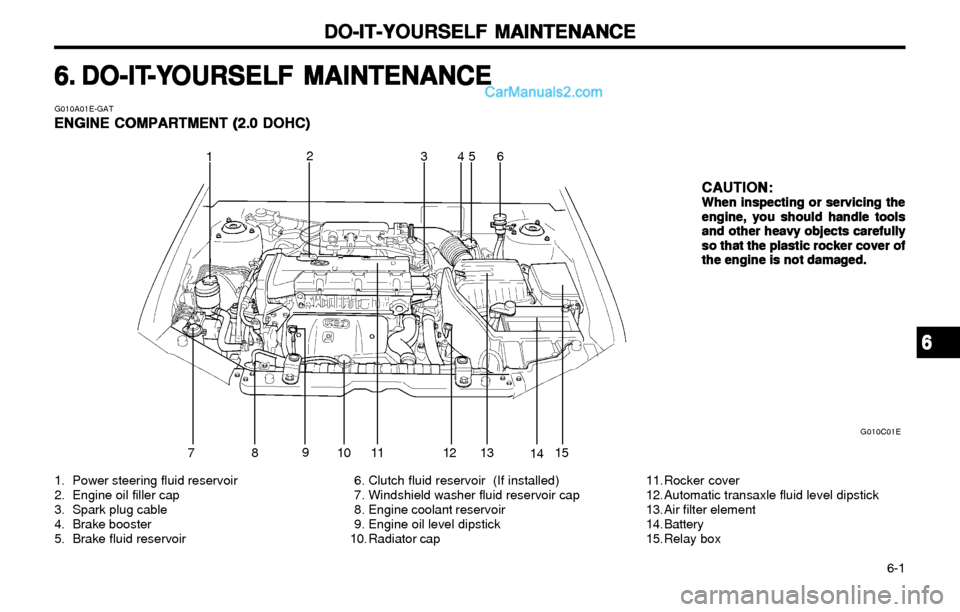
ENGINE COMPARTMENT (2.0 DOHC) ENGINE COMPARTMENT (2.0 DOHC)ENGINE COMPARTMENT (2.0 DOHC) ENGINE COMPARTMENT (2.0 DOHC)
ENGINE COMPARTMENT (2.0 DOHC)
G010C01E
2
13456
711
89
12 10 13
1415
1. Power steering fluid reservoir
2. Engine oil filler cap
3. Spark plug cable
4. Brake booster
5. Brake fluid reservoir 6. Clutch fluid reservoir (If installed)
7. Windshield washer fluid reservoir cap
8. Engine coolant reservoir
9. Engine oil level dipstick
10. Radiator cap11. Rocker cover
12. Automatic transaxle fluid level dipstick
13. Air filter element
14. Battery
15. Relay box
CAUTION: CAUTION:CAUTION: CAUTION:
CAUTION:When inspecting or servicing the When inspecting or servicing theWhen inspecting or servicing the When inspecting or servicing the
When inspecting or servicing the
engine, you should handle tools engine, you should handle toolsengine, you should handle tools engine, you should handle tools
engine, you should handle tools
and other heavy objects carefully and other heavy objects carefullyand other heavy objects carefully and other heavy objects carefully
and other heavy objects carefully
so that the plastic rocker cover of so that the plastic rocker cover ofso that the plastic rocker cover of so that the plastic rocker cover of
so that the plastic rocker cover of
the engine is not damaged. the engine is not damaged.the engine is not damaged. the engine is not damaged.
the engine is not damaged.
6 66 6
6
Page 138 of 172
DO-IT-YOURSELF MAINTENANCE DO-IT-YOURSELF MAINTENANCEDO-IT-YOURSELF MAINTENANCE DO-IT-YOURSELF MAINTENANCE
DO-IT-YOURSELF MAINTENANCE
6-2
G010A02E-GAT
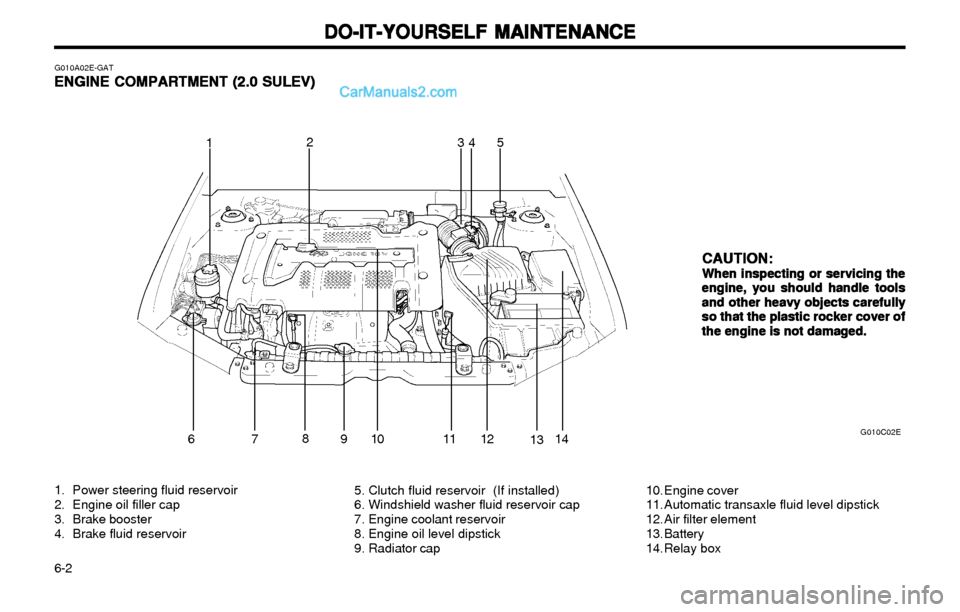
ENGINE COMPARTMENT (2.0 SULEV) ENGINE COMPARTMENT (2.0 SULEV)ENGINE COMPARTMENT (2.0 SULEV) ENGINE COMPARTMENT (2.0 SULEV)
ENGINE COMPARTMENT (2.0 SULEV)
G010C02E
2
134 5
610
78
11 912
1314
1. Power steering fluid reservoir
2. Engine oil filler cap
3. Brake booster
4. Brake fluid reservoir 5. Clutch fluid reservoir (If installed)
6. Windshield washer fluid reservoir cap
7. Engine coolant reservoir
8. Engine oil level dipstick
9. Radiator cap10. Engine cover
11. Automatic transaxle fluid level dipstick
12. Air filter element
13. Battery
14. Relay box
CAUTION: CAUTION:CAUTION: CAUTION:
CAUTION:When inspecting or servicing the When inspecting or servicing theWhen inspecting or servicing the When inspecting or servicing the
When inspecting or servicing the
engine, you should handle tools engine, you should handle toolsengine, you should handle tools engine, you should handle tools
engine, you should handle tools
and other heavy objects carefully and other heavy objects carefullyand other heavy objects carefully and other heavy objects carefully
and other heavy objects carefully
so that the plastic rocker cover of so that the plastic rocker cover ofso that the plastic rocker cover of so that the plastic rocker cover of
so that the plastic rocker cover of
the engine is not damaged. the engine is not damaged.the engine is not damaged. the engine is not damaged.
the engine is not damaged.
Page 141 of 172
DO-IT-YOURSELF MAINTENANCE DO-IT-YOURSELF MAINTENANCEDO-IT-YOURSELF MAINTENANCE DO-IT-YOURSELF MAINTENANCE
DO-IT-YOURSELF MAINTENANCE
6-5 3. Slide underneath the car and loosen the
drain plug by turning it counterclockwise
with a wrench of the proper size. Be sure
that a drain pan is in position to catch the oil
as it drains out, then remove the drain plug.
WARNING: WARNING:WARNING: WARNING:
WARNING:Be very careful when draining the engine oil Be very careful when draining the engine oilBe very careful when draining the engine oil Be very careful when draining the engine oil
Be very careful when draining the engine oil
as it may be hot enough to burn you! as it may be hot enough to burn you!as it may be hot enough to burn you! as it may be hot enough to burn you!
as it may be hot enough to burn you!
4. When the oil has stopped draining, replace
the drain plug using a new washer and
retighten by turning it clockwise.
Drain plug tightening torque: Drain plug tightening torque:Drain plug tightening torque: Drain plug tightening torque:
Drain plug tightening torque:
4.0 ~ 4.5 kgf.m 4.0 ~ 4.5 kgf.m4.0 ~ 4.5 kgf.m 4.0 ~ 4.5 kgf.m
4.0 ~ 4.5 kgf.m
5. Remove the oil filter. You should be able to
unscrew the filter with your hands. (If your
hands are slippery, try to use a cloth be-
tween your hands and the filter to give
yourself a better grip.) A certain amount of
oil will come out when you remove the filter,
so be sure to have your drain pan in place
underneath it.
6. Install a new oil filter in accordance with the
instructions on the carton or on the filter
itself. Do not over-tighten.
Oil filter tightening torque : 1.2 ~ 1.6 kgf.m Oil filter tightening torque : 1.2 ~ 1.6 kgf.mOil filter tightening torque : 1.2 ~ 1.6 kgf.m Oil filter tightening torque : 1.2 ~ 1.6 kgf.m
Oil filter tightening torque : 1.2 ~ 1.6 kgf.m
Be sure that the mounting surface on the
engine is clean and that the old gasket is
removed completely. Lubricate the new gas-
ket on the filter with clean engine oil before
installation.7. Refill the crankcase with the recommended
engine oil. Refer to the specification in chap-
ter 9 for engine oil capacity.
8. Start the engine and check to be sure no oil
is leaking from the drain plug or oil filter.
9. Shut off the engine and recheck the oil level.NOTE: NOTE:NOTE: NOTE:
NOTE:Always dispose of used engine oil in an Always dispose of used engine oil in anAlways dispose of used engine oil in an Always dispose of used engine oil in an
Always dispose of used engine oil in an
environmentally acceptable manner. It is sug- environmentally acceptable manner. It is sug-environmentally acceptable manner. It is sug- environmentally acceptable manner. It is sug-
environmentally acceptable manner. It is sug-
gested that it be placed in a sealed container gested that it be placed in a sealed containergested that it be placed in a sealed container gested that it be placed in a sealed container
gested that it be placed in a sealed container
and taken to a service station for reclama- and taken to a service station for reclama-and taken to a service station for reclama- and taken to a service station for reclama-
and taken to a service station for reclama-
tion. Do not pour the oil on the ground or tion. Do not pour the oil on the ground ortion. Do not pour the oil on the ground or tion. Do not pour the oil on the ground or
tion. Do not pour the oil on the ground or
put it into the household trash. put it into the household trash.put it into the household trash. put it into the household trash.
put it into the household trash.
WARNING: WARNING:WARNING: WARNING:
WARNING:Used motor oil may cause irritation or can- Used motor oil may cause irritation or can-Used motor oil may cause irritation or can- Used motor oil may cause irritation or can-
Used motor oil may cause irritation or can-
cer of the skin if left in contact with the skin cer of the skin if left in contact with the skincer of the skin if left in contact with the skin cer of the skin if left in contact with the skin
cer of the skin if left in contact with the skin
for prolonged periods of time. Wash your for prolonged periods of time. Wash yourfor prolonged periods of time. Wash your for prolonged periods of time. Wash your
for prolonged periods of time. Wash your
hands thoroughly with soap and warm wa- hands thoroughly with soap and warm wa-hands thoroughly with soap and warm wa- hands thoroughly with soap and warm wa-
hands thoroughly with soap and warm wa-
ter as soon as possible after handling used ter as soon as possible after handling usedter as soon as possible after handling used ter as soon as possible after handling used
ter as soon as possible after handling used
oil. oil.oil. oil.
oil.
G050A01A-AATCHECKING AND CHANGING THE CHECKING AND CHANGING THECHECKING AND CHANGING THE CHECKING AND CHANGING THE
CHECKING AND CHANGING THE
ENGINE COOLANT ENGINE COOLANTENGINE COOLANT ENGINE COOLANT
ENGINE COOLANT
WARNING: WARNING:WARNING: WARNING:
WARNING:
Do not remove the radiator cap when the Do not remove the radiator cap when theDo not remove the radiator cap when the Do not remove the radiator cap when the
Do not remove the radiator cap when the
engine is hot. When the engine is hot, the engine is hot. When the engine is hot, theengine is hot. When the engine is hot, the engine is hot. When the engine is hot, the
engine is hot. When the engine is hot, the
engine coolant is under pressure and may engine coolant is under pressure and mayengine coolant is under pressure and may engine coolant is under pressure and may
engine coolant is under pressure and may
erupt through the opening if the cap is erupt through the opening if the cap iserupt through the opening if the cap is erupt through the opening if the cap is
erupt through the opening if the cap is
removed. You could be seriously burned if removed. You could be seriously burned ifremoved. You could be seriously burned if removed. You could be seriously burned if
removed. You could be seriously burned if
you do not observe this precaution. Do not you do not observe this precaution. Do notyou do not observe this precaution. Do not you do not observe this precaution. Do not
you do not observe this precaution. Do not
G050B01A-AAT
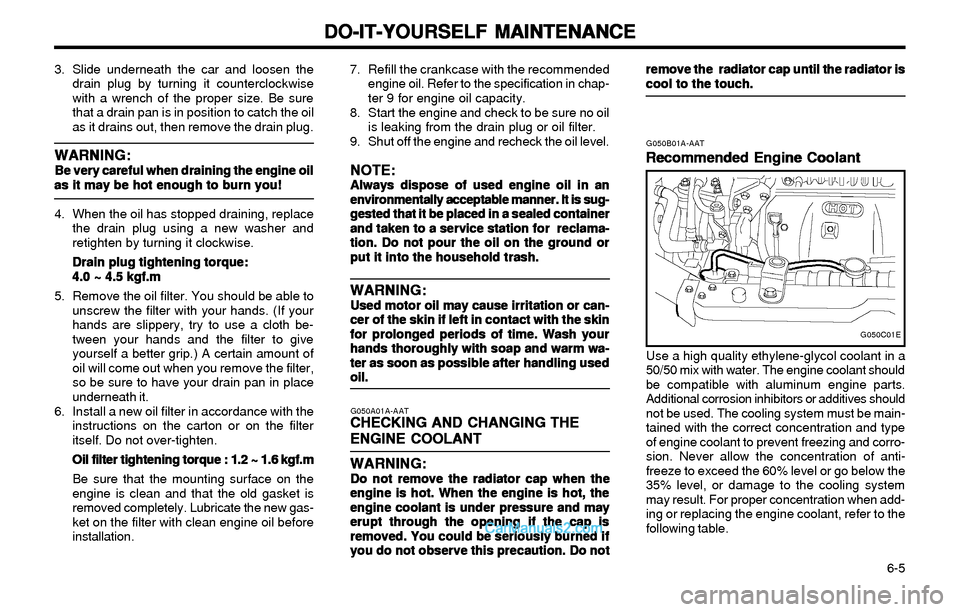
Recommended Engine Coolant Recommended Engine CoolantRecommended Engine Coolant Recommended Engine Coolant
Recommended Engine Coolant
Use a high quality ethylene-glycol coolant in a
50/50 mix with water. The engine coolant should
be compatible with aluminum engine parts.
Additional corrosion inhibitors or additives should
not be used. The cooling system must be main-
tained with the correct concentration and type
of engine coolant to prevent freezing and corro-
sion. Never allow the concentration of anti-
freeze to exceed the 60% level or go below the
35% level, or damage to the cooling system
may result. For proper concentration when add-
ing or replacing the engine coolant, refer to the
following table.
G050C01E
remove the radiator cap until the radiator is remove the radiator cap until the radiator isremove the radiator cap until the radiator is remove the radiator cap until the radiator is
remove the radiator cap until the radiator is
cool to the touch. cool to the touch.cool to the touch. cool to the touch.
cool to the touch.
Page 142 of 172
DO-IT-YOURSELF MAINTENANCE DO-IT-YOURSELF MAINTENANCEDO-IT-YOURSELF MAINTENANCE DO-IT-YOURSELF MAINTENANCE
DO-IT-YOURSELF MAINTENANCE
6-6
Ambient
temperature
°C ( °F)
G050C01A-AAT
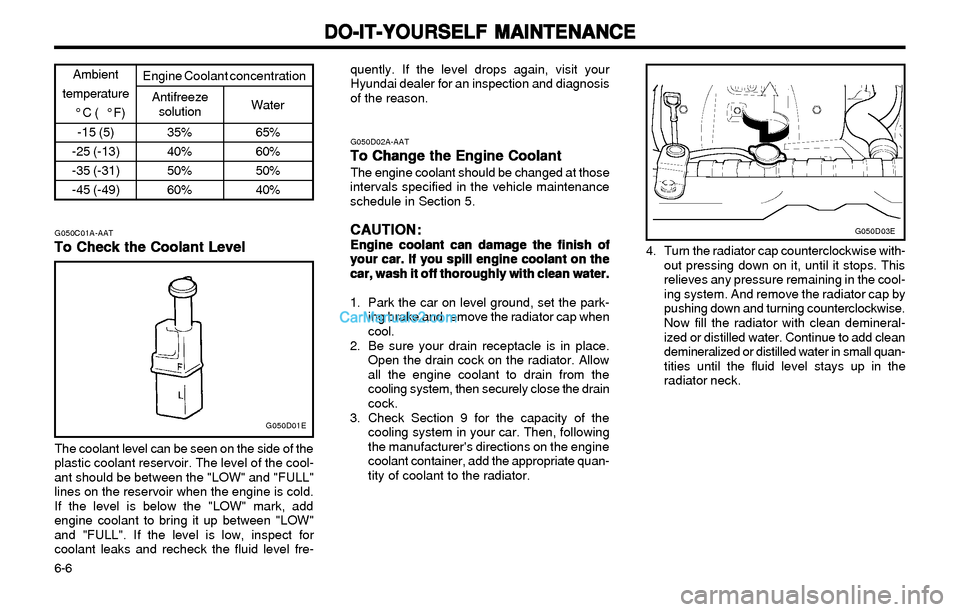
To Check the Coolant Level To Check the Coolant LevelTo Check the Coolant Level To Check the Coolant Level
To Check the Coolant Level
The coolant level can be seen on the side of the
plastic coolant reservoir. The level of the cool-
ant should be between the "LOW" and "FULL"
lines on the reservoir when the engine is cold.
If the level is below the "LOW" mark, add
engine coolant to bring it up between "LOW"
and "FULL". If the level is low, inspect for
coolant leaks and recheck the fluid level fre-quently. If the level drops again, visit your
Hyundai dealer for an inspection and diagnosis
of the reason.
G050D02A-AAT
To Change the Engine Coolant To Change the Engine CoolantTo Change the Engine Coolant To Change the Engine Coolant
To Change the Engine CoolantThe engine coolant should be changed at those
intervals specified in the vehicle maintenance
schedule in Section 5.
CAUTION: CAUTION:CAUTION: CAUTION:
CAUTION:Engine coolant can damage the finish of Engine coolant can damage the finish ofEngine coolant can damage the finish of Engine coolant can damage the finish of
Engine coolant can damage the finish of
your car. If you spill engine coolant on the your car. If you spill engine coolant on theyour car. If you spill engine coolant on the your car. If you spill engine coolant on the
your car. If you spill engine coolant on the
car, wash it off thoroughly with clean water. car, wash it off thoroughly with clean water.car, wash it off thoroughly with clean water. car, wash it off thoroughly with clean water.
car, wash it off thoroughly with clean water.
1. Park the car on level ground, set the park-
ing brake and remove the radiator cap when
cool.
2. Be sure your drain receptacle is in place.
Open the drain cock on the radiator. Allow
all the engine coolant to drain from the
cooling system, then securely close the drain
cock.
3. Check Section 9 for the capacity of the
cooling system in your car. Then, following
the manufacturer's directions on the engine
coolant container, add the appropriate quan-
tity of coolant to the radiator.
G050D01E
Engine Coolant concentration
Antifreeze
solutionWater
35%
40%
50%
60% -15 (5)
-25 (-13)
-35 (-31)
-45 (-49)65%
60%
50%
40%
4. Turn the radiator cap counterclockwise with-
out pressing down on it, until it stops. This
relieves any pressure remaining in the cool-
ing system. And remove the radiator cap by
pushing down and turning counterclockwise.
Now fill the radiator with clean demineral-
ized or distilled water. Continue to add clean
demineralized or distilled water in small quan-
tities until the fluid level stays up in the
radiator neck.
G050D03E
Page 143 of 172

DO-IT-YOURSELF MAINTENANCE DO-IT-YOURSELF MAINTENANCEDO-IT-YOURSELF MAINTENANCE DO-IT-YOURSELF MAINTENANCE
DO-IT-YOURSELF MAINTENANCE
6-7
CHAMPION
NGKRC10PYP4
PFR5N-11
IFR5G-11 Your engine was originally equipped with plati-
num or iridium-tipped spark plugs.
Platinum or iridium-tipped spark plugs will last
longer than conventional type spark plugs and
can be identified by blue lines (platinum only)
on the ceramic shell.NOTE: NOTE:NOTE: NOTE:
NOTE:Do not clean or regap platinum or iridium- Do not clean or regap platinum or iridium-Do not clean or regap platinum or iridium- Do not clean or regap platinum or iridium-
Do not clean or regap platinum or iridium-
tipped spark plugs. tipped spark plugs.tipped spark plugs. tipped spark plugs.
tipped spark plugs.
G050D04E
5. Start the engine, top off the radiator with
water and then add engine coolant to the
reservoir until the level is between "LOW"
and "FULL".
6. Replace the radiator and reservoir caps and
check to be sure the drain cocks are fully
closed and not leaking.
WARNING: WARNING:WARNING: WARNING:
WARNING:The cooling fan is controlled by engine cool- The cooling fan is controlled by engine cool-The cooling fan is controlled by engine cool- The cooling fan is controlled by engine cool-
The cooling fan is controlled by engine cool-
ant temperature and may sometimes oper- ant temperature and may sometimes oper-ant temperature and may sometimes oper- ant temperature and may sometimes oper-
ant temperature and may sometimes oper-
ate even when the engine is not running. ate even when the engine is not running.ate even when the engine is not running. ate even when the engine is not running.
ate even when the engine is not running.
Use extreme caution when working near the Use extreme caution when working near theUse extreme caution when working near the Use extreme caution when working near the
Use extreme caution when working near the
blades of the cooling fan so that you are not blades of the cooling fan so that you are notblades of the cooling fan so that you are not blades of the cooling fan so that you are not
blades of the cooling fan so that you are not
injured by a rotating fan blade. As the en- injured by a rotating fan blade. As the en-injured by a rotating fan blade. As the en- injured by a rotating fan blade. As the en-
injured by a rotating fan blade. As the en-
gine coolant temperature decreases, the fan gine coolant temperature decreases, the fangine coolant temperature decreases, the fan gine coolant temperature decreases, the fan
gine coolant temperature decreases, the fan
will automatically shut off. This is a normal will automatically shut off. This is a normalwill automatically shut off. This is a normal will automatically shut off. This is a normal
will automatically shut off. This is a normal
condition. condition.condition. condition.
condition.
SSA6060A
0.039 ~ 0.043 in. (1.0 ~ 1.1 mm)
G060A03Y-AAT
SPARK PLUGS SPARK PLUGSSPARK PLUGS SPARK PLUGS
SPARK PLUGS
PLATINUM
PLATINUM
IRIDIUM*
G060B02E-AAT
Replacing the Spark Plugs Replacing the Spark PlugsReplacing the Spark Plugs Replacing the Spark Plugs
Replacing the Spark PlugsThe spark plugs should be changed at the
intervals specified in the vehicle maintenance
schedule in Section 5 or whenever engine per-
formance indicates they should be changed.
Symptoms that suggest poor spark plug perfor-
mance include engine misfiring under load, loss
of fuel economy, poor acceleration, etc. When
spark plugs are replaced, always use spark
plugs recommended by Hyundai. The use of
other spark plugs can result in loss of perfor-
mance, radio interference or engine damage.
NOTE: NOTE:NOTE: NOTE:
NOTE:When replacing the spark plugs, genuine When replacing the spark plugs, genuineWhen replacing the spark plugs, genuine When replacing the spark plugs, genuine
When replacing the spark plugs, genuine
Hyundai replacement parts are recom- Hyundai replacement parts are recom-Hyundai replacement parts are recom- Hyundai replacement parts are recom-
Hyundai replacement parts are recom-
mended. mended.mended. mended.
mended.
Recommended Spark Plugs: Recommended Spark Plugs:Recommended Spark Plugs: Recommended Spark Plugs:
Recommended Spark Plugs:
* 2.0L SULEV Only.
Page 145 of 172
DO-IT-YOURSELF MAINTENANCE DO-IT-YOURSELF MAINTENANCEDO-IT-YOURSELF MAINTENANCE DO-IT-YOURSELF MAINTENANCE
DO-IT-YOURSELF MAINTENANCE
6-9
G090A01A-AAT
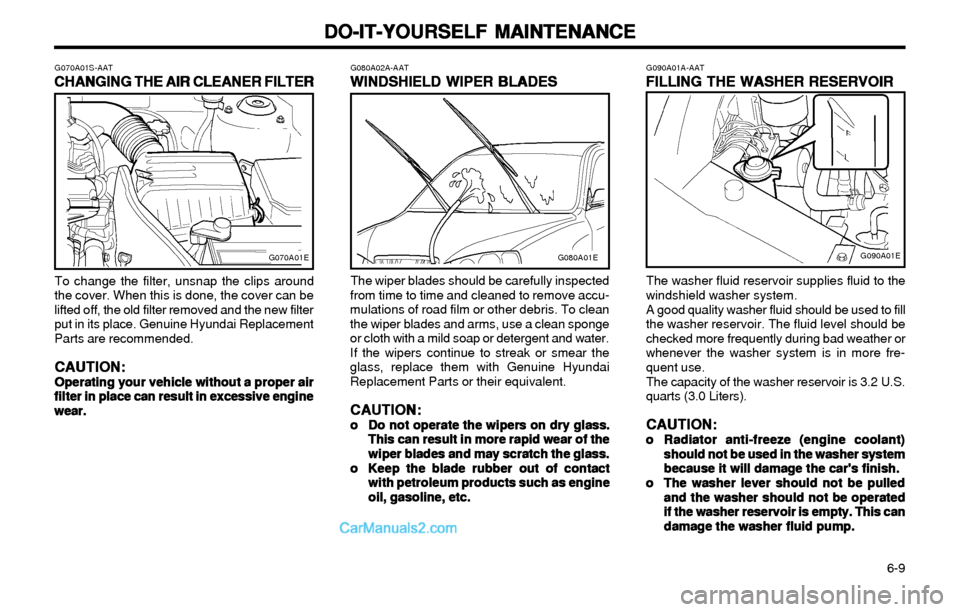
FILLING THE WASHER RESERVOIR FILLING THE WASHER RESERVOIRFILLING THE WASHER RESERVOIR FILLING THE WASHER RESERVOIR
FILLING THE WASHER RESERVOIR
The washer fluid reservoir supplies fluid to the
windshield washer system.
A good quality washer fluid should be used to fill
the washer reservoir. The fluid level should be
checked more frequently during bad weather or
whenever the washer system is in more fre-
quent use.
The capacity of the washer reservoir is 3.2 U.S.
quarts (3.0 Liters).
CAUTION: CAUTION:CAUTION: CAUTION:
CAUTION:o oo o
o
Radiator anti-freeze (engine coolant) Radiator anti-freeze (engine coolant)Radiator anti-freeze (engine coolant) Radiator anti-freeze (engine coolant)
Radiator anti-freeze (engine coolant)
should not be used in the washer system should not be used in the washer systemshould not be used in the washer system should not be used in the washer system
should not be used in the washer system
because it will damage the car's finish. because it will damage the car's finish.because it will damage the car's finish. because it will damage the car's finish.
because it will damage the car's finish.
o oo o
o
The washer lever should not be pulled The washer lever should not be pulledThe washer lever should not be pulled The washer lever should not be pulled
The washer lever should not be pulled
and the washer should not be operated and the washer should not be operatedand the washer should not be operated and the washer should not be operated
and the washer should not be operated
if the washer reservoir is empty. This can if the washer reservoir is empty. This canif the washer reservoir is empty. This can if the washer reservoir is empty. This can
if the washer reservoir is empty. This can
damage the washer fluid pump. damage the washer fluid pump.damage the washer fluid pump. damage the washer fluid pump.
damage the washer fluid pump.
G090A01E G070A01S-AAT
CHANGING THE AIR CLEANER FILTER CHANGING THE AIR CLEANER FILTERCHANGING THE AIR CLEANER FILTER CHANGING THE AIR CLEANER FILTER
CHANGING THE AIR CLEANER FILTER
To change the filter, unsnap the clips around
the cover. When this is done, the cover can be
lifted off, the old filter removed and the new filter
put in its place. Genuine Hyundai Replacement
Parts are recommended.
CAUTION: CAUTION:CAUTION: CAUTION:
CAUTION:Operating your vehicle without a proper air Operating your vehicle without a proper airOperating your vehicle without a proper air Operating your vehicle without a proper air
Operating your vehicle without a proper air
filter in place can result in excessive engine filter in place can result in excessive enginefilter in place can result in excessive engine filter in place can result in excessive engine
filter in place can result in excessive engine
wear. wear.wear. wear.
wear.
G080A02A-AAT
WINDSHIELD WIPER BLADES WINDSHIELD WIPER BLADESWINDSHIELD WIPER BLADES WINDSHIELD WIPER BLADES
WINDSHIELD WIPER BLADES
The wiper blades should be carefully inspected
from time to time and cleaned to remove accu-
mulations of road film or other debris. To clean
the wiper blades and arms, use a clean sponge
or cloth with a mild soap or detergent and water.
If the wipers continue to streak or smear the
glass, replace them with Genuine Hyundai
Replacement Parts or their equivalent.
CAUTION: CAUTION:CAUTION: CAUTION:
CAUTION:o oo o
o
Do not operate the wipers on dry glass. Do not operate the wipers on dry glass.Do not operate the wipers on dry glass. Do not operate the wipers on dry glass.
Do not operate the wipers on dry glass.
This can result in more rapid wear of the This can result in more rapid wear of theThis can result in more rapid wear of the This can result in more rapid wear of the
This can result in more rapid wear of the
wiper blades and may scratch the glass. wiper blades and may scratch the glass.wiper blades and may scratch the glass. wiper blades and may scratch the glass.
wiper blades and may scratch the glass.
o oo o
o
Keep the blade rubber out of contact Keep the blade rubber out of contactKeep the blade rubber out of contact Keep the blade rubber out of contact
Keep the blade rubber out of contact
with petroleum products such as engine with petroleum products such as enginewith petroleum products such as engine with petroleum products such as engine
with petroleum products such as engine
oil, gasoline, etc. oil, gasoline, etc.oil, gasoline, etc. oil, gasoline, etc.
oil, gasoline, etc.
G070A01EG080A01E