lock Hyundai Elantra 2003 Service Manual
[x] Cancel search | Manufacturer: HYUNDAI, Model Year: 2003, Model line: Elantra, Model: Hyundai Elantra 2003Pages: 172, PDF Size: 2.82 MB
Page 121 of 172
WHAT TO DO IN AN EMERGENCY WHAT TO DO IN AN EMERGENCYWHAT TO DO IN AN EMERGENCY WHAT TO DO IN AN EMERGENCY
WHAT TO DO IN AN EMERGENCY
3-6
STA3071H
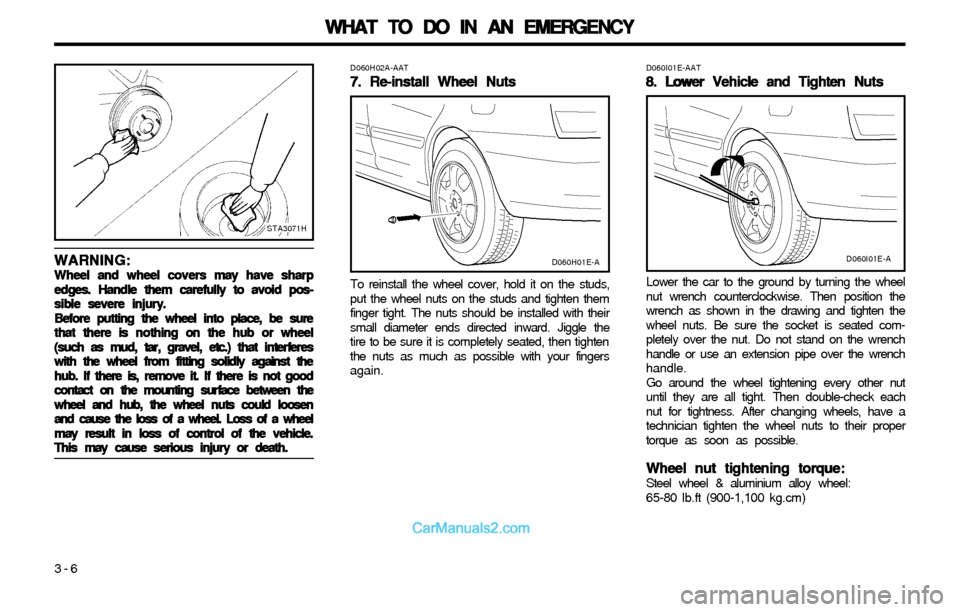
WARNING: WARNING:WARNING: WARNING:
WARNING:Wheel and wheel covers may have sharp Wheel and wheel covers may have sharpWheel and wheel covers may have sharp Wheel and wheel covers may have sharp
Wheel and wheel covers may have sharp
edges. Handle them carefully to avoid pos- edges. Handle them carefully to avoid pos-edges. Handle them carefully to avoid pos- edges. Handle them carefully to avoid pos-
edges. Handle them carefully to avoid pos-
sible severe injury. sible severe injury.sible severe injury. sible severe injury.
sible severe injury.
Before putting the wheel into place, be sure Before putting the wheel into place, be sureBefore putting the wheel into place, be sure Before putting the wheel into place, be sure
Before putting the wheel into place, be sure
that there is nothing on the hub or wheel that there is nothing on the hub or wheelthat there is nothing on the hub or wheel that there is nothing on the hub or wheel
that there is nothing on the hub or wheel
(such as mud, tar, gravel, etc.) that interferes (such as mud, tar, gravel, etc.) that interferes(such as mud, tar, gravel, etc.) that interferes (such as mud, tar, gravel, etc.) that interferes
(such as mud, tar, gravel, etc.) that interferes
with the wheel from fitting solidly against the with the wheel from fitting solidly against thewith the wheel from fitting solidly against the with the wheel from fitting solidly against the
with the wheel from fitting solidly against the
hub. If there is, remove it. If there is not good hub. If there is, remove it. If there is not goodhub. If there is, remove it. If there is not good hub. If there is, remove it. If there is not good
hub. If there is, remove it. If there is not good
contact on the mounting surface between the contact on the mounting surface between thecontact on the mounting surface between the contact on the mounting surface between the
contact on the mounting surface between the
wheel and hub, the wheel nuts could loosen wheel and hub, the wheel nuts could loosenwheel and hub, the wheel nuts could loosen wheel and hub, the wheel nuts could loosen
wheel and hub, the wheel nuts could loosen
and cause the loss of a wheel. Loss of a wheel and cause the loss of a wheel. Loss of a wheeland cause the loss of a wheel. Loss of a wheel and cause the loss of a wheel. Loss of a wheel
and cause the loss of a wheel. Loss of a wheel
may result in loss of control of the vehicle. may result in loss of control of the vehicle.may result in loss of control of the vehicle. may result in loss of control of the vehicle.
may result in loss of control of the vehicle.
This may cause serious injury or death. This may cause serious injury or death.This may cause serious injury or death. This may cause serious injury or death.
This may cause serious injury or death.
D060H02A-AAT
7. Re-install Wheel Nuts 7. Re-install Wheel Nuts7. Re-install Wheel Nuts 7. Re-install Wheel Nuts
7. Re-install Wheel Nuts
To reinstall the wheel cover, hold it on the studs,
put the wheel nuts on the studs and tighten them
finger tight. The nuts should be installed with their
small diameter ends directed inward. Jiggle the
tire to be sure it is completely seated, then tighten
the nuts as much as possible with your fingers
again.Lower the car to the ground by turning the wheel
nut wrench counterclockwise. Then position the
wrench as shown in the drawing and tighten the
wheel nuts. Be sure the socket is seated com-
pletely over the nut. Do not stand on the wrench
handle or use an extension pipe over the wrench
handle.
Go around the wheel tightening every other nut
until they are all tight. Then double-check each
nut for tightness. After changing wheels, have a
technician tighten the wheel nuts to their proper
torque as soon as possible.
Wheel nut tightening torque: Wheel nut tightening torque:Wheel nut tightening torque: Wheel nut tightening torque:
Wheel nut tightening torque:Steel wheel & aluminium alloy wheel:
65-80 lb.ft (900-1,100 kg.cm)
D060I01E-AAT
8. Lower Vehicle and Tighten Nuts 8. Lower Vehicle and Tighten Nuts8. Lower Vehicle and Tighten Nuts 8. Lower Vehicle and Tighten Nuts
8. Lower Vehicle and Tighten Nuts
D060H01E-AD060I01E-A
Page 122 of 172
WHAT TO DO IN AN EMERGENCY WHAT TO DO IN AN EMERGENCYWHAT TO DO IN AN EMERGENCY WHAT TO DO IN AN EMERGENCY
WHAT TO DO IN AN EMERGENCY
3-7
D060J01E-AAT
After Changing Wheels After Changing WheelsAfter Changing Wheels After Changing Wheels
After Changing Wheels
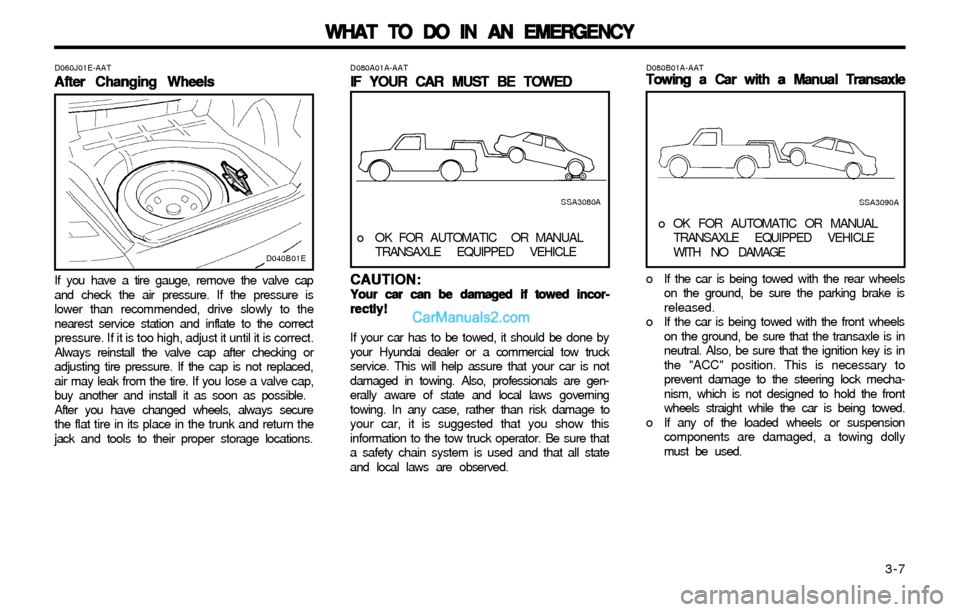
If you have a tire gauge, remove the valve cap
and check the air pressure. If the pressure is
lower than recommended, drive slowly to the
nearest service station and inflate to the correct
pressure. If it is too high, adjust it until it is correct.
Always reinstall the valve cap after checking or
adjusting tire pressure. If the cap is not replaced,
air may leak from the tire. If you lose a valve cap,
buy another and install it as soon as possible.
After you have changed wheels, always secure
the flat tire in its place in the trunk and return the
jack and tools to their proper storage locations.
D080A01A-AAT
IF YOUR CAR MUST BE TOWED IF YOUR CAR MUST BE TOWEDIF YOUR CAR MUST BE TOWED IF YOUR CAR MUST BE TOWED
IF YOUR CAR MUST BE TOWED
CAUTION: CAUTION:CAUTION: CAUTION:
CAUTION:
Your car can be damaged if towed incor- Your car can be damaged if towed incor-Your car can be damaged if towed incor- Your car can be damaged if towed incor-
Your car can be damaged if towed incor-
rectly! rectly!rectly! rectly!
rectly!
If your car has to be towed, it should be done by
your Hyundai dealer or a commercial tow truck
service. This will help assure that your car is not
damaged in towing. Also, professionals are gen-
erally aware of state and local laws governing
towing. In any case, rather than risk damage to
your car, it is suggested that you show this
information to the tow truck operator. Be sure that
a safety chain system is used and that all state
and local laws are observed.
D080B01A-AATTowing a Car with a Manual Transaxle Towing a Car with a Manual TransaxleTowing a Car with a Manual Transaxle Towing a Car with a Manual Transaxle
Towing a Car with a Manual Transaxle
o If the car is being towed with the rear wheels
on the ground, be sure the parking brake is
released.
o If the car is being towed with the front wheels
on the ground, be sure that the transaxle is in
neutral. Also, be sure that the ignition key is in
the "ACC" position. This is necessary to
prevent damage to the steering lock mecha-
nism, which is not designed to hold the front
wheels straight while the car is being towed.
o If any of the loaded wheels or suspension
components are damaged, a towing dolly
must be used.
o OK FOR AUTOMATIC OR MANUAL
TRANSAXLE EQUIPPED VEHICLE
SSA3080A
o OK FOR AUTOMATIC OR MANUAL
TRANSAXLE EQUIPPED VEHICLE
WITH NO DAMAGE
SSA3090A
D040B01E
Page 124 of 172

WHAT TO DO IN AN EMERGENCY WHAT TO DO IN AN EMERGENCYWHAT TO DO IN AN EMERGENCY WHAT TO DO IN AN EMERGENCY
WHAT TO DO IN AN EMERGENCY
3-9
D120A01A-AAT
IF YOU LOSE YOUR KEYS IF YOU LOSE YOUR KEYSIF YOU LOSE YOUR KEYS IF YOU LOSE YOUR KEYS
IF YOU LOSE YOUR KEYSIf you lose your keys, many Hyundai dealers can
make you a new key if you have your key
number.
If you lock the keys inside your car and you
cannot obtain a new key, many Hyundai dealers
can use special tools to open the door for you.
CAUTION: CAUTION:CAUTION: CAUTION:
CAUTION:If the car is being towed with all four wheels If the car is being towed with all four wheelsIf the car is being towed with all four wheels If the car is being towed with all four wheels
If the car is being towed with all four wheels
on the ground, it can be towed only from the on the ground, it can be towed only from theon the ground, it can be towed only from the on the ground, it can be towed only from the
on the ground, it can be towed only from the
front. Be sure that the transaxle is in neutral. front. Be sure that the transaxle is in neutral.front. Be sure that the transaxle is in neutral. front. Be sure that the transaxle is in neutral.
front. Be sure that the transaxle is in neutral.
Do not tow at speeds greater than 30 mph (50 Do not tow at speeds greater than 30 mph (50Do not tow at speeds greater than 30 mph (50 Do not tow at speeds greater than 30 mph (50
Do not tow at speeds greater than 30 mph (50
km/h) and for more than 15 miles (25 km). Be km/h) and for more than 15 miles (25 km). Bekm/h) and for more than 15 miles (25 km). Be km/h) and for more than 15 miles (25 km). Be
km/h) and for more than 15 miles (25 km). Be
sure the steering is unlocked by placing the sure the steering is unlocked by placing thesure the steering is unlocked by placing the sure the steering is unlocked by placing the
sure the steering is unlocked by placing the
key in the "ACC" position. A driver must be in key in the "ACC" position. A driver must be inkey in the "ACC" position. A driver must be in key in the "ACC" position. A driver must be in
key in the "ACC" position. A driver must be in
the towed vehicle to operate the steering and the towed vehicle to operate the steering andthe towed vehicle to operate the steering and the towed vehicle to operate the steering and
the towed vehicle to operate the steering and
brakes. brakes.brakes. brakes.
brakes.
Page 139 of 172
DO-IT-YOURSELF MAINTENANCE DO-IT-YOURSELF MAINTENANCEDO-IT-YOURSELF MAINTENANCE DO-IT-YOURSELF MAINTENANCE
DO-IT-YOURSELF MAINTENANCE
6-3
G020B01A-AAT
Vehicle Exterior Vehicle ExteriorVehicle Exterior Vehicle Exterior
Vehicle ExteriorThe following should be checked monthly:
o Overall appearance and condition
o Wheel condition and wheel nut torque
o Exhaust system condition
o Light condition and operation
o Windshield glass condition
o Wiper blade condition
o Paint condition and body corrosion
o Fluid leaks
o Door and hood lock condition
o Tire pressure and condition (including spare
tire)
G020C01A-AAT
Vehicle Interior Vehicle InteriorVehicle Interior Vehicle Interior
Vehicle InteriorThe following should be checked each time
when the vehicle is driven:
o Lights operation
o Windshield wiper operation
o Horn operation
o Defroster, heating system operation (and air
conditioning, if installed)
o Steering operation and condition
o Mirror condition and operation
o Turn signal operation
o Accelerator pedal operation
o Brake operation, including parking brake
o Manual transaxle operation, including clutch
operation
o Automatic transaxle operation, including
"Park" mechanism operation
o Seat control condition and operation
o Seat belt condition and operation
o Sunvisor operation
If you notice anything that does not operate
correctly or appears to be functioning incorrect-
ly, inspect it carefully and seek assistance from
your Hyundai dealer if service is needed.
G030A01A-AAT
CHECKING THE ENGINE OIL CHECKING THE ENGINE OILCHECKING THE ENGINE OIL CHECKING THE ENGINE OIL
CHECKING THE ENGINE OILEngine oil is essential to the performance and
service of the engine. It is suggested that you
check the oil level at least once a week in
normal use and more often if you are on a trip
or driving in severe conditions.
G030B02A-AAT
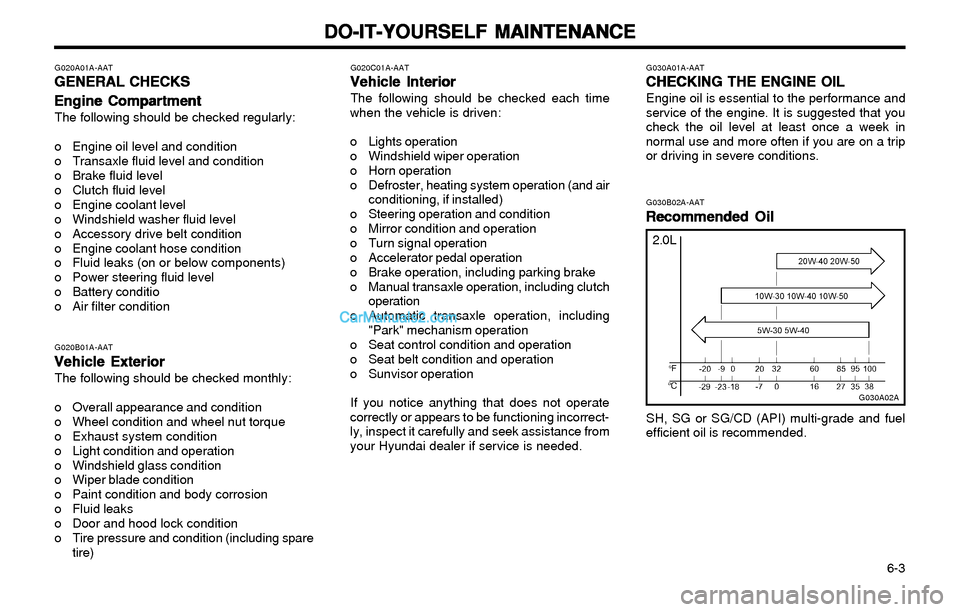
Recommended Oil Recommended OilRecommended Oil Recommended Oil
Recommended Oil
G030A02A
2.0L
SH, SG or SG/CD (API) multi-grade and fuel
efficient oil is recommended.
G020A01A-AAT
GENERAL CHECKS GENERAL CHECKSGENERAL CHECKS GENERAL CHECKS
GENERAL CHECKS
Engine Compartment Engine CompartmentEngine Compartment Engine Compartment
Engine Compartment
The following should be checked regularly:
o Engine oil level and condition
o Transaxle fluid level and condition
o Brake fluid level
o Clutch fluid level
o Engine coolant level
o Windshield washer fluid level
o Accessory drive belt condition
o Engine coolant hose condition
o Fluid leaks (on or below components)
o Power steering fluid level
o Battery conditio
o Air filter condition
Page 140 of 172
DO-IT-YOURSELF MAINTENANCE DO-IT-YOURSELF MAINTENANCEDO-IT-YOURSELF MAINTENANCE DO-IT-YOURSELF MAINTENANCE
DO-IT-YOURSELF MAINTENANCE
6-4
G030B02A
G030C01A-AAT
To Check the Oil Level To Check the Oil LevelTo Check the Oil Level To Check the Oil Level
To Check the Oil Level
G030D01A-AAT
Adding Oil Adding OilAdding Oil Adding Oil
Adding Oil
Wait a minute, then remove the dipstick, wipe it
off, fully reinsert the dipstick and withdraw it
again. Then note the highest level the oil has
reached on the dipstick. It should be between
the upper ("FULL") and lower ("LOW") range.
If the oil level is close to or below the "LOW"
mark, add oil until it reaches the "FULL" mark.
To add oil:
1. Remove the oil filler cap by turning it counter-
clockwise.
2. Add oil, then check the level again. Do not
overfill.
3. Replace the cap by turning it clockwise.
The distance between the "FULL" and "LOW"
marks is equal to about 1 quart of oil.
G030C01E-1
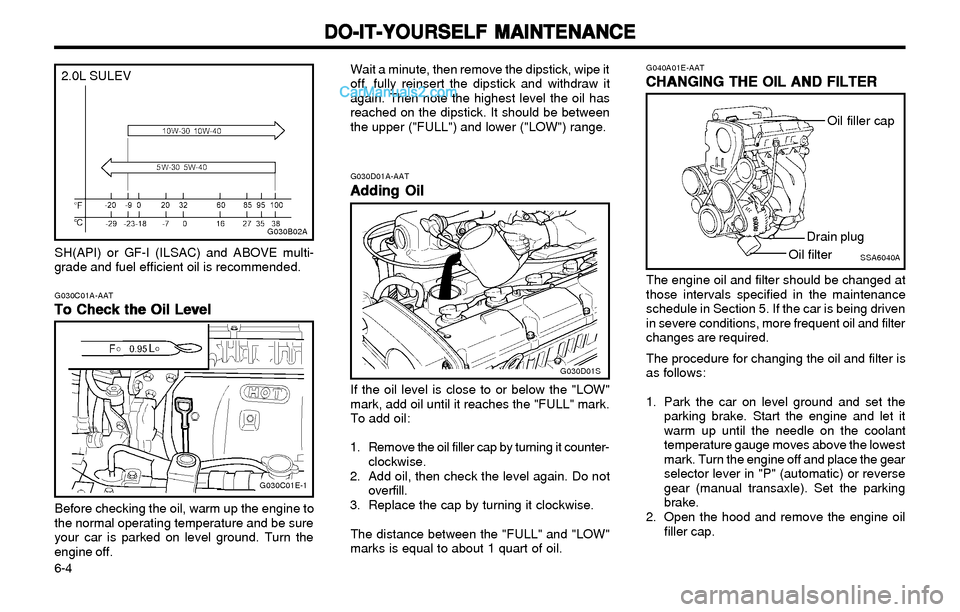
SH(API) or GF-I (ILSAC) and ABOVE multi-
grade and fuel efficient oil is recommended.
G040A01E-AAT
CHANGING THE OIL AND FILTER CHANGING THE OIL AND FILTERCHANGING THE OIL AND FILTER CHANGING THE OIL AND FILTER
CHANGING THE OIL AND FILTER
The engine oil and filter should be changed at
those intervals specified in the maintenance
schedule in Section 5. If the car is being driven
in severe conditions, more frequent oil and filter
changes are required.
The procedure for changing the oil and filter is
as follows:
1. Park the car on level ground and set the
parking brake. Start the engine and let it
warm up until the needle on the coolant
temperature gauge moves above the lowest
mark. Turn the engine off and place the gear
selector lever in "P" (automatic) or reverse
gear (manual transaxle). Set the parking
brake.
2. Open the hood and remove the engine oil
filler cap.
SSA6040A
Oil filler cap
Drain plug
Oil filter 2.0L SULEV
Before checking the oil, warm up the engine to
the normal operating temperature and be sure
your car is parked on level ground. Turn the
engine off.
G030D01S
Page 141 of 172
DO-IT-YOURSELF MAINTENANCE DO-IT-YOURSELF MAINTENANCEDO-IT-YOURSELF MAINTENANCE DO-IT-YOURSELF MAINTENANCE
DO-IT-YOURSELF MAINTENANCE
6-5 3. Slide underneath the car and loosen the
drain plug by turning it counterclockwise
with a wrench of the proper size. Be sure
that a drain pan is in position to catch the oil
as it drains out, then remove the drain plug.
WARNING: WARNING:WARNING: WARNING:
WARNING:Be very careful when draining the engine oil Be very careful when draining the engine oilBe very careful when draining the engine oil Be very careful when draining the engine oil
Be very careful when draining the engine oil
as it may be hot enough to burn you! as it may be hot enough to burn you!as it may be hot enough to burn you! as it may be hot enough to burn you!
as it may be hot enough to burn you!
4. When the oil has stopped draining, replace
the drain plug using a new washer and
retighten by turning it clockwise.
Drain plug tightening torque: Drain plug tightening torque:Drain plug tightening torque: Drain plug tightening torque:
Drain plug tightening torque:
4.0 ~ 4.5 kgf.m 4.0 ~ 4.5 kgf.m4.0 ~ 4.5 kgf.m 4.0 ~ 4.5 kgf.m
4.0 ~ 4.5 kgf.m
5. Remove the oil filter. You should be able to
unscrew the filter with your hands. (If your
hands are slippery, try to use a cloth be-
tween your hands and the filter to give
yourself a better grip.) A certain amount of
oil will come out when you remove the filter,
so be sure to have your drain pan in place
underneath it.
6. Install a new oil filter in accordance with the
instructions on the carton or on the filter
itself. Do not over-tighten.
Oil filter tightening torque : 1.2 ~ 1.6 kgf.m Oil filter tightening torque : 1.2 ~ 1.6 kgf.mOil filter tightening torque : 1.2 ~ 1.6 kgf.m Oil filter tightening torque : 1.2 ~ 1.6 kgf.m
Oil filter tightening torque : 1.2 ~ 1.6 kgf.m
Be sure that the mounting surface on the
engine is clean and that the old gasket is
removed completely. Lubricate the new gas-
ket on the filter with clean engine oil before
installation.7. Refill the crankcase with the recommended
engine oil. Refer to the specification in chap-
ter 9 for engine oil capacity.
8. Start the engine and check to be sure no oil
is leaking from the drain plug or oil filter.
9. Shut off the engine and recheck the oil level.NOTE: NOTE:NOTE: NOTE:
NOTE:Always dispose of used engine oil in an Always dispose of used engine oil in anAlways dispose of used engine oil in an Always dispose of used engine oil in an
Always dispose of used engine oil in an
environmentally acceptable manner. It is sug- environmentally acceptable manner. It is sug-environmentally acceptable manner. It is sug- environmentally acceptable manner. It is sug-
environmentally acceptable manner. It is sug-
gested that it be placed in a sealed container gested that it be placed in a sealed containergested that it be placed in a sealed container gested that it be placed in a sealed container
gested that it be placed in a sealed container
and taken to a service station for reclama- and taken to a service station for reclama-and taken to a service station for reclama- and taken to a service station for reclama-
and taken to a service station for reclama-
tion. Do not pour the oil on the ground or tion. Do not pour the oil on the ground ortion. Do not pour the oil on the ground or tion. Do not pour the oil on the ground or
tion. Do not pour the oil on the ground or
put it into the household trash. put it into the household trash.put it into the household trash. put it into the household trash.
put it into the household trash.
WARNING: WARNING:WARNING: WARNING:
WARNING:Used motor oil may cause irritation or can- Used motor oil may cause irritation or can-Used motor oil may cause irritation or can- Used motor oil may cause irritation or can-
Used motor oil may cause irritation or can-
cer of the skin if left in contact with the skin cer of the skin if left in contact with the skincer of the skin if left in contact with the skin cer of the skin if left in contact with the skin
cer of the skin if left in contact with the skin
for prolonged periods of time. Wash your for prolonged periods of time. Wash yourfor prolonged periods of time. Wash your for prolonged periods of time. Wash your
for prolonged periods of time. Wash your
hands thoroughly with soap and warm wa- hands thoroughly with soap and warm wa-hands thoroughly with soap and warm wa- hands thoroughly with soap and warm wa-
hands thoroughly with soap and warm wa-
ter as soon as possible after handling used ter as soon as possible after handling usedter as soon as possible after handling used ter as soon as possible after handling used
ter as soon as possible after handling used
oil. oil.oil. oil.
oil.
G050A01A-AATCHECKING AND CHANGING THE CHECKING AND CHANGING THECHECKING AND CHANGING THE CHECKING AND CHANGING THE
CHECKING AND CHANGING THE
ENGINE COOLANT ENGINE COOLANTENGINE COOLANT ENGINE COOLANT
ENGINE COOLANT
WARNING: WARNING:WARNING: WARNING:
WARNING:
Do not remove the radiator cap when the Do not remove the radiator cap when theDo not remove the radiator cap when the Do not remove the radiator cap when the
Do not remove the radiator cap when the
engine is hot. When the engine is hot, the engine is hot. When the engine is hot, theengine is hot. When the engine is hot, the engine is hot. When the engine is hot, the
engine is hot. When the engine is hot, the
engine coolant is under pressure and may engine coolant is under pressure and mayengine coolant is under pressure and may engine coolant is under pressure and may
engine coolant is under pressure and may
erupt through the opening if the cap is erupt through the opening if the cap iserupt through the opening if the cap is erupt through the opening if the cap is
erupt through the opening if the cap is
removed. You could be seriously burned if removed. You could be seriously burned ifremoved. You could be seriously burned if removed. You could be seriously burned if
removed. You could be seriously burned if
you do not observe this precaution. Do not you do not observe this precaution. Do notyou do not observe this precaution. Do not you do not observe this precaution. Do not
you do not observe this precaution. Do not
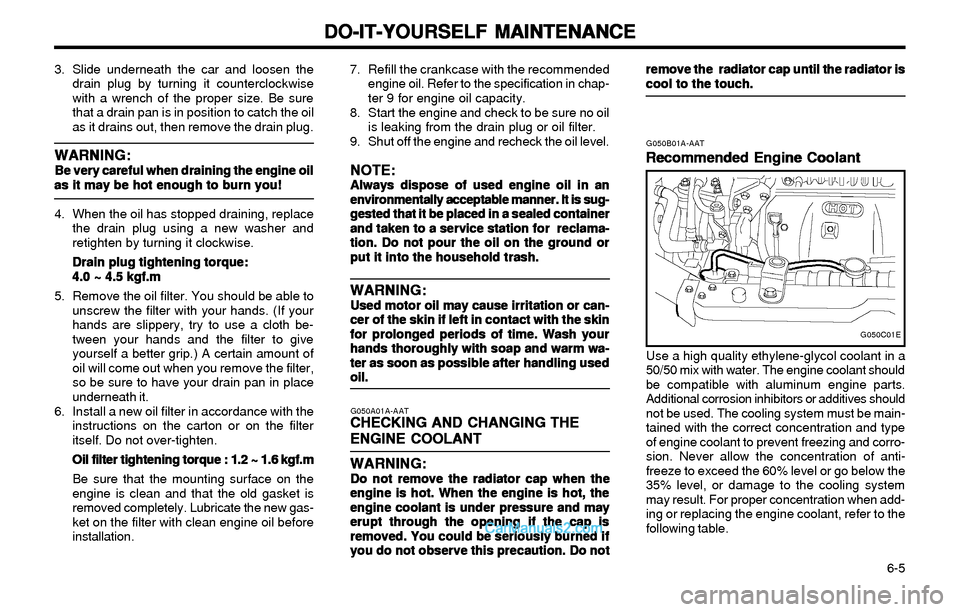
G050B01A-AAT
Recommended Engine Coolant Recommended Engine CoolantRecommended Engine Coolant Recommended Engine Coolant
Recommended Engine Coolant
Use a high quality ethylene-glycol coolant in a
50/50 mix with water. The engine coolant should
be compatible with aluminum engine parts.
Additional corrosion inhibitors or additives should
not be used. The cooling system must be main-
tained with the correct concentration and type
of engine coolant to prevent freezing and corro-
sion. Never allow the concentration of anti-
freeze to exceed the 60% level or go below the
35% level, or damage to the cooling system
may result. For proper concentration when add-
ing or replacing the engine coolant, refer to the
following table.
G050C01E
remove the radiator cap until the radiator is remove the radiator cap until the radiator isremove the radiator cap until the radiator is remove the radiator cap until the radiator is
remove the radiator cap until the radiator is
cool to the touch. cool to the touch.cool to the touch. cool to the touch.
cool to the touch.
Page 142 of 172
DO-IT-YOURSELF MAINTENANCE DO-IT-YOURSELF MAINTENANCEDO-IT-YOURSELF MAINTENANCE DO-IT-YOURSELF MAINTENANCE
DO-IT-YOURSELF MAINTENANCE
6-6
Ambient
temperature
°C ( °F)
G050C01A-AAT
To Check the Coolant Level To Check the Coolant LevelTo Check the Coolant Level To Check the Coolant Level
To Check the Coolant Level
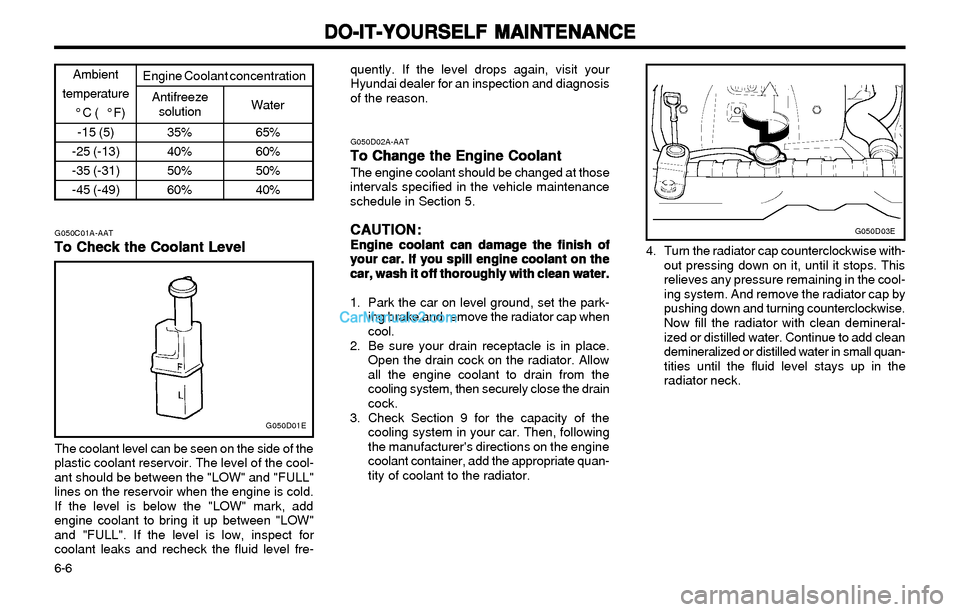
The coolant level can be seen on the side of the
plastic coolant reservoir. The level of the cool-
ant should be between the "LOW" and "FULL"
lines on the reservoir when the engine is cold.
If the level is below the "LOW" mark, add
engine coolant to bring it up between "LOW"
and "FULL". If the level is low, inspect for
coolant leaks and recheck the fluid level fre-quently. If the level drops again, visit your
Hyundai dealer for an inspection and diagnosis
of the reason.
G050D02A-AAT
To Change the Engine Coolant To Change the Engine CoolantTo Change the Engine Coolant To Change the Engine Coolant
To Change the Engine CoolantThe engine coolant should be changed at those
intervals specified in the vehicle maintenance
schedule in Section 5.
CAUTION: CAUTION:CAUTION: CAUTION:
CAUTION:Engine coolant can damage the finish of Engine coolant can damage the finish ofEngine coolant can damage the finish of Engine coolant can damage the finish of
Engine coolant can damage the finish of
your car. If you spill engine coolant on the your car. If you spill engine coolant on theyour car. If you spill engine coolant on the your car. If you spill engine coolant on the
your car. If you spill engine coolant on the
car, wash it off thoroughly with clean water. car, wash it off thoroughly with clean water.car, wash it off thoroughly with clean water. car, wash it off thoroughly with clean water.
car, wash it off thoroughly with clean water.
1. Park the car on level ground, set the park-
ing brake and remove the radiator cap when
cool.
2. Be sure your drain receptacle is in place.
Open the drain cock on the radiator. Allow
all the engine coolant to drain from the
cooling system, then securely close the drain
cock.
3. Check Section 9 for the capacity of the
cooling system in your car. Then, following
the manufacturer's directions on the engine
coolant container, add the appropriate quan-
tity of coolant to the radiator.
G050D01E
Engine Coolant concentration
Antifreeze
solutionWater
35%
40%
50%
60% -15 (5)
-25 (-13)
-35 (-31)
-45 (-49)65%
60%
50%
40%
4. Turn the radiator cap counterclockwise with-
out pressing down on it, until it stops. This
relieves any pressure remaining in the cool-
ing system. And remove the radiator cap by
pushing down and turning counterclockwise.
Now fill the radiator with clean demineral-
ized or distilled water. Continue to add clean
demineralized or distilled water in small quan-
tities until the fluid level stays up in the
radiator neck.
G050D03E
Page 144 of 172

DO-IT-YOURSELF MAINTENANCE DO-IT-YOURSELF MAINTENANCEDO-IT-YOURSELF MAINTENANCE DO-IT-YOURSELF MAINTENANCE
DO-IT-YOURSELF MAINTENANCE
6-8
WARNING: WARNING:WARNING: WARNING:
WARNING:It is recommended that the engine be cool It is recommended that the engine be coolIt is recommended that the engine be cool It is recommended that the engine be cool
It is recommended that the engine be cool
or cold when changing the spark plugs. If or cold when changing the spark plugs. Ifor cold when changing the spark plugs. If or cold when changing the spark plugs. If
or cold when changing the spark plugs. If
the engine is hot, you could burn yourself the engine is hot, you could burn yourselfthe engine is hot, you could burn yourself the engine is hot, you could burn yourself
the engine is hot, you could burn yourself
on the insulated connector, the spark plug on the insulated connector, the spark plugon the insulated connector, the spark plug on the insulated connector, the spark plug
on the insulated connector, the spark plug
or the engine itself. or the engine itself.or the engine itself. or the engine itself.
or the engine itself.
4. When preparing to remove the old spark
plug, guide the socket down over the spark
plug, being careful not to damage the ce-
ramic insulator.
5. To remove the spark plug, turn the wrench
handle in a counterclockwise direction.
6. To replace the new spark plug, guide the
socket down over the spark plug, being
careful not to damage the ceramic insulator.You will find it easier to change spark plugs if
the engine is cold. Always change one spark
plug at a time. This helps avoid getting the wires
mixed up.
1. Remove the center cover on the engine
rocker cover.
2. Using a clean cloth, remove any dirt that has
accumulated around the spark plug so it
cannot fall into the cylinder when the spark
plug is removed.
3. To remove the spark plug cable, pull straight
up on the insulated connector, not the cable.
Pulling on the cable may damage the carbon
core conductor.
HGK257 G060C01S-AAT
Changing the Spark Plugs Changing the Spark PlugsChanging the Spark Plugs Changing the Spark Plugs
Changing the Spark Plugs
HGK256
HGK258
NOTE: NOTE:NOTE: NOTE:
NOTE:Spark plugs should be tightened firmly. Over- Spark plugs should be tightened firmly. Over-Spark plugs should be tightened firmly. Over- Spark plugs should be tightened firmly. Over-
Spark plugs should be tightened firmly. Over-
tightening can damage the threads in the tightening can damage the threads in thetightening can damage the threads in the tightening can damage the threads in the
tightening can damage the threads in the
aluminum cylinder head. Leaving them too aluminum cylinder head. Leaving them tooaluminum cylinder head. Leaving them too aluminum cylinder head. Leaving them too
aluminum cylinder head. Leaving them too
loose can cause the spark plugs to get very loose can cause the spark plugs to get veryloose can cause the spark plugs to get very loose can cause the spark plugs to get very
loose can cause the spark plugs to get very
hot and possibly result in damage to the hot and possibly result in damage to thehot and possibly result in damage to the hot and possibly result in damage to the
hot and possibly result in damage to the
engine. engine.engine. engine.
engine.
7. Replace the cable by pushing the insulated
connector directly down onto the electrode.
Check to be sure it has snapped into place
and can't fall off.
Page 146 of 172
DO-IT-YOURSELF MAINTENANCE DO-IT-YOURSELF MAINTENANCEDO-IT-YOURSELF MAINTENANCE DO-IT-YOURSELF MAINTENANCE
DO-IT-YOURSELF MAINTENANCE
6-10
G100A04A-AATCHECKING THE TRANSAXLE OIL CHECKING THE TRANSAXLE OILCHECKING THE TRANSAXLE OIL CHECKING THE TRANSAXLE OIL
CHECKING THE TRANSAXLE OIL
(MANUAL) (MANUAL)(MANUAL) (MANUAL)
(MANUAL)
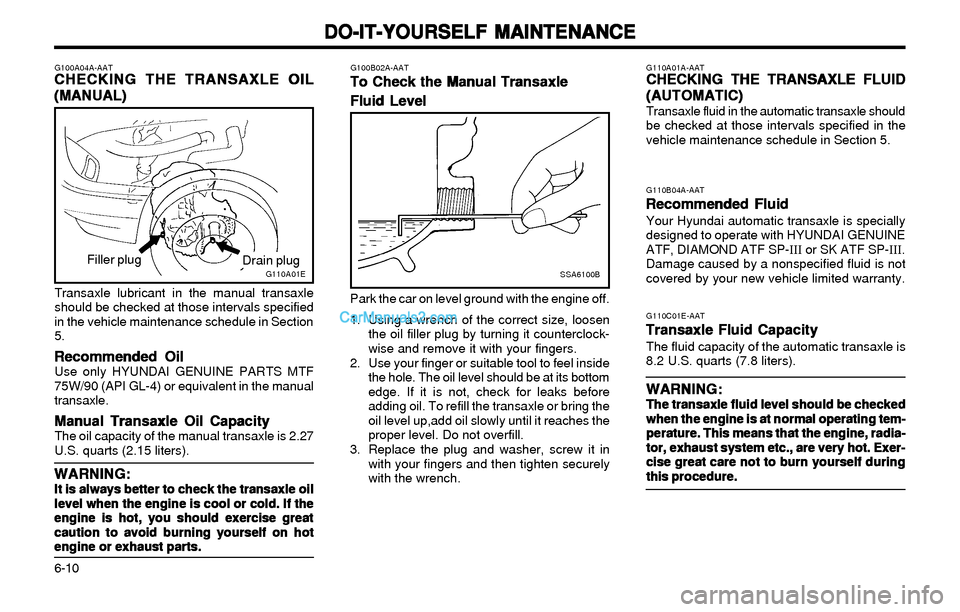
Transaxle lubricant in the manual transaxle
should be checked at those intervals specified
in the vehicle maintenance schedule in Section
5.
Recommended Oil Recommended OilRecommended Oil Recommended Oil
Recommended OilUse only HYUNDAI GENUINE PARTS MTF
75W/90 (API GL-4) or equivalent in the manual
transaxle.
Manual Transaxle Oil Capacity Manual Transaxle Oil CapacityManual Transaxle Oil Capacity Manual Transaxle Oil Capacity
Manual Transaxle Oil CapacityThe oil capacity of the manual transaxle is 2.27
U.S. quarts (2.15 liters).
WARNING: WARNING:WARNING: WARNING:
WARNING:It is always better to check the transaxle oil It is always better to check the transaxle oilIt is always better to check the transaxle oil It is always better to check the transaxle oil
It is always better to check the transaxle oil
level when the engine is cool or cold. If the level when the engine is cool or cold. If thelevel when the engine is cool or cold. If the level when the engine is cool or cold. If the
level when the engine is cool or cold. If the
engine is hot, you should exercise great engine is hot, you should exercise greatengine is hot, you should exercise great engine is hot, you should exercise great
engine is hot, you should exercise great
caution to avoid burning yourself on hot caution to avoid burning yourself on hotcaution to avoid burning yourself on hot caution to avoid burning yourself on hot
caution to avoid burning yourself on hot
engine or exhaust parts. engine or exhaust parts.engine or exhaust parts. engine or exhaust parts.
engine or exhaust parts.
G100B02A-AAT
To Check the Manual Transaxle To Check the Manual TransaxleTo Check the Manual Transaxle To Check the Manual Transaxle
To Check the Manual Transaxle
Fluid Level Fluid LevelFluid Level Fluid Level
Fluid Level
SSA6100B
Park the car on level ground with the engine off.
1. Using a wrench of the correct size, loosen
the oil filler plug by turning it counterclock-
wise and remove it with your fingers.
2. Use your finger or suitable tool to feel inside
the hole. The oil level should be at its bottom
edge. If it is not, check for leaks before
adding oil. To refill the transaxle or bring the
oil level up,add oil slowly until it reaches the
proper level. Do not overfill.
3. Replace the plug and washer, screw it in
with your fingers and then tighten securely
with the wrench.
G110A01EDrain plugFiller plug
G110A01A-AATCHECKING THE TRANSAXLE FLUID CHECKING THE TRANSAXLE FLUIDCHECKING THE TRANSAXLE FLUID CHECKING THE TRANSAXLE FLUID
CHECKING THE TRANSAXLE FLUID
(AUTOMATIC) (AUTOMATIC)(AUTOMATIC) (AUTOMATIC)
(AUTOMATIC)
Transaxle fluid in the automatic transaxle should
be checked at those intervals specified in the
vehicle maintenance schedule in Section 5.
G110B04A-AAT
Recommended Fluid Recommended FluidRecommended Fluid Recommended Fluid
Recommended FluidYour Hyundai automatic transaxle is specially
designed to operate with HYUNDAI GENUINE
ATF, DIAMOND ATF SP-III or SK ATF SP-III.
Damage caused by a nonspecified fluid is not
covered by your new vehicle limited warranty.
G110C01E-AAT
Transaxle Fluid Capacity Transaxle Fluid CapacityTransaxle Fluid Capacity Transaxle Fluid Capacity
Transaxle Fluid CapacityThe fluid capacity of the automatic transaxle is
8.2 U.S. quarts (7.8 liters).
WARNING: WARNING:WARNING: WARNING:
WARNING:The transaxle fluid level should be checked The transaxle fluid level should be checkedThe transaxle fluid level should be checked The transaxle fluid level should be checked
The transaxle fluid level should be checked
when the engine is at normal operating tem- when the engine is at normal operating tem-when the engine is at normal operating tem- when the engine is at normal operating tem-
when the engine is at normal operating tem-
perature. This means that the engine, radia- perature. This means that the engine, radia-perature. This means that the engine, radia- perature. This means that the engine, radia-
perature. This means that the engine, radia-
tor, exhaust system etc., are very hot. Exer- tor, exhaust system etc., are very hot. Exer-tor, exhaust system etc., are very hot. Exer- tor, exhaust system etc., are very hot. Exer-
tor, exhaust system etc., are very hot. Exer-
cise great care not to burn yourself during cise great care not to burn yourself duringcise great care not to burn yourself during cise great care not to burn yourself during
cise great care not to burn yourself during
this procedure. this procedure.this procedure. this procedure.
this procedure.
Page 159 of 172
CONSUMER INFORMATION & REPORTING SAFETY DEFECTS CONSUMER INFORMATION & REPORTING SAFETY DEFECTSCONSUMER INFORMATION & REPORTING SAFETY DEFECTS CONSUMER INFORMATION & REPORTING SAFETY DEFECTS
CONSUMER INFORMATION & REPORTING SAFETY DEFECTS
8-1
TEMPORARY USE ONLY
420(60)
8. 8.8. 8.
8.
CONSUMER CONSUMERCONSUMER CONSUMER
CONSUMER
INFORMA INFORMAINFORMA INFORMA
INFORMA
TION & TION &TION & TION &
TION &
REPOR REPORREPOR REPOR
REPOR
TING TINGTING TING
TING
SAFETY DEFECTS SAFETY DEFECTSSAFETY DEFECTS SAFETY DEFECTS
SAFETY DEFECTSI030A02S-AATRECOMMENDED INFLATION RECOMMENDED INFLATIONRECOMMENDED INFLATION RECOMMENDED INFLATION
RECOMMENDED INFLATION
PRESSURES PRESSURESPRESSURES PRESSURES
PRESSURES
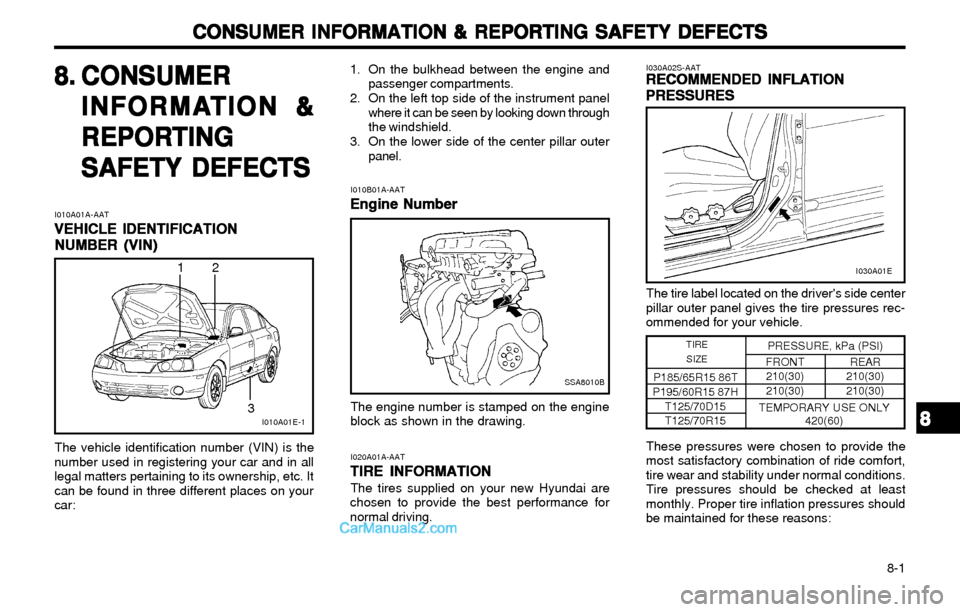
The tire label located on the driver's side center
pillar outer panel gives the tire pressures rec-
ommended for your vehicle.
I030A01E
I010A01A-AAT
VEHICLE IDENTIFICATION VEHICLE IDENTIFICATIONVEHICLE IDENTIFICATION VEHICLE IDENTIFICATION
VEHICLE IDENTIFICATION
NUMBER (VIN) NUMBER (VIN)NUMBER (VIN) NUMBER (VIN)
NUMBER (VIN)
The vehicle identification number (VIN) is the
number used in registering your car and in all
legal matters pertaining to its ownership, etc. It
can be found in three different places on your
car:1. On the bulkhead between the engine and
passenger compartments.
2. On the left top side of the instrument panel
where it can be seen by looking down through
the windshield.
3. On the lower side of the center pillar outer
panel.
I010B01A-AAT
Engine Number Engine NumberEngine Number Engine Number
Engine Number
The engine number is stamped on the engine
block as shown in the drawing.
I020A01A-AAT
TIRE INFORMATION TIRE INFORMATIONTIRE INFORMATION TIRE INFORMATION
TIRE INFORMATION
The tires supplied on your new Hyundai are
chosen to provide the best performance for
normal driving.
SSA8010B
I010A01E-1
12
3
8 88 8
8
These pressures were chosen to provide the
most satisfactory combination of ride comfort,
tire wear and stability under normal conditions.
Tire pressures should be checked at least
monthly. Proper tire inflation pressures should
be maintained for these reasons:
TIRE
SIZEPRESSURE, kPa (PSI)
P185/65R15 86T
P195/60R15 87H
T125/70D15
T125/70R15REAR
210(30)
210(30) FRONT
210(30)
210(30)