fold seats Hyundai Elantra 2003 Owner's Manual
[x] Cancel search | Manufacturer: HYUNDAI, Model Year: 2003, Model line: Elantra, Model: Hyundai Elantra 2003Pages: 172, PDF Size: 2.82 MB
Page 18 of 172
FEATURES OF YOUR HYUNDAI FEATURES OF YOUR HYUNDAIFEATURES OF YOUR HYUNDAI FEATURES OF YOUR HYUNDAI
FEATURES OF YOUR HYUNDAI
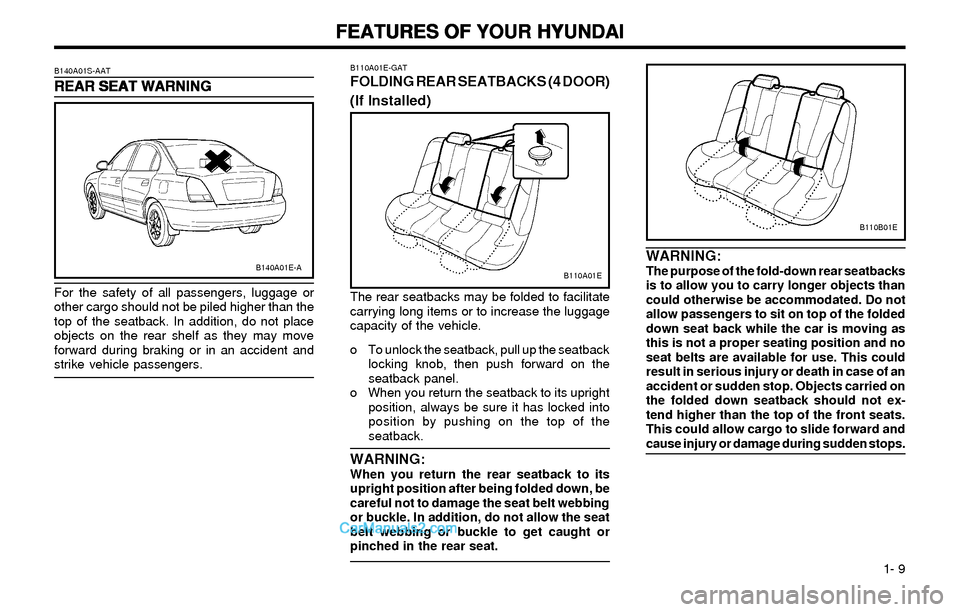
1- 9 For the safety of all passengers, luggage or
other cargo should not be piled higher than the
top of the seatback. In addition, do not place
objects on the rear shelf as they may move
forward during braking or in an accident and
strike vehicle passengers.
B140A01S-AAT
REAR SEAT WARNING REAR SEAT WARNINGREAR SEAT WARNING REAR SEAT WARNING
REAR SEAT WARNING
B140A01E-A
The rear seatbacks may be folded to facilitate
carrying long items or to increase the luggage
capacity of the vehicle.
o To unlock the seatback, pull up the seatback
locking knob, then push forward on the
seatback panel.
o When you return the seatback to its upright
position, always be sure it has locked into
position by pushing on the top of the
seatback.
WARNING:When you return the rear seatback to its
upright position after being folded down, be
careful not to damage the seat belt webbing
or buckle. In addition, do not allow the seat
belt webbing or buckle to get caught or
pinched in the rear seat.
B110A01E-GATFOLDING REAR SEATBACKS (4 DOOR)
(If Installed)
B110A01E
B110B01E
WARNING:The purpose of the fold-down rear seatbacks
is to allow you to carry longer objects than
could otherwise be accommodated. Do not
allow passengers to sit on top of the folded
down seat back while the car is moving as
this is not a proper seating position and no
seat belts are available for use. This could
result in serious injury or death in case of an
accident or sudden stop. Objects carried on
the folded down seatback should not ex-
tend higher than the top of the front seats.
This could allow cargo to slide forward and
cause injury or damage during sudden stops.
Page 20 of 172
FEATURES OF YOUR HYUNDAI FEATURES OF YOUR HYUNDAIFEATURES OF YOUR HYUNDAI FEATURES OF YOUR HYUNDAI
FEATURES OF YOUR HYUNDAI
1- 11
B150A01S-AAT
SEAT BELT PRECAUTIONS SEAT BELT PRECAUTIONSSEAT BELT PRECAUTIONS SEAT BELT PRECAUTIONS
SEAT BELT PRECAUTIONS
WARNING: WARNING:WARNING: WARNING:
WARNING:
All occupants of the vehicle must wear their All occupants of the vehicle must wear theirAll occupants of the vehicle must wear their All occupants of the vehicle must wear their
All occupants of the vehicle must wear their
seat belts at all times. Note that this vehicle seat belts at all times. Note that this vehicleseat belts at all times. Note that this vehicle seat belts at all times. Note that this vehicle
seat belts at all times. Note that this vehicle
is equipped with a Supplemental Restraint is equipped with a Supplemental Restraintis equipped with a Supplemental Restraint is equipped with a Supplemental Restraint
is equipped with a Supplemental Restraint
(Airbag) System as discussed beginning on (Airbag) System as discussed beginning on(Airbag) System as discussed beginning on (Airbag) System as discussed beginning on
(Airbag) System as discussed beginning on
page 1-21. The seat belts must be used in page 1-21. The seat belts must be used inpage 1-21. The seat belts must be used in page 1-21. The seat belts must be used in
page 1-21. The seat belts must be used in
conjunction with the supplemental airbag conjunction with the supplemental airbagconjunction with the supplemental airbag conjunction with the supplemental airbag
conjunction with the supplemental airbag
system. State laws may require that some or system. State laws may require that some orsystem. State laws may require that some or system. State laws may require that some or
system. State laws may require that some or
all occupants of the vehicle use seat belts. all occupants of the vehicle use seat belts.all occupants of the vehicle use seat belts. all occupants of the vehicle use seat belts.
all occupants of the vehicle use seat belts.
The possibility of increased injury or sever- The possibility of increased injury or sever-The possibility of increased injury or sever- The possibility of increased injury or sever-
The possibility of increased injury or sever-
ity of injury in an accident will be increased ity of injury in an accident will be increasedity of injury in an accident will be increased ity of injury in an accident will be increased
ity of injury in an accident will be increased
if this elementary safety precaution is not if this elementary safety precaution is notif this elementary safety precaution is not if this elementary safety precaution is not
if this elementary safety precaution is not
observed. In addition, the following recom- observed. In addition, the following recom-observed. In addition, the following recom- observed. In addition, the following recom-
observed. In addition, the following recom-
mendations are made: mendations are made:mendations are made: mendations are made:
mendations are made:
WARNING:o Before folding the seatback, place the
rear seat belt buckles in the buckle clips
on the seatback. This will prevent the
seat belt buckles from becoming cov-
ered by the seat cushion when it is re-
turned to the seating position.
o When you return the folded down seat
back to its upright position, make sure
the seat belts are in position to be acces-
sible and to function properly.
o WARNING LABEL: When returning the
seat cushion to the seating position, place
the seat belt buckles on top of the cush-
ion.
o The purpose of the fold down rear seat
back and the fold forward rear seat cush-
ion is to increase cargo space. Do not
allow passengers to sit in the cargo area
while the car is moving. This is not a
proper seating position and no seat belts
are available for use when the seat back
is folded down. Passengers who are not
properly seated and wearing seat belts
could sustain serious injuries or death in
case of an accident or a sudden stop.
o Objects should not extend higher than
the top of the front seatbacks. This could
allow cargo to slide forward and cause
injury or damage during sudden stops.
o When you return the folded down seat
back to its upright position, always be
sure to place the rear seat belt buckles
on the seat cushion below the seatback.o When you return the folded down
seatback to its upright position, always
be sure to install the headrests in their
proper positions. Headrests are impor-
tant to the safety of occupants in a rear
collision. If the headrests are not in-
stalled in their proper position, serious
injury or death could result if a rear end
collision occurs.
B150B03Y-AATInfant or Small ChildAll 50 states have child restraint laws. You
should be aware of the specific requirements in
your state. Child and/or infant safety seats
must be properly placed and installed in the
rear seat. Information about the use of these
restraints begins on page 1-16.
WARNING:Every person in your vehicle needs to be
properly restrained at all times, including
infants and children. In a collision, an unre-
strained child can become a "missile" in-
side the car. The force required to hold a
child on your lap could be so great that you
could not hold the child. Any child riding in
the vehicle should always be in a proper
restraint in the rear seat of the vehicle.
NOTE:Small children are best protected from in-
jury in an accident when properly restrained
in the rear seat by a child restraint system
that meets the requirements of the Federal
Motor Vehicle Safety Standards. Before buy-
ing any child restraint system, make sure
that it has a label certifying that it meets
Motor Vehicle Safety Standard 213. The re-
straint must be appropriate for your child's
height and weight. Check the label on the
child restraint for this information. See page
1-16.
Page 21 of 172
FEATURES OF YOUR HYUNDAI FEATURES OF YOUR HYUNDAIFEATURES OF YOUR HYUNDAI FEATURES OF YOUR HYUNDAI
FEATURES OF YOUR HYUNDAI
1- 12
Instead, it will be in front of you. In a crash Instead, it will be in front of you. In a crashInstead, it will be in front of you. In a crash Instead, it will be in front of you. In a crash
Instead, it will be in front of you. In a crash
you could go into it with great force , receiv- you could go into it with great force , receiv-you could go into it with great force , receiv- you could go into it with great force , receiv-
you could go into it with great force , receiv-
ing serious neck or other injuries. ing serious neck or other injuries.ing serious neck or other injuries. ing serious neck or other injuries.
ing serious neck or other injuries.
The lap belt can't do its job either. In a crash The lap belt can't do its job either. In a crashThe lap belt can't do its job either. In a crash The lap belt can't do its job either. In a crash
The lap belt can't do its job either. In a crash
the belt could go up over your abdomen. the belt could go up over your abdomen.the belt could go up over your abdomen. the belt could go up over your abdomen.
the belt could go up over your abdomen.
The belt forces would be applied there, not The belt forces would be applied there, notThe belt forces would be applied there, not The belt forces would be applied there, not
The belt forces would be applied there, not
at your strong pelvic bones. at your strong pelvic bones.at your strong pelvic bones. at your strong pelvic bones.
at your strong pelvic bones.
This could cause serious internal injuries. This could cause serious internal injuries.This could cause serious internal injuries. This could cause serious internal injuries.
This could cause serious internal injuries.
For proper protection when the vehicle is For proper protection when the vehicle isFor proper protection when the vehicle is For proper protection when the vehicle is
For proper protection when the vehicle is
in motion, have the seatback upright. in motion, have the seatback upright.in motion, have the seatback upright. in motion, have the seatback upright.
in motion, have the seatback upright.
Then sit back in the seat and wear your seat Then sit back in the seat and wear your seatThen sit back in the seat and wear your seat Then sit back in the seat and wear your seat
Then sit back in the seat and wear your seat
belt properly. See page 1-14. belt properly. See page 1-14.belt properly. See page 1-14. belt properly. See page 1-14.
belt properly. See page 1-14.
B160A01A-AAT
CARE OF SEAT BELTS CARE OF SEAT BELTSCARE OF SEAT BELTS CARE OF SEAT BELTS
CARE OF SEAT BELTSSeat belt systems should never be disassem-
bled or modified. In addition, care should be
taken to assure that seat belts and belt hard-
ware are not damaged by seat hinges, doors or
other abuse.
WARNING: WARNING:WARNING: WARNING:
WARNING:When you return the rear seatback to its When you return the rear seatback to itsWhen you return the rear seatback to its When you return the rear seatback to its
When you return the rear seatback to its
upright position after the rear seatback was upright position after the rear seatback wasupright position after the rear seatback was upright position after the rear seatback was
upright position after the rear seatback was
folded down, be careful not to damage the folded down, be careful not to damage thefolded down, be careful not to damage the folded down, be careful not to damage the
folded down, be careful not to damage the
seat belt webbing or buckle. Be sure that the seat belt webbing or buckle. Be sure that theseat belt webbing or buckle. Be sure that the seat belt webbing or buckle. Be sure that the
seat belt webbing or buckle. Be sure that the
webbing or buckle does not get caught or webbing or buckle does not get caught orwebbing or buckle does not get caught or webbing or buckle does not get caught or
webbing or buckle does not get caught or
pinched in the rear seat. pinched in the rear seat.pinched in the rear seat. pinched in the rear seat.
pinched in the rear seat.
B150D01S-AAT
Pregnant Women Pregnant WomenPregnant Women Pregnant Women
Pregnant WomenThe use of a seat belt is recommended for
pregnant women to lessen the chance of injury
in an accident. When a seat belt is used, it should
be placed as low and snugly as possible on the
hips, not across the abdomen. For specific
recommendations, consult a physician.
B150E01A-AAT
Injured Person Injured PersonInjured Person Injured Person
Injured PersonA seat belt should be used when an injured
person is being transported. When this is nec-
essary, you should consult a physician for
recommendations.
B150F01A-AAT
One Person Per Belt One Person Per BeltOne Person Per Belt One Person Per Belt
One Person Per BeltTwo people (including children) should never
attempt to use a single seat belt. This could
increase the severity of injuries in case of an
accident.
B150G01A-AAT
Do Not Lie Down Do Not Lie DownDo Not Lie Down Do Not Lie Down
Do Not Lie DownTo reduce the chance of injuries in the event of
an accident, and to achieve maximum effec-
tiveness of the restraint system, all passengers
should be sitting up and the front seats should
be in an upright position when the car is moving.
A seat belt cannot provide proper protection if
the person is lying down in the rear seat or if the
front seat is in a reclined position.
WARNING: WARNING:WARNING: WARNING:
WARNING:Sitting in a reclined position or lying down Sitting in a reclined position or lying downSitting in a reclined position or lying down Sitting in a reclined position or lying down
Sitting in a reclined position or lying down
when your vehicle is in motion can be dan- when your vehicle is in motion can be dan-when your vehicle is in motion can be dan- when your vehicle is in motion can be dan-
when your vehicle is in motion can be dan-
gerous. Even if you buckle up, your seat gerous. Even if you buckle up, your seatgerous. Even if you buckle up, your seat gerous. Even if you buckle up, your seat
gerous. Even if you buckle up, your seat
belts can't do their job when you're reclined. belts can't do their job when you're reclined.belts can't do their job when you're reclined. belts can't do their job when you're reclined.
belts can't do their job when you're reclined.
The shoulder belt can't do its job because it The shoulder belt can't do its job because itThe shoulder belt can't do its job because it The shoulder belt can't do its job because it
The shoulder belt can't do its job because it
won't be against your body. won't be against your body.won't be against your body. won't be against your body.
won't be against your body.
B150C03A-AATLarger ChildrenChildren who are too large for child restraint
systems should always occupy the rear seat
and use the available lap/shoulder belts. The
lap portion should be fastened snug on the hips
and as low as possible. Check belt fit periodi-
cally. A child's squirming could put the belt out
of position. Children are afforded the most
safety in the event of an accident when they are
restrained by a proper restraint system in the
rear seat. If a larger child (over age 13) must
be seated in the front seat, the child should be
securely restrained by the available lap/shoul-
der belt and the seat should be placed in the
rearmost position. Children under the age of 13
should be restrained securely in the rear seat.
Never place a child under the age of 13 in the
front seat. NEVER place a rear facing child seat
in the front seat of a vehicle.