coolant temperature Hyundai Elantra 2003 Owner's Manual
[x] Cancel search | Manufacturer: HYUNDAI, Model Year: 2003, Model line: Elantra, Model: Hyundai Elantra 2003Pages: 172, PDF Size: 2.82 MB
Page 42 of 172
FEATURES OF YOUR HYUNDAI FEATURES OF YOUR HYUNDAIFEATURES OF YOUR HYUNDAI FEATURES OF YOUR HYUNDAI
FEATURES OF YOUR HYUNDAI
1- 33
B290A01E B290A02A-AAT
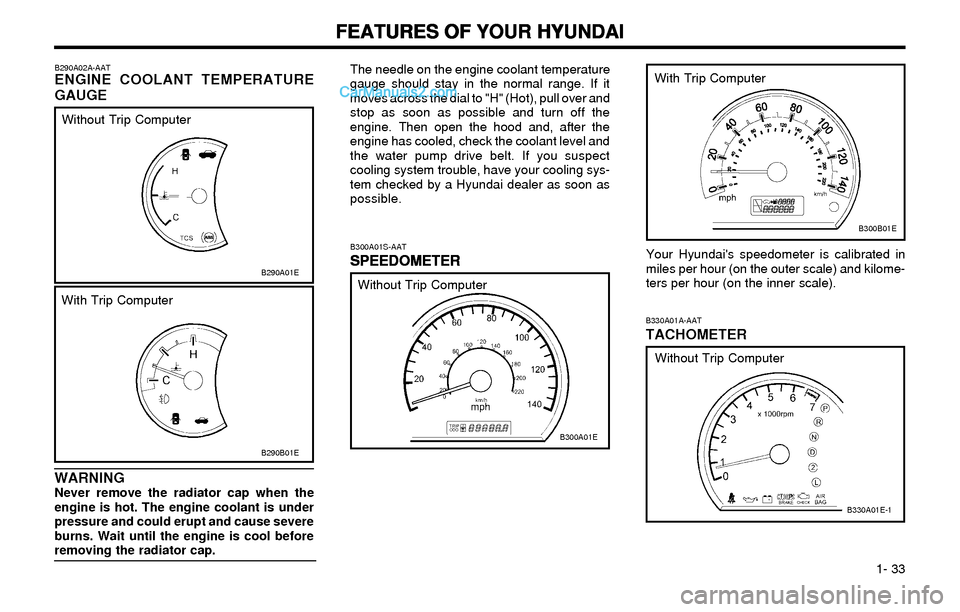
ENGINE COOLANT TEMPERATURE
GAUGE
B290B01E
Without Trip Computer
With Trip Computer
WARNINGNever remove the radiator cap when the
engine is hot. The engine coolant is under
pressure and could erupt and cause severe
burns. Wait until the engine is cool before
removing the radiator cap.
The needle on the engine coolant temperature
gauge should stay in the normal range. If it
moves across the dial to "H" (Hot), pull over and
stop as soon as possible and turn off the
engine. Then open the hood and, after the
engine has cooled, check the coolant level and
the water pump drive belt. If you suspect
cooling system trouble, have your cooling sys-
tem checked by a Hyundai dealer as soon as
possible.
B300A01S-AAT
SPEEDOMETER SPEEDOMETERSPEEDOMETER SPEEDOMETER
SPEEDOMETERYour Hyundai's speedometer is calibrated in
miles per hour (on the outer scale) and kilome-
ters per hour (on the inner scale).
B300A01E
B300B01E
Without Trip ComputerWith Trip Computer
B330A01A-AATTACHOMETER
Without Trip Computer
B330A01E-1
Page 112 of 172

DRIVING YOUR HYUNDAI DRIVING YOUR HYUNDAIDRIVING YOUR HYUNDAI DRIVING YOUR HYUNDAI
DRIVING YOUR HYUNDAI
2- 11 accordance with the maintenance schedule in
Section 5. Before winter, have your coolant test-
ed to assure that its freezing point is sufficient for
the temperatures anticipated during the winter.
C160D01A-AAT
Check Battery and Cables Check Battery and CablesCheck Battery and Cables Check Battery and Cables
Check Battery and CablesWinter puts additional burdens on the battery
system. Visually inspect the battery and cables
as described in Section 6. The level of charge in
your battery can be checked by your Hyundai
dealer or a service station.
C160E01A-AATChange to "Winter Weight" Oil if Change to "Winter Weight" Oil ifChange to "Winter Weight" Oil if Change to "Winter Weight" Oil if
Change to "Winter Weight" Oil if
Necessary NecessaryNecessary Necessary
Necessary
In some climates it is recommended that a lower
viscosity "winter weight" oil be used during cold
weather. See Section 9 for recommendations. If
you aren't sure what weight oil you should use,
consult your Hyundai dealer.
C160F01A-AATCheck Spark Plugs and Ignition Check Spark Plugs and IgnitionCheck Spark Plugs and Ignition Check Spark Plugs and Ignition
Check Spark Plugs and Ignition
System SystemSystem System
System
Inspect your spark plugs as described in Section
6 and replace them if necessary. Also check all
ignition wiring and components to be sure they
are not cracked, worn or damaged in any way.
C160G01A-AAT
To Keep Locks from Freezing To Keep Locks from FreezingTo Keep Locks from Freezing To Keep Locks from Freezing
To Keep Locks from FreezingTo keep the locks from freezing, squirt an ap-
proved de-icer fluid or glycerine into the key
opening. If a lock is covered with ice, squirt it with
an approved de-icing fluid to remove the ice. If
the lock is frozen internally, you may be able to
thaw it out by using a heated key. Handle the
heated key with care to avoid burning the fingers.
C160H01A-AATUse Approved Anti-Freeze in Window Use Approved Anti-Freeze in WindowUse Approved Anti-Freeze in Window Use Approved Anti-Freeze in Window
Use Approved Anti-Freeze in Window
Washer System Washer SystemWasher System Washer System
Washer System
To keep the water in the window washer system
from freezing, add an approved anti-freeze solu-
tion in accordance with instructions on the con-
tainer. Window washer anti-freeze is available
from Hyundai dealers and most auto parts out-
lets. Do not use engine coolant or other types of
anti-freeze as these may damage the finish.
C160I01A-AAT
Don't Let Your Parking Brake Freeze Don't Let Your Parking Brake FreezeDon't Let Your Parking Brake Freeze Don't Let Your Parking Brake Freeze
Don't Let Your Parking Brake FreezeUnder some conditions your parking brake can
freeze in the engaged position. This is most likely
to happen when there is an accumulation of snow
or ice around or near the rear brakes or if the
brakes are wet. If there is a risk the parking brake
may freeze, apply it only temporarily while you
put the gear selector lever in "P" (automatic) or in
first or reverse gear (manual transaxle) and
block the rear wheels so the car cannot roll. Then
release the parking brake.
C160K01A-AAT
Carry Emergency Equipment Carry Emergency EquipmentCarry Emergency Equipment Carry Emergency Equipment
Carry Emergency EquipmentDepending on the severity of the weather where
you drive your car, you should carry appropriate
emergency equipment. Some of the items you
may want to carry include tire chains, tow straps
or chains, flashlight, emergency flares, sand, a
shovel, jumper cables, a window scraper, gloves,
ground cloth, coveralls, a blanket, etc.
C160J01A-AAT
Don't Let Ice and Snow Accumulate Don't Let Ice and Snow AccumulateDon't Let Ice and Snow Accumulate Don't Let Ice and Snow Accumulate
Don't Let Ice and Snow Accumulate
Underneath UnderneathUnderneath Underneath
Underneath
Under some conditions, snow and ice can build
up under the fenders and interfere with the steer-
ing. When driving in severe winter conditions
where this may happen, you should periodically
check underneath the car to be sure the move-
ment of the front wheels and the steering compo-
nents is not obstructed.
C170A01A-AAT
HIGHER SPEED MOTORING HIGHER SPEED MOTORINGHIGHER SPEED MOTORING HIGHER SPEED MOTORING
HIGHER SPEED MOTORING
Pre-Trip Inspections Pre-Trip InspectionsPre-Trip Inspections Pre-Trip Inspections
Pre-Trip Inspections
1. Tires:
Adjust the tire inflation pressures to specifica-
tion. Low tire inflation pressures will result in
overheating and possible failure of the tires.
Avoid using worn or damaged tires which may
result in reduced traction or tire failure.
Page 113 of 172
DRIVING YOUR HYUNDAI DRIVING YOUR HYUNDAIDRIVING YOUR HYUNDAI DRIVING YOUR HYUNDAI
DRIVING YOUR HYUNDAI
2- 12
CAUTION: CAUTION:CAUTION: CAUTION:
CAUTION:Do not do any towing with your car during its Do not do any towing with your car during itsDo not do any towing with your car during its Do not do any towing with your car during its
Do not do any towing with your car during its
first 1,200 miles (2,000 km) in order to allow first 1,200 miles (2,000 km) in order to allowfirst 1,200 miles (2,000 km) in order to allow first 1,200 miles (2,000 km) in order to allow
first 1,200 miles (2,000 km) in order to allow
the engine to properly break in. Failure to the engine to properly break in. Failure tothe engine to properly break in. Failure to the engine to properly break in. Failure to
the engine to properly break in. Failure to
heed this caution may result in serious en- heed this caution may result in serious en-heed this caution may result in serious en- heed this caution may result in serious en-
heed this caution may result in serious en-
gine or transaxle damage. gine or transaxle damage.gine or transaxle damage. gine or transaxle damage.
gine or transaxle damage.
C190B01S-AAT
Trailer Hitches Trailer HitchesTrailer Hitches Trailer Hitches
Trailer HitchesSelect the proper hitch and ball combination,
making sure that it's location is compatible with
that of the trailer or vehicle being towed.
Use a quality non-equalizing hitch which distrib-
utes the tongue load uniformly throughout the
chassis.
The hitch should be bolted securely to the car
and installed by a qualified technician. DO NOT
USE A HITCH DESIGNED FOR TEMPORARY
INSTALLATION AND NEVER USE ONE THAT
ATTACHES ONLY TO THE BUMPER.
C190C03S-AAT
Trailer Brakes Trailer BrakesTrailer Brakes Trailer Brakes
Trailer BrakesIf your trailer is equipped with a braking system,
make sure it conforms to federal and/or local
regulations and that it is properly installed and
operating correctly.
NOTE: NOTE:NOTE: NOTE:
NOTE:If you tow a trailer or vehicle, your car will If you tow a trailer or vehicle, your car willIf you tow a trailer or vehicle, your car will If you tow a trailer or vehicle, your car will
If you tow a trailer or vehicle, your car will
require more frequent maintenance due to require more frequent maintenance due torequire more frequent maintenance due to require more frequent maintenance due to
require more frequent maintenance due to
the additional load. See "Maintenance Under the additional load. See "Maintenance Underthe additional load. See "Maintenance Under the additional load. See "Maintenance Under
the additional load. See "Maintenance Under
Severe Usage Conditions" on page 5-5. Severe Usage Conditions" on page 5-5.Severe Usage Conditions" on page 5-5. Severe Usage Conditions" on page 5-5.
Severe Usage Conditions" on page 5-5.
CAUTION: CAUTION:CAUTION: CAUTION:
CAUTION:o oo o
o
Never connect a trailer brake system di- Never connect a trailer brake system di-Never connect a trailer brake system di- Never connect a trailer brake system di-
Never connect a trailer brake system di-
rectly to the vehicle brake system. rectly to the vehicle brake system.rectly to the vehicle brake system. rectly to the vehicle brake system.
rectly to the vehicle brake system.
o oo o
o
When towing a trailer on steep grades (in When towing a trailer on steep grades (inWhen towing a trailer on steep grades (in When towing a trailer on steep grades (in
When towing a trailer on steep grades (in
excess of 12%) pay close attention to the excess of 12%) pay close attention to theexcess of 12%) pay close attention to the excess of 12%) pay close attention to the
excess of 12%) pay close attention to the
engine coolant temperature gauge to en- engine coolant temperature gauge to en-engine coolant temperature gauge to en- engine coolant temperature gauge to en-
engine coolant temperature gauge to en-
sure the engine does not overheat. If the sure the engine does not overheat. If thesure the engine does not overheat. If the sure the engine does not overheat. If the
sure the engine does not overheat. If the
needle of the coolant temperature gauge needle of the coolant temperature gaugeneedle of the coolant temperature gauge needle of the coolant temperature gauge
needle of the coolant temperature gauge
moves across the dial towards "H" (HOT), moves across the dial towards "H" (HOT),moves across the dial towards "H" (HOT), moves across the dial towards "H" (HOT),
moves across the dial towards "H" (HOT),
pull over and stop as soon as it is safe to pull over and stop as soon as it is safe topull over and stop as soon as it is safe to pull over and stop as soon as it is safe to
pull over and stop as soon as it is safe to
do so, and allow the engine to idle until it do so, and allow the engine to idle until itdo so, and allow the engine to idle until it do so, and allow the engine to idle until it
do so, and allow the engine to idle until it
cools down. You may proceed once the cools down. You may proceed once thecools down. You may proceed once the cools down. You may proceed once the
cools down. You may proceed once the
engine has cooled sufficiently. engine has cooled sufficiently.engine has cooled sufficiently. engine has cooled sufficiently.
engine has cooled sufficiently.
C190D01S-AAT
Safety Chains Safety ChainsSafety Chains Safety Chains
Safety ChainsShould the hitch connection between your car
and the trailer or vehicle you are towing fail, the
trailer or vehicle could wander dangerously across
other lanes of traffic and ultimately leave the
roadway. To eliminate this potentially dangerous
situation, safety chains, attached between your
car and the trailer or towed vehicle, are required
in most states.
NOTE: NOTE:NOTE: NOTE:
NOTE:Never exceed the maximum tire inflation pres- Never exceed the maximum tire inflation pres-Never exceed the maximum tire inflation pres- Never exceed the maximum tire inflation pres-
Never exceed the maximum tire inflation pres-
sure shown on the tires. sure shown on the tires.sure shown on the tires. sure shown on the tires.
sure shown on the tires.
2. Fuel, engine coolant and engine oil:
High speed travel consumes 1.5 times more fuel
than urban motoring. Do not forget to check both
engine coolant and engine oil.
3. Drive belt:
A loose or damaged drive belt may result in
overheating of the engine.
C180A01A-AAT
USE OF LIGHTS USE OF LIGHTSUSE OF LIGHTS USE OF LIGHTS
USE OF LIGHTSCheck your lights regularly for correct operation
and always keep them clean. When driving dur-
ing the day in conditions of poor visibility, it is
helpful to drive with headlights on low beam. This
enables you to be seen as well as to see.
C190A02S-AAT
TRAILER OR VEHICLE TOWING TRAILER OR VEHICLE TOWINGTRAILER OR VEHICLE TOWING TRAILER OR VEHICLE TOWING
TRAILER OR VEHICLE TOWINGIf you are considering towing with your car, you
should first check with your State's Department
of Motor Vehicles to determine their legal re-
quirements.
Since laws vary from State to State, the require-
ments for towing trailers, cars, other types of
vehicles, or apparatus may differ. Ask your
Hyundai dealer for further details before towing.
Page 117 of 172

WHAT TO DO IN AN EMERGENCY WHAT TO DO IN AN EMERGENCYWHAT TO DO IN AN EMERGENCY WHAT TO DO IN AN EMERGENCY
WHAT TO DO IN AN EMERGENCY
3-2
WARNING: WARNING:WARNING: WARNING:
WARNING:The gas produced by the battery during the The gas produced by the battery during theThe gas produced by the battery during the The gas produced by the battery during the
The gas produced by the battery during the
jump-start operation is highly explosive. If jump-start operation is highly explosive. Ifjump-start operation is highly explosive. If jump-start operation is highly explosive. If
jump-start operation is highly explosive. If
these instructions are not followed exactly, these instructions are not followed exactly,these instructions are not followed exactly, these instructions are not followed exactly,
these instructions are not followed exactly,
serious personal injury and damage to the serious personal injury and damage to theserious personal injury and damage to the serious personal injury and damage to the
serious personal injury and damage to the
vehicle may occur! If you are not sure how to vehicle may occur! If you are not sure how tovehicle may occur! If you are not sure how to vehicle may occur! If you are not sure how to
vehicle may occur! If you are not sure how to
follow this procedure, seek qualified assis- follow this procedure, seek qualified assis-follow this procedure, seek qualified assis- follow this procedure, seek qualified assis-
follow this procedure, seek qualified assis-
tance. Automobile batteries contain sulfuric tance. Automobile batteries contain sulfurictance. Automobile batteries contain sulfuric tance. Automobile batteries contain sulfuric
tance. Automobile batteries contain sulfuric
acid. This is poisonous and highly corrosive. acid. This is poisonous and highly corrosive.acid. This is poisonous and highly corrosive. acid. This is poisonous and highly corrosive.
acid. This is poisonous and highly corrosive.
When jump starting, wear protective glasses When jump starting, wear protective glassesWhen jump starting, wear protective glasses When jump starting, wear protective glasses
When jump starting, wear protective glasses
and be careful not to get acid on yourself, and be careful not to get acid on yourself,and be careful not to get acid on yourself, and be careful not to get acid on yourself,
and be careful not to get acid on yourself,
your clothing or on the car. your clothing or on the car.your clothing or on the car. your clothing or on the car.
your clothing or on the car.
o If you should accidentally get acid on your
skin or in your eyes, immediately remove any
contaminated clothing and flush the area with
clear water for at least 15 minutes. Then
promptly obtain medical attention. If you must
be transported to an emergency facility, con-
tinue to apply water to the affected area with
a sponge or cloth.
o The gas produced by the battery during the
jump-start operation is highly explosive. Do
not smoke or allow a spark or an open flame
in the vicinity.
o The battery being used to provide the jump
start must be 12-volt. If you cannot determine
that it is a 12-volt battery, do not attempt to
use it for the jump start.
o To jump start a car with a discharged battery,
follow this procedure exactly:1. If the booster battery is installed in another
vehicle, be sure the two vehicles are not
touching.
2. Turn off all unnecessary lights and acces-
sories in both vehicles.
3. Attach the clamps of the jumper cable in the
exact location shown in the illustration. First,
attach one clamp of the jumper cable to the
positive (+) post or cable of the discharged
battery. Then attach the other end of the
same cable to the positive (+) post or cable
of the booster battery. Next, using the other
cable, attach one clamp to the negative (-)
post or cable of the booster battery. Then
attach the other end of that cable to a solid
metal part of the engine away from the
battery. Do not connect the cable to any
moving part.
4. Start the engine in the car with the booster
battery and let it run for a few minutes. This
will help to assure that the booster battery is
fully charged. During the jumping operation,
run the engine in this vehicle at about 2,000
rpm.
5. Start the engine in the car with the discharged
battery using the normal starting procedure.
After the engine starts, leave the jumper
cables connected and let the engine run at
fast idle or about 2,000 rpm for several min-
utes.
6. Carefully remove the jumper cables in the
reverse order of attachment.
If you do not know why your battery became
discharged (because the lights were left on,
D030A01A-AAT
IF THE ENGINE OVERHEATS IF THE ENGINE OVERHEATSIF THE ENGINE OVERHEATS IF THE ENGINE OVERHEATS
IF THE ENGINE OVERHEATSIf your temperature gauge indicates overheating,
you experience a loss of power, or hear loud
pinging or knocking and the engine is probably
too hot. If this happens and, you should:
1. Pull off the road and stop as soon as it is safe
to do so.
2. Place the gear selector lever in "P" (auto-
matic), or neutral (manual transaxle) and set
the parking brake. If the air conditioning is on,
turn it off.
3. If engine coolant is running out under the car
or steam is coming out from the hood, stop
the engine. Do not open the hood until the
engine coolant has stopped running or the
steaming has stopped. If there is no visible
loss of engine coolant and no steam, leave
the engine running and check to be sure the
engine cooling fan is operating. If the fan is
not running, turn the engine off.
4. Check to see if the water pump drive belt is
missing. If it is not missing, check to see that
it is tight. If the drive belt seems to be satis-
factory, check for engine coolant leaking from
the radiator, hoses or under the car. (If the air
conditioning had been in use, it is normal for
cold water to be draining from it when you
stop).
etc.), have the charging system checked by your
Hyundai dealer.
Page 118 of 172

WHAT TO DO IN AN EMERGENCY WHAT TO DO IN AN EMERGENCYWHAT TO DO IN AN EMERGENCY WHAT TO DO IN AN EMERGENCY
WHAT TO DO IN AN EMERGENCY
3-3
D040B01A-AAT
Handling the Spare Tire Handling the Spare TireHandling the Spare Tire Handling the Spare Tire
Handling the Spare Tire
Remove the installation bolt to remove the spare
tire. To replace the spare tire in its storage
compartment, tighten the bolt firmly with your
fingers until there is no more play in the spare tire.
D050A01A-AAT
IF YOU HAVE A FLAT TIRE IF YOU HAVE A FLAT TIREIF YOU HAVE A FLAT TIRE IF YOU HAVE A FLAT TIRE
IF YOU HAVE A FLAT TIREIf a tire goes flat while you are driving:
1. Take your foot off the accelerator pedal and
let the car slow down while driving straight
ahead. Do not apply the brakes immediately
or attempt to pull off the road as this may
WARNING: WARNING:WARNING: WARNING:
WARNING:While the engine is running, keep hair, hands, While the engine is running, keep hair, hands,While the engine is running, keep hair, hands, While the engine is running, keep hair, hands,
While the engine is running, keep hair, hands,
and clothing away from moving parts such as and clothing away from moving parts such asand clothing away from moving parts such as and clothing away from moving parts such as
and clothing away from moving parts such as
the fan and drive belts to prevent injury. the fan and drive belts to prevent injury.the fan and drive belts to prevent injury. the fan and drive belts to prevent injury.
the fan and drive belts to prevent injury.
5. If the water pump drive belt is broken or
engine coolant is leaking out, stop the engine
immediately and call the nearest Hyundai
dealer for assistance.
WARNING: WARNING:WARNING: WARNING:
WARNING:Do not remove the radiator cap when the Do not remove the radiator cap when theDo not remove the radiator cap when the Do not remove the radiator cap when the
Do not remove the radiator cap when the
engine is hot. This can allow coolant to be engine is hot. This can allow coolant to beengine is hot. This can allow coolant to be engine is hot. This can allow coolant to be
engine is hot. This can allow coolant to be
blown out of the opening and cause serious blown out of the opening and cause seriousblown out of the opening and cause serious blown out of the opening and cause serious
blown out of the opening and cause serious
burns. burns.burns. burns.
burns.
6. If you cannot find the cause of the overheat-
ing, wait until the engine temperature has
returned to normal. Then, if the engine cool-
ant has been lost, carefully remove the radia-
tor cap and add engine coolant to bring the
fluid level in the reservoir up to the halfway
mark.
7. Proceed with caution, keeping alert for fur-
ther signs of overheating. If overheating hap-
pens again, call a Hyundai dealer for assis-
tance.
CAUTION: CAUTION:CAUTION: CAUTION:
CAUTION:Serious loss of engine coolant indicates there Serious loss of engine coolant indicates thereSerious loss of engine coolant indicates there Serious loss of engine coolant indicates there
Serious loss of engine coolant indicates there
is a leak in the cooling system and this should is a leak in the cooling system and this shouldis a leak in the cooling system and this should is a leak in the cooling system and this should
is a leak in the cooling system and this should
be checked as soon as possible by a Hyundai be checked as soon as possible by a Hyundaibe checked as soon as possible by a Hyundai be checked as soon as possible by a Hyundai
be checked as soon as possible by a Hyundai
dealer. dealer.dealer. dealer.
dealer.2. The spare tire should only be used temporari-
ly and should be returned to the luggage
compartment as soon as the original tire can
be repaired or replaced.
3. Continuous use at speeds of over 50 mph
(80 km/h) is not recommended.
4. As the temporary spare tire is specifically
designed for your car, it should not be used on
any other vehicle.
5. The temporary spare tire should not be used
on any other wheels, nor should standard
tires, snow tires, wheel covers or trim rings
be used with the temporary spare wheel. If
such use is attempted, damage to these
items or other car components may occur.
6. The temporary spare tire pressure should be
checked once a month while the tire is stored.
D040A01S-AAT
SPARE TIRE SPARE TIRESPARE TIRE SPARE TIRE
SPARE TIREThe following instructions for the temporary spare
tire should be observed:
1. Check inflation pressure as soon as possible
after installing the spare tire, and adjust to the
specified pressure. The tire pressure should
be periodically checked and maintained at
the specified pressure while the tire is stored.
Spare Tire Pressure Spare Tire PressureSpare Tire Pressure Spare Tire Pressure
Spare Tire Pressure
CAUTION: CAUTION:CAUTION: CAUTION:
CAUTION:o oo o
o
Do not use snow chains with your tempo- Do not use snow chains with your tempo-Do not use snow chains with your tempo- Do not use snow chains with your tempo-
Do not use snow chains with your tempo-
rary spare tire. rary spare tire.rary spare tire. rary spare tire.
rary spare tire.
o oo o
o
Do not use more than one temporary spare Do not use more than one temporary spareDo not use more than one temporary spare Do not use more than one temporary spare
Do not use more than one temporary spare
tire at a time. tire at a time.tire at a time. tire at a time.
tire at a time.
D040B01E
Tire Size
Inflation PressureT125/70D(R)15
60 psi (420 kPa)
Page 140 of 172
DO-IT-YOURSELF MAINTENANCE DO-IT-YOURSELF MAINTENANCEDO-IT-YOURSELF MAINTENANCE DO-IT-YOURSELF MAINTENANCE
DO-IT-YOURSELF MAINTENANCE
6-4
G030B02A
G030C01A-AAT
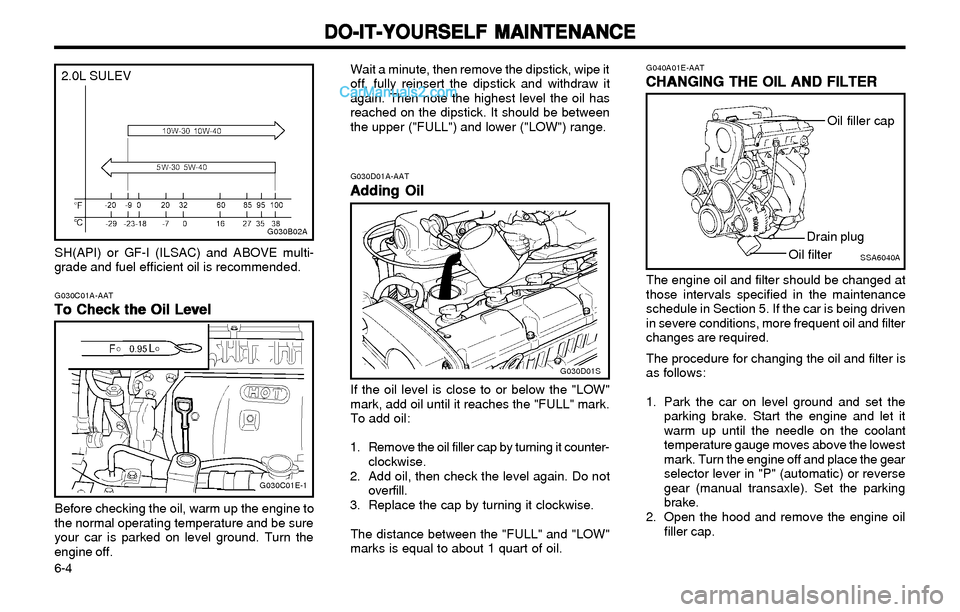
To Check the Oil Level To Check the Oil LevelTo Check the Oil Level To Check the Oil Level
To Check the Oil Level
G030D01A-AAT
Adding Oil Adding OilAdding Oil Adding Oil
Adding Oil
Wait a minute, then remove the dipstick, wipe it
off, fully reinsert the dipstick and withdraw it
again. Then note the highest level the oil has
reached on the dipstick. It should be between
the upper ("FULL") and lower ("LOW") range.
If the oil level is close to or below the "LOW"
mark, add oil until it reaches the "FULL" mark.
To add oil:
1. Remove the oil filler cap by turning it counter-
clockwise.
2. Add oil, then check the level again. Do not
overfill.
3. Replace the cap by turning it clockwise.
The distance between the "FULL" and "LOW"
marks is equal to about 1 quart of oil.
G030C01E-1
SH(API) or GF-I (ILSAC) and ABOVE multi-
grade and fuel efficient oil is recommended.
G040A01E-AAT
CHANGING THE OIL AND FILTER CHANGING THE OIL AND FILTERCHANGING THE OIL AND FILTER CHANGING THE OIL AND FILTER
CHANGING THE OIL AND FILTER
The engine oil and filter should be changed at
those intervals specified in the maintenance
schedule in Section 5. If the car is being driven
in severe conditions, more frequent oil and filter
changes are required.
The procedure for changing the oil and filter is
as follows:
1. Park the car on level ground and set the
parking brake. Start the engine and let it
warm up until the needle on the coolant
temperature gauge moves above the lowest
mark. Turn the engine off and place the gear
selector lever in "P" (automatic) or reverse
gear (manual transaxle). Set the parking
brake.
2. Open the hood and remove the engine oil
filler cap.
SSA6040A
Oil filler cap
Drain plug
Oil filter 2.0L SULEV
Before checking the oil, warm up the engine to
the normal operating temperature and be sure
your car is parked on level ground. Turn the
engine off.
G030D01S
Page 142 of 172
DO-IT-YOURSELF MAINTENANCE DO-IT-YOURSELF MAINTENANCEDO-IT-YOURSELF MAINTENANCE DO-IT-YOURSELF MAINTENANCE
DO-IT-YOURSELF MAINTENANCE
6-6
Ambient
temperature
°C ( °F)
G050C01A-AAT
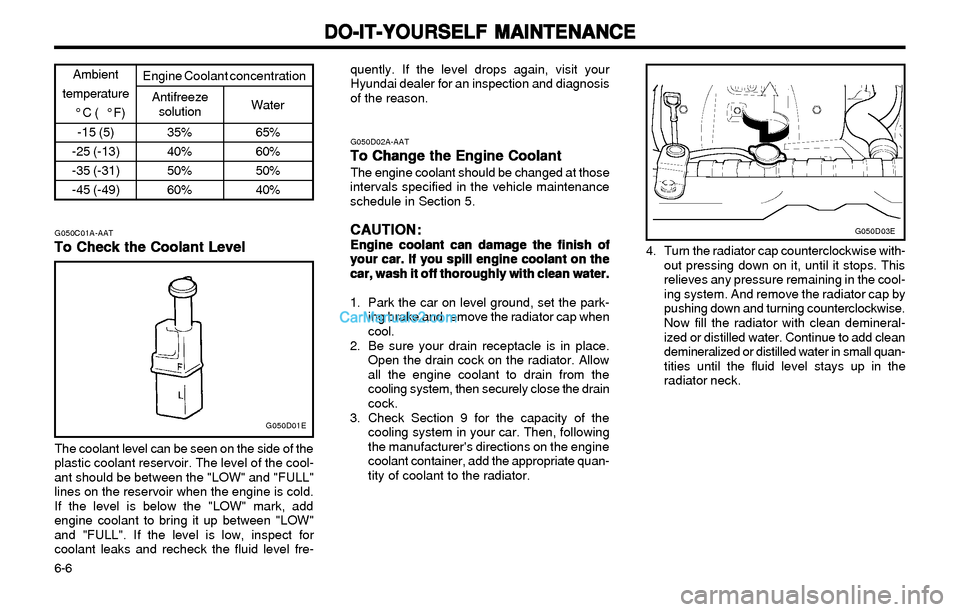
To Check the Coolant Level To Check the Coolant LevelTo Check the Coolant Level To Check the Coolant Level
To Check the Coolant Level
The coolant level can be seen on the side of the
plastic coolant reservoir. The level of the cool-
ant should be between the "LOW" and "FULL"
lines on the reservoir when the engine is cold.
If the level is below the "LOW" mark, add
engine coolant to bring it up between "LOW"
and "FULL". If the level is low, inspect for
coolant leaks and recheck the fluid level fre-quently. If the level drops again, visit your
Hyundai dealer for an inspection and diagnosis
of the reason.
G050D02A-AAT
To Change the Engine Coolant To Change the Engine CoolantTo Change the Engine Coolant To Change the Engine Coolant
To Change the Engine CoolantThe engine coolant should be changed at those
intervals specified in the vehicle maintenance
schedule in Section 5.
CAUTION: CAUTION:CAUTION: CAUTION:
CAUTION:Engine coolant can damage the finish of Engine coolant can damage the finish ofEngine coolant can damage the finish of Engine coolant can damage the finish of
Engine coolant can damage the finish of
your car. If you spill engine coolant on the your car. If you spill engine coolant on theyour car. If you spill engine coolant on the your car. If you spill engine coolant on the
your car. If you spill engine coolant on the
car, wash it off thoroughly with clean water. car, wash it off thoroughly with clean water.car, wash it off thoroughly with clean water. car, wash it off thoroughly with clean water.
car, wash it off thoroughly with clean water.
1. Park the car on level ground, set the park-
ing brake and remove the radiator cap when
cool.
2. Be sure your drain receptacle is in place.
Open the drain cock on the radiator. Allow
all the engine coolant to drain from the
cooling system, then securely close the drain
cock.
3. Check Section 9 for the capacity of the
cooling system in your car. Then, following
the manufacturer's directions on the engine
coolant container, add the appropriate quan-
tity of coolant to the radiator.
G050D01E
Engine Coolant concentration
Antifreeze
solutionWater
35%
40%
50%
60% -15 (5)
-25 (-13)
-35 (-31)
-45 (-49)65%
60%
50%
40%
4. Turn the radiator cap counterclockwise with-
out pressing down on it, until it stops. This
relieves any pressure remaining in the cool-
ing system. And remove the radiator cap by
pushing down and turning counterclockwise.
Now fill the radiator with clean demineral-
ized or distilled water. Continue to add clean
demineralized or distilled water in small quan-
tities until the fluid level stays up in the
radiator neck.
G050D03E
Page 143 of 172

DO-IT-YOURSELF MAINTENANCE DO-IT-YOURSELF MAINTENANCEDO-IT-YOURSELF MAINTENANCE DO-IT-YOURSELF MAINTENANCE
DO-IT-YOURSELF MAINTENANCE
6-7
CHAMPION
NGKRC10PYP4
PFR5N-11
IFR5G-11 Your engine was originally equipped with plati-
num or iridium-tipped spark plugs.
Platinum or iridium-tipped spark plugs will last
longer than conventional type spark plugs and
can be identified by blue lines (platinum only)
on the ceramic shell.NOTE: NOTE:NOTE: NOTE:
NOTE:Do not clean or regap platinum or iridium- Do not clean or regap platinum or iridium-Do not clean or regap platinum or iridium- Do not clean or regap platinum or iridium-
Do not clean or regap platinum or iridium-
tipped spark plugs. tipped spark plugs.tipped spark plugs. tipped spark plugs.
tipped spark plugs.
G050D04E
5. Start the engine, top off the radiator with
water and then add engine coolant to the
reservoir until the level is between "LOW"
and "FULL".
6. Replace the radiator and reservoir caps and
check to be sure the drain cocks are fully
closed and not leaking.
WARNING: WARNING:WARNING: WARNING:
WARNING:The cooling fan is controlled by engine cool- The cooling fan is controlled by engine cool-The cooling fan is controlled by engine cool- The cooling fan is controlled by engine cool-
The cooling fan is controlled by engine cool-
ant temperature and may sometimes oper- ant temperature and may sometimes oper-ant temperature and may sometimes oper- ant temperature and may sometimes oper-
ant temperature and may sometimes oper-
ate even when the engine is not running. ate even when the engine is not running.ate even when the engine is not running. ate even when the engine is not running.
ate even when the engine is not running.
Use extreme caution when working near the Use extreme caution when working near theUse extreme caution when working near the Use extreme caution when working near the
Use extreme caution when working near the
blades of the cooling fan so that you are not blades of the cooling fan so that you are notblades of the cooling fan so that you are not blades of the cooling fan so that you are not
blades of the cooling fan so that you are not
injured by a rotating fan blade. As the en- injured by a rotating fan blade. As the en-injured by a rotating fan blade. As the en- injured by a rotating fan blade. As the en-
injured by a rotating fan blade. As the en-
gine coolant temperature decreases, the fan gine coolant temperature decreases, the fangine coolant temperature decreases, the fan gine coolant temperature decreases, the fan
gine coolant temperature decreases, the fan
will automatically shut off. This is a normal will automatically shut off. This is a normalwill automatically shut off. This is a normal will automatically shut off. This is a normal
will automatically shut off. This is a normal
condition. condition.condition. condition.
condition.
SSA6060A
0.039 ~ 0.043 in. (1.0 ~ 1.1 mm)
G060A03Y-AAT
SPARK PLUGS SPARK PLUGSSPARK PLUGS SPARK PLUGS
SPARK PLUGS
PLATINUM
PLATINUM
IRIDIUM*
G060B02E-AAT
Replacing the Spark Plugs Replacing the Spark PlugsReplacing the Spark Plugs Replacing the Spark Plugs
Replacing the Spark PlugsThe spark plugs should be changed at the
intervals specified in the vehicle maintenance
schedule in Section 5 or whenever engine per-
formance indicates they should be changed.
Symptoms that suggest poor spark plug perfor-
mance include engine misfiring under load, loss
of fuel economy, poor acceleration, etc. When
spark plugs are replaced, always use spark
plugs recommended by Hyundai. The use of
other spark plugs can result in loss of perfor-
mance, radio interference or engine damage.
NOTE: NOTE:NOTE: NOTE:
NOTE:When replacing the spark plugs, genuine When replacing the spark plugs, genuineWhen replacing the spark plugs, genuine When replacing the spark plugs, genuine
When replacing the spark plugs, genuine
Hyundai replacement parts are recom- Hyundai replacement parts are recom-Hyundai replacement parts are recom- Hyundai replacement parts are recom-
Hyundai replacement parts are recom-
mended. mended.mended. mended.
mended.
Recommended Spark Plugs: Recommended Spark Plugs:Recommended Spark Plugs: Recommended Spark Plugs:
Recommended Spark Plugs:
* 2.0L SULEV Only.
Page 147 of 172
DO-IT-YOURSELF MAINTENANCE DO-IT-YOURSELF MAINTENANCEDO-IT-YOURSELF MAINTENANCE DO-IT-YOURSELF MAINTENANCE
DO-IT-YOURSELF MAINTENANCE
6-11
WARNING: WARNING:WARNING: WARNING:
WARNING:The cooling fan is controlled by the engine The cooling fan is controlled by the engineThe cooling fan is controlled by the engine The cooling fan is controlled by the engine
The cooling fan is controlled by the engine
coolant temperature and may sometimes coolant temperature and may sometimescoolant temperature and may sometimes coolant temperature and may sometimes
coolant temperature and may sometimes
operate even when the engine is not run- operate even when the engine is not run-operate even when the engine is not run- operate even when the engine is not run-
operate even when the engine is not run-
ning. Use extreme caution when working ning. Use extreme caution when workingning. Use extreme caution when working ning. Use extreme caution when working
ning. Use extreme caution when working
near the blades of the cooling fan, so that near the blades of the cooling fan, so thatnear the blades of the cooling fan, so that near the blades of the cooling fan, so that
near the blades of the cooling fan, so that
you are not injured by a rotating fan blade. you are not injured by a rotating fan blade.you are not injured by a rotating fan blade. you are not injured by a rotating fan blade.
you are not injured by a rotating fan blade.
As the engine coolant temperature de- As the engine coolant temperature de-As the engine coolant temperature de- As the engine coolant temperature de-
As the engine coolant temperature de-
creases, the fan will automatically shut off. creases, the fan will automatically shut off.creases, the fan will automatically shut off. creases, the fan will automatically shut off.
creases, the fan will automatically shut off.
This is a normal condition. This is a normal condition.This is a normal condition. This is a normal condition.
This is a normal condition.
G120A01A-AAT
CHECKING THE BRAKES CHECKING THE BRAKESCHECKING THE BRAKES CHECKING THE BRAKES
CHECKING THE BRAKES
CAUTION: CAUTION:CAUTION: CAUTION:
CAUTION:
Because brakes are essential to the safe Because brakes are essential to the safeBecause brakes are essential to the safe Because brakes are essential to the safe
Because brakes are essential to the safe
operation of the car, it is suggested that operation of the car, it is suggested thatoperation of the car, it is suggested that operation of the car, it is suggested that
operation of the car, it is suggested that
they be checked and inspected by your they be checked and inspected by yourthey be checked and inspected by your they be checked and inspected by your
they be checked and inspected by your
Hyundai dealer. The brakes should be Hyundai dealer. The brakes should beHyundai dealer. The brakes should be Hyundai dealer. The brakes should be
Hyundai dealer. The brakes should be
checked and inspected for wear at those checked and inspected for wear at thosechecked and inspected for wear at those checked and inspected for wear at those
checked and inspected for wear at those
intervals specified in the vehicle mainte- intervals specified in the vehicle mainte-intervals specified in the vehicle mainte- intervals specified in the vehicle mainte-
intervals specified in the vehicle mainte-
nance schedule in Section 5. nance schedule in Section 5.nance schedule in Section 5. nance schedule in Section 5.
nance schedule in Section 5.
G120B01A-AAT
Checking the Brake Fluid Level Checking the Brake Fluid LevelChecking the Brake Fluid Level Checking the Brake Fluid Level
Checking the Brake Fluid Level
WARNING: WARNING:WARNING: WARNING:
WARNING:
Use caution when handling brake fluid. It Use caution when handling brake fluid. ItUse caution when handling brake fluid. It Use caution when handling brake fluid. It
Use caution when handling brake fluid. It
can damage your vision if it gets into your can damage your vision if it gets into yourcan damage your vision if it gets into your can damage your vision if it gets into your
can damage your vision if it gets into your
eyes. It will also damage your vehicle's paint eyes. It will also damage your vehicle's painteyes. It will also damage your vehicle's paint eyes. It will also damage your vehicle's paint
eyes. It will also damage your vehicle's paint
if spilled on it and not removed immediately. if spilled on it and not removed immediately.if spilled on it and not removed immediately. if spilled on it and not removed immediately.
if spilled on it and not removed immediately.
G110D01E-AAT
To Check the Transaxle Fluid Level To Check the Transaxle Fluid LevelTo Check the Transaxle Fluid Level To Check the Transaxle Fluid Level
To Check the Transaxle Fluid Level
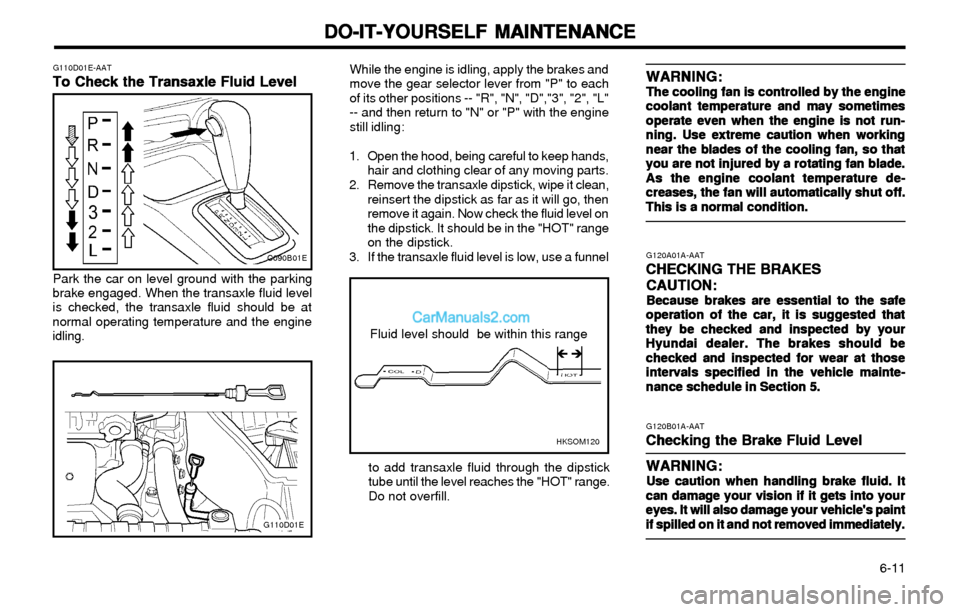
Park the car on level ground with the parking
brake engaged. When the transaxle fluid level
is checked, the transaxle fluid should be at
normal operating temperature and the engine
idling.While the engine is idling, apply the brakes and
move the gear selector lever from "P" to each
of its other positions -- "R", "N", "D","3", "2", "L"
-- and then return to "N" or "P" with the engine
still idling:
1. Open the hood, being careful to keep hands,
hair and clothing clear of any moving parts.
2. Remove the transaxle dipstick, wipe it clean,
reinsert the dipstick as far as it will go, then
remove it again. Now check the fluid level on
the dipstick. It should be in the "HOT" range
on the dipstick.
3. If the transaxle fluid level is low, use a funnel
Fluid level should be within this range
to add transaxle fluid through the dipstick
tube until the level reaches the "HOT" range.
Do not overfill.
C090B01E
G110D01E
HKSOM120
èè
Page 153 of 172
DO-IT-YOURSELF MAINTENANCE DO-IT-YOURSELF MAINTENANCEDO-IT-YOURSELF MAINTENANCE DO-IT-YOURSELF MAINTENANCE
DO-IT-YOURSELF MAINTENANCE
6-17
G230A03A-AAT
POWER STEERING FLUID LEVEL POWER STEERING FLUID LEVELPOWER STEERING FLUID LEVEL POWER STEERING FLUID LEVEL
POWER STEERING FLUID LEVEL
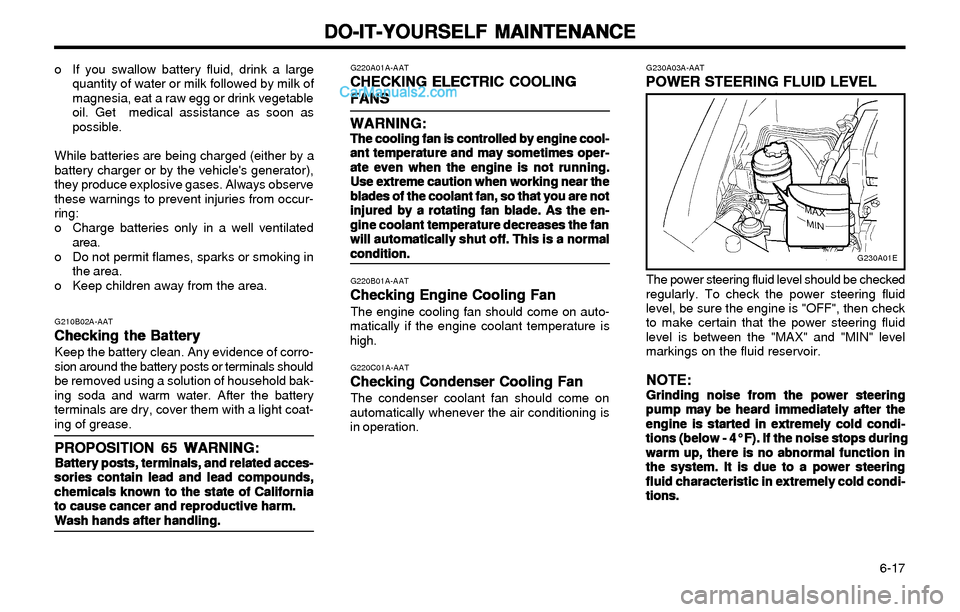
The power steering fluid level should be checked
regularly. To check the power steering fluid
level, be sure the engine is "OFF", then check
to make certain that the power steering fluid
level is between the "MAX" and "MIN" level
markings on the fluid reservoir.
NOTE: NOTE:NOTE: NOTE:
NOTE:Grinding noise from the power steering Grinding noise from the power steeringGrinding noise from the power steering Grinding noise from the power steering
Grinding noise from the power steering
pump may be heard immediately after the pump may be heard immediately after thepump may be heard immediately after the pump may be heard immediately after the
pump may be heard immediately after the
engine is started in extremely cold condi- engine is started in extremely cold condi-engine is started in extremely cold condi- engine is started in extremely cold condi-
engine is started in extremely cold condi-
tions (below - 4°F). If the noise stops during tions (below - 4°F). If the noise stops duringtions (below - 4°F). If the noise stops during tions (below - 4°F). If the noise stops during
tions (below - 4°F). If the noise stops during
warm up, there is no abnormal function in warm up, there is no abnormal function inwarm up, there is no abnormal function in warm up, there is no abnormal function in
warm up, there is no abnormal function in
the system. It is due to a power steering the system. It is due to a power steeringthe system. It is due to a power steering the system. It is due to a power steering
the system. It is due to a power steering
fluid characteristic in extremely cold condi- fluid characteristic in extremely cold condi-fluid characteristic in extremely cold condi- fluid characteristic in extremely cold condi-
fluid characteristic in extremely cold condi-
tions. tions.tions. tions.
tions.
G230A01E G220A01A-AAT
CHECKING ELECTRIC COOLING CHECKING ELECTRIC COOLINGCHECKING ELECTRIC COOLING CHECKING ELECTRIC COOLING
CHECKING ELECTRIC COOLING
FANS FANSFANS FANS
FANS
WARNING: WARNING:WARNING: WARNING:
WARNING:
The cooling fan is controlled by engine cool- The cooling fan is controlled by engine cool-The cooling fan is controlled by engine cool- The cooling fan is controlled by engine cool-
The cooling fan is controlled by engine cool-
ant temperature and may sometimes oper- ant temperature and may sometimes oper-ant temperature and may sometimes oper- ant temperature and may sometimes oper-
ant temperature and may sometimes oper-
ate even when the engine is not running. ate even when the engine is not running.ate even when the engine is not running. ate even when the engine is not running.
ate even when the engine is not running.
Use extreme caution when working near the Use extreme caution when working near theUse extreme caution when working near the Use extreme caution when working near the
Use extreme caution when working near the
blades of the coolant fan, so that you are not blades of the coolant fan, so that you are notblades of the coolant fan, so that you are not blades of the coolant fan, so that you are not
blades of the coolant fan, so that you are not
injured by a rotating fan blade. As the en- injured by a rotating fan blade. As the en-injured by a rotating fan blade. As the en- injured by a rotating fan blade. As the en-
injured by a rotating fan blade. As the en-
gine coolant temperature decreases the fan gine coolant temperature decreases the fangine coolant temperature decreases the fan gine coolant temperature decreases the fan
gine coolant temperature decreases the fan
will automatically shut off. This is a normal will automatically shut off. This is a normalwill automatically shut off. This is a normal will automatically shut off. This is a normal
will automatically shut off. This is a normal
condition. condition.condition. condition.
condition.
G220B01A-AAT
Checking Engine Cooling Fan Checking Engine Cooling FanChecking Engine Cooling Fan Checking Engine Cooling Fan
Checking Engine Cooling FanThe engine cooling fan should come on auto-
matically if the engine coolant temperature is
high.
G220C01A-AAT
Checking Condenser Cooling Fan Checking Condenser Cooling FanChecking Condenser Cooling Fan Checking Condenser Cooling Fan
Checking Condenser Cooling FanThe condenser coolant fan should come on
automatically whenever the air conditioning is
in operation.
G210B02A-AAT
Checking the Battery Checking the BatteryChecking the Battery Checking the Battery
Checking the BatteryKeep the battery clean. Any evidence of corro-
sion around the battery posts or terminals should
be removed using a solution of household bak-
ing soda and warm water. After the battery
terminals are dry, cover them with a light coat-
ing of grease.
PROPOSITION 65 WARNING: PROPOSITION 65 WARNING:PROPOSITION 65 WARNING: PROPOSITION 65 WARNING:
PROPOSITION 65 WARNING:Battery posts, terminals, and related acces- Battery posts, terminals, and related acces-Battery posts, terminals, and related acces- Battery posts, terminals, and related acces-
Battery posts, terminals, and related acces-
sories contain lead and lead compounds, sories contain lead and lead compounds,sories contain lead and lead compounds, sories contain lead and lead compounds,
sories contain lead and lead compounds,
chemicals known to the state of California chemicals known to the state of Californiachemicals known to the state of California chemicals known to the state of California
chemicals known to the state of California
to cause cancer and reproductive harm. to cause cancer and reproductive harm.to cause cancer and reproductive harm. to cause cancer and reproductive harm.
to cause cancer and reproductive harm.
Wash hands after handling. Wash hands after handling.Wash hands after handling. Wash hands after handling.
Wash hands after handling.
o If you swallow battery fluid, drink a large
quantity of water or milk followed by milk of
magnesia, eat a raw egg or drink vegetable
oil. Get medical assistance as soon as
possible.
While batteries are being charged (either by a
battery charger or by the vehicle's generator),
they produce explosive gases. Always observe
these warnings to prevent injuries from occur-
ring:
o Charge batteries only in a well ventilated
area.
o Do not permit flames, sparks or smoking in
the area.
o Keep children away from the area.