lights Hyundai Elantra 2004 Owner's Guide
[x] Cancel search | Manufacturer: HYUNDAI, Model Year: 2004, Model line: Elantra, Model: Hyundai Elantra 2004Pages: 241, PDF Size: 6.5 MB
Page 161 of 241
3WHAT TO DO IN AN EMERGENCY
3
HXDFL523
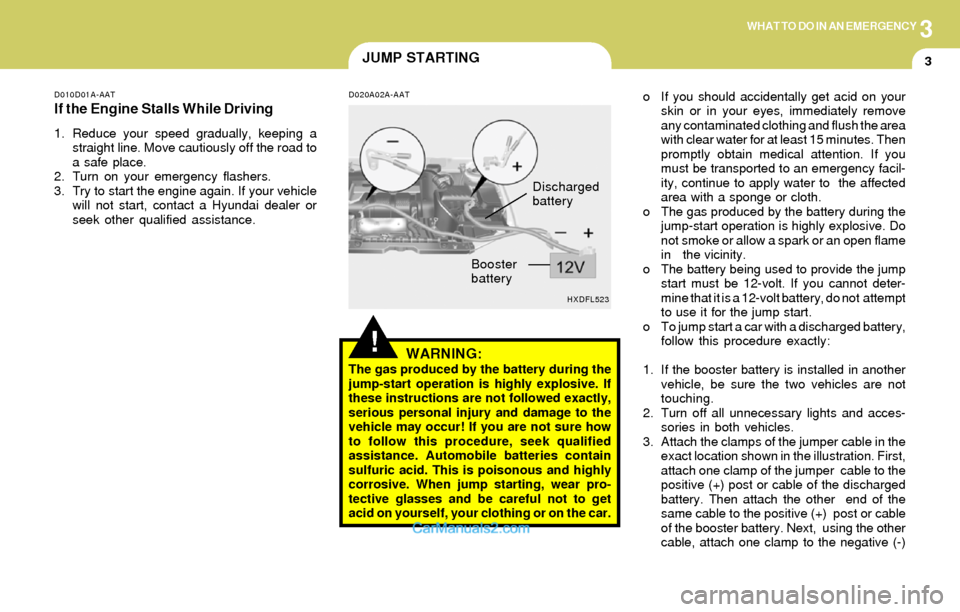
Discharged
battery
Booster
battery
JUMP STARTING
D010D01A-AAT
If the Engine Stalls While Driving
1. Reduce your speed gradually, keeping a
straight line. Move cautiously off the road to
a safe place.
2. Turn on your emergency flashers.
3. Try to start the engine again. If your vehicle
will not start, contact a Hyundai dealer or
seek other qualified assistance.
!
o If you should accidentally get acid on your
skin or in your eyes, immediately remove
any contaminated clothing and flush the area
with clear water for at least 15 minutes. Then
promptly obtain medical attention. If you
must be transported to an emergency facil-
ity, continue to apply water to the affected
area with a sponge or cloth.
o The gas produced by the battery during the
jump-start operation is highly explosive. Do
not smoke or allow a spark or an open flame
in the vicinity.
o The battery being used to provide the jump
start must be 12-volt. If you cannot deter-
mine that it is a 12-volt battery, do not attempt
to use it for the jump start.
o To jump start a car with a discharged battery,
follow this procedure exactly:
1. If the booster battery is installed in another
vehicle, be sure the two vehicles are not
touching.
2. Turn off all unnecessary lights and acces-
sories in both vehicles.
3. Attach the clamps of the jumper cable in the
exact location shown in the illustration. First,
attach one clamp of the jumper cable to the
positive (+) post or cable of the discharged
battery. Then attach the other end of the
same cable to the positive (+) post or cable
of the booster battery. Next, using the other
cable, attach one clamp to the negative (-)D020A02A-AAT
WARNING:The gas produced by the battery during the
jump-start operation is highly explosive. If
these instructions are not followed exactly,
serious personal injury and damage to the
vehicle may occur! If you are not sure how
to follow this procedure, seek qualified
assistance. Automobile batteries contain
sulfuric acid. This is poisonous and highly
corrosive. When jump starting, wear pro-
tective glasses and be careful not to get
acid on yourself, your clothing or on the car.
Page 162 of 241
3WHAT TO DO IN AN EMERGENCY
4IF THE ENGINE OVERHEATS
!
!WARNING:While the engine is running, keep hair,
hands, and clothing away from moving
parts such as the fan and drive belts to
prevent injury.
5. If the water pump drive belt is broken or
engine coolant is leaking out, stop the engine
immediately and call the nearest Hyundai
dealer for assistance.
WARNING:Do not remove the radiator cap when the
engine is hot. This can allow coolant to be
blown out of the opening and cause seri-
ous burns.
6. If you cannot find the cause of the overheat-
ing, wait until the engine temperature has
returned to normal. Then, if coolant has been
lost, carefully add coolant to the reservoir
(page 6-9) to bring the fluid level in the
reservoir up to the halfway mark.
7. Proceed with caution, keeping alert for fur-
ther signs of overheating. If overheating
happens again, call a Hyundai dealer for
assistance.
D030A01A-AAT
If your temperature gauge indicates overheat-
ing, you experience a loss of power, or hear loud
pinging or knocking and the engine is probably
too hot. If this happens and, you should:
1. Pull off the road and stop as soon as it is safe
to do so.
2. Place the gear selector lever in "P" (auto-
matic), or neutral (manual transaxle) and set
the parking brake. If the air conditioning is on,
turn it off.
3. If engine coolant is running out under the car
or steam is coming out from the hood, stop
the engine. Do not open the hood until the
engine coolant has stopped running or the
steaming has stopped. If there is no visible
loss of engine coolant and no steam, leave
the engine running and check to be sure the
engine cooling fan is operating. If the fan is
not running, turn the engine off.
4. Check to see if the water pump drive belt is
missing. If it is not missing, check to see that
it is tight. If the drive belt seems to be
satisfactory, check for engine coolant leak-
ing from the radiator, hoses or under the car.
(If the air conditioning had been in use, it is
normal for cold water to be draining from it
when you stop). post or cable of the booster battery. Then
attach the other end of that cable to a solid
metal part of the engine away from the
battery. Do not connect the cable to any
moving part.
4. Start the engine in the car with the booster
battery and let it run for a few minutes. This
will help to assure that the booster battery is
fully charged. During the jumping operation,
run the engine in this vehicle at about 2,000
rpm.
5. Start the engine in the car with the dis-
charged battery using the normal starting
procedure. After the engine starts, leave the
jumper cables connected and let the engine
run at fast idle or about 2,000 rpm for several
minutes.
6. Carefully remove the jumper cables in the
reverse order of attachment.
If you do not know why your battery became
discharged (because the lights were left on,
etc.), have the charging system checked by
your Hyundai dealer.
Page 187 of 241
6DO-IT-YOURSELF MAINTENANCE
3GENERAL CHECKS
G020C01A-AAT
Vehicle Interior
The following should be checked each time
when the vehicle is driven:
o Lights operation
o Windshield wiper operation
o Horn operation
o Defroster, heating system operation (and air
conditioning, if installed)
o Steering operation and condition
o Mirror condition and operation
o Turn signal operation
o Accelerator pedal operation
o Brake operation, including parking brake
o Manual transaxle operation, including clutch
operation
o Automatic transaxle operation, including
"Park" mechanism operation
o Seat control condition and operation
o Seat belt condition and operation
o Sunvisor operation
If you notice anything that does not operate
correctly or appears to be functioning incor-
rectly, inspect it carefully and seek assistance
from your Hyundai dealer if service is needed.
G020B01A-AAT
Vehicle Exterior
The following should be checked monthly:
o Overall appearance and condition
o Wheel condition and wheel nut torque
o Exhaust system condition
o Light condition and operation
o Windshield glass condition
o Wiper blade condition
o Paint condition and body corrosion
o Fluid leaks
o Door and hood lock condition
o Tire pressure and condition (including spare
tire)
G020A01A-AAT
Engine Compartment
The following should be checked regularly:
o Engine oil level and condition
o Transaxle fluid level and condition
o Brake fluid level
o Clutch fluid level
o Engine coolant level
o Windshield washer fluid level
o Accessory drive belt condition
o Engine coolant hose condition
o Fluid leaks (on or below components)
o Power steering fluid level
o Battery conditio
o Air filter condition
Page 205 of 241
6DO-IT-YOURSELF MAINTENANCE
21
!
G200B01E-AAT
Replacing Accessory Fuse
CAUTION:
When replacing a fusible link, never use
anything but a new fusible link with the
same or lower amperage rating. Never use
a piece of wire or a higher-rated fusible link.
This could result in serious damage and
create a fire hazard.
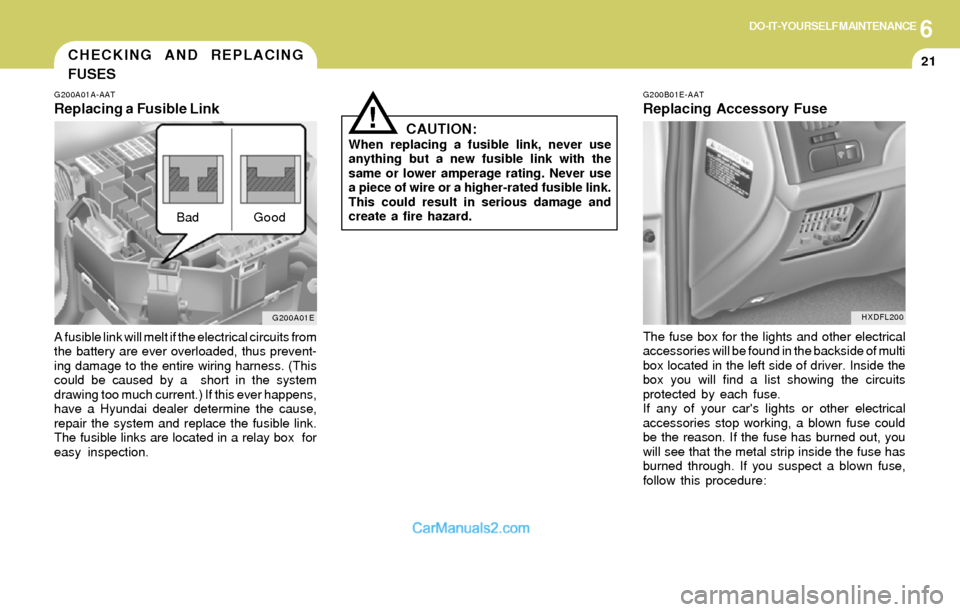
The fuse box for the lights and other electrical
accessories will be found in the backside of multi
box located in the left side of driver. Inside the
box you will find a list showing the circuits
protected by each fuse.
If any of your car's lights or other electrical
accessories stop working, a blown fuse could
be the reason. If the fuse has burned out, you
will see that the metal strip inside the fuse has
burned through. If you suspect a blown fuse,
follow this procedure:
CHECKING AND REPLACING
FUSES
G200A01A-AAT
Replacing a Fusible Link
A fusible link will melt if the electrical circuits from
the battery are ever overloaded, thus prevent-
ing damage to the entire wiring harness. (This
could be caused by a short in the system
drawing too much current.) If this ever happens,
have a Hyundai dealer determine the cause,
repair the system and replace the fusible link.
The fusible links are located in a relay box for
easy inspection.
Good Bad
G200A01EHXDFL200
Page 208 of 241
6DO-IT-YOURSELF MAINTENANCE
24POWER STEERING FLUID LEVEL
G230A03A-AAT
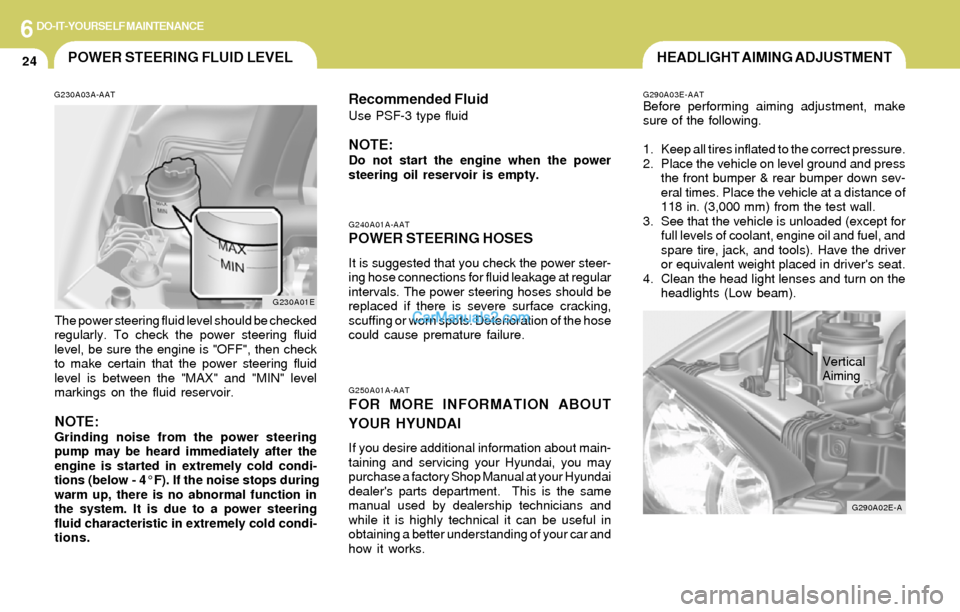
The power steering fluid level should be checked
regularly. To check the power steering fluid
level, be sure the engine is "OFF", then check
to make certain that the power steering fluid
level is between the "MAX" and "MIN" level
markings on the fluid reservoir.
NOTE:Grinding noise from the power steering
pump may be heard immediately after the
engine is started in extremely cold condi-
tions (below - 4°F). If the noise stops during
warm up, there is no abnormal function in
the system. It is due to a power steering
fluid characteristic in extremely cold condi-
tions.
G230A01E
HEADLIGHT AIMING ADJUSTMENT
G250A01A-AATFOR MORE INFORMATION ABOUT
YOUR HYUNDAI
If you desire additional information about main-
taining and servicing your Hyundai, you may
purchase a factory Shop Manual at your Hyundai
dealer's parts department. This is the same
manual used by dealership technicians and
while it is highly technical it can be useful in
obtaining a better understanding of your car and
how it works.
G240A01A-AATPOWER STEERING HOSES
It is suggested that you check the power steer-
ing hose connections for fluid leakage at regular
intervals. The power steering hoses should be
replaced if there is severe surface cracking,
scuffing or worn spots. Deterioration of the hose
could cause premature failure.
Recommended FluidUse PSF-3 type fluid
NOTE:Do not start the engine when the power
steering oil reservoir is empty.
G290A03E-AATBefore performing aiming adjustment, make
sure of the following.
1. Keep all tires inflated to the correct pressure.
2. Place the vehicle on level ground and press
the front bumper & rear bumper down sev-
eral times. Place the vehicle at a distance of
118 in. (3,000 mm) from the test wall.
3. See that the vehicle is unloaded (except for
full levels of coolant, engine oil and fuel, and
spare tire, jack, and tools). Have the driver
or equivalent weight placed in driver's seat.
4. Clean the head light lenses and turn on the
headlights (Low beam).
Vertical
Aiming
G290A02E-A
Page 209 of 241
6DO-IT-YOURSELF MAINTENANCE
25
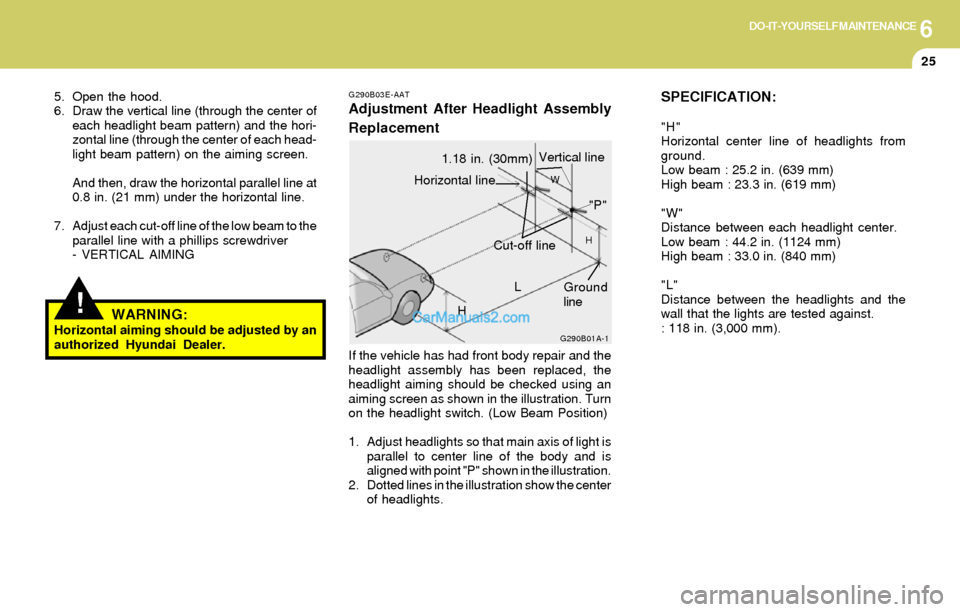
SPECIFICATION:
"H"
Horizontal center line of headlights from
ground.
Low beam : 25.2 in. (639 mm)
High beam : 23.3 in. (619 mm)
"W"
Distance between each headlight center.
Low beam : 44.2 in. (1124 mm)
High beam : 33.0 in. (840 mm)
"L"
Distance between the headlights and the
wall that the lights are tested against.
: 118 in. (3,000 mm).
G290B03E-AAT
Adjustment After Headlight Assembly
Replacement
If the vehicle has had front body repair and the
headlight assembly has been replaced, the
headlight aiming should be checked using an
aiming screen as shown in the illustration. Turn
on the headlight switch. (Low Beam Position)
1. Adjust headlights so that main axis of light is
parallel to center line of the body and is
aligned with point "P" shown in the illustration.
2. Dotted lines in the illustration show the center
of headlights.
!
5. Open the hood.
6. Draw the vertical line (through the center of
each headlight beam pattern) and the hori-
zontal line (through the center of each head-
light beam pattern) on the aiming screen.
And then, draw the horizontal parallel line at
0.8 in. (21 mm) under the horizontal line.
7. Adjust each cut-off line of the low beam to the
parallel line with a phillips screwdriver
- VERTICAL AIMING
WARNING:Horizontal aiming should be adjusted by an
authorized Hyundai Dealer.G290B01A-1
L
W
H
HCut-off line
"P"
1.18 in. (30mm)Vertical line
Horizontal line
Ground
line
Page 238 of 241
10INDEX
4
High-Mounted Rear Stoplight ............................................................1-70
Hood Release....................................................................................1-71
Horn.................................................................................................1-76
I
Ignition Switch ...................................................................................... 2-3
Instrument Cluster and Indicator Lights...........................................1-41
Instrument Panel Light Control (Rheostat).......................................1-59
J
Jump Starting...................................................................................... 3-3
K
Key ................................................................................................... 1-3
If you lose your keys ...................................................................3-12
Positions......................................................................................... 2-3
L
Light Bulbs Replacement..................................................................6-26
Luggage Net ......................................................................................1-75
M
Maintenance Intervals
Explanation of scheduled maintenance items ............................... 5-7
Maintenance under severe usage conditions............................... 5-6
Scheduled maintenance................................................................ 5-4
Service requirements.................................................................... 5-2Mirrors
Day-night inside rearview mirror .................................................1-69
Outside rear view mirror ..............................................................1-67
O
Odometer / Trip Odometer ...............................................................1-50
P
Parking Brake....................................................................................1-61
Power Outlet......................................................................................1-60
Power Steering Fluid Level ...............................................................6-22
R
Rear Seat
Adjusting seatback angle .............................................................1-13
Folding rear seatback and seat cushion ....................................1-16
Rear Window Defroster Switch ........................................................1-58
Reporting Safety Defects ................................................................... 8-7
S
Seat
Adjustable front seats..................................................................1-12
folding rear seatbacks.................................................................1-15
Seat Belts
3-point system.............................................................................1-21
Pretensioner seat belt ..................................................................1-30
Adjusting your seat belt ...............................................................1-22
Care of seat belts .........................................................................1-19
Shop Manual ........................................................................................ 8-6
Page 239 of 241
10INDEX
5
Spark Plugs ......................................................................................... 6-9
Spectacle Case.................................................................................1-66
Speedometer.....................................................................................1-49
Starting Procedure.............................................................................. 2-5
Steering Wheel Free play .................................................................6-19
Steering Wheel Tilt Lever ..................................................................1-76
Stereo Sound System .......................................................................1-98
Sunroof..............................................................................................1-63
Sun visor ...........................................................................................1-69
T
Tachometer.......................................................................................1-50
Tail Gate............................................................................................1-74
Theft-Alarm System............................................................................ 1-8
Tires
Balancing........................................................................................ 8-5
Chains............................................................................................ 8-4
Changing a flat tire ......................................................................... 3-6
If you have a flat tire ....................................................................... 3-6
Information...................................................................................... 8-3
Pressure......................................................................................... 8-3
Replacement.................................................................................. 8-5
Rotation.......................................................................................... 8-4
Snow tires....................................................................................... 8-3
Spare tire........................................................................................ 3-5
Traction.......................................................................................... 8-5Towing
A trailer (or vehicle)......................................................................2-17
Emergency...................................................................................3-11
If your car must be towed ............................................................3-10
Traction Control System ....................................................... 2-12 ~ 2-13
Transaxle
Automatic........................................................................................ 2-7
Automatic transaxle fluid checking ..............................................6-14
Manual............................................................................................ 2-5
Manual transaxle fluid checking..................................................6-13
V
Vehicle Identification Number............................................................. 8-2
Vehicle Specifications
Engine ............................................................................................. 9-3
Lubrication chart............................................................................ 9-4
Measurement................................................................................. 9-2
W
Warning Lights and Indicator Lights.................................................1-45
Windows
Power...........................................................................................1-11
Windshield Wiper and Washer ..........................................................1-56
Windshield Wiper Blades..................................................................6-11