service Hyundai Elantra 2005 User Guide
[x] Cancel search | Manufacturer: HYUNDAI, Model Year: 2005, Model line: Elantra, Model: Hyundai Elantra 2005Pages: 256, PDF Size: 10.4 MB
Page 186 of 256
5
VEHICLE MAINTENANCE REQUIREMENTS2
MAINTENANCE INTERVALS
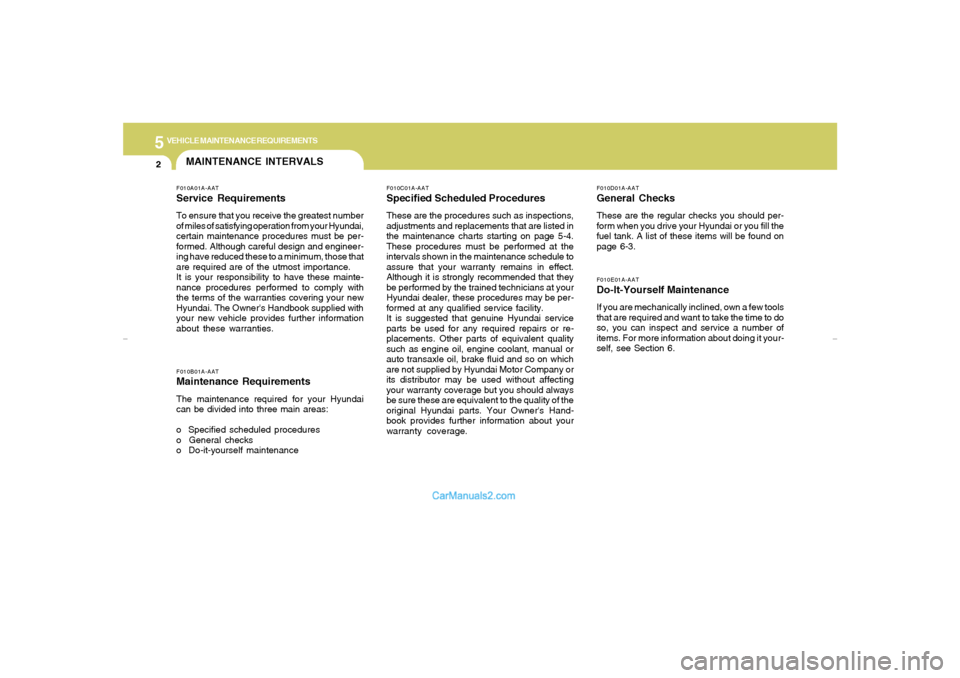
F010D01A-AATGeneral ChecksThese are the regular checks you should per-
form when you drive your Hyundai or you fill the
fuel tank. A list of these items will be found on
page 6-3.
F010C01A-AATSpecified Scheduled ProceduresThese are the procedures such as inspections,
adjustments and replacements that are listed in
the maintenance charts starting on page 5-4.
These procedures must be performed at the
intervals shown in the maintenance schedule to
assure that your warranty remains in effect.
Although it is strongly recommended that they
be performed by the trained technicians at your
Hyundai dealer, these procedures may be per-
formed at any qualified service facility.
It is suggested that genuine Hyundai service
parts be used for any required repairs or re-
placements. Other parts of equivalent quality
such as engine oil, engine coolant, manual or
auto transaxle oil, brake fluid and so on which
are not supplied by Hyundai Motor Company or
its distributor may be used without affecting
your warranty coverage but you should always
be sure these are equivalent to the quality of the
original Hyundai parts. Your Owner's Hand-
book provides further information about your
warranty coverage.
F010A01A-AATService RequirementsTo ensure that you receive the greatest number
of miles of satisfying operation from your Hyundai,
certain maintenance procedures must be per-
formed. Although careful design and engineer-
ing have reduced these to a minimum, those that
are required are of the utmost importance.
It is your responsibility to have these mainte-
nance procedures performed to comply with
the terms of the warranties covering your new
Hyundai. The Owner's Handbook supplied with
your new vehicle provides further information
about these warranties.F010B01A-AATMaintenance RequirementsThe maintenance required for your Hyundai
can be divided into three main areas:
o Specified scheduled procedures
o General checks
o Do-it-yourself maintenance
F010E01A-AATDo-It-Yourself MaintenanceIf you are mechanically inclined, own a few tools
that are required and want to take the time to do
so, you can inspect and service a number of
items. For more information about doing it your-
self, see Section 6.
xdflhma-5.p652/5/2008, 2:11 PM 2
Page 187 of 256
5
VEHICLE MAINTENANCE REQUIREMENTS
3
F020A02S-AATSCHEDULED MAINTENANCE
REQUIREMENTSo Inspection should be performed any time a
malfunction is experienced or suspected.
o Receipts for all emission control system
services should be retained to demonstrate
compliance with conditions of the emissions
system warranty.
o After 120 months or 150,000 miles (240,000
km), continue to follow the prescribed main-
tenance intervals.
o For severe usage maintenance requi-
rements, see page 5-6 of this section.F010F01A-AATA Few Tipso Whenever you have your Hyundai serviced,
keep copies of the service records in your
glove box. This will help assure you can
document the required procedures being
performed to keep your warranties in effect.
This is especially important when service is
not performed by an authorized Hyundai
dealer.
o If you choose to do your own maintenance
and repairs, you may find it helpful to have
an official Hyundai Shop Manual. A copy of
this publication may be purchased at your
Hyundai dealer's parts department.
xdflhma-5.p652/5/2008, 2:11 PM 3
Page 188 of 256
5
VEHICLE MAINTENANCE REQUIREMENTS4
DESCRIPTION
EMISSION CONTROL ITEMS
ENGINE OIL AND FILTER
FUEL FILTER
FUEL LINES, FUEL HOSES AND CONNECTIONS
INSULATOR OF FUEL INJECTOR (2.0 L SULEV Only)
VACUUM AND CRANKCASE VENTILATION HOSES
VAPOR HOSE AND FUEL FILLER CAP
AIR CLEANER FILTER
FUEL TANK AIRFILTER
SPARK PLUGS
SPARK PLUG CABLE (2.0 L SULEV Only)
VALVE CLEARANCE
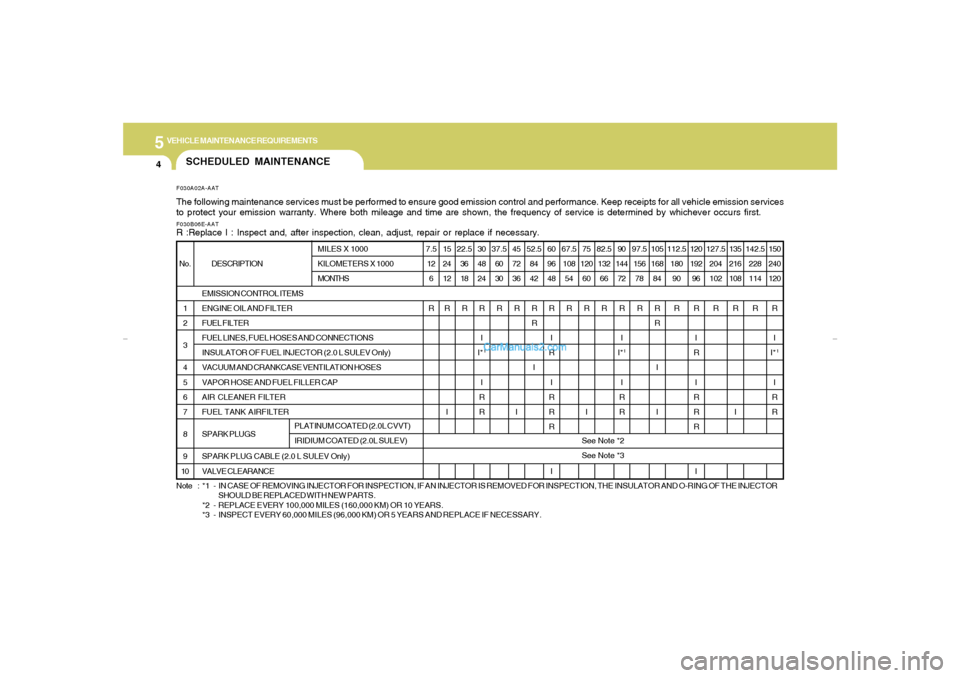
SCHEDULED MAINTENANCEF030B06E-AATR :Replace I : Inspect and, after inspection, clean, adjust, repair or replace if necessary.F030A02A-AATThe following maintenance services must be performed to ensure good emission control and performance. Keep receipts for all vehicle emission services
to protect your emission warranty. Where both mileage and time are shown, the frequency of service is determined by whichever occurs first.No.
1
2
3
4
5
6
7
8
9
10MILES X 1000
KILOMETERS X 1000
MONTHS7.5
12
6
R15
24
12
R
I22.5
36
18
R30
48
24
R
I
I*
1I
R
R37.5
60
30
R45
72
36
R
I52.5
84
42
R
R
I60
96
48
R
I
R
I
R
R
R
I67.5
108
54
R75
120
60
R
I82.5
132
66
R90
144
72
R
I
I*
1I
R
R97.5
156
78
R105
168
84
R
R
I
I112.5
180
90
R120
192
96
R
I
R
I
R
R
R
I127.5
204
102
R135
216
108
R
I142.5
228
114
R150
240
120
R
I
I*
1I
R
R
PLATINUM COATED (2.0L CVVT)
IRIDIUM COATED (2.0L SULEV)
See Note *2
See Note *3
Note : *1 - IN CASE OF REMOVING INJECTOR FOR INSPECTION, IF AN INJECTOR IS REMOVED FOR INSPECTION, THE INSULATOR AND O-RING OF THE INJECTOR
SHOULD BE REPLACED WITH NEW PARTS.
*2 - REPLACE EVERY 100,000 MILES (160,000 KM) OR 10 YEARS.
*3 - INSPECT EVERY 60,000 MILES (96,000 KM) OR 5 YEARS AND REPLACE IF NECESSARY.
xdflhma-5.p652/5/2008, 2:11 PM 4
Page 190 of 256
5
VEHICLE MAINTENANCE REQUIREMENTS6
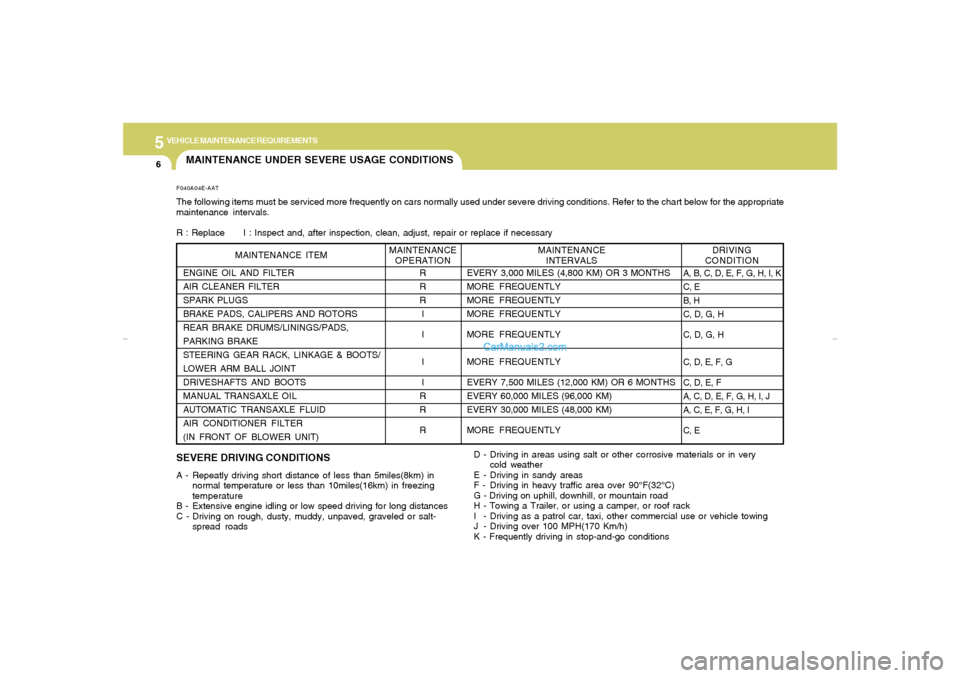
SEVERE DRIVING CONDITIONSA - Repeatly driving short distance of less than 5miles(8km) in
normal temperature or less than 10miles(16km) in freezing
temperature
B - Extensive engine idling or low speed driving for long distances
C - Driving on rough, dusty, muddy, unpaved, graveled or salt-
spread roadsF040A04E-AATThe following items must be serviced more frequently on cars normally used under severe driving conditions. Refer to the chart below for the appropriate
maintenance intervals.
R : Replace I : Inspect and, after inspection, clean, adjust, repair or replace if necessary
D - Driving in areas using salt or other corrosive materials or in very
cold weather
E - Driving in sandy areas
F - Driving in heavy traffic area over 90°F(32°C)
G - Driving on uphill, downhill, or mountain road
H - Towing a Trailer, or using a camper, or roof rack
I - Driving as a patrol car, taxi, other commercial use or vehicle towing
J - Driving over 100 MPH(170 Km/h)
K - Frequently driving in stop-and-go conditions ENGINE OIL AND FILTER
AIR CLEANER FILTER
SPARK PLUGS
BRAKE PADS, CALIPERS AND ROTORS
REAR BRAKE DRUMS/LININGS/PADS,
PARKING BRAKE
STEERING GEAR RACK, LINKAGE & BOOTS/
LOWER ARM BALL JOINT
DRIVESHAFTS AND BOOTS
MANUAL TRANSAXLE OIL
AUTOMATIC TRANSAXLE FLUID
AIR CONDITIONER FILTER
(IN FRONT OF BLOWER UNIT)
MAINTENANCE ITEM
R
R
R
I
I
I
I
R
R
R
EVERY 3,000 MILES (4,800 KM) OR 3 MONTHS
MORE FREQUENTLY
MORE FREQUENTLY
MORE FREQUENTLY
MORE FREQUENTLY
MORE FREQUENTLY
EVERY 7,500 MILES (12,000 KM) OR 6 MONTHS
EVERY 60,000 MILES (96,000 KM)
EVERY 30,000 MILES (48,000 KM)
MORE FREQUENTLY
DRIVING
CONDITION MAINTENANCE
INTERVALS MAINTENANCE
OPERATION
A, B, C, D, E, F, G, H, I, K
C, E
B, H
C, D, G, H
C, D, G, H
C, D, E, F, G
C, D, E, F
A, C, D, E, F, G, H, I, J
A, C, E, F, G, H, I
C, E
MAINTENANCE UNDER SEVERE USAGE CONDITIONS
xdflhma-5.p652/5/2008, 2:11 PM 6
Page 192 of 256
5
VEHICLE MAINTENANCE REQUIREMENTS8
F060E01A-AATo Timing BeltInspect all parts related to the timing belt for
damage and deformation. Replace any dam-
aged parts immediately.F070D01A-AATo Manual Transaxle oilInspect the manual transaxle oil according to
the maintenance schedule.NOTE:If the oil level is low, check for possible leaks
before adding oil. Do not overfill.
F070E07A-AATo Automatic Transaxle FluidThe fluid level should be in the "HOT" range of
the dipstick, after the engine and transaxle are
at normal operating temperature. Check the
automatic transaxle fluid level with the engine
running and the transaxle in neutral, with the
parking brake properly applied. Use HYUNDAI
GENUINE ATF SP III, DIAMOND ATF SP III, SK
ATF SP III or other brands meeting the SP III
specifiction approved by Hyundai Motor Co.
when adding or changing fluid. Using the wrong
ATF may result in damage to the ATM.F070G02A-AATo Brake FluidCheck brake fluid level in the brake fluid reser-
voir. The level should be between "MIN" and
"MAX" marks on the side of the reservoir. Use
only hydraulic brake fluid conforming to DOT 3
or DOT 4.F070F01A-AATo Brake Hoses and LinesVisually check for proper installation, chafing,
cracks, deterioration and any leakage. Replace
any deteriorated or damaged parts immedi-
ately.
F070H01A-AATo Rear Brake Drums/Linings,
Parking BrakeCheck the rear brake drums and linings for
scoring, burning, leaking fluid, broken parts,
and excessive wear. Inspect the parking brake
system including the parking brake lever and
cables. For detailed service procedures, refer
to the Shop Manual.F070J01A-AATo Brake Pads, Calipers and RotorsCheck the pads for excessive wear, discs for
run out and wear, and calipers for fluid leakage.F070K01A-AATo Exhaust Pipe and MufflerVisually inspect the exhaust pipes, muffler and
hangers for cracks, deterioration, or damage.
Start the engine and listen carefully for any
exhaust gas leakage. Tighten connections or
replace parts as necessary.
F060B01A-AATo Drive BeltsInspect all drive belts for evidence of cuts,
cracks, excessive wear or oil saturation and
replace if necessary. Drive belts should be
checked periodically for proper tension and
adjusted as necessary.F070C01A-AATo Engine CoolantThe coolant should be changed at the intervals
specified in the maintenance schedule.
xdflhma-5.p652/5/2008, 2:11 PM 8
Page 196 of 256
6
DO-IT-YOURSELF MAINTENANCE
3
GENERAL CHECKS
G020C01A-AATVehicle InteriorThe following should be checked each time
when the vehicle is driven:
o Lights operation
o Windshield wiper operation
o Horn operation
o Defroster, heating system operation (and air
conditioning, If installed)
o Steering operation and condition
o Mirror condition and operation
o Turn signal operation
o Accelerator pedal operation
o Brake operation, including parking brake
o Manual transaxle operation, including clutch
operation
o Automatic transaxle operation, including
"PARK" mechanism operation
o Seat control condition and operation
o Seat belt condition and operation
o Sunvisor operation
If you notice anything that does not operate
correctly or appears to be functioning incor-
rectly, inspect it carefully and seek assistance
from your Hyundai dealer if service is needed.
G020B01A-AATVehicle ExteriorThe following should be checked monthly:
o Overall appearance and condition
o Wheel condition and wheel nut torque
o Exhaust system condition
o Light condition and operation
o Windshield glass condition
o Wiper blade condition
o Paint condition and body corrosion
o Fluid leaks
o Door and hood lock condition
o Tire pressure and condition (including spare
tire)
G020A02A-AATEngine CompartmentThe following should be checked regularly:
o Engine oil level and condition
o Transaxle fluid level and condition
o Brake fluid level
o Clutch fluid level
o Engine coolant level
o Windshield washer fluid level
o Accessory drive belt condition
o Engine coolant hose condition
o Fluid leaks (on or below components)
o Power steering fluid level
o Battery condition
o Air filter condition
xdflhma-6.p652/5/2008, 2:13 PM 3
Page 197 of 256
6
DO-IT-YOURSELF MAINTENANCE4
CHECKING THE ENGINE OILG030A01A-AATEngine oil is essential to the performance and
service of the engine. It is suggested that you
check the oil level at least once a week in normal
use and more often if you are on a trip or driving
in severe conditions.
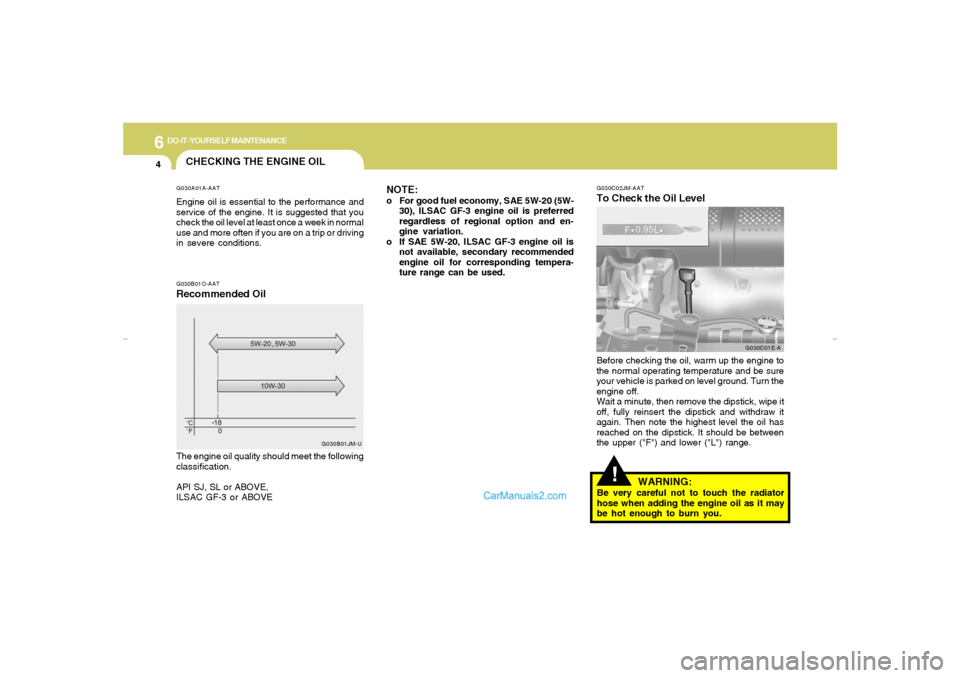
G030C02JM-AATTo Check the Oil LevelBefore checking the oil, warm up the engine to
the normal operating temperature and be sure
your vehicle is parked on level ground. Turn the
engine off.
Wait a minute, then remove the dipstick, wipe it
off, fully reinsert the dipstick and withdraw it
again. Then note the highest level the oil has
reached on the dipstick. It should be between
the upper ("F") and lower ("L") range.
G030C01E-A G030B01O-AAT
Recommended OilThe engine oil quality should meet the following
classification.
API SJ, SL or ABOVE,
ILSAC GF-3 or ABOVE
G030B01JM-U
NOTE:o For good fuel economy, SAE 5W-20 (5W-
30), ILSAC GF-3 engine oil is preferred
regardless of regional option and en-
gine variation.
o If SAE 5W-20, ILSAC GF-3 engine oil is
not available, secondary recommended
engine oil for corresponding tempera-
ture range can be used.
!
WARNING:
Be very careful not to touch the radiator
hose when adding the engine oil as it may
be hot enough to burn you.
xdflhma-6.p652/5/2008, 2:13 PM 4
Page 199 of 256
6
DO-IT-YOURSELF MAINTENANCE6
!
!
6. Install a new oil filter in accordance with the
instructions on the carton or on the filter itself.
Do not over-tighten.
Oil filter tightening torque :
1.2 ~ 1.6 kgf.m
Be sure that the mounting surface on the
engine is clean and that the old gasket is
removed completely. Lubricate the new
gasket on the filter with clean engine oil
before installation.
7. Remove the engine oil level dipstick.
8. Refill the crankcase with the recommended
engine oil. Refer to the specification in chap-
ter 9 for engine oil capacity.
PROPOSITION 65 WARNING:
Used engine oil may cause irritation or
cancer of the skin if left in contact with the
skin for prolonged periods of time. Used
engine oil contains chemicals that have
caused cancer in laboratory animals. Al-
ways protect your skin by washing your
hands thoroughly with soap and warm
water as soon as possible after handling
used oil.
9. Start the engine and check to be sure no oil
is leaking from the drain plug or oil filter.
10.Shut off the engine and recheck the oil level.
CAUTION:
Slowly pour the recommended oil into a
funnel. Do not overfill! Engine damage may
occur if overfilled.
NOTE:Always dispose of used engine oil in an
environmentally acceptable manner. It is
suggested that it be placed in a sealed
container and taken to a service station for
reclamation. Do not pour the oil on the
ground or put it into the household trash.
!
2. Open the hood and remove the engine oil
filler cap.
3. Slide underneath the car and loosen the
drain plug by turning it counterclockwise with
a wrench of the proper size. Be sure that a
drain pan is in position to catch the oil as it
drains out, then remove the drain plug.
WARNING:
Be very careful when draining the engine oil
as it may be hot enough to burn you!
4. When the oil has stopped draining, replace
the drain plug using a new gasket and re-
tighten by turning it clockwise.
Drain plug tightening torque:
4.0 ~ 4.5 kgf.m
5. Remove the oil filter. You should be able to
unscrew the filter with your hands. (If your
hands are slippery, try to use a cloth be-
tween your hands and the filter to give
yourself a better grip.) A certain amount of oil
will come out when you remove the filter, so
be sure to have your drain pan in place
underneath it.
xdflhma-6.p652/5/2008, 2:13 PM 6
Page 207 of 256
6
DO-IT-YOURSELF MAINTENANCE
14
!
G110C01E-AATTransaxle Fluid CapacityThe fluid capacity of the automatic transaxle is
8.2 U.S. quarts (7.8 liters).
WARNING:
The transaxle fluid level should be checked
when the engine is at normal operating
temperature. This means that the engine,
radiator, exhaust system etc., are very hot.
Exercise great care not to burn yourself
during this procedure.
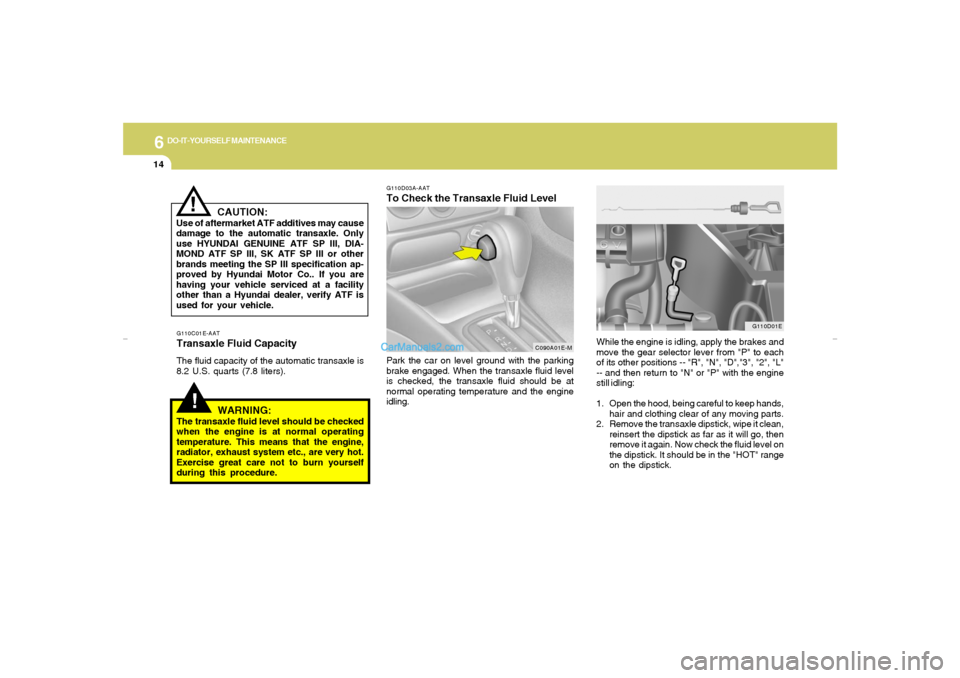
G110D03A-AATTo Check the Transaxle Fluid LevelPark the car on level ground with the parking
brake engaged. When the transaxle fluid level
is checked, the transaxle fluid should be at
normal operating temperature and the engine
idling.
C090A01E-M
While the engine is idling, apply the brakes and
move the gear selector lever from "P" to each
of its other positions -- "R", "N", "D","3", "2", "L"
-- and then return to "N" or "P" with the engine
still idling:
1. Open the hood, being careful to keep hands,
hair and clothing clear of any moving parts.
2. Remove the transaxle dipstick, wipe it clean,
reinsert the dipstick as far as it will go, then
remove it again. Now check the fluid level on
the dipstick. It should be in the "HOT" range
on the dipstick.
G110D01E
!
CAUTION:
Use of aftermarket ATF additives may cause
damage to the automatic transaxle. Only
use HYUNDAI GENUINE ATF SP III, DIA-
MOND ATF SP III, SK ATF SP III or other
brands meeting the SP III specification ap-
proved by Hyundai Motor Co.. If you are
having your vehicle serviced at a facility
other than a Hyundai dealer, verify ATF is
used for your vehicle.
xdflhma-6.p652/5/2008, 2:13 PM 14
Page 209 of 256
6
DO-IT-YOURSELF MAINTENANCE
16
!
G130B02A-AATTo Replace the FluidRecommended brake fluid conforming to DOT
3 or DOT 4 specification should be used. The
reservoir cap must be fully tightened to avoid
contamination from foreign matter or moisture.NOTE:Do not allow any other liquids to contami-
nate the brake fluid. Seal damage will result.
WARNING:
Use caution when handling brake fluid. It
can damage your vision if you get it in your
eyes. It will also damage your vehicle's
paint if spilled on it and not removed imme-
diately.
!
G120E02A-AATAdding Brake Fluid
WARNING:Handle brake fluid carefully. It can damage
your vision if it gets into your eyes. Use only
DOT 3 or DOT 4 specification fluid from a
sealed container. Do not allow the fluid can
or reservoir to remain open any longer than
required. This will prevent entry of dirt and
moisture which can damage the brake sys-
tem and cause improper operation.
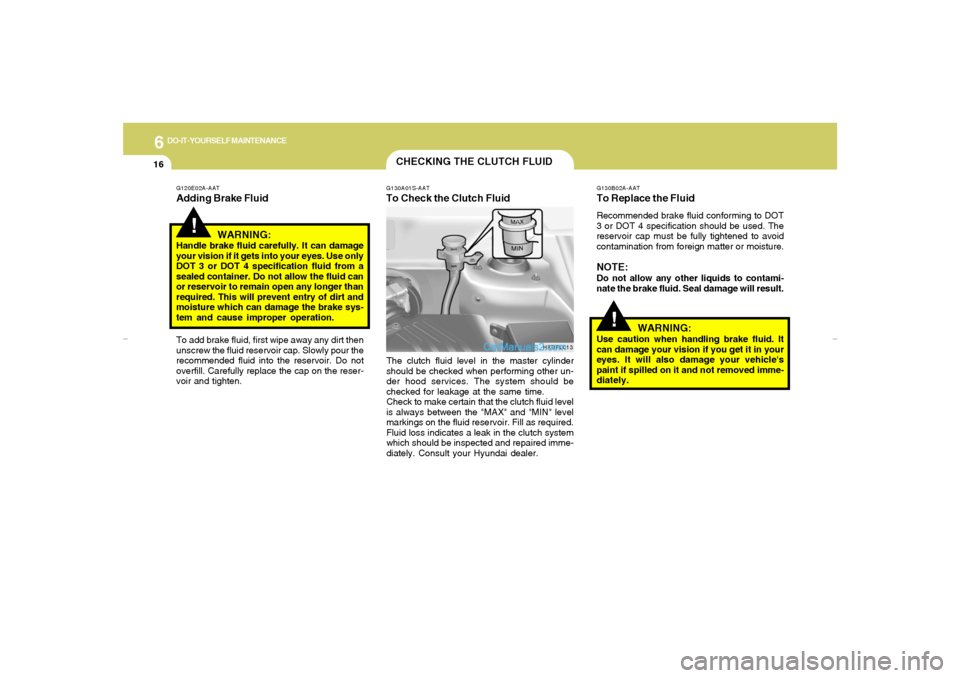
CHECKING THE CLUTCH FLUIDG130A01S-AATTo Check the Clutch FluidThe clutch fluid level in the master cylinder
should be checked when performing other un-
der hood services. The system should be
checked for leakage at the same time.
Check to make certain that the clutch fluid level
is always between the "MAX" and "MIN" level
markings on the fluid reservoir. Fill as required.
Fluid loss indicates a leak in the clutch system
which should be inspected and repaired imme-
diately. Consult your Hyundai dealer. To add brake fluid, first wipe away any dirt then
unscrew the fluid reservoir cap. Slowly pour the
recommended fluid into the reservoir. Do not
overfill. Carefully replace the cap on the reser-
voir and tighten.
HXDFL013
xdflhma-6.p652/5/2008, 2:13 PM 16