warning light Hyundai Elantra 2006 Owner's Guide
[x] Cancel search | Manufacturer: HYUNDAI, Model Year: 2006, Model line: Elantra, Model: Hyundai Elantra 2006Pages: 277, PDF Size: 10.18 MB
Page 93 of 277
1
FEATURES OF YOUR HYUNDAI
79
CAUTION:
Make sure that the support rod has been released prior to closing thehood.!
2. Pull the secondary latch lever up and
lift the hood.
3. Hold the hood open with the support rod.
Before closing the hood, return the support rod to its clip to prevent it from rattling. Lower the hood until it is about30 cm (1 ft.) above the closed position and let it drop. Make sure that it locks into place.
!WARNING:
o Always double check to be sure that the hood is firmly latched before driving away. If it is notlatched, the hood could open while the vehicle is being driven, causing a total loss of visibility,which might result in an acci- dent.
o The support rod must be inserted completely into the hole providedin the hood whenever you in- spect the engine compartment.This will prevent the hood from falling and possibly injuring you.
o Do not move the vehicle with the hood in the raised position, asvision is obstructed and the hood could fall or be damaged.
REMOTE FUEL-FILLER LID RELEASE
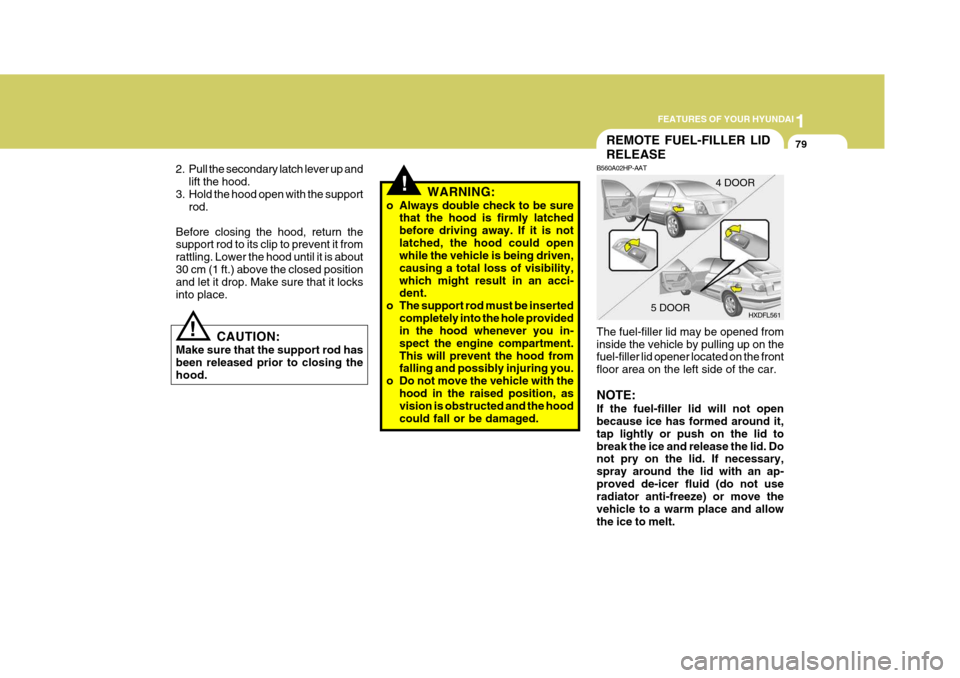
B560A02HP-AAT The fuel-filler lid may be opened from inside the vehicle by pulling up on the fuel-filler lid opener located on the front floor area on the left side of the car. NOTE: If the fuel-filler lid will not open because ice has formed around it, tap lightly or push on the lid tobreak the ice and release the lid. Do not pry on the lid. If necessary, spray around the lid with an ap-proved de-icer fluid (do not use radiator anti-freeze) or move the vehicle to a warm place and allowthe ice to melt. 4 DOOR
HXDFL561
5 DOOR
Page 94 of 277
1FEATURES OF YOUR HYUNDAI
80
!WARNING:
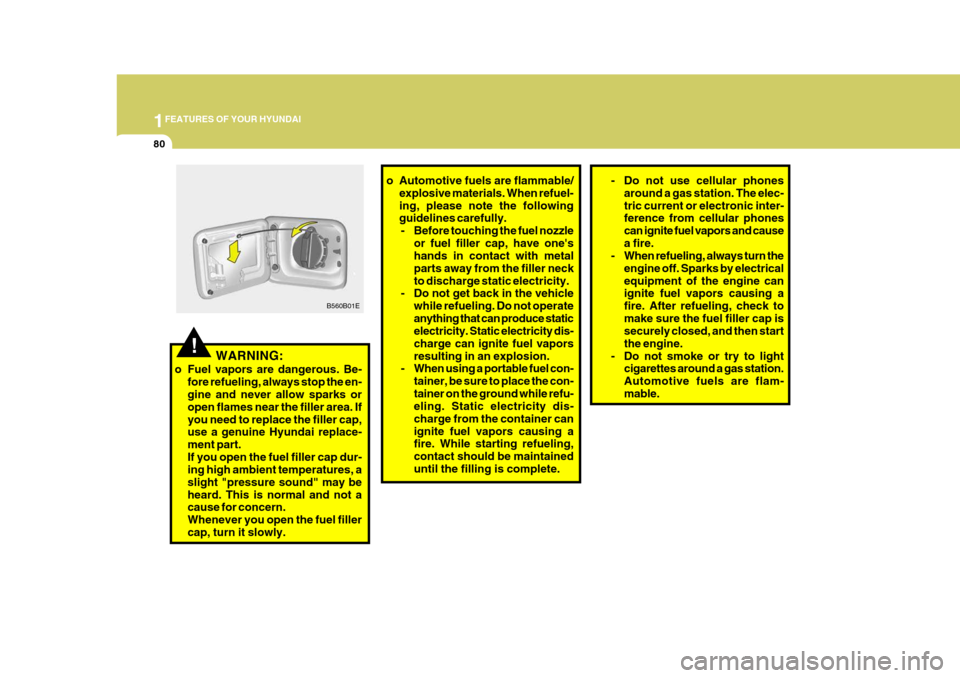
o Fuel vapors are dangerous. Be- fore refueling, always stop the en- gine and never allow sparks or open flames near the filler area. Ifyou need to replace the filler cap, use a genuine Hyundai replace- ment part.If you open the fuel filler cap dur- ing high ambient temperatures, a slight "pressure sound" may beheard. This is normal and not a cause for concern. Whenever you open the fuel fillercap, turn it slowly. B560B01E
o Automotive fuels are flammable/
explosive materials. When refuel- ing, please note the following guidelines carefully.- Before touching the fuel nozzle or fuel filler cap, have one'shands in contact with metal parts away from the filler neckto discharge static electricity.
- Do not get back in the vehicle
while refueling. Do not operateanything that can produce static electricity. Static electricity dis- charge can ignite fuel vaporsresulting in an explosion.
- When using a portable fuel con-
tainer, be sure to place the con-tainer on the ground while refu- eling. Static electricity dis- charge from the container canignite fuel vapors causing a fire. While starting refueling, contact should be maintaineduntil the filling is complete.- Do not use cellular phonesaround a gas station. The elec- tric current or electronic inter- ference from cellular phones can ignite fuel vapors and causea fire.
- When refueling, always turn the
engine off. Sparks by electricalequipment of the engine can ignite fuel vapors causing a fire. After refueling, check tomake sure the fuel filler cap is securely closed, and then start the engine.
- Do not smoke or try to light cigarettes around a gas station.Automotive fuels are flam-mable.
Page 156 of 277
2
DRIVING YOUR HYUNDAI
3
!
TO START THE ENGINEBEFORE STARTING THE ENGINE
C020A01O-GAT Before you start the engine, you should always:
1. Look around the vehicle to be sure
there are no flat tires, puddles of oil, water or other indications of pos- sible trouble.
2. After entering the car, check to be sure the parking brake is engaged.
3. Check that all windows and lights are clean.
4. Check that the interior and exterior
mirrors are clean and in position.
5. Check your seat, seatback and headrest to be sure they are in theirproper positions.
6. Lock all the doors.
7. Fasten your seat belt and be sure
that all other occupants have fas- tened theirs.
8. Turn off all lights and accessories
that are not needed. C030A01A-GAT COMBINATION IGNITION SWITCH Before starting the engine:
o If your Hyundai is equipped with a
manual transaxle, place the shift lever in neutral and depress the clutch pedal fully.
o If your Hyundai has an automatic transaxle, place the shift lever in "P"(park).
o To start the engine, insert the igni- tion key and turn it to the "START"position. Release it as soon as the engine starts. Do not hold the key inthe "START" position for more than 15 seconds.
NOTE: For safety, the engine will not start if the shift lever is not in "P" or "N" Position (Automatic Transaxle).
WARNING (DIESEL ENGINE):
To ensure that sufficient vacuum exists within the brake system dur- ing cold weather start-up condi-tions, it is necessary to run the engine at idle for several seconds after starting the engine.
9. When you turn the ignition switch to
"ON", check that all appropriatewarning lights are operating and that you have sufficient fuel.
10.Check the operation of warning lights and all bulbs when key is inthe "ON" position.
Page 158 of 277
2
DRIVING YOUR HYUNDAI
5
!
STARTING
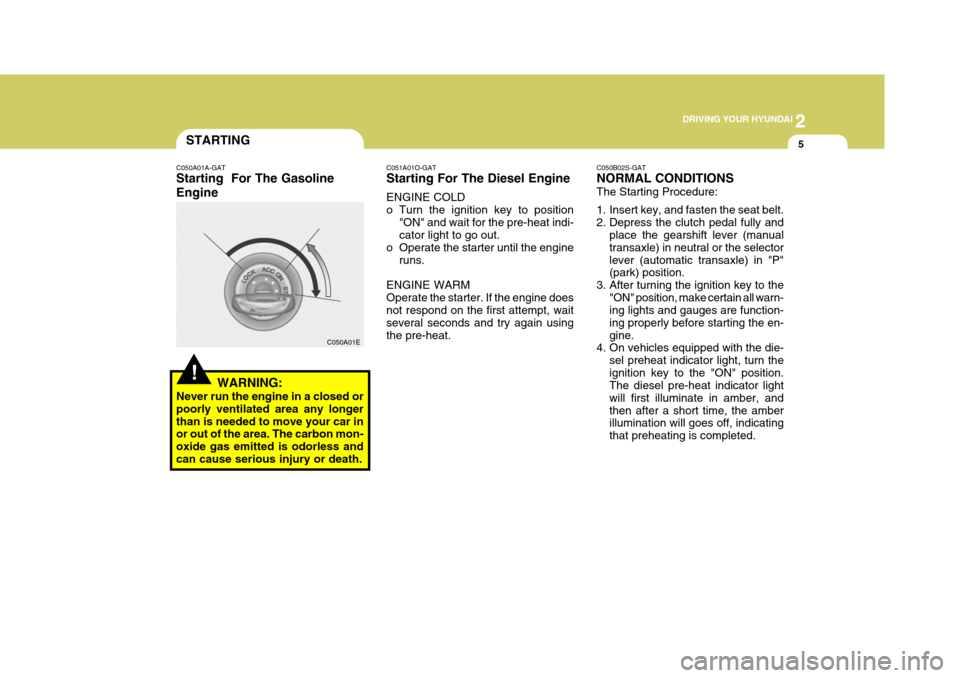
C050A01A-GAT Starting For The Gasoline Engine
C050A01E
WARNING:
Never run the engine in a closed or poorly ventilated area any longerthan is needed to move your car in or out of the area. The carbon mon- oxide gas emitted is odorless andcan cause serious injury or death. C050B02S-GAT NORMAL CONDITIONS The Starting Procedure:
1. Insert key, and fasten the seat belt.
2. Depress the clutch pedal fully and
place the gearshift lever (manualtransaxle) in neutral or the selectorlever (automatic transaxle) in "P" (park) position.
3. After turning the ignition key to the "ON" position, make certain all warn-ing lights and gauges are function- ing properly before starting the en-gine.
4. On vehicles equipped with the die-
sel preheat indicator light, turn theignition key to the "ON" position. The diesel pre-heat indicator light will first illuminate in amber, andthen after a short time, the amber illumination will goes off, indicating that preheating is completed.
C051A01O-GAT Starting For The Diesel Engine ENGINE COLD
o Turn the ignition key to position
"ON" and wait for the pre-heat indi- cator light to go out.
o Operate the starter until the engine runs.
ENGINE WARM Operate the starter. If the engine does not respond on the first attempt, wait several seconds and try again usingthe pre-heat.
Page 167 of 277
2 DRIVING YOUR HYUNDAI
14ANTI-LOCK BRAKE SYSTEM (ABS)
!
C120A02A-AAT (If installed) The Anti-Lock Brake System (ABS) is designed to prevent wheel lock-upduring sudden braking or on hazard- ous road surfaces. The ABS control module monitors the wheel speed andcontrols the pressure applied to each brake. Thus, in emergency situations or on slick roads, ABS will increasevehicle control during braking. NOTE: During ABS operation, a slight pul- sation may be felt in the brake pedal when the brakes are applied. Also, a noise may be heard in the enginecompartment while braking. These conditions are normal and indicate that the anti-lock brake system isfunctioning properly. WARNING:
ABS will not prevent accidents dueto improper or dangerous drivingmaneuvers. Even though vehicle control is improved during emer- gency braking, always maintain asafe distance between you and ob- jects ahead. Vehicle speeds should always be reduced during extremeroad conditions. The braking distance for cars equipped with an anti-lock braking system may be longer than for those without it in the following road con-ditions. During these conditions, the ve-hicle should be driven at reducedspeeds:
o On rough, gravel or snow-cov-
ered roads.
o With tire chains installed.
o On roads where the road surface
is pitted or has different surface height.
The safety features of an ABSequipped vehicle should not be tested by high speed driving orcornering. This could endanger the safety of yourself or others.
Page 168 of 277
2
DRIVING YOUR HYUNDAI
15TRACTION CONTROL SYSTEM (TCS)
!
Driving hints TCS does not actively apply brakes. Be sure to decelerate the car suffi-ciently before entering curves.
C300A02Y-GAT (If installed)
C300A02E
!
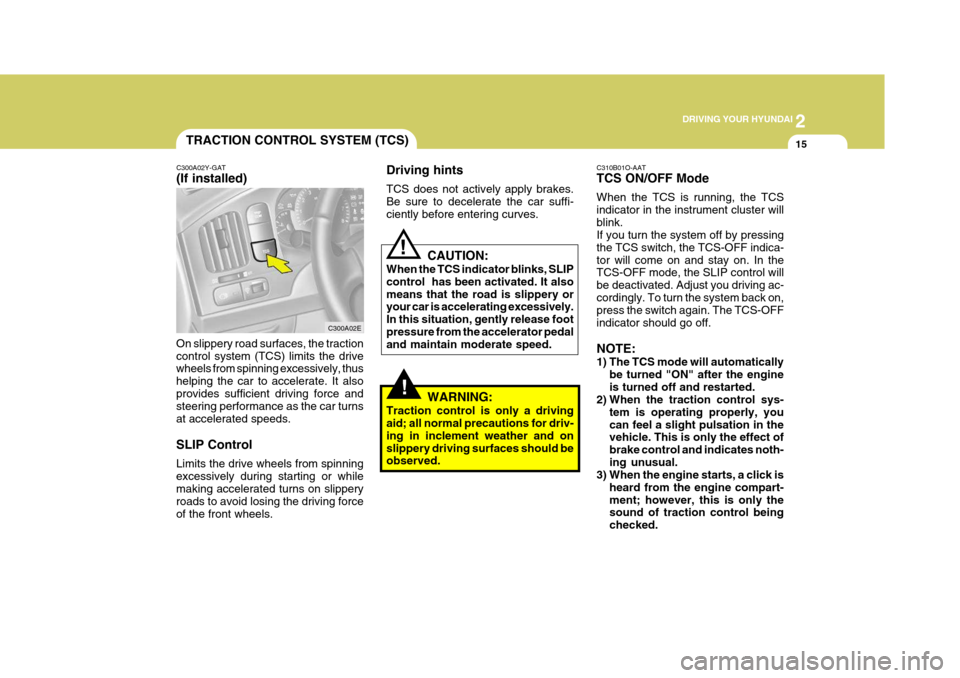
On slippery road surfaces, the traction control system (TCS) limits the drive wheels from spinning excessively, thus helping the car to accelerate. It alsoprovides sufficient driving force and steering performance as the car turns at accelerated speeds. SLIP Control Limits the drive wheels from spinning excessively during starting or while making accelerated turns on slippery roads to avoid losing the driving forceof the front wheels. CAUTION:
When the TCS indicator blinks, SLIPcontrol has been activated. It alsomeans that the road is slippery or your car is accelerating excessively. In this situation, gently release footpressure from the accelerator pedal and maintain moderate speed.
WARNING:
Traction control is only a drivingaid; all normal precautions for driv- ing in inclement weather and onslippery driving surfaces should be observed. C310B01O-AAT TCS ON/OFF Mode When the TCS is running, the TCS indicator in the instrument cluster willblink. If you turn the system off by pressing the TCS switch, the TCS-OFF indica-tor will come on and stay on. In the TCS-OFF mode, the SLIP control will be deactivated. Adjust you driving ac-cordingly. To turn the system back on, press the switch again. The TCS-OFF indicator should go off. NOTE:
1) The TCS mode will automatically
be turned "ON" after the engine is turned off and restarted.
2) When the traction control sys-
tem is operating properly, youcan feel a slight pulsation in the vehicle. This is only the effect of brake control and indicates noth-ing unusual.
3) When the engine starts, a click is
heard from the engine compart-ment; however, this is only the sound of traction control being checked.
Page 169 of 277
2 DRIVING YOUR HYUNDAI
16
If the indicator remains lit even after the engine has been started, haveyour car checked by an authorized Hyundai dealer. NOTE:
1) When the TCS-OFF indicator il-luminates, traction control is au- tomatically deactivated for safety.
2) This warning function is not pro- vided when the driver selects theTCS-OFF mode.
4) When moving out of the mud or
fresh snow, pressing the accel- erator pedal may not cause the engine speed to increase due to TCS operation.
C310D01O-AAT Indicators and Warning The TCS indicators should illuminate when the ignition key is turned to "ON"or "START" but should go out after three seconds. If the indicators do not illuminate, orthe TCS or TCS-OFF indicator does not go out after 3 seconds, have it checked by an authorized dealer. Should there be any unusual condi- tions in the device while driving, TCS-OFF indicator illuminates as a warn- ing. If TCS-OFF indicator illuminates, pullyour car to a safe place and stop the engine. Then, start the engine again to checkif the TCS-OFF indicator goes out.
!
C130A01A-AAT Good braking practices WARNING:
Nothing should be carried on top of the shelf panel behind the rear seat.If there were an accident or a sud- den stop, such objects could move forward and cause damage to thevehicle or injure the occupants.
o After being parked, check to be sure the parking brake is not engaged and that the parking brake indicatorlight is out before driving away.
o Driving through water may get the
brakes wet. They can also get wetwhen the car is washed. Wet brakes can be dangerous! Your car will not stop as quickly if the brakes are wet.Wet brakes may cause the car to pull to one side. To dry the brakes, apply the brakes lightly until thebraking action returns to normal, taking care to keep the car under control at all times. If the brakingaction does not return to normal, stop as soon as it is safe to do so and call your Hyundai dealer forassistance.
Page 181 of 277
3 WHAT TO DO IN AN EMERGENCY
2
!
IF THE ENGINE WILL NOT START
D010A01A-AAT D010B02A-AAT
If Engine Doesn't Turn Over or Turns Over Slowly
1. If your car has an automatic transaxle, be sure the gear selector lever is in "N" or "P" and the emer-gency brake is set.
2. Check the battery connections to be
sure they are clean and tight.
3. Turn on the interior light. If the light dims or goes out when you operatethe starter, the battery is discharged.
4. Check the starter connections to be sure they are securely tightened.
5. Do not push or pull the vehicle to start it. See instructions for "Jump Starting". D010C01A-AAT If Engine Turns Over Normally but Does Not Start
D010B02E
WARNING:
If the engine will not start, do not push or pull the car to start it. This could result in a collision or causeother damage. In addition, push or pull starting may cause the cata- lytic converter to be overloaded andcreate a fire hazard.
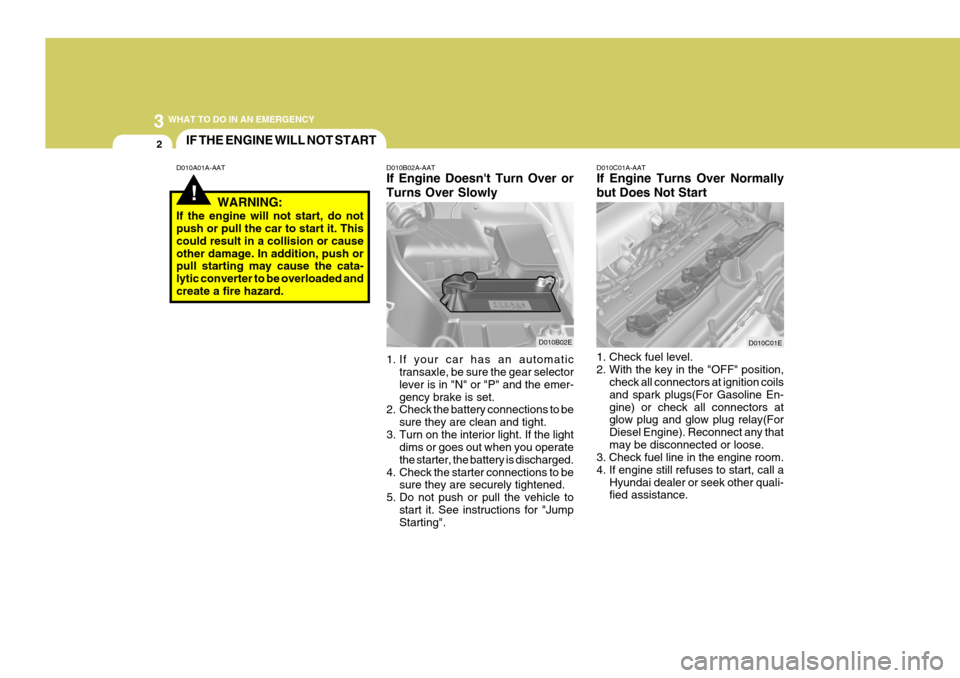
1. Check fuel level.2. With the key in the "OFF" position,check all connectors at ignition coilsand spark plugs(For Gasoline En-gine) or check all connectors at glow plug and glow plug relay(For Diesel Engine). Reconnect any thatmay be disconnected or loose.
3. Check fuel line in the engine room.4. If engine still refuses to start, call a
Hyundai dealer or seek other quali- fied assistance. D010C01E
Page 182 of 277
3
WHAT TO DO IN AN EMERGENCY
3
!
JUMP STARTING
D010D01A-AAT If the Engine Stalls While Driving
1. Reduce your speed gradually, keep- ing a straight line. Move cautiously off the road to a safe place.
2. Turn on your emergency flashers.
3. Try to start the engine again. If your
vehicle will not start, contact a Hyundai dealer or seek other quali- fied assistance. D020A03A-AAT
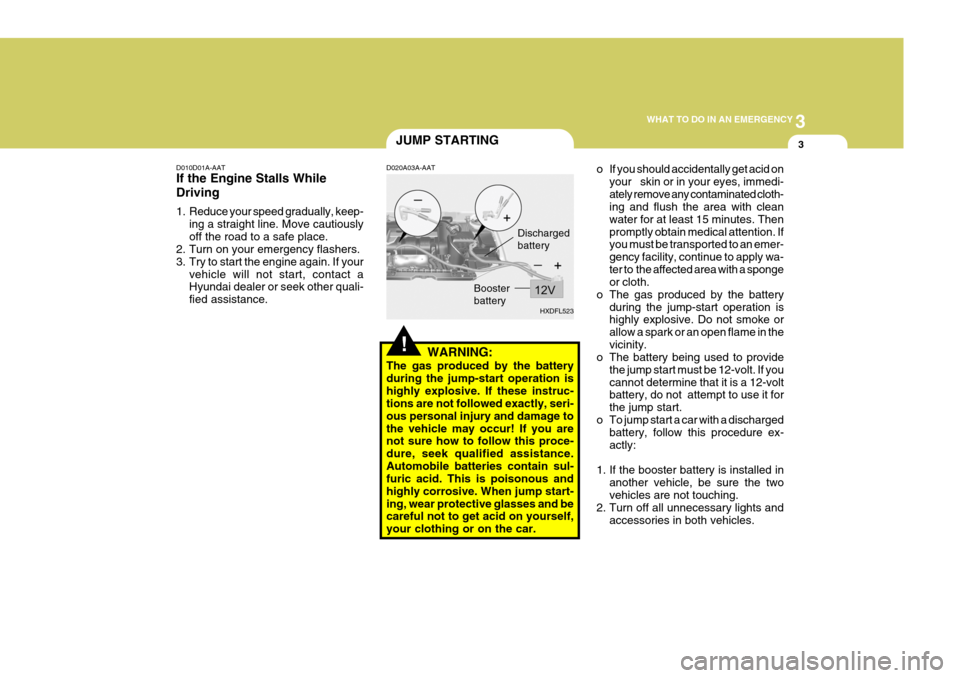
HXDFL523
Discharged battery
Booster battery
WARNING:
The gas produced by the battery during the jump-start operation ishighly explosive. If these instruc- tions are not followed exactly, seri- ous personal injury and damage tothe vehicle may occur! If you are not sure how to follow this proce- dure, seek qualified assistance.Automobile batteries contain sul- furic acid. This is poisonous and highly corrosive. When jump start-ing, wear protective glasses and be careful not to get acid on yourself, your clothing or on the car. o If you should accidentally get acid on
your skin or in your eyes, immedi-ately remove any contaminated cloth- ing and flush the area with clean water for at least 15 minutes. Thenpromptly obtain medical attention. If you must be transported to an emer- gency facility, continue to apply wa-ter to the affected area with a sponge or cloth.
o The gas produced by the battery
during the jump-start operation ishighly explosive. Do not smoke or allow a spark or an open flame in thevicinity.
o The battery being used to provide
the jump start must be 12-volt. If youcannot determine that it is a 12-volt battery, do not attempt to use it for the jump start.
o To jump start a car with a discharged battery, follow this procedure ex-actly:
1. If the booster battery is installed in another vehicle, be sure the twovehicles are not touching.
2. Turn off all unnecessary lights and
accessories in both vehicles.
Page 188 of 277
3
WHAT TO DO IN AN EMERGENCY
9
!
!
D060G02Y-AAT 6. Changing Wheels
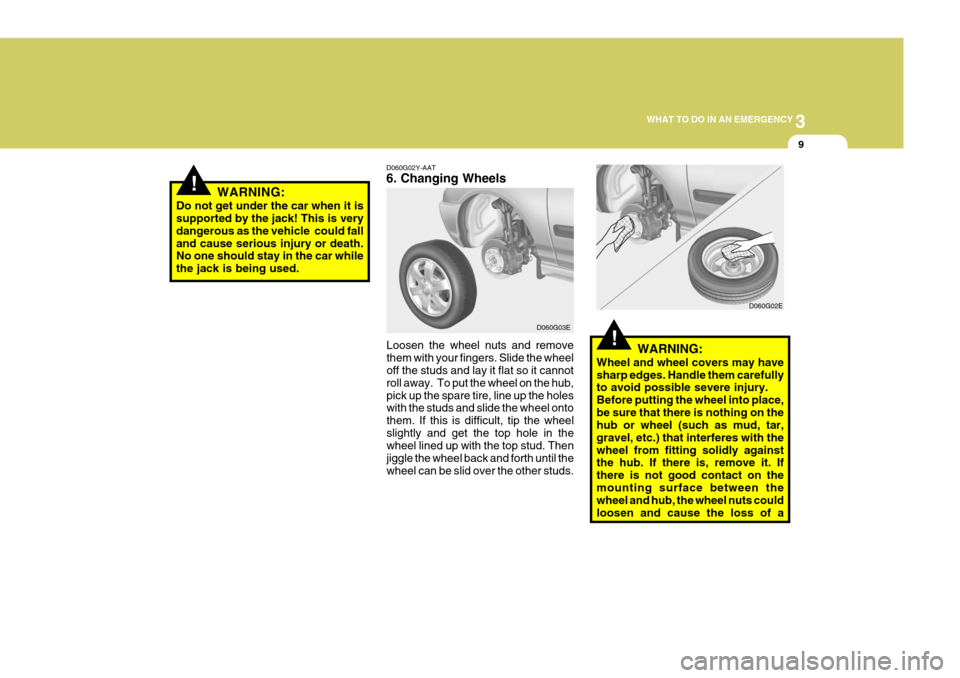
Loosen the wheel nuts and remove them with your fingers. Slide the wheel off the studs and lay it flat so it cannot roll away. To put the wheel on the hub,pick up the spare tire, line up the holes with the studs and slide the wheel onto them. If this is difficult, tip the wheelslightly and get the top hole in the wheel lined up with the top stud. Then jiggle the wheel back and forth until thewheel can be slid over the other studs. D060G03E
WARNING:
Do not get under the car when it is supported by the jack! This is very dangerous as the vehicle could falland cause serious injury or death. No one should stay in the car while the jack is being used.
D060G02E
WARNING:
Wheel and wheel covers may havesharp edges. Handle them carefully to avoid possible severe injury. Before putting the wheel into place,be sure that there is nothing on the hub or wheel (such as mud, tar, gravel, etc.) that interferes with thewheel from fitting solidly against the hub. If there is, remove it. If there is not good contact on themounting surface between the wheel and hub, the wheel nuts could loosen and cause the loss of a